The Sons of Katie Elder

The Sons of Katie Elder
"First, we reunite, then find Ma and Pa's killer...then read some reviews."
Showing posts with label Franchot Tone. Show all posts

Thursday, October 23, 2014

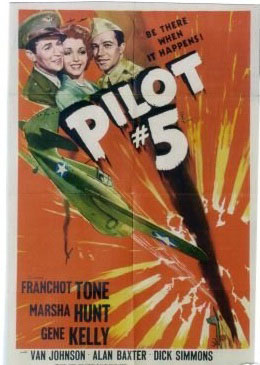
Pilot #5

Oh, propaganda flicks, you're so underplayed and subtle. Well, the better ones try at least to not hit you over the head with a message. Subtle and low-key is the way! I stumbled across 1943's Pilot #5 on Turner Classic Movies with no background or knowledge of it, but a WWII flick released right in the middle of the war? I'll give it a try if nothing else.

On the island of Java, an Allied air base has been under almost constant attack and heavy bombardment from the Japanese Navy. The attacks have wreaked havoc though where the new commander has an uncomfortable situation to resolve. The fighter squadron is down to one plane that's flyable with five pilots available. The lucky one that's chosen? George Collins (Franchot Tone), winning out over his compatriots. His mission is basically suicide though, one plane trying to run the gauntlet through Japanese forces to knock out a key Japanese carrier. As the men left behind tell their commander about the man he's chosen, George takes off in a beat-up fighter with a rigged bomb rack to do what he can. Could he somehow get through unscathed?

This World War II movie from director George Sidney popped up on Turner Classic Movie's schedule this week so I thought I'd give it a try. It clocked in at a brisk-sounding 71 minutes and featured a pretty decent cast so I figured there was little harm in giving it a shot. Even if it was lousy, it's only 71 minutes, right? Right?!? Well, it's a good thing it wasn't any longer because I probably would have bailed. 'Pilot' uses the tried and true storytelling device of...the flashback. When used properly, it can be a gem, helping add layers and background to the story. When not used properly, well, that's the case here. It derails a story I thought had some pretty decent potential.

While the cast is pretty good, no one really stood out from the rest in the end. Franchot Tone as the tortured, redemption-seeking George Collins leaves something to be desired in the old "interesting character" department. The character is just too flat for the movie's sake. We're intrigued with how he ended up in this spot but even when we find out, the payoff isn't worth it. The other pilots include Gene Kelly as the fiery, angry Vito Alessandro, Van Johnson as the jokey Everett Arnold, Alan Baxter as the all-business Winston Davis, and Dick Simmons as Henry Claven, a childhood friend of George's. These characters end up being a means to an end, a way of jumping into the flashbacks and little else. Kelly gets the most screen-time and does pretty well while Van Johnson unfortunately is completely wasted. Also look for a very young Peter Lawford as a British soldier at the base.    

Of the 71 minutes, I'd say about 50 were more concerned with the George Collins flashback...unfortunately. We see George growing up, heading off to law school, and trying to make something of his name and with a big old chip on his shoulder. He gets involved with Kelly's Vito --  a fellow lawyer and jack of all trades -- and ultimately a corrupt governor (Howard Freeman) that seems more fitting in All the King's Men than in a WWII propaganda flick. Throw in a love story lacking basically all chemistry with George's girlfriend, Freddie (Marsha Hunt), and you've got those middle flashback portions absolutely dragging along. Not a positive when you find yourself looking at the clock a whole lot in a 71-minute movie.

The beginning and ending portions are pretty decent. Dark, claustrophobic and uncomfortable as George flies into impossible odds while his fellow pilots wait back at base and listen over the radio to the developing mission. The new Dutch commander (Steven Geray) is a little much in the propaganda part, encouraging the audience to fight back against Fascism and wanting to really know the man he's sending on a suicide mission. A disappointing end result, a war movie with some potential that never really adds up.

Pilot #5 (1943): **/****

Tuesday, September 7, 2010

Advise and Consent

Recently in the news, former Illinois governor Rod Blagojevich was found guilty on one count of 24 levied against him.  A mistrial is in the works, but the news was nothing new.  Controversies and scandals in politics are as old as well, politics itself.  Are we surprised anymore when a politician, whether it be the President or down through the ranks to Senators, Representatives, Governors, and on and on, does something stupid in the news?  Sex, past indiscretions, corruption, all over the above, nothing seems to faze the American public anymore.

Let's go back almost half a century in more innocent times, I guess, the 1960s weren't exactly innocent.  But the times were certainly different without that 24-hour news cycle that keeps viewers up to date on everything going on.  Politicians could have secrets and that's just what they were, secrets.  The master of adult-themed movies, Otto Preminger explored this concept with 1962's Advise and Consent. When you accept a position in the public eye, you lose your privacy to a certain point.  You open yourself up for criticism on many fronts, but if this Preminger movie teaches us anything, we all have secrets. It's only a matter of time before they're found out.

The President of the United States (Franchot Tone) has chosen a nominee for the vacant position of the Secretary of State. The man is Robert Leffingwell (Henry Fonda) and from the get-go, the nomination divides the Senate who will have to approve or disapprove him. The Senate majority leader (Walter Pidgeon) is all for the choice and knows he can get the necessary number of votes for Leffingwell. Opposing him is a long-time senator from South Carolina (Charles Laughton), who was burned by Leffingwell in the past and still holds a grudge. But before a vote can be counted, the nomination must go through a Senate sub-committee headed by an idealistic young senator (Don Murray) who will decide if Leffingwell is capable of doing the job. But as the committee starts, the dirt comes out and the fight begins.

As he did so often with his movies, Preminger puts together a very impressive ensemble cast to work with.  It's so good from top to bottom that Fonda -- yes, Henry Fonda -- is almost an afterthought as a supporting character.  He doesn't even make an appearance in the last 30 minutes.  Preminger was a perfectionist as a filmmaker, but actors must have liked working with him.  Along with the names mentioned above, there is also Gene Tierney, Peter Lawford, Will Geer, Burgess Meredith, Lew Ayres, and Paul Ford among others. Like any large ensemble, some in the cast get more of a chance to shine than others, but none disappoint however long they're on screen.  Murray, Pidgeon and Laughton are the ones that shine brightest though, including Ayres as a vanilla vice president.

This isn't a movie about camera techniques or in your face effects.  Preminger lets takes and scenes go on uninterrupted without the slightest editing.  Characters hold conversations like they would in real life.  He lets his cast show off their ability, letting the dialogue do all the talking the story needs.  At times, the pace can be infuriatingly slow (it is 140 minutes long) because of that, especially toward the end when the pace should be picking up, but it's all part of the story the movie revels in.  Preminger filmed in countless locations in Washington DC -- shooting in black and white -- giving a real feel for all the backroom deals and shady motives that really go on in the capital.  It doesn't intentionally call attention to itself, but the movie is a treat to watch on a purely visual level.

What was somewhat disappointing as the story develops is that by 2010, nothing really surprised me in terms of government scandals and controversies.  In the last 10 or 20 years, there has been murder, extramarital affairs, corruption, prostitution, kidnappings, and any number of other things I'm probably forgetting.  So when the scandals do pop up, including Fonda's Leffingwell and his past involvement in a different government and Murray's Senator's past coming back to haunt him, they don't have a huge affect on the viewer.  Shocking in 1962, maybe, but not in 2010.  Through no fault of Preminger's then (you can't blame him for making a move when he did), the emotional impact is lessened then just by time and how the world has changed in the almost 50 years since.

As everything does unravel in the end and the twists and secrets come out, the story thankfully picks up some steam.  One twist at the very end was a little too coincidental for me personally, the timing just too perfect, but that's movies for you. It is a movie that is as professionally done as just about any other movie you'll come across, and the cast is hard to top.  If there was a way to watch this in 1962, maybe the impact would have been greater, but in 2010, it's still pretty good.

Advise and Consent <---IMDB trailer (1962): ***/****

Thursday, March 4, 2010

Five Graves to Cairo

If there's anything better than a spy movie, it's a case of mistaken identity spy movie.  When dealing with spies or secret agents, there's already a natural tension so adding some more confusion just amps things up; the Bourne movies played this up perfectly.  A long-time writer in Hollywood but directing only his third movie, Billy Wilder deals with spies and mistaken identity amidst the North African campaign during WWII with 1943's Five Graves to Cairo.

Walking out of the desert after his tank was destroyed and his crew killed, Cpl. J.J. Bramble (Franchot Tone) wearily stumbles into a hotel in a dusty, bombed-out town.  The owner, Farid (Akim Tamiroff), and his staff of one, housekeeper Mouche (Anne Baxter), don't know what to do with him and the situation instantly escalates when a German convoy drives into town. It's an advance group of Field Marshall Erwin Rommel's headquarters looking to set up HQ as the Germans march back across Egypt, pushing the British back with ease.  When Rommel's aide (Peter van Eyck) questions who the man is, Bramble poses as the hotel's waiter who was killed in the previous night's bombing.

But just looking for any shot at survival, Bramble's plan falls apart.  The actual waiter, an Alsatian by the name of Paul Davos, was a German agent working as an advance scout for the German attacks.  Luckily, no one knew Davos by appearance, only by reputation, so Bramble is able to play along and poses as the agent.  Even Rommel (Erich von Stroheim) falls for the ruse, talking openly about his plans for an upcoming attack.  But more importantly, Rommel talks about secret supply depots, the 'Five Graves,' buried deep beneath the Egyptian desert, explaining how his lines and troops are so well-supplied.  But surrounded by Germans, can Bramble figure a way to get this information to the retreating Allies?

From the moment the Germans arrive, it's pretty clear who Bramble is going to have to worry about, Van eyck's German lieutenant, Schwegler.  Based on a play by Lajos Biro, Wilder's story has that claustrophobic feel of being on a stage with Farid's run-down hotel substituting for that stage.  Bramble is between a rock and a hard place; he can't run away, where would he go? Into the desert?  If he stays, he's almost surely to be caught sooner or later.  Instead, he's forced to hide in a hornets' nest of people who would shoot him as easily as snapping their fingers if they figured out his actual identity.

Wilder films these hotel scenes -- many of them at night -- in the dark and shadows where anything could be waiting to strike.  This is not a large hotel with just 16 rooms so Bramble, Farid and Mouche room just a few doors down from Rommel and his staff.  That does provide for some awkward moments as Bramble is a bit of a loud talker, making me question how no one heard him spouting his plans to ruin the Germans.  These are some great scenes, full of foreboding and claustrophobia that Bramble is stuck in this situation with nowhere to go.

With this self-contained story -- the war somehow feels very far off even though bombs are dropping not too far away -- the characters are more archetypal than red-blooded, 3-D characters.  Tone's Bramble is the stiff upper-lip British soldier who sees a chance to cripple the German war effort.  Baxter's Mouche is a young French woman looking to rescue her brother from a German concentration camp and is not beneath conspiring with the Germans to get what she wants.  Tamiroff's Farid is a worrier, both for his life and his hotel, and is more of a stereotype than anything but he still manages to make the character sympathetic.  von Stroheim and van Eyck are perfectly cast as the intimidating Germans, and von Stroheim especially is an inspired choice to play Rommel, although he does make him a bit of an eccentric.

Released in 1943, Wilder's movie is suspiciously devoid of a propaganda, war-time message...until the end.  For about 80 minutes, this is a spy story in a war setting full of tension and drama.  The last 15 minutes try to deliver that ever-important message of hope to the home front.  Surprisingly enough, this message works surprisingly well because of a twist revealed in these final scenes.  Leave it to a pro like Wilder to make a propaganda message actually entertaining.  Too often movies released in wartime sacrifice story and entertainment for delivering that message, but not Wilder, who revels in it and fits it in nicely with his script.  A hidden gem from one of Hollywood's most well-known and well-respected directors.

Five Graves to Cairo <----trailer (1943): ***/****

Wednesday, February 17, 2010

Mutiny on the Bounty (1935)

The story of Fletcher Christian's mutiny aboard the H.M.S Bounty against Captain William Bligh is one of the most famous historical stories that just about everyone knows in some form or another.  It is a story that translates well to film, including three well known flicks and a few other less highly regarded ones, with versions made in 1935, 1962, and 1984.  The 1935 version, appropriately titled Mutiny on the Bounty, is the one held in highest regard, even earning the Best Picture Oscar and a long list of nominations.

While I'm not doubting the movie for its entertainment value, it does suffer from a problem many movies from the 1930s have.  The movie studios were still making the transitition from silent to sound with many actors making the jump right from the stage to the big screen.  But before method acting developed in the 1950s, many roles came across as too theatrical, too over the top, as if the actors were playing to audiences who would have been sitting right in front of them.  Because of that, it can be hard to get a read on characters and what they're going through, especially in the case of 1935's Bounty.

Making his first sea voyage with an objective of writing a Tahitian dictionary, Roger Byam (Franchot Tone) boards the H.M.S. Bounty with romantic ideas of what the sea is like.  He bonds quickly with Fletcher Christian (Clark Gable), the master's mate, and the two become fast friends.  The Bounty is sailing to Tahiti where they will pick up 1,000 breadfruits and deliver them to the West Indies.  The captain of the ship, William Bligh (Charles Laughton), rules his ship with an iron fist and quickly turns the crew against him with his gung-ho mentality.  Christian especially bristles at how Bligh runs the ship, and after successly acquiring the breadfruits, leads a mutiny, putting Bligh and some of the crew on a longboat on the open seas.

Having seen the other two versions, the Marlon Brando and Mel Gibson takes, there was nothing that came as much of a surprise with the 1935 version.  The enjoyment of watching movies that deal with similar subjects is how they handle the stories differently.  History is built around facts, but it's funny how different those facts can be interpreted in the eyes of the beholder.  The actual mutiny is typically handled in the same way, but the build-up and repercussions tend to differ.

The Academy must really have loved the acting in 'Bounty' because Laughton, Gable, and Tone were all nominated for Best Actor...with none of them actually winning.  Laughton is a fine actor with a long list of impressive roles to his name, but his Bligh comes across as too cartoonishly evil.  Granted, the historical Bligh was not a pleasant character, but some human emotions would have been nice for the character.  Gable's Christian is a little better, the voice of the crew who can't understand the madness of their captain.  Tone's Byam is a smattering of many different members of the Bounty and is the wavering voter, the individual in the middle.  As an officer in the British navy, he should be loyal to his captain but what about his friendship with Fletcher?

Trying to figure out how to review 'Bounty,' the acting was a sticking point.  It isn't bad, far from it.  I've seen much worse in the way of 1930s over the top theatrical acting.  But at the same time, it's hard to say we actually get to know these characters.  They're more like cardboard cutouts spouting their lines.  Bligh is evil, Christian is good, and Byam is trying to find himself.  The hatred and friendship that develops is genuine, but it's easy to side with Christian's decision -- for me at least.  Bligh is a blatant liar who treats his men horrifically when it doesn't always call for it.  Of course, in all three versions I've sided with Christian's decision.  Guess I would have been a mutineer on Pitcairn Island.

As a historical movie, 'Bounty' is all about the spectacle of a high seas voyage.  While most of the acting on-board the Bounty was clearly done on a soundstage with an oceanic backdrop, there are actual shots of an 18th century ship sailing across the ocean, and not always in calm seas.  There are great shots of the crew preparing the ship for sailing high above in the masts as the expansive sails come flowing down.  And not really a surprise, but Tahiti sure looks nice.  Maybe not as nice as it did in Technicolor in the 1962 version, but it's hard to make paradise look bad.

So good and bad, I'm still recommending this movie.  For all its faults, 'Bounty' is still an entertaining adventure, especially if you're a fan of the history it is based in.  Maybe the acting is too much at times, but Gable is and always will be pretty cool onscreen.  There are flaws, and the ending does leave a fair share of subplots and storylines waving in the breeze, but worth a rent if nothing else.

Mutiny on the Bounty <----trailer (1935): ** 1/2 /****