The Sons of Katie Elder

The Sons of Katie Elder
"First, we reunite, then find Ma and Pa's killer...then read some reviews."
Showing posts with label Otto Preminger. Show all posts

Thursday, January 2, 2014

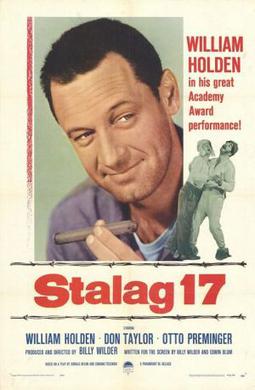
Stalag 17

Well, there are just certain movies I should have reviewed by now. I've mentioned on multiple occasions how much I like prisoner of war movies like The Great Escape and Bridge on the River Kwai, but the first one to really put the WWII sub-genre came along in 1953, Stalag 17, a classic that doesn't always get its due.

It's nearing Christmas in 1944, and a breakout is planned in Stalag 17, a German prisoner of war camp deep in Germany for Allied fliers. The night of the escape, the two prisoners making the attempt are machine gunned outside the barbed wire fence, leaving the prisoners they left behind in Barracks 4 to question what's going on. How did the Germans know details of the escape? The prisoners look to J.J. Sefton (William Holden) as the culprit, a possible stoolie who trades and bargains with the German captors for all sorts of luxuries from eggs to cigarettes to booze. Maybe Sefton has been giving away all their secrets for his own benefit, but Sefton knows otherwise. He may be a chiseler, but he's not a traitor. The problem is simple though, he can't prove it. Who among the other prisoners in Barracks 4 is the real culprit? He's going to need an answer and need it quick before his bunkmates decide they've had enough of him for good.

From director Billy Wilder, 'Stalag' is a gem of a film, one of my favorites going back to when I was a kid. It was based on a Broadway play that had 472 showings over its run. The stage-based play roots are obvious, but in a good way. Filmed in a very appropriate, very effective black and white, 'Stalag' is set almost entirely in Barracks 4 as the story develops, Christmas approaching ever quicker. The only departures we have from the barracks are outside into the camp compound. We never leave the camp, the entire story based in Stalag 17. The crowded, claustrophobic barracks becomes another character with the bunks almost bumping into each other, the windows with the frost and ice sticking to the panes, the clothes hanging from lines hung from wall to wall. Franz Waxman's uncredited score is solid as well if underplayed, Johnny Coming Marching Home a key component of the story as well.

One of three nominations the movie received went to William Holden as Barracks 4 chiseler and general trouble-maker J.J. Sefton. Nominated for his part in Sunset Boulevard but not winning, Holden got a much-deserved win here, taking home the Oscar. More impressive? He was going up against Burt Lancaster and Montgomery Clift in From Here to Eternity. Holden brings this character to life, a less than sympathetic but still appealing individual who's decided to make the most of his prisoner of war status. He's going to live in comfort, and if that means dealing/trading with his German captors, then so be it. It's not an issue until his bunkmates decide he's the traitor giving the Germans all their secrets. This is where Holden's acting steps up a notch, a desperate man now fighting for his survival instead of his personal comfort. Not often remembered as one of his best, but it's a goodie.

Holden's performance comes as part of a very solid ensemble cast that doesn't feature a ton of A-list stars, instead turning to a group of familiar character actors. Start with Robert Strauss as Animal and Harvey Lembeck as Harry Shapiro, the barracks cut-ups, Richard Erdman as Hoffy, the barracks chief, Peter Graves as Price, barracks security, Neville Brand as Duke, the hothead, and Gil Stratton as Cookie, Sefton's mousey assistant, and Robinson Stone, Robert Shawley, and William Pierson rounding out the bunch. Don Taylor co-stars as Lt. Dunbar, a prisoner in transit who comes under SS questioning, Jay Lawrence his impersonating, smart-mouthed traveling companion, Sgt. Bagradian. The comedy between Animal and Harry gets to be a little much at times, Bagradian's impersonations a little forced, but as a collective whole it's a good, strong, deep group of interesting characters.

It is hard to watch this without seeing the obvious influences some 10-plus years later with TV's Hogan's Heroes. Director Otto Preminger stars as Von Scherbach, the Stalag commander, an old-school German aristocrat and gentleman while Sig Ruman plays barracks guard Sgt. Schulz, a VERY obvious influence on John Banner's famous Sgt. Schultz character in the TV show.

An episodic story that clocks in at exactly 120 minutes, there really isn't a slow moment in Wilder's Stalag 17. In directing his film, Wilder decided to shoot chronologically so that way the cast and crew wouldn't know the twist -- the identity of the barracks traitor -- until the end of filming. The first hour or so of the movie blends the drama and comedy nicely setting up the second half of the movie. As the barracks traitor story comes to the forefront, that's when '17' is at its best. The last 30 minutes are pretty perfect, Holden's Sefton starting to piece the clues together in a great couple scenes, Wilder's talent fully on display in shooting style, while the actual reveal and the finale are spot-on. This is a movie that doesn't always get the recognition it deserves, but it sure deserves it. One of my favorites.

Stalag 17 (1953): ****/****

Wednesday, October 6, 2010

River of No Return

I've written before about my general dislike for movies from the 1950s, but as I watched 1954's River of No Return I couldn't come up with a thing to write about. The cast, the director, the premise, the setting, all sounded positive and at least worth giving it a try.  All those things mentioned were worthwhile too, but like so many 50s westerns this oater lacked any heart, any reason for us as viewers getting really involved in it.  Good in a lot of ways, above average in some others, but overall just a boring western.

Because the movie didn't leave much of an impression on me as a whole, I debated just ending the review there with that first paragraph.  But then I'd feel bad for not giving it a fair shake if nothing else so here goes.  Like so many other 50s westerns, 'River' tries to dazzle the viewer with the spectacle of what's going on in the story from the widescreen filmmaking to the Cinemascope camerawork to the breathtaking locations.  Try and keep up with that, Television!  But that's where it stops.  Characters aren't that interesting, the premise is promising but never goes anywhere, and in the end lands with a clunk despite the talent involved.

Working a small farm amidst a raging gold rush, farmer Matt Calder (Robert Mitchum) sends for his son, Mark (Tommy Rettig) when he discovers his estranged wife has passed away.  Everything goes smoothly as the two Calder men cut out a new life for themselves in the wilderness.  One day though, Matt saves a runaway raft on the river, rescuing a gambler named Weston (Rory Calhoun) and his fiancee, Kay (Marilyn Monroe), from almost certain death. Weston has to file a gold claim and steals Matt's horse and rifle, leaving the trio on their own with no protection.  Matt sets out after the gambler with Mark and Kay in tow, navigating the treacherous river in hopes of catching up to the man who shanghaied them.

I can't say I intentionally avoided this flick over the years, but I never actively sought it out either.  But reading through filmographies lately, I stumbled upon it again and saw Mitchum and Monroe's names and then director Otto Preminger too and finally caved and gave it a try. I didn't hate it, and I didn't love it.  It's one of those instantly forgettable movies that has some positives going for it but never amounts to anything bigger and better.  The filming locations in Banff National Park in Alberta, Canada are drop-dead gorgeous and Preminger knows it, shooting the green mountains like they're leading up to heaven.  The location shooting is one of the high points of the movie, but I struggle to recommend a movie based solely on how it looks.

Mitchum is one of my favorites, and even in schlock movies usually makes the most he can out of the badness.  His Matt Carlen is a typically Mitchum western hero, stout, strong, and honest as a man who says few words and doesn't like to be pushed.  It's not his best work, but he was always very watchable and doesn't disappoint here.  At the height of her popularity, Monroe never looked better and also shows she was more than just a ditzy blonde.  The girl could act and even gets a chance to sing -- 5 chances actually -- to show off her voice.  Mitchum and Monroe have some chemistry together, but a forced love scene late puts a damper on any fireworks that might have been possible.  Calhoun as always is a worthy villain, slimy and backstabbing to the end, and Rettig handles himself well, avoiding any annoying child actor comparisons.

Filming a story that requires the cast to navigate down a dangerous river puts Preminger in an awkward spot right from the start.  A studio isn't going to allow big names like Mitchum and Monroe to go anywhere near river rapids so you're forced to improvise.  We do get certain shots of them on an actual river in some ridiculously calm water.  But then when the raft reaches rapids, we get the super-imposed shots of Mitchum/Monroe/Rettig in a studio on a "raft" with the green screen nature shots behind them.  I don't know an alternative other than to not use any close-ups, but then I'd complain about that too.  Sorry, Mr. Preminger, looks like you were fighting a losing, can't win battle.  Damn studios and their worries.

Little else to add here.  Mitchum solid, Monroe shows she can act and looks good doing it, and Banff National Park is gorgeous.  An unexciting western that does little to distinguish itself from the pack, and even at just 90 minutes feels like a half hour or so could have been edited cleanly.

River of No Return <---trailer (1954): **/****

Tuesday, September 7, 2010

Advise and Consent

Recently in the news, former Illinois governor Rod Blagojevich was found guilty on one count of 24 levied against him.  A mistrial is in the works, but the news was nothing new.  Controversies and scandals in politics are as old as well, politics itself.  Are we surprised anymore when a politician, whether it be the President or down through the ranks to Senators, Representatives, Governors, and on and on, does something stupid in the news?  Sex, past indiscretions, corruption, all over the above, nothing seems to faze the American public anymore.

Let's go back almost half a century in more innocent times, I guess, the 1960s weren't exactly innocent.  But the times were certainly different without that 24-hour news cycle that keeps viewers up to date on everything going on.  Politicians could have secrets and that's just what they were, secrets.  The master of adult-themed movies, Otto Preminger explored this concept with 1962's Advise and Consent. When you accept a position in the public eye, you lose your privacy to a certain point.  You open yourself up for criticism on many fronts, but if this Preminger movie teaches us anything, we all have secrets. It's only a matter of time before they're found out.

The President of the United States (Franchot Tone) has chosen a nominee for the vacant position of the Secretary of State. The man is Robert Leffingwell (Henry Fonda) and from the get-go, the nomination divides the Senate who will have to approve or disapprove him. The Senate majority leader (Walter Pidgeon) is all for the choice and knows he can get the necessary number of votes for Leffingwell. Opposing him is a long-time senator from South Carolina (Charles Laughton), who was burned by Leffingwell in the past and still holds a grudge. But before a vote can be counted, the nomination must go through a Senate sub-committee headed by an idealistic young senator (Don Murray) who will decide if Leffingwell is capable of doing the job. But as the committee starts, the dirt comes out and the fight begins.

As he did so often with his movies, Preminger puts together a very impressive ensemble cast to work with.  It's so good from top to bottom that Fonda -- yes, Henry Fonda -- is almost an afterthought as a supporting character.  He doesn't even make an appearance in the last 30 minutes.  Preminger was a perfectionist as a filmmaker, but actors must have liked working with him.  Along with the names mentioned above, there is also Gene Tierney, Peter Lawford, Will Geer, Burgess Meredith, Lew Ayres, and Paul Ford among others. Like any large ensemble, some in the cast get more of a chance to shine than others, but none disappoint however long they're on screen.  Murray, Pidgeon and Laughton are the ones that shine brightest though, including Ayres as a vanilla vice president.

This isn't a movie about camera techniques or in your face effects.  Preminger lets takes and scenes go on uninterrupted without the slightest editing.  Characters hold conversations like they would in real life.  He lets his cast show off their ability, letting the dialogue do all the talking the story needs.  At times, the pace can be infuriatingly slow (it is 140 minutes long) because of that, especially toward the end when the pace should be picking up, but it's all part of the story the movie revels in.  Preminger filmed in countless locations in Washington DC -- shooting in black and white -- giving a real feel for all the backroom deals and shady motives that really go on in the capital.  It doesn't intentionally call attention to itself, but the movie is a treat to watch on a purely visual level.

What was somewhat disappointing as the story develops is that by 2010, nothing really surprised me in terms of government scandals and controversies.  In the last 10 or 20 years, there has been murder, extramarital affairs, corruption, prostitution, kidnappings, and any number of other things I'm probably forgetting.  So when the scandals do pop up, including Fonda's Leffingwell and his past involvement in a different government and Murray's Senator's past coming back to haunt him, they don't have a huge affect on the viewer.  Shocking in 1962, maybe, but not in 2010.  Through no fault of Preminger's then (you can't blame him for making a move when he did), the emotional impact is lessened then just by time and how the world has changed in the almost 50 years since.

As everything does unravel in the end and the twists and secrets come out, the story thankfully picks up some steam.  One twist at the very end was a little too coincidental for me personally, the timing just too perfect, but that's movies for you. It is a movie that is as professionally done as just about any other movie you'll come across, and the cast is hard to top.  If there was a way to watch this in 1962, maybe the impact would have been greater, but in 2010, it's still pretty good.

Advise and Consent <---IMDB trailer (1962): ***/****

Thursday, June 3, 2010

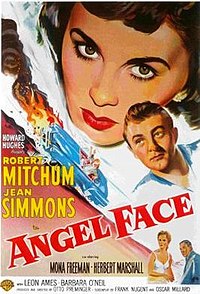
Angel Face

Through no fault of their own sometimes, actors/actresses get typecast as playing one character.  Play enough bad guys and audiences want to see you as bad guys, like Anthony Perkins in Psycho.  Others always play the  cute girl next door and are never given a shot to do anything else.  My example here is Jean Simmons who passed away this past January.  To be fair, I've only seen her in a couple movies, but she looks like the most innocent, angelic person ever in those roles.  Well, I've seen her play a femme fatale now, and to say the least, she's good at it.

A later entry into the film noir chapter, 1952's Angel Face rides on Simmons' shoulders to keep the viewer guessing as to what's going on and what's going through her head. And I guess really that she's not the prototypical femme fatale, not in the typical sense of the definition when it comes to film noir.  But whatever you want to call her part, it is impressive.  Simmons' innocent, doe-eyed look brings you in thinking she's not capable of harming a fly, and then WHAM! There goes the fly.  I'll add spoiler warnings for any twists -- and there are a few -- but be aware they're coming.

Working as an ambulance driver to save money for an exotic car garage, Frank Jessup (Robert Mitchum) is dispatched to a house in the hills outside Los Angelese.  It's there he meets Diane Tremayne (Simmons), the daughter of the patient.  Her stepmother almost asphyxiated when gas was pumped into her room.  The police investigate but come to no conclusions.  Frank puts it behind him, but Diane keeps popping up and the chemistry and romance begin (Frank seems awful clueless at times).  She wants to help him start up his garage and offers him a better paying job as the family's chauffeur.  He somewhat suspiciously accepts the job but finds out this family isn't all it is cracked up to be.  Diane's father (Herbert Marshall) has remarried to a rich woman (Barbara O'Neil) who is jealous of the relationship he has with his daughter.  Can Frank get out of this mess?

I was surprised throughout this movie at the way Simmons is able to pull off cute and innocent one scene and then throw you for a loop with a scene that clearly shows she's not all there in the head.  One extended scene has Simmons walking through the house with a glaze over her face like she doesn't believe what's happened.  SPOILER STOP READING SPOILER She wants to kill her stepmother, but in trying to set up an accident gets her father killed too.  END OF SPOILER  Director Otto Preminger doesn't go all the way in making Diane crazy though.  A sub-plot with Frank's girlfriend Mary (Mona Freeman) dating co-worker Kenneth Tobey is generally let by the wayside, but made me think at some point we'd find out Diane killed her or set her up in some way.

Watching Simmons do her thing, I was reminded of Fatal Attraction with Michael Douglas and Glenn Close.  Like I mentioned, Simmons doesn't go full-on crazy, but I'd wager Close had seen this movie at some point because the influences are all over the place.  As for Mitchum, he's one of my favorite all-time actors, but this has to be his dumbest character ever.  He never seems to catch on to what's actually happening around him.  Even at a trial late in the movie, he seems disinterested in finding out the truth.  There's a part of me wanting to scream at him 'Run for the hills, brother! She's nuts!' but of course stupid characters don't suddenly become aware of how stupid they are.

I did enjoy much of the movie, but some pacing problems exist.  A long 15-20 minute scene is a courtroom scene late in the movie as Diane's lawyer (Leon Ames) does his best to acquit her and Frank with the district attorney (Jim Backus) doing his damnedest to throw the book at them.  It's interesting enough as the two go back and forth, but Simmons and Mitchum are left in the background to grimace or look nervous every once in awhile.  I'd bet neither says a word for 10-minutes plus during this segment.  It doesn't help that Ames' defense lawyer is one of those slimy types you just want to pop in the face.  After over an hour with Diane and Frank, the courtroom segment seems out of place and unnecessarily slows things down.

Following the trial and all its fallout, the ending comes as more of a shock in its violence than in a genuine surprise.  About five minutes out, I called what was going to happen, and how Mitchum's Frank didn't see it coming I'll never know.  But when it does come, it is a doozy, and a good one.  Even with the slower parts, that's the movie as a whole; a good one.  Strong directing from Preminger and Simmons and Mitchum have good chemistry together.

Angel Face <----(1952): ***/****

Wednesday, January 20, 2010

Anatomy of a Murder

In the 1950s, actors like James Dean, Montgomery Clift and Marlon Brando started a trend in acting that continues even to this day; method acting. Actors tried to really get into the role, often times driving everyone around them nuts in the process. What about method directing then? I couldn't help but think of that idea while watching 1959's Anatomy of a Murder from director Otto Preminger.

A producer, director and actor at different points during his career, Preminger never shied away from telling stories without that glossy finish. His movies feel real, almost like a documentary, because they don't call attention to themselves in a highly visual way. These movies are nonetheless great to look at -- the German-born director favored black and white filming -- but as a viewer you feel like you are there with the actors in the scene. Where some directors overfilm (if that's a word/concept), Preminger puts the camera in place and lets his actors go to work. This style pays off with his depiction of a genre that's been used to death in film, the courtroom drama.

Having lost his position as the county district attorney, lawyer Paul Biegler (James Stewart) has settled into an easier, slower-paced lifestyle. He spends much of his time fishing, playing his piano, listening to music and reading law with his friend Parnell McCarthy (Arthur O'Connell), and then takes an occassional case here and there. But then Paul is offered a high-profile case to defend a soldier, Lt. Frederick Manion (Ben Gazzara), who shot a man five times for raping his wife, Laura (Lee Remick). Paul isn't sure if he should take the case but after looking into it and interviewing those involved decides to defend Manion. What's waiting for him in court is Michigan's best prosecutor, a ringer brought in from Lansing, Claude Dancer (George C. Scott).

Having grown up watching countless repeats of Law & Order, Boston Legal, and any number of courtroom movies like 12 Angry Men, I won't say I'm jaded when it comes to that type of story, but I feel like I've seen just about everything the genre has. That doesn't mean I don't seek these movies out, it just takes a little more to impress me. Preminger succeeds on that level with his sometimes leisurely -- slow-paced isn't the right choice of description -- courtroom story that runs 160 minutes. Even at over two and a half hours, it doesn't feel long. The first hour is Biegler's personal investigation as he figures out exactly what happened in the murder. The last 90-100 minutes is the actual trial, and it's one of the best presentations of a courtroom trial I've ever seen, thanks to Stewart and Scott bantering back and forth.

What's interesting in the execution of the trial is the feel of a twist coming, the expectation that we're about to be wowed with some huge revelation. It never comes. There is no twist. Preminger doles out the story, the situation and the characters and lets the story peel like an onion. The jury's verdict is read, and that's it. So in a way, it is a twist. The story is as linear as a story like this could be. Biegler is the viewer because he knows what we know. Was Laura Manion raped, or was she having an affair that went to far? Did Lt. Manion go temporarily insane when he shot the accused rapist? Preminger doesn't give you an easy out, no nice and tidy explanation. And that's why Anatomy of a Murder works.

Working with many of Hollywood's biggest stars, Preminger had a reputation as a stickler for details, but he was always able to get an impressive performance out of his actors. I can't decide about Jimmy Stewart because I say this with every movie I see with him in it, but this is one of his finest performances. With the Manion case, he's up against the wall and must use every trick in the book to get his client acquitted. It's one of those performances where you can't take your eyes off the star, it's that captivating to watch him work. Stewart worked with all the greats in his career, Preminger, Ford, Hitchcock, Capra, and it's easy to see why. He never mails it in, always making his performances special.

To work with Stewart, Preminger assembles an impressive listing for his supporting cast. Gazzara is his typical sneering, intimidating self as Manion, and Remick sexes it up as his possibly trampy wife Laura. Neither character is particularly likable, and we're never sure who's telling the truth so Stewart's Biegler has his work laid out for him if he wants to win the case and get Manion off. This isn't Scott's best part, mostly because it is a one-note part, but he makes the most of it. O'Connell is the stereotypical country drunk who never really lived up to his own expectations but gets a 2nd chance at success with Biegler. Eve Arden has a funny part as Paul's long suffering secretary looking for a paycheck, and Kathryn Grant plays Mary Pilant, the estranged daughter of the murder victim.

Certainly a unique look at a genre that's been overdone at times. Somewhat risque for the time in its depiction of a rape and the rape victim, Preminger has a winner with this courtroom drama. Not a perfect movie, but pretty close to being one. Enjoy the very cheesey, very enjoyable overdone trailer.

Anatomy of a Murder <----trailer (1959): *** 1/2 /****