The Sons of Katie Elder

The Sons of Katie Elder
"First, we reunite, then find Ma and Pa's killer...then read some reviews."
Showing posts with label Al Lettieri. Show all posts

Monday, August 3, 2015

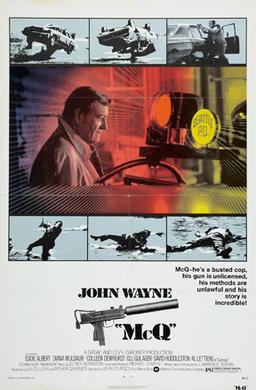
McQ

By the mid 1960's John Wayne wasn't just John Wayne anymore. He was the Duke, an icon and a star. He came to represent something bigger, something Wayne thought people needed to look up to. Because of that sentiment, he turned down some roles that he thought were too much against type. The two big ones? The Major Reisman part from The Dirty Dozen and the role of a famous rogue cop named....Dirty Harry. Wayne regretted not taking the part made famous by Clint Eastwood and went about fixing the issue. The result? Two cop movies, starting with 1974's McQ and following a year later with Brannigan (soon to be reviewed).

A longtime detective on the Seattle police force, Lieutenant Lon 'McQ' McHugh (Wayne) has seen everything there is to be seen. After years on the force, he's sick of the politicians and the glad-handing and all the garbage. He's interested in putting the crooks away, but now one attempted murder hits too close to home when his partner, Lt. Stan Boyle (William Bryant), is shot in the back with a shotgun with no witnesses. Boyle's chances aren't too good, but McQ intends to do something about it. Who shot his partner? The clues are there, and McQ begins to suspect there's a whole lot more going on than meets the eye. He begins to find evidence that could point to any number of trails worth following, from a high-level drug supplier to corruption within the police force. Can he piece it all together before those people he's chasing get him instead?

I've been a huge John Wayne fan for as long as I can remember. If he's starring in a movie, I'll give it a shot. Mostly, they're winners but occasionally there's a dud here and there. I'm looking at you The Conqueror. In this last portion of his career -- mostly the late 1960's and into the 1970's -- Wayne was making movies he wanted to make, movies he figured his fans and audiences wanted to see. Are they classics? With the exception of True Grit and The Shootist, no. On the other hand, they're F-U-N, movies like Big Jake, The Train Robbers, Chisum, The Cowboys and several others. So regretting not taking the Harry Callahan role (a big thank you from Eastwood), Wayne dove headfirst into the renegade cop genre. The winners? Us. McQ and Brannigan aren't classics, but man, are they ever fun.

The rogue/renegade cop movies of the 60's and 70's were everywhere, ranging from Bullitt to Dirty Harry to Magnum Force to The French Connection with plenty more in between. The crime thriller as a whole was at its absolute best. But a John Wayne take on the genre? Yes. Yes. The script gives him some nice touches to show he's a cool cop, like his houseboat, his Pontiac trans am, his efforts to stay involved in his daughter's life, even though ex-wife Julie Adams just couldn't take their marriage anymore. By 1974, Wayne was 66 years old, a little thicker around the midsection and sporting a toupee but you know what? He makes it look effortless. That no-nonsense, all-business attitude plays well as the frustrated cop role. Rules? Meh. Hippies? Don't bug him about them. Getting the crooks behind bars? NOW you're talking.

It doesn't matter the genre. It doesn't matter the script really. It's John Wayne, and he's going to make the most of it. The cast across the board is pretty cool. Eddie Albert gets to glare and snare as Kosterman, McQ's commanding officer who's sick of his take no prisoners attitude, and has some great scenes, two pros going toe to toe. Diana Muldaur plays Boyle's wife, always close with McQ, while Colleen Dewhurst plays Myra, an informant, waitress and drug addict who McQ milks for dirt. Among the cops on the case, also look for Clu Gulager, David Huddleston, and Julian Christopher while Roger E. Mosley plays a pimp/snitch, quite the one-two punch. And last but not least, Al Lettieri does what he does best...in be a slimy 1970's villain, this one a drug supplier with a checkered history with McQ so you know that's going to end well. Some fun parts to back up the Duke throughout.

If you're a fan of Bullitt, the Dirty Harry movies, or assorted other 1960's/1970's cop movies, you'll like this one. Director John Sturges does a good job using his on-location shoots in Seattle to give the story that sense of authenticity, and composer Elmer Bernstein turns in a cool, funky, jazzy score...that's still very clearly an Elmer Bernstein score (and that's a good thing). There's a really cool car chase through and around Seattle's highways about halfway through (just like Bullitt), and the shootout finale on oceanfront beach is very well-done as three 1970's boats, um, I mean "cars," tear after each other. Oh, and John Wayne gets to unleash a heavy-duty automatic machine gun.

Is it a classic? No way, but it is a heck of a lot of fun with a story that never really slows down and has some fun with twists you think you'll see. More than enough to recommend, and John Wayne is having some fun from beginning to end. What would it have been like if Wayne took the Dirty Harry role? We'll never know, but it seemed to turn out generally okay for everyone involved. I guess. Right, Mr. Eastwood?

McQ (1974): ***/****  

Saturday, October 29, 2011

The Getaway

In a too short career, director Sam Peckinpah is both rightly and wrongly remembered for one thing; on-screen violence. It's true of course, The Wild Bunch opening the door for more graphic, brutal portrayals of violence. On the other hand, Peckinpah is so much more, an extremely talented director who used violence as a way of telling his stories. 'Wild' and Straw Dogs were shockers, Bring Me the Head of Alfredo Garcia a drug-induced trip, Ride the High Country a western classic. His most mainstream movie though, just a straight action thriller with no real message, is 1972's The Getaway.

Serving a 10-year sentence for armed robbery, Carter 'Doc McCoy (Steve McQueen) is paroled when his wife, Carol (Ali MacGraw), cuts a deal with a crooked/corrupt businessman, Jack Beynon (Ben Johnson). The parole comes at a price though, Doc having to take part in a bank robbery with two other crooks, Butler (Al Lettieri) and Jackson (Bo Hopkins). The robbery nets $500,000, but in the aftermath Jackson is killed, Butler tries to turn on Doc, and Beynon is looking to double cross them all.  Now with Carol in tow, Doc is on the run, searching for a way out. With hired killers all around smelling the money, Doc and Carol -- dealing with some additional marriage issues -- must run the gauntlet to freedom, but where do they go?

Say what you want about Peckinpah as a director -- and he has his fair share of detractors -- but the man had style.  By 1972, he was an established director and ended up with one of his career's biggest successes with 'Getaway.' His movies had style, but it was a gritty, realistic, no frills style.  His trademark slow-motion violence is there (if somewhat subdued compared to other movies), and the characters are as tough as they come, everyone doing whatever it takes to survive on their own. It's a nasty little world Peckinpah presents as Doc makes his getaway across southern Texas along the Rio Grande. From his typically unique opening credit sequence through the final shootout, Peckinpah always keeps it interesting.

I love seeing teams of superstar directors and actors, especially when they're two of my favorites like here with Peckinpah and McQueen. The duo worked twice together in 1972, also making rodeo flick Junior Bonner. Their personal and individual styles just work together. McQueen's icy, business-like Doc McCoy is one of his darker characters. He's an incredible anti-hero, an ex-con who doesn't trust anybody, even his wife when he finds out what she's been up to. Where some actors made impressions with long stretches of dialogue, McQueen does a lot here -- as he often did -- with very little, using his face, a simple look, his physicality to get a message across. A man of few words to say the least. And because I mention it with every McQueen review....he's very cool. Black suit, shades and a 12-gauge shotgun blasting away at a police car? How isn't that cool?

Because of McQueen as the leading man and Peckinpah in the director's chair, I've always been able to look past some of the movie's more glaring problems. For one? There are surreal moments that just don't fit. Lettieri can and usually was an intimidating villain, but his Rudy Butler is bizarre, almost child-like. He ends up kidnapping a veterinarian, Harold (Jack Dodson), and his wife, Fran (Sally Struthers), to patch up his wounds. The scenes are so off-the-wall they're painful to watch, Rudy having sex with Fran in front of Harold. There's also a food fight, and Fran's utter dependence on Rudy with Struthers at her shrill best. I'm not for domestic abuse, but when McQueen punches a screaming, frantic, whining Struthers near the end it was like a release. Lettieri wasted, and Struthers at her annoying best.

Putting together a finished product, McQueen used his clout to get a new score for the movie, replacing Peckinpah collaborator Jerry Fielding with Quincy Jones. All in all, a bad choice. The score is awful and completely out of place. Not that kind of awful you can ignore either. Harmonica solos? Really, that's the best you've got? And God bless her, but MacGraw just was not a good actress. The future Mrs. Steve McQueen brings little personality to the part with McQueen salvaging what he can of their on-screen time together. Whatever chemistry they had in real-life rolled over to the movie at least a little bit, but that can't save 'Getaway' from her lack of acting ability.

Thankfully there's a ton of other small but well-done supporting parts. Johnson is underused, but his scene with McQueen on the Riverwalk in San Antonio is a great exchange. Hopkins too -- a Peckinpah favorite -- isn't around long, but it's always good seeing his brewing yet cool and laid back persona. Also look for Richard Bright as a conman, Dub Taylor as Laughlin, a hotel owner with connections everywhere, and Roy Jenson and John Bryson as two of Beynon's henchmen. The best part though is for Slim Pickens as an aging Cowboy who Doc and Carol meet in their getaway attempt. It's a small part -- maybe 5 minutes -- that I think should have earned Pickens a Best Supporting Actor nomination, it's that good. His dialogue is honest and refreshing, and his extended scene with McQueen and MacGraw is one of the most natural exchanges I've ever seen. Great part for one of the all-time great character actors.

For a Peckinpah movie, the action is pretty slim. If anything, 'Getaway' focuses more on the chase and the tension that gets built up. McQueen going to town on pursuing police with a shotgun is like a release for him as much as it is the viewer. The same goes for the showdown in Laughlin's hotel, an orgy of shotguns and machine guns. Peckinpah doesn't go overboard, tapping the brakes as necessary. He knows what works and what doesn't, what audiences want to see. It's a flawed movie in the end, but a good one. Since it has inspired a remake while also being sampled by countless other movies, especially impacting No Country for Old Men. Check this one out for Peckinpah behind the camera, and McQueen in front of it.

The Getaway <---trailer (1972): ***/****

Friday, April 16, 2010

A Town Called Hell

When watching a spaghetti western, there's a certain amount of weirdness to be expected.  After all, these were typically European directors/producers/screenwriters interpreting the American west so weirdness just comes with the territory.  But beyond anti-heroes and crazy villains, the spaghettis were often heavy on graphic violence, religious imagery and symbolism, and no penchant for having to have a happy ending.  Basically, everything I like in a western.

For years, the craziest spaghetti I saw was 1967's Django Kill! which features some truly disgusting violence, a gang of gay cowboys, and...wait, that's enough, violence and gay cowboys is a good explanation.  Last night on Netflix Instant viewing, I checked out 1971's A Town Called Hell for a couple reasons, I've never been able to actually track a copy down, and two, the cast looks ridiculously good.  It's not a straight Italian spaghetti western with British and Spanish backing, but it's got all the right elements.  If anything, it's got too many elements.  This one is all over the place and ranks right up there with Django Kill! for new weirdest spaghetti.

It's 1905 in Mexico (right in the middle of the Mexican revolution for you history buffs).  A widower, Alvira (Stella Stevens) rides into the dusty, rundown town of Bastardo -- not 'Hell' as the title implies.  She is offering $20,000 for the man who murdered her husband, but she doesn't know who he is, only that he's in the town.  Alvira's only clue is a name...'Aguila.'  But other than that, she's got nothing to go on.  Three key people in Bastardo seem to have information.  There's the Priest (Robert Shaw), the Colonel (Martin Landau) with his army detachment, and Don Carlos (Telly Savalas), the town's corrupt mayor/bandit. But nothing comes easy, and the betrayals start flying and the bodies start to add up.

Where to start?  Spaghetti westerns generally had an extremely dark tone full of cynicism and violence, lots of anti-establishment feelings.  'Hell' certainly qualifies because no character is safe.  The violence isn't graphic but it is brutal in its honesty.  There are hangings, stabbings, shootings, and so much more.  The setting for this is a really desert town that has fortress walls on all sides, and even though the movie was made/filmed in Spain, it looks like Mexico in all its dusty, dirty glory.  I'm positive I'm reading too much into this, but the town could be some sort of purgatory, some bizarre version of hell.  Or it could just be a whacked out western, you make the decision. 

The story itself is too interesting with director Robert Parrish mixing and matching left and right.  An IMDB user stated there's at least 15 plots, they just last 2 or 3 minutes before moving on, and really, that's a pretty accurate description of this gothic, dark western.  Stevens sleeps in a coffin at night and has a pale deaf-mute protector, Spectre (Dudley Sutton), with her at all times.  Savalas is a violent dictator with an iron fist on this town...until he doesn't anymore when his men turn on him, crucifying him.  Shaw has a vivid dream where Stevens' Alvira kills him in his sleep.  Landau as a Mexican officer?  That does seem pretty logical.  A flashback with a sped-up version of the Battle of New Orleans and a bizarre, confusing backstory just caps it all off.  That's the movie in a nutshell, always moving and never slowing up enough to know how ridiculous it all sounds.

Through all of the craziness, there's a really cool if sometimes odd cast.  Robert Shaw is one of my favorite actors, and he's the star here.  Simply named 'the Priest,' he has a past that still gnaws at him, and he seems to be the only person who knows who 'Aguila' is.  On a non-consequential level, Shaw is also sporting a badass handlebar mustache and mutton chop-like sideburns.  Savalas is the shirtless bandit mayor (honestly, in his 30 minutes he never has a shirt on) who gets to ham it up.  His departure about 30 minutes does come as a surprise, mostly because we never see how he gets whacked.  Landau is the only one who doesn't work because well, he's not Mexican.  He's loud and obnoxious but still isn't a good villain.  Stevens is wasted -- but looks good doing it -- and appears like she wandered into the set and just started reciting lines.

There's also supporting parts for Fernando Rey as an old blind man who may hold the key to Aguila's identity, spaghetti western regular Aldo Sambrell as Calebra, one of Don Carlos' thugs, TV star Michael Craig in flashback as Paco, one of the Priest's partners, and Al Lettieri as La Bomba, Carlos' not so smart treacherous right hand man.  What I liked about this western -- and I did like it -- was the general weirdness of it all.  There's this great cast and no story (not a coherent one at least), but all the little things add up.  Recommending this almost in spite of itself.

A Town Called Hell <----trailer (1971): ** 1/2 /****

Monday, January 19, 2009

Charles Bronson is cooler than you; Netflix review: Mr. Majestyk


So after signing up with Netflix this summer, I've been catching up with a lot of movies that in the past I either couldn't find or couldn't afford. I pay about 10 bucks a month and see eight or nine movies a month if the mail cooperates. After watching the Death Wish movies on AMC last week, I was in a Charles Bronson state of mind so Mr. Majestyk went to the top of the queue.

Bronson plays Vince Majestyk, a Vietnam vet who now owns a 160-acre spread where he grows melons. It's harvest time and the crops needs to be brought in which leads to trouble when local a-hole Bobby Kopas (Paul Koslo) brings in his own crew to work Majestyk's fields for cheap. Vince is having none of that, and after a shotgun showdown, including a rifle butt to Kopas' crotch, he finds himself in jail.


Cue classic 70s villain Al Lettieri (The Godfather's Virgil Solozzo) as mafioso hit man Frank Renda. An escape attempt goes wrong, and Majestyk ends up on Renda's bad side. Majestyk now just wants to get his melon crop in before it's too late so he agrees with the evil "fuzz" to be bait to see if Renda will come back and finish him off.

All-around, a good Bronson action drama when the stone-faced actor was at the top of his game in the years following the first Death Wish. Bronson will never be called a great actor, but he was always a presence on screen, whether it be as a supporting part in John Sturges' 1959 WWII story 'Never So Few' or here when he was a bankable action star. He handles the action well, especially in the final shootout, and his attempts at humor work.

The rest of the cast is solid, especially Lettieri as the villain you love to hate. Linda Cristal (Flaca in John Wayne's The Alamo) is Nancy, a migrant worker who starts off working for Majestyk but ends up dating him, and Koslo as local troublemaker Bobby Kopas is a good counter to Lettieri's tough guy.

The DVD is a good buy, offering widescreen and standard presentations, with a short trailer the only special feature. Not a classic, but certainly worth a watch.

*** out of ****
Mr. Majestyk trailer from Youtube