Late last June, I reviewed 1939's Jesse James, a generally inaccurate, sometimes dull western detailing the life of the infamous outlaw. It played fast and loose with the facts, turning James into a hero more than he probably really was. A bright spot though was Henry Fonda in a small, underused part as Jesse's brother, Frank. Just a year later, Fonda returned with his own movie, 1940's The Return of Frank James.
After the botched Northfield, Minnesota raid, outlaw Frank James (Fonda) leaves the remnant of his brother's gang behind, setting up an alias as a poor farmer. With some help from a youngster, Clem (Jackie Cooper), and a freed slave, Pinky (Ernest Whitman), Frank has managed to hide his identity, leaving his outlaw past behind him. One day though on the farm, he hears that his brother, Jesse, has been murdered, and that his killers, Bob (John Carradine) and Charlie (Charles Tannen) Ford (former members of the James gang), have been found guilty but released from any sentence. Balancing out his desire to leave his violent past behind while still looking to avenge his brother's murder, Frank straps his gunbelt back on and hits the trail in search of the Ford brothers.
There just wasn't much going for the 1939 western that set this sequel up. Tyrone Powers was acceptable as Jesse, but the movie itself lacked any sort of excitement or punch. The sequel is slightly more entertaining for one simple reason, and that's Henry Fonda. He played Frank in the 1939 western, but it is such a small, almost insignificant part that it was a wasted effort. If for nothing else, this sequel is worthwhile to see Fonda -- always the pro -- get an expanded, meatier part. He would later go on to star in westerns like Fort Apache, Once Upon a Time in the West, The Ox-Bow Incident, My Darling Clementine, but this was his first major role in a western. In a movie slightly better than its predecessor, Fonda is the best thing here by far.
In his mid 30s when he made 'Return,' Fonda reflects a lot of what a western hero (in this case anti-hero) should be. Yes, Frank James was an outlaw who's made to look like an immaculate saint here, but he has an ease on-screen that few actors do. He does it so well it doesn't even look like he's trying too hard, but it's there. Like the gentlemanly, serious Wyatt Earp in 'Clementine,' there is a quiet confidence about Fonda's Frank James. He seeks revenge, but he isn't obsessed by it. He has some morals, some ethics, and it is those things that help make it a more interesting character. I especially liked his relationship with young Clem (Cooper does a fine job), almost a big brother-little brother dynamic as they head out on the trail for those murdering Ford boys. It is a 1940 western so it's not real dark, but we at least get to see some of the turmoil brewing in Frank during his hunt.
Beyond Mr. Fonda, there is little star power here. Gene Tierney makes her screen debut as Eleanor Stone, a young woman trying to make it as a newspaper reporter who meets Frank under some odd circumstances....and gets a story in the process (sort of). Henry Hull returns from the original as bombastic, loud, and obnoxious newspaper man Major Rufus Cobb, defender of the downtrodden....and outlaws. Other than that? Not much. Some unintentionally hilarious bad guys, some angelic good guys, and that's it. Carradine is wasted as Jesse James' murderer, Bob Ford, appearing a couple times but mostly spending his screentime on the run.
Clocking in at just 92 minutes, 'Return' isn't around long enough to overstay its welcome. It's inoffensive and doesn't really add anything new to the western genre, but for the first 60 minutes, I was liking it a lot. The look of the movie in odd tinted color is oddly appropriate, and the scale is pretty impressive considering its quickish run-time. It's good, old-fashioned western storytelling at its best. Then, in the final 32 minutes, the story bogs down in Frank's trial as he tries to clear his name. Odd bits of humor, far too much talking, and a complete halt to the story in this disappointing finale for director Fritz Lang's film. The showdown between Frank and Carradine's Bob is a decent last fight, but like the rest of the movie, it's missing that special something. Historical accuracy aside, it's not a bad western, but it's not anything more than good either.
The Return of Frank James (1940): ** 1/2 /****
The Sons of Katie Elder
"First, we reunite, then find Ma and Pa's killer...then read some reviews."
Showing posts with label Gene Tierney. Show all posts
Friday, March 1, 2013
Monday, February 25, 2013
The Left Hand of God
The lives, missions, and beliefs of priests lends well to film adaptations. Think of movies like Keys of the Kingdom, I Confess, The Mission, The Scarlet and the Black, Going My Way, Boys Town and many others. How about a priest sub-genre? Priests who aren't what they seem, films like 1972's The Wrath of God and 1955's The Left Hand of God.
It's 1947 in a remote province of China, and Father O'Shea (Humphrey Bogart) is on his way to an isolated Catholic miss deep in the hills. His predecessor was killed, and the mission is has been missing a priest for months. Three other Americans await, Dr. David Sigman (E.G. Marshall), his wife, Beryl (Agnes Moorehead), and Anne (Gene Tierney), a widow working at the mission. O'Shea's work is cut out for him, the local villagers happy he's there but also worrisome about his arrival. The biggest problem though isn't from the villagers though, but instead the new priest. O'Shea has a secret that threatens to tear the village apart. One of the few men who knows the secret? A warlord, Mieh Yang (Lee J. Cobb), who with his small army of killers poses a huge threat to the poor farming villages.
Based on a novel by William Barrett, this priestly-based story went through its fair share of incarnations and stars before it finally ended up in the hands of director Edward Dmytryk who eventually decided Bogart would be an ideal choice for the part (Kirk Douglas and Gregory Peck were attached to star in earlier incarnations). The film itself is nothing classic, nothing particularly different or unique, but it is nonetheless an enjoyable, well done movie that I was interested in from beginning to end. I'll say it again, familiarity can be a good thing when handled right (read: not boring). Substituting Malibu Canyon, California for China doesn't seem like an obvious choice, but it works in the same way MASH did replacing California for Korea. Composer Victor Young's score is a step above the rest, not your standard epic score.
After reviewing We're No Angels in late 2012, here's another Bogart film from late in the Hollywood icon's career. With Angels, The Harder They Fall, The Desperate Hours and this film (his last four films before his death in 1957), Bogie takes somewhat atypical roles. They're different, not just typical tough guy parts. Semi-spoiler alert......Bogie isn't a priest, taking the disguise and cover story to escape a troublesome situation. I won't spoil the details here, but an effective flashback lays it all out. It's not a showy or scene-stealing part by any means, but there's something charming about it. Bogie's Jim Carmody -- formerly Father O'Shea -- is quite capable of handling himself but there's a certain element of his lifestyle and past that makes him vulnerable.
Without ever becoming sappy, 'Hand' does a fine job of developing the character. We see his interactions with the cynical Dr. Sigman, a physician trying to consider the bottom line and frustrated with Chinese ways, with the widowed Scotty who sees him for the good he does, and most importantly, the Chinese villagers. Converts to Catholicism, they're seeking answers while also looking for a priest to lead the community. Several scenes show Bogie's Father O'Shea interacting with the village children, a good running bit that could have been pushed too far but knows when to tap the brakes. Bogie does a great job with these scenes, especially with his village assistant/quasi-altar boy, John (Victor Sen Yung), and also talking things out with a father (Benson Fong) who loses his wife and newborn baby minutes apart.
Clocking in at just 87 minutes, 'Hand' lacks the epic scale that the story could have required. It's pretty straightforward and to the point but never in a bad way. Marshall, Moorehead, and Tierney all provide solid support for Bogart, three differing performances that show a variety of responses to his arrival and impact. Cobb as the Chinese warlord is an odd choice to play....well, a Chinese warlord, but he avoids being stereotypical or cliched. Bad eye makeup? Yes. Bad performance? No, it could have been awful. Also look for Philip Ahn in a small part as Yang's assistant. Nothing flashy, but I liked this one a lot, especially for a late role for Bogie, and a goodie at that.
The Left Hand of God (1955): ***/****
It's 1947 in a remote province of China, and Father O'Shea (Humphrey Bogart) is on his way to an isolated Catholic miss deep in the hills. His predecessor was killed, and the mission is has been missing a priest for months. Three other Americans await, Dr. David Sigman (E.G. Marshall), his wife, Beryl (Agnes Moorehead), and Anne (Gene Tierney), a widow working at the mission. O'Shea's work is cut out for him, the local villagers happy he's there but also worrisome about his arrival. The biggest problem though isn't from the villagers though, but instead the new priest. O'Shea has a secret that threatens to tear the village apart. One of the few men who knows the secret? A warlord, Mieh Yang (Lee J. Cobb), who with his small army of killers poses a huge threat to the poor farming villages.
Based on a novel by William Barrett, this priestly-based story went through its fair share of incarnations and stars before it finally ended up in the hands of director Edward Dmytryk who eventually decided Bogart would be an ideal choice for the part (Kirk Douglas and Gregory Peck were attached to star in earlier incarnations). The film itself is nothing classic, nothing particularly different or unique, but it is nonetheless an enjoyable, well done movie that I was interested in from beginning to end. I'll say it again, familiarity can be a good thing when handled right (read: not boring). Substituting Malibu Canyon, California for China doesn't seem like an obvious choice, but it works in the same way MASH did replacing California for Korea. Composer Victor Young's score is a step above the rest, not your standard epic score.
After reviewing We're No Angels in late 2012, here's another Bogart film from late in the Hollywood icon's career. With Angels, The Harder They Fall, The Desperate Hours and this film (his last four films before his death in 1957), Bogie takes somewhat atypical roles. They're different, not just typical tough guy parts. Semi-spoiler alert......Bogie isn't a priest, taking the disguise and cover story to escape a troublesome situation. I won't spoil the details here, but an effective flashback lays it all out. It's not a showy or scene-stealing part by any means, but there's something charming about it. Bogie's Jim Carmody -- formerly Father O'Shea -- is quite capable of handling himself but there's a certain element of his lifestyle and past that makes him vulnerable.
Without ever becoming sappy, 'Hand' does a fine job of developing the character. We see his interactions with the cynical Dr. Sigman, a physician trying to consider the bottom line and frustrated with Chinese ways, with the widowed Scotty who sees him for the good he does, and most importantly, the Chinese villagers. Converts to Catholicism, they're seeking answers while also looking for a priest to lead the community. Several scenes show Bogie's Father O'Shea interacting with the village children, a good running bit that could have been pushed too far but knows when to tap the brakes. Bogie does a great job with these scenes, especially with his village assistant/quasi-altar boy, John (Victor Sen Yung), and also talking things out with a father (Benson Fong) who loses his wife and newborn baby minutes apart.
Clocking in at just 87 minutes, 'Hand' lacks the epic scale that the story could have required. It's pretty straightforward and to the point but never in a bad way. Marshall, Moorehead, and Tierney all provide solid support for Bogart, three differing performances that show a variety of responses to his arrival and impact. Cobb as the Chinese warlord is an odd choice to play....well, a Chinese warlord, but he avoids being stereotypical or cliched. Bad eye makeup? Yes. Bad performance? No, it could have been awful. Also look for Philip Ahn in a small part as Yang's assistant. Nothing flashy, but I liked this one a lot, especially for a late role for Bogie, and a goodie at that.
The Left Hand of God (1955): ***/****
Labels:
1950s,
E.G. Marshall,
Edward Dmytryk,
Gene Tierney,
Humphrey Bogart,
Lee J. Cobb
Friday, February 1, 2013
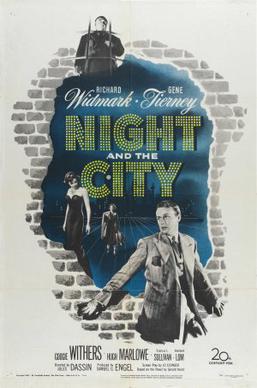
Night and the City
A director with over 20 credits to his name, Jules Dassin has his fair share of classics and memorable movies. But as a director, he hit his stride and reeled off a crazy list of film noir successes in the late 1940s including Brute Force, Thieves' Highway, The Naked City, and welcoming in the new decade, 1950's Night and the City.
An American living in London and trying to make things work with his longtime girlfriend, Mary (Gene Tierney), Harry Fabian (Richard Widmark) wants nothing more than to make it big and make a name for himself. The only problem? Harry has no real charm or talent to do it other than his own charm. In other words, he's a hustler and a con man, always looking for the big thing that will rocket him to the top. In debt and in trouble, Harry might finally have found his in. He meets Gregorious (real-life strongman/wrestler Stanislaus Zbyszko), an internationally renowned wrestler trying to build up the wrestling community/shows in London. It seems like a sure thing, an easy way to make a ton of money, but there's another problem. Gregorious' son, Kristo (Herbert Lom), already has a stranglehold on London wrestling and isn't going to give it away easily.
Released in the heyday of the film noir, 'City' has a trump card that makes it different (and better) from many other noirs of the time. I always think of noirs as taking places in NYC, Los Angeles, any number of small, grimy American towns with all sorts of shady dealings going on in the back alleys. As for this film? Dassin doesn't film his noir in a studio or back lot, he shot on location in and around London. It's a great look to the film, giving the sense of another character in the already incredibly dark story. Sure, much of the story takes place inside (in a studio), but whenever possible, Dassin shot on the streets, alleys, docks and landmarks of London. Filming in black and white, Dassin plays on the usual noir conventions -- darkness, smoke and shadows -- and transports it to London. It's a beyond perfect choice.
Another convention of the noir genre is the general nastiness of the world. Anyone and everyone is looking out for themselves. In other words, always watch your back. Even in the nastiest of movies, there was always that one beacon of light, one good person. Beyond a poor dock owner (Maureen Delaney) who's mixed up in the black market but a good person, there's nary a redeemable character anywhere in sight. In terms of story alone, this is easily one of the darkest, most cynical film noirs I've ever seen. We see the London criminal underworld in all that darkness. But with a talented director like Dassin behind the camera, it's an incredibly stylish if dark look at that world. Dassin uses his camera like few other directors of the time did, including one tracking shot from the back of an open-top convertible navigating London at night. It's a very simple, straightforward scene, but it looks great, and it was certainly far ahead of its time in style.
Still carving out a name for himself as an actor after the star-making role in Kiss of Death, Widmark again shows a knack for playing less than sympathetic characters (if significantly psychotic than Tommy Udo). If there was ever a doomed character in a film noir, Widmark's Harry Fabian has to be near the top of the list. The best part? He's not completely unsympathetic. Harry desperately wants to be something, but he's got no actual way to do it. Instead, he cons, hustles, talks and connives his way into everything he wants and needs. Widmark does a great job showing both sides of this character, but it's apparent from the start where things will end up. In his desperation, Harry simply pushes too far, pitting both sides against each other, and his precarious house of cards hangs in the balance. Another above average performance from a rising star.
And then there's the rest of the nastiness, a whole bunch of similarly despicable characters with their eyes always on the cash. Fabian works for Phillip Nosseross (Francis L. Sullivan), a condescending, immense man who owns a successful night club (maybe a strip club of sorts) with his wife, Helen (Googie Withers). She's also working with Fabian -- behind her husband's back -- to open up a nightclub with a forged license. In a smaller but still effective part, Lom is an ideal intense villain who does have a bit of a human side (however limited). The real-life strongman, Zbyszko is a natural on-screen, a scene-stealer as Gregorious, trying to create a name for a young Greco-Roman wrestler, Nikolas (Ken Richmond). His part is also highlighted by a brutal, knock-down fight with a rival wrestler, the Strangler (Mike Mazurki). Another halfway decent person is Hugh Marlowe's Adam, Mary's neighbor who may have his eyes set on her. Those are the big parts, but even the bit parts are nasty, all of which we see as Harry explores London.
I liked this one a lot right from the start. The only weakness comes in the finale. It's far from slow-moving, but the pacing takes a little time getting to where it wants to be. The issue is that anyone with a working brain knows exactly where it's going. It's not enough to ruin the movie -- not by a long shot -- but it's a minor flaw worth pointing out. An otherwise excellent film noir with a great cast, great look and perfect use of on-location shooting.
Night and the City (1950): ***/****
An American living in London and trying to make things work with his longtime girlfriend, Mary (Gene Tierney), Harry Fabian (Richard Widmark) wants nothing more than to make it big and make a name for himself. The only problem? Harry has no real charm or talent to do it other than his own charm. In other words, he's a hustler and a con man, always looking for the big thing that will rocket him to the top. In debt and in trouble, Harry might finally have found his in. He meets Gregorious (real-life strongman/wrestler Stanislaus Zbyszko), an internationally renowned wrestler trying to build up the wrestling community/shows in London. It seems like a sure thing, an easy way to make a ton of money, but there's another problem. Gregorious' son, Kristo (Herbert Lom), already has a stranglehold on London wrestling and isn't going to give it away easily.
Released in the heyday of the film noir, 'City' has a trump card that makes it different (and better) from many other noirs of the time. I always think of noirs as taking places in NYC, Los Angeles, any number of small, grimy American towns with all sorts of shady dealings going on in the back alleys. As for this film? Dassin doesn't film his noir in a studio or back lot, he shot on location in and around London. It's a great look to the film, giving the sense of another character in the already incredibly dark story. Sure, much of the story takes place inside (in a studio), but whenever possible, Dassin shot on the streets, alleys, docks and landmarks of London. Filming in black and white, Dassin plays on the usual noir conventions -- darkness, smoke and shadows -- and transports it to London. It's a beyond perfect choice.
Another convention of the noir genre is the general nastiness of the world. Anyone and everyone is looking out for themselves. In other words, always watch your back. Even in the nastiest of movies, there was always that one beacon of light, one good person. Beyond a poor dock owner (Maureen Delaney) who's mixed up in the black market but a good person, there's nary a redeemable character anywhere in sight. In terms of story alone, this is easily one of the darkest, most cynical film noirs I've ever seen. We see the London criminal underworld in all that darkness. But with a talented director like Dassin behind the camera, it's an incredibly stylish if dark look at that world. Dassin uses his camera like few other directors of the time did, including one tracking shot from the back of an open-top convertible navigating London at night. It's a very simple, straightforward scene, but it looks great, and it was certainly far ahead of its time in style.
Still carving out a name for himself as an actor after the star-making role in Kiss of Death, Widmark again shows a knack for playing less than sympathetic characters (if significantly psychotic than Tommy Udo). If there was ever a doomed character in a film noir, Widmark's Harry Fabian has to be near the top of the list. The best part? He's not completely unsympathetic. Harry desperately wants to be something, but he's got no actual way to do it. Instead, he cons, hustles, talks and connives his way into everything he wants and needs. Widmark does a great job showing both sides of this character, but it's apparent from the start where things will end up. In his desperation, Harry simply pushes too far, pitting both sides against each other, and his precarious house of cards hangs in the balance. Another above average performance from a rising star.
And then there's the rest of the nastiness, a whole bunch of similarly despicable characters with their eyes always on the cash. Fabian works for Phillip Nosseross (Francis L. Sullivan), a condescending, immense man who owns a successful night club (maybe a strip club of sorts) with his wife, Helen (Googie Withers). She's also working with Fabian -- behind her husband's back -- to open up a nightclub with a forged license. In a smaller but still effective part, Lom is an ideal intense villain who does have a bit of a human side (however limited). The real-life strongman, Zbyszko is a natural on-screen, a scene-stealer as Gregorious, trying to create a name for a young Greco-Roman wrestler, Nikolas (Ken Richmond). His part is also highlighted by a brutal, knock-down fight with a rival wrestler, the Strangler (Mike Mazurki). Another halfway decent person is Hugh Marlowe's Adam, Mary's neighbor who may have his eyes set on her. Those are the big parts, but even the bit parts are nasty, all of which we see as Harry explores London.
I liked this one a lot right from the start. The only weakness comes in the finale. It's far from slow-moving, but the pacing takes a little time getting to where it wants to be. The issue is that anyone with a working brain knows exactly where it's going. It's not enough to ruin the movie -- not by a long shot -- but it's a minor flaw worth pointing out. An otherwise excellent film noir with a great cast, great look and perfect use of on-location shooting.
Night and the City (1950): ***/****
Labels:
1950s,
Film Noir,
Gene Tierney,
Herbert Lom,
Hugh Marlowe,
Jules Dassin,
Richard Widmark
Subscribe to:
Posts (Atom)