The Sons of Katie Elder

The Sons of Katie Elder
"First, we reunite, then find Ma and Pa's killer...then read some reviews."
Showing posts with label Flora Robson. Show all posts

Wednesday, April 10, 2013

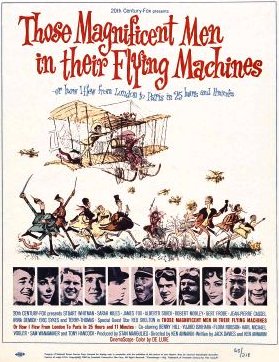
Those Magnificent Men in Their Flying Machines

The roadshow epic is unfortunately a thing of the past, a symbol of a Hollywood era that ruled through the 1950s and early 1960s. Even the lousy ones have something worthwhile. For me, I love the huge scale, the intro music, the intermission, the casts of thousands. By the mid 1960s though, things, they were 'a changing, and the epics were becoming a thing of the past. One of the last films hitting theaters before the era completely died out was a good one, 1965's Those Magnificent Men in Their Flying Machines.

It's 1910, and British army officer Richard Mays (James Fox) is among a small group of pilots worldwide who are helping advance aviation just seven years since the Wright Brothers flew at Kitty Hawk in 1903. He's sorta-engaged to Patricia Rawnsley (Sarah Miles), the daughter of Lord Rawnsley (Robert Morley), a newspaper owner disgusted at the thought of other countries' pilots advancing quicker in aviation than England. Using all his pull, Lord Rawnsley organizes an international air race from England to Paris that will show once and for all who is the best pilot around. Pilots from around the world travel to England with their flying machines with the hopes of winning the race and its lucrative prize. Among them, Orvil Newton (Stuart Whitman), an American cowboy, with his eyes set on the race, the prize, and maybe Patricia too. Uh-oh, America vs. Britain!

Working with Jack Davies to write the script and direct the film as well, Ken Annakin was a huge fan of aviation, and it shows with this 1965 epic. Setting the story in 1910 is a great touch as aviation and flying were still in its infancy. There weren't airlines or commercial jets. Individuals -- not businesses -- were trying to figure out what worked and didn't work in flying. Flying machines (yes, planes) flew much closer to the ground, couldn't stay in the air that long, and had a variety of mechanical and structural issues. Sounds fun, huh? And a little dangerous? Yeah, just a little. Check out the Wikipedia link HERE for an idea of the variety of planes featured here. There's some doozies in the group, definitely making you appreciate the modern jet airliner.

In the vein of The Great Race and It's a Mad, Mad World, 'Flying' is big and flashy but never gets too big or unwieldy. An opening montage with Red Skelton starring as individuals through history learning how hard flying can be (Neanderthal, Ancient Greek, Middle Ages, Victorian), leading right into the cartoon credits played under the Flying Machines theme song (listen HERE). I liked Ron Goodwin's score a lot too, similar to his score four years later in The Battle of Britain. Much of the story was filmed at the Brookley Motor Racing Track, helping give a real sense of 1910s aviation with its lush green fields serving as landing strips, immense wooden hangars housing the new wave of planes, and an outfitted windmill serving as a lookout point for Fire Chief Perkins (Benny Hill). The aerial sequences are impressive, even on the pre-takeoff as we see hundreds and thousands of extras lining the airfields.

The one thing lacking here from most other roadshow epics is huge star power. There are some really solid actors/actresses here, but there's no gigantic star(s). Whitman and Fox get the leads as the American and British pilots, fighting to win the race but also to win the lady. Thankfully, this storyline isn't too painful to watch, bouncing among a handful of different pilots. Some of the other international pilots include Count Emilio (Alberto Sordi), the Italian family man with a penchant for crashing, Pierre Dubois (Jean-Pierre Cassel), the loving life Frenchman, Sir Percy (Terry-Thomas), the sabotaging Englishman with his maligned assistant, Courtney (Eric Sykes), Yamamoto (Yujiro Ishihara), the experienced Japanese pilot and the race favorite, Capt. Rumplestoss (Karl Michael Vogler), the inexperienced but proud German army officer, and MacDougal (Gordon Jackson), the fun-loving Scotsman. Not much star power, but we get a lot of memorable characters with some truly funny recurring bits.

While the scale on a large scale is always impressive, it's the recurring bits that help bring the movie up a notch. It's fun seeing Orvil and Richard go toe-to-toe, the American always looking good in heroic fashion. There's also Dubois swearing he's seeing the same girl over and over again, Irina Dernick playing all of the women. In a pre-World War I time, there's also national rivalries, the English believing they're better than anyone, the Germans doing the same, and the Italians and Frenchmen having fun at their expense. Dubois and his French crew constantly mess with the Germans, especially their commander, Colonel Manfred (scene-stealing Gert Frobe) and Rumplestoss. There's also James Robertson Justice making a quick appearance as the narrator, deadpanning his way through the Skelton bit, Flora Robson as Mother Superior, a nun with an incentive to help the race, Sam Wanamaker as Orvil's partner and friend, and an uncredited Ronnie Stevens as the race's public address announcer.   

'Flying Machines' isn't as long as many epics, wrapping up in just 138 minutes as opposed to so many other three-hour monstrosities. Much of the first 90 minutes is spent on the ground getting to know our pilots, including a whole lot of hijinks and shenanigans as our international lineup tries to outdo each other. The last 50 minutes focus on the race with some impressive aerial sequences, our antiquated looking planes flying across England, the English Channel, and finally Paris. I loved this movie, and more so as it went along. No star power? No problem. It's a gem, and one of the last true roadshow epics. Enjoy it.

Those Magnificent Men in Their Flying Machines (1965): ****/****

Monday, April 9, 2012

Black Narcissus

For hundreds and thousands of years, missionaries have tried to spread their beliefs and principles to the unexposed, those who are unaware and might or might not be willing to change. Film has explored the life and goals of missionaries countless times -- some better and less pretentious than others, but I've watched one that defies description and any predecessor or anything since, 1947's Black Narcissus.

An order of sisters has received an invitation from an Indian general (Esmond Knight) to come to his region and work at a convent and work with the people. Sister Clodagh (Deborah Kerr), a young nun, has been chosen to lead the new convent and is sent to the isolated mission/convent in the Himalayas with four nuns traveling with her, all of them with special skills designed to make the transition easier. The five nuns arrive to find a world unlike anything they've experienced with Mr. Dean (David Farrar), the only white man around for miles, a sort of unofficial guide for them. Clodagh and the sisters settle in, but nothing seems to work for them. Their intentions are pure, but it seems they are doomed to failure from the start.

This is maybe the most beautifully shot movie in the history of movies. Let's get that out there early and let that sink in. Visually stunning, breathtakingly beautiful and frightening at the same time with the credit going to cinematographer and future director Jack Cardiff. Full of color -- from the whites and blues of the nuns' clothes to the vibrant colors of the Indian villagers -- almost every single shot could be freeze-framed and placed on your wall as a work of art. The mission built into the side of a cliff is almost other-worldly (even if the sets were in a studio with liberal and spot-on uses of matte paintings). The wind never stops blowing and the air is always clear at this mission that seems to float above the world. Call it over-analyzing, but it almost serves like a purgatory of sorts for these nuns where a decision must be made on which direction to take. More on the visuals to come.

What originally caught my eye when I read the description at TCM's website was actually a picture....this ONE. Besides the chill that went up my back when I saw it, I knew this wasn't going to be a typical "clean," white-washed missionary story of the 1940s. A character study of nuns and the Indian villagers, yes, but this movie is not that simply described. This movie has all the tension and scares of a Gothic horror movie. We're talking an incredibly uncomfortable movie to watch. With some major spoilers, check out the pictures at THIS review. I thought the movie was going one way, and then it goes another, turning on a dime. I started to question exactly where it was going, what it was building to and was genuinely surprised where it ended up. The last 20 minutes are a straight horror film from the choir singing (with composer Brian Easdale's score) to Cardiff's unsettling visuals.

The visuals, the uniquely dark storytelling, all of that has helped make Black Narcissus a classic over the 60-plus years. However the acting is just as worthy in bringing up even if it's somewhat overshadowed by the visuals and that sense of impending, building doom. Just 26 years old at the time, Deborah Kerr does an amazing job as Sister Clodagh, a young nun who's joined the order because of an incident from her past. Wearing her immaculate white uniform, her face wrapped up tightly, Kerr looks angelic in the part. She doesn't resent her posting, fully committing herself to making it work, but she immediately sees that basically everything in front of her is working against her. Farrar's Dean is an interesting counter, a somewhat mysterious Englishman who's drifted east to India. Why exactly? We never find out. A tortured soul just the same, he serves as a sounding board for Kerr's Clodagh.

Sister Clodagh's nuns include Sister Philippa (Flora Robson), the oldest of the nuns and one struggling with her reasoning for her faith, Sister Honey (Jenny Laird), the youngest and most naive of the group, Sister Briony (Judith Furse), the strongest physically and the healer, and Sister Ruth (Kathleen Byron), the most fragile one who starts to become unhinged mentally. As a group, they're uniformly solid, but it is Byron (with the creepiest, most unsettling eyes EVER) who steals the show. Star of The Jungle Book, Sabu plays the Young General, the son of the older General, a young man trying to learn as much as he can through the sisters. Eddie Whalely Jr. plays Joseph, the Indian boy working with the sisters as a translator, and May Hallatt as Ayah, the somewhat off live-in caretaker of the cliff-side mission. Also making an appearance without saying a word in a key part is the very white Jean Simmons (with heavy makeup) as Kanchi, the Indian girl with a reputation.

I very much enjoyed this movie, or at least as much as you're supposed to enjoy a creepy, moving and unsettling story of five nuns working a mission in the Himalayas. Maybe 'enjoy' isn't the right word. I think we're supposed to appreciate a movie like this more than anything. I don't know if I got the dark message 'Narcissus' worked toward or if I missed something, but it is a movie unlike any I've seen.

Black Narcissus <---TCM trailer/clips (1947): ****/****

Wednesday, February 3, 2010

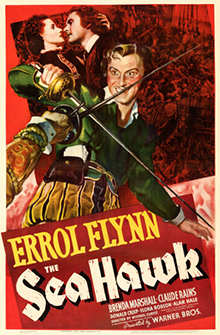
The Sea Hawk

A couple weeks ago I reviewed 1936's Charge of the Light Brigade and as I thought about it since realized I was probably more than a little harsh on star Errol Flynn. I wrote that "he probably didn't act a day in his life" because he seems to always play the ultra-suave, extremely cool hero that saves the day and gets the girl. It came off as more critical than I intended because one of my other favorites, John Wayne, made a career out of playing the same basic character repeatedly. Should we hold it against somebody because they found their niche and ran with it?

It's hard to be critical of Flynn as a movie star because for the most part his movies are so damn entertaining, straight popcorn flicks. But looking at the 1930s and 1940s, he is clearly one of Hollywood's biggest stars. Just look at the movies he made over a 10-year period. He made more classics or near-classics that many actors/actresses make in a career. And as I wrote, just about all those movies has him as a swash-buckling rogue of one sort or another (settings vary) who always ends up on top with a girl on his arm, like 1940's The Sea Hawk.

Flynn plays Geoffrey Thorpe, an English privateer in the late 1500s working for Queen Elizabeth as one of many 'sea hawks.' These English privateers -- or pirates to their enemies -- harass rival countries' ships and keep England flowing in money, gold and treasure. Thorpe's 'Albatross' one day attacks a Spanish galley brimming with treasure and two key passengers onboard, the new Spanish ambassador traveling to England, Don Jose Alvarez (Claude Rains) and his niece Dona Maria (Brenda Marshall). Thorpe delivers his prized catch to Queen Elizabeth (a great performance for Flora Robson) who promptly ignores Alvarez's demands he be put in chains.

Queen Elizabeth has bigger plans for Thorpe and the Albatross. Rumors are swirling that Spain's King Philip is assembling the powerful Spanish Armada with hopes of conquering England. Elizabeth does not have a navy to protect her country -- other than the Sea Hawks -- and no money with which to build a navy. She sends Thorpe on a dangerous mission to Central America; attack the gold convoy coming out of the Spanish mines at Vera Cruz and bring it back so she can assemble a navy in time. Off Thorpe goes, leaving Dona Maria behind. But the plan won't be so easy as Alvarez and the treacherous Wolfingham (Henry Daniell) are at work to make sure the plan fails.

Typecast as a swashbuckler early in his career, it's only fitting that Flynn was in fact very good at fencing having been trained in the art. The training obviously shows because in several of his movies, including The Sea Hawk, Flynn engages in several exciting, intricate-looking sword fights. At one point, Thorpe even takes on four English guards at once in the shadowy court of Queen Elizabeth. It is something so little that as an audience we take for granted sometimes with CGI and stunt doubles, but Flynn handling his own stunts helps make the movie more realistic and for me, much more enjoyable. It's cool to see one of Hollywood's biggest stars at the time going toe to toe like that.

The film opens with a bang as Thorpe's Albatross overwhelms Alvarez's Spanish galley, watch it HERE, with a pretty cool introduction for Flynn as we've heard about his character for most of 10 or 15 minutes. The action sequence does continue into Part 3 for those wanting to continue on. The attack is a great scene in itself, both epically grand as two huge ships duke it out and then on a smaller scale as the two crews engage in hand-to-hand combat to save their ships. The resolution to the fight is particularly unique as how to stop a conflict like that.

Playing Captain Geoffrey Thorpe, Flynn is at his coolest, a driven, patriotic man fighting for queen and country, and of course, the girl. Marshall made 20 movies in a short time and then left show business, and as she shows here as Dona Maria, she's not the greatest actress around but she has some potential. Rains is a worthy villain as always, and Donald Crisp makes the most of a smaller part as Sir John, one of Elizabeth's loyal court members. Often pairing with Flynn as a sidekick, the loyal right hand man, Alan Hale plays Mr. Pitt, the burly, brawling sailor. Robson is actually playing Queen Elizabeth for a second time and almost steals the movie away from Flynn and her co-stars as the outspoken ruler of England.

A movie that's a lot of fun with plenty of action, over-the-top dialogue and some cheesy romance. It's not my favorite Errol Flynn movie, but the swashbuckling actor was never one to disappoint with his action and adventure movies.

The Sea Hawk <----trailer (1940): ***/****