Here's an odd formula for you. A very British actor, a busty bombshell, a British western (British?!?) and filming locations that would go onto bigger and better things within five years. What does all that add up to? A mostly entertaining, often fascinating 1960 western, The Sheriff of Fractured Jaw.
The son of the owner of a firearms company based in England, Jonathan Tibbs (Kenneth More) is looking for something to do. He doesn't feel quite at home in his father's company and is more comfortable building all sorts of crazy gadgets and contraptions. It doesn't take Tibbs too long to figure out a solution. Reading the newspaper one day, he reads a story about the violent wilds of the American west...where guns are quite prevalent. His rationalization? Where there's violence...there's guns so Tibbs packs up and heads to the American west in hopes of expanding his father's business. After plenty of travel, he ends up in the lawless town of Fractured Jaw where sheriffs can't seem to stick around too long. Well, they've got a new one. Through a series of misunderstandings and miscommunications, Tibbs becomes the new sheriff and the key to getting through it? A tough saloon owner, Kate (Jayne Mansfield), who takes a liking to the semi-clueless Brit.
Go figure. This oddball, schizophrenic formula....it kinda works. In one of his last films, director Raoul Walsh helms this goofy, off the wall western. He was past his heyday back in Hollywood's Golden Age, working often with swashbuckling star Errol Flynn, but it's just one more choice you'd think wouldn't work but ends up working quite well. I'll watch anything western but a British western? It wouldn't/shouldn't seem to fit. Look, this isn't a classic. Far from it, things falling apart nicely in the last 30 minutes. When it does work, it's a pleasant change of pace, an entertaining mess. Oh, and those filming locations? 'Fractured' films on-location in Almeria, Spain where in about four years hundreds of spaghetti westerns were filmed. Makes sense, don't it?
Okay, let's cast a male and female lead, two actors who you'd never think would star in a British comedy western together. Hmm, and they're going to have to show off some lovey-dovey chemistry? How about Kenneth More and Jayne Mansfield? DONE! But once again, 'Fractured' gets the last laugh. More is by far the best thing the movie has to offer. A character development that depends on misunderstandings sounds tenuous at best, but More just commits. He plays it all straight and never seems to be going really hard at getting the laughs. He just gets them. The fish out of water routine -- the gentlemanly Brit in the rough and tumble west -- works over and over again. More's Tibbs is a gentleman, polite and trying to make friends and in the process never seems to realize he's doing everything in about the exact wrong way you're supposed to do it. An example? Indians attack the stagecoach he's on so naturally he tries to approach them peaceably to tell them to stop. Oh, by the way. His plan works.
Because More is so good, the chemistry with Mansfield works. One of the biggest sex symbols of the 1950s and into the 1960s, Mansfield isn't a great actress but she makes a go of it. She's here to look sexy, wear very tight dresses and let her natural endowments do the rest. She also sings three different songs, but she's dubbed so that's not her real singing voice. Instead, we're left to consider how anyone could actually be built like that. She's a real-life Barbie doll!
Who else to look for? Some familiar western faces to help ease viewers into...GASP...a British western!!! Henry Hull gets the most screentime as Masters, the Mayor of Fractured Jaw who likes Tibbs immediately, even if he has no idea that his new sheriff can barely handle a gun, much less live up to a reputation of a hardened fast draw. Also look for Bruce Cabot as a rancher who wants to test Tibbs, William Campbell as the real deal, a real fast draw and gunfighter, and Robert Morley as Tibbs' uncle.
So 'Fractured' runs about 103 minutes and for 60 minutes or so, it's really good. Then it takes a detour it never really recovers from. More's Tibbs gets caught up in a sticky situation with two warring ranches and their armies of gunslingers as well as an Indian tribe looking to stir up some trouble. The fish out of water bit wears a little thin as things are stretched out to fill that running time. Still, the first hour is really fun, and I enjoyed it a lot. So in the end, it's an enjoyable mess with some surprisingly good performances. Yep, a British comedy western actually works. I would have bet big money against that thought!
The Sheriff of Fractured Jaw (1960): ** 1/2 /****
The Sons of Katie Elder
"First, we reunite, then find Ma and Pa's killer...then read some reviews."
Showing posts with label Robert Morley. Show all posts
Wednesday, January 14, 2015
Friday, November 28, 2014
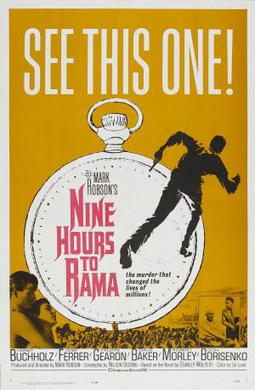
Nine Hours to Rama
So you know what isn't the most uplifting source for stories? Assassins and their assassination attempts. You don't hear a lot of movies about John Wilkes Booth, Lee Harvey Oswald, James Earl Ray and Sirhan Sirhan. How come? Well, it's odd because there's a fascination with killers and those they killed. And then there's the movies that are made, almost completely forgotten like 1963's Nine Hours to Rama, the story of the killer of Mahatma Gandhi.
It's January 30, 1948 in New Delhi, India. Just a few months into the country's independence after 200-plus years under Great Britain's rule, India is still finding its voice as an independent nation, and peace-preaching Mahatma Gandhi is that voice. The police and the army have been mobilized. Evidence and rumors suggest an assassination attempt is going to be made on Gandhi before the day is out. The killer? An extremist hell bent on ending Gandhi's life, his name Naturam Godse (Horst Buchholz). He's been chosen by his movement as the man supposed to kill Gandhi and he is ready to do whatever it takes to accomplish his mission. His work is cut out for him though, as the police, including police superintendent Gopal Das (Jose Ferrer), are closing in on him.
What I don't know about Gandhi's life could fill volumes. The same for Indian history, even more recent history like earning its independence from England. This 1963 story from director Mark Robson has been basically completely forgotten over the last 50-plus years. I caught a couple minutes of 'Rama' a few years back on AMC and finally was able to catch up with the feature film thanks to a recent airing on TV. What an interesting if flawed movie. Robson filmed on location in India, an incredibly nice touch that gives his film quite the authentic feel. He films the crowded streets, the country roads, the people, and there's almost a documentary feel as the story develops. Composer Malcolm Arnold turns in an excellent score, slightly reminiscent of his Bridge on the River Kwai score, to aid the assassination story that's based on the truth but mostly fictionalized.
One of my favorite movies is The Magnificent Seven, a western featuring a cast full of stars and recognizable character actors...and Horst Buchholz, a German actor playing a Mexican gunfighter. It's a very good part, but one of two movies I actually have seen Buchholz in. Well, make that three now with Buchholz doing a solid job here as Naturam. I think the script makes a wise choice in not demonizing him. He's a flawed character, obsessive in his beliefs and convinced he's in the right through his actions. If you know the history, it takes some of the mystery out of where this will end up but that doesn't take away from the strength of the story.
And how about the weakness of the story? That's from a storytelling device that can make or break a movie...the dreaded flashback. This is a story with two paths. One, Naturam in the hours building up to his assassination attempt. Two, his life, how he ended up on this path. His motivations and reasons are one thing, but that doesn't make the flashbacks interesting. Maybe in a separate movie, the flashback device works, but I felt that it fell short here mostly because the other half of the movie is so straightforward and effective. The main focus is on Naturam's troubled relationship with Rani (Valerie Gearon), a woman from vastly different backgrounds and beliefs who's still drawn to Naturam. A fiery, up and down relationship, it just doesn't work well in context. Minimizing the story of Gandhi's assassin to a tortured love story just doesn't work.
With the rest of the cast, Ferrer is the best supporting part. His Das is a dedicated, driven police officer who wants India to succeed as an independent nation. He knows that future needs its leader, Gandhi (J.S. Casshyap, a dead ringer for Gandhi), and has to convince the great man to listen to advice when his life is in danger. Don Borisenko plays Naturam's worrying accomplice, Diane Baker plays a prostitute who Naturam comes across in his efforts to hide while the police search for him and Harry Andrews and Robert Morley don some face-darkening makeup to play an Indian general and an Indian politician.
'Rama' is at its absolute best in the assassination plotline. Ten years before The Day of the Jackal was released, Robson's film does a great job laying things out, a race against time with life and death on the line through a crowded city. Naturam knows he's being pursued with the police close behind every step of the way. The tension keeps building and building as the sun begins to set, especially knowing where the story will end up. Knowledge of the history isn't a hindrance to any enjoyment of the story. It all builds to an incredibly moving ending, a flawed movie that manages to rise above its flaws in its strongest moments. A not so well known historical story but an interesting one to watch develop to its inevitable end.
Nine Days to Rama (1963): ** 1/2 /****
It's January 30, 1948 in New Delhi, India. Just a few months into the country's independence after 200-plus years under Great Britain's rule, India is still finding its voice as an independent nation, and peace-preaching Mahatma Gandhi is that voice. The police and the army have been mobilized. Evidence and rumors suggest an assassination attempt is going to be made on Gandhi before the day is out. The killer? An extremist hell bent on ending Gandhi's life, his name Naturam Godse (Horst Buchholz). He's been chosen by his movement as the man supposed to kill Gandhi and he is ready to do whatever it takes to accomplish his mission. His work is cut out for him though, as the police, including police superintendent Gopal Das (Jose Ferrer), are closing in on him.
What I don't know about Gandhi's life could fill volumes. The same for Indian history, even more recent history like earning its independence from England. This 1963 story from director Mark Robson has been basically completely forgotten over the last 50-plus years. I caught a couple minutes of 'Rama' a few years back on AMC and finally was able to catch up with the feature film thanks to a recent airing on TV. What an interesting if flawed movie. Robson filmed on location in India, an incredibly nice touch that gives his film quite the authentic feel. He films the crowded streets, the country roads, the people, and there's almost a documentary feel as the story develops. Composer Malcolm Arnold turns in an excellent score, slightly reminiscent of his Bridge on the River Kwai score, to aid the assassination story that's based on the truth but mostly fictionalized.
One of my favorite movies is The Magnificent Seven, a western featuring a cast full of stars and recognizable character actors...and Horst Buchholz, a German actor playing a Mexican gunfighter. It's a very good part, but one of two movies I actually have seen Buchholz in. Well, make that three now with Buchholz doing a solid job here as Naturam. I think the script makes a wise choice in not demonizing him. He's a flawed character, obsessive in his beliefs and convinced he's in the right through his actions. If you know the history, it takes some of the mystery out of where this will end up but that doesn't take away from the strength of the story.
And how about the weakness of the story? That's from a storytelling device that can make or break a movie...the dreaded flashback. This is a story with two paths. One, Naturam in the hours building up to his assassination attempt. Two, his life, how he ended up on this path. His motivations and reasons are one thing, but that doesn't make the flashbacks interesting. Maybe in a separate movie, the flashback device works, but I felt that it fell short here mostly because the other half of the movie is so straightforward and effective. The main focus is on Naturam's troubled relationship with Rani (Valerie Gearon), a woman from vastly different backgrounds and beliefs who's still drawn to Naturam. A fiery, up and down relationship, it just doesn't work well in context. Minimizing the story of Gandhi's assassin to a tortured love story just doesn't work.
With the rest of the cast, Ferrer is the best supporting part. His Das is a dedicated, driven police officer who wants India to succeed as an independent nation. He knows that future needs its leader, Gandhi (J.S. Casshyap, a dead ringer for Gandhi), and has to convince the great man to listen to advice when his life is in danger. Don Borisenko plays Naturam's worrying accomplice, Diane Baker plays a prostitute who Naturam comes across in his efforts to hide while the police search for him and Harry Andrews and Robert Morley don some face-darkening makeup to play an Indian general and an Indian politician.
'Rama' is at its absolute best in the assassination plotline. Ten years before The Day of the Jackal was released, Robson's film does a great job laying things out, a race against time with life and death on the line through a crowded city. Naturam knows he's being pursued with the police close behind every step of the way. The tension keeps building and building as the sun begins to set, especially knowing where the story will end up. Knowledge of the history isn't a hindrance to any enjoyment of the story. It all builds to an incredibly moving ending, a flawed movie that manages to rise above its flaws in its strongest moments. A not so well known historical story but an interesting one to watch develop to its inevitable end.
Nine Days to Rama (1963): ** 1/2 /****
Labels:
1960s,
Harry Andrews,
Horst Buchholz,
Jose Ferrer,
Mark Robson,
Robert Morley
Saturday, December 7, 2013
The Good Die Young
Four actors that I like a lot but were never huge stars. A British crime drama with touches of American film noir. Oh, and I've never heard of this movie...at all. Released in 1954, The Good Die Young popped up recently on Turner Classic Movie's schedule, and I couldn't pass up the chance.
On a quiet night on the streets of London, four men sit in a car, one of them, 'Rave' Ravenscourt (Laurence Harvey) passing pistols out to the other three. The quartet is readying themselves to pull off a robbery that will net them each some serious money. What drove them to this point? How did they get here? How did they become so desperate that these four non-criminal types would turn to armed robbery? Rave, Joe Halsey (Richard Basehart), Eddie Blaine (John Ireland) and Mike Morgan (Stanley Baker) are just that though, incredibly desperate with nowhere else to turn. Can they somehow pull the job off?
Tweaked from a novel by Richard MacAulay, 'Die' certainly sounded pretty good to me. Director Lewis Gilbert's film was transplanted from America to London, a nice touch, and certainly pays tribute to its American film noir influences. Filmed in a shadowy, moody black and white, the look of the film reflects the pretty dark, doomed tone of the story. I liked composer Georges Auric's score, appropriately dark and foreboding, building up to the finale we all could see coming. As well, the acting is solid across the board, but I still managed to come away disappointed here. I'm disappointed I was disappointed too, mostly because I really wanted to like this one.
What mostly caught my eye was the casting of the four leads. Laurence Harvey, Richard Basehart, John Ireland and Stanley Baker?!? And in a quasi-film noir?!? The excitment unfortunately ends there. Following the quick, hard-hitting, mysterious opening, the rest of 'Die' is all flashback leading up to what we've already seen. The story bounces among the four different storylines/main characters, the quartet eventually meeting in a London bar and bonding over their generally pathetic situations. They meet everyday, drinking early and often even though none of them really have any money. Obviously, this part was necessary to show the depths they've all sunk to, but they get tedious...very quickly. The movie only runs 94 minutes, but it feels significantly longer. I guess I was expecting more of the crime drama angle so my expectations may have been slightly off, but I still struggled in those later portions before the actual crime.
The acting is still pretty decent even if it just gets to be one thing on top of another late. Harvey becomes the villain, his Rave a suave, smooth, debonaire gentleman who married Eve (Margaret Leighton), a very rich, well to do woman who's got a few years on him. Basehart's Joe is trying to get his British wife, Mary (Joan Collins), to come back to the states with him, ripping her from his evil mother-in-law's grip, (played by Freda Jackson). An infantryman in Germany, Ireland's Eddie is married to Denise (Gloria Grahame), a small-time actress aspiring to be more and with her co-stars too. Lastly, there's Baker's Mike, a boxer trying to leave the ring with the little money he's saved with his loving wife, Angela (Rene Ray), but her family keeps causing them issues. Of the four, Harvey and Baker represent themselves the best, or at least in the most interesting fashion. Also look for Robert Morley in a one-scene part as Rave's father who hates everything that his son has become.
If there is a saving grace in 'Die,' it's the last 20 minutes or so, the flashbacks left behind as the actual robbery develops. Harvey's Rave manages to convince them all to go in on the job, the amateur crooks deciding whether the reward is worth risk. If noirs and crime dramas have taught us anything, it's that crime just will not pay in the long run, and that foreboding sense comes true here. It's the ending you would expect here. I wanted to like the movie a whole lot more, but it loses its momentum in the first hour. Worth seeking out for the cast, but disappointing on most other levels.
The Good Die Young (1954): **/****
On a quiet night on the streets of London, four men sit in a car, one of them, 'Rave' Ravenscourt (Laurence Harvey) passing pistols out to the other three. The quartet is readying themselves to pull off a robbery that will net them each some serious money. What drove them to this point? How did they get here? How did they become so desperate that these four non-criminal types would turn to armed robbery? Rave, Joe Halsey (Richard Basehart), Eddie Blaine (John Ireland) and Mike Morgan (Stanley Baker) are just that though, incredibly desperate with nowhere else to turn. Can they somehow pull the job off?
Tweaked from a novel by Richard MacAulay, 'Die' certainly sounded pretty good to me. Director Lewis Gilbert's film was transplanted from America to London, a nice touch, and certainly pays tribute to its American film noir influences. Filmed in a shadowy, moody black and white, the look of the film reflects the pretty dark, doomed tone of the story. I liked composer Georges Auric's score, appropriately dark and foreboding, building up to the finale we all could see coming. As well, the acting is solid across the board, but I still managed to come away disappointed here. I'm disappointed I was disappointed too, mostly because I really wanted to like this one.
What mostly caught my eye was the casting of the four leads. Laurence Harvey, Richard Basehart, John Ireland and Stanley Baker?!? And in a quasi-film noir?!? The excitment unfortunately ends there. Following the quick, hard-hitting, mysterious opening, the rest of 'Die' is all flashback leading up to what we've already seen. The story bounces among the four different storylines/main characters, the quartet eventually meeting in a London bar and bonding over their generally pathetic situations. They meet everyday, drinking early and often even though none of them really have any money. Obviously, this part was necessary to show the depths they've all sunk to, but they get tedious...very quickly. The movie only runs 94 minutes, but it feels significantly longer. I guess I was expecting more of the crime drama angle so my expectations may have been slightly off, but I still struggled in those later portions before the actual crime.
The acting is still pretty decent even if it just gets to be one thing on top of another late. Harvey becomes the villain, his Rave a suave, smooth, debonaire gentleman who married Eve (Margaret Leighton), a very rich, well to do woman who's got a few years on him. Basehart's Joe is trying to get his British wife, Mary (Joan Collins), to come back to the states with him, ripping her from his evil mother-in-law's grip, (played by Freda Jackson). An infantryman in Germany, Ireland's Eddie is married to Denise (Gloria Grahame), a small-time actress aspiring to be more and with her co-stars too. Lastly, there's Baker's Mike, a boxer trying to leave the ring with the little money he's saved with his loving wife, Angela (Rene Ray), but her family keeps causing them issues. Of the four, Harvey and Baker represent themselves the best, or at least in the most interesting fashion. Also look for Robert Morley in a one-scene part as Rave's father who hates everything that his son has become.
If there is a saving grace in 'Die,' it's the last 20 minutes or so, the flashbacks left behind as the actual robbery develops. Harvey's Rave manages to convince them all to go in on the job, the amateur crooks deciding whether the reward is worth risk. If noirs and crime dramas have taught us anything, it's that crime just will not pay in the long run, and that foreboding sense comes true here. It's the ending you would expect here. I wanted to like the movie a whole lot more, but it loses its momentum in the first hour. Worth seeking out for the cast, but disappointing on most other levels.
The Good Die Young (1954): **/****
Wednesday, April 10, 2013
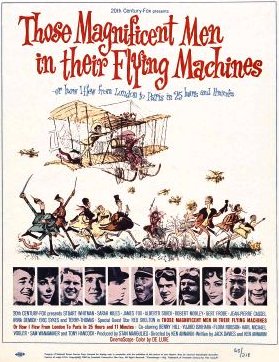
Those Magnificent Men in Their Flying Machines
The roadshow epic is unfortunately a thing of the past, a symbol of a Hollywood era that ruled through the 1950s and early 1960s. Even the lousy ones have something worthwhile. For me, I love the huge scale, the intro music, the intermission, the casts of thousands. By the mid 1960s though, things, they were 'a changing, and the epics were becoming a thing of the past. One of the last films hitting theaters before the era completely died out was a good one, 1965's Those Magnificent Men in Their Flying Machines.
It's 1910, and British army officer Richard Mays (James Fox) is among a small group of pilots worldwide who are helping advance aviation just seven years since the Wright Brothers flew at Kitty Hawk in 1903. He's sorta-engaged to Patricia Rawnsley (Sarah Miles), the daughter of Lord Rawnsley (Robert Morley), a newspaper owner disgusted at the thought of other countries' pilots advancing quicker in aviation than England. Using all his pull, Lord Rawnsley organizes an international air race from England to Paris that will show once and for all who is the best pilot around. Pilots from around the world travel to England with their flying machines with the hopes of winning the race and its lucrative prize. Among them, Orvil Newton (Stuart Whitman), an American cowboy, with his eyes set on the race, the prize, and maybe Patricia too. Uh-oh, America vs. Britain!
Working with Jack Davies to write the script and direct the film as well, Ken Annakin was a huge fan of aviation, and it shows with this 1965 epic. Setting the story in 1910 is a great touch as aviation and flying were still in its infancy. There weren't airlines or commercial jets. Individuals -- not businesses -- were trying to figure out what worked and didn't work in flying. Flying machines (yes, planes) flew much closer to the ground, couldn't stay in the air that long, and had a variety of mechanical and structural issues. Sounds fun, huh? And a little dangerous? Yeah, just a little. Check out the Wikipedia link HERE for an idea of the variety of planes featured here. There's some doozies in the group, definitely making you appreciate the modern jet airliner.
In the vein of The Great Race and It's a Mad, Mad World, 'Flying' is big and flashy but never gets too big or unwieldy. An opening montage with Red Skelton starring as individuals through history learning how hard flying can be (Neanderthal, Ancient Greek, Middle Ages, Victorian), leading right into the cartoon credits played under the Flying Machines theme song (listen HERE). I liked Ron Goodwin's score a lot too, similar to his score four years later in The Battle of Britain. Much of the story was filmed at the Brookley Motor Racing Track, helping give a real sense of 1910s aviation with its lush green fields serving as landing strips, immense wooden hangars housing the new wave of planes, and an outfitted windmill serving as a lookout point for Fire Chief Perkins (Benny Hill). The aerial sequences are impressive, even on the pre-takeoff as we see hundreds and thousands of extras lining the airfields.
The one thing lacking here from most other roadshow epics is huge star power. There are some really solid actors/actresses here, but there's no gigantic star(s). Whitman and Fox get the leads as the American and British pilots, fighting to win the race but also to win the lady. Thankfully, this storyline isn't too painful to watch, bouncing among a handful of different pilots. Some of the other international pilots include Count Emilio (Alberto Sordi), the Italian family man with a penchant for crashing, Pierre Dubois (Jean-Pierre Cassel), the loving life Frenchman, Sir Percy (Terry-Thomas), the sabotaging Englishman with his maligned assistant, Courtney (Eric Sykes), Yamamoto (Yujiro Ishihara), the experienced Japanese pilot and the race favorite, Capt. Rumplestoss (Karl Michael Vogler), the inexperienced but proud German army officer, and MacDougal (Gordon Jackson), the fun-loving Scotsman. Not much star power, but we get a lot of memorable characters with some truly funny recurring bits.
While the scale on a large scale is always impressive, it's the recurring bits that help bring the movie up a notch. It's fun seeing Orvil and Richard go toe-to-toe, the American always looking good in heroic fashion. There's also Dubois swearing he's seeing the same girl over and over again, Irina Dernick playing all of the women. In a pre-World War I time, there's also national rivalries, the English believing they're better than anyone, the Germans doing the same, and the Italians and Frenchmen having fun at their expense. Dubois and his French crew constantly mess with the Germans, especially their commander, Colonel Manfred (scene-stealing Gert Frobe) and Rumplestoss. There's also James Robertson Justice making a quick appearance as the narrator, deadpanning his way through the Skelton bit, Flora Robson as Mother Superior, a nun with an incentive to help the race, Sam Wanamaker as Orvil's partner and friend, and an uncredited Ronnie Stevens as the race's public address announcer.
'Flying Machines' isn't as long as many epics, wrapping up in just 138 minutes as opposed to so many other three-hour monstrosities. Much of the first 90 minutes is spent on the ground getting to know our pilots, including a whole lot of hijinks and shenanigans as our international lineup tries to outdo each other. The last 50 minutes focus on the race with some impressive aerial sequences, our antiquated looking planes flying across England, the English Channel, and finally Paris. I loved this movie, and more so as it went along. No star power? No problem. It's a gem, and one of the last true roadshow epics. Enjoy it.
Those Magnificent Men in Their Flying Machines (1965): ****/****
It's 1910, and British army officer Richard Mays (James Fox) is among a small group of pilots worldwide who are helping advance aviation just seven years since the Wright Brothers flew at Kitty Hawk in 1903. He's sorta-engaged to Patricia Rawnsley (Sarah Miles), the daughter of Lord Rawnsley (Robert Morley), a newspaper owner disgusted at the thought of other countries' pilots advancing quicker in aviation than England. Using all his pull, Lord Rawnsley organizes an international air race from England to Paris that will show once and for all who is the best pilot around. Pilots from around the world travel to England with their flying machines with the hopes of winning the race and its lucrative prize. Among them, Orvil Newton (Stuart Whitman), an American cowboy, with his eyes set on the race, the prize, and maybe Patricia too. Uh-oh, America vs. Britain!
Working with Jack Davies to write the script and direct the film as well, Ken Annakin was a huge fan of aviation, and it shows with this 1965 epic. Setting the story in 1910 is a great touch as aviation and flying were still in its infancy. There weren't airlines or commercial jets. Individuals -- not businesses -- were trying to figure out what worked and didn't work in flying. Flying machines (yes, planes) flew much closer to the ground, couldn't stay in the air that long, and had a variety of mechanical and structural issues. Sounds fun, huh? And a little dangerous? Yeah, just a little. Check out the Wikipedia link HERE for an idea of the variety of planes featured here. There's some doozies in the group, definitely making you appreciate the modern jet airliner.
In the vein of The Great Race and It's a Mad, Mad World, 'Flying' is big and flashy but never gets too big or unwieldy. An opening montage with Red Skelton starring as individuals through history learning how hard flying can be (Neanderthal, Ancient Greek, Middle Ages, Victorian), leading right into the cartoon credits played under the Flying Machines theme song (listen HERE). I liked Ron Goodwin's score a lot too, similar to his score four years later in The Battle of Britain. Much of the story was filmed at the Brookley Motor Racing Track, helping give a real sense of 1910s aviation with its lush green fields serving as landing strips, immense wooden hangars housing the new wave of planes, and an outfitted windmill serving as a lookout point for Fire Chief Perkins (Benny Hill). The aerial sequences are impressive, even on the pre-takeoff as we see hundreds and thousands of extras lining the airfields.
The one thing lacking here from most other roadshow epics is huge star power. There are some really solid actors/actresses here, but there's no gigantic star(s). Whitman and Fox get the leads as the American and British pilots, fighting to win the race but also to win the lady. Thankfully, this storyline isn't too painful to watch, bouncing among a handful of different pilots. Some of the other international pilots include Count Emilio (Alberto Sordi), the Italian family man with a penchant for crashing, Pierre Dubois (Jean-Pierre Cassel), the loving life Frenchman, Sir Percy (Terry-Thomas), the sabotaging Englishman with his maligned assistant, Courtney (Eric Sykes), Yamamoto (Yujiro Ishihara), the experienced Japanese pilot and the race favorite, Capt. Rumplestoss (Karl Michael Vogler), the inexperienced but proud German army officer, and MacDougal (Gordon Jackson), the fun-loving Scotsman. Not much star power, but we get a lot of memorable characters with some truly funny recurring bits.
While the scale on a large scale is always impressive, it's the recurring bits that help bring the movie up a notch. It's fun seeing Orvil and Richard go toe-to-toe, the American always looking good in heroic fashion. There's also Dubois swearing he's seeing the same girl over and over again, Irina Dernick playing all of the women. In a pre-World War I time, there's also national rivalries, the English believing they're better than anyone, the Germans doing the same, and the Italians and Frenchmen having fun at their expense. Dubois and his French crew constantly mess with the Germans, especially their commander, Colonel Manfred (scene-stealing Gert Frobe) and Rumplestoss. There's also James Robertson Justice making a quick appearance as the narrator, deadpanning his way through the Skelton bit, Flora Robson as Mother Superior, a nun with an incentive to help the race, Sam Wanamaker as Orvil's partner and friend, and an uncredited Ronnie Stevens as the race's public address announcer.
'Flying Machines' isn't as long as many epics, wrapping up in just 138 minutes as opposed to so many other three-hour monstrosities. Much of the first 90 minutes is spent on the ground getting to know our pilots, including a whole lot of hijinks and shenanigans as our international lineup tries to outdo each other. The last 50 minutes focus on the race with some impressive aerial sequences, our antiquated looking planes flying across England, the English Channel, and finally Paris. I loved this movie, and more so as it went along. No star power? No problem. It's a gem, and one of the last true roadshow epics. Enjoy it.
Those Magnificent Men in Their Flying Machines (1965): ****/****
Monday, September 17, 2012
Around the World in 80 Days (1956)
There are epics, and then there are EPICS. In the age of such immense, gigantically-scaled films of the 1950s and 1960s, studios pulled out all the stops in hopes of impressing moviegoers. Huge all-star casts with thousands of extras, lavish sets and costumes, and in general, a sight to behold on the big screen. Some movies were just made for a viewing that only a full-size movie theater can offer, like 1956's Around the World in 80 Days.
It is the 1870s and new technological advances have made travel to far-off places not only possible but quicker, more efficient, and more entertaining. A prim and proper Englishman, Phileas Fogg (David Niven), even boasts to his fellow members of the Reform Club that he can travel completely travel around the world in just 80 days. The club members laugh at the thought, but Fogg maintains his stance and a bet is born. With a significant amount of money on the line, Fogg and his assistant/valet, Passepartout (Mexican actor Cantinflas), embark on a journey around the world against the clock with no idea of what will be actually thrown their way during their adventurous travels.
If you were trying to define what an old-school Hollywood epic is to someone who didn't know, this would be a great start. Filming in locations around the world from Japan, the U.S., Thailand, Spain, England, France, Pakistan and China, '80 Days' is a true visual stunner. The screen is filled with incredible locations packed to the gills with the cast and then hundreds and thousands of extras behind them. Director Michael Anderson filmed with a Todd-AO technique, an ultra-widescreen filming process that makes certain shots look like epically wide panoramic shots. I was impressed watching the film on my 32-inch TV. I can only imagine what this film would look like on a movie screen. As well, composer Victor Young's score (which won an Oscar) is light-hearted and fun, keeping the travels moving.
It is hard to criticize this movie on its technical levels. It is far easier to criticize the movie for basically everything else. Oh, didn't see that twist coming, did you? All that epic quality comes at the expense of character, story and any sort of development involving either of those. This is a movie you appreciate, just sit back and enjoy it. The widescreen filming process is a sight to behold, but they become tedious by the 11th or 12th such long shot of a mountain vista, train running down a track, Cantinflas fighting a bull. Yes, I get it. On visuals alone, this is a stunningly beautiful movie. But at almost three-hours long, it feels like nothing more than an extended world travel guide. There never is even the slightest sense of urgency to the 80 day deadline until the final 10 minutes. Instead we get the visual, Niven's Fogg paying someone to right a wrong, then another nature shot.
I'll go into more depth about the supporting cast of thousands in a bit, but let's start with the lead performances. David Niven is one of my favorite actors, but I came away disappointed here. His Fogg is the definition of a prim and proper Englishman. He's even asked 'Why must you be so British?' at one point. At no point though does he actually look interested in bringing the part to life. To me, Niven look bored, and that's tough to say as a fan. Famed Mexican actor Cantinflas sure takes some grief for his part as Passepartout, but I thought he did a fine job with his limited grasp of English. His bit with Red Skelton is a highlight, the duo shoveling food into the others mouth in a very funny routine. Other bigger parts include Shirley MacLaine oddly cast as an Indian princess traveling with Fogg and Passepartout, and Robert Newton as Mr. Fix, a bank investigator trailing Fogg who's convinced the Englishman is an infamous bank robber.
Then there's the cameos, a long list that must put even The Greatest Story Ever Told to shame. Take a deep breath, and here goes. Look out for Finlay Currie, Robert Morley, Noel Coward, Trevor Howard, John Gielgud, Charles Boyer, Gilbert Roland, Cesar Romero, Cedric Hardwicke, Peter Lorre, George Raft, Marlene Dietrich, Frank Sinatra, John Carradine, Buster Keaton, Joe E. Brown, Andy Devine, Victor McLaglen, John Mills and Glynis Johns among others. I include those names because I recognized them in the cast, not because I necessarily saw them in the actual film. They are the 'blink and you'll miss them' type of cameos to the point many don't even register. Sinatra is shown over his shoulder three times and then turns and smiles. Mind you, he doesn't even say anything. He SMILES. That's it. Yes, it's fun seeing all these actors/actresses together but give them something to do.
This is a tough one to review in the end. It's too long, downright dull at times, a visual treat to watch, and a movie experience unlike any other. It's flaws though are crippling. '80 Days' may be three-hour longs but because of its schizo, hyper kinetic energy that bounces all over the place, it feels significantly longer and has not aged well over the years. A movie to be appreciated for its positives for what it does amount to, even if I won't be watching it again anytime soon. Okay, maybe in a movie theater.
Around the World in 80 Days <---trailer (1956): ** 1/2/****
It is the 1870s and new technological advances have made travel to far-off places not only possible but quicker, more efficient, and more entertaining. A prim and proper Englishman, Phileas Fogg (David Niven), even boasts to his fellow members of the Reform Club that he can travel completely travel around the world in just 80 days. The club members laugh at the thought, but Fogg maintains his stance and a bet is born. With a significant amount of money on the line, Fogg and his assistant/valet, Passepartout (Mexican actor Cantinflas), embark on a journey around the world against the clock with no idea of what will be actually thrown their way during their adventurous travels.
If you were trying to define what an old-school Hollywood epic is to someone who didn't know, this would be a great start. Filming in locations around the world from Japan, the U.S., Thailand, Spain, England, France, Pakistan and China, '80 Days' is a true visual stunner. The screen is filled with incredible locations packed to the gills with the cast and then hundreds and thousands of extras behind them. Director Michael Anderson filmed with a Todd-AO technique, an ultra-widescreen filming process that makes certain shots look like epically wide panoramic shots. I was impressed watching the film on my 32-inch TV. I can only imagine what this film would look like on a movie screen. As well, composer Victor Young's score (which won an Oscar) is light-hearted and fun, keeping the travels moving.
It is hard to criticize this movie on its technical levels. It is far easier to criticize the movie for basically everything else. Oh, didn't see that twist coming, did you? All that epic quality comes at the expense of character, story and any sort of development involving either of those. This is a movie you appreciate, just sit back and enjoy it. The widescreen filming process is a sight to behold, but they become tedious by the 11th or 12th such long shot of a mountain vista, train running down a track, Cantinflas fighting a bull. Yes, I get it. On visuals alone, this is a stunningly beautiful movie. But at almost three-hours long, it feels like nothing more than an extended world travel guide. There never is even the slightest sense of urgency to the 80 day deadline until the final 10 minutes. Instead we get the visual, Niven's Fogg paying someone to right a wrong, then another nature shot.
I'll go into more depth about the supporting cast of thousands in a bit, but let's start with the lead performances. David Niven is one of my favorite actors, but I came away disappointed here. His Fogg is the definition of a prim and proper Englishman. He's even asked 'Why must you be so British?' at one point. At no point though does he actually look interested in bringing the part to life. To me, Niven look bored, and that's tough to say as a fan. Famed Mexican actor Cantinflas sure takes some grief for his part as Passepartout, but I thought he did a fine job with his limited grasp of English. His bit with Red Skelton is a highlight, the duo shoveling food into the others mouth in a very funny routine. Other bigger parts include Shirley MacLaine oddly cast as an Indian princess traveling with Fogg and Passepartout, and Robert Newton as Mr. Fix, a bank investigator trailing Fogg who's convinced the Englishman is an infamous bank robber.
Then there's the cameos, a long list that must put even The Greatest Story Ever Told to shame. Take a deep breath, and here goes. Look out for Finlay Currie, Robert Morley, Noel Coward, Trevor Howard, John Gielgud, Charles Boyer, Gilbert Roland, Cesar Romero, Cedric Hardwicke, Peter Lorre, George Raft, Marlene Dietrich, Frank Sinatra, John Carradine, Buster Keaton, Joe E. Brown, Andy Devine, Victor McLaglen, John Mills and Glynis Johns among others. I include those names because I recognized them in the cast, not because I necessarily saw them in the actual film. They are the 'blink and you'll miss them' type of cameos to the point many don't even register. Sinatra is shown over his shoulder three times and then turns and smiles. Mind you, he doesn't even say anything. He SMILES. That's it. Yes, it's fun seeing all these actors/actresses together but give them something to do.
This is a tough one to review in the end. It's too long, downright dull at times, a visual treat to watch, and a movie experience unlike any other. It's flaws though are crippling. '80 Days' may be three-hour longs but because of its schizo, hyper kinetic energy that bounces all over the place, it feels significantly longer and has not aged well over the years. A movie to be appreciated for its positives for what it does amount to, even if I won't be watching it again anytime soon. Okay, maybe in a movie theater.
Around the World in 80 Days <---trailer (1956): ** 1/2/****
Saturday, May 28, 2011
The Journey
One of the 1950's most popular films, 1956's The King and I was loved by audiences, award shows, and critics alike. Maybe the biggest reason for the movie's popularity -- besides the Rodgers and Hammerstein music and the epic story -- was the pairing of its two stars, Yul Brynner and Deborah Kerr. I haven't seen the movie in years but still remember their chemistry. It was only a matter of time before they were paired in a movie together again, that coming three years later with 1959's The Journey.
The story is based during the Hungarian Revolution of 1956. My background in said revolution is that there was in fact a revolution in Hungary in 1956. As much as I like history, you just can't read and learn about everything. The setting -- while specific -- is applicable to any world conflict. It is based in individuals in a bad situation trying to reach some sort of safety, some feeling of normalcy. Through these situations, you often bond through your trials. For all its uniqueness concerning a conflict in a far-off part of the world though, 'Journey' isn't always the most exciting movie, resorting to its star power to carry it through the slower portions.
It's 1956 in Budapest, Hungary, and an English woman, Diane Ashmore (Kerr), arrives at the airport trying to get out of the country and back home to England. She's given some tough news though; the Hungarian people are revolting against their Russian/Soviet rulers, and all traffic in and out of the country has been canceled. However, transportation has been arranged for Diane and 13 other international passengers trying to leave Hungary. They will board a bus and drive the 250 miles to safety at the Austrian border. Before they reach the border though, they're stopped and inspected by the local commander, a Russian major, Surov (Brynner), who won't let them pass until everyone is approved. Diane starts to worry because she knows a secret about a fellow passenger on board, Fleming (Jason Robards), that threatens to get them all shot.
This is an all-around kind of weird movie. It isn't like so many other movies, but not always in a good or bad way. It is just different. Director Anatole Litvak films his movie in Hungary on some of the locations where the actual revolution took place just three years before in 1956. It certainly gives the movie a feeling of realism, of authenticity that couldn't have been duplicated on a Hollywood backlot (even if it does look like a studio at times). Instead, much of the story is set in a small hotel and its surrounding buildings. There is a washed out look to The Journey that I suppose could have been the TCM print, but I don't know for sure. I can't put my finger on it, but something about the film just didn't click with me.
With two leads like Kerr and Brynner at the forefront of the movie, it's understandable that you want them to carry the movie as much as possible. Their performances are the least of the movie's problems. Their chemistry together is hard to disagree with. They're just good together. Kerr is quiet and composed, eventually pushed to the point of nerves taking over while Brynner is bigger than life, able to dominate the screen just by standing there. But in developing these characters, the story requires them to fall for each other. The final 20-30 minutes come along, and they're fighting off urges that I just didn't see building up throughout the movie. It's dialogue and more dialogue and more dialogue. The movie is a tad long at 126 minutes, taking quite awhile to get where it's going.
As if Kerr and Brynner weren't enough to satisfy most moviegoers, Jason Robards makes his feature film debut as Fleming, the mysterious passenger on-board who has all the other passengers concerned what he's up to. SPOILERS STOP READING SPOILERS Kerr is trying to sneak him out of the country, past lovers reunited after he escaped from a Russian prison. END OF SPOILERS Robards is one of the more underrated actors from the era, and he shows off the talent we'd all get to see in the coming years. Filling out the international list of passengers is Robert Morley as the scene-stealing, stiff upper lip Englishman, Deverill, E.G. Marshall and Anne Jackson as an American couple traveling with their kids (including a 5-year old Ron Howard), and other characters from Egypt, France, Germany, and in an interesting twist, a Jewish man. There was potential here for more development among these characters, and yes, I know the focus is on the leads. The 14 passengers though screamed out for a mini-series, something that would have given them a chance to shine. Also look for Senta Berger in a bit part as a serving girl at the hotel.
Maybe the biggest problem 'Journey' has going for it is a lack of focus. Brynner's Surov is investigating these international passengers, but nothing ever seems to get done. He spends most of the time riding his prized horse, eating and drinking with the passengers who are scared to death of him, and all the while, Kerr's Diane worries he'll figure out what's going on. By the way, he does....and pretty quickly. There is no urgency though at all, and the movie's pacing suffers. The ending makes up for it some in terms of surprise and shock value, a moving finale that definitely caught me off guard. I just wish more of the movie could have been like that.
The Journey <---trailer (1959): ** 1/2 /****
The story is based during the Hungarian Revolution of 1956. My background in said revolution is that there was in fact a revolution in Hungary in 1956. As much as I like history, you just can't read and learn about everything. The setting -- while specific -- is applicable to any world conflict. It is based in individuals in a bad situation trying to reach some sort of safety, some feeling of normalcy. Through these situations, you often bond through your trials. For all its uniqueness concerning a conflict in a far-off part of the world though, 'Journey' isn't always the most exciting movie, resorting to its star power to carry it through the slower portions.
It's 1956 in Budapest, Hungary, and an English woman, Diane Ashmore (Kerr), arrives at the airport trying to get out of the country and back home to England. She's given some tough news though; the Hungarian people are revolting against their Russian/Soviet rulers, and all traffic in and out of the country has been canceled. However, transportation has been arranged for Diane and 13 other international passengers trying to leave Hungary. They will board a bus and drive the 250 miles to safety at the Austrian border. Before they reach the border though, they're stopped and inspected by the local commander, a Russian major, Surov (Brynner), who won't let them pass until everyone is approved. Diane starts to worry because she knows a secret about a fellow passenger on board, Fleming (Jason Robards), that threatens to get them all shot.
This is an all-around kind of weird movie. It isn't like so many other movies, but not always in a good or bad way. It is just different. Director Anatole Litvak films his movie in Hungary on some of the locations where the actual revolution took place just three years before in 1956. It certainly gives the movie a feeling of realism, of authenticity that couldn't have been duplicated on a Hollywood backlot (even if it does look like a studio at times). Instead, much of the story is set in a small hotel and its surrounding buildings. There is a washed out look to The Journey that I suppose could have been the TCM print, but I don't know for sure. I can't put my finger on it, but something about the film just didn't click with me.
With two leads like Kerr and Brynner at the forefront of the movie, it's understandable that you want them to carry the movie as much as possible. Their performances are the least of the movie's problems. Their chemistry together is hard to disagree with. They're just good together. Kerr is quiet and composed, eventually pushed to the point of nerves taking over while Brynner is bigger than life, able to dominate the screen just by standing there. But in developing these characters, the story requires them to fall for each other. The final 20-30 minutes come along, and they're fighting off urges that I just didn't see building up throughout the movie. It's dialogue and more dialogue and more dialogue. The movie is a tad long at 126 minutes, taking quite awhile to get where it's going.
As if Kerr and Brynner weren't enough to satisfy most moviegoers, Jason Robards makes his feature film debut as Fleming, the mysterious passenger on-board who has all the other passengers concerned what he's up to. SPOILERS STOP READING SPOILERS Kerr is trying to sneak him out of the country, past lovers reunited after he escaped from a Russian prison. END OF SPOILERS Robards is one of the more underrated actors from the era, and he shows off the talent we'd all get to see in the coming years. Filling out the international list of passengers is Robert Morley as the scene-stealing, stiff upper lip Englishman, Deverill, E.G. Marshall and Anne Jackson as an American couple traveling with their kids (including a 5-year old Ron Howard), and other characters from Egypt, France, Germany, and in an interesting twist, a Jewish man. There was potential here for more development among these characters, and yes, I know the focus is on the leads. The 14 passengers though screamed out for a mini-series, something that would have given them a chance to shine. Also look for Senta Berger in a bit part as a serving girl at the hotel.
Maybe the biggest problem 'Journey' has going for it is a lack of focus. Brynner's Surov is investigating these international passengers, but nothing ever seems to get done. He spends most of the time riding his prized horse, eating and drinking with the passengers who are scared to death of him, and all the while, Kerr's Diane worries he'll figure out what's going on. By the way, he does....and pretty quickly. There is no urgency though at all, and the movie's pacing suffers. The ending makes up for it some in terms of surprise and shock value, a moving finale that definitely caught me off guard. I just wish more of the movie could have been like that.
The Journey <---trailer (1959): ** 1/2 /****
Subscribe to:
Posts (Atom)