The Sons of Katie Elder

The Sons of Katie Elder
"First, we reunite, then find Ma and Pa's killer...then read some reviews."
Showing posts with label Woody Allen. Show all posts

Wednesday, August 31, 2011

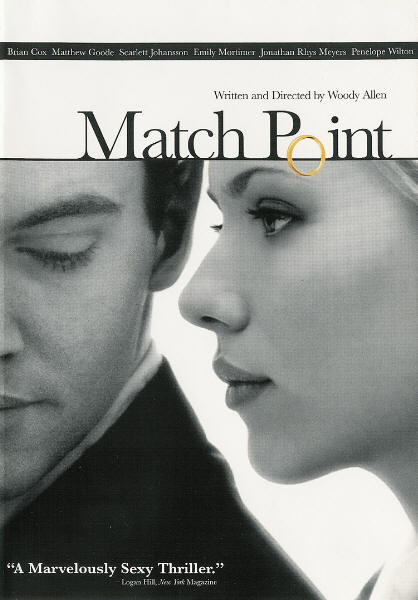
Match Point

For years, director Woody Allen was associated with New York City, filming countless movies there and basically making the city another character in his stories. After being one of the city's most recognizable celebrities and biggest promoters, Allen has started filming in Europe over the last eight or nine years, specifically London and more recently Paris.  The cities always are key to his story, not just being a jumping off point that could be any international city.

Sitting in my Netflix Queue for almost the last year was Allen's 2005 film Match Point, a cold, dark film where London is as cold and barren as the characters and story. The Netflix description was pretty accurate, a thriller with Hitchcockian tones (is that a word? Eh, it sounds cool).  I'd like to think that's a compliment, but the more I think about it, I'm just not sure.  Allen has a personal directing style that's all his own, but with Match Point and 2007's Cassandra's Dream, he does seem to be going down the smart, sophisticated thriller that Hitchcock is so often associated with. Good or bad, compliment or criticism, the movie is a good one.

A successful mid-level professional tennis player, Irish-born Chris Wilton (Jonathan Rhys-Meyers) is moving on with his life. Working as a tennis pro at a high-end club, Chris meets Tom Hewett (Matthew Goode), a young businessman raised in a very well-to-do upper class family. Chris and Tom hit it off quickly, Chris becoming very popular with the Hewetts (parents Brian Cox and Penelope Wilton), especially their single daughter, Chloe (Emily Mortimer). Chris sees a chance at a life he never had growing up and embraces it, including starting to date Chloe, a relationship that quickly becomes serious. Everything seems to be going perfectly for Chris until he meets Nola (Scarlett Johannson), Tom's American fiance, with whom he has an instant sexual/physical attraction. Chris is going down a bad road -- and he knows it -- but can he stop himself?

There is a lot to like about this movie so I was surprised to read a fair share of hate for 'Match' at any number of message boards.  The script -- from Allen himself -- is well-written even if it does depend on coincidences and chance encounters a bit much for my liking. At just over two hours, the movie has a leisurely pace for a thriller. Scenes are in no rush to speed up to the message, enjoying the process of just getting there.  Long scenes of uncut dialogue, just two people communicating, pepper the story, giving the movie a throwback feel from the 1960s.  Allen just sets his camera up and lets his actors act.  He doesn't call attention to himself much, filming from a distance. It is a cold story (in terms of visuals but also what's going on with the characters), one that I can understand some viewers having trouble getting into.

Where I had a problem is that not one character is particularly redeeming or even remotely likable.  I don't need anyone to be a saint of angelic proportions, but someone to root for is always nice.  Some are obviously worse than others, but they all have these annoying character traits -- some on a larger scale than others -- that hamstring them. Rhys-Meyers as Chris is obviously the worst, a conniving, rat-like manipulator who betrays all those around him while cheating on his wife and possibly much, much worse. Johannson's Nola goes from the sexual, beautiful gorgeous ideal to a clingy, overly-emotional wreck. Even Mortimer -- who ends up being the most sympathetic of all these wrecks -- has this passive aggressive way of communicating, condescendingly pointing out that she's rich and you're not.  A mess of characters, all of them very interesting to watch take each other down.

The acting then can be hard to judge.  I disliked and/or hated most of the characters, wanting them to get what they deserved in the end.  I guess that's a good sign then of the actors/actresses bringing their characters to life, especially Rhys-Meyers.  There is something about him physically that makes me not like him, not as a character but as a person (and I feel bad judging him like that). Chris is a weasel, a smooth, suave sophisticated just all around bastard able to convince everyone around him he's quality people. The cast on the whole works well together, all of them with their own egotistical reasons for doing what they do.  Johannson's performance is a little too far over the top at times, but it's a quality performance. Mortimer, Goode, Cox, and Wilton are relegated to the background at times, but all carry themselves well, especially Mortimer as the ultimately pretty sweet Chloe and Goode as Tom, the charming, roguish brother-in-law.

Allen's story builds and builds, that sense of dread building as the situation gets murkier and murkier.  The story goes about the route you would expect as Chris backs himself into a corner and then has to claw his way out, lying left and right to cover his ass.  The opening scene gives you an indication of exactly where the story is going, but that being said, I hated the ending.  It needed more resolution than what's provided.  My reasoning most likely comes from my dislike of the Chris character, but a relatively open-ended finale was disappointing.  It doesn't ruin the movie, but it does take it down a notch. A different, more emotional ending would have done wonders for the movie on the whole.

Match Point <---trailer (2005): ***/****   

Friday, February 4, 2011

Casino Royale (1966)

After a four-year gap since Pierce Brosnan's final James Bond movie, MI6 agent 007 returned in a big way in 2006 with Daniel Craig taking over the part of the secret agent.  It was a huge success and served as an excellent reboot for the franchise, quickly climbing into my top 5 all-time Bond flicks.  Why did it work? Like most of the best movies from the franchise, it stuck close to the Ian Fleming source novel that had not been made previously...in a serious fashion at least.  That's where 1966's awful Casino Royale jumps in.

By 1966, star Sean Connery had already completed four 007 movies and had turned James Bond into one of the world's biggest stars.  It was so popular that spoofs started popping up like James Coburn as Derek Flint and Dean Martin as Matt Helm among others.  I get it, strike when the iron is hot, but in a saturated market of spy and espionage movies -- serious and spoof -- don't you want to at least turn out a quality product?  With six different directors shooting different portions of the movie, this was like How the West Was Won: 007 Style.  Besides an occasional laugh here and there, the only redeeming quality is an out-of-this world (if wasted) cast, but more on that later.

All over the world, American, British, Russian, and French agents are turning up dead and their agencies don't have the slightest clue or evidence as to who's pulling off the jobs.  The agency heads turn to retired MI6 agent, Sir James Bond (David Niven), to root out the problem. Bond is a legend in the espionage business, but his best days are behind him, and he questions what has happened to the field he worked so well in, carving out a name and reputation for himself.  He concocts a crazy plan to smoke out whoever is behind the murders; using his name, agents all over the world (Peter Sellers, Ursula Andress, Daliah Lavi, Joanna Pettet, Woody Allen, Terence Cooper) will see if working as bait draws the mastermind out of his lair. The plan might be too good though because SMERSH and mastermind Le Chiffre (Orson Welles) send agents to kill the original and still best James Bond around.

Now anyone familiar with Casino Royale -- Fleming's novel or the Craig movie -- knows that the plot described there is nothing like the book or the movie.  Bond's effort to detain Le Chiffre at the baccarat table is handled in a scene that takes about 10 minutes, not an entire movie.  Using other spy spoofs as an example, there is clearly potential here.  A character as ripe for the picking as James Bond is hard to mess up in the humor department, but this movie is a mess.  For all the subtle, perfectly delivered lines that pepper the script, there's huge scenes of excess of physical and slapstick humor that even Mel Brooks must have shaken his head at.  The finale is the worst of all with one of the 14 directors obviously not knowing where to cut things off.

Let's start with the crazy amount of talent involved here behind the camera, including John Huston (also playing M in one scene) and Robert Parrish among four other less notable names.  The writing too includes Sellers, Billy Wilder, and Joseph Heller.  How did this much talent put together such an awful movie? On top of the cast listed above, there's also parts for Deborah Kerr, William Holden, Jean-Paul Belmondo, Peter O'Toole (on-screen for about 6 seconds), Charles Boyer, George Raft, Jacqueline Bisset, and Barbara Bouchet. What's worse is that the cast appears to be having a blast making the picture.  It's just that much worse that what they're working with is beneath all of their talent.  Bit parts and extended cameos for almost all of these names limit actual on-screen time, but just in terms of name power, this movie is impressive.

The only star that I thought was legitimately good was David Niven as retired 007, Sir James Bond, enjoying his retirement in an isolated English country villa only to be thrust back into the world of espionage.  Because it is an older Bond, Niven has some fun with the part, poking fun at Connery's portrayal especially.  He gets some good laughs from his constant curiosity of how all secret agents have become sex fiends, leaving lonely, beautiful women in every city all over the Earth.  He shakes his head at all the changes he sees in the life of a spy only to embrace them once he's back into it.  A professional plain and simple, Niven makes the most of the material, rising above it to deliver a worthwhile performance.

So this movie was bad, downright awful at times, okay? I am scraping the bottom of the barrel here looking for something to write about.  Most of the movie was just so stupid and dumb I can't even complain.  It's so bad it is surreal at times.  So what can I recommend? If nothing else with this overabundance of characters, the script calls for a long list of beautiful actresses who are required to wear slinky outfits and do little else.  Kerr, Lavi, Pettet, Andress, and Bouchet are all half-naked for about 90% of the movie, and that's all I've got.  So stupidly bad, this movie has to be seen to be believed.

Casino Royale <---trailer (1966): */****

Tuesday, October 27, 2009

Cassandra's Dream

In an episode of Seinfield, Jerry proudly announces that he's never seen an episode of I Love Lucy. While I can't compare to that -- I've seen quite a few episodes -- I can counter with something of my own. Until this weekend, I'd never seen any of the 30-plus movies that director Woody Allen has made. From what I knew about him and his personal life (kinda creepy) and the types of movies he's made, I just never sought one out. It wasn't intentional, just happened.

Netflix recommended a Woody Allen movie for me and with an interesting premise and two actors I like in leading roles I thought I'd give Cassandra's Dream a chance. From what little I know about Allen, his directing tone has changed over the years from comedies to dramas including Match Point in 2005. So with no background in the director's filmography, I didn't have high expectations going in but ended up loving the movie.

Two English brothers, Ian (Ewan McGregor) and Terry (Colin Farrell), find themselves in deep trouble in the money department for vastly different reasons. Ian is sick of working in his father's restaurant and wants to move on to bigger and better things including a hotel venture in Los Angeles. On top of that, Ian has fallen in love with a young model, Angela (Hayley Atwell), and wants to start a new life with her. Terry is an alcoholic, pill-popping gambler who finds himself $90,000 in debt when a poker game gets out of hand. Trying to make payments on a house for his wife Kate (Sally Hawkins), Terry doesn't know where to turn. The brothers have a streak of luck though as their uncle Howard (Tom Wilkinson) is visiting from China.

Uncle Howard is loaded with plastic surgery clinics dotting the globe. But he's in a desperate situation too as a former employee, Martin Burns (Philip Davis) is scheduled to testify in a case against him with a possible lifetime jail sentence on the line. With nowhere to turn, Howard offers to give Ian and Terry whatever money they need...if they kill Martin. In terms of storytelling, this is similar to Sidney Lumet's 'Before the Devil Knows You're Dead,' another crime amongst family story. It's ripe with tension as your average John Smith is forced into actions that before would have seemed improbable.

SPOILERS What works so well is the suspense and tension that Allen builds. It's almost a full hour before Howard's proposition is brought up so by then as a viewer we've gotten to see Ian and Terry and their backgrounds. Both with their own flaws, there is empathy for them and their predicaments. Ian's ambitions are boundless but he needs some $ backing, and Terry just wants to make his wife happy but his vices get the best of him. What is unique is that the murder (yes, they do murder him) is almost an afterthought. It's the build-up and the resulting guilt and inner turmoil that step to the forefront.

With a story like this, it's hard not to compare it to a movie like Dial M For Murder, and in a positive way 'Cassandra' feels like a Hitchcock movie. The brothers break into Martin's house, ready to kill him when he returns from dinner. Then, the phone rings. What do you do? By the way, the ring startled me like something out of a horror movie. Later, Martin arrives home but with a woman. Do they kill both? Just another wrench into their otherwise seamless plan. In the aftermath of the murder and getting the money, Ian is able to put their dastly deed behind them while Terry is torn up with guilt. It all builds to an ending that does work although it feels rushed a bit like Allen just wanted to wrap things up.

Considering McGregor is Scottish and Farrell is Irish, the relationship between the two English brothers is the lynch pin of the movie. A fair share of critics didn't find the dynamic between the two actors believable, but it worked for me perfectly. Ian's smooth and calm, thinking everything out, while Terry is more emotional, more spur of the moment. McGregor and Farrell physically look nothing alike, but does it matter when their interactions are so believable? Wilkinson is only in the movie for two or three scenes but makes the quick appearance instantly memorable, especially the scene where he presents the brothers with his plan. John Benfield and Clare Higgins play the brothers' long-suffering parents who want the best for their children.

Getting average reviews from critics and so-so to downright bad from fans, I'm thinking I liked the movie because I haven't seen any other Woody Allen movies. The dialogue is quick and snappy, the cinematography is beautiful for filming in dreary old England, and the cast is solid from top to bottom, especially McGregor and Farrell. Maybe it isn't up to par with other Allen classics, but I've got nothing to compare this to, and I loved it. So take that Woody Allen devotees.

Cassandra's Dream <---trailer (2007): *** 1/2 /****