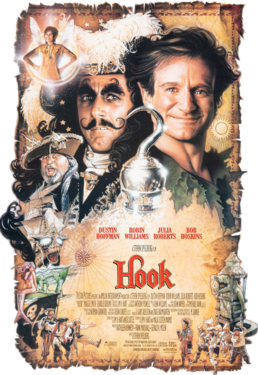
Let's face it. Who among us actually wanted to grow up? It's just more fun being a kid. Less responsibilities, no obligations, and basically? Do what you want. That's part of the long-lasting charm of the Peter Pan character, a mischievous boy who never grows up, causing mischief and enjoying himself wherever he goes. What if Peter did grow up though, forgetting about what he used to be? So goes 1991's Hook.
A ruthless businessman who can scoop up struggling businesses effortlessly, Peter Banning (Robin Williams) takes his wife and kids, Jack (Charlie Korsmo) and Maggie (Amber Scott), to visit his grandmother, Wendy (Maggie Smith), in London. Obsessed with a merger, Peter has lost touch with his family, and one night, they're mysteriously taken from Wendy's home, an ominous note from a JAS Hook left on their bedroom door. It defies a 'Peter Pan' to come back to Neverland and rescue his children. Peter has no idea what to make of it until Maggie reveals a secret; Peter is in fact Peter Pan all grown up, his "childhood" lost since forgotten when he chose to grow up. How can he get his kids back? By embracing who he used to be, visiting Neverland and tangling with the nasty Captain Hook (Dustin Hoffman).
As a literary character, Peter Pan first appeared in author J.M. Barrie's 1902 book The Little White Bird. Peter would appear in several other Barrie books and since then has become an instantly recognizable literary character from books and plays to stage plays and feature films, even the iconic Disney classic from 1953. It is a character most kids are aware of at least a little, and there is a charm to the boy who refuses to grow up. A story delving into a 'what if?' about said character is an interesting, unique idea. Peter decided to grow up when he fell in love with his future wife, Moira (Caroline Goodall). And what if a full-grown Peter doesn't remember his past life as the infamous Peter Pan? Well, away we go.
I watched the movie and enjoyed it only to get a rather large surprise as the credits rolled. Directed by.....Steven Spielberg?!? I couldn't and didn't believe it. Not one of Spielberg's best films, Hook is nonetheless a good film. What struck me most was the distinct look of the film, giving an appearance of almost being based on a stage. The sets are all clearly indoors -- especially the outdoor ones on Neverland and on Hook's ship -- but they're busy, cluttered and claustrophobic. There's always lots of action and movement around, filling the screen to the point it looks like it may burst. John Williams' score is okay if not particularly memorable, never rising above the action on-screen.
What I liked most though was the casting, almost from top to bottom. Who better than to play wild man-child Peter Pan than ultra-goofy Robin Williams? He brings the character to life; a business suit executive who can't be bothered with anything fun. Then, he starts to remember what he used to be and watch out! Let the fireworks ensue. Hoffman is a scene-stealer as Capt. Hook, the infamous pirate leader with a hook for a hand after a crocodile bit his hand off. Julia Roberts plays Tinkerbell, the tiniest of fairies who guides Peter on his rediscovery of who he is. Bob Hoskins too is very good as Smee, Hook's right hand man. Of Peter's Lost Boys, the ones that stand out the most are Dante Brasco as Rufio, the new leader of the Boys, and Raushan Hammond as Thud Butt, the rather....round, jovial Lost Boy. Even look for singer Phil Collins in a small part and Gwyneth Paltrow as a young Wendy in a flashback.
Far from perfect, the movie does have its flaws. At 144 minutes, it's far too long. Here's my issue. The movie never really slows down from its London intro to the majority of the time being spent on Neverland. It isn't really the pacing's fault, but the movie feels incredibly long at times. Some scenes go on for too long without knowing where to cut it off. As well, the use of some computer generated images looks dated now some 20-plus years later. Hard to criticize it too much, but it's certainly noticeable. Still, it's an entertaining story with an iconic character, an interesting visual look, and a deep cast.
Hook <---trailer (1991): ** 1/2 /****
The Sons of Katie Elder
"First, we reunite, then find Ma and Pa's killer...then read some reviews."
Showing posts with label Bob Hoskins. Show all posts
Tuesday, August 21, 2012
Saturday, July 21, 2012
Michael
There are some things you just don't make fun of, and for many people, that's religion or anything even remotely similar. Me on the other hand, I eat that stuff up. I'm not talking about mocking Jesus or the saints, or ripping something that people hold dear to them. What about just having a little fun with preconceived notions, things you to a point take for granted? That's part of the fun of 1996's Michael.
Working for the National Mirror -- a sensationalist tabloid magazine -- in Chicago, reporter Frank Quinlan (William Hurt) has fallen on some tough times after losing his job with the Chicago Tribune. Now, he finds himself tracking down one ridiculous angle after another, including his latest, a true whopper. A woman in Iowa (Jean Stapleton) claims to be housing an angel named Michael (John Travolta), wings and all. With some company from another down luckless writer, Huey (Robert Pastorelli), and a supposed company stooge, Dorothy (Andie MacDowell), Quinlan heads to Iowa to see if the woman's claim could actually be true. It couldn't, could it?
So what do you think an angel would look like should you stumble across one? I go two ways here. One, a blonde child with pale skin so a cherub basically. Two, a full-grown man in his 20s or so, an impressive physical specimen who is strong and capable, able to fight for and represent some sort of god. And how about this 1996 movie's portrayal from director Nora Ephron? This angel is a middle-aged, overweight man with long, messy hair and stubble on his face at all times. The script certainly has some fun with that premise, playing on those notions you had coming in of what an angel is. The same goes for what an angel would/should act like. Travolta certainly doesn't go for typical here, and that ends up being the best thing about the movie.
Following his return to mainstream Hollywood with his part in Pulp Fiction, Travolta went through a stretch of some really good movies and some truly bad ones. While 'Michael' on the whole isn't a great movie, it is worth recommending because of Travolta's scene-stealing part in the lead as the archangel Michael. It is a fun character, and one Travolta clearly has some fun developing and playing against type. Michael has an overpowering charm on women wherever he goes, some magnetic power that goes unexplained. Travolta gets to ham it up a bit, improvise a dance scene in a packed country bar (watch it HERE), and ends up being the heart of the movie. A surprising revelation comes out late about his character's revelations, providing a good twist that provides a very moving ending as well. From start to finish, it's Travolta's movie.
And then there's the rest of the cast in Hurt, MacDowell and Pastorelli. All three are talented actors/actresses, but their characters here held little interest for me other than as foils to Michael's antics. Travolta's part is obviously the showy one, and in comparison the other parts pale. Hurt and MacDowell falling for each other? Aw, that's sweet, but boring. Pastorelli caring for a little dog? Yeah, necessary for the story, but getting there isn't too interesting. Oh, and MacDowell is an aspiring country singer? Can't wait for that story to develop. Bob Hoskins has a small part as the screaming managing editor of the Mirror, yelling at his employees to break more stories, with Joey Lauren Adams and Carla Gugino having small supporting parts. As Michael's first encounter, Stapleton is a bright spot too, making the most of a quick appearance.
Movies about religion, God, angels and faith can be tricky. They can be overbearing and obnoxious in a lot of different directions or they can be too afraid to actually say anything meaningful. 'Michael' isn't trying to deliver any profound message. A story of an angel making a visit to Earth and experiencing all the little things we might take for granted on a daily basis provides some heartfelt, moving and funny moments. It is at its best when its focusing on Travolta's Michael, and for his performance alone, this is a movie worth checking out.
Michael <---Youtube clip/Michael's appearance (1996): ** 1/2 /****
Working for the National Mirror -- a sensationalist tabloid magazine -- in Chicago, reporter Frank Quinlan (William Hurt) has fallen on some tough times after losing his job with the Chicago Tribune. Now, he finds himself tracking down one ridiculous angle after another, including his latest, a true whopper. A woman in Iowa (Jean Stapleton) claims to be housing an angel named Michael (John Travolta), wings and all. With some company from another down luckless writer, Huey (Robert Pastorelli), and a supposed company stooge, Dorothy (Andie MacDowell), Quinlan heads to Iowa to see if the woman's claim could actually be true. It couldn't, could it?
So what do you think an angel would look like should you stumble across one? I go two ways here. One, a blonde child with pale skin so a cherub basically. Two, a full-grown man in his 20s or so, an impressive physical specimen who is strong and capable, able to fight for and represent some sort of god. And how about this 1996 movie's portrayal from director Nora Ephron? This angel is a middle-aged, overweight man with long, messy hair and stubble on his face at all times. The script certainly has some fun with that premise, playing on those notions you had coming in of what an angel is. The same goes for what an angel would/should act like. Travolta certainly doesn't go for typical here, and that ends up being the best thing about the movie.
Following his return to mainstream Hollywood with his part in Pulp Fiction, Travolta went through a stretch of some really good movies and some truly bad ones. While 'Michael' on the whole isn't a great movie, it is worth recommending because of Travolta's scene-stealing part in the lead as the archangel Michael. It is a fun character, and one Travolta clearly has some fun developing and playing against type. Michael has an overpowering charm on women wherever he goes, some magnetic power that goes unexplained. Travolta gets to ham it up a bit, improvise a dance scene in a packed country bar (watch it HERE), and ends up being the heart of the movie. A surprising revelation comes out late about his character's revelations, providing a good twist that provides a very moving ending as well. From start to finish, it's Travolta's movie.
And then there's the rest of the cast in Hurt, MacDowell and Pastorelli. All three are talented actors/actresses, but their characters here held little interest for me other than as foils to Michael's antics. Travolta's part is obviously the showy one, and in comparison the other parts pale. Hurt and MacDowell falling for each other? Aw, that's sweet, but boring. Pastorelli caring for a little dog? Yeah, necessary for the story, but getting there isn't too interesting. Oh, and MacDowell is an aspiring country singer? Can't wait for that story to develop. Bob Hoskins has a small part as the screaming managing editor of the Mirror, yelling at his employees to break more stories, with Joey Lauren Adams and Carla Gugino having small supporting parts. As Michael's first encounter, Stapleton is a bright spot too, making the most of a quick appearance.
Movies about religion, God, angels and faith can be tricky. They can be overbearing and obnoxious in a lot of different directions or they can be too afraid to actually say anything meaningful. 'Michael' isn't trying to deliver any profound message. A story of an angel making a visit to Earth and experiencing all the little things we might take for granted on a daily basis provides some heartfelt, moving and funny moments. It is at its best when its focusing on Travolta's Michael, and for his performance alone, this is a movie worth checking out.
Michael <---Youtube clip/Michael's appearance (1996): ** 1/2 /****
Monday, December 20, 2010
The Long Good Friday
I've got to give the Brits credit when it comes to crime thrillers. Plain and simple, they don't pull any punches in delivering gritty, realistic and often very stylish movies that translate well to audiences (often turning the movies into cult classics after their releases). And no, these aren't the ultra-stylish movies of the last 10 or 15 years that come to mind like Guy Ritchie-directed crime capers or even one of my new favorite movies, Layer Cake. These are movies in the dark, dank streets of England no matter how high up the food chain these characters are. They work in the back alleys in a world filled with violence and betrayal. Now let's allow Mr. Hoskins to get to work.
Having spent 10 years assembling a crime empire in London, Harold Shand (Hoskins) has finally put it all together, a plan that will put him at the top of the criminal underworld not only in England but possibly Europe too. But right as he is about to close a huge deal with the American Mafia, things go haywire. An attempted hit on his mother goes wrong, an old friend and right-hand man is stabbed to death, and another bomb in his casino somehow doesn't go off before being found. Is someone gunning for Harold? Does someone resent the power he's acquired? Could this be the start of a gang war after years of peace? Or in a worse case scenario, is one of his own turning on him? With a deadline working against him, Harold goes on the warpath to figure out who or what is gunning for him.
Style-wise, this John Mackenzie-directed crime thriller reminded me in a lot of ways of the original Get Carter starring Michael Caine. It is dark, gritty and cynical with some expert touches of black humor thrown in for good measure. We see the London underworld for what it is, seedy, violent and full of betrayal, not some romantic, idealized view of how cool and suave you might often think of. Released in the U.S. in 1980, 'Friday' hit theaters in England in 1979 so on top of that low-down, gritty style, we also get a picture of that over the top, awful 1970s sense of style from the wardrobe to the sets. It all adds up for the better though, like a time capsule dropping you in on the groovy 1970s.
While Hoskins had been visible on TV and in movies for almost nine years before this movie, his Harold Shand was his breakout role, the one that put him in the public eye. It's a remarkable performance, full of rage and intensity coupled with genuine confusion and frustration at not knowing what's going on. On appearances alone, Hoskins doesn't look like a star. He's short, stocky and balding, but this is a man just boiling over with intensity that could explode at any moment. One second, he's calm and controlled, and the next he's lashing out. His Harold is incredibly intelligent and brave (with some hypocrisy too) but also stubborn and full of pride. It's a bad combination for a man in power trying to hold his teetering empire together. The whole performance is memorable, but Hoskins saves his best for last including the haunting final shot of the movie that you won't soon forget, all of it aided by Francis Monkman's quirky yet appropriate score. Listen HERE for the main theme.
What worked so well for me with this mystery within the crime thriller is that the twist is so simple in its execution and reveal. I won't spoil it here, but the reason behind it all is out of Harold's control. That's what makes it work so well. As to who is behind it, the supporting cast keeps you guessing. Helen Mirren plays Victoria, Harold's girlfriend and assistant, Derek Thompson and P.H. Moriarty are Jeff and Razors, two of Harold's enforcers, Bryan Marshall is Harris, a lawyer with mob connections, Eddie Constantine and Stephen Davies are Charlie and Tony, Harold's American "business connections," and Dave King is Parky, Harold's source on the police force. Also look out for a 26-year old Pierce Brosnan in his film debut as a hired gun.
There's nothing particularly new or different about this British crime thriller overall. From top to bottom though, it is well-made and professional, ranging from the cool sets and filming locations to a winding story that always keeps you guessing to a cast that uniformly delivers great performances, especially Hoskins in his star-making role. If you're curious about the movie and can't find a copy, check it out on Youtube starting with Part 1 of 11.
The Long Good Friday <---trailer (1980): ***/****
Labels:
1980s,
Bob Hoskins,
British crime,
Gangsters,
Helen Mirren,
Pierce Brosnan
Tuesday, August 24, 2010
Zulu Dawn
Military victories when handled the right way -- good cast, big enough budget, halfway decent script -- can translate well to a feature length movie. Think of D-Day, Gettysburg, Battle of Britain for examples of a battle filmed on an epic scale with the final result the better for it. So flip the coin then and look at the opposite, military disasters. It can be fascinating to see a skirmish, battle, or even a war turn for the worse and what made it do that. Telling the story of one of the worst military disasters in history, 1979's Zulu Dawn does everything it should in giving an honest look at that disaster.
In theaters 15 years before 'Dawn,' 1964's Zulu told the true story of the battle of Rorke's Drift, a last stand situation where about 100 British soldiers in 1879 held off the attacks of thousands of Zulu warriors for over a day. Before that battle, an army of thousands of Zulu warriors had almost completely destroyed a whole British battalion a few miles away. So while there is no link other than the same setting and story, Zulu Dawn is an unofficial prequel to a movie made 15 years earlier. 1964's Zulu mentioned the previous battle in a prologue, but director Douglas Hickox delves right in to tell the story of one of history's biggest military disasters.
In the South African province of Natal in 1879, British general Lord Chelmsford (Peter O'Toole) awaits orders on what to do with the possibility of a war breaking out between the British and the Zulu nation. A representative of the British government (John Mills) has sent an ultimatum to the Zulus, disassemble your army of warriors and dissolve the nation as a whole and there will be no issue. The offer is of course refused so Chelmsford leads a small army of around 2,000 men (including 2nd in command Burt Lancaster, a real scene-stealer here) into the Zulu territory against an army estimated at 30,000 men. But the proud, even arrogant British march into Zululand assuring themselves of an easy victory, not knowing what awaits them.
If you haven't figured by now, that easy victory never comes to fruition after Chelmsford foolishly splits up his forces and basically invites piecemeal destruction as overwhelming numbers just destroy his men. It seems through history the British have had their fair share of military disasters and never really learn from those defeats. Marching into Zulu territory, one officer (Christopher Cazenove) remarks how noble their effort is, how heroic their actions like the campaign will be a walk in the park. Like any story where the end result is never in doubt, Hickox creates palpable tension, a sense of doom of what is to come.
Of course with a historical movie like that, you want to see the disaster, you want to see the Titanic sink so getting there can be a little tedious at times. Where 'Dawn' is at its absolute best is in the depiction of the battle of Isandlwana where thousands of Zulu warriors take heavy casualties as they wipe out almost all the British defenders at their camp in a ragtag defense. As near as I can figure, the battle scene was filmed on the actual location of the massacre, giving the whole sequence an eerie feeling. On a huge scale, the battle is amazing to watch, but never overwhelming. You're always aware of what's going on, where the lines are, if the British are holding or falling back. Elmer Bernstein's score aids the cause, helping the battle both on an epic scale but also the smaller scale of the man-to-man fighting element of what a last stand must be like. The movie's good, but the Isandlwana sequence at almost 40 minutes long is great.
With a large cast with a long list of characters, some get lost in the shuffle more than others. O'Toole is the stereotypical arrogant, gentlemanly British officer while Lancaster is more an officer of the men, looking out for their best interest whenever possible. Lancaster's Colonel Durnford is definitely the star of the movie, even in an underused part. Simon Ward impresses as Lt. Verecker, a cavalry officer who lived in South Africa before volunteering with the Brits. Also joining the British army is Denholm Elliott as a commanding officer, Cazenove and James Faulkner as lower ranking officers who make a gallant charge in the closing moments in the massacre, Bob Hoskins as a veteran sergeant desperately trying to keep his men in order and alive, Nigel Davenport as O'Toole's aide, and many more, some making better and longer impressions than others, but those are the best of the bunch.
Filming on location in South Africa, you truly get a sense of the wide open expanses of the African frontier. This definitely aids the battle scenes with an enormous scale of armies and strategy as the battle develops from a firefight into a bloody, fleeing massacre. There are some great visual moments but also emotional, surprising moments, like Verecker's patrol riding over the crest of a hill and stumbling upon an immense army of Zulu warriors facing them. In the massacre, all the soldiers we've met go out in their own blaze of glory. This is available to watch through Youtube, start with Part 1 of 12. Overall, not as good as Zulu but a worthy prequel, and it would certainly make an entertaining double-bill.
Zulu Dawn <---Video Detective trailer (1979): ***/****
In theaters 15 years before 'Dawn,' 1964's Zulu told the true story of the battle of Rorke's Drift, a last stand situation where about 100 British soldiers in 1879 held off the attacks of thousands of Zulu warriors for over a day. Before that battle, an army of thousands of Zulu warriors had almost completely destroyed a whole British battalion a few miles away. So while there is no link other than the same setting and story, Zulu Dawn is an unofficial prequel to a movie made 15 years earlier. 1964's Zulu mentioned the previous battle in a prologue, but director Douglas Hickox delves right in to tell the story of one of history's biggest military disasters.
In the South African province of Natal in 1879, British general Lord Chelmsford (Peter O'Toole) awaits orders on what to do with the possibility of a war breaking out between the British and the Zulu nation. A representative of the British government (John Mills) has sent an ultimatum to the Zulus, disassemble your army of warriors and dissolve the nation as a whole and there will be no issue. The offer is of course refused so Chelmsford leads a small army of around 2,000 men (including 2nd in command Burt Lancaster, a real scene-stealer here) into the Zulu territory against an army estimated at 30,000 men. But the proud, even arrogant British march into Zululand assuring themselves of an easy victory, not knowing what awaits them.
If you haven't figured by now, that easy victory never comes to fruition after Chelmsford foolishly splits up his forces and basically invites piecemeal destruction as overwhelming numbers just destroy his men. It seems through history the British have had their fair share of military disasters and never really learn from those defeats. Marching into Zulu territory, one officer (Christopher Cazenove) remarks how noble their effort is, how heroic their actions like the campaign will be a walk in the park. Like any story where the end result is never in doubt, Hickox creates palpable tension, a sense of doom of what is to come.
Of course with a historical movie like that, you want to see the disaster, you want to see the Titanic sink so getting there can be a little tedious at times. Where 'Dawn' is at its absolute best is in the depiction of the battle of Isandlwana where thousands of Zulu warriors take heavy casualties as they wipe out almost all the British defenders at their camp in a ragtag defense. As near as I can figure, the battle scene was filmed on the actual location of the massacre, giving the whole sequence an eerie feeling. On a huge scale, the battle is amazing to watch, but never overwhelming. You're always aware of what's going on, where the lines are, if the British are holding or falling back. Elmer Bernstein's score aids the cause, helping the battle both on an epic scale but also the smaller scale of the man-to-man fighting element of what a last stand must be like. The movie's good, but the Isandlwana sequence at almost 40 minutes long is great.
With a large cast with a long list of characters, some get lost in the shuffle more than others. O'Toole is the stereotypical arrogant, gentlemanly British officer while Lancaster is more an officer of the men, looking out for their best interest whenever possible. Lancaster's Colonel Durnford is definitely the star of the movie, even in an underused part. Simon Ward impresses as Lt. Verecker, a cavalry officer who lived in South Africa before volunteering with the Brits. Also joining the British army is Denholm Elliott as a commanding officer, Cazenove and James Faulkner as lower ranking officers who make a gallant charge in the closing moments in the massacre, Bob Hoskins as a veteran sergeant desperately trying to keep his men in order and alive, Nigel Davenport as O'Toole's aide, and many more, some making better and longer impressions than others, but those are the best of the bunch.
Filming on location in South Africa, you truly get a sense of the wide open expanses of the African frontier. This definitely aids the battle scenes with an enormous scale of armies and strategy as the battle develops from a firefight into a bloody, fleeing massacre. There are some great visual moments but also emotional, surprising moments, like Verecker's patrol riding over the crest of a hill and stumbling upon an immense army of Zulu warriors facing them. In the massacre, all the soldiers we've met go out in their own blaze of glory. This is available to watch through Youtube, start with Part 1 of 12. Overall, not as good as Zulu but a worthy prequel, and it would certainly make an entertaining double-bill.
Zulu Dawn <---Video Detective trailer (1979): ***/****
Subscribe to:
Posts (Atom)