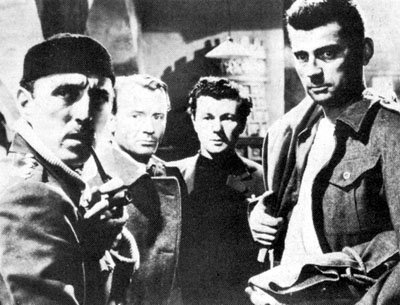
I've written about it before, and it will most likely come up again at some point. You're watching a movie, everything's going smoothly. You're liking it a lot, maybe even loving it, and then something happens. It's as quick as flipping a switch, and all that positive momentum goes right out the window. Some movies can save themselves in the end. What about 1968's Deadfall? Read on and see.
Resting and recuperating a rest clinic for alcoholism (or is he?), Henry Clarke (Michael Caine) is approached one day by a young visitor, the beautiful Fe Moreau (Giovanna Ralli), with a proposal. Her husband, Richard (Eric Portman), a significantly older man than his young wife, knows Henry's secret, that he's a master thief and he's got a job in mind for the unlikely trio. Clarke does his detective work and agrees to go along with the plan. First, though Richard wants to test Clarke's ability, but that is the least of the master thief's worries. As he gets to know the couple, Henry falls hard for the beautiful Fe, and the feeling is mutual. As the job nears, he also finds out that Richard hasn't been telling him everything he needs to know.
This film from director and screenplay writer Bryan Forbes is an interesting one. It has received pretty lukewarm reviews, and some are significantly more harsh. An actor for years, Forbes made the jump to the director's chair without a glitch. In Deadfall, he creates quite the interesting movie to watch for good and bad. Visually, it is a stunner, shot on location in Spain. Forbes rarely uses a straight-on camera angle, instead opting for off-kilter, slightly ajar shots. Many reviews point to the director trying to adapt a European New Wave look with his unconventional shooting style, and I tend to agree. You can watch it and appreciate for any number of things from the unique angles and style to the stunning Spanish locations serving as a backdrop to the story.
Ah, the story, and here we are with the problems that ultimately bring the movie down a notch (or more depending on your opinion). For a 1968 audience, it does deal with some fairly controversial topics. We learn about Richard's past in World War II and also how he came to marry the beautiful Fe. It takes Caine's Clarke only a meeting or two to figure out that the older husband is in fact, gay. So what's he up to? What is his background in World War II? That's the problem with the story. It has a lot of ideas but no real focus. It kinda sorta knows where it wants to get, but not really how to get there. Instead, Forbes' screenplay (based off a novel by Desmond Cory) bounces back and forth among a whole lot of different things from adultery, incest, Nazism, betrayals and much more. A story that doesn't spell every single little thing out isn't a deal breaker -- in some cases it can be a huge positive -- but 'Deadfall' is too vague for its own good.
The most unfortunate thing is that for the first half of this 120-minute movie, I did love this movie. That Euro New Wave style works perfectly in a tension-packed heist movie that is mysterious, intense and keeps you guessing. Richard insists Henry prove himself in one heist, robbing a high-walled villa in Tangiers under heavy guard. It is a remarkable sequence, artsy and stylish like the best heist sequences can be when handled right. The extended sequence -- running about 15 minutes -- is done with virtually no dialogue, just composer John Barry's score playing over the developing heist. The best addition? The owner of the villa is at a concert -- listen HERE -- so the music we're hearing at the concert (Barry making a cameo, Renata Tarrago playing a Spanish guitar) is edited into the heist. It develops like a stage play, a tour de force sequence that I loved.
What's the problem? The heist is completed by the hour-mark. The second hour? Not so enjoyable. It devolves into a love triangle as Clarke fights for Fe, Fe wrestles with what to do, and Richard decides how to handle his new rival. Throw in Richard's young lover, Tony (Carlos Pierre), and we've got ourselves quite the mess. A tension-packed heist flick turned into a love triangle where our three participants philosophically analyze what love is? Gag me. It gets to be too pretentious for its own good at times. The ending especially comes out of nowhere and seems forced.
It's unfortunate -- yes, I'm using that again -- because Caine, Portman and Ralli all do pretty good jobs bringing the characters to life. Maybe I'm just that much in love with the first hour that I'm equally frustrated with the second half. It's a mixed bag, but what I loved, I really loved -- especially the heist sequence -- and what I didn't like came up short in a lot of ways. Also look for Nanette Newman as the Girl, a pretty young woman who keeps popping up, Leonard Rossiter as Fillmore, a source of info for Clarke, and David Buck as Salinas, a possible target for Clarke.
Deadfall (1968): ***/****
The Sons of Katie Elder
"First, we reunite, then find Ma and Pa's killer...then read some reviews."
Showing posts with label Bryan Forbes. Show all posts
Tuesday, April 23, 2013
Thursday, May 10, 2012
The Key
As a movie lover, Turner Classic Movies has been invaluable to me over the years. I've been introduced to movie stars, unknown classics, American, English, French, Japanese and many more types of movies. But every so often, their website cracks me up. Take 1958's The Key for example. The plot description aptly and appropriately stated 'The key to a woman's apartment may hold bad luck for her lovers.' All true, but what did it leave out? That whole WWII backdrop thing....if that means anything.
More than just a World War II setting, this Carol Reed-directed story is a unique, different WWII setting. Little background heading into that ever-important plot description. It isn't on the battlefield or even the home front, but somewhere in between. It is early in the war (1940 and 1941) and the North Atlantic is full of ships, the German U-boats wreaking havoc on Allied shipping. Because of these attacks, many ships are unable to sail to port, often severely damaged and desperately needing assistance. Enter the basically defenseless tug boats who's job it is to bring them in, the U-boats waiting to strike again. And on with that plot thing....
An American who volunteered with the Canadian Army, Capt. David Ross (William Holden) has been reassigned and given a command in the British Navy. He will co-command a tugboat that rescues handicapped Allied ships, a dangerous task considering his boat has one ancient gun and no armor. Ross immediately meets Capt. Chris Ford (Trevor Howard), an old friend and commander of another tugboat in the outfit. They hit it off right away, the old friends reuniting. In passing though, Chris hands Ross a key to his flat, telling him that if anything happens to him, he can move into the apartment. The only issue? A young woman named Stella (Sophia Loren) lives there too. The situation strikes Ross as particularly odd. What isn't Chris telling him, if anything?
From the few Reed movies I've seen -- from his classic The Third Man to lesser known films like The Running Man -- it's easy to see the British director is so highly respected. As a filmmaker, he's a step above most other directors. Anyone can point a camera at the action and call it a day. He goes for more than that, and 'Key' is certainly an example of that. As I mentioned before, the WWII backdrop is an essential part of the story, but the TCM description is spot-on too without even mentioning the war. So in the end, this is a WWII story with a quasi-love triangle (and more) where death hovers above the characters waiting for a chance to strike. It refuses to be pigeon holed at any point, seemingly reveling in its different qualities. Hard to compare to anything else, but it's a movie I very much enjoyed.
SPOILERS STOP READING SPOILERS The "twist" of sorts is that Loren's Stella is apparently some sort of angel of death. Her husband was a tugboat captain but was killed at sea. Her apartment was up for grabs then -- exact details and background are fuzzy -- but another sailor/tugboat captain moved in. He was killed....as was the next one, and then Howard's Ford moves in. Can you see where this is going? Reed plays up this angle for all it's worth. Yes, it is a love story set in WWII England, but it is also much more than that. As I watched, I couldn't help but think this was an extended, feature length episode of The Twilight Zone. That was a compliment by the way. I love that show.
Reed builds up those creepier elements, all the little things coming together to work together perfectly. Much of composer Malcolm Arnold's score sounds exactly like his score from The Bridge on the River Kwai, but then he uses a soft, eerie score that will send shivers up your back in certain scenes. Loren plays Stella almost like an apparition, a ghost. She can sense when her lovers' time is up, asking if she can go to the dock to say goodbye to them. Because of the job of the captains and its inherent risk, death is prevalent, but she knows when it's coming. Reed uses his camera here as a mood-setting, tilting it off to one way or another, aggressively zooming in and out at the action and dialogue. They are just little things that don't drastically affect anything about the story, but at the same time, it is subtle in its effectiveness.
From his spot behind the camera, Reed almost always had impressive casts to work with, and 'Key' is no different. This was Holden at the top of his game, and he doesn't disappoint. It isn't smooth, charming William Holden. This is an underrated acting performance for him. He's scared, angry and upset at the futility of what they do, finding a friend in Chris and possibly more in Stella. Howard plays against type to a point, getting a chance to ham it up a bit. It is a dark part (his "None of us will make it out alive" line speaking volumes), but it is a character that intends to take advantage of whatever time he has left. This is also the first Loren part I've seen that didn't glam her up. She's a beautiful woman, but that's not the focus of the part. She is traumatized, depressed and confused with what the world has thrown at her. Loren does a great job with the part, showing off her dramatic ability when given a chance to be only an actress with eye candy possibility.
Also look for Kieron Moore as Kane, Chris' weary second-in-command, Oskar Homolka as Capt. Van Dam, Ross' fellow commander of the tugboat they share, switching off missions back and forth, Bernard Lee as Commander Wadlow, the officer in charge of his unlikely fleet of tugboats, and Bryan Forbes as Weaver, Ross' second-in-command trying to help out in whatever way he can.
I don't want to give the impression that I liked this movie solely because it was different although that certainly helped. It is a genuinely good story and film, aided by Reed's direction and the acting performances from a very talented cast. Different? Yes, but for all the right reasons.
The Key <---TCM trailer/clips (1958): ***/****
More than just a World War II setting, this Carol Reed-directed story is a unique, different WWII setting. Little background heading into that ever-important plot description. It isn't on the battlefield or even the home front, but somewhere in between. It is early in the war (1940 and 1941) and the North Atlantic is full of ships, the German U-boats wreaking havoc on Allied shipping. Because of these attacks, many ships are unable to sail to port, often severely damaged and desperately needing assistance. Enter the basically defenseless tug boats who's job it is to bring them in, the U-boats waiting to strike again. And on with that plot thing....
An American who volunteered with the Canadian Army, Capt. David Ross (William Holden) has been reassigned and given a command in the British Navy. He will co-command a tugboat that rescues handicapped Allied ships, a dangerous task considering his boat has one ancient gun and no armor. Ross immediately meets Capt. Chris Ford (Trevor Howard), an old friend and commander of another tugboat in the outfit. They hit it off right away, the old friends reuniting. In passing though, Chris hands Ross a key to his flat, telling him that if anything happens to him, he can move into the apartment. The only issue? A young woman named Stella (Sophia Loren) lives there too. The situation strikes Ross as particularly odd. What isn't Chris telling him, if anything?
From the few Reed movies I've seen -- from his classic The Third Man to lesser known films like The Running Man -- it's easy to see the British director is so highly respected. As a filmmaker, he's a step above most other directors. Anyone can point a camera at the action and call it a day. He goes for more than that, and 'Key' is certainly an example of that. As I mentioned before, the WWII backdrop is an essential part of the story, but the TCM description is spot-on too without even mentioning the war. So in the end, this is a WWII story with a quasi-love triangle (and more) where death hovers above the characters waiting for a chance to strike. It refuses to be pigeon holed at any point, seemingly reveling in its different qualities. Hard to compare to anything else, but it's a movie I very much enjoyed.
SPOILERS STOP READING SPOILERS The "twist" of sorts is that Loren's Stella is apparently some sort of angel of death. Her husband was a tugboat captain but was killed at sea. Her apartment was up for grabs then -- exact details and background are fuzzy -- but another sailor/tugboat captain moved in. He was killed....as was the next one, and then Howard's Ford moves in. Can you see where this is going? Reed plays up this angle for all it's worth. Yes, it is a love story set in WWII England, but it is also much more than that. As I watched, I couldn't help but think this was an extended, feature length episode of The Twilight Zone. That was a compliment by the way. I love that show.
Reed builds up those creepier elements, all the little things coming together to work together perfectly. Much of composer Malcolm Arnold's score sounds exactly like his score from The Bridge on the River Kwai, but then he uses a soft, eerie score that will send shivers up your back in certain scenes. Loren plays Stella almost like an apparition, a ghost. She can sense when her lovers' time is up, asking if she can go to the dock to say goodbye to them. Because of the job of the captains and its inherent risk, death is prevalent, but she knows when it's coming. Reed uses his camera here as a mood-setting, tilting it off to one way or another, aggressively zooming in and out at the action and dialogue. They are just little things that don't drastically affect anything about the story, but at the same time, it is subtle in its effectiveness.
From his spot behind the camera, Reed almost always had impressive casts to work with, and 'Key' is no different. This was Holden at the top of his game, and he doesn't disappoint. It isn't smooth, charming William Holden. This is an underrated acting performance for him. He's scared, angry and upset at the futility of what they do, finding a friend in Chris and possibly more in Stella. Howard plays against type to a point, getting a chance to ham it up a bit. It is a dark part (his "None of us will make it out alive" line speaking volumes), but it is a character that intends to take advantage of whatever time he has left. This is also the first Loren part I've seen that didn't glam her up. She's a beautiful woman, but that's not the focus of the part. She is traumatized, depressed and confused with what the world has thrown at her. Loren does a great job with the part, showing off her dramatic ability when given a chance to be only an actress with eye candy possibility.
Also look for Kieron Moore as Kane, Chris' weary second-in-command, Oskar Homolka as Capt. Van Dam, Ross' fellow commander of the tugboat they share, switching off missions back and forth, Bernard Lee as Commander Wadlow, the officer in charge of his unlikely fleet of tugboats, and Bryan Forbes as Weaver, Ross' second-in-command trying to help out in whatever way he can.
I don't want to give the impression that I liked this movie solely because it was different although that certainly helped. It is a genuinely good story and film, aided by Reed's direction and the acting performances from a very talented cast. Different? Yes, but for all the right reasons.
The Key <---TCM trailer/clips (1958): ***/****
Labels:
1950s,
Bernard Lee,
Bryan Forbes,
Carol Reed,
Kieron Moore,
Sophia Loren,
Trevor Howard,
William Holden,
WWII
Friday, September 30, 2011
The League of Gentlemen
As a sucker for heist films, I fell hook, line and sinker for this British heist flick. Add in the element of a team of specialists working together to pull off an impossible job, and I was officially done for. 'League' was released this summer through the Criterion Collection as part of the Basil Dearden's London Underground Collection, featuring three other movies. The cover art grabbed my attention right away, and once I read who starred in the movie, I couldn't wait to see this one. One of the earlier heist films I've seen, it's an obvious influence on countless movies since, all the while maintaining its own unique British style.
After 25 years serving in the military, Colonel Norman Hyde (Jack Hawkins) is being forcibly retired. He's devoted his life to the army, and being separated from his wife has little to occupy his time. With nothing but time to spare, he goes about preparing a heist, a bank robbery, an intricate job that will need to be planned down to the tiniest detail. To help him pull off the robbery, Hyde assembles a group of seven fellow ex-soldiers, including right hand man and wheeler dealer Race (Nigel Patrick). As they plan for the robbery, Hyde insists his crew live by military standards and rules, instilling a mindset in them of efficiency and effectiveness. With a huge payday almost in their laps, he reasons that nothing can stop an organized, brutally efficient group of highly trained soldiers. But with a job like this, there's always something you can't plan for.
There is something that's hard to explain about the appeal of a movie like this. It is easy to see its influence on future heist movies from the characters to the set-up to the actual heist to the aftermath. Dearden is calm behind the camera, and it rubs off on the movie. It runs 116 minutes and is a patient -- some critics say boring -- story that slowly builds tension. It is filmed in black and white, reflecting a general darkness and cynicism in the story. There are some odd moments of attempted humor that fall short, but some lines work because they do come out of left field. When asked if his wife is dead, Hawkins' Hyde replies "No, I regret to say the bitch is still going strong." It's 1960. How great a line is that? An easy-going confidence is an inherent part of the story, helping out the slower parts because you know it's heading in the right direction.
That general darkness and cynicism comes across best in the casting and the characters. Would it have been nice to get some more personal development, some background on these men? Yes, but the importance is the team aspect, all of them working together, not individually. Hawkins and Patrick just work smoothly together, their scenes together flowing with an equal give and take. The catch with Hawkins' team is that they're all ex-soldiers cashiered out of the army for one thing or another. The group includes Richard Attenborough as Levy, the radio expert, Roger Livesey as Mycroft, a con man who works as a priest, Bryan Forbes as Porthill, a possible executioner of prisoners, Kieron Moore as Stevens, a Fascist, Terence Alexander as Rupert, a money launderer, and Norman Bird as Weaver, the former alcoholic and demolitions expert. With the exception of Hawkins, none of the characters are particularly likable, but I still found myself hoping they pull off the job. Go figure.
Like so many quality heist movies before and since, 'League' succeeds because other than a few vague details we don't know how the actual robbery is going to be pulled off. Relative to some more modern heist flicks, this one is pretty simple, although it does depend on split second timing, and a lot of things going right. The sequence is Rififi-esque, around 15 minutes in length where little is said, just the action and build-up and musical score moving things along. You're waiting for something to go wrong, anything at all, especially after almost 90 minutes of that slow-burning adrenaline.
Where the movie fails somewhat is the end. It is still 1960, and the whole 'crime doesn't pay' angle is one that movies often played up. It's not how something will get messed up, but when it will get messed up. If you can call it one, the twist is somewhat disappointing, partially because it was hinted at earlier, and also because it wastes a ton of potential. It could have been a classic ending, one that would have been true to the movie's dark roots. As is now, it is still far from a happy ending, but the movie ends on a bit of a whimper if you ask me. That said, I still very much enjoyed the movie. Little known but worth seeking out.
Also, keep your eye out for Patrick Wymark as a sugar daddy, Nigel Green as angry man on a date, David Lodge in a quick but funny supporting part, and Oliver Reed as a gay actor. Three odd, but funny parts considering the caliber of actor and the stars they would become.
The League of Gentlemen <---trailer (1960): ***/****
Tuesday, April 26, 2011
The Wooden Horse
Since I was introduced to the 1963 classic WWII movie The Great Escape as a kid, I've been a sucker for prisoner of war stories. I've read books, seen movies, and watched documentaries about the lives of P.O.W.'s -- usually Allied prisoners -- as they fought the war from the inside of prison camps. The courage shown by these men in continuing to attempt to perform their duty of escaping never ceases to impress me. In camps specifically built to stop them from escaping, the prisoners concocted unique, innovative, even brilliant plans at getting outside the barbed wire and trying to make their way to freedom.
One of the first movies to show these efforts was 1950's The Wooden Horse, a British film documenting the story of British prisoners in a German prisoner of war camp in 1943. Movies like The Great Escape focused on a mass escape, a whole camp working together. Von Ryan's Express was a completely fictional story of a desperate mass escape that had no basis in reality. Other movies like Bridge on the River Kwai were about more than just prisoners of war, attempting to deliver a message about the war and what it does to its soldiers, bringing up questions of honor and duty. But in the early 1950s, a handful of British movies were almost documentary looks at prisoners of war, like The Colditz Story or here with The Wooden Horse.
A prisoner at Stalag Luft III in Germany, downed British airman Peter (Leo Genn) has seen countless escape attempts fail as the German guards foil most escapes before they can even get outside the barbed wire. His friend and fellow prisoner John (Anthony Steel) comes up with a plan just desperate and idiotic enough to work. Building a movable gymnastic vaulting platform with a hollow bottom, the prisoners will sneak someone out underneath it into the compound. Then, while other prisoners use the platform as a means of exercise, one prisoner under cover of the platform will dig straight down and then out to the other side of the barbed wire. With some help from their bunkmates, including resourceful Phil (David Tomlinson), they go to work, the slow, dangerous work of moving hundreds and thousands of pounds of sand one bag full at a time. With the slow-going work proceeding at a snail's pace, will the German guards figure out their plan before the tunnel is complete?
There is a whole sub-culture of prisoner of war movies, a culture and knowledge I might take for granted as I write this review or even just talk about the POW movies in general. Director Jack Lee doesn't have the time, sources, or budget to spend a lot of time giving background on the camp, a few title cards quickly explaining the situation. With nothing to do but sit around, these prisoners had countless hours to come up with plans of escape, and that's what they did. These German POW camps were built specifically to hold them, the huts built hundreds of feet from the barbed wire so tunnels would be nearly impossible. The huts were built off the ground so sand from said tunnels couldn't be dispersed there. As desperate as it sounds, the 'Wooden Horse' plan was ingenious, and in reality the tunnel under the platform wasn't found until after the escape.
Like a lot of POW movies, it could be easy to get lost in the details of these highly involved, ridiculously detailed escape attempts. But for 'Wooden Horse,' that's the strength of the movie. One scene shows the tunnel -- moving quite along toward the wire -- collapsing, a small hole opening up in the compound above. The prisoners must frantically think of something to cause a diversion to fill the hole, save their buried bunkmate, keep the German guards away, and do it all just seconds and minutes before roll call. Perfectly simple in its execution, the scene is a prime example of how to build tension without any gimmicks, just a good twist. The movie is at its best while in the camp as the tunnel digging gets underway. A few montages show the tunnel proceeding, a process that ended up taking quite a few months.
What was disappointing is the second half of the movie after the actual attempt -- yes, three prisoners successfully escape. The trick with these stories is that even getting out of the POW camps was a victory, but a small one. These camps were hundreds of miles behind enemy lines in Germany and all over Europe. The escapees now had to get out of a country full of military and intelligence officials frantically searching for them. Unfortunately, none of the tension was really here after the trio of prisoners escaped, the story following Genn's Peter and Steel's John. As they search for some means of reaching Sweden, the story even borders on boring when the momentum should be picking up, driving the story forward. 'Horse' limps to the finish, not quite sure where it should end, finishing on a note of dry British humor that didn't hit me right. It seemed too jokey for this type of movie.
No big names here in the cast although I've seen Genn in a few movies and know Tomlinson mostly for his acting in Disney movies, especially The Love Bug and Mary Poppins. Without any particularly fascinating characters, they still manage to be interesting mostly because you're rooting for them to pull off this impossible escape. Along with Steel as the bullheaded John, some of the POWs helping with the escape include Michael Goodliffe, Anthony Dawson, David Greene, Patrick Waddington as the Senior British Officer, Peter Burton and Bryan Forbes. I didn't recognize him at the time, but even Peter Finch makes a quick appearance as an Australian prisoner Genn meets in the hospital. No stars in the bunch, but several recognizable faces if you've seen any British movies from the 1950s and 1960s. A good but somewhat disappointing POW story, one that could have been better, but is still worth a watch because you have to see this escape to believe it. It is available to watch at Youtube, starting HERE.
The Wooden Horse <--- TCM clips (1950): ** 1/2 /****
One of the first movies to show these efforts was 1950's The Wooden Horse, a British film documenting the story of British prisoners in a German prisoner of war camp in 1943. Movies like The Great Escape focused on a mass escape, a whole camp working together. Von Ryan's Express was a completely fictional story of a desperate mass escape that had no basis in reality. Other movies like Bridge on the River Kwai were about more than just prisoners of war, attempting to deliver a message about the war and what it does to its soldiers, bringing up questions of honor and duty. But in the early 1950s, a handful of British movies were almost documentary looks at prisoners of war, like The Colditz Story or here with The Wooden Horse.
A prisoner at Stalag Luft III in Germany, downed British airman Peter (Leo Genn) has seen countless escape attempts fail as the German guards foil most escapes before they can even get outside the barbed wire. His friend and fellow prisoner John (Anthony Steel) comes up with a plan just desperate and idiotic enough to work. Building a movable gymnastic vaulting platform with a hollow bottom, the prisoners will sneak someone out underneath it into the compound. Then, while other prisoners use the platform as a means of exercise, one prisoner under cover of the platform will dig straight down and then out to the other side of the barbed wire. With some help from their bunkmates, including resourceful Phil (David Tomlinson), they go to work, the slow, dangerous work of moving hundreds and thousands of pounds of sand one bag full at a time. With the slow-going work proceeding at a snail's pace, will the German guards figure out their plan before the tunnel is complete?
There is a whole sub-culture of prisoner of war movies, a culture and knowledge I might take for granted as I write this review or even just talk about the POW movies in general. Director Jack Lee doesn't have the time, sources, or budget to spend a lot of time giving background on the camp, a few title cards quickly explaining the situation. With nothing to do but sit around, these prisoners had countless hours to come up with plans of escape, and that's what they did. These German POW camps were built specifically to hold them, the huts built hundreds of feet from the barbed wire so tunnels would be nearly impossible. The huts were built off the ground so sand from said tunnels couldn't be dispersed there. As desperate as it sounds, the 'Wooden Horse' plan was ingenious, and in reality the tunnel under the platform wasn't found until after the escape.
Like a lot of POW movies, it could be easy to get lost in the details of these highly involved, ridiculously detailed escape attempts. But for 'Wooden Horse,' that's the strength of the movie. One scene shows the tunnel -- moving quite along toward the wire -- collapsing, a small hole opening up in the compound above. The prisoners must frantically think of something to cause a diversion to fill the hole, save their buried bunkmate, keep the German guards away, and do it all just seconds and minutes before roll call. Perfectly simple in its execution, the scene is a prime example of how to build tension without any gimmicks, just a good twist. The movie is at its best while in the camp as the tunnel digging gets underway. A few montages show the tunnel proceeding, a process that ended up taking quite a few months.
What was disappointing is the second half of the movie after the actual attempt -- yes, three prisoners successfully escape. The trick with these stories is that even getting out of the POW camps was a victory, but a small one. These camps were hundreds of miles behind enemy lines in Germany and all over Europe. The escapees now had to get out of a country full of military and intelligence officials frantically searching for them. Unfortunately, none of the tension was really here after the trio of prisoners escaped, the story following Genn's Peter and Steel's John. As they search for some means of reaching Sweden, the story even borders on boring when the momentum should be picking up, driving the story forward. 'Horse' limps to the finish, not quite sure where it should end, finishing on a note of dry British humor that didn't hit me right. It seemed too jokey for this type of movie.
No big names here in the cast although I've seen Genn in a few movies and know Tomlinson mostly for his acting in Disney movies, especially The Love Bug and Mary Poppins. Without any particularly fascinating characters, they still manage to be interesting mostly because you're rooting for them to pull off this impossible escape. Along with Steel as the bullheaded John, some of the POWs helping with the escape include Michael Goodliffe, Anthony Dawson, David Greene, Patrick Waddington as the Senior British Officer, Peter Burton and Bryan Forbes. I didn't recognize him at the time, but even Peter Finch makes a quick appearance as an Australian prisoner Genn meets in the hospital. No stars in the bunch, but several recognizable faces if you've seen any British movies from the 1950s and 1960s. A good but somewhat disappointing POW story, one that could have been better, but is still worth a watch because you have to see this escape to believe it. It is available to watch at Youtube, starting HERE.
The Wooden Horse <--- TCM clips (1950): ** 1/2 /****
Labels:
1950s,
Bryan Forbes,
Leo Genn,
Peter Finch,
Prisoners of War,
WWII
Monday, November 15, 2010
The Colditz Story
I started reading about history pretty early in grammar school and never really stopped. I was introduced early to The Great Escape -- the book and the movie -- and 40 or 50 viewings later, it is still one of my two favorite movies. The story of Allied prisoners of war during WWII has translated well to both book form and movies in the 60-plus years since the end of the war, some more well known than others. I've seen a fair share -- Bridge on the River Kwai, Stalag 17, King Rat -- among others, but I always keep an eye out for ones I've missed, including 1955's The Colditz Story.
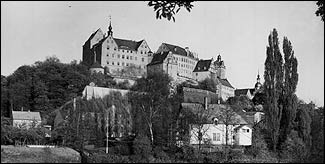
Like The Great Escape, this WWII P.O.W story is based on the actual escape attempts of the prisoners from their German captors. The start of the WWII brought up the question for both sides; what to do with captured prisoners? The Geneva Convention provided for the treatment of prisoners, but there was still the matter of housing and feeding the thousands of prisoners on either side. A prisoner's right and responsibility was to try and escape so the German Luftwaffe was forced to improvise. One of the most infamous prison camps was in the town of Colditz in the Colditz Castle, a medieval building reserved for only those prisoners dubbed the most dangerous, those most likely to escape. A recipe for a successful POW movie if there ever was.
It's summer 1940 and two British officers, Captain Pat Reid (John Mills) and Mac McGill (Christopher Rhodes), have been captured by the Germans and sent to the prison camp at Colditz Castle deep in Germany. There they find only two other British officers, Pat Tyler (Lionel Jeffries) and Jimmy Winslow (Bryan Forbes), who they quickly hit it off with. It's not long before truckloads of new prisoners arrive, including a senior British officer, Colonel Richmond (Eric Portman), who doesn't seem interested in escaping. In the crowded supposedly inescapable prison, the Brits go to work on their escape attempts, but coupled with the efforts of the French, Poles, and Dutch, end up stepping on each others toes. With help from Richmond, the diverse group of prisoners begin to work together in their escape plans, all with the hopes of someone hitting a "home run" and making it all the way to Switzerland.
Mostly known and respected for some of the earliest and best James Bond movies, director Guy Hamilton makes an entertaining, somewhat atypical war movie here. For being supposedly an inescapable prison, Colditz actually had its fair share of successful escapes over the course of WWII so right off the start Hamilton is working with a story that maybe -- just maybe -- could end on a positive note. The movie was filmed on location in Colditz (a nice touch), but I'm not sure how much and where. Regardless, it gives the story an air of authenticity as we're seeing the actual buildings these events took place in. Mills' character Pat Reid was an actual escapee from Colditz and wrote several books about his time in the prison so the story feels truthful and authentic in dealing with the facts.
Like other POW movies focusing on escape, the story isn't the most linear thing around. It tends to bounce from escape attempt to escape attempt rather than focusing on one specific plan devised by the prisoners. This could have ended with a bloated, overlong movie, but at just 97 minutes, Hamilton picked an appropriate run time. He wastes little time early on, introducing his characters and the setting and moves on to what viewers want to see; the Allied prisoners cleverly trying to escape from their German captors. Just the sheer audacity in which these prisoners make their attempts is impressive. They had no fear, no worries about consequences and repercussions. Watch one stupidly brave attempt HERE. These prisoners would try anything to escape, and that's maybe the most amazing thing about the story of this movie. These things actually happened.
Telling the story of a multinational group of Allied prisoners allows Hamilton to assemble a cast of multinational talent to fill out his ranks. Mills leads the heavily British cast as Pat Reid, a prisoner who becomes "escape officer," basically a coordinator of escapes who by taking the position agrees not to attempt an escape on his own. I like Mills as an actor on-screen because he has a knack for making his characters likable with little effort, and his Reid definitely is a prisoner you're rooting for. Portman as Colonel Richmond too is a scene-stealer, the stiff upper lip British officer who'd like nothing more than to break out as many prisoners as possible. Rhodes, Jeffries and Forbes are all solid as fellow British prisoners, especially Rhodes as a prisoner who may be too tall to escape. Frederick Valk plays the German commandant at Colditz and Denis Shaw plays Priem, a German ferret assigned with rooting out any and all escape attempts.
Because of my love for The Great Escape, I'm a sucker for like-minded movies like this one. It was a British production so it is not well known outside of England, but because it deals with the facts of being a WWII prisoner, it's easy to see the blueprint it laid out for prisoner of war movies yet to come. Filmed in a stark black and white on location in Colditz, this flick doesn't do anything great and isn't as flashy as The Great Escape or epic as River Kwai. But it is the truth in the story it tells that makes this movie worthwhile.
The Colditz Story <----opening 9 minutes (1955): ***/****
Like The Great Escape, this WWII P.O.W story is based on the actual escape attempts of the prisoners from their German captors. The start of the WWII brought up the question for both sides; what to do with captured prisoners? The Geneva Convention provided for the treatment of prisoners, but there was still the matter of housing and feeding the thousands of prisoners on either side. A prisoner's right and responsibility was to try and escape so the German Luftwaffe was forced to improvise. One of the most infamous prison camps was in the town of Colditz in the Colditz Castle, a medieval building reserved for only those prisoners dubbed the most dangerous, those most likely to escape. A recipe for a successful POW movie if there ever was.
It's summer 1940 and two British officers, Captain Pat Reid (John Mills) and Mac McGill (Christopher Rhodes), have been captured by the Germans and sent to the prison camp at Colditz Castle deep in Germany. There they find only two other British officers, Pat Tyler (Lionel Jeffries) and Jimmy Winslow (Bryan Forbes), who they quickly hit it off with. It's not long before truckloads of new prisoners arrive, including a senior British officer, Colonel Richmond (Eric Portman), who doesn't seem interested in escaping. In the crowded supposedly inescapable prison, the Brits go to work on their escape attempts, but coupled with the efforts of the French, Poles, and Dutch, end up stepping on each others toes. With help from Richmond, the diverse group of prisoners begin to work together in their escape plans, all with the hopes of someone hitting a "home run" and making it all the way to Switzerland.
Mostly known and respected for some of the earliest and best James Bond movies, director Guy Hamilton makes an entertaining, somewhat atypical war movie here. For being supposedly an inescapable prison, Colditz actually had its fair share of successful escapes over the course of WWII so right off the start Hamilton is working with a story that maybe -- just maybe -- could end on a positive note. The movie was filmed on location in Colditz (a nice touch), but I'm not sure how much and where. Regardless, it gives the story an air of authenticity as we're seeing the actual buildings these events took place in. Mills' character Pat Reid was an actual escapee from Colditz and wrote several books about his time in the prison so the story feels truthful and authentic in dealing with the facts.
Like other POW movies focusing on escape, the story isn't the most linear thing around. It tends to bounce from escape attempt to escape attempt rather than focusing on one specific plan devised by the prisoners. This could have ended with a bloated, overlong movie, but at just 97 minutes, Hamilton picked an appropriate run time. He wastes little time early on, introducing his characters and the setting and moves on to what viewers want to see; the Allied prisoners cleverly trying to escape from their German captors. Just the sheer audacity in which these prisoners make their attempts is impressive. They had no fear, no worries about consequences and repercussions. Watch one stupidly brave attempt HERE. These prisoners would try anything to escape, and that's maybe the most amazing thing about the story of this movie. These things actually happened.
Telling the story of a multinational group of Allied prisoners allows Hamilton to assemble a cast of multinational talent to fill out his ranks. Mills leads the heavily British cast as Pat Reid, a prisoner who becomes "escape officer," basically a coordinator of escapes who by taking the position agrees not to attempt an escape on his own. I like Mills as an actor on-screen because he has a knack for making his characters likable with little effort, and his Reid definitely is a prisoner you're rooting for. Portman as Colonel Richmond too is a scene-stealer, the stiff upper lip British officer who'd like nothing more than to break out as many prisoners as possible. Rhodes, Jeffries and Forbes are all solid as fellow British prisoners, especially Rhodes as a prisoner who may be too tall to escape. Frederick Valk plays the German commandant at Colditz and Denis Shaw plays Priem, a German ferret assigned with rooting out any and all escape attempts.
Because of my love for The Great Escape, I'm a sucker for like-minded movies like this one. It was a British production so it is not well known outside of England, but because it deals with the facts of being a WWII prisoner, it's easy to see the blueprint it laid out for prisoner of war movies yet to come. Filmed in a stark black and white on location in Colditz, this flick doesn't do anything great and isn't as flashy as The Great Escape or epic as River Kwai. But it is the truth in the story it tells that makes this movie worthwhile.
The Colditz Story <----opening 9 minutes (1955): ***/****
Labels:
1950s,
Bryan Forbes,
Guy Hamilton,
John Mills,
Prisoners of War,
WWII
Subscribe to:
Posts (Atom)