Released in 1939, John Ford's Stagecoach is one of the all-time great westerns. It was hugely influential in countless westerns that followed, and of course, is famous for helping make John Wayne a huge star, one of the biggest movie stars of all-time. So what's the biggest form of flattery? A remake! And unnecessary ones! Ford's western has been remade twice, first in 1966, and with today's review, a 1986 TV western, Stagecoach.
In the small town of Tonto, a stagecoach is set to leave and keeps its schedule in making it to its next stop in Lordsburg. It is far from an easy ride though across the desert, especially when reports of Geronimo and his Apache warriors being on the warpath start to hit the town. An already dangerous ride is that much worse. The driver, Buck (John Schneider), intends to do his job though, taking the coach through, Apaches be damned. So with a full coach of passengers, Buck leaves Tonto with a cavalry escort hoping to avoid Geronimo and his warriors. His passengers, all of them, have reasons to undertake such a dangerous trip. Some are trying to get somewhere while others are simply trying to get away, but to a person, they believe they're right. Are they? Can they get to Lordsburg safely without coming under attack?
Okay, No. 1. Something that needs to be said. There's no reason to remake Ford's film. NO reason. It's about as perfect a western as you'll find out there. So to remake it in different formats twice? Unnecessary to say the least. I haven't seen the 1966 version -- I'd like to, the cast is pretty crazy -- but I feel safe saying the original is better. The same here. Why bother remaking a movie that didn't need to be remade? Well, the answer isn't one you might easily come up with.
Any ideas? This TV western actually puts a country music spin on the original formula! Didn't see that one coming now, did you?!? The cast includes Johnny Cash, Willie Nelson, Waylon Jennings and Kris Kristofferson in major roles. Now even as a non-country music fan, that's an impressive pairing of talent! The biggest difference between the '86 TV flick and the '39 original is the re-working of certain characters so the Big 4 Country Stars are actually given something to do. Cash is Marshal Curly Wilcox, on the hunt for Kristofferson's Ringo Kid, with Nelson as the Doc Holliday (quite the change!), and Jennings as Hatfield, a talented gambler (some would say cheater) looking for some redemption. Take the original characters/story, add country stars, lather, rinse and repeat and you definitely get some tweaked stories! That's not a bad thing, giving a refreshing new look at a familiar story.
Of the four, I thought Cash and Nelson come out the best. Cash isn't the greatest actor, but he's very natural, and his scenes with John Schneider's Buck are excellent, two experienced trailhands discussing what their best plan is and should be. Nelson too is excellent as maybe the most famous dentist ever, Doc Holliday (not any old Doc like the Ford version), philosophizing and smoking a cigar and generally having a good time. Obviously he's having some fun with the part. Jennings is okay as Hatfield but nothing crazy. I'm a big Kristofferson fan, but it's a bit of bad casting here. Maybe it's because John Wayne's take on Ringo is so iconic, but Kristofferson is too old for the part and his scenes with Dallas (Elizabeth Ashley), an aging, disillusioned prostitute, lack some chemistry. It kinda feels like a western Last Vegas or Grumpy Old Men, four aging stars getting together and having some fun. Nothing wrong with that, right?
Who else to look for on the crowded stagecoach? Also look for the always welcome Tony Franciosa as Gatewood, a corrupt banker getting out of town with his bank's latest deposit (some $30,000), Anthony Newley as Peacock, a traveling whiskey salesman, and Mary Crosby as Lucy Mallory, a very pregnant young woman traveling west to meet up with her husband, a cavalry officer.
So while there are some changes along the way -- some major, some not as significant -- mostly this TV western sticks with the original's story. The soundtrack isn't entirely country (featuring some solid uses of guitar), and the locations are solid but don't register like Monument Valley does -- I know! Go figure in that department. The biggest changes are saved for the end in a finale that feels somewhat disjointed and/or rushed. It's not an especially good flick, but it is entertaining from beginning to end. The novelty of the country casting is just enough to give it a recommendation. It ain't on par with the 1939 original, but few are. Still....it's not bad.
Stagecoach (1986): ** 1/2 /****
The Sons of Katie Elder
"First, we reunite, then find Ma and Pa's killer...then read some reviews."
Showing posts with label Anthony Newley. Show all posts
Saturday, February 6, 2016
Wednesday, May 8, 2013
Pursuit of the Graf Spee
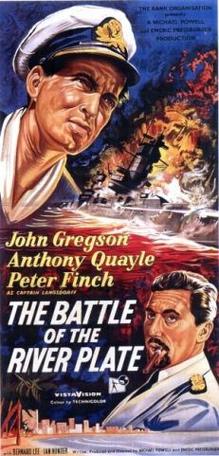
In the early years of World War II, Germany ruled the seas as its enemies jumped into a new age of naval warfare. The battleship Bismarck was the most infamous example of German firepower on the high seas, a ship that terrorized Allied shipping. Another example -- a significantly lesser-known one -- is the pocket battleship Graf Spee, a cruiser dubbed a battleship that caused an international sensation late in 1939, a story told in 1956's Pursuit of the Graf Spee.
As 1939 comes to a close, British merchant marine Captain Dove (Bernard Lee) sees his ship sunk by a German cruiser, the Graf Spee, that is gaining notoriety around the world for its ability to disrupt Allied shipping. On board the German cruiser, Dove meets its captain, Langsdorff (Peter Finch), who tells him that he will be kept with other prisoners until they can be dealt with. The days and weeks pass though and Dove is joined by countless other prisoners who tell him a rumor of coming trouble. The British are sending a three-cruiser convoy in pursuit to hunt down the infamous German warship. Outnumbered but not necessarily outgunned, the Graf Spee is ready for a battle, but the coming fight involves more than either side was planning for, including international negotiations and intrigue.
From directors Michael Powell and Emeric Pressburger, 'Pursuit' is an interesting movie, but for reasons I really didn't see coming. A forerunner of 1960s/1970s WWII movies like Midway, The Longest Day, A Bridge Too Far, Tora Tora Tora, this British-made film plays like a documentary at times. Big, expansive story telling a true historical battle and a big impressive cast set the backdrop. What I was most impressed with was the use of real ships that give the story a sense of authenticity and realism. There are some truly impressive shots of these immense, destructive warships at sea, and some equally enjoyable shots of cast and crew on-board these ships.
Beyond that though, the movie stays on a superficial for its first half of the 119-minute running time. It gets bogged down quickly in the details and the naval tactics of the history. It's apparently very accurate, but that doesn't make the story interesting to watch. The commander of the cruiser convoy (Anthony Quayle) sits down with his ship commanders and explains what their plan of attack is. Then we see the attack after an excruciatingly long segment of the ships scanning the horizons for the Graf Spee that plays in real-time (seemingly of course). The actual battle is ships miles away from each other just blasting away at each other. While we see the effects as the shells land and tear the ships apart, it is far from exciting to watch. I never felt emotionally or personally invested in the story that sticks to close to its quasi-documentary style.
After the slow-moving naval intro that never really caught my attention, 'Pursuit' finally picked up pace in the second half when it takes a surprising turn. Severely damaged in the battle, the Graf Spee makes a beeline for the neutral harbor of Montevideo with the British not far behind. What follows is an interesting twist of that international intrigue as the Uruguayan government (including minister Peter Illing) decides what to do with the situation as several foreign ministers (Anthony Bushell = British, Douglas Wilmer = French, John Chandos = German) try to get their two cents in. At the same time, intelligence agents (Michael Goodliffe and William Squire) attempt to decipher what the Germans will do. An American radio rep (Lionel Murton) for NBC describes the action from shore as huge crowds gather on the beaches and docks to see what happens. The story just plays differently, and it plays well with a change of pace.
The overall casting has its positives and negatives. 'Pursuit' features a lot of impressive names, but like the early goings in the story, it has a superficial feel to it. The naval battle is especially affected in negative fashion, faceless sailors in white yelling amidst smoke and chaos. The captains of the British cruisers include John Gregson, Ian Hunter and Jack Gwillim with Patrick Macnee as one of their subordinates. Also look for Christopher Lee as Manolo, a passionate Uruguayan bar owner who bothers Murton's radio man, with Donald Moffat as a signalman in his film debut, and Anthony Newley and Nigel Stock with small, uncredited supporting parts. I wanted to like this one more, but it's too uneven and missing that special something (energy is my final verdict) that brings a movie up a notch. The second half is considerably better so stick with it for the payoff.
Pursuit of the Graf Spee (1956): ** 1/2 /****
As 1939 comes to a close, British merchant marine Captain Dove (Bernard Lee) sees his ship sunk by a German cruiser, the Graf Spee, that is gaining notoriety around the world for its ability to disrupt Allied shipping. On board the German cruiser, Dove meets its captain, Langsdorff (Peter Finch), who tells him that he will be kept with other prisoners until they can be dealt with. The days and weeks pass though and Dove is joined by countless other prisoners who tell him a rumor of coming trouble. The British are sending a three-cruiser convoy in pursuit to hunt down the infamous German warship. Outnumbered but not necessarily outgunned, the Graf Spee is ready for a battle, but the coming fight involves more than either side was planning for, including international negotiations and intrigue.
From directors Michael Powell and Emeric Pressburger, 'Pursuit' is an interesting movie, but for reasons I really didn't see coming. A forerunner of 1960s/1970s WWII movies like Midway, The Longest Day, A Bridge Too Far, Tora Tora Tora, this British-made film plays like a documentary at times. Big, expansive story telling a true historical battle and a big impressive cast set the backdrop. What I was most impressed with was the use of real ships that give the story a sense of authenticity and realism. There are some truly impressive shots of these immense, destructive warships at sea, and some equally enjoyable shots of cast and crew on-board these ships.
Beyond that though, the movie stays on a superficial for its first half of the 119-minute running time. It gets bogged down quickly in the details and the naval tactics of the history. It's apparently very accurate, but that doesn't make the story interesting to watch. The commander of the cruiser convoy (Anthony Quayle) sits down with his ship commanders and explains what their plan of attack is. Then we see the attack after an excruciatingly long segment of the ships scanning the horizons for the Graf Spee that plays in real-time (seemingly of course). The actual battle is ships miles away from each other just blasting away at each other. While we see the effects as the shells land and tear the ships apart, it is far from exciting to watch. I never felt emotionally or personally invested in the story that sticks to close to its quasi-documentary style.
After the slow-moving naval intro that never really caught my attention, 'Pursuit' finally picked up pace in the second half when it takes a surprising turn. Severely damaged in the battle, the Graf Spee makes a beeline for the neutral harbor of Montevideo with the British not far behind. What follows is an interesting twist of that international intrigue as the Uruguayan government (including minister Peter Illing) decides what to do with the situation as several foreign ministers (Anthony Bushell = British, Douglas Wilmer = French, John Chandos = German) try to get their two cents in. At the same time, intelligence agents (Michael Goodliffe and William Squire) attempt to decipher what the Germans will do. An American radio rep (Lionel Murton) for NBC describes the action from shore as huge crowds gather on the beaches and docks to see what happens. The story just plays differently, and it plays well with a change of pace.
The overall casting has its positives and negatives. 'Pursuit' features a lot of impressive names, but like the early goings in the story, it has a superficial feel to it. The naval battle is especially affected in negative fashion, faceless sailors in white yelling amidst smoke and chaos. The captains of the British cruisers include John Gregson, Ian Hunter and Jack Gwillim with Patrick Macnee as one of their subordinates. Also look for Christopher Lee as Manolo, a passionate Uruguayan bar owner who bothers Murton's radio man, with Donald Moffat as a signalman in his film debut, and Anthony Newley and Nigel Stock with small, uncredited supporting parts. I wanted to like this one more, but it's too uneven and missing that special something (energy is my final verdict) that brings a movie up a notch. The second half is considerably better so stick with it for the payoff.
Pursuit of the Graf Spee (1956): ** 1/2 /****
Labels:
1950s,
Anthony Newley,
Anthony Quayle,
Bernard Lee,
Christopher Lee,
Peter Finch,
WWII
Sunday, May 20, 2012
The Cockleshell Heroes
Writing reviews about World War II, I've watched epics about large-scale battles, personal stories about the home front, behind the scenes stories about government/administration, but my favorite has always been the men-on-a-mission sub-genre, commandos, specialists and secret agents working together to pull off an impossible mission. One of my favorites I recently rewatched for the first time in quite awhile is 1955's The Cockleshell Heroes.
Early in 1942 with WWII's outcome still very much in question, Royal Marines Captain Stringer (Jose Ferrer) has been tasked with an improbable mission. German ships operating out of the French city of Bordeaux have been wreaking havoc on Allied shipping, and Stringer must attempt to reach the harbor city with a small group of commandos, destroying as many ships as possible. The catch? They'll be doing it by paddling up the Garonne River in two-man canoes. With help from a career Marine officer, Captain Thompson (Trevor Howard), Stringer goes about training his team of volunteers for a mission that seems suicidal to everyone involved.
From star and director Ferrer (one of 7 films he directed), 'Heroes' is based on the true story of Operation Frankton which took place in December 1942. I watched it as a kid on the History Channel and have always remembered it fondly. Released in 1955, it is more of a heroic look at the bravery these commandos showed on their mission. It doesn't yet have the darkness, cynicism or reality of so many WWII movies released a few years later in the 1960s. There is still an innocence to the story, a "nice" factor. The commandos are the heroes, their Nazi counterparts stereotypically evil. 'Heroes' is only 98 minutes long and was shot on a smaller scale (some cool English locations providing good background) with the focus on this specific mission. There's no sense of a bigger issue or the state of the war. Instead, it's about 8 commandos and the officers leading them. When handled right, who needs a bigger scale than that?
Not a hugely well known movie, 'Heroes' doesn't have the same name recognition in its cast so many other war films have. Ferrer is solid but not particularly memorable as Major Stringer, the unlikely, volunteer commander of the mission. He has several strong dialogue scenes with Howard's Thompson as a rivalry develops about how the mission should be handled, but there's little doubt who the star is. Trevor Howard is a scene-stealer, putting a spin on the stiff upper lip British officer. He's prim and proper and interested in the bottom line -- the success of the mission -- more than how the men feel about him. Thompson is the only character given any real background and Howard does not disappoint. The commandos include Victor Maddern as Sgt. Craig, Thompson's right hand man, as well as the Marine volunteers; Anthony Newley as Clarke, the smart-alec, David Lodge as Ruddock, the strongest of the Marines, Peter Arne as Stevens, the capable Corporal, Percy Herbert, Graham Stewart, John Fabian as Cooney, the Irishman, John Van Eyssen, and Robert Desmond (The Great Escape). Newly, Maddern and Lodge stand out from the group as memorable.
At its heart, this is a men on a mission movie. It just so happens to be based on a true story, the results of the movie mission exaggerated a bit relative to the actual history. Truth or not, 'Heroes' follows a familiar formula. The story is pretty clearly divided in two parts; the training for the mission and then the execution of said-mission. I would have liked some more character background on the commandos, but the training scenes do just enough to differentiate them from each other. There are some original, unique scenes, including Stringer parachuting his commandos into England.....dressed as German soldiers. No money, no identification, they must trek some 300-plus miles back to the base without getting caught. These are some necessary scenes, giving us a rooting interest in these men as they head off to their mission.
Not surprisingly then, the best parts of the movie are the actual mission, dubbed 'Cockleshell,' as Stringer's team is dropped off by a British sub (commanded by Christopher Lee) and must paddle over 70 miles up the Garonne River to their target, ships waiting in the harbor. The final 40 minutes are tense and adrenaline-pumping as they navigate the river. It's here where I started to question. If I didn't know this was in fact a real mission, I'd say it was ridiculous. The bravery exhibited here in insane, commandos in 2-man canoes paddling exposed up a heavily guarded/defended river. HERE is a Google Map showing how far they actually traveled. The ending is downbeat with a sense of success, Howard delivering a very moving final line. Success at what cost though? Listen to some of the main theme HERE, a whistle-worthy score from composer John Addison. The link below is a documentary about the real-life mission. As for the movie, a hidden gem and one I've always enjoyed.
The Cockleshell Heroes <---documentary (1955): ***/****
Early in 1942 with WWII's outcome still very much in question, Royal Marines Captain Stringer (Jose Ferrer) has been tasked with an improbable mission. German ships operating out of the French city of Bordeaux have been wreaking havoc on Allied shipping, and Stringer must attempt to reach the harbor city with a small group of commandos, destroying as many ships as possible. The catch? They'll be doing it by paddling up the Garonne River in two-man canoes. With help from a career Marine officer, Captain Thompson (Trevor Howard), Stringer goes about training his team of volunteers for a mission that seems suicidal to everyone involved.
From star and director Ferrer (one of 7 films he directed), 'Heroes' is based on the true story of Operation Frankton which took place in December 1942. I watched it as a kid on the History Channel and have always remembered it fondly. Released in 1955, it is more of a heroic look at the bravery these commandos showed on their mission. It doesn't yet have the darkness, cynicism or reality of so many WWII movies released a few years later in the 1960s. There is still an innocence to the story, a "nice" factor. The commandos are the heroes, their Nazi counterparts stereotypically evil. 'Heroes' is only 98 minutes long and was shot on a smaller scale (some cool English locations providing good background) with the focus on this specific mission. There's no sense of a bigger issue or the state of the war. Instead, it's about 8 commandos and the officers leading them. When handled right, who needs a bigger scale than that?
Not a hugely well known movie, 'Heroes' doesn't have the same name recognition in its cast so many other war films have. Ferrer is solid but not particularly memorable as Major Stringer, the unlikely, volunteer commander of the mission. He has several strong dialogue scenes with Howard's Thompson as a rivalry develops about how the mission should be handled, but there's little doubt who the star is. Trevor Howard is a scene-stealer, putting a spin on the stiff upper lip British officer. He's prim and proper and interested in the bottom line -- the success of the mission -- more than how the men feel about him. Thompson is the only character given any real background and Howard does not disappoint. The commandos include Victor Maddern as Sgt. Craig, Thompson's right hand man, as well as the Marine volunteers; Anthony Newley as Clarke, the smart-alec, David Lodge as Ruddock, the strongest of the Marines, Peter Arne as Stevens, the capable Corporal, Percy Herbert, Graham Stewart, John Fabian as Cooney, the Irishman, John Van Eyssen, and Robert Desmond (The Great Escape). Newly, Maddern and Lodge stand out from the group as memorable.
At its heart, this is a men on a mission movie. It just so happens to be based on a true story, the results of the movie mission exaggerated a bit relative to the actual history. Truth or not, 'Heroes' follows a familiar formula. The story is pretty clearly divided in two parts; the training for the mission and then the execution of said-mission. I would have liked some more character background on the commandos, but the training scenes do just enough to differentiate them from each other. There are some original, unique scenes, including Stringer parachuting his commandos into England.....dressed as German soldiers. No money, no identification, they must trek some 300-plus miles back to the base without getting caught. These are some necessary scenes, giving us a rooting interest in these men as they head off to their mission.
Not surprisingly then, the best parts of the movie are the actual mission, dubbed 'Cockleshell,' as Stringer's team is dropped off by a British sub (commanded by Christopher Lee) and must paddle over 70 miles up the Garonne River to their target, ships waiting in the harbor. The final 40 minutes are tense and adrenaline-pumping as they navigate the river. It's here where I started to question. If I didn't know this was in fact a real mission, I'd say it was ridiculous. The bravery exhibited here in insane, commandos in 2-man canoes paddling exposed up a heavily guarded/defended river. HERE is a Google Map showing how far they actually traveled. The ending is downbeat with a sense of success, Howard delivering a very moving final line. Success at what cost though? Listen to some of the main theme HERE, a whistle-worthy score from composer John Addison. The link below is a documentary about the real-life mission. As for the movie, a hidden gem and one I've always enjoyed.
The Cockleshell Heroes <---documentary (1955): ***/****
Friday, December 16, 2011
Tank Force
Running for two season in the 1960s, The Rat Patrol was a fun, little show following the exploits of the real-life Long Range Desert Group. Yes, it was ridiculous, four men taking on seemingly the entire German army in North Africa without taking casualties, but it was entertaining and a lot of fun to watch. Released in 1958, British war flick Tank Force seems almost like a dry run for the short-lived TV show.
Caught up in a chaotic back and forth battle, two British tank crews, one commanded by an American, Sgt. Thatcher (Victor Mature), and the other by Sgt. Kendall (Leo Genn), are captured by German forces. They are transported to a makeshift prison camp where hundreds of other Allied prisoners are being held in the Libyan desert. Kendall goes along with the flow, joining the escape committee and joining in on the effort to pull off a successful escape. Thatcher on the other hand is looking out for himself, planning his own escape without checking in with the rest of the camp. His efforts piss off the other prisoners, but he has his reasoning. An SS officer is headed to the camp to interrogate Thatcher who has no intention of being around for that questioning.
Directed by future James Bond director Terence Young, 'Tank' is a forgettable if entertaining WWII story. I enjoyed it, but didn't love it and probably won't feel the need to revisit again anytime soon. Part tank battle, part POW escape story, it's heavy on action and short on story and any sort of reality. It is entertaining though, and a WWII story that focuses on the 1942 North Africa campaign is rarely dull. Desert warfare always makes for interesting, unique viewing, and an escape across that desert with murdering Arab tribesmen, Italian and German forces on patrol and waiting is a cool premise.
American and British, a natural and historical rivalry, so in step Mature and Genn. Their dynamic is easily the best thing going in 'Tank.' They both want the same thing but go about it in polar opposite fashion, Mature's Thatcher on his own and Genn's Kendall as part of the team. Only when their backs are against the wall do they decide to work together. Their rivalry actually consists of a handful of scenes where they argue back and forth, but seeing the brooding intimidating American -- with an interesting backstory at that -- and the stuffy shirt, prim and proper British soldier going at it certainly keeps the action going.
Filling out Tank's Rat Patrol is a small but international bunch, starting with Anthony Newley as Pvt. 'Tiger' Noakes, Kendall's driver and all-around optimist. Nothing seems to rattle him, and he's always ready with a joke like most of Newley's supporting parts were. Bonar Colleano plays Walewski, the Polish POW who teams up with Thatcher in his escape efforts. Ready and willing to kill to preserve his own well-being, it certainly adds a darker dimension to the group. Some other familiar faces include Sean Kelly, Percy Herbert, David Lodge and Alfred Burke as the other British prisoners. Future Bond-girl/villain Luciana Paluzzi has a small part to as Carola, an Italian woman aiding the escape effort.
Not surprisingly, the action is what will draw most viewers in. Escaping the prison camp, Thatcher, Kendall and crew cut a swath through North Africa a mile wide, taking out Germans and Italians wherever they go. It's a fun movie overall that isn't great and isn't bad. Entertaining and forgettable but not much else. Probably worth a watch if nothing else.
Tank Force (1958): ** 1/2 /****
Caught up in a chaotic back and forth battle, two British tank crews, one commanded by an American, Sgt. Thatcher (Victor Mature), and the other by Sgt. Kendall (Leo Genn), are captured by German forces. They are transported to a makeshift prison camp where hundreds of other Allied prisoners are being held in the Libyan desert. Kendall goes along with the flow, joining the escape committee and joining in on the effort to pull off a successful escape. Thatcher on the other hand is looking out for himself, planning his own escape without checking in with the rest of the camp. His efforts piss off the other prisoners, but he has his reasoning. An SS officer is headed to the camp to interrogate Thatcher who has no intention of being around for that questioning.
Directed by future James Bond director Terence Young, 'Tank' is a forgettable if entertaining WWII story. I enjoyed it, but didn't love it and probably won't feel the need to revisit again anytime soon. Part tank battle, part POW escape story, it's heavy on action and short on story and any sort of reality. It is entertaining though, and a WWII story that focuses on the 1942 North Africa campaign is rarely dull. Desert warfare always makes for interesting, unique viewing, and an escape across that desert with murdering Arab tribesmen, Italian and German forces on patrol and waiting is a cool premise.
American and British, a natural and historical rivalry, so in step Mature and Genn. Their dynamic is easily the best thing going in 'Tank.' They both want the same thing but go about it in polar opposite fashion, Mature's Thatcher on his own and Genn's Kendall as part of the team. Only when their backs are against the wall do they decide to work together. Their rivalry actually consists of a handful of scenes where they argue back and forth, but seeing the brooding intimidating American -- with an interesting backstory at that -- and the stuffy shirt, prim and proper British soldier going at it certainly keeps the action going.
Filling out Tank's Rat Patrol is a small but international bunch, starting with Anthony Newley as Pvt. 'Tiger' Noakes, Kendall's driver and all-around optimist. Nothing seems to rattle him, and he's always ready with a joke like most of Newley's supporting parts were. Bonar Colleano plays Walewski, the Polish POW who teams up with Thatcher in his escape efforts. Ready and willing to kill to preserve his own well-being, it certainly adds a darker dimension to the group. Some other familiar faces include Sean Kelly, Percy Herbert, David Lodge and Alfred Burke as the other British prisoners. Future Bond-girl/villain Luciana Paluzzi has a small part to as Carola, an Italian woman aiding the escape effort.
Not surprisingly, the action is what will draw most viewers in. Escaping the prison camp, Thatcher, Kendall and crew cut a swath through North Africa a mile wide, taking out Germans and Italians wherever they go. It's a fun movie overall that isn't great and isn't bad. Entertaining and forgettable but not much else. Probably worth a watch if nothing else.
Tank Force (1958): ** 1/2 /****
Labels:
1950s,
Anthony Newley,
David Lodge,
Leo Genn,
Luciana Paluzzi,
Percy Herbert,
Terence Young,
Victor Mature,
WWII
Monday, November 28, 2011
The Bandit of Zhobe
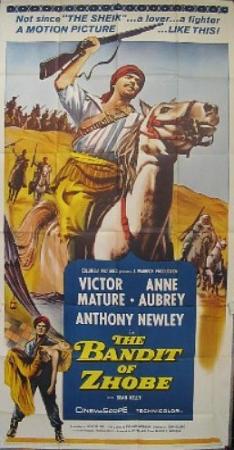
Late this summer I reviewed 1956's Zarak, a quasi-historical epic that was entertaining for all the wrong reasons. Epically bad choices in casting, lack of story and character development, all lost in a search for that epic scale which was never really there to begin with. So how do you improve on it? Well, long story short, you don't. Made three years later, 1959's The Bandit of Zhobe is almost scene-for-scene the exact same movie.
A chieftain of an Indian tribe (India, not Native American) on the frontier, Kasim Khan (Victor Mature) has his family and life torn apart from him, his tribe massacred in a brutal massacre led by Azhad Khan (Walter Gotell), a rival chief who leads the attack with his men dressed as British troops. With a small but loyal group of followers, Kasim becomes a bandit, terrorizing British interests in the area. The regional commander, Major Cowley (Norman Wooland), would like nothing more than to get his hands on the bandit, but Kasim avoids him at every turn. Cowley's daughter, Zena (Anne Aubrey), believes Kasim deserves a chance to know the truth, but can she get him to believe what actually happened?
I gave a marginally positive review for 1956's Zarak (read HERE) in July. The TCM website inexplicably listed this quasi-sequel/remake as a western, but it was apparent almost immediately that this was basically the same thing as Zarak. Check that, it's not basically the same thing. It is the same thing. Mature plays the same character risen from the dead, Wooland the capable British officer trying to arrest him, and Aubrey the oddly out of place possible love interest. Maybe studios thought audiences were stupid enough to forget. Maybe the studios just didn't care, seeing a cheap chance to make some money. Yeah, that second one sounds more appropriate.
For whatever reason and having seen the two movies about four-five months apart, I liked 'Bandit' considerably more than its predecessor. Go figure because I certainly can't. The same problems are there -- little story, just a running series of battles, no character development -- but I went along with it this time. Hoping to capitalize and make some easy $, the studio reuses countless shots and whole sequences. Watch them back-to-back and you'll see at least 15-20 minutes of footage pop up in both films. The battle scenes are ripped from Zarak in their entirety and dropped into this movie. The positive? The Zarak battles scenes were the best thing going for that movie, and not surprisingly they work here too.
Looking like he's phoning it in for a paycheck, Mature says about 18 words the whole movie. Those words are growled and muttered. He is the star of the movie with name recognition only, nothing else. The focus instead turns to his British counterparts. Anthony Newley plays Cpl. Stokes, the somewhat goofy British soldier placed in charge of watching the major's daughter and not enjoying his duty at all. Some comedy but not too much thankfully. Aubrey is the innocent one, sure she can figure everything out without anything bad happening, Wooland the veteran officer trying to avoid a full-scale war breaking out.
So this isn't much of a shocker, but for a 1959 British movie generally forgotten and made on the cheap, there isn't much info out there about 'Bandit.' I'd like to say where the movie was filmed, but I honestly have no idea, and I can't find that information anywhere. So what to say? In Italy or Asia or wherever 'Bandit' was filmed, it is a starkly shot but certainly visually interesting film. The TCM print was in pan-n-scan too, and it still looked good. That speaks to something. An average movie for sure, but one I enjoyed. I'd say watch Zarak too, but the pure awesomeness might blow your mind.
The Bandit of Zhobe <---Youtube scene (1959): ** 1/2 /****
A chieftain of an Indian tribe (India, not Native American) on the frontier, Kasim Khan (Victor Mature) has his family and life torn apart from him, his tribe massacred in a brutal massacre led by Azhad Khan (Walter Gotell), a rival chief who leads the attack with his men dressed as British troops. With a small but loyal group of followers, Kasim becomes a bandit, terrorizing British interests in the area. The regional commander, Major Cowley (Norman Wooland), would like nothing more than to get his hands on the bandit, but Kasim avoids him at every turn. Cowley's daughter, Zena (Anne Aubrey), believes Kasim deserves a chance to know the truth, but can she get him to believe what actually happened?
I gave a marginally positive review for 1956's Zarak (read HERE) in July. The TCM website inexplicably listed this quasi-sequel/remake as a western, but it was apparent almost immediately that this was basically the same thing as Zarak. Check that, it's not basically the same thing. It is the same thing. Mature plays the same character risen from the dead, Wooland the capable British officer trying to arrest him, and Aubrey the oddly out of place possible love interest. Maybe studios thought audiences were stupid enough to forget. Maybe the studios just didn't care, seeing a cheap chance to make some money. Yeah, that second one sounds more appropriate.
For whatever reason and having seen the two movies about four-five months apart, I liked 'Bandit' considerably more than its predecessor. Go figure because I certainly can't. The same problems are there -- little story, just a running series of battles, no character development -- but I went along with it this time. Hoping to capitalize and make some easy $, the studio reuses countless shots and whole sequences. Watch them back-to-back and you'll see at least 15-20 minutes of footage pop up in both films. The battle scenes are ripped from Zarak in their entirety and dropped into this movie. The positive? The Zarak battles scenes were the best thing going for that movie, and not surprisingly they work here too.
Looking like he's phoning it in for a paycheck, Mature says about 18 words the whole movie. Those words are growled and muttered. He is the star of the movie with name recognition only, nothing else. The focus instead turns to his British counterparts. Anthony Newley plays Cpl. Stokes, the somewhat goofy British soldier placed in charge of watching the major's daughter and not enjoying his duty at all. Some comedy but not too much thankfully. Aubrey is the innocent one, sure she can figure everything out without anything bad happening, Wooland the veteran officer trying to avoid a full-scale war breaking out.
So this isn't much of a shocker, but for a 1959 British movie generally forgotten and made on the cheap, there isn't much info out there about 'Bandit.' I'd like to say where the movie was filmed, but I honestly have no idea, and I can't find that information anywhere. So what to say? In Italy or Asia or wherever 'Bandit' was filmed, it is a starkly shot but certainly visually interesting film. The TCM print was in pan-n-scan too, and it still looked good. That speaks to something. An average movie for sure, but one I enjoyed. I'd say watch Zarak too, but the pure awesomeness might blow your mind.
The Bandit of Zhobe <---Youtube scene (1959): ** 1/2 /****
Labels:
1950s,
Anthony Newley,
Historical epics,
Victor Mature
Friday, November 25, 2011
The Man Inside
Having planned the robbery for 15 years, Englishman Sam Carter (Nigel Patrick) walks into a diamond exchange in New York City and steals a diamond worth over $700,000. The success comes from the simplicity of the job, and now no one -- including the police -- know where to start looking for Carter or the diamond. Milo March (Jack Palance), a private detective, is called in to see what he can find trying to pick up the crook's trail. March finds himself globe-trotting, following Carter to Lisbon, Madrid, Paris and London, always one step behind him. He keeps running into a mysterious Austrian woman (Anita Ekberg) who similarly has an interest in acquiring the diamond, and that's not all. Some very bad, very hard men don't care who gets hurt as they search for the rare diamond.
As I found out afterward, 'Inside' is not available on VHS or DVD so I was glad to stumble across it on TCM's schedule. It's nothing special and drifts along with its story more than a pointed, driven effort. Still, director John Gilling keeps it interesting if not always hugely entertaining. There are villains, but the type you assume will never successfully hurt a good guy. Said good guys betray each other, but you know they'll end up working together in the end. Part film noir, heist, and European tour guide, 'Inside' never really decides what it is. Drama? Comedy? Never great and never awful, decent enough way to spend 97 minutes.
Newley didn't get a mention in the plot review because like a lot of sidekicks, his part isn't essential to the story. The very British Newley plays the very Italian Ernesto, a taxi driver and guide in Madrid who meets Palance's March and ends up helping him around the city. He plays surprisingly well off the always intense Palance, providing some lighter moments with some running comedic bits that just shouldn't work, but well, they end up working. It's a good supporting part for Mr. Newley who always seems to be having fun no matter the role he plays.
It always feels like a cop-out when I write about this in a review, devoting an entire paragraph to this particular aspect, but as was the case here in 'Inside' it is really good. Yes, here I go again with on-location shooting, Gilling filming much of his movie in Lisbon, Madrid and Paris. Filmed in a very stylish black and white, this very visual movie helped me as a viewer slog through some of the slower portions. And while it sounds obvious, a movie is just better when you see the actors actually in the locations, not a poorly done green screen effect. It's always pretty clear when the actor isn't actually in those glamorous European cities. To some, maybe it's a little thing, but it's a major selling point for me, and 'Inside' doesn't disappoint on that level.
The good and bad here is that the cast assembled is a good one, but they're not always given anything to do. Lots of travel scenes, lots of pointless talking that waste an otherwise talented cast. Palance's March is a step back from his usual psychotic character he perfected over his career. Still intense, but pulled back a notch or two. Human Barbie doll Ekberg is the femme fatale, playing all sides for her own gain. Patrick is the shifty Carter, the diamond thief who we know little about. Some more background would have been nice about the character, his motivations, his reasoning, something. Also look for Donald Pleasance as a Spanish organ grinder, Sid James as March's friend and supervisor Franklin, and Bonar Colleano and Sean Kelly as two hired guns after the diamond.
All things considered, a pretty forgettable movie. The cast is above average though, and it's a great movie to look at so there's just enough to recommend here. Barely, but still recommending it.
The Man Inside (1958): **/****
Labels:
1950s,
Anita Ekberg,
Anthony Newley,
Donald Pleasence,
Jack Palance,
Nigel Patrick
Subscribe to:
Posts (Atom)
.jpg)