The Sons of Katie Elder

The Sons of Katie Elder
"First, we reunite, then find Ma and Pa's killer...then read some reviews."
Showing posts with label Ty Hardin. Show all posts

Wednesday, January 29, 2014

PT 109

John F. Kennedy  is known for any number of things from a tragically shortened life. His beautiful wife, Jackie, his supposed affairs with Marilyn Monroe among others, his charm and popularity, his turbulent presidency that included the Cuban Missile Crisis, and most tragically, his assassination under the rifle of Lee Harvey Oswald. One of the most fascinating parts of his adventure-filled life? His World War II exploits as told in 1963's PT 109.

While the fighting rages in the Solomon Islands in the Pacific in 1943, Lt. John F. Kennedy (Cliff Robertson) arrives at a small naval base specializing in patrol torpedo boats (PT) meant to keep Japanese forces at bay. Kennedy is given command of PT 109, a beat-up old boat that has seen far better days. He's given just a week to get the 109 ready for action, assembling a crew, including Ensign Leonard Thom (Ty Hardin), cleaning the boat, and rehabbing the engines. They manage to come in under deadline, Kennedy, his crew and the 109 thrust immediately into action. The day-to-day life of a PT boat is a dangerous one though, the boats meant to be used to buy time while the U.S. Navy still tries to recover from Pearl Harbor. Patrols, routine or not, rescues, deliveries, Kennedy and his crew take it all on, but the mission that will put them all in the history books awaits one pitch-black night in the Blackett Strait in the Solomon Islands.

One of my favorite movies growing up, I can still go back and visit this 1963 WWII movie from director Leslie H. Martinson and enjoy it from beginning to end. This isn't the most hard-hitting of movies, but like some other WWII movies from Warner Bros., there is a distinct visual look, a professionalism and a straightforward style that plays well. Could things be tightened up a bit with a 140-minute movie? Sure, here and there, but it's an excellent story and film just the same. It was filmed in the Florida Keys, and it's sunny and sandy with plenty of palm trees to help stand in for the Solomon Islands in the Pacific. The musical score from composers David Buttolph and William Lava knows when to lighten the mood and when to show the developing drama, a score that sounds similar to another Warner Bros. WWII movie, 1962's Merrill's Marauders.

Released in theaters less than six months before his death in Dallas, PT 109 was made with the help of Kennedy right in the midst of his term as President. He even had final say on the actor who would play him, Robertson being his ultimate choice. It ends up being a great pick, one that makes the movie far more memorable in my eyes. Besides the striking physical resemblance -- look at Robertson in an iconic JFK picture HERE -- Robertson nails the heroic, likable, charming part of a future American president. That's the movie's goal, to show Kennedy as a hero. More on the details in the next paragraph, but Kennedy's actions were more than enough so Martinson didn't have to stretch things too much. Robertson's Kennedy is smart, quick with a comeback and a plan, a leader who's respected by his men and fellow officers, and a capable commander with a knack for doing the right thing. It's not the most in-depth characterization, but it never set out to be. Kudos to Robertson, already one of my favorites.

Semi-SPOILERS from here on in. The truth of the story behind PT 109 is remarkable in itself. Patrolling in the Blackett Strait a dark August night, the 109 was struck by a Japanese destroyer similarly on patrol. Kennedy's boat was ripped in two pieces, two crewmen killed in the collision. Banding the men together, Kennedy got the survivors to swim to a far-off island and hopefully wait for survival. What followed is and was an inspiring story in itself, Kennedy ultimately winning the the Congressional Medal of Honor for his heroic actions. The movie itself is divided into two halves, the first introducing Kennedy, the crew, the boat and their exploits, the second half following its chapter in history as a Japanese destroyer tears the little boat apart. Both halves are excellent, but it's hard to beat the second half as the survivors desperately wait for help in one form or another, Kennedy swimming out into the Strait at night to flag down an American ship.

While the focus is obviously on Robertson as Kennedy, the supporting cast is very solid without stealing the spotlight. Hardin as 2nd-in-command Ensign Thom has a good chemistry with Robertson, Robert Blake, Norman Fell, and Biff Elliot starring as the most visible of the 109's crew. James Gregory is a scene-stealer as Commander Ritchie, the leader of a squadron of PT boats, a veteran officer who's never seen combat but is always searching for the best out of his men. Even Robert Culp shows up at the halfway point as Ensign Barney Ross, an old friend of Kennedy's who ends up on the 109 for its fateful mission, Michael Pate making a memorable appearance as Evans, an Australian coastwatcher who plays an integral part in the eventual rescue of Kennedy and the remaining survivors. Also lending his voice talents in an uncredited narrator role is Andrew Duggan

This isn't a WWII movie that rewrites the genre. It is a movie meant to honor the heroics of future president John F. Kennedy, and it does it well. Exciting with some good action, some genuine laughs and some lighter moments, and Robertson in a great leading part as Kennedy himself.

PT 109 (1963): *** 1/2 /****
Rewrite of August 2010 review

Friday, August 5, 2011

One Step to Hell

Thanks to a change in monthly pricing, I've had to adjust my Netflix subscription recently. Instead of paying about $10 per month for one DVD at a time and unlimited streaming content through their website, the rate for each individual feature got bumped up to $8...each. I don't watch enough movies at the website to justify subscribing both so starting in mid August (about when this review will be posted, give or take a few days) I lose Instant Watch capabilities.  In other words? I've got about 3 weeks to watch all the Instant Watch movies I wanted before I lose the chance.

That brings us to 1968's One Step to Hell, also known and released as King of Africa. Listed as a western through Netflix's website, this flick stars Ty Hardin and sounded like a pretty typical if hopefully enjoyable western oater. Well, part of that description was right, but it's hard to explain this one. It is a western -- sort of -- but it is set in Africa as opposed to the American west, it looks to have Italian backing and has the feel of spaghetti western, and worst of all, the version I saw was 90 minutes long even though a 100-minute version is supposedly available somewhere out there.  Odd, off the wall, eccentric, all three apply in this genuinely different western.

A British colonial policeman in South Africa around the turn of the 20th Century, Lt. King Ray (Hardin) faces a difficult decision. Three prisoners he helped bring in, including bandit ringleader Anders (George Rigaud), have escaped while being transported to a nearby town and a likely death sentence.  He can't convince his superiors (George Sanders in an odd cameo) to allow him to pursue the bandits though, forcing him to make a tough decision. He goes on "furlough," using his coming break to hit the trail and hopefully bring these bandits to justice. Anders and Co. up the ante quickly though when their goals become known. They've kidnapped the wife (Pier Angeli) of a gold mine owner and are using her to guide them to the hidden, lucrative mine. Can King catch up in time across the desolate plains of Africa?

Years of watching spaghetti westerns -- some really good, others really bad, but for the most part entertaining -- has trained me to appreciate these movies made on a smaller budget. There is a charm to the lower quality, no frills, action-packed stories where there were never really "good guys," just some guys who weren't as bad as the others. This is a movie that certainly qualifies in the vein of a spaghetti western. The African setting is a great change of pace (and a real beauty to look at with some stunning shots), and the story feels like so many westerns set in America, a bounty hunter/sheriff on the trail of a gang of outlaws. Nothing particularly remarkable about any of it, but going in it certainly sounded interesting.

This is a movie that has basically been completely forgotten over the last 40-plus years. Where to start for the reasons that might account for its complete lack of notoriety. The credits provide some clues, starting with director Nino Scolaro directing his one and only feature. For a movie and screenplay where the story never seems on a direct path to anywhere, there are five different names listed as helping in some way with the script. The biggest issue though -- because all the above problems can be dealt with -- is that I watched the 90-minute version, not the supposedly longer 100-minute cut that was released in Spain. Scenes end in a ragged fashion, leaving things unsettled and moving on before anything can be resolved. Is that because of the cuts or the jagged story to begin with? None of this is helped by composer Gianni Marchetti's score which ranges from spaghetti-themed and appropriate to jazzy and out of place at other times.

From an American perspective, some of these European productions from the 1960s and 1970s throw me for a loop. With a long cast listing, only 10 actual names have a character listed to them. That makes describing characters a tad bit difficult once you get past the main stars. On the backside of his career, Ty Hardin is a solid enough lead as Lt. King, a police officer trying to right a wrong. He's in beefcake mode here for the female members of the audience, always seeming to run around with little in the way of clothes on. Angeli is all right as Mrs. Benton, but I swear the script gets her character and Helga Line's Deborah confused late in the movie, Hardin's King even calling Mrs. Benton 'Deborah.' One relative bright spot is Rigaud as Anders, a somewhat charismatic aging outlaw looking for one last strike. His gang (some of the few people actually listed in the credits) include Luciano Pigozzi, Miguel Del Castillo, and Antonio Mayans among several other nameless actors. Rossano Brazzi has a small but solid part as Dr. Hamilton, a physician also trying to convert his African patients to Christianity.

'Step' certainly has all the makings of a solid if not so unique western, but something never clicks into place. Even at just 90 minutes, it ends up being surprisingly dull.  Long stretches of a slow-moving story are interrupted by quick bursts of graphic action, but the ending is never really in doubt, or at least it shouldn't be if you've got two or three brain cells working.  It ultimately gets some points for being unique in terms of setting and characters, but that's not enough to carry it overall.  A deeply flawed and even at times bad western that still manages to be entertaining.

One Step to Hell (1968): **/****

Sunday, August 22, 2010

The Last Rebel

Michael Jordan, Pele, Shaquille O'Neal, all superstar athletes who took a turn at the movie business, some with better results than others.  Kazaam comes to mind as a not so quality venture.  It's the rare athlete who has the same talent on-screen that they had playing on their court, diamond, field, whatever.  In the 1960s and 1970s one of the biggest stars both on and off the field was AFL/NFL quarterback Joe Namath, also known as Broadway Joe for his ability to dominate the spotlight.  Like so many stars, he gave movies and television a shot, including an appropriately forgotten spaghetti western, 1971's The Last Rebel.

In most variations of athlete turned movie star, the athlete plays a variation of himself/herself, if not just actually playing themselves.  MJ played MJ in Space Jam, Pele played a soccer star, Shaq was a genie (check that one), but Broadway Joe doesn't go that route, instead playing a Confederate soldier turned gunfighter in the days and months following the Civil War.  I've been watching spaghetti westerns for years, and I can almost always find something to recommend about them.  They're often enough so bad they're good.  But The Last Rebel?  Possibly the worst movie I've ever seen.  And I've seen a fair share of stinkers, but this may take the cake.

When news reaches Missouri that the Union has won the Civil War, Confederate soldiers Hollis (Namath) and Matt (Jack Elam) light out for the west rather than be thrown in some prison camp while everything cools down.  Heading west, the unlikely duo becomes a trio when Hollis rescues a black man, Duncan (Woody Strode) from a lynch mob.  Looking for a way to earn some money, the trio rides into a not so friendly town with a not so friendly sheriff (scruffy looking Ty Hardin) who doesn't take kindly to strangers in his town.  Honestly, some more stuff happens, backstabbing, betrayal, a fair share of sex, then a showdown and credits roll.  End of movie.  Good enough plot description for you?

I honestly try and keep an open mind whenever I start a new movie, no matter what I've heard going in.  That plot description isn't leaving anything out at all.  That's it.  To say this awful spaghetti western even has a plot is a stretch.  In a 90-minute movie, I'd wager half of it is long, unedited shots of two or three of our characters riding through the countryside with a truly out of place soundtrack playing over the visual.  Trying to show a passage of time is one thing, but this was just bizarre.  A 30-second uncut scene of Namath and Elam has the duo ride across a ridge or over a hill, but instead of proceeding to them riding into a town, we get another shot of them riding across a ridge or over another hill.  Truly embarrassing stuff almost right from the get-go.

At a certain point, I almost felt bad for Namath.  His part isn't so much acting as reciting lines and squinting, shrugging and generally looking uncomfortable no matter what he's doing.  But Namath was a sex symbol in his playing days so he does bed down a handful of women in the movie, including saloon girl Pearl (Victoria George, a bright spot for her appearance and general lack of clothes). There's also the bizarre scene where Hollis -- acquiring the rank 'Captain' out of nowhere -- rides onto a Spanish hacienda and sleeps with two different Mexican sisters in the same night, just a room apart.  Then, oh yeah, gotta go back to new love of your life Pearl.  It's probably not fair to call this acting to begin with, but Namath should have stuck with that football thing.  I hear he was halfway decent.

Heading into the movie, I thought a saving grace might be the trio of actors in support of Namath in the lead, Elam, Strode and Hardin.  Well, thanks to a complete lack of any sort of script or story to move things along, the three are beyond wasted.  Elam has the most screentime, but that doesn't mean much.  He growls a lot and looks at the camera with that shifty look of his.  Other than a weird monologue he has with a random black boy (honestly, the kid's credited as 'The Black Boy'), Strode has about 18 words of dialogue.  Not lines, just words.  As for Hardin, it's just bad news.  He's the bad guy I guess, but we're never told why.  He's a sheriff, of course he wants to protect his town.  But he has a gnarly looking beard so he must be the bad guy.  Hardin disappears for about 40 minutes, only to reappear when Namath needs to kill someone.

Director Denys McCoy understandably didn't get another movie to direct after this gem.  A star-driven vehicle is one thing, but at least give Namath something to do other than sleep with random women.  It is one of the most random, truly pointless movies I've ever seen.  Nothing can really save this one.  No script, no plots, no interesting characters other than the mostly nude Victoria George, and a soundtrack that features 70s rock and ballads all add up to a sorry excuse for a movie.  I'll give anything a try, but this was a painful experience, and that's from someone who loves spaghetti westerns.  Steer clear.

The Last Rebel <---TCM clip (1971): 1/2 /****  

Sunday, August 15, 2010

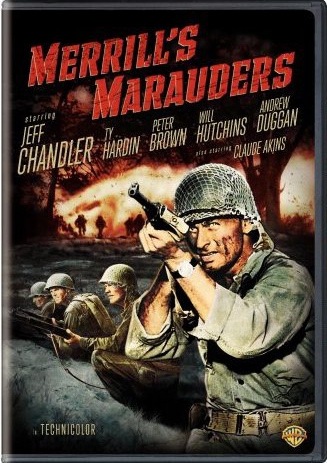
Merrill's Marauders

After reviewing a heavily anti-war movie yesterday, I thought it was only right to counter today with a different look at war and soldiers in a more heroic light.  The 1960s were full of war flicks that focused on real-life military units, like 1968's The Devil's Brigade that dealt with the First Special Service Force, and then for a change of pace here, 1962's Merrill's Marauders in the Pacific theater of WWII.

Directed by WWII vet Samuel Fuller, Marauders tells a mostly factual story of the 5307th Composite Unit (provisional), dubbed Merrill's Marauders after their commander, General Frank Merrill. This was a fighting force of 3,000 American volunteers with experience in jungle warfare after years of island-hopping across the Pacific on places like Guadalcanal, Bougainville, and many others. Fuller doesn't try to present the Marauders as a unit of Superman-like soldiers who can't be defeated.  These are men pushed to their physical, emotional and mental limits as they undertake a near-suicide mission late in WWII.  Heroes of course, but Fuller isn't going to shove any rhetoric down your throat.  Here's the story, and if you don't like it, tough.

Early in 1944 as the advantage shifts toward the Allies in WWII, the 5307th Composite Unit marches into Burma from India with a dangerous mission, get behind enemy lines and walk 125 miles undetected in Japanese territory to knock out a key Japanese supply base.  Commander Brigadier General Frank Merrill (Jeff Chandler) is at the lead, pushing his men every step of the way. The mission is a success if a costly one, but it's only the start.  The Marauders are ordered to continue on, marching further into the Burmese jungle on their way to an essential airfield at Myitkyina where they will link up with British forces.  Out in front leading his scout platoon, Lt. Stockton (Ty Hardin) begins to see the men wear down but somehow continue on, ready for whatever awaits them.   

Telling the story of the Marauders, Fuller puts together a fast-paced, full of action story that never slows down, even in the moments following the firefights as the men wait for orders.  With backing from the U.S. Army, Fuller films his story in the Philippines which does a fine job filling in for Burma.  Much of the movie is filmed in dense jungle, giving a feel of what trudging through such horrifically dense landscape would be like.  Howard Jackson's musical score borrows some from 1945's Objective Burma! but stands well on its own, supplying a driving pace at times that balance out the softer moments as the Marauders cope with their situation.

Chandler tragically died at the age of 42 before this last movie of his was ever in theaters, a shame because of how good his performance is.  Never a huge star, he was a class professional, and makes Merrill a red-blooded character, an officer who knows he must sacrifice some of his men if the Allies ever hope to win the war.  Difficult decisions, but he knows the end result will prove it all worthwhile.  He has a father-son relationship with Hardin's Stock, the platoon leader who struggles dealing with the ever-increasing casualties among his men.  Joining the platoon is Bullseye (Peter Brown), the sharpshooter, Kolowicz (Claude Akins), the tough but fair sergeant, Muley (Charlie Briggs), the mule driver with his pack animal Eleanor, Chowhound (Will Hutchins), the platoon a-hole, and Taggy (Filipino star Pancho Magalona), a Filipino volunteer. We get to know little to nothing about these men, but by seeing their actions, as viewers we get a strong sense of who they are as people.  The personal background would be a wasted effort.

Certain moments can bring a war movie up a notch or two, and it doesn't require an epic battle or a heroic sacrifice.  Here, it comes following a bloody battle at a railyard.  Stock walks over cement posts where the heaviest fighting took place, the bodies mingled together so closely it is impossible to tell who was American and who was Japanese.  It is one long tracking shot as Stock surveys the battle silently, Jackson's score playing softly.  A few minutes later, Akins -- in a career-best performance -- is offered food by a young boy and his grandmother.  They're just offering a cup of water and a bowl of rice (very little in the grand scheme of things), but Akins' Wolowicz breaks down, the exhaustion taking over of months behind enemy lines.  These are the moments that stick with you more than anything else, the mark of a truly moving story.

With his lightning quick pacing, Fuller covers a ton of ground in just 97 minutes. The studio made certain cuts -- including a slightly different ending -- giving the story a sometimes disjointed feel, but it never distracts for long.  The battle sequences sound like toy guns instead of real guns (Fuller opted for blanks instead of sound effects), but they're shot so well you hardly notice minutes in.  The movie ends on a positive note, asking the question that's been brought up the whole movie by Doc (Andrew Duggan). Men on the brink of exhaustion after months of fighting with limited supplies, how do they do it?  They did it because they had to.  A great, underrated WWII movie well worth catching up with.

Merrill's Marauders <---trailer (1962): *** 1/2 /****

Thursday, May 13, 2010

Savage Pampas

When it comes to watching westerns, I'd like to think I've seen just about anything and everything the genre can offer.  I started watching them when I was little and never really stopped.  I'll watch good and bad, classic and panned, it really doesn't matter to me.  Spaghetti westerns came along when I was introduced to Clint Eastwood and opened up all sorts of new doors for the western.  For a bigger picture, foreign westerns are almost always interesting, presenting a non-American's view of what our west was like in the 19th Century.

That's the difference though, most foreign westerns take place in the American west or south into Mexico.  That is not the case with 1966's Savage Pampas, a Eurowestern made with U.S., Spanish and Argentinian backing.  The story is set in the last quarter of the 19th Century and is set on the Argentinian pampas -- flatlands, think the American plains.  The basic premise is of cavalry vs. Indians, albeit on a different continent with different players.  For any number of reasons -- I'm struggling to pick out just one -- I really enjoyed this movie, but I don't know why.  One thing is sure though, it's different from just about any other western I've ever seen.

Commanding a remote army outpost on the Argentinian pampas, Captain Martin (Robert Taylor) is facing two major problems, one affecting the other.  A deserter from the fort and a renegade, El Padron (Ron Randell), is fighting with the indigenous Indians, encouraging them to attack the army outposts.  Making his plan more effective, Patron is offering any deserters women once they arrive in his camp.  Stationed days from any nearby town, the outpost's garrison hasn't seen a woman in years.  Martin has proposed a plan to bring women -- prostitutes called 'camp followers' -- to Fort Toro, which is approved but first he has to go get them.  With a mid-sized patrol, Martin heads out across the Pampas to pick up 'the cargo' but Padron has spies everywhere, and it's only a matter of time before he figures out Martin's plan.

Several American westerns have dealt with at least somewhat similar topics, including a Taylor western titled 'Westward the Women.'  But 'Pampas' has a style all to its own.  The Argentinian cavalry here looks to be a mix between the Foreign Legion, the U.S. Cavalry and the gauchos that work the pampas in their extravagant, stylish outfits.  Bandits are bandits, and the Indians basically want nothing to do with any development.  Change a few lines here and there and you'd never know this was set in the Argentinian flatlands instead of the American southwest.  But that's a strong part of 'Pampas' because director Hugo Fregonese films in Argentina.  Echoing many John Ford westerns, Fregonese uses many shots of troopers on the horizon on the spacious plains.  At a very basic level, Savage Pampas is a pretty movie to look at, and that's always a strong jumping off point.

After the first 30 minutes, the rest of the movie is almost exclusively dedicated to Martin's patrol picking up 10 women that will be brought back to the fort and work as prostitutes.  The story handles this well, making these women more than just something to leer at as the men on the patrol guarding them start to develop relationships with them.  I really didn't expect the story to take that sort of route, but it works surprisingly well.  Instead of just having lonely, horny soldiers trying to rape these women, we get character development.  Some of the men include Lt. Del Rio (Angel del Pozo), the new, inexperienced officer, Sgt. Barril (Marc Lawrence), a tough-talking leader, El Gato (Charles Fawcett), the veteran scout,  Pvt. Luis (Jose Jaspe), an older soldier who takes a protective eye on one of the women, among several others who step into the limelight.

That's what surprised me more than anything, the character development, especially in a Eurowestern which typically key in on action and shootouts.  Robert Taylor did what so many actors did in the late 60s and went to Europe for parts, and his Capt. Martin -- other than the non-Spanish sounding name -- is a strong lead.  He's good at what he does but fed up at the lack of help and supplies he's offered.  Taylor also has a pretty ridiculous looking goatee, but it gets lost in the shuffle.  Also along for the patrol are Camila (Felicia Roc), a political prisoner forced to become a prostitute, Rucu (Rosenda Monteros), an Indian girl Martin buys, and Carreras (Ty Hardin), an anarchist journalist sentenced to join Martin's force.  Taylor and Hardin have some great scenes together as they discuss the dangerous situation they're in, especially their last scene alone on the pampas.

The patrol storyline is nothing new or unique, but it certainly keeps the story moving along.  Padron's forces wait for their chance to attack in a large, well-staged attack in a lonely village that highlights the movie's action scenes.  There is a starkness to the pampas and seeing a huge battle play out has an almost apocalyptic feel as the two sides clash. The ending caught me off guard too, but in a good way.  It's a less than happy ending, but for how the characters and story developed, an appropriate one.

Savage Pampas definitely surprised me in just about every way possible.  The cast delivers fine performances -- especially Taylor and Hardin -- and Fregonese is able to bring something new to the cavalry picture by developing his patrol and giving us a reason to root for them.  The Argentinian locations are beautiful to look at and give a sense of how wide open the pampas really is.  DVDs and VHS tapes are difficult to find for a reasonable price so keep your eye out on TCM for another airing.  It is shown in widescreen and doesn't disappoint.

Savage Pampas <----TCM clip (1966): *** 1/2 /****