Spaghetti westerns are inherently dark and twisted, a view of the American west that is based in some sort of historical reality but done up with a heavy dose of steroids. Some obviously are tougher to handle than others, my toughest to get through being 1967's Django Kill! Well, I've got a new spaghetti western that I had trouble getting through. Uncomfortable and dull to boot, it's 1975's Four of the Apocalypse.
Thrown into jail in the western town of Salt Flats, gambler Stubby Preston (Fabio Testi) finds himself sharing the jail with three other people; Bunny (Lynne Frederick), a pregnant prostitute, Clem (Michael J. Pollard), a dimwitted drunk, and Bud (Harry Baird), a drunk who sees ghosts all around him. That night, Salt Flats comes under attack by a gang of bandits, much of the townspeople killed in the attack. The quartet is untouched, leaving them on their own with no guns and little supplies to get to the nearest town across the desert. Stubby and his motley trail mates head out into the desert, meeting an assortment of people along the way. One of them is a bandit named Chaco (Tomas Milian) who at first seems helpful enough but quickly shows his true colors. Now they must band together more than ever if they hope to survive both the desert and Chaco's sadistic tendencies.
A writer and director with a ton of scripts and feature films to his name, 'Apocalypse' director Lucio Fulci is known above all else as the king of gore in the 1970s and 1980s. His love of gore obviously found a home in the Italian horror genre, but he departed long enough early in his career for this spaghetti western. In the years since its release, that's what 'Apocalypse' is known for more than ever...the violence. The action is kept to a minimum, but the early attack on Salt Flats is horrifically bloody, huge bright red blood squibs seemingly throwing up out of people. One scene has Chaco carving up a living man's stomach, probably the most uncomfortable scene in the entire movie. There's an edge of the uncomfortable throughout the movie. It isn't always the violence that startles us, but the build-up instead, the personal nature of it. There's also some cannibalism, rape, massacres, and crippling knee shots for those tallying at home.
The unfortunate part is that the violence is used to shock us, but to what end? What is Fulci trying to say here? What's his message? I think at some point he set out to make an allegory, a metaphor about the world in its entirety. We get four people with some huge flaws -- gambling, prostitution, alcoholics, insane -- and they are thrust into this apocalyptic, end of the world type situation. It's a world where anything goes and seemingly no law exists. It sounds good, huh? I thought so, but the execution isn't there. At one scene, it is the darkest, most disturbing movie you've ever seen, and the next, a town of all men up in the snow-capped mountains are celebrating the birth of a baby boy. It just doesn't fit together. A message needed to be picked and stuck to it. Instead, I feel like Fulci is trying to deliver some profound message that never quite comes to fruition.
Not helping the cause is a script that doesn't make any of the characters that interesting and/or sympathetic. Testi is far from your prototypical spaghetti western hero, and that's a cool change of pace. On the other hand, he's a helpless, whiny doofus who can't see trouble until it hits him in the face. Frederick is required to look worried, Pollard is Pollard, goofy and aloof with that constant confusing grin on his face, and Baird hams it up, describing all the ghosts and dead people he sees. None are that interesting to watch, making their plight in the desert uninteresting and taking away any emotional investment we have away in rooting for them to make it. Spaghetti regular Bruno Corazzari is solid as Lemmy, a drunken doctor up in the mountains who helps care for Bunny while Adolfo Lastretti has a fun if underused part as a gun-toting preacher. Also look quickly for Donald O'Brien as the sheriff of Salt Flats.
The best thing going for 'Apocalypse' is Milian as Chaco, for good and bad. This is a villain so sadistic, so pure evil that it becomes almost unbearable to watch these scenes. He baits the desert travelers and then turns on them, feeding them some sort of hallucinogen and then proceeds to torture them in various ways, always with a smile on his face. His look/appearance is a big part of the character, long, flowing hair, a bandana around his head, long, colorful robes, maybe a little mascara under there, and what appears to be crucifixes carved under his eyes. In a would-be allegory about life, is Chaco's evil supposed to be the Devil? Is he just the Devil, straight up? That's up to you to decide, but his scenes are the most interesting thing in this story, even as uncomfortable as they are to watch.
Intentions of a profound story that doesn't amount to anything aside, I think my biggest issue here is a cardinal sin in filmmaking. This is an incredibly dull, downright boring film. It has no real redeeming qualities other than Milian's performance. What is it trying to say? Is it trying to say anything? In between bits of shocking violence, we get long stretches of Stubby and his fellow travelers walking across deserts, through the hills and all to a ridiculously awful folk-like soundtrack from Italian songwriters. It is out of place and just too folksy for its own good. I found myself fast-forwarding a lot late in the film, and even Stubby looking for some vengeance in the last act could save this bomb. Very disappointing negative review.
Four of the Apocalypse (1975): */****
The Sons of Katie Elder
"First, we reunite, then find Ma and Pa's killer...then read some reviews."
Showing posts with label Tomas Milian. Show all posts
Tuesday, September 3, 2013
Tuesday, December 4, 2012
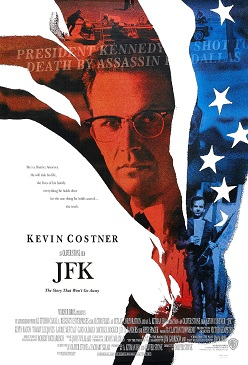
JFK
On November 22, 1963, President John F. Kennedy was traveling by motorcade in Dallas when he was shot and killed by Lee Harvey Oswald. Or so some think at least. One of the most tragic events in U.S. history, Kennedy's assassination has sparked hundreds and thousands of theories. Was Oswald working alone? Was it a government conspiracy to kill Kennedy? Maybe no one will ever know for sure, but the conspiracy theories abound. Enter stage right, 1991's JFK.
The district attorney in New Orleans, Jim Garrison (Kevin Costner) is stunned like so many Americans when news of President Kennedy's death hits the airwaves. He watches with morbid curiosity and a desire for answers as Lee Harvey Oswald (Gary Oldman) is arrested for the murder and summarily shot by Jack Ruby two days later. Several years pass, but by 1966, Garrison is bothered more and more by the details of the assassination. With help from his staff, Garrison begins to do his own investigation, and the results are startling. What exactly happened in the days and months leading up to Nov. 22, 1963? More importantly, what happened after? The more they find out, the more Garrison smells a government cover-up.
From director Oliver Stone, this is quite the ambitious project. For starters, because it involves such a touchy subject as the JFK assassination, everyone has at least somewhat of an opinion on the subject. More than just viewer opinions, the amount of info, theories and evidence involving the assassination is endless. Type in 'JFK Conspiracy' at Google, and see how many results you get. So walking through a virtual filming minefield, Stone takes on a gargantuan task. The end result is a thought-provoking, somewhat meandering (at 206 minutes) story that throws a lot at the viewer, but if you pay attention, it's not a difficult movie to keep up with.
The goal from the beginning is simple; Stone intends to put that bug in your head that the lone shooter theory -- Oswald shooting Kennedy -- just isn't the way it happened. Recent studies show that some 60% of Americans believe there was a conspiracy involving the shooting. Stone has always had an aggressive shooting style, but it's a positive here. The entire movie is basically one interview after another -- quick cuts, fast editing, flashbacks galore -- as one piece of evidence piles up one on top of the other through Garrison and Co.'s investigation. The story is based on the true-to-life efforts of Garrison and his staff (with some tweaks here and there), but it plays like All the President's Men or any number of other films detailing an investigative report.
Ready to be impressed? This is one doozy of a cast, starting with Costner who delivers a likable, human performance as the D.A. driven to obsession to find out the truth. The subplot with his family (including wife Sissy Spacek) is one of the few weak points the movie has. Seeing him only in flashback, Oldman is frighteningly good as Oswald, and a dead ringer physically to boot. Garrison's investigative staff includes Jay O. Sanders, Laurie Metcalf, Wayne Knight, Michael Rooker and Gary Grubbs. Don't go anywhere. I'm not to the halfway point yet. There's also Ed Asner, Jack Lemmon, Brian Doyle-Murray (as Jack Ruby), Walther Matthau, John Candy, Tommy Lee Jones, Donald Sutherland, Kevin Bacon, Joe Pesci, and Tomas Milian. Some are nothing more than a scene or two cameo, but their presence alone legitimizes their scenes. Jones, Sutherland, Bacon and Pesci are the most memorable of the group.
Presenting all sorts of what ifs and could bes, the movie builds to a courtroom scene where Garrison puts someone on trial for conspiring to kill JFK. The scene is a gem, capping off all we've heard, sene and learned through their investigation. Costner is highly effective in this scene, both pointing out the flaws in the lone shooter theory (later referenced famously in Seinfeld with the Magic Loogie, watch HERE) but also addressing the jury for what they should do. It shows one man's frustration at what he believes the government has been up to, doing something for extraordinary amounts of money rather than what's good for the country. The whole movie is enjoyable and extremely polished, but the court scene (about 35 minutes at the end) is the best thing going.
So did Oswald shoot Kennedy? Were there other shooters? We'll probably never know. But I have to give Stone's film credit. Say what you want about your own thoughts on the assassination, but Stone cleanly lays out the potential for at least one possibility. Maybe Oswald was a patsy, one man set up by larger forces at work. It's something you will have to think about yourself, but as a director, Stone does an admirable job at least making us question what really happened.
JFK (1991): ***/****
The district attorney in New Orleans, Jim Garrison (Kevin Costner) is stunned like so many Americans when news of President Kennedy's death hits the airwaves. He watches with morbid curiosity and a desire for answers as Lee Harvey Oswald (Gary Oldman) is arrested for the murder and summarily shot by Jack Ruby two days later. Several years pass, but by 1966, Garrison is bothered more and more by the details of the assassination. With help from his staff, Garrison begins to do his own investigation, and the results are startling. What exactly happened in the days and months leading up to Nov. 22, 1963? More importantly, what happened after? The more they find out, the more Garrison smells a government cover-up.
From director Oliver Stone, this is quite the ambitious project. For starters, because it involves such a touchy subject as the JFK assassination, everyone has at least somewhat of an opinion on the subject. More than just viewer opinions, the amount of info, theories and evidence involving the assassination is endless. Type in 'JFK Conspiracy' at Google, and see how many results you get. So walking through a virtual filming minefield, Stone takes on a gargantuan task. The end result is a thought-provoking, somewhat meandering (at 206 minutes) story that throws a lot at the viewer, but if you pay attention, it's not a difficult movie to keep up with.
The goal from the beginning is simple; Stone intends to put that bug in your head that the lone shooter theory -- Oswald shooting Kennedy -- just isn't the way it happened. Recent studies show that some 60% of Americans believe there was a conspiracy involving the shooting. Stone has always had an aggressive shooting style, but it's a positive here. The entire movie is basically one interview after another -- quick cuts, fast editing, flashbacks galore -- as one piece of evidence piles up one on top of the other through Garrison and Co.'s investigation. The story is based on the true-to-life efforts of Garrison and his staff (with some tweaks here and there), but it plays like All the President's Men or any number of other films detailing an investigative report.
Ready to be impressed? This is one doozy of a cast, starting with Costner who delivers a likable, human performance as the D.A. driven to obsession to find out the truth. The subplot with his family (including wife Sissy Spacek) is one of the few weak points the movie has. Seeing him only in flashback, Oldman is frighteningly good as Oswald, and a dead ringer physically to boot. Garrison's investigative staff includes Jay O. Sanders, Laurie Metcalf, Wayne Knight, Michael Rooker and Gary Grubbs. Don't go anywhere. I'm not to the halfway point yet. There's also Ed Asner, Jack Lemmon, Brian Doyle-Murray (as Jack Ruby), Walther Matthau, John Candy, Tommy Lee Jones, Donald Sutherland, Kevin Bacon, Joe Pesci, and Tomas Milian. Some are nothing more than a scene or two cameo, but their presence alone legitimizes their scenes. Jones, Sutherland, Bacon and Pesci are the most memorable of the group.
Presenting all sorts of what ifs and could bes, the movie builds to a courtroom scene where Garrison puts someone on trial for conspiring to kill JFK. The scene is a gem, capping off all we've heard, sene and learned through their investigation. Costner is highly effective in this scene, both pointing out the flaws in the lone shooter theory (later referenced famously in Seinfeld with the Magic Loogie, watch HERE) but also addressing the jury for what they should do. It shows one man's frustration at what he believes the government has been up to, doing something for extraordinary amounts of money rather than what's good for the country. The whole movie is enjoyable and extremely polished, but the court scene (about 35 minutes at the end) is the best thing going.
So did Oswald shoot Kennedy? Were there other shooters? We'll probably never know. But I have to give Stone's film credit. Say what you want about your own thoughts on the assassination, but Stone cleanly lays out the potential for at least one possibility. Maybe Oswald was a patsy, one man set up by larger forces at work. It's something you will have to think about yourself, but as a director, Stone does an admirable job at least making us question what really happened.
JFK (1991): ***/****
Thursday, January 7, 2010
Almost Human
Every so often a character in a movie, a book, a TV show, anything really, comes along that is just so despicable, so downright low that it is beyond easy to hate them. They tend to have no redeemable qualities at all, often performing acts so unspeakable it can be difficult to watch. For me at least, this is often balanced out because that character is the villain, an individual matched in screentime by some sort of hero. What about if there isn't a hero, and that villain dominates almost every scene? Put that all together, and you've got 1974's Almost Human.By 1974, Cuban actor Tomas Milian had made quite a name for himself working in Europe, tending to stay within the western and crime genres for his parts. He was a perfect choice for a roguish individual who usually lived in that fine line between good and bad but often enough ended up making the right choice and saving the day. Often enough, but not every time. Working with director Umberto Lenzi for the first time, Milian delivers a performance in Almost Human that pulls out all the stops with a character so ridiculously evil that it borders on going too far over the top. But of all his roles, Milian picks 'Almost Human' as his best.
Working as a low-level hood for the mafia in Italy, Giulio Sacchi (Milan) panics during a bank robbery and kills a police officer trying to ticket his car. The mafia capo, Majone (Luciano Catenacci), does not appreciate any undue attention being called to him and his organization and lets Giulio go. Fed up with these small-time jobs, Giulio turns to bigger fish and finds what seems the perfect crime when he visits his girlfriend (Anita Strindberg) at work. Her boss has a young daughter in her early 20s, and Giulio decides there's millions of lire in it if he was to kidnap her and demand ransom. Working with two similarly low-level thugs, Carmine (Ray Lovelock) and Vittorio (Gino Santercole), Giulio goes about figuring out his plan for the kidnapping.
The story starts with Giulio panicking and killing a patrolling police officer and never stops from there. The body count begins to build -- I counted 15 people Giulio kills by himself -- as the crimes escalate and the kidnapping plan is put into execution. The transformation Milian's main character goes through is alarming, starting off as a thug who panics in a chaotic situation but degenerating into a sadistic killer who has little whim about killing anyone if it will benefit him. At one point, he even guns down a little girl with a machine gun. If that's not a character to root against, I don't know if there's one out there. Giulio is a brutal, bi-sexual, drug addicted murderer who you can't wait to see get his comeuppance. I put bi-sexual not as a judgement, just to add to the overall eccentricity of the character.
What makes this all more uneasy to watch is that the 'good guy' is nothing more than a crime thriller stereotype. Usually playing the role Milian takes here, Henry Silva is police commissioner Walter Gribaldi, a veteran officer trying to piece together all these crimes popping up. For one thing, it's nice to see Silva playing a good guy after a long line of psychotic lunatics, but the character has no development other than being a near-obsessed police officer. Even then, Silva isn't given much to work with in his scenes although he does come around in the end...the end you can see coming miles away. More was needed though to give the viewer someone to root for.
Where many other Italian crime thrillers added other elements to the main story, 'Almost Human' rises and falls on Milian's performance alone. And character dislike aside, this is a great performance for the actor although I disagree that this is his best overall. But other than Milian, there's not much to recommend. I can't place it, but I swear Ennio Morricone's score was used in another movie, and the action overall isn't meant to be exciting, but unsettling instead. It's a pulpy B-movie with plenty of blood and guts, gratuitious nudity, and an in your face style. Take away Milian in the lead, and it's a bad movie. With the performance, it's at least worth giving a mild recommendation.
Almost Human <----trailer (1974): **/****
Saturday, October 10, 2009
Face to Face
Directed by the other Sergio, no, not Leone or Corbucci, yes to Sergio Sollima, Face to Face was the director's follow-up to The Big Gundown which is also considered one of the best in the genre. While many spaghettis went for the lowest common denominator, lots of mindless killing, cool musical score, badass anti-hero, Sollima's westerns, like all his movies, try to deliver a message. It's nothing deep or profound, but there's always something there that adds a deeper layer to the story. Of course, it helps to have the killing, music and antihero to help things along.
A history professor at an eastern university, Brad Fletcher (Gian Maria Volonte) is told to head west by his doctors for the better climate to fight off the disease that is quickly killing him. He improves immediately, but one day a stagecoach occupied by three marshals transporting a prisoner pulls into his village. Brad offers to help the prisoner, but ends up in a hostage situation as the bandit kills his escort. Out in the desert, easterner Brad must care for the wounded bandit, Solomon 'Beau' Bennett (Tomas Milian), the leader of a decimated gang known as Bennett's Raiders.
With nothing tying him down to his home, Brad joins Beau as the bandit reassembles his gang who've been scattered all over thinking their leader is dead. He finds them one by one (spaghetti regulars Frank Brana, Jose Torres, Angel del Pozo, and Nello Pazzafini) and they go back to work. At first timid about handling and shooting a gun, Brad develops into a right hand man to Beau and possibly a threat to his leadership. That's not all that Beau must deal with as Pinkerton agent Charlie Siringo (William Berger) is on his trail, looking to bring him to justice.
Unlike a lot of spaghetti westerns where the bad guys are supremely evil and the antiheroes are really only in it for themselves and the money, Sollima's westerns play on the audience's preconceptions about the characters they're watching. From the start, it's figured that Volonte's Brad is the good guy, the one to root for, while Milian's Beau is the prototypical bad guy, a bandit who will get his due in the end. That changes by the halfway mark as both characters transform into someone different. It's great to see a spaghetti really flesh the characters out.
In doing that, it helps to have actors the caliber of Volonte and Milian. Starring in two of Leone's Dollars trilogy, Volonte is becoming one of my favorite actors. He has an intense look about him, and he wastes no time getting into character. Brad is the early favorite for the good guy role, but he undergoes a change over the course of the movie that is believable and never seems forced. The same can be said for Milian who made his fair share of high-quality spaghettis. He had a penchant for over-the-top Mexican bandit characters in the vein of Eli Wallach's Tuco, and even when his character is a little crazy, he's still appealing, likable to the viewer, or at least me for sure.
As for the checklist of must-haves in the Italian western genre, the leads are a given with Berger rounding out the top trio. His Siringo is based on a real historical figure, and Berger makes the most of a part that has him in and out of the story a lot. In the easy on the eyes department, Jolanda Modio, Carole Andre, and Linda Veras play love interests who are given little to do and have very few lines but look great doing it. So much for well-rounded strong female characters here. 'Face' was filmed in Almeria so you'll see a lot of familiar locations, and Ennio Morricone provides a typically reliable if not hugely memorable score. A botched bank robbery highlights the action late in the movie.
As is the case with Sollima's other westerns, Face to Face doesn't settle for the staus quo. It's a whole lot better than the typical spaghetti western and benefits from strong performances of stars Gian Maria Volonte and Tomas Milian. If like me you're not willing to drop a pretty penny on a region-free DVD player, cruise on over to Youtube and give this one a try. If you're new to the spaghetti western, it's also a good place to start right up there with the Leone and Corbucci entries.
Face to Face <----trailer (1967): *** 1/2 /**** Part 1 of 11 on Youtube
Subscribe to:
Posts (Atom)