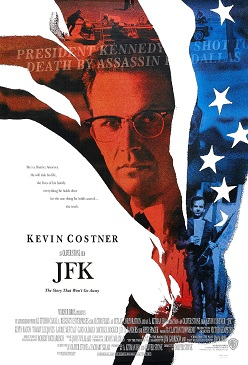
On November 22, 1963, President John F. Kennedy was traveling by motorcade in Dallas when he was shot and killed by Lee Harvey Oswald. Or so some think at least. One of the most tragic events in U.S. history, Kennedy's assassination has sparked hundreds and thousands of theories. Was Oswald working alone? Was it a government conspiracy to kill Kennedy? Maybe no one will ever know for sure, but the conspiracy theories abound. Enter stage right, 1991's JFK.
The district attorney in New Orleans, Jim Garrison (Kevin Costner) is stunned like so many Americans when news of President Kennedy's death hits the airwaves. He watches with morbid curiosity and a desire for answers as Lee Harvey Oswald (Gary Oldman) is arrested for the murder and summarily shot by Jack Ruby two days later. Several years pass, but by 1966, Garrison is bothered more and more by the details of the assassination. With help from his staff, Garrison begins to do his own investigation, and the results are startling. What exactly happened in the days and months leading up to Nov. 22, 1963? More importantly, what happened after? The more they find out, the more Garrison smells a government cover-up.
From director Oliver Stone, this is quite the ambitious project. For starters, because it involves such a touchy subject as the JFK assassination, everyone has at least somewhat of an opinion on the subject. More than just viewer opinions, the amount of info, theories and evidence involving the assassination is endless. Type in 'JFK Conspiracy' at Google, and see how many results you get. So walking through a virtual filming minefield, Stone takes on a gargantuan task. The end result is a thought-provoking, somewhat meandering (at 206 minutes) story that throws a lot at the viewer, but if you pay attention, it's not a difficult movie to keep up with.
The goal from the beginning is simple; Stone intends to put that bug in your head that the lone shooter theory -- Oswald shooting Kennedy -- just isn't the way it happened. Recent studies show that some 60% of Americans believe there was a conspiracy involving the shooting. Stone has always had an aggressive shooting style, but it's a positive here. The entire movie is basically one interview after another -- quick cuts, fast editing, flashbacks galore -- as one piece of evidence piles up one on top of the other through Garrison and Co.'s investigation. The story is based on the true-to-life efforts of Garrison and his staff (with some tweaks here and there), but it plays like All the President's Men or any number of other films detailing an investigative report.
Ready to be impressed? This is one doozy of a cast, starting with Costner who delivers a likable, human performance as the D.A. driven to obsession to find out the truth. The subplot with his family (including wife Sissy Spacek) is one of the few weak points the movie has. Seeing him only in flashback, Oldman is frighteningly good as Oswald, and a dead ringer physically to boot. Garrison's investigative staff includes Jay O. Sanders, Laurie Metcalf, Wayne Knight, Michael Rooker and Gary Grubbs. Don't go anywhere. I'm not to the halfway point yet. There's also Ed Asner, Jack Lemmon, Brian Doyle-Murray (as Jack Ruby), Walther Matthau, John Candy, Tommy Lee Jones, Donald Sutherland, Kevin Bacon, Joe Pesci, and Tomas Milian. Some are nothing more than a scene or two cameo, but their presence alone legitimizes their scenes. Jones, Sutherland, Bacon and Pesci are the most memorable of the group.
Presenting all sorts of what ifs and could bes, the movie builds to a courtroom scene where Garrison puts someone on trial for conspiring to kill JFK. The scene is a gem, capping off all we've heard, sene and learned through their investigation. Costner is highly effective in this scene, both pointing out the flaws in the lone shooter theory (later referenced famously in Seinfeld with the Magic Loogie, watch HERE) but also addressing the jury for what they should do. It shows one man's frustration at what he believes the government has been up to, doing something for extraordinary amounts of money rather than what's good for the country. The whole movie is enjoyable and extremely polished, but the court scene (about 35 minutes at the end) is the best thing going.
So did Oswald shoot Kennedy? Were there other shooters? We'll probably never know. But I have to give Stone's film credit. Say what you want about your own thoughts on the assassination, but Stone cleanly lays out the potential for at least one possibility. Maybe Oswald was a patsy, one man set up by larger forces at work. It's something you will have to think about yourself, but as a director, Stone does an admirable job at least making us question what really happened.
JFK (1991): ***/****
The Sons of Katie Elder
"First, we reunite, then find Ma and Pa's killer...then read some reviews."
Showing posts with label John Candy. Show all posts
Tuesday, December 4, 2012
Sunday, December 20, 2009
The Silent Partner
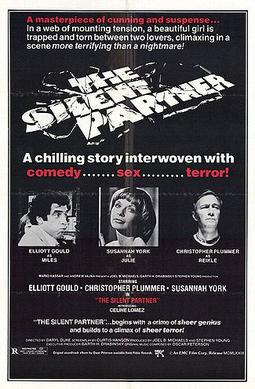
This was a Netflix recommendation based off my previous ratings, and with a few exceptions they've been pretty good about movies they'd think I'll like. 'Silent Partner' is set in Toronto and was filmed there too -- making a movie out of the U.S. always seems to be cheaper. Released in the late 70s, it has a low budget look that works well in giving the story a seedy feel to it both in terms of character and background. There are flaws, including one major plothole in the beginning, but Netflix came through with a good pick again.
Working as the head teller at a Toronto bank based in a busy mall, Miles Cullen (Elliott Gould) begins to notice clues that someone is planning a robbery of his bank. It's the holidays and more money than usual is available in the bank so Miles takes his chance. Seeing the robber preparing for his robbery -- he's working as a mall Santa Clause -- Miles pockets almost $50,000 from his drawer. So the armed robber gets away with a few thousand dollars, but thanks to Miles, he gets blamed for taking all of it. Miles thinks he's gotten away with it, but soon after he starts getting mysterious calls from the robber, Harry Reikle (Christopher Plummer), warning him that he wants all his money. So starts a cat-and-mouse game as Miles and Reikle try to outsmart each other.
The high point of the movie by far is the interaction between Gould's Cullen and Plummer's Reikle. From the start, it is very clear that Reikle is more than a little crazy and capable of just about anything if it gets him his money. Two scenes in particular jump out, Reikle cornering Miles in his apartment, and Reikle later using Miles' fish tank for a rather uncomfortable torture scene. If anything, Plummer is underused as his possibly bisexual or just very 70s villain drifts in and out of the story. As the 'good guy,' Gould is the opportunistic criminal who still remains sympathetic mostly because Plummer is so downright scary.
This back and forth retaliation continues to escalate including a friend of Reikle's, Elaine (Celine Lomez), joining the conflict in a plot twist that if you don't see coming, you should be ashamed of yourself. Parts in the middle do drag a bit (usually when Plummer isn't around), and Gould even seems surprised that the bank robber is coming after him for the cash. What did he think would happen? My only other major complaint is how Cullen catches on to the plan by finding a carbon copy of a note Reikle supposedly slipped to another teller. Has he been robbing other tellers, but if not that, did he just happen to lose that note when he was practicing for the real deal? Who knows for sure, but it did bug me.
Some reviews mentioned this 70s thriller as having a Hitchcockian feel, and I wouldn't disagree. The story could be streamlined some more, especially Cullen's on again off again relationship with another bank employee, Julie, played by the very lovely Susannah York. After the initial robbery, it's almost 30 minutes before the conflict arises. Maybe director Daryl Duke was going for a slow burn to try and lull the viewer into a feeling of security only to unleash Plummer's villain, but if you ask me it takes too long. These are just minor complaints because otherwise I really enjoyed this movie.
Slow-paced at times, but this offbeat, little known Canadian crime thriller (how often do you hear that?) has a lot going for it including an ending that confused me at first but worked when I went back and reviewed it. That ending also adds another odd chapter into Plummer's character, but I don't want to spoil it here. It's got a little bit of everything from random, unnecessary 70s nudity (it seems every female member of the cast signed on for a topless scene), and Candy making an appearance as a clueless bank teller, but what makes it worth watching is Elliott Gould and Christopher Plummer as the leads. Definitely worth checking out if you haven't heard of it. Sorry no trailer on this one, there wasn't even one on the DVD.
The Silent Partner (1978): ***/****
Labels:
1970s,
Christopher Plummer,
Elliott Gould,
John Candy,
Susannah York
Thursday, December 10, 2009
Uncle Buck
Over a ten year stretch that started in 1984 with Sixteen Candles, director John Hughes made a handful of movies that are as iconic as anything that came out of the 1980s. Over 25 years later, fans still adore these movies like The Breakfast Club, Planes, Trains and Automobiles, and Ferris Bueller among many, many others that he either wrote or produced. And even though he hadn't made a movie in over 10 years before his death this past August, Hughes will always be a fan favorite.His movies tended to be dramedies, stories based in some sort of real life --families, friends, co-workers, high school -- that had lots of humor in them. To call them one or the other, drama or comedy, wouldn't be fair because they were more than that. Sure, they made you laugh, but there was almost always some sort of message to go with. A sappy, corny, grab the Kleenex kind of message, but it still counts. Of all the movies he was involved in, one of the most underrated has to be 1989's Uncle Buck, one of only eight movies Hughes actually directed.
Right up there with Planes, Trains, and Automobiles two years prior as his funniest movie, Hughes delivers a classic with this story. The Russell family has recently moved to north suburban Chicago to make more cash. Late one night, they get a phone call from family that saying the mother's dad has had a heart attack. The parents decide to head off to Indianapolis to be with him, but who can watch the three kids? The only option is Uncle Buck (John Candy), a freewheeling bachelor and basically the black sheep of the family who hasn't seen his nieces and nephews for years.
So while the parents are away, Uncle Buck moves in and has to run the family. Two of the kids, Miles (pre-Home Alone Macaulay Culkin) and Maizy (Gaby Hoffmann), warm up to him right away even though they haven't seen him for years. Not so easy to warm up is 15-year old Tia (Jean Louisa Kelly) who is basically the definition of an angry teenager. She's pissed at her parents for moving them from Indy to Chicago and takes it out by being pissed at the world. Buck does his best to keep the house going while also dealing with his longtime girlfriend Chanise (Amy Madigan) who is trying to get him to marry her.
Right up there with John Belushi and Chris Farley, John Candy was a comedian and movie star that was taken too early as he died in 1994 at the age of 44. From his early days with Second City and SCTV to his movies throughout the 80s, Candy was one of the funniest guys around whether it be in television or movie. Obviously a big man, he was a hilarious physical actor -- check this dance scene out -- who could also deliver a line so deadpan, so perfectly he could have you falling out of your seat. Watch this scene with Culkin that shows off that ability.
It's Candy who carries the movie, nailing all three different relationships the character requires. Culkin and Hoffman are great with Candy, and Louisa Kelly is perfectly evil as the bitchy teenager. Amy Madigan comes in and out of the story in an effort to help Buck grow up (whether he wants to or not), and Laurie Metcalf has a funny part as a recently divorced neighbor who sets her sights on Buck. Her introduction, sneaking up on Buck ''doing the laundry," is one of the funniest scenes in the movie. The supporting cast is great, but it's John Candy's movie and he doesn't disappoint. Ranks with 'P, T and A' as his best part.
Most of the sappy family happy ending is saved for the last 10 minutes or so, but it never feels too forced. Of course it's meant to pull at your heart strings, but 95 minutes in or so we've gotten to know the characters pretty well and root for them to be happy. It's a John Hughes movie after all, there is going to be a happy ending so get used to it. If you've seen other Hughes movies and liked them, this is a sure thing. You won't be disappointed.
Uncle Buck <---trailer (1989): *** 1/2 /****
Subscribe to:
Posts (Atom)