The Sons of Katie Elder

The Sons of Katie Elder
"First, we reunite, then find Ma and Pa's killer...then read some reviews."
Showing posts with label Oliver Stone. Show all posts

Thursday, February 28, 2013

Wall Street: Money Never Sleeps

One of the more iconic movies to come out of the 1980s, 1987's Wall Street is memorable because of star Michael Douglas and his infamous line, "Greed is good." The movie itself is pretty good, and 23 years after its release, director Oliver Stone decided to return to his iconic character and continue the story with 2010's Wall Street: Money Never Sleeps.

After spending 13 years in jail for insider training and securities fraud, Gordon Gekko (Douglas) is finally given his parole. Some seven years pass, and now he's promoting his new book 'Is Greed Good?' when he meets a young stock broker, Jake Moore (Shia LaBeouf), who is engaged to Gordon's estranged daughter, Winnie (Carey Mulligan). Gordon wants to form a relationship with a daughter who might as well consider him dead. At the same time, Gordon begins to help Jake, a talented, intelligent broker in his own right, as he starts a new job with a high-level firm broker, Bretton James (Josh Brolin), who has rubbed plenty of people the wrong way in his rise to power. With millions and billions of dollars on the line and the massive egos to boot, an epic confrontation looms, but the struggling economy may have the last laugh over everyone involved.

For starters, let's get this somewhat obvious statement out of the way. Like just about any sequel ever, this is basically the definition of unnecessary. Why go back to a movie from 23 years ago and revisit a character -- however iconic -- and story that didn't need revisiting? Oh...the sequel made $130 million in theaters? I suppose that's as good a reason as any. Well, in business at least. Other than the epic economic issues of the last 10 years, there's no real reason to make this sequel. That said, it's not bad. The biggest thing working in positive fashion is the acting. The story lacks a bit of punch -- it's missing something in the energy department -- but I liked it just the same. Unnecessary? Oh, you betcha, but you could do worse.

I like movies, sports, reading. I can B.S. my way through a fair share of conversations. The financial crisis of 2008 is most definitely not one of those things. I have a very basic knowledge of the economic collapse that this sequel goes into in depth, but I'm far from an expert. In other words, some background and/or understanding in big money, Wall Street, stocks, and everything financial will no doubt help your enjoyment of this flick. Because my knowledge of the subject material is limited, I wasn't always crystal clear on what was going on. I still liked it, but it's an issue just the same. End of sidenote.

Without question, the best thing going for Stone's sequel is the return of Michael Douglas as Gordon Gekko. His introduction is perfect, Gekko getting his parole and being released from prison after serving 13 total years in jail. We see him get his possessions back from a suit to a watch to a rather massive cell phone. The message is clear; times have changed, and Gordon is a dinosaur who has to adjust with the times. I think Stone makes an incredibly wise choice. For much of the movie, Gekko is a secondary -- if incredibly important secondary -- character that fleets in and out of the story as needed. Any scene with Douglas in it is worth watching, his appearances bringing the entire movie up a notch just by being there. He makes the others around him better. The new movie itself is unnecessary, but Douglas's appearance makes it worthwhile.

The rest of the cast is solid if unspectacular. It seems no matter the movie, LaBeouf takes grief for any number of things -- wooden acting, bad acting, off-screen antics -- but as long as he's not in loud, obnoxious, and obvious Transformers mode, I like him. It isn't a flashy part (that is left to Douglas, nailing it in subtle fashion), but LaBeouf's Jake is the main character, and for me, an interesting one. Mulligan too is pretty good as Winnie, Gordon's estranged daughter who wants nothing to do with her father. Behind Douglas, I thought the best part was from Brolin as the Wall Street rival with some ulterior motives. Frank Langella is a scene-stealer as well as Louis Zabel, Jake's aging mentor who hates what Wall Street is becoming, Susan Sarandon plays Jake's mom who's heavily invested in real estate, Eli Wallach as a Wall Street dinosaur, and Jason Clarke as the NYC Fed chief. Not necessarily great performances, but it's fun to see all those names assembled.

This 2010 sequel is missing that special something from making it an above-average, truly enjoyable flick. It's good enough, but it's never more than that. Clocking in at 138 minutes, it feels incredibly long in certain stretches. Lots of dialogue isn't a bad thing, but at times, it gets a little tedious, a little slow. Douglas certainly helps the momentum pick up a bit, especially late when we see the Gekko we all love to hate. Charlie Sheen even makes a cameo as Bud Fox, the protagonist in the original Wall Street. I liked this one, didn't love it. Not bad stuff.

Wall Street: Money Never Sleeps (2010): ** 1/2 /****

Tuesday, December 4, 2012

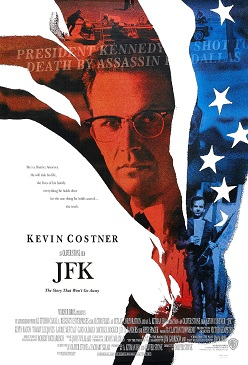
JFK

On November 22, 1963, President John F. Kennedy was traveling by motorcade in Dallas when he was shot and killed by Lee Harvey Oswald. Or so some think at least. One of the most tragic events in U.S. history, Kennedy's assassination has sparked hundreds and thousands of theories. Was Oswald working alone? Was it a government conspiracy to kill Kennedy? Maybe no one will ever know for sure, but the conspiracy theories abound. Enter stage right, 1991's JFK.

The district attorney in New Orleans, Jim Garrison (Kevin Costner) is stunned like so many Americans when news of President Kennedy's death hits the airwaves. He watches with morbid curiosity and a desire for answers as Lee Harvey Oswald (Gary Oldman) is arrested for the murder and summarily shot by Jack Ruby two days later. Several years pass, but by 1966, Garrison is bothered more and more by the details of the assassination. With help from his staff, Garrison begins to do his own investigation, and the results are startling. What exactly happened in the days and months leading up to Nov. 22, 1963? More importantly, what happened after? The more they find out, the more Garrison smells a government cover-up.

From director Oliver Stone, this is quite the ambitious project. For starters, because it involves such a touchy subject as the JFK assassination, everyone has at least somewhat of an opinion on the subject. More than just viewer opinions, the amount of info, theories and evidence involving the assassination is endless. Type in 'JFK Conspiracy' at Google, and see how many results you get. So walking through a virtual filming minefield, Stone takes on a gargantuan task. The end result is a thought-provoking, somewhat meandering (at 206 minutes) story that throws a lot at the viewer, but if you pay attention, it's not a difficult movie to keep up with.

The goal from the beginning is simple; Stone intends to put that bug in your head that the lone shooter theory -- Oswald shooting Kennedy -- just isn't the way it happened. Recent studies show that some 60% of Americans believe there was a conspiracy involving the shooting. Stone has always had an aggressive shooting style, but it's a positive here. The entire movie is basically one interview after another -- quick cuts, fast editing, flashbacks galore -- as one piece of evidence piles up one on top of the other through Garrison and Co.'s investigation. The story is based on the true-to-life efforts of Garrison and his staff (with some tweaks here and there), but it plays like All the President's Men or any number of other films detailing an investigative report.

Ready to be impressed? This is one doozy of a cast, starting with Costner who delivers a likable, human performance as the D.A. driven to obsession to find out the truth. The subplot with his family (including wife Sissy Spacek) is one of the few weak points the movie has. Seeing him only in flashback, Oldman is frighteningly good as Oswald, and a dead ringer physically to boot. Garrison's investigative staff includes Jay O. Sanders, Laurie Metcalf, Wayne Knight, Michael Rooker and Gary Grubbs. Don't go anywhere. I'm not to the halfway point yet. There's also Ed Asner, Jack Lemmon, Brian Doyle-Murray (as Jack Ruby), Walther Matthau, John Candy, Tommy Lee Jones, Donald Sutherland, Kevin Bacon, Joe Pesci, and Tomas Milian. Some are nothing more than a scene or two cameo, but their presence alone legitimizes their scenes. Jones, Sutherland, Bacon and Pesci are the most memorable of the group.

Presenting all sorts of what ifs and could bes, the movie builds to a courtroom scene where Garrison puts someone on trial for conspiring to kill JFK. The scene is a gem, capping off all we've heard, sene and learned through their investigation. Costner is highly effective in this scene, both pointing out the flaws in the lone shooter theory (later referenced famously in Seinfeld with the Magic Loogie, watch HERE) but also addressing the jury for what they should do. It shows one man's frustration at what he believes the government has been up to, doing something for extraordinary amounts of money rather than what's good for the country. The whole movie is enjoyable and extremely polished, but the court scene (about 35 minutes at the end) is the best thing going.

So did Oswald shoot Kennedy? Were there other shooters? We'll probably never know. But I have to give Stone's film credit. Say what you want about your own thoughts on the assassination, but Stone cleanly lays out the potential for at least one possibility. Maybe Oswald was a patsy, one man set up by larger forces at work. It's something you will have to think about yourself, but as a director, Stone does an admirable job at least making us question what really happened.

JFK (1991): ***/****

Sunday, July 29, 2012

Savages

First released in 2010, author Don Winslow's novel Savages is a mostly entertaining, sometimes maddening and uniquely written story. The trailer for 2012's Savages -- the feature film version -- had me intrigued so I read the book first and was glad I did. The movie? Mostly entertaining, sometimes maddening and....yeah, that ending. Wow, what a mess. Still worth a watch, but I'll have some advice on the ending later.

Selling and distributing some of the best marijuana that southern California has ever seen, Iraq war vet Chon (Taylor Kitsch) and pacifist/botanist Ben (Aaron Johnson) are making money hand over fist and have been doing so for years. In fact, their business is too good because now they've attracted the attention of the powerful Baja Cartel in Mexico, run with an iron fist by the brutal Elena (Salma Hayek) and her enforcer, Lado (Benicio Del Toro). Seeing through the ruse of an offer, Chon and Ben turn down an offer to become "partners" with the cartel, and quickly feel the repercussions when their mutual girlfriend, O, short for Ophelia (Blake Lively), is kidnapped by the Baja cartel. What to do now? Go along with the previously offered plan, or come up with a new one that will bring O back to them?

With movies like World Trade Center, W., and his Wall Street sequel, director Oliver Stone got away from that brutal, in your face, aggressive style that shot him to stardom behind the cameras. It's safe to say that with this drug crime thriller, he's back to basics. This is a world where our heroes are drug dealers, somewhat idealistic drug dealers (well, Ben at least), but you get the point. It's a down and dirty world where lives come cheap, and the end result is accepted if there is enough money or supply to justify the means. The bad guys are bad whether they be the indie drug dealers, the sadistically evil cartel, or even the corrupt DEA agents involved. It's good to see Stone get back to that darker view of the world. Hopefully he keeps up with movies like this.

What allows the movie to be entertaining considering it deals with such a dark, nasty occupation is the style Stone brings to it. It's the type of style you're either going to go along with it and enjoy it or resent it almost immediately. The intro gets things rolling, Lively's O stating "Just because I'm telling this story doesn't mean I'm alive in the end." There are artsy retro title cards to introduce where the action takes place. Stone films with a variety of film styles; black and white, digital, good old-fashioned formatting, hyper edited in a few instances. And the Laguna Beach/Mexico location sure adds a lot of color to the proceedings. The soundtrack too is a positive boost, an eclectic mix of classical music, choirs, modern pop/rock, and an almost ethereal sound of beach music. Throwing so much at the wall and seeing what sticks shouldn't work like this -- it just shouldn't -- but the completely random collection ends up doing just that.

Opinions will vary no doubt, but the casting department did a fine job selecting its three young leads. The dynamic among O, Chon and Ben is certainly unique; two well-to-do, attractive 20-somethings sharing a girlfriend? Hayek's Elena has some fun with that, telling O they'll never love her as much as they love each other. However you interpret that odd triangle, Kitsch, Johnson and Lively are all surprisingly good. Kitsch especially stands out, his Chon a veteran of a 2-year stretch in Iraq and Afghanistan where he saw the worst the world can offer. His enforcer attitude works well alongside Johnson's Ben, his highly intelligent, idealistic business partner. Ben struggles to comprehend the violence the duo will have to undertake if they hope to succeed. My least favorite character in the book as well as the movie, O as done by Lively is the weakest link, but it's not a bad performance, especially late when the kidnapping goes down. Her narration is beyond bad at times (not her fault), that awful mix of trying to be smart and pretentiously unique. She says at one point "I have orgasms, Chon has wargasms." Oh, clever!

Then there's the fun, more over the top, and in some cases, stereotypical roles, but dammit, these actors are enjoying themselves. Start with Salma Hayek as Elena, the leader of the Baja cartel who does it with as little humanity as possible. She's cold, sinister, intimidating and seems to be channeling some Spanish soap operas at times, but it's a solid performance. Del Toro as Lado is a scene-stealer. He is callous in his brutality, less than honest in his dealings, and interested in saving his own backside first and foremost. Rounding out the bigger parts, John Travolta is also a scene-stealer right up there with Del Toro as he plays Dennis, the DEA agent working with Ben and Chon -- and seemingly everyone else -- to keep the drug wars away....and a little extra cash in his pocket. Also look for Emile Hirsch in a quick, memorable part as Spin, Ben and Chon's money launderer, and recent Oscar nominee Demian Bichir as Alex, Elena's "accountant" of sorts.

So here we are. The ending. Winslow's ending in the novel is a bloody, chaotic gem that worked on so many levels, both for the characters, the story and the general darkness of the story. The odd thing? Stone uses that ending too, and then literally rewinds back and erases that ending, O explaining 'And this is how it really happened.' It is the definition of a cop out. Not only that, you feel duped as a viewer. We see one ending -- a highly effective one -- and then are introduced to a genuinely dumb, tacked-on ending. What was Stone thinking? This new ending is single-handedly able to ruin the movie. So rather than rip the entire movie, I'm trying to think outside of the box a little. For me, the ending comes right before "O's rewind." That epilogue, explaining how everything turned out, doesn't exist in my mind. I can't believe Stone willingly changed that "alternate" ending though. It's that bad. The movie though is still very entertaining and worth a watch.

Savages <---trailer (2012): ***/****