The Sons of Katie Elder

The Sons of Katie Elder
"First, we reunite, then find Ma and Pa's killer...then read some reviews."

Sunday, January 23, 2011

The Millionairess

Each and every movie genre has its fair share of predictability, but depending on the viewer it might not be as big a deal.  For me, westerns can be easy to predict where they're going, but part of the fun is how it gets to the end result.  Yeah, the good guy usually wins, but how does he get to that point? What challenges does he face?  The journey getting there can overcome any predictability in the overall story.  How about romantic comedies though? The guy always gets the girl, but it's hard to get wrapped up in a story like that -- for me at least.

Something else has to work for a romantic comedy to be anything but average.  That's why typically I avoid rom-coms unless something secondary jumps out at me.  Interesting leads in the cast always help, and that's why I watched 1960's The Millionairess with Sophia Loren and Peter Sellers in the leads. Loren for all her beauty was an underrated comedic actress, and Sellers is one of the most accomplished comedic actors in movie history.  But the pairing just felt odd to me taking all considerations of talent aside.  Well, my worries were legitimate because even as talented as both actors are, they lack any real chemistry.  It's not entirely their fault because the script is rather lacking, but no chemistry is a deal-killer here in this romantic comedy.

After her extraordinarily rich father dies, Epifania Parerga (Loren) inherits so much money that she becomes the richest woman in the world.  But for all the money, the clothes, the glitz and glamor, Epifania just isn't happy with her life, especially when her choice for a husband ends up cheating on her.  She sets out to find a new husband -- because as comedies tell us, an unmarried woman is a failure at life -- who lives up to her recently passed father's expectations.  She can't find anyone until she meets an Indian doctor, Ahmed el Kabir (Sellers), who she quickly falls for.  The only problem?  Dr. Kabir has no interest in her whatsoever, and no matter what advances she makes, he wants nothing to do with her.

Depending on the quality of the movie and the timeliness, a movie can age well or not at all, and this one feels like a very 1960s comedy.  It's still funny that so many of these comedies were right at home with the premise that a woman might as well roll over and die if she wasn't married by a certain age.  That's Loren's character who has all the money in the world, runs a variety of successful businesses, and basically has the world at her disposal, but because she can't, and I quote "Make a man happy" she thinks her life is being wasted.  Any story that needs that kind of gimmick already has a strike against it before anything else happens.

It never helps then that an actress as beautiful as Loren plays a character so shrill, so downright annoying that you don't care how she ends up.  Her ploy to seducing Sellers is to continuously attempt to kill herself only to have the good doctor rescue her at the last second.  If that's not love, I don't know what is.  Her tactics border on stalkerish, and it's understandable why Seller's Dr. Kabir has no interest in this intensely shallow woman.  What's worse is that because the movie requires it, he eventually gets worn down and falls in love with her too.  Now it is Loren at her most drop-dead gorgeous so instead of a well-written character, we get to see her in various stages of undress that include lingerie, a *gasp* naked back, and all sorts of tight-fitting, very stylish outfits.  So the character's annoying, but she's nice to look at.

A concern I had reading the description was that Sellers -- a very British actor -- was going to play an Indian doctor.  It takes a very talented actor to play a different race, and that's just for starters.  There's nothing like a bad makeup job to make a pasty Sellers look like a middle-aged Indian man.  Well, my concerns were unfounded although at times it did sound like Sellers was doing Apu from The Simpsons.  He underplays his role so well that his Dr. Kabir is one of the more redeeming things about the movie.  His character is likable, and that's key when you hate his counterpart.  I've always liked Sellers as an actor, but he's much better when he isn't hamming it up like the Pink Panther movies. His humor is more subtle here, and the movie is better for it.

Still, as good as Sellers is, that doesn't overcome a lack of chemistry with Loren.  I assumed with two actors as immensely talented as them that an on-screen chemistry would just happen naturally, but it never develops.  I don't think it's their fault so chalk it up to the awful script or the directing or both. The script just doesn't give a lot of chances for anyone to be funny or a chance for the characters to interact in a humorous way. Alastair Sim has a funny part as Loren's lawyer Julius, and Vittorio De Sica is good as a sweatshop owner who meets Loren, but that's about it for the cast. A romantic comedy doesn't have to be hilarious to be good, but it can't be downright dull.  All other things aside, this movie was dull no matter the talent involved.

The Millionairess <---TCM clips (1960): **/****

Saturday, January 22, 2011

The Sea Wolf

Based on the real life incident, the mutiny on the H.M.S. Bounty has been a ripe picking ground for movies over the years with a handful of flicks released over the years.  It's a solid story of how horrifically bad living on the sea was as a sailor in the 1700s.  At a certain point though, all other mutinies at sea feel like they're borrowing liberally from any of the Bounty stories.  You start seeing repeats and do-overs, the evil, despicable captain and the crew pushed to its limits.  That's why 1941's The Sea Wolf never amounts to anything better than a decent story, we've seen it before and will see it again.

Starting a movie based off a novel by famed novelist Jack London is usually about as solid a footing as a studio can pick. I grew up reading Call of the Wild and White Fang and loved them, but I'll admit I've never read London's The Sea Wolf, one of over 20-plus novels he wrote in his short career.  Not having read the book, I can't fairly compare the novel to the movie, but with a little Wikipedia investigating it didn't take long to find out how much was changed from one medium to the next.  Hollywood studios at work turning a solid, respected story into a dumbed down version that they believe audiences will love.  Nice work all around.

In 1900 in the Pacific Ocean, there is one ship -- named The Ghost -- that no sailor willingly wants to work on.  The ship's captain, Wolf Larsen (Edward G. Robinson), is a rabid tyrant, treating his men cruelly with little regard for anything but their job at hand, hunting seal. But on this trip, Larsen doesn't have a particular objective, he's running from something.  On board are three new passengers including George Leach (John Garfield), a man similarly hiding from his past, and two passengers rescued at sea following a collision, Ruth Webster (Ida Lupino), an escaped convict from a women's prison, and Humphrey Van Weyden (Alexander Knox), a writer. All three want off the ship for one reason or another, but Larsen has no intention of changing his plans for everyone else regardless of the cost.

I will say before I rip into the movie that I liked the style of the film overall with director Michael Curtiz turning in a typically polished finished product. 'Wolf' plays like a film noir on the high seas where each character is flawed from their past and are thrown together to piece everything into place.  There are no real good guys -- although Knox's Van Weyden is pretty close -- and everyone else is in shades of gray.  For a movie from Warner Bros. in the early 1940s, it has a dark, shadowy look that ends up playing well because the Ghost is clearly a stage, a set built.  No real-life adventures on the high seas here, too pricey.  Money was spent on the film though, and it's enjoyable enough to watch.

Molding London's novel though from a book to a movie, some major changes were made, and even I didn't need to look this one up.  As a writer, London doesn't seem the type to waste a lot of pages developing a hackneyed relationship between two characters who fall madly in love with each other almost at first glance.  It's just not his style if you ask me.  Well, the studios thought that would be a good route to take with the story.  Lupino and Garfield were some of the best and most recognizable stars from the 1940s with talent to spare, but they're wasted here.  Neither character was even in the book so the script adds them to apparently bring in a wider audience.  Instead, this "relationship" falls flat and drags the movie downhill quickly.

Where the movie gets it right working off of London's novel was the odd bond that develops between Robinson's Wolf Larsen -- a smaller Capt. Bligh with more of a cruel streak -- and Knox's Van Weyden.  As individual characters, you feel you actually get to know them through this high seas cruise.  Robinson plays Larsen as a ball of contradictions, one second an intelligent, rational individual and the next, a raving lunatic pitting his men against each other.  Knox makes Humphrey the most sympathetic character, a man forcefully enlisted to work with the crew even though he knows nothing of being a sailor.  His writing talents come out, and when Larsen finds out about his honest analysis of this captain, he's not angry or disappointed.  Maybe it's his pride, his ego, but he's intrigued and encourages Van Weyden to continue writing.

Too bad more of the movie couldn't have been devoted to that portion of the story.  Robinson has that intensity in his parts that so few actors can pull off and not make it feel forced.  His performance carries the movie as he drips with anger and even a little lunacy.  Knox in the quieter part doesn't get lost along the way, managing to keep up with Robinson.  Other strong supporting parts include Gene Lockhart as Dr. Louie, a drunk doctor who yearns for his glory days of the past, and Barry Fitzgerald playing against type in a particularly nasty part as Cookie, the ship's cook and an informant for Larsen about the goings on with the crew. The movie is all right overall, but it could have been better.

The Sea Wolf <---trailer (1941): ** 1/2 /****

Friday, January 21, 2011

The Safecracker

One of England's most prolific character actors, Percy Herbert had a face that any moviegoer would recognize.  With over 100 film and television roles, it would be hard for someone not to at least stumbled across Herbert in a movie.  Now, whether you knew who he was or what his name was, that's a different story. With his steely scowl and Cockney accent, he was always a welcome addition to a movie and never disappointed in his supporting roles.  He made a career of those parts, often in WWII stories where he was the tough drill sergeant, a smart-mouthed soldier, or even just the reliable veteran in the background.  Never a star but always visible, Herbert is one of my favorites.

Like so many of his movies, 1958's The Safecracker doesn't give him much in the way of screen-time, but he makes the most of his limited appearance. That's part of the fun of so many British movies from the 1950s and 1960s.  There were always the established stars out front leading the way, but the rest of the cast was always peppered with these great character actors, instantly recognizable faces and talented individuals who have a knack for bringing a movie up a notch just by being there.  Too often they don't get enough recognition for their talents, but they always brighten up a movie for me, especially here with such a different WWII story that isn't as good as it could have been.  More on the cast later because there's a handful of worthwhile supporting roles.

An honest worker who creates safes while opening safes that banks/businesses/individuals have lost the combination for, Colly Dawson (Ray Milland) is bored with his profession.  He's the best at what he does, but what does he have to show for it?  He takes up with an unscrupulous art dealer, Bennett Carfield (Barry Jones), who puts Colly to work stealing art from otherwise unbreakable safes.  Colly pushes too far though and is thrown in jail in 1939 for a 10-year sentence. But by 1941, Great Britain is up to its neck in WWII and on a dangerous mission the army needs a safecracker to be dropped into Belgium with a commando team. The only candidate with the required skills for the job is Colly who agrees only when told that his sentence will be commuted upon return.  But can this safecracker keep up with the commandos behind enemy lines?

For a movie that I'd never heard of, I was looking forward to seeing this safecracker turned commando WWII story.  But starring and directing, Milland makes two different movies rolled into one 96-minute feature length movie. The first 50 minutes covers his exploits as a locksmith turned master thief while the remaining 45 minutes show his participation on the commando raid into Belgium.  Both segments would have been interesting movies on their own, but here they are too rushed to be any good.  The master thief segment is surprisingly boring maybe because Milland's Colly is too good at what he does.  Up until the job he is arrested on, he's never as much as questioned or spotted during a robbery.  Long scenes with no dialogue and no tension help make an easy decision to fast forward this slow-moving story.

Thankfully, Milland rights the ship in the second half with the training for and execution of the commando raid.  It's a case of too little too late, but is still head and shoulder above the rest of the movie.  Ernest Clark plays Major Adbury, commander of the raid, with Herbert as the tough sergeant with Victor Maddern and a young Bernard Fox as two of the 8-man commando team. The training portion provides some laughs as the older, out of shape Colly struggles to keep up with the younger, fitter commandos as he goes through hikes, runs, and parachute training.  The mission itself is the best part of the movie with Colly's services needed to crack a safe that holds a list of all the German agents working in England.  Performed at night, it's a tense, well-executed scene that helps the movie overcome its painfully slow first half.

A problem I've come across with movies starring Ray Milland is that Ray Milland is in them.  That's not to say he's a bad actor, far from it, he's very good.  It's that no matter the part he is playing, he comes across as a cocky, downright arrogant individual who is hard to put up with at all, much less like him.  Whether it's his upper-class British accent or his general demeanor, you can feel him glaring down his nose at you.  Watching his Colly Dawson go about his job, I actively disliked this character.  For lack of a better description, he's an asshole.  Too old to begin with for the part, he's in it for himself and doesn't care about the consequences as they affect everyone else.  Then there's the ending where his character makes a decision so epically stupid that says everything about his character.  A final scene tries to make him a hero -- and to a point, he is -- but it comes across as a whitewash, covering up something else as it really happened.  Milland is a talented actor, but it's hard to like him or his characters.

Two movies edited into one, Milland the director could have chosen one or the other and made a single movie about a safecracker or a commando.  There was certainly potential here, and it's not an awful movie.  The second half saves it from being unwatchable, but that's still only half a movie.  Just start at the 50-minute mark and imagine an hour-long TV show instead.

The Safecracker <---TCM trailer (1958): **/****    

Thursday, January 20, 2011

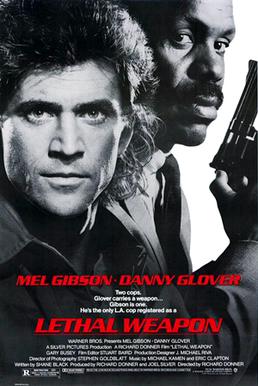
Lethal Weapon

When thinking of celebrities who have fallen from grace, a good place to start is with Mel Gibson.  It's hard to think of another celebrity who was as universally popular as Gibson was only to fall hard and fast under a long list of embarrassing public incidents. The criticism started with his Passion of the Christ as questions arose about his message in the movie, and it went downhill from there.  The anti-Semitic issue came full front in some of Gibson's drunken rages in the years since, and for the most part he's disappeared from the limelight.

It's just hard to believe that someone as popular as Gibson could do something so stupid.  It goes to show you that as moviegoers and fans of celebrities, we can pretend all we want that we "know" these people, but if anything we know their on-screen personality and most often, not their real personality.  With Gibson, it is easier to think of Mad Max, William Wallace, and overall one of the biggest and most bankable stars of the 1980s and 1990s.  Of all his roles though, one recurring character stands out from the rest, his crazy cop Martin Riggs in the four Lethal Weapon movies, starting first with 1987's Lethal Weapon.

Sergeant Roger Murtaugh (Danny Glover) is a veteran cop in Los Angeles with a wife and four kids waiting for him at home.  Just having turned 50, Murtaugh is a good cop if a cautious one.  Sergeant Martin Riggs (Gibson) is a younger narcotics officer on the force struggling to cope with the recent death of his wife. Rumors throughout the LAPD linger that Riggs is suicidal so no one wants to work with him.  Unfortunately for Murtaugh, that's just what he gets as the two cops with very different styles are partnered together on a prostitute's murder.  Murtaugh and Riggs feel each other out, figuring out how the other one operates, all the while the evidence building up and the clues pointing to an immense drug and prostitution ring that dates back to some shady dealings during the Vietnam War. Can Murtaugh and Riggs work together to take the ring down?

If you have never heard of a buddy cop movie, this is the movie to start with.  And two, if you haven't heard of a buddy cop movie, what's wrong with you? Where have you been?  The formula is simple and was used before Lethal Weapon and has been used since LW, but it's rarely been handled as perfectly as it was in this 1987 action classic.  Pair two opposites together in some dangerous situation, let them fight things out as they discover all their differences, work together to solve a crime or case, let them bond through said differences, and let the entertainment values shoot up.  When handled correctly, the buddy cop movie is that perfect mix of action, drama and humor.  The 1980s were rampant with movies like this, but few are as good as the original Lethal Weapon.

For starters, instead of focusing on an overload of pointless shootouts, director Richard Donner focuses a majority of the movie on his two main characters. Without the development that comes out in these characters over the course of the movie, we're left with two cardboard cutouts of police officers.  One, the family man cop, and two, the livewire cop with a death wish.  Instead, Donner fleshes Murtaugh and Riggs out.  Yes, Murtaugh is a family man concerned about who his daughter's dating, the boat sitting in his driveway, and he complains about his wife's cooking.  Yes, Riggs is suicidal after his wife's death in a car accident.  But there's more than just that for both men.  By the end of the movie -- and into the three sequels -- we actually get a feel for who these two police officers are.

That's what separates Lethal Weapon from just about any other buddy cop movie you're going to see.  Amidst the humor and action, it's just a good, solid, well-written and well-made movie.  Gibson -- awesome 80s mullet and all -- was rarely better than he was here.  He's crazy, but he's a damn good cop too.  Glover isn't quite the straight man because he gets his fair share of laughs (his 'I'm getting too old for this shit' line is priceless) playing off of Gibson.  As separates, they're both great characters, but working together it takes the movie to another level.  For every scene where they bitch back and forth at each other, there's another endearing scene where they talk things out, realize they're after the same thing, and end up becoming not just partners, but friends.  It's not as sappy as I've made it out to be, but you get the idea.  Gibson and Glover carry the movie.

All the touches of a buddy cop movie are there though, not just the two leads.  You obviously need some particularly nasty villains, and Mitchell Ryan and Gary Busey certainly fill those shoes nicely as a former Special Forces general turned drug dealer and his head man, now working as a mercenary. The action is top-notch throughout, especially a Mexican standoff in the desert with Riggs and Murtaugh going toe to toe with Ryan's crew.  The finale between Gibson and Busey is epic, one expert fighter against another expert fighter in hand-to-hand combat.  I loved it all, the very 80s soundtrack, the action, the characters.  It's that perfect dose of action, drama and humor, and I look forward to seeing the sequels.

Lethal Weapon <---trailer (1987): ****/****

Wednesday, January 19, 2011

Fate is the Hunter

When I think of disaster movies, I think The Poseidon Adventure and other 1970s epically bad but still enjoyable movies with huge casts of stars and dated special effects.  Through the 1950s and 1960s, disaster movies were made, just not on the same scale.  Only part of 1964's Fate is the Hunter really matches up with any of the criteria for a disaster flick, but it foreshadows what was to come in the coming decades as audiences watched planes crash, earthquakes tear apart the world, towering buildings go up in flames and much, much more.

Director Ralph Nelson takes control of the helms here in this quasi-disaster flick which is both ahead of its time in storytelling but also very dated at times.  Nelson is one of those hidden gems of a director you stumble across every so often.  He was never pigeon-holed into one specific type of movie and ended up directing films across countless genres.  Action, western, drama, comedy, message movies, he tried them all and did them all well.  Never flashy but always getting the job done in above average fashion, Nelson doesn't have a true classic to his name, but his filmography is nonetheless littered with worthwhile movies.

On a flight from Los Angeles to Seattle, veteran pilot Capt. Jack Savage (Rod Taylor) and his crew run into mechanical problems and are forced to crash land on a beach, the jet airliner exploding on contact with a pier running across the beach. Everyone on board other than one stewardess (Suzanne Pleshette) is killed, and the public, the corporation, and the media want answers.  What happened that caused Savage to attempt such a difficult maneuver? All evidence points to pilot error being the cause, but airline executive, former pilot and friend of Savage's, Sam McBane (Glenn Ford), thinks something else happened. Time is running out though, and McBane must prove Savage's innocence before a board of inquiry pins the blame on the deceased pilot.

Wasting little time surprising the viewer, Nelson kills off star Rod Taylor before the credits even roll.  Just when you think Taylor's Savage has successfully landed his jet airliner carrying 49 passengers...BOOM! The plane explodes, and 'Fate is the Hunter' pops up on the screen.  Talk about a tone-setter. No worries though for Taylor fans, this is not the last we'll see of him.  His involvement in the movie from there on in besides his character being constantly talked about is through flashbacks that flesh him out as an individual.  It's those little bits of character that should help us decide if this experienced, always calm and capable pilot was really incapable of dealing with what seemed like a minor mechanical issue.  Long story short, don't miss the first 10 minutes, or you'll be lost.

The problem any movie faces when it has such a strong start is sustaining that energy over the length of the movie.  That's where 'Hunter' struggles.  The investigation is interesting enough because it's hard not to be curious about what actually caused the plane to malfunction in such a surprising way.  But Ford's questioning gets tedious quickly.  The flashbacks are beyond tedious and serve only to make Savage more of a 3-D character.  After the first flashback, it becomes too much.  We get it.  He's a good pilot who is cocky, arrogant, not always likable and quite the ladies man.  But is a movie really going to peg Taylor as a boozehound who caused the deaths of over 50 people? I think not.  It's not a matter of if, it's a matter of how Taylor didn't crash the plane because he was drunk. 

Worse than that though (as a Lost fan I can appreciate even the slowest of flashbacks) is the direction Ford's character and the story takes overall in the final half hour.  Now granted, the word 'Fate' is in the movie's title.  As the evidence comes together and Ford's McBane talks to all these possible witnesses, he begins to question if maybe, just maybe, fate played a role in that plane crashing.  An out of season bird may have flown into the engine, three other planes were all off-schedule by a few minutes, the pier was supposed to have been removed a week earlier, it just doesn't add up.  Was something else at play here? Ford's testimony is even worse when he admits all this.  I can't tell if it is just all too sappy or handled poorly, but if Nelson was trying to deliver a message with this change in direction it didn't work.  I haven't read the source novel to know one way or another, but the ending disappoints on a lot of levels.

The redeeming factor through all the negatives is the impressive cast assembled here.  Ford is never flashy but is as reliable as always with Taylor making the most of his posthumous part...in character at least. Pleshette has a small but integral part (and looks great by the way). Also look for Nancy Kwan, Constance Towers, Jane Russell in a cameo as herself in 1945, Nehemiah Persoff, an uncredited Dorothy Malone, Max Showalter, Wally Cox and many more recognizable faces even if you don't know their name. Other than the cast and some nice-looking black and white camerawork, I struggled to get through this movie.  Potentially good but never amounts to anything much.

Fate is the Hunter <---trailer (1964): **/****

Tuesday, January 18, 2011

The Killer

My lone experience with director John Woo has been in his ventures into the U.S., most notably Mission: Impossible 2 and Face/Off.  Neither are classic movies, but I enjoyed both of them.  That's not to say I'm not aware of Woo's other movies, I just never sought them out.  As a fan of just about any sort of action movie, I've stumbled across his name countless times, and finally got around to actually watching one of his non-American movies.  I started at the top with most likely is most well-respected -- critically and among fans -- movie, 1989's The Killer.

Above all else, Woo is known for an ability to assemble an action sequence like few others can. As a fan of director Sam Peckinpah, I thought I had seen my fair share of epic slow-motion violence accompanied by excessive, graphic uses of blood squibs.  Well, that was until I saw this flick.  Some of the best, most interestingly choreographed gunfights I've ever seen dominate the movie.  Woo must have been impacted by Peckinpah's movies -- especially The Wild Bunch -- because not only is the effect felt on the action, but on the story too.  Here though instead of the wild west, it's Hong Kong with hired killers filling in for aging gunfighters.  Dealing with similar themes and topics, The Killer is must-see for action fans, especially anyone familiar with Peckinpah.

After years of working as a hired killer, Ah Jong (Chow Yun Fat) has grown tired with the business as the realization what he's done during his career wears him down. He has unwillingly taken on one more hit, a high-ranking mob official with ties in the government mostly out of guilt.  During a recent hit, a beautiful young singer, Jennie (Sally Yeh) was blinded, and Jong intends to use the money he earns helping her pay for a vision-repairing surgery. The hit is a set-up though by his superiors, and Jong barely survives. He manages to escape though but is now facing problems on all sides.  The mob and a hit squad is closing in, he doesn't have the necessary money for Jennie's surgery, and a persistent but similarly disillusioned cop, Inspector Ying (Danny Lee), is hot on his tail. There's only one way out for Jong, and that's doing what he does best, picking up a gun again.

My first reaction reading the plot of this movie was a little disappointed.  This was a story seen in countless other cop/crook movies like Heat, The Boondock Saints, and any number of Melville crime thrillers from the 1960s and 1970s.  And really, Woo doesn't bring anything new to the table.  The story is solid if unspectacular, but Woo is so clearly comfortable with the setting that it works in spite of the 'been there, done that' feel to it.  It deals with issues that are regularly seen in westerns, men with a code of honor and living, making the right decision regardless of the difficult consequences.  They are brothers in arms who bond through their similar beliefs, principles and actions.  The end result is a costly one often enough, but for these men sacrificing for what they believe is right is worth it when all is said and done.

Besides the action, the biggest similarity The Killer has to The Wild Bunch is the relationship between the two main characters.  Where William Holden and Robert Ryan played the roles originally, Yun Fat and Lee are channeling those two American actors.  Yun Fat is the troubled killer struggling desperately to get away from the life and profession he is so good at.  He has no equal but lives by a code that allows him to continue to kill, hopefully dispatching the bad and not the good.  Lee is the police inspector fed up with the behind the scenes politicking on the force.  In Ah Jong, his Ying sees everything that could be right with such a bizarre profession.  Ying chases and chases, but by the end these two not so different men are fighting alongside the other, not against each other.  The relationship provides some touching moments as the duo faces almost certain death, including an incredibly moving ending.

Just like Peckinpah though, Woo clearly has a fascination with violence and its depiction.  Peckinpah became synonymous with extreme, graphic, slo-mo violence, and Woo follows suit.  A 'ballet of death' indeed. The action through the first hour is solid but nothing too memorable.  The last 30-45 minutes take this movie to another level with two extended shootouts, starting HERE with Jong and Ying battling a small army of hit-men. As good as that firefight is, the scene that has become one of the more iconic shootouts in movie history is the finale in a candle-lit church with slow-motion, blood squibs and symbolic white doves flying through the scene.  Watch it HERE (SPOILERS obviously) and continue it into Part 11.

Some directors just know how to direct action, and this is Woo at his absolute best.  The action is so over the top and ridiculous that it borders on the cartoonish, but because Woo and his cast and crew commit to what's happening on-screen it avoids becoming cliched.  This style of action/violence clearly has impacted just about every action movie released in the 20-plus years since, and it's easy to see why.  Stylish in a way that somehow makes the graphic depictions of violence like a work of art, the church shootout is one of the best action sequences ever.  The ending delivers one cruel twist of fate to a key character (I'm cynical, but it even bothered me in how cruel it is), but the final shot of the movie will almost certainly hit you square in the stomach.  Surprising? No, but it's moving even knowing what's about to happen.  An action classic and a great introduction to the films of John Woo.

The Killer <---trailer (1989): *** 1/2 /****

Sunday, January 16, 2011

The Last Mile

I've always believed one of the best things about movies is that they let you get away from everything, just sit back and enjoy something entertaining for a few hours if you so choose.  They let you step into the shoes of someone else, something else, anything.  You can be an astronaut, a cop, a businessman, a gunfighter, name a profession and there's most likely a movie out there about it.  But what about the movies that aren't specifically made to entertain, but instead deliver a message, an objective of some kind?  That's mostly what I thought about while watching 1959's The Last Mile.

Have you ever wondered it would be like to be a Death Row inmate awaiting your coming death, those last few days, hours and minutes both flying by and dragging at the same time?  I can't say I have, but it's an interesting premise.  People die from any number of things, some by surprise and quickly in car accidents or as innocent bystanders.  Others pass on from medical issues, diseases that ravage your body.  But what about an individual who did something so horrifically wrong that they too are sentenced to die for their actions?  All they can do is wait and wonder...what if?  That's this movie, an unsettling look at life in the death house, the prisoners awaiting their final judgment in the electric chair.

Sentenced to death for a murder he committed, Richard Walters (Clifford David) is assigned to Death Row, the aptly titled 'Death House' where all prisoners awaiting corporal punishment are held. Walters is just two weeks away from his date with the electric chair and has nothing to do but sit back and wait, pondering all the thoughts that race through his head in his final days.  It is during these days that he meets and bonds with his fellow cellmates even though he can't see them, only hear them.  He especially forms a bond with his next-door neighbor, Johnny Mears (Mickey Rooney).  As the date of his execution nears, Walters begins to fear that the stay of execution will not come in time, but in the next cell over, Mears has a plan that could save them all, or get them all killed in the process.

Director Howard Koch makes a wise decision in telling this story that's a remake of a 1932 film and loosely based on a real-life incident in a Southwestern prison. With eight cells in 'the death house,' it would have been incredibly easy to vilify these main characters.  It's safe to assume if you're awaiting your execution, you've done something horrific to get to that point.  But with a movie meant to condemn the unnecessary brutality of the prison system, you just can't delve into the crimes these men have committed if as a director you want the viewer to have any sort of sympathy for these men.  We find out Walters killed a man -- he claims he didn't mean to -- but never the circumstances or situation that prompted the act.  It's a wise choice in story-telling because when the sh*t does hit the fan, you're oddly drawn to these Death Row inmates.

Filmed in black and white with minimal sets -- the eight cells of the death house dominate the movie -- Koch's movie has the distinct feel of a stage play.  The camera rarely ventures into the cells, choosing to stay on the other side of the imposing bars of the cell.  The black and white camerawork keeps everything in the shadows, the prisoners hiding in the darkness of their cells, the guards lurking around just out of sight.  It's an incredibly uncomfortable movie to watch, seeing men waiting for their death, hopeless waiting for some sort of reprieve.  An early segment shows a prisoner (John Vari) in his final hours, finally being pulled from his chair and sent to the electric chair.  We don't see the results first hand, instead only witnessing the overhead lights flickering as the switch is pulled. It's a startling opening and does a great job of setting the mood for what's to come, especially when Walters' death sentence nears.

The opening credits of the movie list only Mickey Rooney as the star, and for good reason.  This is his movie from the beginning.  He plays Johnny Mears, a condemned killer who is typically quiet, subdued and a calming influence on the other prisoners.  Rooney's stature can throw you off.  He's not tall, and you wouldn't normally think of him as an intimidating, imposing person.  But this Mears character, when he blows, he blows in a big way.  Pushed too far, he takes matters into his own hands leading a violent, take no prisoners approach to the standoff.  It's the type of performance that you just can't take your eyes off of.  Rooney steals the movie, including one of the great final lines and shots of a movie I can remember.  The other prisoners include David, Vari, Michael Constantine, George Marcy, John McCurry, Ford Rainey, Johnny Seven, and Sully Michaels.  They're all relative unknowns, and are good enough in their parts without distracting from Rooney.  Also look for Frank Overton as Father O'Connors, the prison priest, and Clifton James, Red Barry, Leon Janney and Clifton James as the most sadistic guards.

So the story builds and builds, and all the while I'm thinking this could be the most depressing movie I've ever seen.  90 minutes of sitting around listening to a group of men talk about their fear of death?  Rooney's Mears leads a prison revolt that gets bloody very quickly with hostages taken.  It's an interesting balance because Mears and his fellow prisoners stand to lose nothing.  What are the guards and warden going to do? Kill them twice? From the warden's perspective, he can't give in to their demands without causing a domino effect in prisons across the country.  The ending keeps things on line with the whole movie's tone and demeanor, staying cynical to the end.  Stick around until the end credits though because that ending is a whopper of a good one.

The Last Mile (1959): *** 1/2 /**** 

Saturday, January 15, 2011

Drive a Crooked Road

Thanks to a heavy day of programming in late December with movies I'm interested in, I've been on Mickey Rooney overload over the last week or so. That's not a bad thing because as I've pointed out in recent reviews, he's one of my favorite character actors once he grew up into an adult actor.  The latest Rooney flick I reviewed, My Outlaw Brother, wasn't a great showcase for his abilities, but an unknown noir that's slipped through the cracks over the years, 1954's Drive a Crooked Road, certainly does. 

There's nothing about Rooney that upon looking at him screams 'I'm a movie star!' He stood only 5'3 and wasn't a classically handsome guy.  For me though, that's part of his appeal.  He was the anti-star who overcame an early career as a child star to become an adult star.  In this age of failed celebrities, how rare does that actually happen?  He was capable of humor (Mad, Mad World), drama, action, and combinations of the three like his parts in Ambush Bay or The Secret Invasion where he got to ham it up with scenery-chewing parts.  Of all the Rooney roles I've seen though, 'Crooked Road' may be the best.

Working as a mechanic in a Los Angeles garage, Eddie Shannon (Rooney) leads a quiet life.  He rents a small apartment and lives alone, sometimes entering road races on the weekend for some extra cash.  Eddie has a scar across his forehead from an incident in his past, one that clearly troubles him as he goes through his lonely life.  One day, he meets the very beautiful Barbara (Dianne Foster) when she brings her car into the garage Eddie works at.  He can't explain it, but for some reason Barbara is interested in him, and they start seeing each other.  It all seems too good to be true, and it is.  After several weeks, Barbara introduces him to two friends of hers, Steve (Kevin McCarthy) and Harold (Jack Kelly) who have a business proposition for him. Steve has planned the perfect robbery, and all he needs is a skilled driver for the getaway. Torn about what to do, Eddie balances out his feelings for Barbara with the knowledge he's going down a road he can't return on.

If you're not familiar with Rooney or any of his roles, or you are familiar with him and didn't think much of him as an actor, check this movie out.  As Foster's Barbara describes Rooney's Eddie, he is a 'lonely, little animal' who is just looking for some sort of happiness.  His facial scar is left unexplained for the most part other than a throwaway line explaining it was 'part of a car accident.' Maybe that line is truthful, but there is something more to it that we never find out about it.  Was someone else in the car with him, someone he cared or loved about very much?  His Eddie Shannon character doesn't have a mean bone in his body, going about his business quietly even as co-workers (including Jerry Paris, Paul Picerni, Harry Landers and Dick Crockett) poke fun at him.   

What takes this character to another level is his relationship with the very pretty Barbara, someone he clicks with right away.  You can tell through his interactions that he's somewhat skeptical about the developments.  He's burn hurt in the past somehow and isn't quite ready to open up to someone new, even if he does have strong feelings for her.  The tragic character description comes through when Barbara introduces him to Steve and Harold, and you start to question what her motives were all along.  Was it as a favor to old friend Steve, or at any point were there genuine feelings involved?  Pushed too far and already head over heels, Eddie continues because he genuinely cares for her and thinks this is what she wants him to do. Rooney does a fabulous job bringing this character to life, a vulnerable but kind-hearted man just looking for some sort of normalcy, some sort of happiness. He sees his shot -- however slim -- in getting to that point in a relationship doomed from the start.

Something appealed to me about this movie that I can't quite put my finger on, even now a day after finishing it.  Director Richard Quine doesn't do anything too spectacular here, nothing out of left field, but everything from casting to locations to story is handled professionally and capably.  The movie is shot in black and white giving the Los Angeles locations an old nostalgic feel of a time long since passed.  Foster is the femme fatale, the female character you're just not sure of.  She seems perfect early on, basically the ideal woman even though later we find out everything isn't as it seems.  McCarthy plays the impossibly smooth friend/crook who gets Eddie involved in the heist while Kelly plays his partner and heavy doomed to meet a nasty fate.  The heist itself is nothing special and is more of a vehicle to the end than anything else although Eddie's getaway across a desert road is a highlight.

So what worked so well?  All the little pieces add up nicely, but the selling point here is Mickey Rooney.  With a B-movie, a noir like this, I think it would have been hard for Rooney to get anything in the way of recognition from the Academy Awards, but I feel safe saying he certainly deserved a nomination here.  It's an understated performance that doesn't get caught up in theatrics, and credit to Rooney for that.  Like many heist/robbery movies, the heist is actually the easy part, it's the fallout that causes the problems.  It's there where the movie goes into tragic territory. A great part, a moving, heart-breaking ending, and a movie that has been wrongfully forgotten in the years since.

Drive a Crooked Road <---TCM trailer (1954): ****/**** 

Friday, January 14, 2011

The Quiller Memorandum

By 1966, the James Bond phenomenon had taken over the world with the huge successes of Dr. No, From Russia With Love, Goldfinger and Thunderball.  Audiences wanted more spy movies, and studios obliged them whenever they could.  A wall of international intrigue movies hit theaters ranging from Bond knockoffs to spoofs like the Matt Helm and Derek Flint series to attempts that took a more serious approach to the spy genre, including 1966's The Quiller Memorandum.

This is the anti James Bond movie, a spy story focusing on the more subtle but still very dangerous life of a espionage agent.  There is no globe-trotting heroics, no ridiculously over the top shootouts and chases, no bedding down of countless women, just a good old-fashioned story of a spy with a dangerous mission that could easily cost him his life.  You know what though? All those things about the Bond series that viewers typically either hate or love...they were fun to watch.  That's missing here.  It's a dull transition to the screen from a novel by Trevor Dudley Smith that lacks anything in the way of excitement or thrills.  I'm all for more realistic spy movies, but at least make them enjoyable to sit through.

Two British agents in post-WWII Berlin have been murdered so a new American agent, Quiller (George Segal), is brought in to pick up the investigation where his predecessors left off. His superior, Pol (Alec Guinness), tells him something else about the mission that could put him in even more danger.  Both murdered agents were investigating the possible reemergence of an extremist Nazi group that wants to again claim power in Germany. If possible, Quiller must infiltrate this Nazi group (headed by Max von Sydow) and find their hideout before any of their plan can take effect. One of the few clues Quiller has though to get close to the group is a schoolteacher, Inge (Senta Berger), who may or may not know more than she's letting on.

There was a lot about this movie that appealed to me.  The setting of post-World War II Berlin is a really unique to tell this hard-boiled story that remains rooted in a believable plot, not a plan to take over the world.  Director Michael Anderson is a visual director, using some great on-location shoots as Segal's Quiller explores Berlin looking for clues.  I've never thought of Berlin as a particularly pretty city, but the locations here are a great scene-setter and background.  It's refreshing also to see a spy movie so heavy on dialogue -- and good, snappy dialogue at that -- instead of relying so heavily on babes and action.  Visually, a great movie to watch and listen to when it's 'on' but not always an exciting movie to watch.

That last part surprised me because with the cast involved and the basic premise, it sounded like a real winner.  A second Nazi party looking to regain power? Now that's a prime villain if there ever was one.  Maybe the movie's best scene are these Nazis including von Sydow interrogating Segal in a great, very unique scene unlike any other interrogation I've seen in a movie.  Watch it HERE. That's the whole movie though, great moments broken up by long periods of nothing.  There is no real plot to begin with, and Segal's Quiller makes some unbelievably stupid decisions for someone who is considered such a top spy.  His character drifts along and stumbles into clues rather than deducing anything for himself.  Add in an oddly out of place and overbearing John Barry score, and the plotline is cartoonish with this blaring music being played over it.   

I don't fault Segal for bad acting here because it's the writing, not his acting.  His Quiller is just not a very strong main character.  A very capable spy by reputation, he makes decision after decision that should have ended with him getting a bullet in the head yet somehow he survives time and time again.  I have always liked Segal as an actor, but this wasn't his best part.  His romance with the lovely Senta Berger never goes anywhere and has a forced feeling to it.  They've got a decent chemistry together, but the story gets bogged down in their romantic interludes.  Worst of all, a somewhat coherent twist late in the movie between the two characters is so poorly handled that it misses having any impact.  The movie just ends with no resolution, or not one I was satisfied with.

Now I can't say I was surprised by the positives in this movie, both of them..Guinness and von Sydow.  Guinness' part as Pol is nothing more than three or four scenes that probably total 10-15 minutes on-screen, and he steals every scene he is in, especially an explanation of the trials Quiller will face from both sides.  Underused, sure, but what's there is choice.  Playing a steely-eyed, blonde and blue eye Nazi villain, who is better than von Sydow? His character is pretty one-note with no surprises, but he brings such a feeling of menace and intensity to it you can't help but remember his smallish part. Also watch for George Sanders in a humorous cameo as a higher-up agent in London. 

The Quiller Memorandum <---trailer (1966): **/****