The names of the U.S. Presidents are instantly recognizable, names synonymous with the history of the United States, especially that building where the president leaves, whatever it's called. The White House I think? What about all the people who work at the White House, who keep the place running? And no, it's not just the nameless/faceless individuals who get killed during terrorist attacks in movies like White House Down and Olympus Has Fallen. I kid of course as we jump into 2013's Lee Daniels' The Butler, the true story of one of the White House's longtime butlers.
Growing up as a young boy with his sharecropping family in 1926 Georgia, Cecil Gaines has his outlook on life forever impacted when his father is shot down by a white man, the land owner where the family work, after raping his mother. Cecil is taught to be a house worker, a butler, and grows up finding jobs here and there working as a butler for the rich and well-to-do, eventually ending up at a Washington D.C. hotel. It isn't long before a grown-up Cecil (Forest Whitaker) has created quite a reputation for himself, earning an interview and eventually a full-time job at the White House, working with the sizable staff to make sure the President's home is a crisp, clean operation on a day-to-day basis. It's the late 1950s though, America heading into a turbulent time in its young history. Cecil has an inside look at America's involvement at home and internationally, all the while trying to raise a family with his wife, Gloria (Oprah Winfrey).
This wasn't a movie I was dying to see, but I was nonetheless curious, even intrigued to see it. Loosely based on the true story of Eugene Allen, 'Butler' is director Lee Daniels' second film since his 2009 movie, Precious, that really put him on the map. It received pretty solid reviews and was a surprise success in theaters, earning over $167 million. I'm not really sure what to take away from it overall. I can appreciate what the message is going for, what it's trying to stand for and say about American history, yet that said, I didn't especially like it. What it's trying to do is admirable. What it accomplishes? Still mulling that over. Some of that can be chalked up to the script which tries to accomplish a ton in a 132-minute movie.
What I didn't question was Forest Whitaker in the lead role. Playing Cecil Gaines, Whitaker is our window as an audience into a whole lot of American history. We see his mindset, his frustrations, his motivations, his friendships, his rivalries, all of it. It isn't a flashy part, far from it, just a very straightforward, effective part. Whitaker's Cecil is a family man who wants to provide for that family, especially his wife, Gloria, struggling with alcoholism as she misses Cecil, his oldest son, Lewis (David Oyelowo, a good performance with some odd moments as a 37-year old playing a 15-year old), who dives headfirst into the civil rights movement, and his youngest son, Charlie (Elijah Kelley). His narration as a lead characters gets to be a little heavy-handed at times, but that's the script and not on Whitaker's shoulders. A very solid performance for Whitaker, a man trying to get by and live in some extremely turbulent times.
Beyond the family though, the supporting cast is mostly a long list of historical characters and bit parts that aren't around long enough to resonate. We meet a handful of Presidents including Dwight Eisenhower (Robin Williams), John F. Kennedy (James Marsden), Lyndon B. Johnson (Liev Schreiber), Richard Nixon (John Cusack) and Ronald Reagan (Alan Rickman), even meeting Nancy Reagan (Jane Fonda). These little episodes are pretty cool, but they're also gone as quick as they started. Because of that pacing issue, these scenes, appearances and story developments aren't as effective as they could and should have been. In storytelling technique, 'Butler' reminded me of the classic Forrest Gump, bouncing around to a lot of stories, a lot of key moments in American history, the story giving us a window into those moments. Where Forrest Gump blended the humor and drama though, 'Butler' stays on the dramatic path, and it wore on me. This can be a heavy, dark movie to get through at times.
Give the movie credit. It tries to do a lot. Ultimately though, I felt like it tries to do too much. A story focusing on Cecil's 30-plus year career at the White House would have been fascinating in itself. The same for a man trying to care for his family through the turbulence of the Civil Rights movement, into Vietnam and beyond. Doing both ends up making things too bouncy to the point neither story gets the attention it deserves. Much time is spent with Oyelowo's efforts in the Civil Rights movement, Cecil and Gloria worried and angry back home. Moments that feel like they should resonate well and carry the movie feel rushed, not letting those moments breathe. Much like the recent The Monuments Men, this feels like a story that would have been better suited to a miniseries. The effort is admirable, the execution tolerable. Moments like Cecil interacting with his fellow butlers (Cuba Gooding Jr. and Lenny Kravitz) ended up resonating more with me than most of the far-more dramatic scenes. Also look for Terrence Howard , Mariah Carey, Alex Pettyfer, Vanessa Redgrave in odd, out of place parts.
That's the biggest issue. It doesn't pick a route and stick with it. Moments that work among portions of story that drift too much, kinda a necessity with a story that covers six decades in a man's life. I also resented something from the final scene, a written, on-screen message thanking all the men and women that have helped gain "our freedom." As a white individual, this message hit me the wrong way, and I admit I may be over-analyzing. Is this a movie meant solely for an African-American audience? Should I not be watching this movie? It's a mixed bag in the end, a generally interesting movie that ultimately doesn't live up to its potential.
Lee Daniels' The Butler (2013): ** 1/2 /****
The Sons of Katie Elder
"First, we reunite, then find Ma and Pa's killer...then read some reviews."
Thursday, March 13, 2014
Wednesday, March 12, 2014
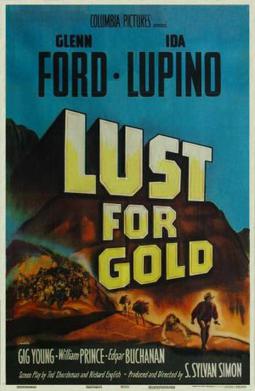
Lust for Gold
As Gordon Gekko profoundly said, 'Greed is good.' One of the all-time great films dealing with one of the seven deadly sins was released in 1948, Treasure of the Sierra Madre, a frightening look at what gold can do to one's minds. It's one of the all-time classics, making 1949's Lust for Gold an odd choice. Was it an effort to build off its success? Whatever the reason, it doesn't work despite some potential.
It's 1948 in Arizona, a treasure-hunter of sorts, Barry Storm (William Prince), is walking through the Superstition Mountains looking for a supposedly long-lost mine, the Lost Dutchman. He's actually following a famous treasure hunter who states he's got the mystery figured out, but Storm is stunned when he hears a gunshot and soon after finds the treasure hunter dead. He walks to the nearest town, still several days away, to report the murder, quickly realizing this isn't some innocent old treasure hunt. Storm is quickly cleared of suspicion, but his interest makes some curious as he claims to be the grandson of the original owner of the Dutchman mine. As the police waits for a break in the case, Storm sits back and listens to the legendary story of how the mine came to be, including how his grandfather, Jacob Walz (Glenn Ford), came to be involved.
This was an interesting movie, not always for the good. From director S. Sylvan Simon (and an uncredited George Marshall), 'Lust' does have its positives and negatives. It plays at times like a pseudo-documentary, a film noir meets a rough and tumble western. Unfortunately, it never really gels as one coherent film. I liked the framing device in the story, a 90-minute story split about 55 (the Glenn Ford part) and 35 (the 1948 part) divvying things up appropriately. It comes with a message from the state of Arizona -- almost like a Welcome Guide, "Come and see Arizona!" -- stating that the mine is still out there somewhere. It is based off a book by the real Barry Storm, called Thunder Gods Gold, and it plays like a pandering effort to sell some copies of the book. Prince's Storm's narration is a little much too, almost an attempt to sound like a James Cagney-esque gangster. "The gold's out there, I tells ya! Don't believe me, eh?!?"
Oddly enough though, I enjoyed the 1948 portion of the story far more than the 1885 portion. Prince is okay as the intrepidly curious Storm, jobless and interested in finding the lost mine that's supposedly filled with literally tons of gold. The film noir in the desert plays well, dead bodies and potshots piling up over the years as treasure hunters supposedly near the location of the lost mine. In addition to Prince, look for Paul Ford as the local sheriff with Will Geer and an uncredited Jay Silverheels (later Tonto on The Lone Ranger) as his two deputies. The mystery builds nicely and when things wrap up back in 1885, we get some solid resolution. The ending was pretty exciting, wrapping things up that the first 20-25 minutes set up.
Surprising for me was how dull the actual 1880 Arizona western was. It starts off well, greed, murder and betrayal introduced early to the point I thought I had stumbled onto a hidden gem from a genre I love. Well, I didn't. The story detours quickly and is never able to recover. Glenn Ford gets a rare turn as a bad guy -- an out and out bad guy -- but it's wasted because after he finds the gold mine by some rather duplicitous means (read = Murder) the story hamstrings the character as it devolves into a forced love triangle with Ida Lupino's Julia and her husband who she fights with constantly and would like to divorce, played to smarmy annoyingness by Gig Young. Wait, she loves her husband, but she doesn't because she loves Jacob but she doesn't love him either. Gag me, the story goes nowhere, turning a potentially really good story about what greed can do to people into a lame, glacially-moving love triangle. A love triangle of sorts. You've gotta be kidding me.
In the flashback portion, also look for Edgar Buchanan as a grizzled old trail hand working with Ford's Jacob and uncredited parts for Arthur Hunnicutt and Antonio Moreno as two rivals who may hold the key to the location of the lost gold mine. Even western veteran John Doucette turns up for a quick appearance in a barber shop talking about how much gold may be out there.
There are parts that worked surprisingly well. The explanation of how the gold came to be in the mine is a gem, an Apache war party descending on a heavily-guarded escort in a surprisingly graphic action scene. The same for the intro to the 1880s flashback, Glenn Ford's Jacob straight up murdering folks. How many movies can you say that about? Glenn Ford is a good guy for goodness sake! The ending in the flashback has some potential too, but by then I was so bored with the Ford-Lupino-Young part of the story I just didn't care. A movie that has its moments, but not enough of them unfortunately.
Lust for Gold (1949): **/****
It's 1948 in Arizona, a treasure-hunter of sorts, Barry Storm (William Prince), is walking through the Superstition Mountains looking for a supposedly long-lost mine, the Lost Dutchman. He's actually following a famous treasure hunter who states he's got the mystery figured out, but Storm is stunned when he hears a gunshot and soon after finds the treasure hunter dead. He walks to the nearest town, still several days away, to report the murder, quickly realizing this isn't some innocent old treasure hunt. Storm is quickly cleared of suspicion, but his interest makes some curious as he claims to be the grandson of the original owner of the Dutchman mine. As the police waits for a break in the case, Storm sits back and listens to the legendary story of how the mine came to be, including how his grandfather, Jacob Walz (Glenn Ford), came to be involved.
This was an interesting movie, not always for the good. From director S. Sylvan Simon (and an uncredited George Marshall), 'Lust' does have its positives and negatives. It plays at times like a pseudo-documentary, a film noir meets a rough and tumble western. Unfortunately, it never really gels as one coherent film. I liked the framing device in the story, a 90-minute story split about 55 (the Glenn Ford part) and 35 (the 1948 part) divvying things up appropriately. It comes with a message from the state of Arizona -- almost like a Welcome Guide, "Come and see Arizona!" -- stating that the mine is still out there somewhere. It is based off a book by the real Barry Storm, called Thunder Gods Gold, and it plays like a pandering effort to sell some copies of the book. Prince's Storm's narration is a little much too, almost an attempt to sound like a James Cagney-esque gangster. "The gold's out there, I tells ya! Don't believe me, eh?!?"
Oddly enough though, I enjoyed the 1948 portion of the story far more than the 1885 portion. Prince is okay as the intrepidly curious Storm, jobless and interested in finding the lost mine that's supposedly filled with literally tons of gold. The film noir in the desert plays well, dead bodies and potshots piling up over the years as treasure hunters supposedly near the location of the lost mine. In addition to Prince, look for Paul Ford as the local sheriff with Will Geer and an uncredited Jay Silverheels (later Tonto on The Lone Ranger) as his two deputies. The mystery builds nicely and when things wrap up back in 1885, we get some solid resolution. The ending was pretty exciting, wrapping things up that the first 20-25 minutes set up.
Surprising for me was how dull the actual 1880 Arizona western was. It starts off well, greed, murder and betrayal introduced early to the point I thought I had stumbled onto a hidden gem from a genre I love. Well, I didn't. The story detours quickly and is never able to recover. Glenn Ford gets a rare turn as a bad guy -- an out and out bad guy -- but it's wasted because after he finds the gold mine by some rather duplicitous means (read = Murder) the story hamstrings the character as it devolves into a forced love triangle with Ida Lupino's Julia and her husband who she fights with constantly and would like to divorce, played to smarmy annoyingness by Gig Young. Wait, she loves her husband, but she doesn't because she loves Jacob but she doesn't love him either. Gag me, the story goes nowhere, turning a potentially really good story about what greed can do to people into a lame, glacially-moving love triangle. A love triangle of sorts. You've gotta be kidding me.
In the flashback portion, also look for Edgar Buchanan as a grizzled old trail hand working with Ford's Jacob and uncredited parts for Arthur Hunnicutt and Antonio Moreno as two rivals who may hold the key to the location of the lost gold mine. Even western veteran John Doucette turns up for a quick appearance in a barber shop talking about how much gold may be out there.
There are parts that worked surprisingly well. The explanation of how the gold came to be in the mine is a gem, an Apache war party descending on a heavily-guarded escort in a surprisingly graphic action scene. The same for the intro to the 1880s flashback, Glenn Ford's Jacob straight up murdering folks. How many movies can you say that about? Glenn Ford is a good guy for goodness sake! The ending in the flashback has some potential too, but by then I was so bored with the Ford-Lupino-Young part of the story I just didn't care. A movie that has its moments, but not enough of them unfortunately.
Lust for Gold (1949): **/****
Labels:
1940s,
Arthur Hunnicutt,
Edgar Buchanan,
Gig Young,
Glenn Ford,
Ida Lupino,
westerns,
Will Geer
Tuesday, March 11, 2014
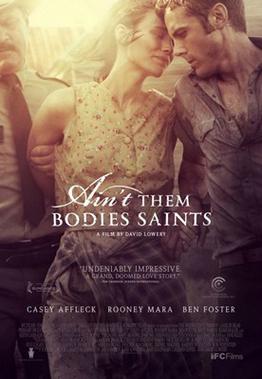
Ain't Them Bodies Saints
I'll make a bet with you. I swear I'll pay up too if I lose. I would wager that David Lowery is a fan of two things. One, he's a fan of the films of Terrence Malick, few though they are. Two, he grew up watching 1970s crime thrillers set in the South, including Texas. How do I know this you ask? I watched Lowery's film that he directed and wrote, 2013's Ain't Them Bodies Saints, a film with obvious influences from both of the above.
After a botched robbery that resulted in a police officer getting shot, outlaw Bob Muldoon (Casey Affleck) is sent to prison with a 25-to-life jail sentence. He took all of the guilt and blame for the robbery and the shooting, his pregnant wife, Ruth (Rooney Mara), a willing participant and the one who actually shot the officer. Years pass, Ruth has a baby daughter, and life moves on of sorts, Bob writing her almost every day from prison as his sentence wears on. After three-plus years go by, Ruth is shocked when the police arrive to tell her something....Bob has escaped from prison. Does she know anything about the escape, his intentions or where he's heading? Ruth maintains that Bob wants nothing to do with her, holding back the truth, but she knows her husband is coming back to bring them with on a new life. Does Ruth want to go?
When I saw this trailer last spring/summer for this movie, I was immediately intrigued. The visual, the lyrical story, the small-time crooks, all those different stylistic choices, I was convinced this was a film from director Terrence Malick. Convinced of it. I was wrong, Lowery both writing and directing this 2013 film. The influences though are obvious from Affleck's ethereal, dream-like narration, the long shots of open fields and grass blowing in the wind, the music from composer Daniel Hart that's almost trance-like, soothing and calming with an ever-growing sense of doom and dread. It reminded me of Malick's Badlands, of the more recent Cold Mountain, and of countless movies set in the South and in Texas, different worlds when it comes to movie portrayals, especially with crime stories. It's a different sort of crime here, more personal and on a smaller scale.
So what doesn't add up? I....don't....know. Okay, that's not fair, I know, but I'm struggling to explain it. All I can I come up with is this, 'Bodies' doesn't create its own identity. It feels familiar, like we've seen this countless times before. It's too familiar. More than that though, 'Bodies' depends on that familiarity. Lowery's script isn't interested in explaining or in some cases, even addressing how the story develops. It drifts from scene to scene without transitions, scenes of nature and sunsets and grassy hills serving as those transitions. The story is equal parts too fast and too slow because of those seemingly missing scenes that just ain't there. I'm going down a slippery slope here in my criticism. Stories like this force critics' hands. Is it smart because it doesn't spell everything out for us? Or is pretentious, using that as an excuse to gloss over flaws in a story? Lyrical, dream-like only goes so far when those missing gaps are key to....well, everything.
The biggest fatality is the characters. At no point did I feel like I was really invested in any of these characters. Affleck is hit the hardest, his Bob Muldoon going from possibly a tragic anti-hero to a rambling, angry husband and father who may not be all there. Affleck's Bob has two rambling monologues that other characters interrupt to correct/question, painting Bob as something else than we're seeing. Getting out of this unscathed, even representing herself very well, is Mara (a rising star in Hollywood) as Ruth, an almost single mother who's tortured by a decision that tore the family apart. Her scenes with her daughter, Sylvie (played by twins), are effective and moving, especially as she sees this new life she's got isn't so bad. Also coming away looking good is Ben Foster as Patrick Wheeler, the police officer who Ruth shot but Bob took the wrap for. Years later, he's drawn to Ruth, not knowing the truth. Mara and Foster are very good together, the high point in the acting department.
With a small cast, there's really only two other parts worth mentioning. Keith Carradine is misused as Skerritt, an obvious influence on Bob and Ruth growing up....but, yeah, that's all. This is another huge hit because of the script. It's hinted that Skerritt ran some sort of gang in the past -- Bob, Ruth, even his own son included -- and was almost a surrogate father. That's all though. Hinted at isn't enough, too much mystery out there when even a little detail would have gone a long way. Another solid part is from Nate Parker as Sweetie, a bar owner who has a past with Bob, possibly working with him in some criminal undertakings.
No doubt about it, some moments do work. Without anything said or spelled out, it seems the story is set in the 1970s. The folksy musical score underplays the story and what little action there is. A nighttime ambush by three bounty hunters/hired guns with Bob is chaotic and crazy, a chase ensuing with fast-paced, backroads Cajun music playing with it. It isn't enough though, the moments not adding up to a worthwhile package. When things truly fall apart in the finale, we're supposed to feel something, but it's just not there. I was never invested in the characters or their goals or concerns so when the inevitable downbeat ending comes along, it falls short. A disappointing negative review because there was potential for an interesting movie.
Ain't Them Bodies Saints (2013): **/****
After a botched robbery that resulted in a police officer getting shot, outlaw Bob Muldoon (Casey Affleck) is sent to prison with a 25-to-life jail sentence. He took all of the guilt and blame for the robbery and the shooting, his pregnant wife, Ruth (Rooney Mara), a willing participant and the one who actually shot the officer. Years pass, Ruth has a baby daughter, and life moves on of sorts, Bob writing her almost every day from prison as his sentence wears on. After three-plus years go by, Ruth is shocked when the police arrive to tell her something....Bob has escaped from prison. Does she know anything about the escape, his intentions or where he's heading? Ruth maintains that Bob wants nothing to do with her, holding back the truth, but she knows her husband is coming back to bring them with on a new life. Does Ruth want to go?
When I saw this trailer last spring/summer for this movie, I was immediately intrigued. The visual, the lyrical story, the small-time crooks, all those different stylistic choices, I was convinced this was a film from director Terrence Malick. Convinced of it. I was wrong, Lowery both writing and directing this 2013 film. The influences though are obvious from Affleck's ethereal, dream-like narration, the long shots of open fields and grass blowing in the wind, the music from composer Daniel Hart that's almost trance-like, soothing and calming with an ever-growing sense of doom and dread. It reminded me of Malick's Badlands, of the more recent Cold Mountain, and of countless movies set in the South and in Texas, different worlds when it comes to movie portrayals, especially with crime stories. It's a different sort of crime here, more personal and on a smaller scale.
So what doesn't add up? I....don't....know. Okay, that's not fair, I know, but I'm struggling to explain it. All I can I come up with is this, 'Bodies' doesn't create its own identity. It feels familiar, like we've seen this countless times before. It's too familiar. More than that though, 'Bodies' depends on that familiarity. Lowery's script isn't interested in explaining or in some cases, even addressing how the story develops. It drifts from scene to scene without transitions, scenes of nature and sunsets and grassy hills serving as those transitions. The story is equal parts too fast and too slow because of those seemingly missing scenes that just ain't there. I'm going down a slippery slope here in my criticism. Stories like this force critics' hands. Is it smart because it doesn't spell everything out for us? Or is pretentious, using that as an excuse to gloss over flaws in a story? Lyrical, dream-like only goes so far when those missing gaps are key to....well, everything.
The biggest fatality is the characters. At no point did I feel like I was really invested in any of these characters. Affleck is hit the hardest, his Bob Muldoon going from possibly a tragic anti-hero to a rambling, angry husband and father who may not be all there. Affleck's Bob has two rambling monologues that other characters interrupt to correct/question, painting Bob as something else than we're seeing. Getting out of this unscathed, even representing herself very well, is Mara (a rising star in Hollywood) as Ruth, an almost single mother who's tortured by a decision that tore the family apart. Her scenes with her daughter, Sylvie (played by twins), are effective and moving, especially as she sees this new life she's got isn't so bad. Also coming away looking good is Ben Foster as Patrick Wheeler, the police officer who Ruth shot but Bob took the wrap for. Years later, he's drawn to Ruth, not knowing the truth. Mara and Foster are very good together, the high point in the acting department.
With a small cast, there's really only two other parts worth mentioning. Keith Carradine is misused as Skerritt, an obvious influence on Bob and Ruth growing up....but, yeah, that's all. This is another huge hit because of the script. It's hinted that Skerritt ran some sort of gang in the past -- Bob, Ruth, even his own son included -- and was almost a surrogate father. That's all though. Hinted at isn't enough, too much mystery out there when even a little detail would have gone a long way. Another solid part is from Nate Parker as Sweetie, a bar owner who has a past with Bob, possibly working with him in some criminal undertakings.
No doubt about it, some moments do work. Without anything said or spelled out, it seems the story is set in the 1970s. The folksy musical score underplays the story and what little action there is. A nighttime ambush by three bounty hunters/hired guns with Bob is chaotic and crazy, a chase ensuing with fast-paced, backroads Cajun music playing with it. It isn't enough though, the moments not adding up to a worthwhile package. When things truly fall apart in the finale, we're supposed to feel something, but it's just not there. I was never invested in the characters or their goals or concerns so when the inevitable downbeat ending comes along, it falls short. A disappointing negative review because there was potential for an interesting movie.
Ain't Them Bodies Saints (2013): **/****
Labels:
2010s,
Ben Foster,
Casey Affleck,
Keith Carradine,
Nate Parker,
Rooney Mara
Monday, March 10, 2014
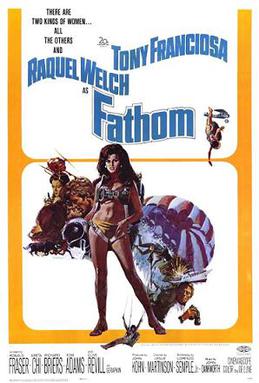
Fathom
James Bond, Derek Flint, Matt Helms, even the more straight-laced British spy Harry Palmer played by Michael Caine. The 1960s had countless spy and espionage movies for audiences that ate them up. A whole lot of testosterone, huh? How about a female secret agent navigating some international intrigue? I've long been aware of this one and was finally able to catch up with it, 1967's Fathom.
An American skydiver touring Europe with a U.S. parachuting team, Fathom Harvill (Raquel Welch) has become quite the attraction for audiences. Well, now she's getting some attention for another reason. After one successful jump, Fathom is approached by a mysterious security officer, Colonel Douglas Campbell (Ronald Fraser), who enlists her help in a matter of worldwide peace. A trigger/detonator -- dubbed the Fire Dragon -- that can set off a nuclear device has gone missing. The trail has led Campbell to a countryside Spanish villa where an agent working for the Chinese, Peter Merriwether (Tony Franciosa), is staying. With no other alternative to getting into the villa, Fathom will have to parachute in, pretending to have gone off course and accidentally landing at the villa. Find the Fire Dragon, get out and return it. Simple, right? Not everyone is telling her all she needs to know.
This is a fun movie. That's all, and that's not a bad thing so deal with it. From director Leslie H. Martinson, 'Fathom' has that 1960s style that can be so fun to watch now, look back and appreciate. The 1960s are my favorite decade for movies, and while this isn't an all-time classic (far from it), it's what can be so fun about the decade as a whole. It's goal is to be fun, to entertain, to put pretty people in pretty places with some witty repartee (and some subtle sexual innuendos. Scandalous!). 'Fathom' was filmed on location in the Spanish coast and countryside in and around Cartama, Mijas, Malaga, Torremolinos, and Nerja in Andalucia. It is a gorgeous-looking movie, Spain providing quite the visual backdrop....in addition to other things to come. There's also a dreamy theme song, listen and more importantly watch it HERE, with a good score from John Dankworth. The message is simple. This isn't a hard-hitting spy movie. It's not quite a spoof, just somewhere fun in between.
Blah blah blah, let's talk about Raquel Welch! One of the biggest sex symbols of the 1960s (and in Hollywood history in general), Welch was coming off the immensely successful One Million Years, B.C. that really put her and her fur bikini on the map. This is Miss Welch at her best. With the right part in a more dramatic movie, she did have some acting chops she could show off. This is more suited to her comedic ability, a lighter, more fun role that doesn't strain any acting muscles. Welch was a better comedic actress than she's given credit for, and this is a good follow-up rule to her speech-limited part in 'Million.' This movie was one of three female spy movies from Warner Bros. in 1967, and it's not a mystery why this one was remembered better than Caprice (starring Doris Day) and Come Spy With Me (starring Andrea Dromm). It's Raquel Welch.
Let's not misconstrue this, and yes, it's time to be a shallow dude. Raquel Welch is sexy, beautiful and taking her status as a 1960s sex symbol quite, quite seriously. Yes, there's a twisting story with a whuddunnit mystery, but let's get down to basics. This movie exists to get Welch into as many skimpy outfits as humanly possible. We're talking bikinis, short skirts, tight jumpsuits, plunging necklines, any and all. I've long had a crush on Raquel Welch, but I don't know if she ever looked as downright good-looking as she did here. And so ends a rant from this shallow guy. If you're a Welch fan, you'll like this movie.
But onto actual movie analysis! The cast supporting Welch is having some fun, none of the characters telling the complete truth and all of them having a secret or two. Actually the top-billed star here, Franciosa does what he does best, a roguish charming renegade, here as Merriwether, an agent working for the Chinese. He has a great chemistry with Welch, calling her 'Poppet' for some reason. He also gets some help from Greta Chi's Major Jo-May Soon, a real-life Chinese agent. Having some fun as the security officer who sends Fathom on her mission, Fraser does a good job as the equally mysterious Col. Douglas, Richard Briers playing his assistant, Lt. Timothy Webb, who has an interest in Welch's Fathom. Also hamming it up in Bond villain-esque mode is Clive Revill as Serapkin, the monocle-wearing Russian black market dealer with a low body temperature, forcing him to...."seek warmth" with Fathom at basically all times. Also look for Tom Adams (a supporting player in The Great Escape) as Mike, a hotel owner with an interest in everything going on.
In a 99-minute movie, 'Fathom' packs one surprise/twist on top of each other in waves. We're never sure who's working with who, which side is trying to scam Fathom out of the Fire Dragon (it ain't what it seems), and who will end up with it in the end. Getting there? Basically nonstop action, lots of fun, some cool stunts that force Welch to run, jump and fly across Spain. A very entertaining movie throughout.
Fathom (1967): ***/****
An American skydiver touring Europe with a U.S. parachuting team, Fathom Harvill (Raquel Welch) has become quite the attraction for audiences. Well, now she's getting some attention for another reason. After one successful jump, Fathom is approached by a mysterious security officer, Colonel Douglas Campbell (Ronald Fraser), who enlists her help in a matter of worldwide peace. A trigger/detonator -- dubbed the Fire Dragon -- that can set off a nuclear device has gone missing. The trail has led Campbell to a countryside Spanish villa where an agent working for the Chinese, Peter Merriwether (Tony Franciosa), is staying. With no other alternative to getting into the villa, Fathom will have to parachute in, pretending to have gone off course and accidentally landing at the villa. Find the Fire Dragon, get out and return it. Simple, right? Not everyone is telling her all she needs to know.
This is a fun movie. That's all, and that's not a bad thing so deal with it. From director Leslie H. Martinson, 'Fathom' has that 1960s style that can be so fun to watch now, look back and appreciate. The 1960s are my favorite decade for movies, and while this isn't an all-time classic (far from it), it's what can be so fun about the decade as a whole. It's goal is to be fun, to entertain, to put pretty people in pretty places with some witty repartee (and some subtle sexual innuendos. Scandalous!). 'Fathom' was filmed on location in the Spanish coast and countryside in and around Cartama, Mijas, Malaga, Torremolinos, and Nerja in Andalucia. It is a gorgeous-looking movie, Spain providing quite the visual backdrop....in addition to other things to come. There's also a dreamy theme song, listen and more importantly watch it HERE, with a good score from John Dankworth. The message is simple. This isn't a hard-hitting spy movie. It's not quite a spoof, just somewhere fun in between.
Blah blah blah, let's talk about Raquel Welch! One of the biggest sex symbols of the 1960s (and in Hollywood history in general), Welch was coming off the immensely successful One Million Years, B.C. that really put her and her fur bikini on the map. This is Miss Welch at her best. With the right part in a more dramatic movie, she did have some acting chops she could show off. This is more suited to her comedic ability, a lighter, more fun role that doesn't strain any acting muscles. Welch was a better comedic actress than she's given credit for, and this is a good follow-up rule to her speech-limited part in 'Million.' This movie was one of three female spy movies from Warner Bros. in 1967, and it's not a mystery why this one was remembered better than Caprice (starring Doris Day) and Come Spy With Me (starring Andrea Dromm). It's Raquel Welch.
Let's not misconstrue this, and yes, it's time to be a shallow dude. Raquel Welch is sexy, beautiful and taking her status as a 1960s sex symbol quite, quite seriously. Yes, there's a twisting story with a whuddunnit mystery, but let's get down to basics. This movie exists to get Welch into as many skimpy outfits as humanly possible. We're talking bikinis, short skirts, tight jumpsuits, plunging necklines, any and all. I've long had a crush on Raquel Welch, but I don't know if she ever looked as downright good-looking as she did here. And so ends a rant from this shallow guy. If you're a Welch fan, you'll like this movie.
But onto actual movie analysis! The cast supporting Welch is having some fun, none of the characters telling the complete truth and all of them having a secret or two. Actually the top-billed star here, Franciosa does what he does best, a roguish charming renegade, here as Merriwether, an agent working for the Chinese. He has a great chemistry with Welch, calling her 'Poppet' for some reason. He also gets some help from Greta Chi's Major Jo-May Soon, a real-life Chinese agent. Having some fun as the security officer who sends Fathom on her mission, Fraser does a good job as the equally mysterious Col. Douglas, Richard Briers playing his assistant, Lt. Timothy Webb, who has an interest in Welch's Fathom. Also hamming it up in Bond villain-esque mode is Clive Revill as Serapkin, the monocle-wearing Russian black market dealer with a low body temperature, forcing him to...."seek warmth" with Fathom at basically all times. Also look for Tom Adams (a supporting player in The Great Escape) as Mike, a hotel owner with an interest in everything going on.
In a 99-minute movie, 'Fathom' packs one surprise/twist on top of each other in waves. We're never sure who's working with who, which side is trying to scam Fathom out of the Fire Dragon (it ain't what it seems), and who will end up with it in the end. Getting there? Basically nonstop action, lots of fun, some cool stunts that force Welch to run, jump and fly across Spain. A very entertaining movie throughout.
Fathom (1967): ***/****
Labels:
1960s,
Clive Revill,
Espionage,
Raquel Welch,
Ronald Fraser,
Tony Franciosa
Friday, March 7, 2014
Don Jon
Is there a bigger rising star out there right now than Joseph Gordon-Levitt? The child star of 3rd Rock from the Sun has turned himself into a legitimate dramatic and comedic actor since then with countless roles like The Lookout, The Dark Knight Rises, 500 Days of Summer, Inception and Looper. Well, he's stepping behind the camera now, starring in while also writing and directing 2013's Don Jon.
A mid-20 something who works as a bartender (that we never see), Jon Martello (Gordon-Levitt) has a pretty good life in his eyes. He cares about his body, his friends, his family, his apartment, his muscle car, his church, his ladies and most importantly, his porn. While he has quite the active social life with a seemingly endless string of one-night stands, Jon actually prefers watching porn more than the actual act of sex with a woman, typically seeking out porn after hooking up with a girl. That trend may change though, whether he wants to or not, when he meets Barbara (Scarlett Johansson) one night at a club. They click immediately, start dating and eventually become exclusive...until Barbara walks in on Jon watching porn. To keep her, he promises to stop watching it, but that promise may be tougher than he was counting on.
I'm not sure what I was expecting heading into this movie. I saw the trailer. I was intrigued from the cast to the pretty racy story and a lot in between. Director/writer/star Gordon-Levitt received almost uniformly positive reviews for his film, and I did know what it was about. I swear. So what happened? I really didn't like it. It's funny, but not funny in the way you'd think it would be. Who knows? Maybe it was supposed to be funny in a painfully awkward way, but I was groaning and groaning early and often.
Let's start with the style. It's start with the narration, Gordon-Levitt's Jon reciting how cool his life is. How he cares for his muscle car, cleans his apartment obsessively, goes to church every Sunday and then has dinner with his family, on and on. We see him walk down the same hallway, across a street and up the stairs to church and ultimately....masturbate while watching porn. Gordon-Levitt even removed some more graphic porn to avoid an X-rating for his final cut. I don't know what it was. It's a boys club type story. Jon's narration is aggressively forthright, brutally in your face and highly, graphically sexual. Definitely not a movie for the faint of heart or anyone who blushes easily. The repetitive style seems to reflect Jon's repetitive lifestyle, but that doesn't make it interesting. If anything, it made me feel bad for Jon (but that's a personal judgment). A 90-minute movie plays like one recurring message, a message that is tedious already and doesn't get any better.
Did you watch MTV's Jersey Shore during its infamous run? I'm not proud to admit it, but I did. It was like a trainwreck episode in and episode out. Can you see where I'm going with this? Gordon-Levitt's Jon could have been plucked right out of the show without missing a beat. Above all else, above any other criticisms I had, I just didn't like the main character. He's such a cliched stereotype of a club-hopping, one-night stand seeking tool with his muscle shirts and heavily-gelled hair that it's hard to sympathize with him in the slightest. He preens, struts, smirks and mumbles his way through life. There are moments that provide some laughs, his weekly confessions at church totaling up the times he had sex with a girl and times he masturbated while watching porn especially. You laugh, but it's almost uncomfortable. Confession cures all though, right? Joseph Gordon-Levitt is a very talented actor, but I couldn't stand this character.
Scarlett Johansson is my big crush out there so her part here was a big selling point. Her part is excellent if frightening in its craziness as more and more is revealed. Shallow dude moment, but she looks good....craziness aside. Julianne Moore has an interesting part as Esther, a woman Jon meets at a night class he's taking. Moore is okay in the part, but I'm not sure if it is the right casting choice. Tony Danza and Glenne Headley are high points as Jon's parents, his Dad getting in constant screaming matches, his Mom nagging him about finding the right girl and settling down. Brie Larson is good too as Jon's younger sister. Also look for Rob Brown and Jeremy Luke as Jon's best friends.
In a 90-minute movie, the first hour was rough to get through while the last half hour was far more tolerable. It doesn't play like an instructional guide to how to be a Club Tool, actually exploring some human emotions. Personally, it was a case of too little too late. The ending does provide a saving grace of sorts, but the first hour left such a bad taste in my mouth that it was hard for the story to recover. A valiant effort from Gordon-Levitt but one that falls short in the end.
Don Jon (2013): * 1/2/ ****
A mid-20 something who works as a bartender (that we never see), Jon Martello (Gordon-Levitt) has a pretty good life in his eyes. He cares about his body, his friends, his family, his apartment, his muscle car, his church, his ladies and most importantly, his porn. While he has quite the active social life with a seemingly endless string of one-night stands, Jon actually prefers watching porn more than the actual act of sex with a woman, typically seeking out porn after hooking up with a girl. That trend may change though, whether he wants to or not, when he meets Barbara (Scarlett Johansson) one night at a club. They click immediately, start dating and eventually become exclusive...until Barbara walks in on Jon watching porn. To keep her, he promises to stop watching it, but that promise may be tougher than he was counting on.
I'm not sure what I was expecting heading into this movie. I saw the trailer. I was intrigued from the cast to the pretty racy story and a lot in between. Director/writer/star Gordon-Levitt received almost uniformly positive reviews for his film, and I did know what it was about. I swear. So what happened? I really didn't like it. It's funny, but not funny in the way you'd think it would be. Who knows? Maybe it was supposed to be funny in a painfully awkward way, but I was groaning and groaning early and often.
Let's start with the style. It's start with the narration, Gordon-Levitt's Jon reciting how cool his life is. How he cares for his muscle car, cleans his apartment obsessively, goes to church every Sunday and then has dinner with his family, on and on. We see him walk down the same hallway, across a street and up the stairs to church and ultimately....masturbate while watching porn. Gordon-Levitt even removed some more graphic porn to avoid an X-rating for his final cut. I don't know what it was. It's a boys club type story. Jon's narration is aggressively forthright, brutally in your face and highly, graphically sexual. Definitely not a movie for the faint of heart or anyone who blushes easily. The repetitive style seems to reflect Jon's repetitive lifestyle, but that doesn't make it interesting. If anything, it made me feel bad for Jon (but that's a personal judgment). A 90-minute movie plays like one recurring message, a message that is tedious already and doesn't get any better.
Did you watch MTV's Jersey Shore during its infamous run? I'm not proud to admit it, but I did. It was like a trainwreck episode in and episode out. Can you see where I'm going with this? Gordon-Levitt's Jon could have been plucked right out of the show without missing a beat. Above all else, above any other criticisms I had, I just didn't like the main character. He's such a cliched stereotype of a club-hopping, one-night stand seeking tool with his muscle shirts and heavily-gelled hair that it's hard to sympathize with him in the slightest. He preens, struts, smirks and mumbles his way through life. There are moments that provide some laughs, his weekly confessions at church totaling up the times he had sex with a girl and times he masturbated while watching porn especially. You laugh, but it's almost uncomfortable. Confession cures all though, right? Joseph Gordon-Levitt is a very talented actor, but I couldn't stand this character.
Scarlett Johansson is my big crush out there so her part here was a big selling point. Her part is excellent if frightening in its craziness as more and more is revealed. Shallow dude moment, but she looks good....craziness aside. Julianne Moore has an interesting part as Esther, a woman Jon meets at a night class he's taking. Moore is okay in the part, but I'm not sure if it is the right casting choice. Tony Danza and Glenne Headley are high points as Jon's parents, his Dad getting in constant screaming matches, his Mom nagging him about finding the right girl and settling down. Brie Larson is good too as Jon's younger sister. Also look for Rob Brown and Jeremy Luke as Jon's best friends.
In a 90-minute movie, the first hour was rough to get through while the last half hour was far more tolerable. It doesn't play like an instructional guide to how to be a Club Tool, actually exploring some human emotions. Personally, it was a case of too little too late. The ending does provide a saving grace of sorts, but the first hour left such a bad taste in my mouth that it was hard for the story to recover. A valiant effort from Gordon-Levitt but one that falls short in the end.
Don Jon (2013): * 1/2/ ****
Thursday, March 6, 2014
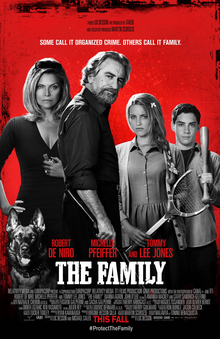
The Family
If movies have taught me anything about the Mafia, one thing rises above all else. Don't turn on the Family. They will get you for it and make you pay for it. What about those who do and get away with it? Well, kinda get away it. Let's get going with 2013's The Family.
It's the middle of the night in Normandy and the Blake family has arrived, their furniture, clothes and possessions waiting for them in a quiet, corner house. They move in glumly, unpacking and getting ready to set up their new lives. There's a problem though. This isn't really the Blake family. This is the Manzoni family, including patriarch Giovanni (Robert De Niro), a former Mafia family from New York City now in the Witness Protection program. Giovanni and his wife, Maggie (Michelle Pfeiffer), and their kids, Belle (Dianna Agron) and Warren (John D'Leo), keep getting in trouble though, forcing them to move from town to town all over Europe with the FBI's help and surveillance. They keep reverting to their old ways, forcing the FBI to keep moving them. Their idyllic lives (of sorts) could be in trouble though. Giovanni testified against his former mob boss (Stan Carp) after a failed hit, and wasting away in jail, he's enlisted the help of a hitman to find the Manzonis and kill them.
There sure are a lot of movies out there, huh? Great lead-in, right? I mean it though. This dark Mafia comedy was released in theaters last summer without much in the way of fanfare or positive reviews, but it did okay in theaters, earning over $68 million. It's one of many movies I was aware of, knew what it was about and had some interest in seeing. But getting to the theaters proves to be kinda difficult at times so here we sit courtesy of Netflix. The complaints in negative reviews were pretty much across the board from too violent to too schizophrenic to too goofy. I'm not saying this was a classic movie by any means, but I was entertained throughout, a talented cast and an interesting premise rising above some of its flaws. I find myself saying it more and more as I defend movies, but is it so wrong to just be entertained by a movie?
For starters, 'Family' is very stylish and very dark. It wastes no time revealing its darkness, the lead hit man, Rocco (Jon Freda), blowing away a whole family in the opening scene, an innocent family at that as he suspects they're the Manzonis. That's the whole tone of the movie, the moments where that schizo nature works well. The line "You can take the boy out of the country, but you can't take the country out of the boy" kept coming up for me. You can move this Mafia family to France, but they're still a tough, hard-edged, take no prisoners family. Giovanni still resorts to strong arm tactics to get what he needs (including drastic measures to get clear water, not brown water from the faucet), Maggie doesn't appreciate the American hate and takes out a grocery store, Belle fights off the "charms" of the locals and young Warren sets up a crime ring within days. It's these moments that are the most fun. Even better? Giovanni's mental asides as we see what he'd like to do to those who come up against him for any number of reasons.
I didn't understand the hate some reviews had, mostly because of the cast. The last couple years have been up and down for De Niro with some of his roles, but he shows off here that he as good a dramatic actor as he is, he's also a really funny actor. He doesn't try too hard. He just is funny, getting the laugh from playing a ridiculously brutal straight man. His facial expressions are priceless, his deadpan deliveries even better. He's got an excellent chemistry with Pfeiffer as his wife, a similarly dark, funny part. Her highlight? Her confession to the village priest is so startling (we don't hear it) that the priest wants nothing to do with her. The kids have their moments too, virginal Belle turning back advances from some less than smooth village boys, turning her attention to a dreamy college student/teacher while Warren gets beat up badly the first day at school and goes to work setting up his own little crime ring. As bizarre and dark and goofy as this group is, I liked them all.
There's more though, starting with Tommy Lee Jones as Agent Robert Stansfield, the FBI agent placed in charge of the Manzonis as they move from one place to another in Witness Protection. Jimmy Palumbo and Domenick Lombardozzi have some fun too as the two surveillance agents assigned as security over the Manzonis in their cozy French house.
It all builds to an inevitable showdown, the Mafia finally tracking them down in their new French home. A squad of Italian hit men descend on the village, the Manzonis forced to improvise as they come under attack. There's some cool action in this finale, even if it is more than a little ridiculous in the end results. That's the movie in itself. It is all over the place, struggling to find that one tone that works and sticking with it. The script at times in director Luc Besson's film depends far too much on coincidence -- like how the Mafia finds Giovanni and Co., not to mention finding the house -- for my liking, but the moments that work, really work. How about Giovanni (posing as a writer) asked to be a guest speaker at a film screening, originally intended to be Some Came Running but it ends up being....Goodfellas. Yes, it's a self-conscious script/movie decision (De Niro starred in said movie) but it works and the payoff is excellent.
Good movie, not great, with some very funny, very dark moments.
The Family (2013): ***/****
It's the middle of the night in Normandy and the Blake family has arrived, their furniture, clothes and possessions waiting for them in a quiet, corner house. They move in glumly, unpacking and getting ready to set up their new lives. There's a problem though. This isn't really the Blake family. This is the Manzoni family, including patriarch Giovanni (Robert De Niro), a former Mafia family from New York City now in the Witness Protection program. Giovanni and his wife, Maggie (Michelle Pfeiffer), and their kids, Belle (Dianna Agron) and Warren (John D'Leo), keep getting in trouble though, forcing them to move from town to town all over Europe with the FBI's help and surveillance. They keep reverting to their old ways, forcing the FBI to keep moving them. Their idyllic lives (of sorts) could be in trouble though. Giovanni testified against his former mob boss (Stan Carp) after a failed hit, and wasting away in jail, he's enlisted the help of a hitman to find the Manzonis and kill them.
There sure are a lot of movies out there, huh? Great lead-in, right? I mean it though. This dark Mafia comedy was released in theaters last summer without much in the way of fanfare or positive reviews, but it did okay in theaters, earning over $68 million. It's one of many movies I was aware of, knew what it was about and had some interest in seeing. But getting to the theaters proves to be kinda difficult at times so here we sit courtesy of Netflix. The complaints in negative reviews were pretty much across the board from too violent to too schizophrenic to too goofy. I'm not saying this was a classic movie by any means, but I was entertained throughout, a talented cast and an interesting premise rising above some of its flaws. I find myself saying it more and more as I defend movies, but is it so wrong to just be entertained by a movie?
For starters, 'Family' is very stylish and very dark. It wastes no time revealing its darkness, the lead hit man, Rocco (Jon Freda), blowing away a whole family in the opening scene, an innocent family at that as he suspects they're the Manzonis. That's the whole tone of the movie, the moments where that schizo nature works well. The line "You can take the boy out of the country, but you can't take the country out of the boy" kept coming up for me. You can move this Mafia family to France, but they're still a tough, hard-edged, take no prisoners family. Giovanni still resorts to strong arm tactics to get what he needs (including drastic measures to get clear water, not brown water from the faucet), Maggie doesn't appreciate the American hate and takes out a grocery store, Belle fights off the "charms" of the locals and young Warren sets up a crime ring within days. It's these moments that are the most fun. Even better? Giovanni's mental asides as we see what he'd like to do to those who come up against him for any number of reasons.
I didn't understand the hate some reviews had, mostly because of the cast. The last couple years have been up and down for De Niro with some of his roles, but he shows off here that he as good a dramatic actor as he is, he's also a really funny actor. He doesn't try too hard. He just is funny, getting the laugh from playing a ridiculously brutal straight man. His facial expressions are priceless, his deadpan deliveries even better. He's got an excellent chemistry with Pfeiffer as his wife, a similarly dark, funny part. Her highlight? Her confession to the village priest is so startling (we don't hear it) that the priest wants nothing to do with her. The kids have their moments too, virginal Belle turning back advances from some less than smooth village boys, turning her attention to a dreamy college student/teacher while Warren gets beat up badly the first day at school and goes to work setting up his own little crime ring. As bizarre and dark and goofy as this group is, I liked them all.
There's more though, starting with Tommy Lee Jones as Agent Robert Stansfield, the FBI agent placed in charge of the Manzonis as they move from one place to another in Witness Protection. Jimmy Palumbo and Domenick Lombardozzi have some fun too as the two surveillance agents assigned as security over the Manzonis in their cozy French house.
It all builds to an inevitable showdown, the Mafia finally tracking them down in their new French home. A squad of Italian hit men descend on the village, the Manzonis forced to improvise as they come under attack. There's some cool action in this finale, even if it is more than a little ridiculous in the end results. That's the movie in itself. It is all over the place, struggling to find that one tone that works and sticking with it. The script at times in director Luc Besson's film depends far too much on coincidence -- like how the Mafia finds Giovanni and Co., not to mention finding the house -- for my liking, but the moments that work, really work. How about Giovanni (posing as a writer) asked to be a guest speaker at a film screening, originally intended to be Some Came Running but it ends up being....Goodfellas. Yes, it's a self-conscious script/movie decision (De Niro starred in said movie) but it works and the payoff is excellent.
Good movie, not great, with some very funny, very dark moments.
The Family (2013): ***/****
Labels:
2010s,
Luc Besson,
Mafia,
Michelle Pfeiffer,
Robert De Niro,
Tommy Lee Jones
Wednesday, March 5, 2014
Prisoners
It was a movie that seemed like it was a sure thing to snag some Oscar nominations. Powerful, dramatic acting, incredibly dark subject matter, and a whole lot of talent assembled for a cast. And what did 2013's Prisoners get nominated for? Exactly....one, that nomination for Best Cinematography. Okay, yes, that's fair. It's certainly a visually interesting film, but nothing else?!? Come on now. So....anyways, yeah, this was an excellent movie.
On a gloomy, rainy Thanksgiving Day, Keller Dover (Hugh Jackman) and his family walk down the street to celebrate the holiday with their neighbors, the Birch's. After dinner as the Dovers get ready to go, they realize their daughter and the Birch's youngest daughter are both missing, nowhere to be found. Minutes turn to hours, hours to a day, and there's no trace of either girl. The police are called in, including lead detective David Loki (Jake Gyllenhaal), a suspect, Alex Jones (Paul Dano), found just a few hours after the disappearance was first reported. Looking for clues/evidence tying Jones to the girls though, the police come up empty and are forced to release him after a 48-hour hold. Keller remains convinced that Jones is the one who kidnapped the two girls and decides to take drastic measures to bring them back. All the while, Loki becomes progressively more obsessed with the case, leads drying up in one dead end after another. The clock is ticking for the two girls.
From director Denis Villeneuve and writer Aaron Guzkowski, this movie is a doozy. Movies about serial killers, murderers, diseases running rampant, they can all be uncomfortable in countless ways. But as for a movie about someone kidnapping two young children? Unsettling doesn't begin to describe that ever-developing story. I watched this one, and I couldn't help but think of my five-year old niece. This is a movie that isn't intended to entertain (obviously) but one you appreciate. Audiences responded to the film, 'Prisoners' earning $122 million, and it's easy to see why. The acting here is what acting is all about. It's human and real, and when it calls for some big, dramatic moments, it doesn't feel authentic. It is authentic, credit to Villeneuve and cinematographer Roger Deakins for making a film with a bleak, dreary look that doesn't pull any punches. Deakins picked up an Oscar nomination for his cinematography. Tough to see him winning against Nebraska or Gravity, but he deserved that nomination.
The 2013 film year was very loaded when it comes to acting, especially for Best Actor and Best Supporting Actor. Maybe the issue here was deciding between Jackman and Gyllenhaal in nominations? These are two powerhouse performances and for different reasons. A family man and middle-class dad torn apart by his daughter's kidnapping? A detective with a troubled childhood past who similarly becomes obsessed with finding two missing girls? These are great parts, both actors stepping up to the plate and delivering. Jackman handles his role in the right way with scenes that could feel forced or overdone. He's driven down a road that most would never want to even contemplate, but he's going to get his daughter back. He doesn't care what he does, if it's right, morally or in the eyes of the law, or what his decisions will ultimately do to him. I thought Gyllenhaal's part was underrated, reminding me some of his part in Zodiac. His detective is tough, brutally efficient and the pressure is starting to wear on him, especially with Jackman's Keller pressuring him to close the case and bring his daughters back.
Brace yourself for the rest of the cast though. It is a halfway decent group if you're into that sort of thing. Maria Bello plays Keller's wife, Grace, progressively losing her mind as hours turn into days, needing her husband more than ever as he takes desperate measures to get their child back, Dylan Minnette playing their teenage son. The parents of the second kidnapped girl are played to perfection by Terrence Howard and Viola Davis while Zoe Borde plays their teenage daughter. Dano seems to be typecast a bit as the possibly crazy/unhinged guy but there's a reason. He's good at it, really good. We're never quite sure of his intentions, his background, his motivation, Melissa Leo playing his aunt. Also look for Wayne Duvall, Len Cariou and David Dastmalchian in key supporting parts.
Beyond the general uncomfortable feeling in tone and emotion that basically permeates every single scene in a 153-minute movie (It never drags), what makes it especially memorable and tolerable is that the story becomes a whudunnit story. Yes, obviously, we want to see the girls rescued. But as clues and leads and evidence dry up, we also want to see who did the kidnapping. Why did they do it? Guzkowski's script does a great job keeping us guessing right until the reveal. Hints are dropped here and there, but it's difficult to peg everything down as it comes along. Uncomfortable? Yes, but the mystery aspect makes it interesting on a far different level.
It all builds to an impressive reveal and finale, including a great final scene. Some viewers/critics call it ambiguous, but it really isn't if you think it through. I very much liked this movie, or at least as much as you're supposed to like a movie about child kidnapping. Appreciate it for the top to bottom strengths of the cast.
Prisoners (2013): ***/****
On a gloomy, rainy Thanksgiving Day, Keller Dover (Hugh Jackman) and his family walk down the street to celebrate the holiday with their neighbors, the Birch's. After dinner as the Dovers get ready to go, they realize their daughter and the Birch's youngest daughter are both missing, nowhere to be found. Minutes turn to hours, hours to a day, and there's no trace of either girl. The police are called in, including lead detective David Loki (Jake Gyllenhaal), a suspect, Alex Jones (Paul Dano), found just a few hours after the disappearance was first reported. Looking for clues/evidence tying Jones to the girls though, the police come up empty and are forced to release him after a 48-hour hold. Keller remains convinced that Jones is the one who kidnapped the two girls and decides to take drastic measures to bring them back. All the while, Loki becomes progressively more obsessed with the case, leads drying up in one dead end after another. The clock is ticking for the two girls.
From director Denis Villeneuve and writer Aaron Guzkowski, this movie is a doozy. Movies about serial killers, murderers, diseases running rampant, they can all be uncomfortable in countless ways. But as for a movie about someone kidnapping two young children? Unsettling doesn't begin to describe that ever-developing story. I watched this one, and I couldn't help but think of my five-year old niece. This is a movie that isn't intended to entertain (obviously) but one you appreciate. Audiences responded to the film, 'Prisoners' earning $122 million, and it's easy to see why. The acting here is what acting is all about. It's human and real, and when it calls for some big, dramatic moments, it doesn't feel authentic. It is authentic, credit to Villeneuve and cinematographer Roger Deakins for making a film with a bleak, dreary look that doesn't pull any punches. Deakins picked up an Oscar nomination for his cinematography. Tough to see him winning against Nebraska or Gravity, but he deserved that nomination.
The 2013 film year was very loaded when it comes to acting, especially for Best Actor and Best Supporting Actor. Maybe the issue here was deciding between Jackman and Gyllenhaal in nominations? These are two powerhouse performances and for different reasons. A family man and middle-class dad torn apart by his daughter's kidnapping? A detective with a troubled childhood past who similarly becomes obsessed with finding two missing girls? These are great parts, both actors stepping up to the plate and delivering. Jackman handles his role in the right way with scenes that could feel forced or overdone. He's driven down a road that most would never want to even contemplate, but he's going to get his daughter back. He doesn't care what he does, if it's right, morally or in the eyes of the law, or what his decisions will ultimately do to him. I thought Gyllenhaal's part was underrated, reminding me some of his part in Zodiac. His detective is tough, brutally efficient and the pressure is starting to wear on him, especially with Jackman's Keller pressuring him to close the case and bring his daughters back.
Brace yourself for the rest of the cast though. It is a halfway decent group if you're into that sort of thing. Maria Bello plays Keller's wife, Grace, progressively losing her mind as hours turn into days, needing her husband more than ever as he takes desperate measures to get their child back, Dylan Minnette playing their teenage son. The parents of the second kidnapped girl are played to perfection by Terrence Howard and Viola Davis while Zoe Borde plays their teenage daughter. Dano seems to be typecast a bit as the possibly crazy/unhinged guy but there's a reason. He's good at it, really good. We're never quite sure of his intentions, his background, his motivation, Melissa Leo playing his aunt. Also look for Wayne Duvall, Len Cariou and David Dastmalchian in key supporting parts.
Beyond the general uncomfortable feeling in tone and emotion that basically permeates every single scene in a 153-minute movie (It never drags), what makes it especially memorable and tolerable is that the story becomes a whudunnit story. Yes, obviously, we want to see the girls rescued. But as clues and leads and evidence dry up, we also want to see who did the kidnapping. Why did they do it? Guzkowski's script does a great job keeping us guessing right until the reveal. Hints are dropped here and there, but it's difficult to peg everything down as it comes along. Uncomfortable? Yes, but the mystery aspect makes it interesting on a far different level.
It all builds to an impressive reveal and finale, including a great final scene. Some viewers/critics call it ambiguous, but it really isn't if you think it through. I very much liked this movie, or at least as much as you're supposed to like a movie about child kidnapping. Appreciate it for the top to bottom strengths of the cast.
Prisoners (2013): ***/****
Tuesday, March 4, 2014
Major Dundee
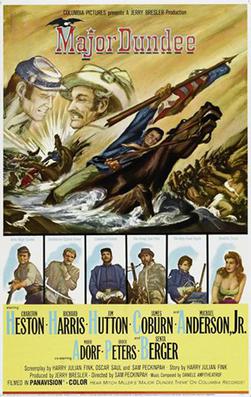
It's late in 1864, the Civil War raging back east, but in the New Mexico territory, an Apache war party led by Sierra Charriba (Michael Pate), massacres a troop of U.S. cavalry, kidnapping three boys from a local ranch at the same time. The commander of a nearby Confederate prison camp, Major Amos Dundee (Charlton Heston) decides to go after the Apaches, rescuing the kids and bringing Charriba to justice. Without abandoning the camp though, he must assemble a ragtag group of Confederate prisoners, black infantry, inexperienced officers, cowboys, drunks, bandits and thieves to capture the Apaches. At his right hand is a Confederate officer and friend from the past but now a sworn enemy, Capt. Benjamin Tyreen (Richard Harris). Dundee's company of irregular cavalry hits the trail, following the Apache war party into Mexico, tangling with occupying French forces as well. The Apaches and the French are just two enemies though, the Union and Confederate loyalties among the company threatening to tear Dundee's command apart from the inside.
The production history of this Peckinpah western has quite the checkered past. The production in Mexico went way over budget and way over schedule. Depending on what you read, Peckinpah's original cut for 'Dundee' was anywhere between three and four hours long. When the studio took it away from him, it was cut down to just over two hours. A DVD released in 2005 had a new, never before seen version with almost 15 additional minutes added to the running time. Some additional footage was found that was unable to be reinserted back into the film, but as is, we'll probably never know/see Peckinpah's intended version. So what's the end result with the 136-minute version? A far better western than the 123-minute version that features some good performances, a ridiculously deep cast, some ahead of its time vicious action, and a story that drifts needlessly at times.
What was Peckinpah's goal? He wanted to make an epic western, a new western in the vein of the John Ford cavalry movies. It was supposed to be big and violent full of scope and vision. 'Dundee' doesn't quite live up to that, but in terms of pure entertainment, it's hard to beat. It starts with Charlton Heston in the titular role. Like Peckinpah's best movies, Dundee is the flawed anti-hero like nobody's business. The story almost becomes Moby Dick in the Civil War west. Dundee has been posted to this isolated prison camp because of a command decision he made at Gettysburg (hinted at, never spelled out), and he intends to right that wrong. His plan? Get the kids back, take out Sierra Charriba, become a hero again. The problem? Dundee may not be cut out for command. He's equal parts brilliant strategist with overreaching egoist. His pride and ego get in the way of things, the mission into Mexico becoming an obsession. Quite the performance, one that doesn't always get the notoriety it deserves in Heston's already impressive filmography.
One of Peckinpah's favorite storytelling devices was the anti-hero and his right hand man, sometimes a former friend turned unwilling ally, a device used to its best ability four years later in The Wild Bunch. Here, that relationship is between Heston's Dundee and Richard Harris' Capt. Ben Tyreen. Again, their checkered history (friendship turned bitter rivalry, even hatred) all leads up to this, two men forced to work together. Harris is one of my favorite actors, and this is my favorite performance of many, one of my all-time favorite characters in any film. Harris' Tyreen is everything Dundee wants to be; intelligent, charming, a good leader, and well liked and respected by his men. Tyreen has one great line after another, Harris bringing this character to life, a Irish immigrant turned cashiered American officer to Confederate renegade. The dynamic between Dundee and Tyreen provides some of the movie's best dialogue scenes, the confrontations crackling with energy. Kudos to both actors for developing that chemistry to its fullest.
Brace yourself though. This movie has one sick cast of tough guy actors, many from the Peckinpah stock character Hall of Fame. Jim Hutton provides some laughs as Lt. Graham, a bumbling artillery officer assigned to the cavalry. James Coburn is a scene-stealer as Samuel Potts, Dundee's one-armed, bearded, quick-witted scout, as is Mario Adorf as the feisty, loyal Sgt. Gomez, Dundee's most capable Union soldier. Michael Anderson Jr. does a fine job too as Trooper Ryan, Dundee's young bugler, providing the narration from his in-mission journal. There's also Brock Peters as Aesop, the leader of the small contingent of black infantry, Slim Pickens as Wiley, the drunken mule-packer, R.G. Armstrong as Reverend Dahlstrom, the shotgun-wielding preacher, and Dub Taylor as Priam, the disheveled horse thief. As for Tyreen's Confederates, there's Ben Johnson as the tough Sgt. Chillum, L.Q. Jones and Warren Oates as Arthur and O.W. Hadley, and John Davis Chandler as Jimmy Lee, the troublemaker. Also look for Karl Swenson as Dundee's second-in-command at the prison camp. Just a ridiculously deep cast full of great characters.
Where the movie struggles some -- but is also damn entertaining in those struggles -- is the final 40 minutes. The story does drift too much from the Apaches to the French to Dundee's lost weekend in Durango and a brief love affair with Senta Berger's Teresa. Trooper Ryan's narration gets choppy, weeks slipping by in a flash. The saving grace is back-to-back action sequences, one a showdown with the Apaches in a box canyon, the other a bloody, violent battle with French lancers in the Rio Grande. This is Peckinpah at his action best, clearly an indicator of where his movies would go, especially with The Wild Bunch. Watch the scene with the French and see how brutal it is, how graphic it could have been if censors allowed it. Characters are unceremoniously killed off (blink and you'll miss it), including one surprising death, but it's just a great action scene leading to a quick ending.
Most Peckinpah fans don't list this as their favorite, maybe not even one of their favorites. I just really like this movie, always have, and the longer version with the additional 15 minutes or so really does help make it better. The musical score from composer Daniele Amfitheatrof takes some heat, especially the Major Dundee theme (listen HERE), but I like it, almost as a guilty pleasure. Filming on location in Mexico, including stops in Durango, a gorgeous waterfall location at El Saltito, and many more, all add to that authentic flavor. You really feel like you're on an odyssey across Mexico, seeing a variety of spots, locations and cities. One of my favorite westerns, a heavily flawed but just a damn entertaining movie in the end. Hard to beat, even if we'll never see that epic 4-hour version Peckinpah intended.
Major Dundee (1965): ****/****
Rewrite of August 2009 review
Monday, March 3, 2014
Battle for the Planet of the Apes
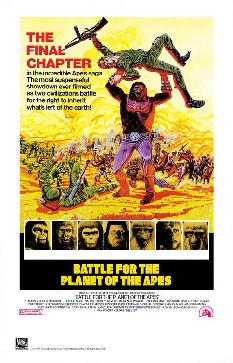
Here we sit. It's been a long ride full of ups and downs, but we made it through, and I'd like to thank all of those who supported me along the way. Yes, it is officially time to wrap up the Planet of the Apes series. It is time for 1973's Battle for the Planet of the Apes. Pretty dramatic, huh?!? I should totally do voiceover work.
It has been 12 years since the highly intelligent, thoughtful talking chimp, Caesar (Roddy McDowall) led the bloody revolt that gained apes -- the chimps, orangutans, and gorillas -- their freedom from their cruel human masters. It was a revolt that set off a chain reaction, countries and cities turning on each other, nuclear weapons wiping whole cities off the face of the Earth. Caesar and a small community of apes and humans manage to escape the destruction, building a city in the wilderness and starting their own civilization of sorts. It is a tenuous situation though, Caesar dealing with the apes' control over the humans, an ape general, Aldo (Claude Akins), eager to gain power, and the possibility of another group of human survivors -- mutated beings -- invading his territory. Can he hold it all together?
I've long been a fan of the Planet of the Apes series so it's been fun catching up with the series, especially watching all five movies straight through for the first time ever. It's cool to see the continuity among the five flicks, see recurring characters, recurring stories and plotlines. This fifth entry, from director J. Lee Thompson (who also directed Conquest), was released as part of the collection as an 'Extended Version,' running 93 minutes with about 10 minutes of additional footage reinserted. Not going to lie here, I was kinda disappointed with this final entry. There are positives -- more in that department later -- but there are also far too many negatives. The story seems like a jumbled collection of the previous storylines -- especially Beneath and Conquest -- and doesn't create enough of its own identity. Fans of the series will definitely enjoy it, but as far as series finales go, this one could have been better.
What are the biggest issues? Well, the script for starters. Reading about the Extended Cut (with spoilers), it's cool to see what footage was added back into the movie. Some scenes work better than others, some lack any rhythm or pacing. The exploration of the bombed-out city should be adrenaline-pumping, but the build-up is slow that it loses any momentum. It also seems thrown together for the sake of a sequel, an unnecessary one at that. It's only 12 years since the end of 'Conquest,' but the apes speak clearly and perfectly understandable. A whole species learns to speak in a little over a decade? Why did the humans go with the apes? Was it for survival? A whole sub-culture comes together so quickly, rushed backstory like the entire movie. There are portions that work as it tries to connect and wrap up with the rest of the series, especially the connection to Beneath, the villain, Governor Kolp (Severn Dearden), having an assistant, Mendez (Paul Stevens), the same name as the leader of the mutants in Beneath, the Alpha bomb there too. Little touches like that are pretty cool, especially for nerds like me
The biggest positive is the face of the franchise right there with Charlton Heston, Roddy McDowall, who starred in four of the five movies playing two different roles. His Caesar is the intelligent, thoughtful leader of the ape civilization, juggling countless roles. He's a leader, a father, a friend, and he's got to keep all the plates spinning at once. McDowall is the heart of it all, and not surprisingly, he kills the part. He is the link through it all, the best aspect of the character being his interest, his curiosity about his past. What were his parents like? How did they end up on a human-ruled Earth? What led to their tragic deaths? As a family man, we meet his wife, Lisa (Natalie Trundy, who also starred in four Ape movies), and his teenage son, Cornelius (Bobby Porter), who just wants to be a kid, Caesar doing his best to make his son's life smooth and easy. Any issues the movie may have, McDowall is above it. A fitting lead performance to wrap things up.
The rest of the cast is okay, some solid names, some recognizable faces, but nothing really eye-popping. Akins hams it up like a crazy person, his General Aldo really just a child in a position of power. He's the polar opposite of Caesar, fiery and emotional, but an action he takes certainly takes drives the story forward. For some of the other key ape performances, Lew Ayres is a scene-stealer as Mandemus, the senior citizen ape placed in charge of the armory, his logical thinking tripping everyone up, and Paul Williams as Virgil, the intellectual, the thinker who plays Devil's Advocate to just about everything Caesar does, but in a helpful fashion. Austin Stoker plays MacDonald, the face of the human group living with the apes. He has a good chemistry with McDowall's Caesar in their scenes together in an underused part.
I don't know. I came away disappointed. Maybe it tries to do too much, maybe it's just not very good. If you're a fan of the series, you've got to see it to wrap things up. There, plain and simple. It lacks that special something to hold it all together. A framing device with John Huston making a quick appearance as the Lawgiver tries to show that the Apes timeline can and should be adjusted, but everything else in the series seems to suggest otherwise. If it didn't, everything would collapse in on itself in the space time continuum. Yeah, time travel analysis. Didn't see that coming, did you?!? Watch it for the series, for the sci-fi aspect, just enough positives in a movie that lacked some energy. Still, it's been a hugely entertaining series, a fun ride over five movies. Thanks to the girlfriend for the Christmas present. Now, I've just gotta get her to watch them...
Battle for the Planet of the Apes (1973): ** 1/2 /****
It has been 12 years since the highly intelligent, thoughtful talking chimp, Caesar (Roddy McDowall) led the bloody revolt that gained apes -- the chimps, orangutans, and gorillas -- their freedom from their cruel human masters. It was a revolt that set off a chain reaction, countries and cities turning on each other, nuclear weapons wiping whole cities off the face of the Earth. Caesar and a small community of apes and humans manage to escape the destruction, building a city in the wilderness and starting their own civilization of sorts. It is a tenuous situation though, Caesar dealing with the apes' control over the humans, an ape general, Aldo (Claude Akins), eager to gain power, and the possibility of another group of human survivors -- mutated beings -- invading his territory. Can he hold it all together?
I've long been a fan of the Planet of the Apes series so it's been fun catching up with the series, especially watching all five movies straight through for the first time ever. It's cool to see the continuity among the five flicks, see recurring characters, recurring stories and plotlines. This fifth entry, from director J. Lee Thompson (who also directed Conquest), was released as part of the collection as an 'Extended Version,' running 93 minutes with about 10 minutes of additional footage reinserted. Not going to lie here, I was kinda disappointed with this final entry. There are positives -- more in that department later -- but there are also far too many negatives. The story seems like a jumbled collection of the previous storylines -- especially Beneath and Conquest -- and doesn't create enough of its own identity. Fans of the series will definitely enjoy it, but as far as series finales go, this one could have been better.
What are the biggest issues? Well, the script for starters. Reading about the Extended Cut (with spoilers), it's cool to see what footage was added back into the movie. Some scenes work better than others, some lack any rhythm or pacing. The exploration of the bombed-out city should be adrenaline-pumping, but the build-up is slow that it loses any momentum. It also seems thrown together for the sake of a sequel, an unnecessary one at that. It's only 12 years since the end of 'Conquest,' but the apes speak clearly and perfectly understandable. A whole species learns to speak in a little over a decade? Why did the humans go with the apes? Was it for survival? A whole sub-culture comes together so quickly, rushed backstory like the entire movie. There are portions that work as it tries to connect and wrap up with the rest of the series, especially the connection to Beneath, the villain, Governor Kolp (Severn Dearden), having an assistant, Mendez (Paul Stevens), the same name as the leader of the mutants in Beneath, the Alpha bomb there too. Little touches like that are pretty cool, especially for nerds like me
The biggest positive is the face of the franchise right there with Charlton Heston, Roddy McDowall, who starred in four of the five movies playing two different roles. His Caesar is the intelligent, thoughtful leader of the ape civilization, juggling countless roles. He's a leader, a father, a friend, and he's got to keep all the plates spinning at once. McDowall is the heart of it all, and not surprisingly, he kills the part. He is the link through it all, the best aspect of the character being his interest, his curiosity about his past. What were his parents like? How did they end up on a human-ruled Earth? What led to their tragic deaths? As a family man, we meet his wife, Lisa (Natalie Trundy, who also starred in four Ape movies), and his teenage son, Cornelius (Bobby Porter), who just wants to be a kid, Caesar doing his best to make his son's life smooth and easy. Any issues the movie may have, McDowall is above it. A fitting lead performance to wrap things up.
The rest of the cast is okay, some solid names, some recognizable faces, but nothing really eye-popping. Akins hams it up like a crazy person, his General Aldo really just a child in a position of power. He's the polar opposite of Caesar, fiery and emotional, but an action he takes certainly takes drives the story forward. For some of the other key ape performances, Lew Ayres is a scene-stealer as Mandemus, the senior citizen ape placed in charge of the armory, his logical thinking tripping everyone up, and Paul Williams as Virgil, the intellectual, the thinker who plays Devil's Advocate to just about everything Caesar does, but in a helpful fashion. Austin Stoker plays MacDonald, the face of the human group living with the apes. He has a good chemistry with McDowall's Caesar in their scenes together in an underused part.
I don't know. I came away disappointed. Maybe it tries to do too much, maybe it's just not very good. If you're a fan of the series, you've got to see it to wrap things up. There, plain and simple. It lacks that special something to hold it all together. A framing device with John Huston making a quick appearance as the Lawgiver tries to show that the Apes timeline can and should be adjusted, but everything else in the series seems to suggest otherwise. If it didn't, everything would collapse in on itself in the space time continuum. Yeah, time travel analysis. Didn't see that coming, did you?!? Watch it for the series, for the sci-fi aspect, just enough positives in a movie that lacked some energy. Still, it's been a hugely entertaining series, a fun ride over five movies. Thanks to the girlfriend for the Christmas present. Now, I've just gotta get her to watch them...
Battle for the Planet of the Apes (1973): ** 1/2 /****
Subscribe to:
Posts (Atom)