The Sons of Katie Elder

The Sons of Katie Elder
"First, we reunite, then find Ma and Pa's killer...then read some reviews."

Thursday, September 12, 2013

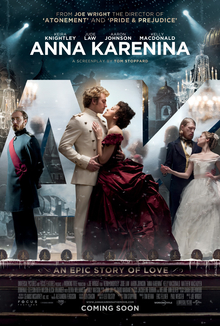
Anna Karenina

Thanks to high school and college honors classes in English and literature, certain names and genres scare me to death. Yeah, Shakespearean anything isn't my favorite, nor is Victorian literature. But anything Russian absolutely sends a shiver up my back, especially Leo Tolstoy. I've never had the guts to try one of his behemoth novels, but movies? Sure, why not?!? Let's give 2012's Anna Karenina a shot.

It is 1874 in imperialist Russia and Anna Karenina (Keira Knightley) visits her brother's family in Moscow from St. Petersburg. Her brother, Stiva (Matthew Macfayden), has been kicked out of his home by his wife who caught him with a mistress. During her visit, Anna attends a ball, meeting Count Vronsky (Aaron Taylor-Johnson), a young, handsome, glamorous cavalry officer with quite the reputation as a ladies man. She is immediately drawn to him, putting her in quite the morally questionable spot. Anna is married to Alexei Karenin (Jude Law) for years and very much loves him, her life and her young son. She can't help what she feels though, and her emotions for Vronsky seem very real. Pursuing anything with the young Count though could tear her life apart as well as the lives of her family.

A Tolstoy novel from the 1870s, 'Anna' is a classic novel that ranks with War and Peace as the Russian author's best. It has been adapted to film countless times (okay, 15 according to Wikipedia) and with director Joe Wright (Atonement, Pride and Prejudice) at the helm of a very talented cast and crew, this 2012 version seemed like a gimme. I'm a huge fan of historical epics and periods pieces, and I was psyched to check this one out. Even Netflix thought I'd like it, recommending a 4.1 on a 5 scale. The movie is a stunner to watch -- kudos to cinematographer Seamus McGarvey -- and features great uses of wardrobe and period appropriate attire. Even the music from composer Dario Marianelli is solid, a good mix of stirring epic and soothing classical, stands out from the crowd.

Unfortunately, not much else stands out from the crowd. Stylistically, there are issues which I'll get to in a bit, but the biggest issue kneecapping the story is the casting and the script. I like Knightley a lot, but she keeps playing the same part over and over again, a strong historical woman who's forced to deal with some gutwrenchingly emotional issue. Much of the movie follows her relationship with Taylor-Johnson's Vronsky, maybe the dullest relationship I can think of in recent memory. They exchange glances at the ball and are instantly in love. For some reason, Anna falls madly in love with him -- obviously because of his stirring personality -- and ruins her life. I liked Taylor-Johnson in Savages, and by all accounts, he's good in Kick-Ass, but other than his good looks, I thought his Vronsky had the personality of cardboard. It's hard to see why they're drawn to each other. Is it just a physical connection? That's all I was seeing.

Some of the supporting performances stand out for the better, even if their purpose is distracting. I especially liked Jude Law as Alexei, Anna's husband who comes out smelling like roses here. With their marriage possibly crumbling, Alexei must decide what is most important to him. As a powerful government statesman, his name and reputation are on the line, but that doesn't seem to bother him in the least. A solid, understated and emotional performance from Law. Macfayden is good as Stiva with Kelly McDonald playing his wife, Dolly. Also worth mentioning is Domhnall Gleeson as Levin, a young man from a well-to do family who wants to create a life for himself with Kitty (Alicia Vikander), a beautiful young woman and Dolly's younger sister. At a certain point though, faces start to look alike, characters run together, and none make too much of an impression.

One major style choice ends up handcuffing the movie in a big way. Filming his movie, Wright actually shot much of it on an old stage in an abandoned theater. Scenes transition from one to another, the camera whirling around to follow the characters. The sets, designs and backgrounds change, but much of the movie quite literally takes place on a stage. Is he going for a truly artsy look? If so, it doesn't work. It took me completely out of the movie itself, making me question if I was watching a stage-based adaptation instead of a theatrical release. While the thought was there to try something new/unique, it came across as pretentious a little bit. "Oh, look at me, look what I can do!" Too bad, because the visuals are certainly there to make an above average period piece.

Most of all, it's just the characters. For lack of a more thought out, articulate description, they're annoying. Anna and Vronsky look adoringly into each others' eyes, each imploring the other to tell them how much they love the other one. Anna is beyond stupid, not seeing what consequences her actions are going to produce. It's just disappointing. You can have all the great sets and designs, all the impressive set pieces, but it comes down to this. If you're not interested in the characters, it's hard to be interested in the film.

Anna Karenina (2012): **/****

Wednesday, September 11, 2013

The Split

A stylish, dark heist flick from the 1960s with one of the all-time great tough guy casts. It's a winning formula for sure, especially for a sucker like me for heist movies. It took me years to track down 1968's The Split -- which I first reviewed in August 2009 -- and I was less than impressed with the film on my first viewing. When it popped up on Turner Classic Movie's schedule recently, I was going to give it another try. I mean....come on.....look at this cast!

A master thief who's gone off the grid seemingly for several years, a man named McClain (Jim Brown) is reunited with a former partner and an expert planner, Gladys (Julie Harris), when it comes to pulling off impossible jobs. They team up again, Gladys putting forth the plan; rob the L.A. Coliseum during an NFL playoff game that will net $500,000. McClain assembles a team of crooks who haven't worked together in the past, but he convinces them to put their differences aside with the thought of a very lucrative payday. The five-man team goes about planning the job with very little time to do so. The dangerous job is one thing though, but the fallout from the job may be even more dangerous, especially when an investigating detective, Lt. Brill (Gene Hackman), catches wind of them and is right behind them.

For years, this 1968 heist film from director Gordon Flemyng wasn't available in any form; DVD, VHS, nothing. Now, it's available on a burn-for-order DVD so if you've never seen it and are dying to catch up, there it is for you. First or second viewing though, I had the same issues. 'Split' has a lot of potential, much of it tied to the casting, but it never quite goes anywhere. It's got the style from its frame-in-frame credits sequence to its Quincy Jones soundtrack, the on-location shooting at the L.A. Coliseum to the dark nature of the team of crooks working together. All these disparate elements never manage to jell, ending up with a heist film that takes a really bizarre turn in the last third of the movie. A very disappointing end result because it did have so much potential.

How about that casting though? In assembling his team for the robbery, Brown's McClain brings together Bert Clinger (Ernest Borgnine), a gym owner and strong man, Harry Kifka (Jack Klugman), a down on his luck limo driver who will serve as the team's getaway driver, Marty Gough (Warren Oates), a temperamental safe cracker, and Dave Negli (Donald Sutherland), a smooth as ice hit man and hired killer. And NFL great turned action star Jim Brown for good measure?!? How can you lose??? Well, as dark and dirty as things get, something is missing from the group. The movie runs only 91 minutes and after McClain's recruiting, things move right along to the actual heist. The group is full of so many bad guys I never found myself rooting for them to pull the job off successfully. Still, it is an impressive grouping of star power, misutilized though they may be.

I think that's the problem for 'Split' in general. With so much going on, the right tone is never picked out. It bounces back and forth and among all these different things. Brown's McClain meets up with his jilted ex-wife, Ellie (Diahann Carroll), still holding a grudge, but darn it, she still likes him a lot as we see in a montage set to a Jones song as they walk along a beach. The actual recruiting of the team just feels a tad bit off, like certain things aren't fitting together well, but it's entertaining enough. The robbery at the Coliseum lacks a certain energy with no real catch of anything unique helping them pull the job off. But the biggest problem? That would be the final half hour.

One of the keys to a good heist film is oddly enough, not the heist. It's the fallout after the job when the cops close in, the team has to wait for things to cool down to get their money, and seemingly inevitably....turn on each other. That's fine and dandy, just about any good heist movie follows that formula. Ready for the derail? It comes in a really odd one-scene cameo from James Whitmore as Ellie's creepy landlord. Then, Gene Hackman doesn't even make his first appearance until 70 minutes into a 90-minute movie. From there on in, the story and twists and turns feel rushed. It's a pretty dark ending, but even that feels mishandled. The movie just sort of ends, leaving all sorts of questions unanswered. A truly disappointing movie, one that handled differently could have been a near-classic among the heist genre. Oh, and the above poster is bad, giving the impression the team is just a bunch of friends out to pull a job. Um.....no.

The Split (1968): **/****
Rewrite of August 2009 review

Tuesday, September 10, 2013

10 Years

I had a momentary freakout recently following my 28th birthday. It's 2013. I graduated from high school in 2003. By my count, that means I've been out of high school for 10 years. Oh, no! Ten year reunion! I can't be that old, can I? Thankfully no invite for said reunion has come in the mail so I can calm down a little for the time being. In the meantime, I can watch other people struggle through the same issues in 2012's 10 Years.

A moderately successful mortgage broker, late 20s Jake (Channing Tatum) is pleased with where his life is if not completely pleased. He's got a good if safe job and a smoking hot longtime girlfriend, Jess (Jenna Dewan-Tatum), so when his 10-year high school reunion pops up, Jake is both excited and nervous. His former classmates are similarly descending on the town back home, coming from all reaches of life, some more successful than others, but they seemingly all have a goal at the reunion. Just catching up with old friends, in some cases hooking up with former classmates, making apologies, or even bringing closure to certain things. The jocks, the nerds, the cheerleaders, the popular kids and the smart kids, they've all grown up to some point. For Jake though, he's most worried about seeing his ex-girlfriend, Mary (Rosario Dawson), and what she's up to after a tough breakup for the both of them. The reunion promises to be very interesting for all involved.

For starters, let me clear things up. I needed something remotely coherent for the plot description so I streamlined things...a lot. While dreamy Channing Tatum is in the movie a lot, he's merely a part of a very strong ensemble cast. So that's it. This isn't his movie on his own. Okay, now that we've got that out of the way, let's move on. 'Years' comes from first-time director Jamie Linden who has worked previously as both a writer and producer. It's a more than solid debut, showcasing an ease with the script and talent that should bode well for Linden's future films. Reunion movies can be pretty common from the lousy American Reunion to The Big Chill and plenty in between, but Linden's film has a nice, easygoing charm about it. The IMDB rating is currently at 6.0 (low if you ask me) so naturally I liked it and am now assuming I missed something about it.

Writing the script and directing his feature debut, Linden does a really solid job sticking with what works in the reunion genre but managing to keep it fresh. He throws a lot of characters together, some more familiar than others, and lets them do their thing. The beauty of having so many characters is that we get to run the gamut of high school all over again. We do see all those dreaded high school cliques from the jocks, bullies and nerds to the cheerleaders, hot chicks and loners and everything in between. The movie runs 100 minutes and is basically moving along non-stop, flitting around among all the characters and their issues. As is the case with any ensemble, some are more interesting than others, but most importantly, none of them are dull. From the reunion to the post-reunion booze fest at a local bar, it's a lot of fun to watch.

Again proving me wrong after years of doubting him, Tatum seems right at home as Jake, the former jock who's now in a good place but always worried what could have been with Dawson's Mary (now married to the older Ron Livingston). Dewan-Tatum, Mrs. Channing Tatum, is good too in a part that avoids cliches for the most part as the worrying girlfriend. My favorite parts were Justin Long and Max Minghella as Marty, a successful publisher in NYC, and A.J., his equally successful friend struggling with some issues. They have a believable friendship, one that goes through its ups and downs as A.J. tries to "wingman" it for single Marty. I also especially liked Chris Pratt as Cully, the former bully now trying to apologize to all the then-nerds he terrorized in high school (including a very good Aaron Yoo) with Ari Gaynor as his wife, Sam, who he has two kids with. Sam wants to enjoy herself too, not just watch over Cully embracing his high school craziness.  

Not enough young talent for you? There's plenty more. Oscar Isaac is Reeves, who's recently gained a lot of popularity across the country as a pop star musician, but he just wants to talk to Kate Mara's Elise. It's a decent subplot, but probably the weakest of all the stories. Isaac and Mara are good, it's just not as interesting. Scott Porter plays Scott, a globe-trotting happy-go-luck guy with his wife, Suki (Eiko Nijo), who he met in Japan. Anthony Mackie as Andre is just looking to have some fun, especially when he sees Garrity (Brian Geraghty), a white guy who thought he was black in high school, news to his wife (Aubrey Plaza). There's also Lynn Collins as Anna, the hottest girl in high school, Marty seeing if he can make up for lost time with her. 

No point in analyzing this one too much. A fun, cute reunion story with a good mix of laughs and comedy with some actual sympathetic human emotion. What a novel concept! I especially liked the cast and feel very comfortable recommending it.

10 Years (2012): ***/****

Monday, September 9, 2013

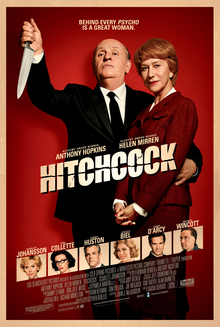
Hitchcock

A movie about the making of a movie? Yeah, that doesn't necessarily sound that interesting. Oh, it's about all-time great director Alfred Hitchcock and one of his most respected classics? Okay, I'm a little more interested now. I was curious but skeptical going in, but I ended up liking 2012's Hitchcock a whole lot.

It is 1959 and highly respected Alfred Hitchcock (Anthony Hopkins) is coming off one of his best movies in terms of critical acclaim and audience success, North by Northwest. He's thrown for a loop when a reporter asks if he's going to retire now that's he 60 years old. Hitchcock vows his next film will be his best, a unique, doozy of a flick that audiences have never seen the likes of before. He finds his source in a novel called Psycho, a story loosely based on a real-life murderer. The subject matter is highly controversial, especially for a 1960 audience, and he struggles from the get-go to get the backing to produce his movie. Instead, he and his wife, Alma (Helen Mirren), fund the movie themselves, putting their own money up as backing. Casting, the actual filming, the studio, the censors, all will prove difficult in getting his film made, but it's also threatening to tear up his longtime marriage and partnership with Alma.

Released in 1960, Psycho was a film that earned lukewarm reviews but rabid audiences ate it up and helped it take off. It earned four Oscar nominations -- including Hitchcock for director, Janet Leigh for supporting actress --and quickly became a classic with a story and style that helped rewrite the thriller/horror genre. While it's remembered as a classic now, it had a checkered production as Hitchcock struggled to get backing (studio head Richard Portnow) while also doing battle with the censors (played by Kurtwood Smith) to make the movie that he wanted to make. From the infamous shower scene to the on-screen depiction of violence and sex, it is a gem of a film. Enough with background though. Is a movie about a movie interesting? Sometimes stories based on facts like this can play like reading an encyclopedia, but this one is interesting from the first scene right to the end.

I know there's a lot of great acting performances out there, but I'm genuinely surprised Hopkins did not earn a Best Actor nomination. He certainly deserved it. For one, he's almost unrecognizable as the famous English director. Looks are just one aspect of the performance, one that isn't a do or die moment. What's more important is that Hopkins becomes Hitchcock. The speech patterns, the personal, little mannerisms like holding his suit, pursing his lips, it all adds up to bring the puzzle pieces together. When Hopkins is on-screen, you can't take your eyes away from him. It also isn't a hero pic, portraying the director as he was, an incredibly talented if mercurial director who had tendencies that drove people up a wall at times. On the other hand, he was so talented those people had to put up with him at times.

The movie is significantly better for it. While it is about the making of Psycho, it's more so about how the making of Psycho affected Hitchcock's marriage to Alma Reville, played to perfection by Helen Mirren. While filming, Hitchcock had his quirks. He was always searching for that perfect platinum blonde (Kim Novak, Janet Leigh, Tippi Hedren), sometimes at the expense of paying Alma any attention at all, something that plays out as Alma works with smooth-talking screenwriter Whitfield Cook (Danny Huston). Neither Hitch (he at one points says "Hitch....never mind the cock") nor Alma is below playing some head games, testing their marriage when the pressure of making their movie successful is already wearing on them. We see Hitchcock in all his glory and flaws -- holding grudges, being a peeping tom among others -- but it adds to the movie, making it more than just a documentary. Hopkins and Mirren are two pros at the top of their games, great lead performances.

Working with director Sacha Gervasi is a very talented supporting cast beyond his two stars. I was worried some because the actors are playing....well, actors, and actors much of the audience will be familiar with. Scarlett Johansson is excellent playing Janet Leigh, the star of Psycho who bonds quickly with Hitchcock during filming, Jessica Biel also solid as Psycho co-star Vera Miles. Toni Collette is solid too as Peggy Robertson, Hitch's much-maligned assistant who is nonetheless someone the director counts on in a big way. Michael Stuhlbarg is very good as Lew Wasserman, Hitch's agent trying to help him through the troubled production. Michael Wincott is perfectly creepy as Ed Gein, the real-life inspiration for the Norman Bates character, James D'Arcy playing Anthony Perkins. In a cool storytelling device, Gein actually "talks" to Hitchcock, apparently giving the director inspiration in bringing his movie together.

I liked this movie. Good style, solid characterization and an inside look at a classic film. I loved the bookend storytelling too, Hitchcock actually talking to the audience much like he did in his Alfred Hitchcock Presents TV show. It's on-screen narration that works so well, setting things up. In a cool visual with the narration, the final scene gives a hint to Hitchcock's next film, another classic remembered fondly with Psycho. Just a good solid film overall, most memorable for Anthony Hopkins and Helen Mirren.

Hitchcock (2012): ***/****

Friday, September 6, 2013

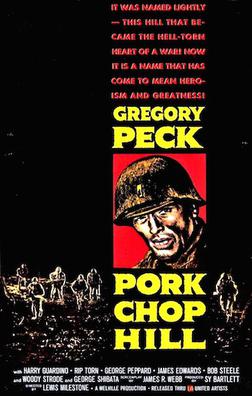
Pork Chop Hill

No soldier wants to die. But what about as a war nears its end? The end of the fighting may only be days away, maybe even hours away. So goes the background for the underrated Korean War drama from 1959, Pork Chop Hill.

It's April 1953 and both American and North Korean/Chinese commanders have agreed to a cease fire with the two sides meeting at Panmunjom. The negotiations though are moving along at a frustratingly slow pace with little being resolved. Near the front lines, the fighting rages on with Lt. Joe Clemons (Gregory Peck) and his King Company awaiting orders, supposedly to withdraw as the fighting dies down with negotiations picking up. The orders though are just the opposite, orders to move forward and take Pork Chop Hill, a worthless hill that's been lost and regained countless times. Now, the Chinese are in possession, but it is a spot on the line that's been deemed very important to negotiations. Clemons assembles his weary company, moving forward to take a hill that holds no military value.

Dubbed the Forgotten War, the Korean War pales in comparison to both World War II and Vietnam in terms of theatrical films released about them. From director Lewis Milestone (A Walk in the Sun, Halls of Montezuma, All Quiet on the Western Front), 'Hill' is a generally forgotten war film that certainly deserves better. It is similar in a lot of ways to 1962's Hell is For Heroes -- even using an eerily similar score from Leonard Rosenman -- and is based on a true story, the battle for Pork Chop Hill. It was filmed in black and white, a highly effective shooting technique, giving everything a sparse, cold and vacant look. Why isn't it remembered as the near-classic that it is? I've got no idea.

What jumped out at me on my recent viewing was the cynicism and darkness that's evident throughout. More surprising? It was made with cooperation from the U.S. Army which in itself isn't too surprising. It's that in exploring the battle, 'Hill' at times shows the complete ineptitude of the American commanders. Assaulting the hill, Clemon's company is put on the grid when American spotlights actually shine right on them in the dead of night. Other companies are given wrong orders, ranging from just plain wrong to misleading. Once King Company is in position, the rear command is genuinely confused, thinking they're fighting a mop-up action when in reality, they're holding on by their fingernails with limited ammunition, food and water. At one point, an U.S.O. photographer is sent up the hill to get photos of an American victory because the folks back home need to see an American win. Peck's reaction is priceless, a commander at wit's end who doesn't know what else to say.

This is an honest criticism of headquarters that's based in reality, and for a 1959 audience, it seems light years ahead of its time. If I didn't know better, it sounds like a Vietnam War movie like Platoon or Apocalypse Now more than a major studio release from 1959. Leading the way is the always reliable, always impressive Gregory Peck. His performance reminded me some of his Oscar-nominated turn in Twelve O'Clock High 10 years earlier. His Clemons is an effective commander simply trying to follow orders and get as many men through the battle unscathed as is possible. Even he is pushed to his limits as one bumbling order after another comes through, the commanders refusing to acknowledge that the battle isn't going as they expected. It's an understated part, but an emotionally effective one. We see the wear and tear on his face, his reassuring, confident tone slowly being worn down.

Beyond Peck though, 'Hill' is noteworthy for its supporting cast of rising and future stars. Harry Guardino and George Peppard play Forstman and Federson, two buddies lugging a machine gun around the hill. Rip Torn plays Lt. Russel, commander of the relief company assigned to help out King Company. 'Hill' is also one of the first war films to show integrated units, Woody Strode playing Franklin, a private fed up with the war, and James Edwards as Cpl. Jurgens, one of Clemon's most dependable, trustworthy men. Also cool casting is George Shibata as Lt. Ohashi, a Japanese-American soldier, Clemon's close friend and one of his platoon commanders. Also look for Norman Fell, Gavin MacLeod, Robert Blake, Biff Elliott, Martin Landau, Harry Dean Stanton, Clarence Williams III and several other familiar faces rounding out King Company's roster.

Clocking in at 97 minutes, a majority of 'Hill' is spent in the trenches and bunkers with King Company, a few asides here and there showing the negotiations of the cease fire. This is a movie interested in the nuts and bolts of the battle, the flanking movements, the reserve companies, the crossfires and preparations for counterattacks. It never gets bogged down though, the battle scenes uncomfortable and unsettling in their reality. It isn't graphic violence here, but that doesn't mean it's not hard to watch. Add in the psychological warfare of a Chinese broadcaster bombarding the American troops with propaganda, and you've got quite the battle here. It's not just bullets and soldiers anymore, but the effect it has on the soldiers' heads too. A great war movie, one that deserves more of a reputation/following.

Pork Chop Hill (1959): *** 1/2 /****

Thursday, September 5, 2013

Dead Man Down

Having directed the huge 2009 hit The Girl With the Dragon Tattoo, Niels Arden Oplev made an interesting decision. He stepped away. The film broke box office records, but Oplev was in no rush to get behind a film camera again, instead working some in television. He's finally returned to movies, coming back in strong fashion with 2013's Dead Man Down.

Having infiltrated a small-time but growing criminal empire, Victor (Colin Farrell) is a trusted member of a crew run by Alphonse Boyd (Terrence Howard). Alphonse's crew is in trouble though, one of his most trusted men having turned up. Clues are sent in the mail to Boyd, someone clearly intent on torturing him before unleashing their final attack. Living in the apartment building adjacent from his, Victor meets Beatrice (Noomi Rapace), a young woman still recovering from a horrific car accident -- at the hands of a drunk driver -- that left her with a heavily scarred face, even with plastic surgery. What seems like a potential friendship is something else though. Beatrice saw Victor murder a man in his apartment and now intends to blackmail him with that information. In this case though, Beatrice may have stumbled into something far bigger than she intended.

From director Oplev, 'Dead' was a real winner for me. Not surprisingly, it received pretty mixed to negative reviews and didn't do much damage at the box office, earning about $18 million. I'm a big Colin Farrell fan though, and the trailer caught my eye in a big way. Add in my general gullible qualities when it comes to even remotely decent crime thrillers, and I must have been a fish waiting for a line in the water with this one. I liked it a lot, and for all the reasons a lot of critics/reviews didn't. The story is convoluted and does depend on some rather crazy plot twists. As a positive though, much of the script from writer J.H. Wyman is a gem, filtering out little bits of information with each passing scene. In other words, pay attention to those first 45 minutes because very little is spelled out. It all comes together nicely, the momentum picking up at the 45-minute mark or so.

What appealed to me most -- along with the casting -- was a reliance on style. The story is there (a must) and doesn't disappoint, but it's that brutally dark style incorporated by Oplev and cinematographer Paul Cameron. This is apparently a world without sunshine. The movie is filmed almost entirely at night and indoors in poorly lit rooms and apartments. When it does go out into the day, it's always cloudy and gloomy, reflecting the general gloominess of the story and its characters. Add in Jacob Groth's gloomy, trance-like score too for a nice touch. It's a nasty world they're living in, a dog eat dog world where everyone looks out for themselves first. Rapace's Beatrice is constantly yelled at and insulted by a group of kids because of her scars. There's gangsters, gangsters and more gangsters, all ready to dispatch each other with the slightest provocation. That general darkness in crime thrillers (in any movies really) has always appealed to me, and it's handled nicely here.

It seems there are diehard fans of Colin Farrell and those that can't stand him. Well, I come down in the diehard camp then. With just about every new part, I like him more and more. Even in average flicks like Total Recall, he's a bright spot. How about a film with a good script and a good part for him? He isn't going to disappoint too much. His character here as Victor reminded me in some ways of his part from London Boulevard (another film I thought didn't get a fair shake), a tragic character who's been down quite the path and is trying to right a wrong no matter how he can. Farrell is excellent at that tragic antihero, Victor's backstory certainly putting him into that category. He does a lot without much in the way of dialogue, expressing a lot with a look here, a worried glance there, an intense outburst breaking the silence. In a very good movie all around, I thought Farrell was the best thing going here.

Adding some depth to the character is Rapace's similarly layered performance as Beatrice. The original Girl With the Dragon Tattoo, Rapace's Beatrice enlists Victor to exact her own form of revenge but instead finds herself dealing with a similarly flawed, troubled individual. The dynamic between them is spot-on, underplayed nicely without going for any obvious genre conventions. Howard too is very good as Alphonse, a criminally smooth bad guy, Howard's silky voice putting his victims at ease before he strikes. Dominic Cooper is a scene-stealer as Darcy, Victor's friend and a member of Alphonse's crew trying to climb his way up. Also look for Isabelle Huppert as Beatrice's worrying mother, an excellent F. Murray Abraham as a man from Victor's past helping him out, James Biberi as Ibir, an Albanian gangster working with Alphonse, Armand Assante as a higher-up gangster disappointed in Alphonse, and Luis Da Silva Jr. as Terry, Alphonse's right hand man.  

Because I do my best not to spoil new movies I really like, I'm trying not to reveal too many twists and turns here. If there's flaws, they aren't big enough to derail the movie. That's part of the fun, going along with a story that slowly parcels out information with each passing scene. There is action, quick and hard-hitting but not overtly graphic, with the finale packing in an impressive, artsy shootout in a mansion packed with gangsters. I was worried about where the movie was leading, what kind of ending we were in store for, but it worked on just about every level I could think of. I liked the whole movie a whole lot. Well worth seeking it out.

Dead Man Down (2013): *** 1/2 /****

Wednesday, September 4, 2013

The Mercenary

If Sergio Leone is the Founding Father of the spaghetti western, Sergio Corbucci has to be the really cool uncle in the family. He directed some of the coolest and most entertaining westerns to come out of the genre, everything from Django to The Great Silence, Hellbenders to Navajo Joe. Thanks to the Music Box Theatre on the northside of Chicago showcasing spaghetti westerns all summer, I was able to catch up with 1968's The Mercenary.

It's the 1910s and the Mexican Revolution is raging all over the country. Among those fighting is a peon turned bandit, Paco (Tony Musante), who dreams of fighting back against authority, doing something his father was never able to do. Leading a bloody uprising at the silver mine he works at, Paco gets his chance, earning himself a small group of followers. They soon meet Kowalski (Franco Nero), a Polish gun-for-hire who saves himself from a nasty death by agreeing to work with Paco and his men...for a price. Kowalski gives them weapons, ammunition and equipment, more importantly leading them with tactics and strategy. From town to town they attack the government troops, Paco gaining national notoriety while Kowalski earns more and more money. Their fame and notoriety has come at a price with the Mexican army hunting them down, including a dandy of a hired gun, Curly (Jack Palance). All their paths seemed destined to cross.

Over a span of just five years (1966-1970), Corbucci directed six different spaghetti westerns that are considered must-see flicks in the genre, and this is certainly one of them. Where Leone has a reputation of a master filmmaker, Corbucci doesn't have the same pull. His efforts -- while highly entertaining, sometimes highly controversial/weird -- are more straightforward. The movies have more of a rogue, renegade quality that at times feels like its a blood and guts amateur quality. The camera is off-center, cuts and edits are rough to say the least. The counter is that they're usually a hell of a lot of fun. Some like Django are shocking in their violence, others like The Great Silence are shocking but in terms of an almost romantically doomed storyline. Somewhere in between? The Mercenary, just an entertaining flick all around.

'Mercenary' comes from a subgenre dubbed 'the Zapata western' that dealt with the Mexican Revolution, usually focusing on political issues in one way or another. In that sense, it deals with a lot of familiar characters and themes. Nero's Kowalski is the almost necessary outsider, the gunrunner, the mercenary, the hired gun, any variation of American and/or foreign adventurers/profiteers who find themselves in Mexico with a chance to make money. Musante's Paco is the illiterate peon who wants more, who doesn't want to be held down. If there's some fame and riches in the process for him, so be it. Then there's Palance's Curly, the sadistically unique villain that every good western needs. The politics are there but not too heavy-handed, Kowalski and Paco talking about what they hope to achieve, what they can achieve, about what the people should get/want and what the government actually provides.

So, yes, there is politics, but the focus here is far more on the really cool characters and the really cool action. The similarities are obvious in the casting to Leone's Good, Bad and Ugly, assembling a trio of antiheroes -- one worse than the others -- and it works here perfectly too. Nero as Kowalski is a movie-stealer, his Polish mercenary who's out for money, riches and adventure and willing to sell his services to the highest bidder. It's the visual too, his long duster, his tight-fitting vest and tailored shirts, his flat brim hat, his Fu Manchu mustache and long sideburns, even a little guyliner for good measure. Kowalski is smooth, smoother and smoothest, letting absolutely nothing rattle him. It's that confidence that oozes out in the roll, the little touches Nero brings to the part, like striking matches on anything and everything; a woman's breast, a dead man's boot as he hangs from a noose, a rival's gunbelt among others. It is a great leading part, and another great part from the always criminally cool Franco Nero.

Two years later, Corbucci would basically remake this movie with 1970's Companeros. Nero and Palance would return in similar roles with Tomas Milian replacing Musante. While Musante has a good chemistry with Nero and he's very watchable, it just isn't a great part. He gets lost in the shuffle at times, his idealistically fun yet clueless revolutionary not quite living up to expectations. Musante also gets the love interest, Giovanni Ralli as Columba, the Mexican woman caught up in his revolutionary band. And then there's Palance as Curly. Spaghetti westerns had gay characters all over the place, but it's a scream to watch at times. Curly is the definition of a gay caballero, his immaculately coiffed hair, flowers in his jacket lapels, his almost-dainty mannerisms, and adding a nice touch just because, crossing himself over his victims and as he passes crucifixes and churches. An underused part, but a great villain just the same.

Also look for familiar spaghetti western faces Lorenzo Robledo, Raf Baldassarre and plenty of others rounding out the supporting cast. The focus is most definitely on Nero, Musante, Palance and Ralli as the story develops. Having worked with Corbucci in 1966's Django, Eduardo Fajardo returns here as Col. Garcia, the Mexican officer at the head of the regular army column always in pursuit of Kowalski, Paco and his band. And because it'd be criminal to not mention him, Ennio Morricone (working with Bruno Nicolai) turns in another memorable score, this one featuring three main themes, all of them gems. Give it a listen HERE.

Onto the action! Onto the gunfights! There are plenty here, the episodic story of Kowalski and Paco working together well to provide plenty of shootouts, both on a small scale and the large. When it is on-screen, the action is big and chaotic, explosions and shootouts, featuring machine guns, cannons and even an airplane attack late. Corbucci adds a nice touch, hinting at a coming attack at one point, but only lets us hear about its bloody details later. The best though is in the Leone mold, a shootout in an empty bull ring, Kowalski serving as the ringmaster. The buildup is great, the payoff even better. Now the fact that the movie goes on for another 15 unnecessary minutes is an issue, but a minor complaint. A spaghetti western with a great cast and fun action, just a lot of fun to watch.

The Mercenary (1968): ***/**** 

Tuesday, September 3, 2013

Four of the Apocalypse

Spaghetti westerns are inherently dark and twisted, a view of the American west that is based in some sort of historical reality but done up with a heavy dose of steroids. Some obviously are tougher to handle than others, my toughest to get through being 1967's Django Kill! Well, I've got a new spaghetti western that I had trouble getting through. Uncomfortable and dull to boot, it's 1975's Four of the Apocalypse.

Thrown into jail in the western town of Salt Flats, gambler Stubby Preston (Fabio Testi) finds himself sharing the jail with three other people; Bunny (Lynne Frederick), a pregnant prostitute, Clem (Michael J. Pollard), a dimwitted drunk, and Bud (Harry Baird), a drunk who sees ghosts all around him. That night, Salt Flats comes under attack by a gang of bandits, much of the townspeople killed in the attack. The quartet is untouched, leaving them on their own with no guns and little supplies to get to the nearest town across the desert. Stubby and his motley trail mates head out into the desert, meeting an assortment of people along the way. One of them is a bandit named Chaco (Tomas Milian) who at first seems helpful enough but quickly shows his true colors. Now they must band together more than ever if they hope to survive both the desert and Chaco's sadistic tendencies.

A writer and director with a ton of scripts and feature films to his name, 'Apocalypse' director Lucio Fulci is known above all else as the king of gore in the 1970s and 1980s. His love of gore obviously found a home in the Italian horror genre, but he departed long enough early in his career for this spaghetti western. In the years since its release, that's what 'Apocalypse' is known for more than ever...the violence. The action is kept to a minimum, but the early attack on Salt Flats is horrifically bloody, huge bright red blood squibs seemingly throwing up out of people. One scene has Chaco carving up a living man's stomach, probably the most uncomfortable scene in the entire movie. There's an edge of the uncomfortable throughout the movie. It isn't always the violence that startles us, but the build-up instead, the personal nature of it. There's also some cannibalism, rape, massacres, and crippling knee shots for those tallying at home.

The unfortunate part is that the violence is used to shock us, but to what end? What is Fulci trying to say here? What's his message? I think at some point he set out to make an allegory, a metaphor about the world in its entirety. We get four people with some huge flaws -- gambling, prostitution, alcoholics, insane -- and they are thrust into this apocalyptic, end of the world type situation. It's a world where anything goes and seemingly no law exists. It sounds good, huh? I thought so, but the execution isn't there. At one scene, it is the darkest, most disturbing movie you've ever seen, and the next, a town of all men up in the snow-capped mountains are celebrating the birth of a baby boy. It just doesn't fit together. A message needed to be picked and stuck to it. Instead, I feel like Fulci is trying to deliver some profound message that never quite comes to fruition.

Not helping the cause is a script that doesn't make any of the characters that interesting and/or sympathetic. Testi is far from your prototypical spaghetti western hero, and that's a cool change of pace. On the other hand, he's a helpless, whiny doofus who can't see trouble until it hits him in the face. Frederick is required to look worried, Pollard is Pollard, goofy and aloof with that constant confusing grin on his face, and Baird hams it up, describing all the ghosts and dead people he sees. None are that interesting to watch, making their plight in the desert uninteresting and taking away any emotional investment we have away in rooting for them to make it. Spaghetti regular Bruno Corazzari is solid as Lemmy, a drunken doctor up in the mountains who helps care for Bunny while Adolfo Lastretti has a fun if underused part as a gun-toting preacher. Also look quickly for Donald O'Brien as the sheriff of Salt Flats.   

The best thing going for 'Apocalypse' is Milian as Chaco, for good and bad. This is a villain so sadistic, so pure evil that it becomes almost unbearable to watch these scenes. He baits the desert travelers and then turns on them, feeding them some sort of hallucinogen and then proceeds to torture them in various ways, always with a smile on his face. His look/appearance is a big part of the character, long, flowing hair, a bandana around his head, long, colorful robes, maybe a little mascara under there, and what appears to be crucifixes carved under his eyes. In a would-be allegory about life, is Chaco's evil supposed to be the Devil? Is he just the Devil, straight up? That's up to you to decide, but his scenes are the most interesting thing in this story, even as uncomfortable as they are to watch.

Intentions of a profound story that doesn't amount to anything aside, I think my biggest issue here is a cardinal sin in filmmaking. This is an incredibly dull, downright boring film. It has no real redeeming qualities other than Milian's performance. What is it trying to say? Is it trying to say anything? In between bits of shocking violence, we get long stretches of Stubby and his fellow travelers walking across deserts, through the hills and all to a ridiculously awful folk-like soundtrack from Italian songwriters. It is out of place and just too folksy for its own good. I found myself fast-forwarding a lot late in the film, and even Stubby looking for some vengeance in the last act could save this bomb. Very disappointing negative review.

Four of the Apocalypse (1975): */****

Monday, September 2, 2013

Missing in Action

Before he was the punchline to countless facts and one-liners about how cool, awesome and badass he was, Chuck Norris was quite the action star in the late 1970s and throughout the 1980s. We're not talking classic, big budget action flicks, just hard-edged, action-packed B-movies that fans and audiences usually ate up. Are they good? For the most part, not particularly, but Chuck Norris is so cool!!! Here's one of his best, an audience favorite and near cult classic (because it's really dumb), 1984's Missing in Action.

Having spent seven years in a North Vietnamese prisoner of war camp, Lt. Colonel James Braddock (Norris) still struggles with the traumatic experience. He escaped 10 years ago, but the experience still lingers with him, especially because he believes that even long after the war, Braddock believes there are still many more missing in action American soldiers. The only problem is, he can't convince anyone of his belief. Braddock is finally able to get back into Vietnam, convincing a government investigation team to look out for evidence of other M.I.A. American soldiers. The team is met with a stone wall of doubt and questioning, frustrating Braddock even further. The former Colonel takes things into his own hands, planning an excursion deep into Vietnam where he's found the location of a hidden camp for POWs. Can he somehow pull it off, rescuing the prisoners who have long since been abandoned?

If that plot description sounds familiar, it should. In 1983, a story treatment from director James Cameron made its way around Hollywood and was eventually turned into Rambo: First Blood Part II. The studio that made 'Action,' Cannon Group, claimed to be "inspired" by the treatment and made its own rescuing POW movie. It was actually two movies, this one and a prequel, Missing in Action 2: The Beginning, that were made back-to-back and raced into theaters before Rambo's bloody return in 1985. So is it familiar? Yes, it should be. More than that, there's a whole sub-genre about rescue efforts of Americans in Vietnam, including this one, Rambo, and the first and best of the bunch, 1983's Uncommon Valor. The Vietnam War was unlike any other war America had fought in, and numbers differ about how many soldiers were missing in action or their bodies were never recovered.

It's a natural jumping off point for a story/script, right? Operations and missions into Vietnam to rescue Americans, how can you lose? Uncommon Valor is an action-packed, men on a mission movie with a solid cast. Rambo is mindlessly stupid, Sylvester Stallone a ridiculous one-man killing machine. And then there's this movie. Yeahhhhhhhhhh, I thought Rambo was pretty bad until I saw this movie. The script is the biggest culprit. We get countless scenes of Braddock staring into the distant with a blank stare on his face. We get more scenes of him walking around Vietnam and Thailand. There is no real tension at any point in the story that basically drifts along from dull action scene to dull action scene through the first hour plus. It's very basic. Americans = angelically good. Vietnamese = Satanically evil in sinister ways. All of them. They're all bad. It's so simplistic in its execution that it ceases to be a good bad movie, one you can sit back and revel in. It becomes just bad.

Surely Chuck Norris himself can be a saving grace, can't it? Yeah, that's what I was counting on, but that never comes around. As an action star, Norris is quite capable. He handles much of his own stunts, including one impressive stunt late as he hangs from a ladder on a hovering helicopter, and all his hand-to-hand combat scenes are pretty decent. Maybe it's the character, maybe it's the script, but the character just isn't very interesting. Braddock's tortured past is shown and mentioned, but I never actually felt too interested in him. M. Emmet Walsh gets to ham it up as Tuck, Braddock's old friend who owes him one and uses his boat as a way to get back into Vietnam. David Tress is the U.S. Senator at the head of the investigating team with Lenore Kasdorf as Ann, the Senator's assistant who helps Braddock and gets nude too! The horrific Vietnamese villains are James Hong as General Trau with Ernie Ortega as Vinh, the sadistic prison guard who is now a government official apparently.

So if Chuck Norris can't save the movie, surely the action can, right? Right?!? Once again, it comes up short. 'Action' basically rewrites Action Movie Cliches 101. Braddock can hit anything and everything he aims at. He can be running, walking, crouching, falling, and he's going to drill that bad guy dead center. Meanwhile, the Vietnamese troops -- supposedly trained at some point in firearms -- can't hit one freaking guy! Not once, not even a scratch! The action scenes aren't actually that bad, providing a minor positive in an otherwise pretty lousy story, but the cliches get to be a little much. Even the best scene, Braddock and Tuck on a motorized raft gunboat attacking a Vietnamese column on shore, is undone by the appearance of a Vietnamese patrol boat/gunboat. Oh, and a helicopter! Braddock arranged days before for it to show up at the exact second it's needed! Tuck's assistant guns away at the boat (seemingly not hitting it at all), and then Tuck takes over. There are scenes of seven, eight seconds of these guys blasting away, unedited, just firing. It's riveting to watch, as riveting as it was to write.

Here's a good example. If this scene puts a smile on your face, check the movie out and start drinking (heavily). If it doesn't, this ain't for you. Thinking they've killed Braddock -- silly Vietnamese -- three soldiers stand and show off their most ridiculous, over the top evil laughter, celebrating killing the indestructible American. In slow motion (of course), Braddock pops up out of the water and shoots them to pieces. I thought this movie would have a put of that guilty pleasure charm, a really bad movie that embraces the badness. Mostly, it takes itself too seriously and is one big dull final product.

Missing in Action (1984): */****