The Sons of Katie Elder

The Sons of Katie Elder
"First, we reunite, then find Ma and Pa's killer...then read some reviews."

Friday, January 4, 2013

The Help

By no means did I avoid 2011's The Help, but I never actively sought it out either. A success at the box office and during awards season, I just wasn't dying to see it regardless of all the positive reviews. I'm stubborn that way apparently. So here we sit, a year later, and I caught up with it. Definitely worth the wait, and another lesson I shouldn't be so stubborn when it comes to movies.

Having just gotten her college degree, Skeeter Phelan (Emma Stone) heads home to Jackson, Mississippi hoping to get a job writing for a local newspaper. She gets that job, ghostwriting a column about cleaning advice. Skeeter seeks the help of Aibileen (Viola Davis), a maid who works for one of the richer, well-to-do families in town. Having grown up in Jackson, Skeeter has seen the inner workings of the town; white families served hand and foot by their African-American servants with no regard for feelings. Talking to Aibileen, Skeeter thinks it would be a great idea to write a book written from the perspective of "the help." Aibileen and her friend and fellow maid, Minny (Octavia Spencer), agree, but they're scared to death of the possible consequences.

From director Tate Taylor, this is an interesting movie to watch, digest and review. While it is a highly enjoyable film to watch, it is also intensely uncomfortable to watch because of.....well, it's honesty. Set in early 1960s Mississippi, the focus is clearly on the racism and segregation that ran rampant in the South and around much of the U.S. for years (and still does in different ways). It is a difficult movie to watch, difficult to comprehend people treat others like this. The help are treated like dirt with some believing they carry "different diseases" to the point their own bathrooms are built in garages.

Credit to Taylor and his crew though for making the movie. Set just 50 years ago from the present, it feels like we're traveling as viewers in a time machine. You watch this movie and feel like you've been transported to 1960s Jackson. Everything from the wardrobe to the sets to the big boats of cars gives 'Help' an air of authenticity. We see people smoking anywhere and everywhere, we see the violence that erupts from the developing Civil Rights movement, and the way the maids and help are treated like second-class citizens. I especially liked Thomas Newman's score as well, an underplayed score that moves the story along nicely.

By far though, the best thing going for Taylor's film is the cast. It's a deep cast. Very deep. Up until this point in her career, Emma Stone had done mostly comedic work, even some light drama. In a major starring role, Stone doesn't disappoint. It isn't a performance that requires her to carry the movie, but that's the beauty of such a strong ensemble. She develops quite the interesting character, and one that ends up being a means to an end to introduce the deeper, more dramatic parts. Also look for Allison Janney as Skeeter's mother, Charlotte, Ahna O'Reilly as Elizabeth, a young married woman who has Aibileen as a maid, Sissy Spacek as an aging Southern belle and the mother of another character (more on Hilly later), and Cicely Tyson as Constantine, the Phelan's maid who was a key figure in Skeeter's childhood.

 All those performances are solid, but four other performances end up being what many viewers took away from the film. Octavia Spencer won a Best Supporting Actress Oscar for her part as Minny, the fiery, opinionated maid who ends up butting heads with Bryce Dallas Howard's Hilly, the -- pardon my language -- Queen Bitch in Jackson. Spencer is the showier part while Viola Davis gets the more understated and underplayed part that provides the perfect counter to Spencer's Minny. It is an epically appropriate duo, two genuine friends who have also bonded through their similar trials. Davis was also nominated for an Oscar but lost to Meryl Streep from The Iron Lady. Her motherly relationship with Elizabeth's daughter is the crux of the movie. Howard is a despicably unlikable villain in a great performance. The third nominated part goes to Jessica Chastain as Celia, an outsider in Jackson because Hilly hates her. Her relationship with Spencer's Minny ends up being a key part of the movie, a highly effective emotional relationship. Four great performances though.

If there is a complaint I had, it's that at 146 minutes, 'Help' is a tad on the long side. It's never boring and always interesting to watch, but in certain parts of the second half it felt like I had been watching the movie for quite a long time. The ending makes up for any draggy portions with a kick right in the crotch in the emotion department. It's a heartbreakingly real ending, one that while appropriate is depressing nonetheless. A very good movie overall that deserves all the kudos and accolades it's earned. Glad I caught up with it.

The Help (2011): ***/****

Thursday, January 3, 2013

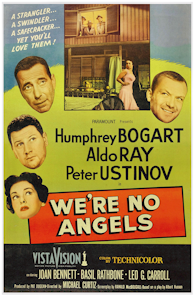
We're No Angels

By 1955, Humphrey Bogart had done everything possible to be a true Hollywood legend. What do you think of when you hear his name though? I typically think of heavy roles, dramatic, intimidating tough guys. Sure, they're not all like that, The African Queen comes to mind, but a majority were. Well, we can add another film to that small list, 1955's We're No Angels.

It's Christmas Eve on Devil's Island in 1895, and three convicts, Joseph (Bogart), Albert (Aldo Ray) and Jules (Peter Ustinov), have managed to escape. The only problem? They've got no money, no papers, and no way of getting off the island. Instead, they meet Felix Ducotel (Leo G. Carroll), a quiet, worrisome and soft-spoken shopkeeper who offers them a job fixing his roof. The trio sees a chance for some easy money, pretending to work on the roof and waiting for nightfall for a chance to rob the shopkeeper blind, giving them everything they need to pull off the successful escape. Pretty simple, right? From their rooftop perch, the convicts start to listen to the goings on in Felix's worrisome life. Uh-oh, now the convicts are interested and even going to help. That escape plan is on hold....for now.

This was a movie on my Netflix queue as a 'Save' option for months after I accidentally read about it at IMDB. I couldn't find it anywhere, and it didn't seem to be on TV...ever. So when TCM aired it in early December, I jumped at the chance. It was well worth the wait. That plot description doesn't exactly scream out buddy comedy, does it? That's what it is though at its most basic. It just happens to be a buddy comedy on steroids that blends a great script, perfect casting and a unique setting that takes advantage of the early stages of widescreen format in films. Long story short, I liked this movie from director Michael Curtiz a whole lot.

The casting works so well because it plays against convention and typecasting. My first thought at hearing Bogie, Aldo Ray and Peter Ustinov in a movie about convicts escaping Devil's Island? Not going to be a comedy. While all three actually are criminals, their crimes are played for laughs (Bogie is a forger, Ray and Ustinov murderers) and end up producing some of the biggest laughs in the movie. I probably use this too much, but the chemistry among these three actors -- all very talented in their own right -- is spot-on. It's effortless. They do it with ease. And because it's a comedy, it's that much better. Dramatic actors doing comedy can be hit or miss, but when handled correctly as it is here, it can carry a movie.

So as is usually the case, this movie goes both ways. Is it the cast lifting up a script or a solid script giving the cast something to do for a change? Oh, no, the Chicken or Egg: Movie Edition! It's both here. Bogie, Ray and Ustinov doing comedy is a welcome change. As good as they are dramatically, they're even better doing comedy. Read some of the more memorable quotes from 'Angels' over at IMDB HERE. It's never obvious humor, most of it underplayed to the point some lines are probably too subtle to even register. That is the beauty though of smart humor though. And throw into the shenanigans, Adolph, a very little, very poisonous snake as the fourth member of the troop with a knack for "solving problems," and we've got some laughs.

Playing the straight man to the convicts' subtle shenanigans, Carroll does a fine job as constantly worried Felix whether it be his family or his business. Joan Bennett and Gloria Talbott round out Felix's family, his loving wife, Amelie, and his daughter, Isabel, madly in love. Basil Rathbone and John Baer play visiting family members, both with their own secrets and looking to take advantage of Felix, his family and his general store. Rathbone is particularly nasty, rounding out a supporting cast that does a solid job without taking away the spotlight from the three main stars.

On top of the acting though the little things come through in 'Angels.' It was one of the first films to use Vistavision, a unique, very colorful widescreen format. The main setting -- Felix's shop, house and roof -- plays like an on-stage play, but the screen is constantly full of bright colors and vivid backgrounds. It hits the ground running in an opening scene that shows the trio of angels escaping from quite a distance. The story itself is pretty interesting and never dull, but it never hurts when a movie is fun to watch in a visual-sense alone. As I seem to do so often, I feel like I'm not explaining why I liked this movie real well (damn comedies!), but I did. A lot, I liked this movie a ton. If you can find a copy or stumble across it on TV, sit down, plant it somewhere comfy and enjoy it.

We're No Angels (1955): *** 1/2 /**** 

Monday, December 31, 2012

Ride to Hangman's Tree

When I think of Jack Lord, I think of one thing; Lord as Steve McGarrett on CBS' Hawaii Five-O. The cop drama ran for 12 years, and Lord became forever associated with the part. He nonetheless had many other parts, including key roles in Dr. No and Man of the West. There were some stinkers in the group too, like 1967's Ride to Hangman's Tree.

After a botched robbery and narrowly escaping a lynch mob, outlaws Guy Russell (Lord), Matt Stone (James Farentino) and Nevada Jones (Don Galloway) go their separate ways. Matt heads for California while Guy and Nevada stick together, riding into Texas to continue their outlaw ways. Two years pass as Matt creates a name for himself, albeit a hidden one. Working with an inside source, Matt robs Wells Fargo stagecoaches as the Black Bandit. His identity is hidden though as he creates a new life for himself. Things seem rosy until Guy and Nevada show up and threaten to spoil the secret unless they're allowed in for a cut. As if that wasn't fun enough, Guy and Matt are fighting over a traveling singer, Lizzie Malone (Melodie Johnson).

Remakes can be tolerable when done correctly, right? Sure, why not? This western from director Alan Rafkin is a remake of another American western, 1948's Black Bart. A remake is one thing though, and an exact copy another thing. This is one of the laziest efforts I've ever seen, and it's made worse by the fact that 'Ride' was made some 19 years later. Already a B-movie on a limited scale, 'Ride' just splices footage from the 1948 version into the 1967 version. The 19-year difference rears its head there. Grainy footage doesn't translate well to the less grainy footage in 1967, and it stands out like a sore thumb. Money-saving effort, maybe, but that's not all. The producers can't even splice it accurately. We see the 1948 footage, the splice, and the 1967 footage doesn't even look the same. At one point, characters are wearing completely different clothes from scene to scene. Smooth, huh?

More than just the general laziness and cheapness in the moviemaking process, 'Ride' just isn't a very good movie. In just 90 minutes, it manages to cover a lot of ground, and none of it very well. The 'Ride' referred to in the title is covered in the first 15 minutes, and then it's off to California for the Gold Rush: Part 2. At no point does it really no where it's going or even what story it is telling. We're talking outlaws betraying each other, corrupt businessmen working both sides, a love triangle that goes nowhere, and an ending that tops everything in terms of laziness. My theory? It looks like 'Ride' simply ran out of money and decided to wrap things up as tidy as possible. The end result is less than impressive.

But as a fan of both westerns and Jack Lord, I stuck with this one. In a sea of mediocrity, Lord stands out from the rest. He manages to rise above the rather dull story, having some fun with the part of likable outlaw Guy Russell. Always looking out for himself -- but with a smile on his face -- he's a likable quasi-bad guy. So if there's a positive, it comes from the outlaw trio. Bad script though it may be, Lord, Farentino and Galloway show off an easy-going, likable chemistry of three outlaws who have ridden together for quite awhile. Lord's Guy and Farentino's Matt are always fighting, always trying to top each other while Galloway is the goofy third wheel, always ready with a cheesy one-liner to lighten the mood or rescue his partners as needed.

The rest of the cast is straightforward and unspectacular. Playing the love interest, Melodie Johnson gets to sing (badly), dance (badly) and be seductive (not well). It is 1967 though, and we get some "risque" scenes; Melodie swimming naked, changing with her bare shoulders exposed (GASP!), and dancing and singing in skimpy outfits. Richard Anderson plays the Wells Fargo man tasked with finding the Black Bandit with Ed Peck as Sheriff Stewart, the clueless peace officer. I can't really recommend this one. There's just not enough positive going on to give it even a slight recommendation. If you're going to watch, I'll say this. It's bad, but in an entertaining bad way. See how much worse it gets by the finale. You won't thank me.

Ride to Hangman's Tree (1967): * 1/2 /****

Sunday, December 30, 2012

Barquero

With the distinct feel of a spaghetti western, 1970s Barquero relies on a simple formula; pair two very successful western stars and let them do their thing. Not particularly flashy by any means, it's a meat and potatoes kind of western, just barely worth getting an above average rating.

At an isolated river crossing along the border, Travis (Lee Van Cleef) is thriving as the owner of a river barge. The crossing is the only spot for miles in either direction, and a little town has popped up around Travis' barge. Miles away, infamous outlaw Jake Remy (Warren Oates) and his gang have led a bloody raid on a cavalry convoy transporting silver and repeating rifles, wiping out a town in the process. Remy's gang heads for the river crossing, knowing time will become a factor with the Army in hot pursuit to get back their silver and rifles. Travis and the river town catch wind though, getting to the far side of the river. Now Travis and Co. are on one side while Remy's gang is on the other, plotting their next move as the Army closes in behind them. Who will cave first?

From director Gordon Douglas, this is a western from a sub-genre that popped up in the late 1960s in the U.S. In Europe, the spaghetti westerns had emerged as a factor to be reckoned with, and western fans responded. They wanted darker, more cynical and more violent westerns. Good guys weren't just good guys. They became anti-heroes. So studios gave them what they want, and the result is a sticky middle ground that isn't pigeon-holed clearly. I have always thought of them as quasi-spaghetti westerns, movies like 100 Rifles, Villa Rides, Charro!, Shalako and so many more. 'Barquero' wasn't filmed in Europe -- Colorado is the backdrop, and a good one at that -- but it still feels like a spaghetti western. Composer Dominic Frontiere's score is okay, but it's not memorable like some of his better scores.

The best thing going for this American-ish spaghetti western is the casting of Lee Van Cleef and Warren Oates as rivals. Both actors were at the height of their popularity. Van Cleef became an international star because of the spaghetti westerns, and Oates had risen from a career of supporting parts to become a leading man/star in his own right. They look to be having a lot of fun in the process, two tough guys sneering and yelling at each other from across a river. As Travis -- dubbed 'the Barquero' (Spanish for boatman) -- Van Cleef is not playing his typical gunfighter, but instead a tough as nails working man who won't turn his back on something he has created. Playing Remy, Oates hams it up (as usual, but it's always interesting) as the unhinged outlaw. We learn some about his past, and how he got here -- most definitely crazy -- but he plays one nasty dude like few others can.

Beyond that tough guy duo, 'Barquero' lacks the star power, but the supporting cast doesn't disappoint. I thought the best part was for Kerwin Matthews as Marquette, Remy's right hand man in leading a brutal gang. He is a former French officer who survived when French emperor Maximilian was killed by Mexican revolutionaries, now working as Remy's reasonable thinking ally. Also providing a scene-stealing supporting part is Forrest Tucker as Mountain Phil, a mountain man drifter who teams with Travis to protect the crossing. Both fighting over Van Cleef's Travis, Marie Gomez and Mariette Hartley play the love interests. Rounding out Remy's gang of cutthroats are Armando Silvestre, John Davis Chandler, Ed Bakey, Richard Lapp and Brad Weston. Craig Littler plays Pitney, the town store owner doubling as a con man preacher.

While I did like this western, I can't say I loved it. The premise is cool; two rivals across a river from each other. Time is running out for one of them, and they need to get across the river. Sounds like a pretty decent cat and mouse game, doesn't it? It should be, but it isn't. Remy's plan is....well, he doesn't have one. He brews and stews on his side of the river for much of the middle portion of the movie without actually doing anything. It's Matthews' Marquette who finally comes up with a plan. Clocking in at 109 minutes, it's a tad long with not enough going on. Still, it's a worthwhile popcorn western. Enjoy it for what it is, and watch Van Cleef and Oates be cool together. You can watch the entire movie HERE at Youtube.

Barquero (1970): ** 1/2 /****

Saturday, December 29, 2012

2001: A Space Odyssey

From director Stanley Kubrick, 1968's 2001: A Space Odyssey is generally regarded as one of the all-time great movies to ever come out of Hollywood. I point this out with my introductory sentence because I have no freaking idea what to write about. I watched Kubrick's film for the first time recently, and I don't even know what to say. I don't know what it was trying to achieve or show, and I came away vastly disappointed.

It is a film that to me seems to defy all description or plot synopsis. I apologize now before we get into the guts of the review because I've got a feeling this might get a little on the rambling side. There is no real plot to follow, just four extended divisions of a loosely linked narrative. Throughout time, we as viewers are shown immense black monoliths in different places and locations around the universe. Somehow and some way, it is all connected. What do these monoliths represent in the bigger scheme of things? Are they responsible for human evolution, both good and bad? Do they mean anything at all? Are we even supposed to find an answer?

I think that's what I found most disappointing about Kubrick's classic film. I resent so many reviews that state 'One has to be highly intelligent to comprehend and appreciate this movie.' Condescending and pretentious much? It is a film that requires the viewer to engage and watch everything, come up with your own conclusions. That's fine. I don't need a movie to spell out every little thing for me, but even a hint here and there would be nice. I'm not sure what Kubrick wants to say here. Is it something as simple as the circle of life, a progression of mankind over millenniums from an ape to a space-exploring human? Okay, that's fair and definitely interesting. The story though is anything but.

Kubrick's film is broken into four loosely tied together segments. The first follows a group of almost human-like gorillas living in a quasi-desert environment. One ape discovers an animal bone and realizes he can use it as a weapon. It's a profoundly cool moment, symbolically sending mankind down a path that cannot be reversed. The second segment follows a doctor (William Sylvester) as he prepares to visit a space station on the Moon where a black monolith has been discovered deep beneath the Moon's surface. Next up, fast forward 18 months later as astronauts Dr. Dave Bowman (Keir Dullea) and Dr. Frank Poole (Gary Lockwood) are in deep space heading to Jupiter with the help of the HAL-9000, a brilliant, possibly free-thinking computer. The last segment takes Dr. Dave into some sort of deep space portal on the far side of Jupiter.

Of the four, the opening ape/gorilla segment is especially effective. The follow-up, the doctor's trip to the Moon lets the momentum get tripped up, ending on a mysterious note that leads into Dave, Frank and HAL's segment. This is the most iconic, memorable segment of the movie. HAL begins to think for himself, making decisions that the human doctors don't agree with. HAL's iconic, eternally memorable "I'm sorry, I can't do that, Dave' manages to send a chill right up my back. Then, the finale is the trippiest and most visual of all the segments.....and the most mysterious. There are moments that work on an epic scale; the transition from ape to space, a monolith screeching, the realization that HAL is reading lips and thinking for himself, but there aren't enough.

I just don't know what to say here. As a visual medium alone, this is an incredible movie. As an interesting story, not so much. The musical score, including the Blue Danube (listen HERE), is probably the best thing going here. But overall, the movie is so schizophrenic I have trouble deciphering it. The story is too slim with nothing more than the thinnest of connections. The visual is amazing to watch, but it gets lost in a sea of monotonous, tedious shots of space ships floating through space. The same for the people. Seeing Frank run around the ship? Not interesting to watch. I can't put my finger on why exactly this universally accepted classic didn't resonate with me in the least. At the same time, it's hard to pick one fault and really explain it. What I do know is simple. I didn't like it....at all.

2001: A Space Odyssey (1968): ** 1/2 /****

Friday, December 28, 2012

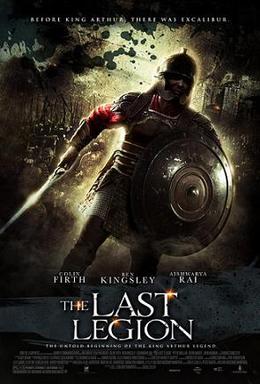
The Last Legion

Colin Firth is first and foremost an actor. He is not a movie star in the typical sense. The 52-year old actor has films like The King's Speech, A Single Man and many more dramatic movies to his name. Then, there are the departure films, like 2007's The Last Legion.

It's 460 A.D., and the Roman Empire is struggling through some perilous times. After years away from Rome and Italy and all its issues, veteran soldier Aurelius Antoninus (Firth) is being called back to the city. He has been tasked with a dangerous mission, protecting the recently appointed emperor, Romulus (Thomas Brodie-Sangster), a teenage boy. With a legion of loyal soldiers, Aurelius settles in, preparing anything he can to protect the boy emperor. Multiple factions are working against the boy though, including a Goth leader (Peter Mullan), who wants nothing more than to turn Rome on its side and take power. When the coup-like attack comes, Aurelius must turn to his most trusted men while also relying on one last legion of Roman troops in Britannia.

Despite the generally lukewarm reviews and less than impressive Netflix rating, I went into this historical epic with somewhat high hopes. Director Doug Lefler has crafted an enjoyable epic story that at its best feels like an old-fashioned epic from the 1950s and 1960s. It runs only 102 minutes so we're not talking a 3-hour mega epic here, just a solid, fast-moving story. There is something appealing about that throwback quality, especially one set in the declining years of the Roman Empire. Lefler filmed 'Legion' in Slovakia and Tunisia, giving his story an exotic feel to it that genuinely gives the impression of a moving story that has characters all over the known world. I also liked composer Patrick Doyle's score, big and booming like an epic demands. It's the good guys and bad guys, and there's no room for that messy middle ground.

Unfortunately, that throwback quality only goes so far. For me, that point was about the 55-minute mark. The entire movie covers a ridiculous amount of ground -- more on that later -- in a movie that doesn't even come close to the two-hour mark. For the first hour of the movie, that isn't a problem. The pacing is actually a benefit as Firth's Aurelius and a small group of soldiers protects Romulus apparently all over the Empire. Then out of the blue, Aurelius and Co. decide they need to go to Britannia (that's England) to seek the aid of the last remaining loyal legion of Roman troops, the Ninth Legion. That's fair. A legion of troops would be helpful in putting down a coup. But once arriving in Britannia, Aurelius and his followers must now battle a Britannic leader who has long sought the sword that will one day "rule the Empire." Basically, the story throws out the first half of the movie, going down a completely different road. Too bad, the first hour was highly enjoyable.

That's the biggest issue hamstringing this otherwise enjoyable flick. It just tries to do far too much. The final battle between Aurelius, his followers, the lost legion, and the forces of the diabolically evil Vortgyn (Harry Van Gorkum) ends, and that's it. A final scene connects the story to a well-known story in history and literature -- no real spoilers here, it does come as a pleasant surprise -- but in the process basically disregards the entire first half of the movie. Reading up on the movie, it seems it was originally intended to be anywhere between three and four hours. Can we believe that? Who knows, but a little extra meat on the bone sure couldn't have hurt. That way, it could have played like a two-part miniseries at least. That's wishful thinking though. The movie is what we have, not what it could have been.

A saving grace is the casting, starting with Firth. Far from his typical role, Firth represents himself well as the aging veteran who can still hold his own on the battlefield. I was especially impressed with how he handled the action scenes, more than holding his own. Ben Kingsley looks to be having some fun as Ambrosinus, a philosopher, teacher and warrior who works as Romulus' guardian/protector. Indian beauty Aishwarya Rai plays Mira, a warrior from Constantinople traveling with Romulus. Aurelius' Roman soldiers include Rupert Friend, Nonso Anozie and Owen Teale. Before being discarded at the movie's halfway point, Mullan is a solid villain with Kevin McKidd capably taking the reins as scarred Goth warrior, Wulfila, who would like nothing more than to kill the boy emperor. Also look for John Hannah as a Roman senator with a long history working with Aurelius.  

For the most part, I liked this flick. There are times the action/violence feels toned down -- like 'Legion' was going for a PG-13 rating more than an R rating -- but the battle scenes are fun, exciting and fast-moving in a bloodless way. The final battle in Britannia is similarly epic, but I keep coming back to the somewhat disjointed feel of the story. The movie struggles to find any sort of rhythm, and that ends up being a major issue.

The Last Legion (2007): ** 1/2 /****

Tuesday, December 25, 2012

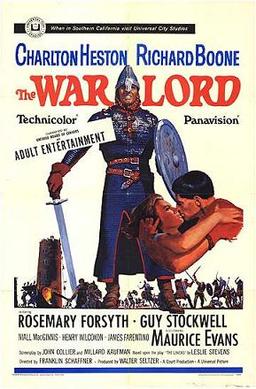
The War Lord

With movies like Ben Hur, The Ten Commandments, The Agony and the Ecstasy, El Cid and plenty more, Charlton Heston is an actor directly associated with historical epics. Some have gotten lost in the shuffle over the years, including the worthwhile 1965 epic The War Lord.

It's the 11th Century in the Middle Ages in France, knight Chrysagon de la Cruex (Heston) has been given a mission. An isolated Druid village along the coast comes under constant attack so Chrysagon is tasked with taking a small troop of knights and soldiers, including his brother, Draco (Guy Stockwell), and right hand man, Bors (Richard Boone). Upon arriving, he finds a poor village where a failed defensive castle was only partially built and villagers who have strayed from acceptable ways. Chrysagon's group works well though, but the knight falls for a beautiful young woman from the village, Bronwyn (Rosemary Forsyth). The only problem? She is engaged to a villager, and the only way Chrysagon can have her is to simply take her, angering the rest of the villagers. All the while, the threat of an attack looms.

In the age of the epics -- the 1960s -- this modestly scaled epic from director Franklin J. Schaffner has been lost in the shuffle over the last 40-plus years. I say 'modestly scaled,' and I don't intend that at all in a negative way. There are no on-location shooting, just California filling in for Middle Ages France. Much of the story is contained in one stretch of marshy coast, Chrysagon's single-towered castle sitting just off the land in a shallow waterway. There is something simple and elegant about the setting; the knights in their water-surrounded castle, the villagers hidden away in the woods. So while the scale isn't on a hugely epic level -- no countries warring, no government in-fighting -- it focuses on the personal at its most simple. In this case, it's just a man and woman who fall madly in love with each other and all the repercussions and fall-out.

I've made no secret about my general disdain for romance sub-plots in stories that simply don't call for it. In this epic though, it's not only necessary but handled well. I don't think of Heston as a natural choice for a historical epic's romantic lead, but he does a solid job here in an understated way. His Chrysagon has been fighting for a Duke for 20-something years, traveling, fighting and warring wherever he goes. When he meets Forsyth's Bronwyn, he can't help himself. He needs her, wants her. Similarly, Bronwyn is drawn to him in a way she can't explain. Without being ridiculously lovey-dovey or over the top, this relationship seems real. Everything hits the fan when Chrysagon realizes a local custom allows the powerful lords to take a virgin bride on her wedding night for himself. Not surprisingly, Bronwyn's husband-to-be (James Farentino) is less than pleased to give away his wife for a night. The results are not surprisingly pretty downbeat, but getting there is worthwhile, and the finale is a highly effective emotional punch.

Balancing out the effective love story is the solid casting backing up Heston. Adding another dimension is Stockwell's Draco as Chrysagon's brother. Brothers in the Middle Ages who differ in opinions on how to do things? Well, it doesn't take a nuclear scientist to figure out that might not end well. Stockwell does a fine job as Draco, the less-experienced knight in battle who nonetheless wants to prove himself. As the gruff voiced Bors, Boone delivers the best supporting performance. As we learn more about how these characters came to ride together, Boone's acting gets better and better, including a great job in the last few scenes without saying more than a few words. Also look for Maurice Evans as the local priest caught in the middle of the knights and villagers, Niall MacGinnis as Odins, the village elder trying to hold his people together, Henry Wilcoxon as the rival Frisian chief, and Allen Jaffe and Michael Conrad as two of Chrysagon's men.

So overall, I liked this movie a lot. I liked it a lot, and that's considering that there is little in the way of action until the last third of the 120-minute long movie. When it does arrive on the scene, the action does not disappoint. The Frisian raiders arrive to reclaim the chief's son -- accidentally left behind in a raid and feared dead -- forcing Chrysagon and his troop to retreat to their castle tower for defense. The violence is brutal without being graphic, and the action is kept from the view of the foot soldiers. We see the Frisians attacking -- catch an example HERE -- in various ways, any way to breach the heavily guarded door or at least get over the walls. The attack runs about 25 minutes, and it's a gem. The post-battle fallout is equally good too. Also worth mentioning, the score from Jerome Moross and Hans J. Salter is perfect for both the action and the love scenes. Check out the entire movie at Youtube starting HERE.

The War Lord (1965): ***/****

Monday, December 24, 2012

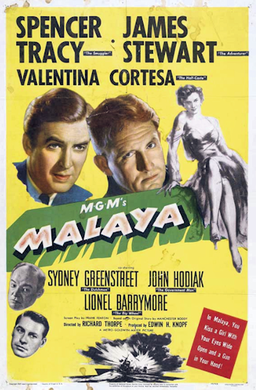
Malaya

Look down the right side of the page, and you'll see under 'Labels' quite a few war movies. For the most part though, most are about the actual fighting, the combat of war. What about the behind the scenes war angle though? How about the things that make a war possible, like production of planes, guns, materiel, and all that good stuff? A little change of pace today with 1949's Malaya, a shadowy film noir-ish story set in World War II.

Having just escaped the South Pacific with Japanese forces on his tail, newspaper reporter John Royer (James Stewart) is approached by a former boss (Lionel Barrymore) upon arrival. The conversation turns to Royer's exploits -- sometimes shady ones -- in Asia and the Pacific, Royer admitting he knows where quite a lot of raw rubber is being stored, harvested and hidden in Malaya. As the need for war materiel increases, so does the need for rubber, used to build countless key things needed to fight the war. With backing from the government (on a somewhat backdoor-ish deal), Royer agrees to go back to Malaya and see if he can buy as much as the rubber as possible and slip it out of the country. He needs help though and arranges for a friend, former partner and smuggler, Carnahan (Spencer Tracy), to aid the cause. Together, they head into Japanese-occupied territory on their nearly suicidal mission.

Considering the star power assembled here -- and there's more -- I was surprised I had never stumbled across this WWII flick before. I'm glad I did. From director Richard Thorpe, it's a mix between a behind the lines secret agent mission with many of the conventions viewers in 1949 had come to love about the film noir genre. Filmed in black and white with Malaya as the backdrop, it is a South Pacific film noir, and I can honestly say I've never seen a movie quite like that. Okay, maybe 1952's Macao. I loved the setting here, the crowded, smoky saloon and gambling house, the alleyways and dim streets, the expansive mansions and businesses in the countryside. The combination of the war movie and the crime noir just flows well together. It's always fun to see two such vastly different genres combine (usually not this well), but the end result is a lot of fun.

Not exactly a buddy movie, 'Malaya' nonetheless plays on some of those conventions that would become so familiar to audiences over the coming years. This film was the only on-screen pairing Tracy and Stewart ever made although they were together in 1962's How the West Was Won (Tracy narrating, Stewart acting). I'm never going to complain when a film pairs two Hollywood legends like this and lets them have at it. The two play well off each other. Stewart's Royer is a journalist with quite the checkered past, but with this mission, he wants to accomplish something, something meaningful. Tracy's Carnahan is a businessman and a convincing one. He looks out for himself more than anything, questioning Royer's patriotic actions. His bottom line? Usually dollar signs. Together though, they're great, always sarcastically calling each other 'Buddy!' as the mission develops. A WWII Odd Couple noir style of sorts, it's a winning combination.

Most movies would be quite content to pair two actors of that caliber together and let things be, but Thorpe doesn't settle for just two stars. This is one impressive cast, both in star power and performances delivered. Noir veteran and perpetual scene stealer Sydney Greenstreet plays the Dutchman, a saloon and gambling house owner with his hand in everything that could make him more money who joins in with Carnahan and Royer. Valentina Cortese is the checkered woman with a heart of gold, Luana, Carnahan's long-time love. John Hodiak is underused but reliable as always as Keller, a government agent working with Royer who puts the plan in motion for his Malayan plan. Barrymore too makes what amounts to a cameo as Manchester, a businessman working with several other very well to-do businessman to help the war effort. Also look for Gilbert Roland as Romano, one of the locals who teams up with Carnahan, utilizing his "unique" skill set to help in the thieving. Richard Loo gets to sneer and leer as Colonel Tomura, the Japanese officer suspicious of what's going on.

So a story that blends WWII and noir conventions? Not bad, not bad at all. How about elements of a western too? Why not?!? I very much enjoyed how the story plays out as Royer and Carnahan deal with various rubber plantation owners, working with some, intimidating others. We see their motives and intentions though, and that goes a long way. Royer is far from an idealist, but he wants to accomplish something. Carnahan is the opposite, thinking logically. Where it comes to a fork in the road is that both men come to a point where they want to do what's right. Is is the smart decision? No, if anything it's more dangerous, but there's a code of honor of sorts. As a man, what do you decide? The ending has a bit of a cop-out, but it's not a big deal. It's a movie that blends a whole lot of different things but manages to come out the better. Well worth checking out.

Malaya (1949): ***/****

Friday, December 21, 2012

The Violent Men

A western doesn't have to be done on a huge scale to be a true epic. Sometimes the beauty of an epic western is that it's done on a more personal scale, like 1955's The Violent Men. Echoing characters, relationships, betrayals and backstabbings that Greek mythology and William Shakespeare would have been proud of, this is an underrated gem.

Having been severely wounded during the Civil War, John Parrish (Glenn Ford) moves west and starts up a successful ranch as his wounds heal. It takes some three years, but he's healthy again and intends to sell the ranch and move back East with his fiance, Caroline (May Wynn). Against his better judgment, Parrish is going to sell the ranch to Lee Wilkison (Edward G. Robinson), the crippled owner of the Anchor ranch, the biggest cattle ranch in the territory. In an effort to buy up the whole valley, Wilkison and his wife, Martha (Barbara Stanwyck), try to low-ball Parrish. Making matters worse, they try to strong-arm him, killing one of his ranch hands. Quite content to take the low offer prior to the killing, Parrish has had enough. Outnumbered by Wilkison's small army of gunhands, Parrish -- a former cavalry officer -- goes on the offensive.

Though I've long been aware of this 1955 western from director Rudolph Mate, I never actively sought it out. For whatever reason, I looked it up on Netflix recently and seeing a very impressive cast, I gave it a shot. I'm glad I did. Partially because of its relatively short run-time at just 95 minutes, it isn't remembered as a classic, and I suppose it isn't. What it is is an above average, well-told, exciting adult western that doesn't settle for a status quo in a typical sense. It was filmed in the Alabama Hills in California (along with some location shooting in Old Tucson) and definitely has the look, if not the feel, of a much larger scaled, epic western. I also liked composer Max Steiner's score, sounding somewhat like a Dimitri Tiomkin score. Whatever it reminded me of, I liked it.

While there are very clearly good guys -- Ford's Parrish obviously -- and very clearly bad guys -- Robinson, Stanwyck and more -- this Mate-directed western is far from your typical good guys in white hats shooting it out with bad guys in black hats type of western. Comparing any western to Greek mythology or a Shakespearean play is opening the door for all sorts of criticism, but it's all deserved here. Ford's Parrish is the unquestioned hero while Robinson's Wilkison is the crippled, aging ranch owner. That would be a one-on-one showdown worth the price of admission, but that's the start. Robinson's brother, Cole (Brian Keith), is also having an affair with Martha, who wants nothing more than to own the valley, not really caring which man she's with to get there. Filling out the family tree is Judith (Dianne Foster), Lee and Martha's daughter, who knows exactly what's going on but doesn't know where to start or who to help. As a bonus, Wynn's fiance is also a cold-hearted you know what. Lots of betrayal, backroom deals and back-stabbings around every corner, and everyone is looking out for themselves.

With a cast this good, I probably would have gotten some enjoyment out of the story even if it was a dud. Watching this much talent on-screen can be fun in itself. On the positive though, the cast does a solid job from top to bottom here. The more I see Ford, the more I like him. His Parrish is a great hero, but one with a mean streak as needed. Robinson, Stanwyck and Keith are the three heads of one bad snake, all working against and with each other at the same time. It's only a matter of time before they start attacking each other. Foster is good too as the maligned Judith while Wynn is your pretty typical evil woman looking out for herself. Richard Jaeckel is all duded up as Wade Matlock, the Wilkison's top hired gun. His scenes with Ford are worth it to track the movie down on its own. Also look for Warner Anderson, Basil Ruysdael, Willis Bouchey, Jack Kelly and William Phipps in key supporting parts.

After a somewhat slow start as all the characters are introduced, the story picks up the Wilkisons try to strong-arm Parrish into selling his ranch. He puts his military background into effect, unleashing his own kind of strategic offensive on the better equipped, better outfitted Anchor ranch riders. The action picks up including a classic showdown between Ford and Jaeckel, a night ambush in a rocky canyon, and one form of guerrilla warfare after another. Not a lot of analysis needed for this one. It's a western that mixes elements of a good old-fashioned shoot 'em up with other more adult-themed elements. Well worth checking out.

The Violent Men (1955): ***/****