As friend and fellow blogger Chris said so succinctly in his review of this movie....politics are bad. Let that sink in for awhile. Comes as quite a revelation doesn't it? Check out his review HERE. I guess it's safe to say as a viewing audience we're not going to get many in the way of happy-go-lucky political movies these days. Yeah, recession! Political thrillers are usually pretty reliable though -- however familiar -- so I at least wanted to give 2011's The Ides of March a fair shot.
It is a week away from the all-important but not quite decisive Ohio primary for the Democratic party, and campaign adviser Stephen Meyers (Ryan Gosling) is riding high. He is second only to veteran manager, Paul Zara (Philip Seymour Hoffman) in the campaign of Governor Mike Morris (George Clooney), a popular, likable and seemingly shoe-in candidate for the next presidential election. The Republicans have no counter for him so all Morris needs to do is gain the Democratic bid. Stephen genuinely believes in Morris, thinking he has a chance to help make things right in America where others will certainly fail. As the Ohio primary draws closer though, their Democratic rivals for the bid have news that could cripple the campaign, not to mention Stephen finding out something about the supposedly-perfect Governor Morris.
There is a certain comfort level when watching a political thriller. From older classics like Fail Safe and The Manchurian Candidate to more recent entries like Spy Game, the Jack Ryan films, and The International, it is an enjoyable genre to watch. You know what to expect going in; betrayals, under-handed deals, conspiracies, murder and who knows what else? While I don't think 'Ides' is a classic by any means, I can say I enjoyed it. The story telegraphs everything that's going to happen -- okay, there's a twist here and there -- and the characters are stock characters we've all seen before and will see again. It isn't particularly unique, new, or even that memorable, but in the moment? It's good enough. Put as much talent together as was involved here (Clooney also directed and wrote), and it's hard to mess that up.
A star on the rise, Gosling had quite a year in 2011 with starring roles here and also in Drive and Crazy, Stupid Love. I'm not completely sold on him yet, but I think there's potential if nothing else. Just 31 years old, he is excelling of late at playing that smart, preppy, well-spoken young man able to get what he wants because he's smooth, charming and likable. In other words? Feels like he's playing himself. Of all the characters though, Gosling's Stephen is given the only real character arc from beginning to end. It sounds dumb, but it is cool to actually see a character change some over the course of a film. It is a somewhat obvious change -- idealistic and naive to bitter and manipulative -- but because Gosling is so likable, I went along for the ride. His character is supposed to be disarming and able to convince you of something without revealing he's doing that. Good if not great performance to lead the way.
The rest of the cast definitely comes from the Stock Characters 101: Political Thrillers Edition. If there was lesser talent involved, it'd be a dull movie to watch. Clooney is Clooney, a similarly charming presidential candidate who is respected and even loved by some of his followers. Some thinly veiled comparisons to the Obama campaign fall flat by the way. It's not an out of this world great part, but a necessary one. It amounts to what the Morris character means more than what we actually see. Hoffman is his typical solid self, intense throughout as the veteran campaign manager with far too many campaigns under his belt, Paul Giamatti as Tom Duffy, Hoffman's rival in the other Democratic camp. Giamatti is a scene-stealer in a small but very effective supporting role. Evan Rachel Wood is also good if a little cliched as Molly, the 20-year old intern who similarly believes in Morris, but also has her eye on Gosling's Stephen. Marisa Tomei does what she can as a walking cliche, a reporter looking for a scoop and not caring who gets taken down in the process.
It is a story that is focused on politics so are we supposed to be surprised when we find out that everyone has secrets they'd like to keep to themselves? Nothing about 'Ides' should shock viewers, absolutely nothing. If the movie is at fault, it's there. While the twists and turns in the campaign are key, they don't exactly come out of left field. Jeffrey Wright as a Democratic senator who will pledge his delegates to Morris....if he gets a cabinet seat?!? Gasp! 'Ides' shouldn't surprise you. People making decisions not on like or dislike, but the bigger picture seems like Politics 101 to me. Manipulation, betrayal, blackmail, back-alley deals, under-handed arrangements, conspiracy theorists, all the ingredients of the game.
With that said, I did like this movie. It isn't a great political thriller, but it is a good one if nothing else. If it's not particularly original or innovative, well, so be it. A good political thriller can still be a good thing.
The Ides of March <---trailer (2011): ***/****
The Sons of Katie Elder
"First, we reunite, then find Ma and Pa's killer...then read some reviews."
Tuesday, May 8, 2012
Monday, May 7, 2012
The Avengers
Since 2008's Iron Man, the Marvel Comics universe has been introduced to a worldwide audience via a series of films featuring an infamous list of heroes. With each passing movie, the audience would see little snippets of something bigger being hinted at, something else coming along down the road. We saw quick scenes of characters, usually post-credits, and the rumors drifted. Would all these superhero characters team up as they did in the Marvel comics, forming The Avengers (<---the comic)? You bet, and that's where 2012's The Avengers rides into town to open the summer blockbusters.
For those not familiar with the Avengers' lineup, here goes, a refresher course in badass superheroes. The plot synopsis is next, but I wanted to start with a listing of these characters. The biggest and baddest? Well, I guess that's a personal choice, but I'm starting with Iron Man (Robert Downey Jr.), Tony Stark in real life, a rich, eccentric playboy philanthropist. Joining him are Captain America (Chris Evans), a WWII hero come back to fight in 2012, Thor (Chris Hemsworth), an other-worldly Norse god, and the Hulk (Mark Ruffalo), scientist Bruce Banner post-gamma ray accident. Rounding out the group are two assassins and special agents, Black Widow (Scarlett Johansson), a brutally efficient expert in hand-to-hand combat, and Hawkeye (Jeremy Renner), a pilot and marksman with bow and arrow. Good enough? That's just the start.
Director of espionage and intelligence agency S.H.I.E.L.D., Nick Fury (Samuel L. Jackson) arrives at a remote secure facility in the desert as a time portal opens up and brings an unwelcome visitor. It is Loki (Tom Hiddleston), half-brother of Norse god, Thor, and he intends to wreak havoc on Earth. Loki steals the all-powerful Tesseract -- a pure, clean and unmeasurable source of energy -- and intends to use it to take over the planet. With nowhere to turn and no mortal, normal solution, Fury turns to the only individuals he can in a plan dubbed the Avengers Initiative, a collection of "freaks" all with unique, bizarre powers. With these different personalities and talents, can the group put their differences aside long enough to save the planet?
This is a summer blockbuster, definition of basically, director Joss Whedon's film raking in over $200 million its opening weekend alone, and that's just the United States. It is a big, big movie, but a good big movie, and that means everything. It clocks in at 143 minutes total and even without the most pointed of stories manages to be entertaining from start to finish. 'Avengers' is in no rush to get anywhere. It is a great popcorn movie. The action is great to watch, shot on a huge scale and using CGI but never that ridiculous-looking 'Oh, look, it's CGI' type reaction. Genuinely funny with a handful of legitimate laughs, full of action and great characters, this will not disappoint fans of the Iron Man movies, Hulk, or Thor. The Avengers very much so lives up to its admittedly rather high expectations.
A good script is one thing, and having the talent to execute it another thing entirely. The cast here are movie stars who can act, not just movie stars. The obvious star is Robert Downey Jr. as Iron Man/Tony Stark, bringing this character to life perfectly the same way he did in Iron Man 1 and 2. Amidst a sea of solid actors, he manages to stand out, delivering countless smarmy, smart-ass one-liners. I'm also a fan of Evans too, and he's in close second as Captain America in terms of memorable superheroes. None of that is to say the rest are disappointing. Ruffalo and Hemsworth are excellent in smaller parts, pieces of an ensemble. Johansson seems a little out of place, but watching her in a leather catsuit puts any of those questions to bed. Renner too doesn't have a ton to do, but as one of the rising stars in Hollywood, it's one more solid, worthwhile part.
Not enough? Along with the always reliable, always worth watching Samuel L. Jackson, Hiddleston is a great maniacal villain you love to hate, Clark Gregg runs with his chance at more screentime as SHIELD agent Coulson and never looks back, Cobie Smulders (How I Met Your Mother) plays another SHIELD agent, Stellan Skarsgard is the brilliant scientist duped into working for Loki, Harry Dean Stanton as a security guard who meets post-rage Hulk, and Powers Boothe has a quick part as a member of the World Security Council. Oh, can't forget about Gwyneth Paltrow's quick appearance as Pepper Potts, Tony's girlfriend. Not too bad of a cast, huh?
The action is impressive -- more on that later -- but what I liked most was the team aspect of the Avengers. Who's the leader? How will they work together? Can they? The script has countless scenes that throw them together in groups of two and three, five and six, and just lets them go. Yes, they're all different people, but they are in fact fighting together. Jackson's Fury has a great scene late when he has to convince the remaining Avengers to band together, the movie on the whole taking a turn for the dark side as push comes to shove. Their interactions -- both dramatic and humorous -- are a pleasure to watch. Then there's that little kid, primal thing that kicks in. A fight among Iron Man, Thor and Capt. America? Oh, hell yes! A brutal, knock-down fight between Thor and Hulk? Sign me up. The specialist, expert team aspect sounds obvious that it would work (and it does) but these characters clicking into place makes the movie particularly memorable.
Oh, by the way, there's crazy amounts of amazing action. I mentioned earlier watching CGI action gets old quickly, but that's not the case here. The CGI for one, looks real. Crazy thought, isn't it? The movie never goes long without a fight/action sequence, but the best is saved for last, Loki's minions unleashed through a universe portal on New York City, and all that stands in front of them is the Avengers. It goes on for most of 45 minutes but the time flies by. The whole movie does in that sense. Highly entertaining, funny and dramatic, memorable action, and a lineup sheet of some of the coolest superheroes and characters around. Go see this.
The Avengers <---trailer (2012): *** 1/2 /****
Saturday, May 5, 2012
Dr. Seuss' The Lorax
The name Dr. Seuss is synonymous with children's books, and that popularity means it was only a matter of time before those stories were turned into feature films. We've gotten some bad ventures -- The Cat in the Hat, How the Grinch Stole Christmas -- and some inoffensive entries, like Horton Hears a Who. Recently, one of Dr. Seuss' more underrated stories finally got the big screen treatment, 2012's Dr. Seuss' The Lorax.
In the town of Thneedville, nothing is quite how it should be. A complete lack of nature has forced the residents to rely on fake trees, fake grass, and provided air from rich businessman, Mr. O'Hare (Rob Riggle). Trying to impress his crush, Audrey (country singer Taylor Swift), 13-year old Ted (Zac Efron), goes about trying to find a real tree for her. Audrey's an artist -- drawing countless trees, even a mural on her house -- and would like nothing more than to see one in person. Where to even start? Ted seeks out the Once-ler (Ed Helms), a hermit living outside of the town who is responsible for destroying valleys of beautiful trees for his business years before. From the crotchety old man, Ted hears the story of the Lorax (Danny DeVito), a small furry, mustached character who's job is to guard and protect the woods and animals.
The visual look of the Dr. Seuss books makes for an easy transition from the page to the screen. 'Lorax' is big, bright and colorful, best watched while taking some acid. Sorry, disregard that last statement....seriously though, it's a trippy movie to watch. While I like Pixar and its new wave of animated movies, I like the old-school animated movies that are....well, animated. 'Lorax' doesn't look so over-processed by a computer. Unlike so many other recent animated features, it isn't quirky or eccentric, just unique from the start, good for kids with some laughs for the adults too.
I've always been a fan of Danny DeVito, but over recent years, I've come to know him as Frank Reynolds, the foul-mouthed, gun-toting nut of a father on FX's It's Always Sunny in Philadelphia. My first thought when I saw he was playing one of Dr. Seuss' most iconic characters? No freaking way that works....no chance in hell. I was wrong, mostly because I'm so used to 'Sunny.' Playing the Lorax, the small, furry creature with some strong opinions and an epic yellow mustache, DeVito nails the part. His voice is instantly recognizable -- that familiarity ends up working well -- and there's just enough of a dark edge to the character to make it interesting. When Helms' Once-ler disregards his threat, the Lorax and his animal friends steal his bed and let him loose on a gently-flowing (at first) river. That scene provides some of the movie's biggest laughs, DeVito carrying the movie throughout as the iconic Lorax.
The rest of the voice talents are pretty solid across the board, no one a huge, memorable part and no one a train wreck that ruins the movie. The two that stand out the most for all the good reasons are Helms as the Once-ler and Riggle as the evil, diabolical O'Hare. Whether it's on NBC's The Office or his role in The Hangover movies, Helms has a very expressive voice, one that translates well to an animated character, whether it's as a young man or a much, much older guy. Riggle too can fill up the screen with his voice, a funny comparison with O'Hare's visual, a stout, very short man with a bowl cut, his hair cut so he can see out. O'Hare has a great scene late, his verse in a finale song providing some good laughs. Efron and Swift are just fine -- not great, not bad -- as Ted and Audrey. Betty White has some fun as Grammy Norma, Ted's grandma who gives him the idea to seek out the Once-ler in search of the long-gone trees.
Because DeVito and Helms are the more memorable voice talents here, the parts of the story that flow better are the flashback to the history of the Lorax. At 86-minutes, it's not like the movie ever really slows down, but the flashbacks were more entertaining. The visual is there -- especially the unique trees that look like cotton candy palm trees -- and the characters -- the Lorax, Once-ler, the cute animals from a chubby bear to a singing trio of fish -- more appealing. Yes, the movie's 'Save the world' message gets to be a little heavy-handed, and there are a fair share of pretty trippy moments, but it's a fun, entertaining and well-made animated movie. A classic it isn't, but just a good animated movie ain't bad, especially considering the wave of needlessly quirky or repetitive and unnecessary sequels hitting theaters.
Dr. Seuss' The Lorax <---trailer (2012): ***/****
Labels:
2010s,
Animated,
Danny DeVito,
Ed Helms,
Rob Riggle,
Zac Efron
Friday, May 4, 2012
Apollo 18
A recent trend that is hopefully nearing its successful run is the found footage genre. It includes movies like Blair Witch, Cloverfield, and the Paranormal Activity series; stories that are completely told from footage found after the fact. Lots of shaky-cam, security cameras, motion-sensing cameras, garbage like that. The premise in itself is appealing with a ton of potential, but used repeatedly, one film after another? Everything has it's limit. Take 2011's Apollo 18 for example. Great trailer, great premise....and that's it.
The Apollo Space Program was run by NASA between 1961 and 1972, and is most well-known for landing the first man on the moon in 1969. They're also known for their failures, including the Apollo 1 accident that claimed the lives of all three astronauts, as well as Apollo 13 when three crew members barely made it back to Earth after an in-flight malfunction. History says the program stopped after Apollo 17 in 1972, but conspiracy theorists have long theorized about an additional flight, Apollo 18, one that NASA fully denies. What if something horrific happened, something NASA didn't want released to the general public? Cue the found footage.
It's 1974 and three astronauts in the Apollo space program are more than a little surprised when they get news that they're needed for an upcoming flight, Apollo 18. Astronauts John Grey (Ryan Robbins), Nate Walker (Lloyd Owen), and Ben Anderson (Warren Christie) are tasked with traveling to the moon and placing new technology and equipment there that will be used in conjunction with a missile defense system in case of a Russian attack. Nate and Ben head down to the surface of the moon while John keeps tabs on them from several thousand feet up. Their mission starts off easily enough, but something isn't quite right. They find tracks all over the surface, their equipment seems to be tampered with, and evidence of an unheard of Russian landing is everywhere. What weren't they told?
Part Cloverfield, part Paranormal Activity (you pick which one), Apollo 18 is dripping with potential. Where does it succeed? Director Gonzalo Lopez-Gallego succeeds in making a genuinely creepy, unsettling and moody sci-fi horror flick. There aren't many 'Gotcha!' moments, 'Apollo' succeeding on a more subtle level. The Moon/space setting obviously helps. Some 200,000-plus miles from Earth, you're completely on your own. Anything....anything...can happen to you, and no one is there to rescue you. Space is a big old place, hiding all kinds of secrets and possibilities. Anything and/or anyone could be waiting out there, something we have no ability to even process. That's where 'Apollo' lives up to its potential. It sets the mood right away and is genuinely creepy right until the very end.
The problem comes from a bunch of different reasons, some worse than others. Let's start with the found footage angle. The whole premise relies on something bad happening, otherwise how was the footage just found? There were no witnesses, only the cameras that were rolling that caught the incident on film. While this found footage angle adds an element to the story, it also limits it. The grainy, fuzzy 1970s camera techniques get old quickly. It becomes tedious watching the astronauts from the same two or three angles where cameras have been installed on their lunar landing module. I get it. Found footage makes it seem real, like maybe...just maybe, it really happened. What's wrong with a straight story with regular cameras? You can still make it on a low-budget with that underlying sense of doom. A "real movie" doesn't have to be obvious or aggressively in your face. Good and bad here, disappointing when the premise had the potential for being great.
Here we are again at my Christmas Eve theory. Is it more fun not knowing what your presents are or finding out in the morning? Do you want to know what's actually going on to these astronauts? Is there something else living on the Moon? Any movie is in a lose-lose situation. You will never appease every fan everywhere. SPOILERS STOP READING SPOILERS So what's actually up on the moon? Apollo 18 visits the south pole on the Moon, an area unexplored previously. Deep in impact craters are boring old moon rocks....almost. They end up being chittering spider/crab rocks that get into your body and infect you. Okay, for one, that's cool. Very, very creepy. Instead of having Predator-like, guns-blazing aliens, we get something different. Kudos to Apollo 18. In keeping it edgy and mysterious though, we don't get enough of these parasitic, virus-causing aliens. I realize if they went too far and showed them, I'd probably complain they looked fake so yes, I'm a hypocrite.
That's what killed me. There was so much potential in that aspect. The astronauts pick up seemingly harmless moon rocks, but instead they're some sort of alien life waiting to strike. It's original. But there needed to be more, not in the way of explanation -- mystery can be a good thing -- but just a more visual alien life. One effective deleted scene showed them in more detail that couldn't have hurt the finished product. Onto other things, like how this found footage was....well...how it was found. All the astronauts die, none making it back, the spaceships exploding in space. How did the footage get back then? Your guess is as good as mine. END OF SPOILERS KEEP ON READING
The acting here with only three prominent speaking roles are more necessary than anything. No personal development or characterization -- and that's fine, it would just feel forced -- as we see the trio of astronauts interacting. Christie especially stands out though, including most of the last 30 minutes as Control back in Houston stuns him with a revelation about their mission. The realization of what's told to him is a great scene. Owen's Walker has some especially creepy moments, Robbins' John the odd man out, confused as anyone about what's happening below him on the Moon. So mostly I'm disappointed with the movie. I typically think the whole found footage idea is wasted, but this one had a ton of genuine potential. Still worth watching for what could have been.
Apollo 18 <---trailer (2011): ** 1/2 /****
Wednesday, May 2, 2012
White Fang and the Hunter
Like any successful genre, spaghetti westerns weren't always the most unique, original-idea producing movies. Go with what audiences want to see. Gunfights, epic anti-heroes, despicable villains, and often enough, combinations of characters thrown together into the same movie for no valid reason other than 'Eh, it'll be fun.' Then there's 1975's White Fang and the Hunter. A spaghetti western based off the Jack London novel? Oh, this should be interesting.
Traveling across the snow-covered Canadian(?) mountains, trapper Daniel (Robert Woods) and his loyal wolf-dog, White Fang (Habbash, yes, I'm providing a link to a dog), meet up with a heavily bearded hunter, Dollar (Ignazio Spalla), who would like nothing more than a good, stiff drink. Together the unlikely trio keeps on the move to the nearest town. It is run by a businessman, Ferguson (Claudio Undari), who owns everything with $ for his eyes. With the railroad coming to town, he's trying to scoop up as much land as possible, but a property owned by a young widow, Linda Burton (Malisa Longo), stands in his way, and she won't sell. Stepping in to help, Daniel, White Fang and Dollar aren't going to let Ferguson intimidate the widow out of what's hers.
Now 11 movies into the set of 44 spaghetti westerns I bought two Christmases back, I'm probably rocking about a 50 percent success rate. Two or three were pretty good, three or four were tolerable, and the rest? Well, I'll be kind and say 'Not good.' That's where 'White Fang' falls, right in that 'not good' territory. Is it even a spaghetti western? Yes, it is an Italian made movie with some familiar faces and a quirky musical score, but I wouldn't say it is a spaghetti western in the traditional sense. Some of the issue here -- fair or unfair -- is that the print of this movie was pretty awful. Pan-n-scan where we don't even see the faces of the people talking as we watch a blank screen. Daniel kisses Linda at one point, and the camera swerves to actually get them in frame. That's just solid work. Kudos to the editors on that.
Because this movie was generally pretty awful, I won't be seeking it out, but it was apparently part of a double feature of sorts, starting two years prior with White Fang and the Gold Diggers. As I've mentioned, cheap is one thing -- it can be a positive in a film -- but there has to be something redeeming about that low budget quality. The acting is uniformly bad, and it features some of the worst dubbing I've ever seen. The worst example is Linda's son, Johnny (Massimo De Cecco in one of his two career roles), who for all we know could be a great actor. What we hear though is a shrill, screeching voice that sounds like nails on a chalkboard every time he speaks. Sorry, kid. It's hard to judge a film based off a bad dubbing, but it is especially notable here. The snow-bound setting is cool if for nothing else than a change of pace from the sand-swept deserts, but even then, the DVD print makes it look like indecipherable clouds. Eh, actually seeing the movie is overrated, right?
What else to criticize? I guess we can talk about the acting. An American actor who found a niche in the European market, Woods is given little to do as the "hero." He walks around a lot with White Fang, meets Dollar, gets into some fistfights, and woos Linda because the story requires something to happen. To quote Seth Rogen's coining the term, his "Jew-fro" looks a tad out of place too. Spalla does what he did best in the Sabata trilogy, mug for the camera, overact, and drink a ton of whiskey. Where there was some charm in the Sabata movies, the attempts at humor fall flat here for him as he tries to woo an Indian woman, Luna (Linda Sini), who can similarly drink a whole lot of booze. Undari is a pretty standard weak villain, not imposing or intimidating in the least although his main sidekick and henchman, Mr. Slider (Franco Lantieri, I think?), could have the coolest name ever.These villains shoot dogs by the way. Any question they're killed gruesomely?
Meandering along for 89 minutes without much going on, 'White Fang' just doesn't have much going for it. The link below will include a brief sample of a whistle-worthy theme (definitely out of place, catchy nonetheless). Daniel and Dollar do have a cool scene with a small army of wolves attacking them, and a late brawling fistfight is cool. Really though? There's no link at all to London's works or characters other than the fact he did write about a bad-ass wolf-dog. The sad thing though is that White Fang is the coolest character here. During that fistfight, he removes the pistols from all the thugs' belts and piles them nicely behind the bar out of harm's way. Earlier, he wipes his paws before entering a bar because he's seen Daniel do the same. This movie was bad, no doubt about it. An 89-minute movie following White Fang around and not the semi-handicapped humans? I'd watch that one. The link below is the movie condensed into 10 minutes.
White Fang and the Hunter <---Youtube clip (1975): * 1/2 /****
Tuesday, May 1, 2012
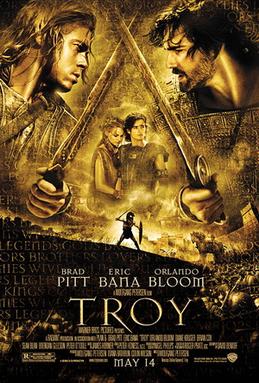
Troy
Made by a respected director with a strong ensemble cast and using the original epic story as its source, 2004's Troy certainly has a lot going for it. So what happened in theaters? I guess it's a shame to call a movie that made over $130 million a failure, but when that movie cost $175 to make....yeah, that's a failure. Too bad because the end result -- no matter the money -- is a huge, well-made and entertaining epic, a throwback to the 1950s and 1960s in terms of scale.
Sometime around 1,000 B.C., Trojan princes Hector (Eric Bana) and Paris (Orlando Bloom) are visiting Sparta and its king, Menelaus (Brendan Gleeson). Paris falls madly in love with the king's wife, Helen (Diane Kruger), secretly taking her with them as they return to Troy. Finding his wife gone, Menelaus goes to his brother, Agamemnon (Brian Cox), seeking help in getting her back. The Greek king has amassed quite an empire and sees an opportunity for it to grow bigger. He assembles an army of thousands of ships and over 50,000 men, sailing across the Aegean Sea to attack Troy. The fortified and high-walled city awaits what the Greeks can throw at them, including the most powerful warrior of his time, the legendary if moody Achilles (Brad Pitt). The coming battle will be unlike anything the world has ever seen.
Based on the original literature epic, Homer's Iliad, Troy is a movie made on a massive scale. Director Wolfgang Petersen assembles quite the cast, built lavish sets with even more lavish costuming, and for lack of a better description, makes everything BIG. That's good and bad. It is an impressive movie to watch at times, but in its scale, it loses some of its heart. Troy keeps you at arm's length. At times, far too much is going on. Even at 162 minutes, some subplots feel disjointed and rushed, others completely pushed to the side. Composer James Horner's score is all right, but it pales in comparison to some of his best works. Josh Groban's song 'Remember' is played over the credits too, listen HERE. Positive and/or negative, Troy is missing that special something. It is a good movie, but that missing ingredient isn't there to make it a classic.
It would be hard to have a better jumping off point than Homer's Iliad in turning any form of literature into a feature film. For starters, there's a reason it's called Greek tragedy. No matter if you're good or bad, in the end it likely won't end well for you. No time is wasted on petty arguments. Greek tragedies and epics are interested in the big picture. We're talking power and glory, love and betrayal, murder and backstabbing. Petersen faces a monumental task in bringing the story to theaters though. The Iliad takes place over a decade. The movie? Seems like the siege of Troy takes place over a long weekend. With so many characters and so many stories bouncing around, some can't help but be left behind. This is a story that would be suited to a four or five part miniseries...at the least. On the positive side, Troy is about the people, not the people and the Greek gods. Wise choice there, Mr. Petersen, wise choice.
The best dynamic in the movie is between Brad Pitt and Eric Bana, warriors on opposite sides of the war who are on a collision course to face each other. Buffed up with about 30-40 pounds of extra muscle, Pitt went through quite a transformation to look like half-man, half-god Achilles. In the acting department though, this is far from his best work. It's a despicable character, but Pitt doesn't bring a ton of energy to the screen until about the halfway point. Bana is the main reason to see Troy as Hector, the honor-bound prince of Troy who sticks by his family when it would be incredibly easy to leave. Both men live by a personal code and principle, holding some similarities while also being vastly different. Those differences make for an interesting rivalry to watch unfold.
And then there's the rest of the cast, apparently everyone in Hollywood getting a part here and there. Playing Greek king Agamemnon, Cox is the most villainous of all the characters, a power-obsessed ruler willing to sacrifice anything as needed to achieve his goal. In this case, that's pouncing on his brother's request for help. Gleeson as the spurned and scorned Menelaus is surprisingly sympathetic in an underused part. Bloom and Kruger are pretty together, basically a means to get the story moving before being dumped in the trash. Bloom does a fine job turning Paris into a whiny weakling capable of doing anything right. Yes, that's sarcasm. Also look for screen legend Peter O'Toole as Priam, the aging Trojan king, Sean Bean as Odysseus, another Greek king and close friend of Achilles, Garrett Hedlund as Patroclus, Achilles' young nephew and warrior-to-be, Julie Christie in a one-scene cameo as Thetis, Achilles' mother, Saffron Burrows as Andromache, Hector's loving wife, Rose Byrne as Briseis, the Trojan girl who catches Achilles' eye, and Vincent Regan as Eudorus, Achilles' right-hand man in his unit of Myrmidons.
Part of the fun of these ancient/biblical epics was the spectacle in watching them, a cast of thousands filling the screen. That fun element is robbed some with an overabundance of CGI throughout, thousands of CGI creations filling out the Greek and Trojan armies. Battle scenes are still a sight to behold, immense scale as the two warring sides throw charge after charge at one another. Like the movie on the whole, it's just missing something. What is it? I can't quite figure it out yet, but I'll get there. In the meantime, I'll like the movie, but not love it.
Troy <----trailer (2004): ***/****
Monday, April 30, 2012
Vengeance (2009)
I'd never heard of Johnny Hallyday in the least. I read his name in a movie that sounded interesting because I was familiar with the director and wanted to give him a try. Who is he? A French singer/performer and actor who in the 1960s was dubbed the French Elvis Presley. Pretty lofty comparison, isn't it? My first introduction to him -- singing or acting -- was a good one, a Hong Kong action shoot 'em up, 2009's Vengeance.
For almost 20 years, Francis Costello (Hallyday) has tried to put his checkered past behind him, opening up a successful restaurant in Paris and working there as its chef. But in Macao, his daughter and her family are brutally attacked by a hit team; her husband and children killed. The daughter (Sylvie Testud) lives long enough to see her father one last time, dying soon after his arrival in Macao. Costello is a former hit man and returns to the life he tried to put behind him. He enlists the help of three local hired killers, Kwai (Anthony Wong Chau-Sang), Chu (Ka Tung Lam), and Fat Lok (Suet Lam), to assist him in finding the killers, but in his search for revenge, Costello isn't telling them something very important about himself.
A little over a year ago, I stumbled across the films of Hong Kong director Johnnie To, starting with The Mission, and have been hooked ever since. While carving out quite a little niche for himself, To is clearly a fan of past cinema, paying homage to directors from the 1960s and 1970s with both his style and storytelling, but also simply the ways he goes about getting his message across. His characters -- typically the definition of anti-heroes -- reflect the doomed camaraderie and loyalty of men fated to die bloody a la Sam Peckinpah in the Wild Bunch. His stories take place in a sparse, cruel world a la Jean-Pierre Melville, and the action and gunplay are reminiscent of both those directors, but he was obviously greatly influenced by John Woo's slow-motion, blood-squibbed landscapes. Most importantly, he does all this while still being unique and original.
What I love about the films of To, Peckinpah, Melville, Woo and even someone like Sergio Leone are the worlds they create in their stories. To doesn't make the criminal underworld look glamorous, but he makes it look effortlessly cool and stylish. These are all bad men with deeds that must be answered and paid for, but these are also men who live by a code and expect others to do so at the same time. When you give your word to someone, you're expected to keep it. These hired killers are the modern day gunslingers. They do their jobs for money, exploring a cutthroat world and just trying to survive. To shoots these men (with a camera, not physically shooting them) like the iconic heroes of those past directors. Four men silhouetted against a backdrop, their coats whipping around, all of them waiting for the dangerous and possible death ahead of them. Stylish, cool, and great characters to go along with.
Like many directors, To has his crew of actors he likes to work with so he's worked with them on repeated occasions. Start with Chau-Sang as Kwai, the unofficial leader of the group of three hit men. He's quiet, stoic, loyal to a fault and he's principled. Lam's Chu has similar qualities although he questions their objectives a little more while Lam's Lok goes with the group as needed. We're given little in the way of background, but there's a sense of history among the group. Chau-Sang and Lam are frequent collaborators with To, both the actors and director getting along quite well. Hallyday is an interesting choice to play Costello. Besides his eyes looking truly bizarre, he's a solid if unspectacular anti-hero. I don't know if this character -- or Hallyday as an actor -- could carry the movie alone, but as part of this killing quartet, he works well. In pre-production, the part was offered to Alain Delon who ended up deciding not to take the part. Hallyday does a good job as Costello, but I can't help but wonder what Delon would have done with the part.
Another frequent To collaborator, Simon Yam plays George Fung, the Triad mob boss who ordered the hit on Costello's family. Putting together his stories/scripts, To is always a fan of likable anti-heroes and love to hate villains. Yam isn't around a whole lot during the movie, but he tries to make the most of his appearances. Some more background would have been nice for his character, but the lack of development doesn't derail the movie. A somewhat obvious twist -- to this somewhat slow reviewer -- involves Fung's alliances, but it is telegraphed pretty early. 'Vengeance' does try to throw a couple plot twists our way, but none of them really come as an effective surprise. One uses a story point from Memento -- a forgetful main character -- but it feels forced into the script and a little hackneyed at times.
All that description and analysis of story and character seems a waste as I try to wrap things up. To doesn't have the name recognition of some of the best action directors around, but he should. Blending the bloody, slow-motion action sequences of Peckinpah and Woo, To is a phenomenal action director, able to put unique set pieces together that bring his films up a notch or two. Even the ones that feel familiar are a treat to watch develop as the body count rises. One moonlit firefight is impressive in a wooded, isolated park, but the best has Kwai, Chu and Fat Lok battling a small army of killers, all of them decked out in body length, hooded dusters. If you're anything like me, you're drawn in by the action and end up staying for the style and characters. Not To's best, but it's certainly up there.
Vengeance <---trailer (2009): ***/****
Labels:
2000s,
Anthony Wong Chau-Sang,
Hitmen,
Hong Kong action,
Johnnie To,
Simon Yam
Sunday, April 29, 2012
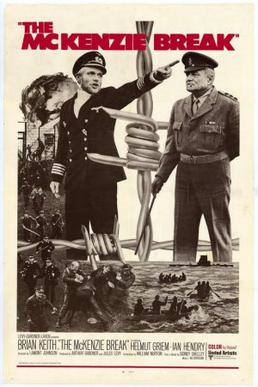
The McKenzie Break
While there have been obvious exceptions, I usually think of WWII prisoner of war movies from the Allied P.O.W.'s perspective. Movies like The Great Escape, Stalag 17, Bridge on the River Kwai among others. The lack of Axis POW movies can be explained with the fact that many prisoners spent the war in the U.S., but I suppose there's a more obvious one. The appeal of prisoner of war movies is the escape. You're rooting for the prisoners to get out. This may just be a personal thing, but unless I'm given some sort of motivation, I ain't rooting for German/Japanese prisoners to escape, like 1970's The McKenzie Break.
It is late in World War II, but the fighting rages on, even in isolated northern Scotland at a German P.O.W. camp in McKenzie commanded by the British, including Major Perry (Ian Hendry). Perry's prisoners are almost exclusively officers -- no enlisted men here -- and thanks to their ranking officer, a U-boat commander, Captain Willi Schlueter (Helmut Griem), those prisoners have organized. While they're still prisoners, they essentially run the camp, Perry unable to enforce even the most basic rules and laws. An Irishman and former journalist working for British Intelligence, Captain Jack Connor (Brian Keith), has been assigned to the McKenzie camp to aid the situation. What exactly are these German prisoners up to? Can Connor figure out their plan before it is unleashed?
As I'm planning what to write here, I'll say this out front. If it comes across poorly or naive, I apologize. I know atrocities were committed on both sides during WWII, but I'm more familiar with those of the German/Japanese forces against Allied prisoners than the other way around. The victors write the history books and all that. So anyways, here goes. Almost all countries signed the Geneva Convention, a document protecting prisoners of war as much as possible, basically treating them like humans. As presented in 'McKenzie' and making it difficult to watch, only so much can be done. German forces always seemed ready to brutally respond to any prisoner issues, but Hendry's Major Perry seems helpless here even when German prisoners physically assault his guards. He makes the point that any action against these prisoners will be taken against Allied prisoners in Germany which is true. Maybe it's just a deeper seeded issue, a more human way of doing your job. At what cost and how far does a country and its people go? Maybe the Germans were just more comfortable in their brutality? Sorry for a somewhat off tangent. Just had to say it.
I've mentioned before, and I'll most likely mention it again, but I'm a sucker for prisoner of war movies. They're unique to war movies because they can focus on the natural tension of the conflict without getting anywhere near the battlefield. Director Lamont Johnson is at the helm of a dreary-looking film (I suppose on-location Ireland doesn't get a lot of sun) that certainly adds some dimension to the story. It is refreshing to see the Allies as the guards and the Germans as the prisoners in this tweak of a familiar story-line. The opening set-piece especially sets the tone, Perry's complete failure at "commanding" his McKenzie camp. Watch it HERE. I kept waiting for the order to fire on the prisoners -- physical assault on guards seems like reason enough -- but the opener does a great job of setting things up. This is not your typical camp where the prisoners meekly assemble and wait out the end of the war, no matter how the war effort is going for the Germans.
Amidst all the bigger picture elements in 'McKenzie' is a simple plot device that is as close to a sure-thing as you can get; a cat and mouse game between two intelligent minds, in this case Keith's Capt. Connor and Griem's Schleuter. Connor knows his German counterpart is up to something, Griem knows Connor is hot on his trail. Keith does a great job in the part, a cynical, honest quasi-soldier who isn't interested in chain of command, honor, bravery, and the so-called glory of war. He's doing his job as if he was a civilian, military protocol be damned. Griem as U-boat commander Schleuter is the villain here, not just an enemy. A devout Nazi and former member of the Hitler Youth, he is an elitist, racist, brutal officer, obsessed with helping the German and Nazi war effort. No cost is too high for this young officer. At one point, he even organizes the murder of one of his own men, a homosexual. The banter between the rival officers is pitch-perfect, neither man letting on how much he knows, both men knowing they're facing a worthy competitor.
Not many other parts really stand out, but Hendry especially does his best. It's not that his Major Perry is a bad officer, but he's at the end of his rope and limited by orders from above. Too bad his character is basically pushed to the side once Connor shows up. Patrick O'Connell does a fine job as Sgt. Major Cox, the head non-commissioned officer who works with Connor and is drawn to his more straightforward approach to handling the issue of how to handle the German prisoners. Even Jack Watson has a small but interesting part as General Kerr, Connor's commander and old friend who wants the problem to be solved quickly, efficiently and quietly. Horst Janson plays Lt. Neuchl, the gay German officer who feels the wrath of his fellow soldiers.
Having watched countless prisoner of war movies, I was a little upset with myself about the conclusion I'd come to. It sounds obvious, I'm not going to root for the Germans to escape, just like I didn't want Hardy Kruger to escape in The One That Got Away. I want Keith's Capt. Connor to get his hands on these guys before they can reach safety. The final 45 minutes pick up the pace as the story reveals more of itself, not just prisoners trying to escape but why they're doing so with orders coming from German High Command. On the other side, Connor sees potential for an impressive coup. Which one will work? The ending is especially clever in its development in this underrated P.O.W. movie.
The McKenzie Break <---trailer/clips (1970): ***/****
Labels:
1970s,
Brian Keith,
Ian Hendry,
Jack Watson,
Prisoners of War,
WWII
Friday, April 27, 2012
The Andromeda Strain (1971)
Because rocks, bows and arrows, swords, guns, bombs and nuclear devices
aren't enough to kill people, human beings had to develop something
darker, more sinister, more downright evil, and more effective to help
off our fellow man. Germ and biological warfare come on down! Based off a
novel by Michael Crichton, 1971's The Andromeda Strain
uses that new age weapon (of sorts) as a jumping off point in a story
that must have seemed ahead of its time on its release. Now? Not so
much.
Searching for a downed satellite, the U.S. Army discovers that almost the entire population of the desert town of Piedmont is dead, the bodies lining the street. What happened to all the people to cause them to drop dead? The satellite is found, recovered and brought to a top secret government facility -- dubbed Wildfire -- where it will be examined by a team of doctors, including Dr. Stone (Arthur Hill), Dr. Dutton (David Wayne), Dr. Hall (James Olson), a medical surgeon, and Dr. Leavitt (Kate Reid). Two survivors were found in Piedmont -- a 6-month old infant and an old man -- but can the team explain how/why they survived while also containing whatever caused the mass deaths? Danger is looming, something that could not only kill the team but thousands and maybe millions around the world.
Serial killers, world-killing storms, all creepy, but what about a disease that could wipe out the world? That's scary as hell, and in that way 'Andromeda' reminded me off The Satan Bug by Alistair MacLean. It doesn't really matter what era, decade, region, country. A disease or virus that can't be stopped is a great villain. It is inhuman. So the premise is good/scary, and the story certainly has potential. Director Robert Wise assembled a set for this underground facility that resembles a spaceship -- curved hallways, sliding doors out of Star Trek, and a sanitary, ice cold feel to the proceedings. It is unsettling at times, incredibly creepy at others, and even gets the adrenaline flowing late. The only problem? Getting there.
Clocking in at 131 minutes, 'Andromeda' basically wastes most of its potential with a more-than leisurely pace. It feels like a documentary, presenting the inner workings of a government facility, like the viewer is privy to something we shouldn't be. That's all fine and dandy, but has a government lab ever been so dull? Add in an extraterrestrial virus/disease, and you would think we're talking instant classic, but.....not quite. To get down to the lab, our intrepid team of doctors must descend down five levels, going through extremely detailed procedures to basically rid themselves of as many germs and contaminants as possible. It's certainly different, but it's not exciting or interesting to watch in the least bit. Unfortunately after a great opening, this extended sequence kills all that momentum.
And that's the shame of it all. The bookends of the movie are classic, rivaling some of the best Twilight Zone episodes in terms of pure creepiness. Hill's Dr. Stone and Olson's Dr. Hall walking through the dead ghost town of Piedmont is eerie and downright chilling, the small population lying dead all around them, life gone in an instant because of some unseen, unrecognizable attacker. Decked out in hazmat suits, the doctors look other-worldly as they search for survivors and answers. The same goes for the finale, a little cliched but exciting nonetheless. The facility is equipped with a doomsday device, a nuclear bomb ready to explode if a virus -- any virus -- escapes and threatens the safety of the world. Set to blow up, Dr. Hall is given the task of disarming it, a single, middle-aged man who would be able to rationally look at the situation and perform his duty. Adrenaline-pumping with tension to spare, it's an exciting finale. Too bad then there was so much blah building up to it.
Because the focus is so much on the facility, the situation, and the doomsday scenario, all that's required of the cast are workmanlike performances. None really stand out as this small group of character actors take center stage. It was a wise choice not choosing bigger, more recognizable names because that would have taken away from some of the tension. As Dr. Hall, Olson is a bright spot, a medical surgeon who isn't wired the same way the others are, questioning where others don't. Hill's Stone is the driven -- even obsessed -- leader, Reid's Leavitt the cynical one, and Wayne's Dutton the logical thinker. No one else stands out, the story focusing almost exclusively on these four main characters. Not bad, but not great either, mostly because we're not given much of a reason to root for these folks.
Jumping off that thought, 'Andromeda' is neither very good nor very bad. The moments and scenes that work do so in grand fashion, but the ones that flop? They flop in a big way. A mixed bag in the end, a movie that's too long but has just enough potential and positive elements to recommend.
The Andromeda Strain <----trailer (1971): ** 1/2 /****
Subscribe to:
Posts (Atom)