Movies are right at home, the old bread and butter, when dealing with characters running away from something, looking for another shot after some horrific mistake was made in the past. If movies have taught us anything, for an American in this situation, there's two options...both equally deadly. One, enlist in the French Foreign Legion where you will most likely get killed in a nasty massacre in the desert. Two, go to South America and waste away in some dingy, damp village. That's not the whole premise of 1939's Only Angels Have Wings, but it's close.
Reading the description of this 1939 flick from Columbia Pictures, my first reaction was how similar it sounded to the French classic The Wages of Fear and its American remake Sorcerer. 'Angels' obviously came first, but it deals with a similar topic. Deep in an unnamed South American country, a group of Americans -- displaced by their choice or someone else forcing their hand -- working for a struggling company. For one reason or another, they're all running from something in their past, now forced into doing a job that will just as likely kill them as make them rich.
Waiting for her ship to depart, American singer Bonnie Lee (Jean Arthur) stumbles upon a little haven of back home in a South American port city. A complex owned by a European immigrant, Dutch (Sig Ruman) and run by an American pilot, Geoff Carter (Cary Grant), has a restaurant that serves good, old-fashioned American food with a runway outside the building. Bonnie is quickly drawn to the smooth, suave, most definitely aloof Geoff, only to find out how perilous the situation is. Dutch and Geoff have signed a contract to deliver the mail twice a week by plane to cities inland for six months and then receive a big payday. If they fail to deliver, the contract is void. With their stable of American pilots and World War I era planes, they've managed to make it five months and two weeks. They're close to their goal, but the flights become ever more dangerous, and the only way through to the next city is a flight through the fog-covered, looming mountains inland.
I watched this movie over a couple of sittings -- stupid work, getting in the way of my movie watching -- and certainly enjoyed it enough, although I didn't love it. My complaint here is one I usually have with movies released in the 1930s. Hollywood was still figuring out what worked and didn't work with movies, what audiences wanted and what they didn't want. For the most part, the acting isn't over the top as the cast thankfully turns down the theatrical stage touches. It is filmed completely on an indoor set which limits the scope of the story, but in an effort to balance that out, there is some great footage of these rickety looking planes flying through the mountains, taking off and landing, canceling out some of the cheaper effects to illustrate the planes "flying" through rough weather conditions. So what was wrong with this flick? I'm not sure, but something was missing.
Director Howard Hawks carved quite a nice little niche for himself in a career that includes over 40 movies, many of them held in high regard among fans and critics. His stories often focused on a group of men brought together through unlikely, strenuous circumstances having to band together to accomplish a similar goal, bonding in the process and putting their differences aside. 'Angels' is right at home with that premise. Grant is the tough but fair owner and chief pilot of this motley "airline," if you can call it that. His pilots include the always reliable and entertaining Thomas Mitchell as Kid Dabb, a veteran pilot struggling with vision loss, Allyn Joslyn, Noah Beery Jr., Victor Kilian, John Carroll, and Don Barry filling out the ranks of this misfit outfit.
Through all the slower portions of the movie with the pretty awful love triangle, Geoff's crew and their story carries the movie. Grant is at his suave, roguish best, Mitchell is as reliable as ever as the smart-mouthed sidekick, and Rugan and Co. fill in the holes wherever necessary. A key subplot has a new pilot, Bat MacPherson (Richard Barthelmess) arriving to fly, only to find out he's got a past with Mitchell's Kid. The men hold his past decisions against him, but MacPherson rises to the occasion as he desperately attempts to prove it was all a mistake. That's what works so well here. All these men are running from something so whether they realize it or not, they're all in the same boat. If this business have any hopes of succeeding, they will have to work together and put their differences aside. For Hawks, it's a tried and true formula, and as usual, it works.
Now Hawks used that formula a few more times during his career, but he also threw in those awkward, unnecessary love triangles too. Arthur's Bonnie falls for Cary Grant almost right away so then we get two hours of her trying to figure out if she belongs with him. Then MacPherson's new bride (21-year old Rita Hayworth) ends up being a woman from Grant's past to complicate things. Oh, no! Two women in love with the same man?!? If you have an iota of intelligence, you know who he is going to end up with, but my goodness, it takes awhile getting there. Thankfully, there's enough positive going on to outweigh the dull, slow-moving negatives. You can watch it at Youtube, starting HERE with Part 1 of 12.
Only Angels Have Wings <---trailer (1939): ***/****
The Sons of Katie Elder
"First, we reunite, then find Ma and Pa's killer...then read some reviews."
Tuesday, February 1, 2011
Monday, January 31, 2011
The Anderson Tapes
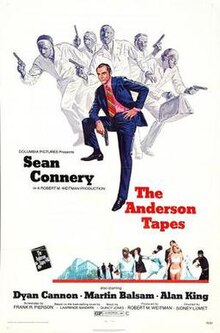
In a little over two years writing reviews here, I've watched my fair share of heist movies (11 if I've got the tags right). It's that perfect blend of action, suspense and drama all wrapped up into one as -- typically -- a group of specialists work together to steal something thought unattainable. Inception had dreams, Goldfinger was Fort knox, and Heat was piles of money. It's almost always one specific thing. That's not the case with 1971's The Anderson Tapes where the target isn't one thing, but one apartment building and everything in it.
To say director Sidney Lumet is slumming here isn't fair, but I'll admit it was the first thing I thought when his name popped up in the opening credits. This is the man who directed 12 Angry Men, Network, Dog Day Afternoon, Serpico, and so many more classic movies, and now he's directing a good old-fashioned heist movie? With a director of his caliber, I don't know if you can call it slumming, but it's a hell of a lot of fun to see someone like Lumet try a more mainstream movie dead set on entertaining more than delivering a message. It is a movie that isn't particularly unique compared to most heist movies, but it is solid all around and very entertaining.
After 10 years in prison for a burglary charge, master thief Duke Anderson (Sean Connery) visits an old girlfriend, Ingrid (Dyan Cannon), who lives in a posh apartment in New York City. Duke is looking for a job to pull off -- any job at all -- and realizes it's staring him dead in the face. Ingrid's building has 12 separate apartments owned by doctors and lawyers and all of society's best (translation = richest). Duke goes about putting together a motley crew of crooks and ex-cons to pull off the job, even going to the mob and kingpin, Angelo (Alan King) for backing. But as he goes about planning the elaborate heist of 12 apartments at one time, Duke realizes security has changed since he went into jail? Security cameras are everywhere, and it seems someone is watching him.
Released in 1971, this is a movie that at the time must have felt like a futuristic look at security with all its high-tech equipment. Now in 2011, it seems very dated that a team of crooks would be even slowed up by a security camera here and there. Composer Quincy Jones' score even plays that up with a robotic, electronic sound which is more distracting than necessary. The subplot with Anderson being constantly videotaped (hence the title of the movie) is disappointing though, not really going anywhere. It is the type of story where all these unknown elements feel like they're building to a huge, twist ending, but it never comes. The final scene is disappointing in that way as so many different elements and unanswered questions don't gel in the end.
That complaint aside, I really enjoyed this movie. This was one of Connery's movies in between James Bond roles, and before he returned to the part in Diamonds are Forever later in 1971. He is one of my all-time favorite actors so seeing him in a well-made heist movie is a cinch for me. His Duke Anderson is tough, intelligent and after 10 years in jail...desperate. He wants and needs to pull of a job. It's as high risk as they come, but the potential for payout at the end is huge so he puts it all on the line. I would have liked a little more resolution late in the movie with his character, but it does make it pretty clear what happens to him. Connery has a good chemistry too with Cannon in their few scenes together (he plays up his sexy, hairy Bond angle). If nothing else, 'Anderson' is worth seeing to get a glimpse of Connery without his toupee, just his thinning hair here.
So in the action equivalent of a men on a mission movie, Connery's Anderson must assemble a team of specialists to help him pull off the job. This is where 'Anderson' is better than most, the supporting cast. Martin Balsam is a scene-stealer and downright hilarious as Haskins, a gay interior decorator along to pick out what's valuable and what isn't worth stealing in the building. Stereotypical and a little politically incorrect? You bet, but it's funny. In one of his first featured roles, a young Christopher Walken plays the Kid, a young ex-con who's an expert in safecracking and dismantling alarms. There's also Val Avery as Parelli, the mob muscle, Dick Anthony Williams as Spencer, the getaway driver, Stan Gottlieb as Pop, an ex-con struggling to adjust to life outside prison, and Paul Benjamin as Spencer's former partner in crime along to help. With smaller parts, Anderson's crew makes the most of it, helping each character leave a lasting impression even with their limited screen-time.
Prior to the heist, there is little in the way of explanation of how Duke and Co. are going to pull this off so not surprisingly, the 40-minute heist sequence to close the movie out is a high point. Lumet films in it a unique way, showing the team get into an apartment, flash to the occupants later being interviewed by the police explaining what happened, and then bouncing back to inside the apartment during the job. It's a cool technique that keeps you guessing because if you pay attention in the background, you see clues of how the job went and if it was successful or not. In the heist, look for Ralph Meeker as a police commander brought in to deal with the crooks, and future SNL star Garrett Morris as a leader of a SWAT team. Nothing new, nothing flashy here, just a solid, exciting heist movie with a good cast.
The Anderson Tapes <---trailer (1971): ***/****
To say director Sidney Lumet is slumming here isn't fair, but I'll admit it was the first thing I thought when his name popped up in the opening credits. This is the man who directed 12 Angry Men, Network, Dog Day Afternoon, Serpico, and so many more classic movies, and now he's directing a good old-fashioned heist movie? With a director of his caliber, I don't know if you can call it slumming, but it's a hell of a lot of fun to see someone like Lumet try a more mainstream movie dead set on entertaining more than delivering a message. It is a movie that isn't particularly unique compared to most heist movies, but it is solid all around and very entertaining.
After 10 years in prison for a burglary charge, master thief Duke Anderson (Sean Connery) visits an old girlfriend, Ingrid (Dyan Cannon), who lives in a posh apartment in New York City. Duke is looking for a job to pull off -- any job at all -- and realizes it's staring him dead in the face. Ingrid's building has 12 separate apartments owned by doctors and lawyers and all of society's best (translation = richest). Duke goes about putting together a motley crew of crooks and ex-cons to pull off the job, even going to the mob and kingpin, Angelo (Alan King) for backing. But as he goes about planning the elaborate heist of 12 apartments at one time, Duke realizes security has changed since he went into jail? Security cameras are everywhere, and it seems someone is watching him.
Released in 1971, this is a movie that at the time must have felt like a futuristic look at security with all its high-tech equipment. Now in 2011, it seems very dated that a team of crooks would be even slowed up by a security camera here and there. Composer Quincy Jones' score even plays that up with a robotic, electronic sound which is more distracting than necessary. The subplot with Anderson being constantly videotaped (hence the title of the movie) is disappointing though, not really going anywhere. It is the type of story where all these unknown elements feel like they're building to a huge, twist ending, but it never comes. The final scene is disappointing in that way as so many different elements and unanswered questions don't gel in the end.
That complaint aside, I really enjoyed this movie. This was one of Connery's movies in between James Bond roles, and before he returned to the part in Diamonds are Forever later in 1971. He is one of my all-time favorite actors so seeing him in a well-made heist movie is a cinch for me. His Duke Anderson is tough, intelligent and after 10 years in jail...desperate. He wants and needs to pull of a job. It's as high risk as they come, but the potential for payout at the end is huge so he puts it all on the line. I would have liked a little more resolution late in the movie with his character, but it does make it pretty clear what happens to him. Connery has a good chemistry too with Cannon in their few scenes together (he plays up his sexy, hairy Bond angle). If nothing else, 'Anderson' is worth seeing to get a glimpse of Connery without his toupee, just his thinning hair here.
So in the action equivalent of a men on a mission movie, Connery's Anderson must assemble a team of specialists to help him pull off the job. This is where 'Anderson' is better than most, the supporting cast. Martin Balsam is a scene-stealer and downright hilarious as Haskins, a gay interior decorator along to pick out what's valuable and what isn't worth stealing in the building. Stereotypical and a little politically incorrect? You bet, but it's funny. In one of his first featured roles, a young Christopher Walken plays the Kid, a young ex-con who's an expert in safecracking and dismantling alarms. There's also Val Avery as Parelli, the mob muscle, Dick Anthony Williams as Spencer, the getaway driver, Stan Gottlieb as Pop, an ex-con struggling to adjust to life outside prison, and Paul Benjamin as Spencer's former partner in crime along to help. With smaller parts, Anderson's crew makes the most of it, helping each character leave a lasting impression even with their limited screen-time.
Prior to the heist, there is little in the way of explanation of how Duke and Co. are going to pull this off so not surprisingly, the 40-minute heist sequence to close the movie out is a high point. Lumet films in it a unique way, showing the team get into an apartment, flash to the occupants later being interviewed by the police explaining what happened, and then bouncing back to inside the apartment during the job. It's a cool technique that keeps you guessing because if you pay attention in the background, you see clues of how the job went and if it was successful or not. In the heist, look for Ralph Meeker as a police commander brought in to deal with the crooks, and future SNL star Garrett Morris as a leader of a SWAT team. Nothing new, nothing flashy here, just a solid, exciting heist movie with a good cast.
The Anderson Tapes <---trailer (1971): ***/****
Sunday, January 30, 2011
How I Won the War
If a director is going to make anti-war movie, more power to you, but pick what kind of anti-war movie you're going to make. Don't bounce back and forth in tone between jovial and laughing to dark and serious. Director Richard Lester chooses to bounce back and forth, unfortunately for him and for us as viewers. There are moments with lots of potential and some great film-making techniques, but they're ruined by the movie's tone that relies on existential, slapstick, and subtle humor all at the same time. It's the rare movie that I can't find something to recommend, but this was awful. I physically wanted to hurt someone watching it, but instead watched most of it on fast-forward. It was a good choice. This movie couldn't have ended soon enough.
Joining the army in 1939 as World War II begins, a young man named Goodbody (Michael Crawford) is deemed officer material and is given the rank of lieutenant. He's placed in charge of a squad of misfit soldiers who hopefully will never see combat, but of course they do. It's not long before Lt. Goodbody and his men are part of the British forces sent to North Africa to fight the Germans. But before they can even reach the beaches as part of an invasion force, they're assigned a dangerous but necessary mission. Three days before the invasion, they will land in North Africa and travel behind enemy lines to build a...wait for it...cricket pitch. Can they get the job done, or will they all get killed in the process?
Just judging this flick as something visual to watch or look at, Lester clearly pulls out all the stops. His story is non-linear, starting the movie in 1945 as the Allies fight their way across the Rhine River into Germany, then bounces back to 1939 when Goodbody meets his squad and follows their "adventures" in the war. Then periodically, it jumps back to 1945 to show the lieutenant's interactions with the German officer who captured him. Lester also has all his characters address the camera in first person as if they're talking right to the viewer. He uses stock footage spliced in with his footage, and then gets artsy with dead soldiers returning as statue-like individuals painted in bright colors tagging along with the survivors as silent partners.
All those filmmaking techniques are fine and dandy though in a war movie, but not one as schizophrenic as this one. There's all this ridiculous humor followed by moments that are supposed to shock you with its violence. Don't combine stock footage of dead soldiers with jovial images of a squad of British soldiers literally marching into German machine guns only to have the Germans stand up and surrender. I know it's a movie, and maybe this wasn't the intention, but it felt very disrespectful to me of those soldiers who did give their lives. Also, piece of advice, don't compare yourself to other movies. Soundtrack cues from Bridge on the River Kwai and Lawrence of Arabia were both used at different points. Used for comic relief? Maybe, but all I could think was that I should be watching those GOOD movies instead of this slop.
My all-time favorite literary character is John Yossarrian, Joseph Heller's main character in Catch-22. He's a perfect cookie cutter for how to do a lead character in an anti-war flick. Brash, honest, fully sane (maybe), but just fed up with the situation he's in. In 'Won the War,' none of that exists with Crawford's Goodbody. I've rarely come across a main character more shrill, more obnoxious, just out out and annoying than this one. From an upper class family, he has the mindset that war is fun, even heroic giving men a chance to prove their worth. He is oblivious to everything around him and has no clue that his men despise him. Goodbody continues to preach about the glory and honor of war, but all I could think was that he deserved to be shot by his own men. In his squad look for Beatle John Lennon in his only non-Beatles role, Roy Kinnear, Lee Montague, and several other random actors that played parts that left little impression on me.
One scene -- yes, that's it -- actually made an impression on me, when Goodbody's squad is killed by a German tank column supported by infantry. It's shot in a hazy fog and has the look of a dream gone bad. When ripped to pieces by German mortars, Lennon looks at the camera and confusedly states 'You knew this would happen.' Kinnear tries to talk to his German captor only to be bayoneted in the stomach. It's just a small snippet that shows Lester could have made a powerful anti-war movie. As a viewer, I felt nothing for these characters, but because it is shot so well in such a dark fashion, their deaths hit me like a punch to the gut. Watch it HERE starting at about the 4-minute mark and continuing into Part 11.
Writing about that one scene, I can't completely rip this movie. That one scene is actually that good. I can't say it's the worst movie I've ever seen, but it's up there. I wish Lester would have picked one route and gone with it. It is nearly impossible to deliver an anti-war message with a tone and humor as broad as the one here. War is insane, no one can disagree with that, but by making the soldiers lunatics, cowards, straight up idiots, you're ignoring and disrespecting the people who actually fought and weren't all those things. How I Won the War is one of the strangest movies I've ever seen, and while I can't recommend it as a movie, it's something you just have to decide for yourself how good or bad it is. Give it a try at Youtube.
How I Won the War <---trailer (1967): */****
Saturday, January 29, 2011
The Professional
Two years ago, the first Jean-Pierre Melville movie I saw was his classic Le Samourai. Starring Alain Delon, it was a very stylish look at the life of a hit-man who meticulously went about his business as the police desperately tried to track him down. I didn't love the movie, but I certainly liked it enough to give some other Melville crime thrillers a chance. But then I kept seeing references to Le Samourai coming up, some major and some more minor, but it was hard to miss them. Over 40 years later, this Melville flick is still making its impact felt on countless action movies in terms of style and story. One of the few to even come close to measuring up is 1994's The Professional.
In past reviews, I've written about some of my favorite character actors from the era of classic Hollywood between the 1930s and 1960s (even into the decade of the character actor, the 1970s). When I think of current actors who can pull off supporting roles perfectly in movies now being released in theaters, it's harder to think of many. One exception is Jean Reno, a veteran of Hollywood and European movies. He's the type of actor who legitimizes a movie just by being there. When given a rare chance at a starring role like the one in The Professional, Reno doesn't miss, swinging for the fences and hitting a home run with this very Melville-like character.
Working for a mid-level mafioso (Danny Aiello) in New York City, a man known only as Leon (Reno) is one of the best "cleaners" around. For a price of $5,000 a person, Leon will kill any man, but he refuses to kill a woman or a child. He leads a simple life when he isn't on the job until one day his routine is shaken. In the apartment building he lives in, Leon's next door neighbors are gunned down by a rogue D.E.A. agent, Stansfield (Gary Oldman). The only survivor is 12-year old daughter, Mathilda (Natalie Portman), who hides out and convinces Leon to let her live with him. Leon doesn't know what to do other than the fact that he can't just put her on the streets. Mathilda has an offer for him, teach her to be a cleaner like him. Leon isn't so sure it is a good idea though, knowing that Stansfield is eventually going to track her down looking to finish the job he started.
Like Melville did in Le Samourai with Delon's main character, director Luc Besson builds up Leon, his main character, without much in the way of describing his background, instead just showing his daily routine and hearing a few quick snippets of his principles. A middle-aged man living by himself almost like a monk, Leon constantly drinks milk and nothing else -- especially hard liquor or beer -- while caring for his small house plant. He sleeps sitting up in his chair for quick catnaps, never resting for too long. Leon can't read or write well, and he watches old movies at small NYC theaters in the morning hours. As deadly capable as he is, Leon is also a vulnerable, somewhat innocent, even naive individual. He trusts Aiello's word to a fault, letting him hold onto the money he earns. All these little things add up to this great character that is hard not to like, even considering his career. Even then, he's a bit of a righteous killer, taking out the worst society has to offer.
Reno is clearly channeling Delon's Samourai character, and I mean that as a compliment. Usually relegated to key supporting roles in movies like Ronin, Godzilla, Mission: Impossible, and quite a few other movies, Reno makes Leon into this ultra-cool, killing machine. The visual alone of his retro glasses and black overcoat quickly became an iconic image associated with the movie and wisely used on DVD boxes. It can be a difficult challenge making a hired killer a sympathetic character, but Reno's Leon is as human as they come. For her sake and his, he contemplates killing Portman's Mathilda to put her out of her misery, even putting a gun to her head as she sleeps. He has countless opportunities to leave her or kick her out, only to realize he should and will do the right thing. Call it a father-daughter, brother-sister relationship, but he starts to look out for her like family, like a guardian angel doing his damnedest to protect her.
In the news recently for her performance in The Black Swan, Portman is as well known for her parts in the Star War movies and V for Vendetta as this performance in The Professional. More impressive? This was her first feature film role, and it's clearly an example of the talent she's working with. Her chemistry with Reno is flawless and instantly believable. She should have won awards for one scene alone when she stands outside Leon's apartment crying after walking past her dead family, pleading in a whisper for him to open the door. The 13-year old Portman is a revelation here, and any fans of hers should see this movie. And for an off his rocker, eccentric DEA agent, who better than Oldman (one of the greatest villainous actors of all-time)? His part is hamming it up and over the top, a necessary counter to Leon's quiet, smooth demeanor.
As the viewer, our introduction to Leon is about as well-handled as possible. His hit attempt on a well-guarded mafioso is action at its tense best, guards being picked off one-by-one by this unseen, fast moving killer. Before we know anything about Leon, we know he's an expert at what he does with few if any rivals. For the most part, that's all the action until the end when SPOILER ALERT Stansfield finally tracks down Mathilda with Leon holding off countless SWAT team members and DEA agents. Big, loud and chaotic, the finale is a spectacle to behold. The ending itself isn't necessarily a happy ending, but it's an appropriate one, and a moving one at that. A great movie overall.
The Professional <---trailer (1994): ****/****
In past reviews, I've written about some of my favorite character actors from the era of classic Hollywood between the 1930s and 1960s (even into the decade of the character actor, the 1970s). When I think of current actors who can pull off supporting roles perfectly in movies now being released in theaters, it's harder to think of many. One exception is Jean Reno, a veteran of Hollywood and European movies. He's the type of actor who legitimizes a movie just by being there. When given a rare chance at a starring role like the one in The Professional, Reno doesn't miss, swinging for the fences and hitting a home run with this very Melville-like character.
Working for a mid-level mafioso (Danny Aiello) in New York City, a man known only as Leon (Reno) is one of the best "cleaners" around. For a price of $5,000 a person, Leon will kill any man, but he refuses to kill a woman or a child. He leads a simple life when he isn't on the job until one day his routine is shaken. In the apartment building he lives in, Leon's next door neighbors are gunned down by a rogue D.E.A. agent, Stansfield (Gary Oldman). The only survivor is 12-year old daughter, Mathilda (Natalie Portman), who hides out and convinces Leon to let her live with him. Leon doesn't know what to do other than the fact that he can't just put her on the streets. Mathilda has an offer for him, teach her to be a cleaner like him. Leon isn't so sure it is a good idea though, knowing that Stansfield is eventually going to track her down looking to finish the job he started.
Like Melville did in Le Samourai with Delon's main character, director Luc Besson builds up Leon, his main character, without much in the way of describing his background, instead just showing his daily routine and hearing a few quick snippets of his principles. A middle-aged man living by himself almost like a monk, Leon constantly drinks milk and nothing else -- especially hard liquor or beer -- while caring for his small house plant. He sleeps sitting up in his chair for quick catnaps, never resting for too long. Leon can't read or write well, and he watches old movies at small NYC theaters in the morning hours. As deadly capable as he is, Leon is also a vulnerable, somewhat innocent, even naive individual. He trusts Aiello's word to a fault, letting him hold onto the money he earns. All these little things add up to this great character that is hard not to like, even considering his career. Even then, he's a bit of a righteous killer, taking out the worst society has to offer.
Reno is clearly channeling Delon's Samourai character, and I mean that as a compliment. Usually relegated to key supporting roles in movies like Ronin, Godzilla, Mission: Impossible, and quite a few other movies, Reno makes Leon into this ultra-cool, killing machine. The visual alone of his retro glasses and black overcoat quickly became an iconic image associated with the movie and wisely used on DVD boxes. It can be a difficult challenge making a hired killer a sympathetic character, but Reno's Leon is as human as they come. For her sake and his, he contemplates killing Portman's Mathilda to put her out of her misery, even putting a gun to her head as she sleeps. He has countless opportunities to leave her or kick her out, only to realize he should and will do the right thing. Call it a father-daughter, brother-sister relationship, but he starts to look out for her like family, like a guardian angel doing his damnedest to protect her.
In the news recently for her performance in The Black Swan, Portman is as well known for her parts in the Star War movies and V for Vendetta as this performance in The Professional. More impressive? This was her first feature film role, and it's clearly an example of the talent she's working with. Her chemistry with Reno is flawless and instantly believable. She should have won awards for one scene alone when she stands outside Leon's apartment crying after walking past her dead family, pleading in a whisper for him to open the door. The 13-year old Portman is a revelation here, and any fans of hers should see this movie. And for an off his rocker, eccentric DEA agent, who better than Oldman (one of the greatest villainous actors of all-time)? His part is hamming it up and over the top, a necessary counter to Leon's quiet, smooth demeanor.
As the viewer, our introduction to Leon is about as well-handled as possible. His hit attempt on a well-guarded mafioso is action at its tense best, guards being picked off one-by-one by this unseen, fast moving killer. Before we know anything about Leon, we know he's an expert at what he does with few if any rivals. For the most part, that's all the action until the end when SPOILER ALERT Stansfield finally tracks down Mathilda with Leon holding off countless SWAT team members and DEA agents. Big, loud and chaotic, the finale is a spectacle to behold. The ending itself isn't necessarily a happy ending, but it's an appropriate one, and a moving one at that. A great movie overall.
The Professional <---trailer (1994): ****/****
Labels:
1990s,
Gary Oldman,
Hitmen,
Jean Reno,
Luc Besson,
Natalie Portman
Friday, January 28, 2011
Easy A
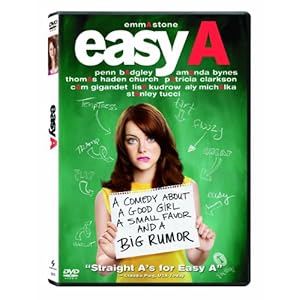
Then there's 2010's Easy A, a comedy about teenagers and about sex but not specifically a teen sex comedy...if that makes any sense at all. The ads late last summer really did their best to shove this movie down audience's throats, and I remember thinking that if I hadn't been overloaded with ads, I might have been interested in seeing this critically well-received comedy. This is one of those rare comedies with a heart that also tries to deliver a message to its teenage audience, and to its older audience members a look at the life of a high schooler (albeit a movie teen). Now it is still a movie portrayal of what someone must think high school is like, but compared to most, this one is moderately realistic, and that's something.
Your typical high school student, Olive Penderghast (Emma Stone) is like a lot of the kids in her high school. She's more than content to hang out with her friends and just blend in with the crowd as opposed to standing out. But one day she tells her best friend Rhiannon (Aly Michalka) that she lost her virginity to a college freshman and the news spreads like wildfire. People look at Olive differently, and her reputation grows for the better. 'She's the girl who had sex!' The reputation grows to the point where a gay student (Dan Byrd) asks Olive to pretend she had sex with him to help build his own reputation as a ladies man while avoiding the beatings and mocking for being gay. Olive goes along with it trying to help a friend, but she could never imagine what happens next as a result of her choice.
A recurring problem with movies based in a high school is that some combination of writers/studios/producers/directors clearly never went to any sort of a realistic high school. Or on the other hand, they did and decide to make a movie about what they think high school should have been like. Thankfully here director Will Gluck finds a nice middle ground in between. The cliques among the students, the ever-moving rumor mill, the cool teacher, the stiff faculty, these all feel authentic. Add in some modern elements like Twitter, webcams, Facebook and all sorts of other technology, and you get a movie that if nothing else feels authentic. Is it? Not at all times, but for the most part Easy A tries to represent at least a somewhat realistic view of high school.
From the time I saw her in Superbad a few years back, I've had a crush on Emma Stone so I'll say that early and get it out of the way. I'm a sucker for redheads so when an actress is a genuinely funny one -- and a redhead at that -- I'm dead meat. Besides not looking like your typical high school student, Stone puts off this very cool, smart appeal. Physical humor or just a subtle delivery of a line, she can do it both equally well. She plays off her cast nicely, giving everyone else a chance to shine while still making sure the camera's focus is on her. In her first part where it's truly HER movie, Stone nails it. Hopefully this is a sign of things to come as she continues her climb to stardom.
Stone does her fair share of heavy lifting as Olive, but Gluck assembles quite a cast around her. Penn Badgley (of Gossip Girl) is Todd, Olive's big crush since the 8th grade who seems oblivious to all the rumors that start to fly around her. Amanda Bynes is the requisite bitchy character, an all-around good student and firm believer of Catholicism, looking down on anyone and everyone around when given the chance. Michalka is also good in the smaller part as Olive's best friend, Rhi. The real supporting stars are the more established adult actors, some playing parts that amount to extended cameos. Stanley Tucci and Patricia Clarkson are hilarious together as Olive's honest, intelligent parents who just want what's best for her. Thomas Haden Church steals every scene he is in as Mr. Griffith, Olive's favorite teacher, with Lisa Kudrow playing his wife, a guidance counselor at the school. Also can't forget Malcolm McDowell as the principal always worried about what all his students are up to.
You know what surprised me most about this movie? It's a comedy that's genuinely funny. It feels real and rarely tries too hard, making the movie funnier because it isn't force feeding you the laughs. Easy A is well-written with some biting humor and criticism of the current state of high schools and students everywhere. Comparisons to the classic John Hughes comedies of the 1980s are not far off base in this comedy that is funny from beginning to end...and a happy one at that.
Easy A <---trailer (2010): ***/****
Labels:
2010s,
Comedy,
Emma Stone,
Malcolm McDowell,
Stanley Tucci,
Thomas Haden Church
Thursday, January 27, 2011
The Deep Six
The idea of a conscientious objector is a sticky one because it has to be hard to read a man's true intentions. Combat and war are a terrifying premise, and most would do anything possible to avoid it. But regardless of personal or religious beliefs, some men slip through the cracks and make it into combat on a front-line position. That's 1958's The Deep Six, the story of a man raised as a Quaker who outgrew his childhood beliefs as he grew into an adult. Now when his draft summons arrives in the mail, his beliefs come up again. If it came down to it, could he kill?
A successful advertising artist in Los Angeles, Alec Austen (Alan Ladd), is riding high. His job pays well, he owns a beautiful seaside home, and he's in love and about to be engaged to his boss, beautiful Susan Cahill (Dianne Foster). When it seems everything is lining up into place, Alec relieves a draft summons for the U.S. Navy because he took an ROTC program in college and is still part of the Naval Reserves. Raised as a Quaker, he wavers over what to do but ultimately reports for duty where he's assigned to the USS Poe, a destroyer in the Pacific captained by Commander Meredith (James Whitmore). As the Poe sails toward the Japanese and the conflict awaits, Alec begins to question if his childhood beliefs of pacifism are really gone. When the time comes will he be able to give the order to fire, an order that will almost certainly end in the death of a human being?
Movies about war -- especially in the 1950s -- are a dime a dozen. Doing the norm and making a flick about combat is fine by me, I love that type of story and own a fair share of those on DVD, but it's always refreshing to see a war story with a fresh spin. This story is effective because it's hard not to feel for Ladd's Alec character. It's only natural to be scared about how you'll respond in a situation like he is in regardless of your beliefs or ideologies. Alec must not only worry about his own concerns, and how he'll respond, but if the choices he makes will end up taking the lives of his crew, the men he bunks and eats with on board the Poe. Throw in that the crew (including nasty executive officer Keenan Wynn) finds out about his Quakerism and ostracizes him, and you've got a whole bucket of worms.
In a career that was cut short because of his personal demons, Ladd still made his mark on Hollywood. He always had an easy-going way about him that played on his character's vulnerabilities and made him a likable leading man. His Alec is quiet and unassuming, a good man pressed into a difficult choice. He doesn't whine or moan about his predicament, doing his best to deal with it himself. For the most part, Alec bonds well with his men because he has their best interest at heart. In helping us to get to know his main character, director Rudolph Mate adds in the subplot with Alec's fiance Susan. Where some movies use this technique and it fails miserably, it works here, and I can't explain why the subplot didn't send me up the wall. It just works, and it certainly makes Alec more human. He's worried about marrying Susan because of the very real possibility that he may die at sea, sacrificing his feelings and needs/wants for his concerns on how that event that might not even happen would affect her.
Still, The Deep Six is a war movie, and the heart of the story is Alec and the USS Poe's involvement in the war in the Pacific against the Japanese. The combat is held to a minimum with an occasional strike by a patrolling Japanese plane and saved for the end when Alec must lead a small patrol onto a Japanese-held island where five downed fliers await rescue. The finale -- as was the case with much of the movie -- is limited by a smaller budget, but it makes up for any epic battle with the impact the fighting makes. Filming much of his film at sea, Mate give viewers quite a look at life on a U.S. destroyer, providing some great footage with his cast (not stock footage) on board the ship. The supporting cast includes JHP favorite Whitmore as the veteran commander, Wynn as the bloodthirsty XO, Efram Zimbalist Jr. as on-ship physician/doctor, Lt. Blanchard, and a scene-stealing William Bendix as Frenchy Shapiro, Alec's close friend and Chief officer.
Reminding me of the somewhat out of place humor in John Ford's Mister Roberts, too much time is spent with the crazy antics of the crew, including a pre-Rat Pack Joey Bishop, Perry Lopez, and voice of Alvin and the Chipmunks Ross Bagdasarian (among other cast members). The humor is unnecessary, and if it is an attempt to lighten the mood, it fails badly. It's just not funny and takes away from the more interesting aspects of the story. By no means enough to detract overall from the movie, but worth mentioning.
The Deep Six (1958): ***/****
Labels:
1950s,
Alan Ladd,
James Whitmore,
Joey Bishop,
Keenan Wynn,
Perry Lopez,
Rudolph Mate,
William Bendix,
WWII
Wednesday, January 26, 2011
Layer Cake
This is one of those movies you stumble across almost by accident, love it, and then can't convince enough people to watch it. I watched it based solely because I was a Daniel Craig fan, and shame on me, the DVD box looked cool. I've seen it called all kinds of things, a Guy Ritchie knock-off especially, but it's one of those rare great movies that works almost in spite of itself. Based off a novel by J.J. Connolly, Layer Cake has too many characters, more style than substance often enough, and twists and turns so much it took me a couple viewings to piece everything together for sure. All that out of the way, I love this movie. I'll explain later.
A high-end drug distributor, a man known only as XXXX (Craig) has quickly risen through the ranks of the very stylish but still cutthroat underworld. In fact, he's done so well with his crew of chemists, bodyguards and distributors, that he's calling it quits at the age of 30 and going into early retirement. Not so fast, his boss (Kenneth Cranham) has two more jobs for him, and then he'll let him walk away. First, a shipment of 1 million ecstasy pills is on the market, and they're just sitting there for the taking. Two, the daughter of an old friend of the boss is missing, and she must be found before something happens to her. Completely backed into a corner unless he wants to risk a bullet in his head, X takes both jobs in his effort to leave the business cleanly. But as he so well knows, nothing comes easy, and nothing here goes as planned.
The basic idea of the last job is nothing new here as X tries to pull off these last two jobs. The novel is a great jumping off point -- even if the ending sucks in the book -- and director Matthew Vaughn runs with the idea. The movie has the action style of a Bourne movie, the look of a glossy British crime thriller, the dark humor of a Scorsese gangster flick, and the twists and turns you'd expect from a Shyamalan movie. What's so odd is that all these vastly different pieces click together and work so smoothly. It's stylish without overdoing it, violent without being gratuitous, funny without pandering for laughs, and keeping you on your toes without trying to straight out confuse you. A winner on all accounts.
As I mentioned earlier, Craig is a huge bright spot here, showing a different side as an actor. He hadn't yet done a Bond film so he's not in crazy, ridiculous physical shape here. He's on the thin side which is important because he isn't this superhero dealer. X explains, "He's just a business man" and a highly intelligent one at that. Nothing about these two jobs is as simple as they seem, and he's got to figure everything out before it's too late. X is smooth, smart and very capable of handling himself...although if the chance arises he'll hire someone who is also capable of handling themselves. His narration is spot-on, especially in the movie's opening (watch HERE) and sets the stage perfectly for the rest of the movie. The tone is going to be cynical with its dark look at the criminal underworld and all its shady dealings. As a front man for this movie, Craig was a perfect choice.
Don't get confused though and think this is just Daniel Craig's movie because the cast has so much more to offer. Where to start, where to start? Vaughn assembles this great list of British actors to play this long list of eclectic, often rather eccentric characters. Here's just some, starting with George Harris as Morty, X's security with a checkered past, with Tom Hardy and Tamer Hassan as X's crew. Cranham is Jimmy Price, X's shady boss who pawns off much of his work on Colm Meaney's Gene, X's link to Jimmy. Sienna Miller is Tammie, a club girl who X instantly feels a connection too. Miller is sexy as hell, check here out HERE. Michael Gambon is Eddie Temple, Jimmy's old friend and current rival, ready to throw X for a loop in his perfect plan. Then there's Dexter Fletcher, Steve John Shepard, Stephen Walters, and Louis Emerick, all recognizable faces if you don't know their names in great supporting parts that requires barely more than a scene or two to establish who they are and what they're up to.
What's funny as I write this is that the list previously mentioned is only the key characters. Yeah, there's more characters that bounce in and out as needed. Almost every single one of the above characters mentioned is so well-written that they could all get their own movie. So throw all these individuals in one movie -- with surprising amounts of background -- and you've got a gem. Harris' Morty and Meaney's Gene stand out from the rest, two quick flashbacks revealing all you need to know about them. With X, Morty, Gene and the crew, there is a perfect chemistry, a relationship formed from men having worked together in difficult, strenuous situations and bonding through it. A great scene between Craig, Harris and Meaney has them talking about strategy, what their next move is as the walls start closing in on them. It reminded me of a scene that Peckinpah would have used in The Wild Bunch, Scorsese in Goodfellas, John Sturges in The Magnificent Seven. Would it have been great to see a 4-hour version where every single character gets his chance to shine? Sure, absolutely, but Vaughn somehow finds a way to weave all these people together and make it work. Kudos to you, Mr. Vaughn.
What else is there to say? I love this movie, and try to watch it at least once a year. It's one of those hidden gems you're beyond happy you stumbled upon. Stylish, funny, entertaining with some gunplay, some sex, and a story that will keep you guessing right until the end. Make sure to watch all the way until the credits because the ending is a whopper of a surprise. It says it all in a movie that doesn't need to deliver a message but does anyway, a good one on the irony scale. For all the epic moves and detailed planning, it can be the smallest detail that ends up making the biggest impact.
Layer Cake <---trailer (2004): ****/****
Labels:
2000s,
British crime,
Colm Meaney,
Daniel Craig,
Dexter Fletcher,
Gangsters,
Michael Gambon,
Tom Hardy
Tuesday, January 25, 2011
After the Fox
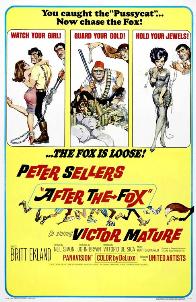
So what does that intro to a review have to do with anything? Well, I didn't actually watch an Italian neorealist film (not yet at least). Instead I watched an Italian comedy that spoofed the genre with star Peter Sellers impersonating a director that sounds suspiciously a lot like famous Italian director Federico Fellini, 1966's After the Fox. This isn't an obvious spoof like Airplane! or The Naked Gun series, but it certainly pokes fun at these art-house movies that are held in such high regard. Not a hilarious movie, but still a funny one with Sellers dominating the movie like so few can.
Serving a sentence in an Italian mountaintop prison, infamous master thief Aldo Vanucci (Sellers) hears his younger sister, Gina (Britt Ekland), is in trouble and promptly breaks out of prison as easy as snapping his fingers. When he quickly realizes there's nothing he can do to help his aspiring actress of a sister, Aldo decides to take part in a dangerous job of helping transport 300 gold bars from Egypt into Italy. Every police and detective agency in Europe knows the gold is coming so how can Aldo and his "gang" help get the gold into the country? He develops a plan where he'll pose as an Italian filmmaker filming a movie in a small coastal village about what else? A ship carrying bars of gold landing in Italy after a successful heist of course. The plan seems ludicrous, but could it somehow work?
Growing up watching movies, I was never a huge fan of Peter Sellers. Aware of him, yes, but I never sought out his movies. The original Pink Panther didn't hit me right, but I'd like to give it another try at some point. One criticism I've had of Sellers is that he seems to play the same niche role. Like Eddie Murphy has done over the last 15 or 20 years, Sellers would play two or three roles in a single movie, and something that I can't explain always bugged me about that. We get it, you're talented. Now back off. As I see more of him though, it's easy to see why he's got such a strong fan following. Regardless of the role, the man is extremely funny. His deliveries are impeccable, that perfect mix of subtle laughs and more obvious physical, slapstick humor.
Nowhere is that more evident than the second half of After the Fox when Sellers' Aldo unleashes his plan to get the gold into Italy. He dupes an entire town, a police chief, and even an American actor (Victor Mature poking fun at himself) to star in this "film." The only problem is the timing doesn't work out quite to plan so Aldo -- renaming himself Federico Fabrizi -- has to actually stage scenes to buy himself some time. So with no script and no real movie at all (with an entire village watching all the time), Aldo improvises and comes up with a neorealistic film about two lost loves (Mature and Ekland) finding each other in this other-worldly depiction of love. This is Sellers at his best, big and loud, screaming and directing like a nut. These are the inspired scenes that produce the biggest laughs.
With Sellers posing like a madman as he "directs" his movie all in hopes of actually pulling off this heist, it's Victor Mature as past his prime American actor Tony Powell who steals the movie. Looking to legitimize his fake film, Sellers somehow convinces Mature's Powell to take part in this innovative new project. Martin Balsam as Mature's questioning, worrying agent is priceless as well. So hard up for work and desperately looking to get back into the limelight, Powell goes for it hook, line and sinker. Every request, every command Aldo makes, Powell goes for it, enthusiastically replying 'Beautiful!' before immediately complying. Mature is playing a variation on himself by this point in his career and nails the part. It's a bit of a dig without being mean or cruel, but because he commits so forcefully to this wacky movie you can't help but laugh.
All told, I liked this movie but didn't love it. Director Vittorio De Sica takes his time getting the story where it needs to be so that first hour takes a little while to develop. Sellers helps things along and keeps them moving thankfully. For the rest of the cast, Ekland doesn't look Italian even with brown hair instead of her usual blonde, but she makes the most of a smaller part. Akim Tamiroff is the stupidly evil plotter of the gold heist always ready with a double-cross with the beautiful Maria Grazia Buccella as his eye candy. Paolo Stoppa, Tino Buazzelli, and Mac Ronay are very funny as Aldo's inept gang too. A funny movie in the vein of a light-hearted spoof, worthwhile for Sellers and Mature.
After the Fox <---trailer (1966): ***/****
Labels:
1960s,
Akim Tamiroff,
Britt Ekland,
Comedy,
Peter Sellers,
Victor Mature
Monday, January 24, 2011
Max Payne
Everything from books to songs to poetry to comic books have been transformed into feature films so why not video games? Whole series like Mortal Kombat, Lara Croft, House of the Dead have been turned from a video/arcade game into successful (depending on the series) movie franchises. One of the more popular video game series through the early 2000s was Max Payne, the story of a NYPD cop looking for revenge after the murder of his family. It's a popular series that didn't translate well to theaters, both critically and in the box office, but here's the counter argument because I liked 2008's Max Payne.
Complaints range all over the place, and nothing is free of scrutiny here when it comes to diehard fans of the original game. I never played any of the Payne series so I had no preconceived notions about what the movie version should be in terms of casting, characters, and storytelling. I went in as a fan of star Mark Wahlberg and thought the supporting cast and the premise sounded interesting. Is it a great movie? Not at all. It doesn't really add anything to an action genre that's seen just about everything. It feels like a mix of several different movies, everything from The Matrix to Sin City and a ton more in between. So be forewarned, I know little to nothing about Max Payne and still liked it.
It's been several years since NYPD detective Max Payne (Wahlberg) came home to find his wife and baby son killed by three gangsters. He's been relegated to Cold Case files and is hidden away in the archives of the police department. At night though, Payne comes to life, walking the streets looking for clues as to the killer of his family and kicking some ass in the process. Low-level crooks watch out, Max Payne is gunning for you. His former partner (Donal Logue) stumbles onto a clue that could help Max out, but he's gunned down before he can tell him the actual news. Max is on the hunt now, and he doesn't care much what his badge represents by now. With some help from a mafia-connected hit woman, Mona (Mila Kunis) also looking for revenge, Max follows the lone clue he has available to him and walks into something bigger than he had planned on.
I'm always surprised when I see a movie that I enjoyed only to read reviews and message boards that spew just posts and posts of hatred for the film version of Max Payne. It starts with Wahlberg who it seems moviegoers either love or hate. I like him, and while I can see the criticism that he always plays variations of himself, it doesn't bother me. His Max is that prototypical man seeking vengeance, and that's a hard character to mess up. He's got the sympathy vote because who doesn't feel for a guy who saw his wife and infant son murdered? His Max is a man of few words, and at times (like a few other Wahlberg parts I can think of) he reminds me of Steve McQueen in his loner, antisocial anti-hero parts, especially in The Getaway as Doc McCoy. Wahlberg is a more than capable actor, and he can handle all sorts of action scenes. Was he the best choice to play Max? I don't know, but from someone with no background in the game or character, the casting worked for me.
In terms of style, visually this movie looks a lot like Sin City. The whole story takes place almost completely at night so visually we're talking a modern film noir with shadows and darkness, and a little CGI thrown in for good measure and tone-setting. It's New York City, but it has a feel of a darker, more sinister city, like Gotham before Batman did his thing. Sometimes the style comes at the expense of the story, but most action movies lean in that direction. With the story, there are elements of the video game thrown in, and even a little comic book style too. Nothing is particularly new or innovative, but it's a well-made, good looking action movie and stays well within a comfort zone throughout.
With a movie that in its unrated director's cut clocks in at 103 minutes, there are certain sacrifices made. The story is disjointed at times with too many elements bouncing around. In an investigation -- rogue cop or not -- we're going to meet a lot of characters, but there's just too many here. Kunis continues to show she's capable of being in action movies (check out Book of Eli too), although it's weird hearing Meg Griffin's voice so clearly at times. She's that perfect female co-star, beautiful and badass, especially late when she's covering Max's back with a machine gun. The rest of the cast includes rapper Ludacris again proving he's got some work to do in the acting department, Logue in a small part as Max's former partner, Beau Bridges as an old family friend, Chris O'Donnell as a former co-worker of Max's wife, an underused Olga Kurylenko as Kunis' sister, and Amaury Nolasco as Lupino, a super-soldier who can't be stopped.
So if all else, it's a video game movie, and there's plenty of quality action...right? Finally something I think most viewers can agree on. Criticize just about anything else you want from this flick, but I think the action sequences are pretty untouchable. Two shootouts stand out, one a running firefight in a crowded office with some nice use of slow-motion, and two, the finale as Max goes gunning for the man who pulls all the strings and was responsible for the death of his wife. All in all, pleasantly surprised with this one. I can't speak for anyone else, but it's a solid action flick with a good cast.
Max Payne <---trailer (2008): ***/****
Complaints range all over the place, and nothing is free of scrutiny here when it comes to diehard fans of the original game. I never played any of the Payne series so I had no preconceived notions about what the movie version should be in terms of casting, characters, and storytelling. I went in as a fan of star Mark Wahlberg and thought the supporting cast and the premise sounded interesting. Is it a great movie? Not at all. It doesn't really add anything to an action genre that's seen just about everything. It feels like a mix of several different movies, everything from The Matrix to Sin City and a ton more in between. So be forewarned, I know little to nothing about Max Payne and still liked it.
It's been several years since NYPD detective Max Payne (Wahlberg) came home to find his wife and baby son killed by three gangsters. He's been relegated to Cold Case files and is hidden away in the archives of the police department. At night though, Payne comes to life, walking the streets looking for clues as to the killer of his family and kicking some ass in the process. Low-level crooks watch out, Max Payne is gunning for you. His former partner (Donal Logue) stumbles onto a clue that could help Max out, but he's gunned down before he can tell him the actual news. Max is on the hunt now, and he doesn't care much what his badge represents by now. With some help from a mafia-connected hit woman, Mona (Mila Kunis) also looking for revenge, Max follows the lone clue he has available to him and walks into something bigger than he had planned on.
I'm always surprised when I see a movie that I enjoyed only to read reviews and message boards that spew just posts and posts of hatred for the film version of Max Payne. It starts with Wahlberg who it seems moviegoers either love or hate. I like him, and while I can see the criticism that he always plays variations of himself, it doesn't bother me. His Max is that prototypical man seeking vengeance, and that's a hard character to mess up. He's got the sympathy vote because who doesn't feel for a guy who saw his wife and infant son murdered? His Max is a man of few words, and at times (like a few other Wahlberg parts I can think of) he reminds me of Steve McQueen in his loner, antisocial anti-hero parts, especially in The Getaway as Doc McCoy. Wahlberg is a more than capable actor, and he can handle all sorts of action scenes. Was he the best choice to play Max? I don't know, but from someone with no background in the game or character, the casting worked for me.
In terms of style, visually this movie looks a lot like Sin City. The whole story takes place almost completely at night so visually we're talking a modern film noir with shadows and darkness, and a little CGI thrown in for good measure and tone-setting. It's New York City, but it has a feel of a darker, more sinister city, like Gotham before Batman did his thing. Sometimes the style comes at the expense of the story, but most action movies lean in that direction. With the story, there are elements of the video game thrown in, and even a little comic book style too. Nothing is particularly new or innovative, but it's a well-made, good looking action movie and stays well within a comfort zone throughout.
With a movie that in its unrated director's cut clocks in at 103 minutes, there are certain sacrifices made. The story is disjointed at times with too many elements bouncing around. In an investigation -- rogue cop or not -- we're going to meet a lot of characters, but there's just too many here. Kunis continues to show she's capable of being in action movies (check out Book of Eli too), although it's weird hearing Meg Griffin's voice so clearly at times. She's that perfect female co-star, beautiful and badass, especially late when she's covering Max's back with a machine gun. The rest of the cast includes rapper Ludacris again proving he's got some work to do in the acting department, Logue in a small part as Max's former partner, Beau Bridges as an old family friend, Chris O'Donnell as a former co-worker of Max's wife, an underused Olga Kurylenko as Kunis' sister, and Amaury Nolasco as Lupino, a super-soldier who can't be stopped.
So if all else, it's a video game movie, and there's plenty of quality action...right? Finally something I think most viewers can agree on. Criticize just about anything else you want from this flick, but I think the action sequences are pretty untouchable. Two shootouts stand out, one a running firefight in a crowded office with some nice use of slow-motion, and two, the finale as Max goes gunning for the man who pulls all the strings and was responsible for the death of his wife. All in all, pleasantly surprised with this one. I can't speak for anyone else, but it's a solid action flick with a good cast.
Max Payne <---trailer (2008): ***/****
Labels:
2000s,
Beau Bridges,
Cops,
Ludacris,
Mark Wahlberg,
Mila Kunis,
Olga Kurylenko
Subscribe to:
Posts (Atom)