The Sons of Katie Elder

The Sons of Katie Elder
"First, we reunite, then find Ma and Pa's killer...then read some reviews."

Monday, February 24, 2014

One Foot in Hell

Alan Ladd is Shane. That's it. End of story. In the classic 1953 western, Ladd played one of the genre's most famous gunfighters/cowboys, a man named Shane working with homesteaders against ruthless cattle barons. It's an iconic character, one that is easily remembered as one of Ladd's best. So what to make of Alan Ladd -- Shane himself -- playing....a bad guy?!? I know. It caught me by surprise too, but here we are with 1960's One Foot in Hell.

The end of the Civil War is a recent memory as former Confederate soldier Mitch Barrett (Ladd) moves west with his wife, Ellie (Rachel Stephens), hoping to start a new life. Ellie is pregnant though and goes into labor as they ride into the town of Blue Springs, Arizona. Mitch tries to get a hotel room, get a doctor, get medicine, but before he can get back to Ellie, she passes away. He holds certain townspeople to blame for his wife's death, but looking to move on, he takes a job as a deputy in town and settles into a new life. Months go by, Mitch becoming a trusted member of the community, forming friendships and relationships with the townspeople. One day, he approaches a drunken prisoner, Dan Keats (Don Murray), with an offer to cripple the town, but he needs help. As Dan quickly figures out, Mitch hasn't let his feelings of revenge go at all, and he's going to do everything he can to cripple this town.


This western from director James B. Clark actually has its root in television. It's based off a screenplay from Aaron Spelling (later of Beverly Hills 90210, Charlie's Angels, 7th Heaven fame and many others). Spelling had written it originally for Playhouse 90, a TV show that aired in the late 1950s, then adapting it for the big screen in this B-western that clearly didn't have a big budget but also doesn't let that be a huge detriment. It has been almost completely forgotten within the western genre, lost in waves of B-westerns that bombarded audiences in the 1950s and 1960s. Why shouldn't it be forgotten? Well, for starters, it is dark. Very dark. Most 1960 westerns, I still have this picture of white hat good guys vs. black hat bad guys. That trend was starting to change by 1960, especially here in this generally forgotten genre entry.

Where to start? With Ladd as revenge-seeking Mitch. In all my reviews of Ladd films, I feel like I've brought up his general stiffness on-screen, only certain parts rising above that wooden delivery. This actually isn't that part, but the wooden acting actually pays off here. Until Ladd's Mitch approaches Murray's Keats in his jail cell, I wasn't sure where the movie was heading, thinking maybe I was watching a pretty straightforward western hero gets second chance story. Nope, not at all. This is a man who wants revenge, and he's willing to wait for it to make it more painful for all those involved. By 1960, alcoholism was ravaging Ladd, and it shows. He doesn't look good at all. But that wooden delivery? It plays well with a man driven to obsession about gaining that revenge. It's hard to read his intentions at almost all times. How far is he willing to go? What is he willing to sacrifice? If it sounds like a backhanded compliment, so be it. Ladd's performance works, and it's definitely cool to see him play such a dark, villainous role.

Ladd is the biggest name here, but the supporting cast is pretty good, adding to that darkness started off by Ladd's Mitch. Hamming it up a bit at times, Murray is good as Keats, the former Confederate soldier who's turned to the bottle rather than deal with his tragic losses from the war. He's also a talented artist and an artillery specialist, giving Mitch a versatile assistant in his revenge plan. Mitch also assembles a small crew to work with including Sir Harry Ivers (Dan O'Herlihy), an English gentleman and a master thief, Julie (Dolores Michaels), a prostitute posing as Mitch's new wife, and Stu Christian (Barry Coe), a fast draw and gunman with no scruples about killing innocents. It's an interesting group to watch, one that threatens to tear itself apart before it can even unleash its plan. Star power? Nope, but some cool characters. It would have been nice to get some more background, more development, but cool just the same. Also, look for Larry Gates as the town doctor who convinces Mitch to stick around.

But again, that darkness, it's hard to shake it. The opening scene is uncomfortable to watch, Mitch meeting a slow-moving hotel desk clerk (Henry Norell) with lots of questions, a store owner (John Alexander) who holds Mitch up over $1.87 he owes for medicine his wife desperately needs, not allowing it on credit, and the sheriff (Karl Swenson) who arrests Mitch when he's forced to pull a gun to get the medicine. It just caught me by surprise, but for the good. The ending taps the brakes some unfortunately, an out of left field storyline that feels forced and far more typical of a 1960 American western. Also -- and I could have been watching an edited version of the film -- one key character's death isn't shown. Hhhmmm, interesting, but not for the better.

Still, getting to the finale is very interesting. It's a cool change of pace for any number of reasons, especially Alan Ladd in a bad guy role. If you can track down a copy, definitely give it a shot.

One Foot in Hell (1960): ***/****

Saturday, February 22, 2014

Soup to Nuts

I grew up watching The Three Stooges, and I'll always love them. Most fans know of their comedy shorts, usually running about 15-20 minutes, but their movie careers? Not nearly as well known. Their later movies with Curley Joe DeRita are readily available, even popping up on TV occasionally, but the same can't be said for their early entries prior to their Columbia shorts. Their feature debut? A 1930 comedy called Soup to Nuts.

Working at a costume shop, Ted (Ted Healy) isn't much of a worker, instead hanging out with three of his friends (The Three Stooges) as they work at a local firehouse. That costume shop is in trouble though, the owners sending in a new young businessman, Carlson (Stanley Smith), to clean things up and get the business back on track. Wouldn't you know it though? Carlson falls madly in love with the older owner's daughter, Louise (Lucile Browne), and we've got an issue. At the same time, Ted is trying to appease his whiny girlfriend, Queenie (Frances McCoy), who seems to be interested in him because he can pay for an occasional dinner. Whatever will all these crazy folks do? Can everything be fixed?!?

Does anything jump out from that plot description? One, it doesn't sound very funny. Two, the Stooges aren't in it much. From director Benjamin Stoloff, this 1930 comedy clocks in at a slim 70 minutes and for lack of a better description, is light on actual laughs. This is still very early in the sound era, and it shows. Studios and writers were still figuring out how to transition stage and theatrical work to feature films, what worked and didn't work. The end result is an odd middle ground that's neither theater or film. The humor is broad and not so funny, and the story drifts from one uninteresting subplot to another. Win-win, huh?

I watched this one because of the Three Stooges in their feature debut. For several years before they really took off, the Stooges worked with Ted Healy, the trio acting as sidekicks to the better known comedian. Thankfully by 1934, their contract ended with Healy, and they were able to branch out on their own. They never looked back, becoming an integral, iconic part of American pop culture. Forty-plus years since they released anything -- shorts, films, TV cartoons -- and they're still an instantly recognizable group. Another fact that gets lost in the shuffle at times? The original Stooges were Moe Howard, Larry Fine and.....Shemp Howard, not Curly. Shemp eventually went solo, Curly replacing him in the act, in the process becoming the most popular of all the Stooges. So at this early point in their career, it was the Howard brothers, Moe and Shemp, working with Larry so don't be too surprised if you check this one out.

Take the Stooges out of this movie, and you've got one of thousands of movies that have generally been forgotten by Hollywood, studios and fans over the years. With them? Because they're underused and/or ignored, it's barely watchable. I was fast-forwarding like crazy when they weren't on-screen. The potential is there for the trio though. When they're on-screen, it's fun to watch from the fast-paced dialogue, the physical humor as the trio slaps and hits each other into oblivion. It's all there. A highlight late in the movie has them doing their routine with Ted Healy in front of an audience, the quartet showing they were good together. Too bad there wasn't more of the Stooges. There's also an odd fourth Stooge (played by Fred Sanborn), a mute, bow-legged fireman with some incredibly bushy eyebrows. So about that....yeah, they made the right decision sticking with three rather than four.

Let's keep this short. Do you like The Three Stooges? Give this one a shot with very modest to low expectations. This is not the way to introduce yourself to the comedy legends. If you're looking to do that, check out some of their early Columbia shorts. I've got a feeling if this is your first introduction, it's probably going to be your last. Besides, they're only on-screen for about 15-20 minutes.

Soup to Nuts (1930): */****

Friday, February 21, 2014

The Lone Ranger

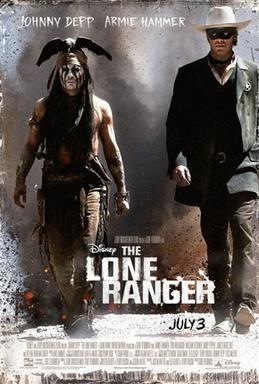
It is a character who's name is instantly recognizable, the Lone Ranger. First appearing in radio serials in 1933, the Lone Ranger has seen has his own very successful TV show in the 1950s, a brief run as an animated star in the 1960s, a disastrously bad (so I've heard) film version in 1981, and most recently, a reboot of the character of sorts, 2013's The Lone Ranger. Where does it stand? Well, it was one of the biggest financial disappointments of the year. Give it a try though, keep an open mind and I think you'll like it. I did.

It's 1869 in Colby, Texas and a young, naive, idealistic new district attorney, John Reid (Armie Hammer) arrives in town ready to clean up the area. The country is expanding, the railroad racing across the state, and Reid wants to be a part of it, to bring some civilization to the area. A problem has arisen though, a sadistic outlaw, Butch Cavendish (William Fichtner), escaping from custody. Reid heads out with a posse of Texas Rangers to catch Cavendish, but they're ambushed and Reid is the only one to survive, albeit getting shot in the process. He awakes to find a Comanche warrior, Tonto (Johnny Depp), looking out for him, claiming that Reid is now a Spirit Warrior, a man who passed to the other side and come back to normal life. Tonto too is searching for Cavendish with his own reasons for revenge. Forming an unlikely partnership, Reid -- disguising himself because Cavendish believes he's dead -- and Tonto decide to work together to find Cavendish, all amidst the railroad issues and cavalry intervening with a possible Comanche uprising.

Released last summer in theaters, 'Lone' had quite the checkered history in actually getting to theaters. When it did reach audiences, it flopped. Odd to think of any movie that earned $260 million internationally being a flop, but when a film had a budget somewhere between $225-250 million and another $100-plus on promotion, well, it's a flop. Well.....I liked it. For me, my enjoyment started because it is an entertaining movie. Plain and simple, it's entertaining. More than that though as a western, it knows where the genre has come from. Hans Zimmer's musical score is solid if not up there with his best, but it samples spaghetti western master composer Ennio Morricone's scores from Once Upon a Time in the West and The Good, the Bad and the Ugly in some nice nods to genre classics.  'Lone' was also filmed in Monument Valley, made famous by director John Ford, and even some of the shots are reminiscent of iconic Ford shots. It's nice little touches that this that start 'Lone' off on the right foot.

With a film directed by Gore Verbinski and starring Johnny Depp, my worry was that I would be watching a western version of Pirates of the Caribbean: Western Style. The end result is a positive and negative. Yes, it is in the same vein of the Pirates movies. It's big and loud and colorful and schizophrenic at times. There's a lot of characters, a lot going on, blending in the drama with some laughs and some action. In other words, 'Lone' tries to be that perfect summer blockbuster, succeeding for the most parts. What then are the biggest issues? A framing device in the story department comes up short, an aged, wrinkly Tonto in 1933 San Francisco telling the Lone Ranger's story to a little boy, is forced and tries to lighten the mood too much. The elements of the mystical and spiritual are overdone as well, Tonto's insistence that John is a Spirit Warrior good but just used too much. Also, is Tonto a spirit himself? Just have fun with the story. Don't overdo it like that.

One of the original hero/sidekick duos, the Lone Ranger and Tonto are two pretty cool characters no matter what Ranger incarnation we're talking. I wasn't sold on Hammer (The Social Network) as John Reid, but he grew on me with each passing scene. The same for Depp, the casting looking like he'd play Capt. Jack Sparrow in the west. His Tonto is quirky, a little off in the Capt. Jack vein, but it is most definitely a fun part. He definitely doesn't deserve the flak he's received, including a Razzie nomination for Worst Actor. I also don't think it's fair to criticize Depp for being cast as a Native American. Is it in poor taste? It's a movie. Cool your jets. Above all else, I liked the chemistry between Hammer and Depp. Hammer's John is somewhat suspicious of Tonto, wanting to do things his way. Depp's Tonto thinks John is a little off himself, his idealistic motivations having no place in the wild west. They're funny together, both given some background to humanize them a bit, Tonto's background providing some of the emotional background.

Who else to look out for? Fichtner is very creepy as the infamous outlaw Butch Cavendish who enjoys eating his victims' hearts as they die. Look for James Frain and Leon Rippy in small parts as members of Butch's gang. Tom Wilkinson plays Latham Cole, the railroad executive placed in charge of advancing the rails as fast and far as possible. It's Wilkinson so you know he's up to something. Otherwise, why would he be here? Ruth Wilson is solid too as John's sister-in-law, a past love, who married John's brother, a Texas Ranger, played in a nice supporting part for James Badge Dale. Also having some fun is Helena Bonham Carter as Red, a brothel owner with an ivory leg, siding with John and Tonto in their troubles while Barry Pepper plays a God-fearing, gung-ho cavalry officer working with Cole to control the Comanches. Even Stephen Root makes an appearance late as a higher-up in the railroad company who's checking on the progress his company is making.

Again in the vein of the Pirates series is the rollover in the action department. What's there is surprisingly gruesome in terms of on-screen violence, if not particularly graphic. So be forewarned, this may not be the movie for younger kids. Mostly though, the action is flashy and fun, big and entertaining, gigantic action sequences full of CGI, crazy stunts and scenarios that no real-life human being could accomplish. The opening sequence where John and Tonto meet is pretty cool, the duo chained together and trying to stop a runaway train. The same for the finale, a train packed with silver lode being chased by another train, anyone and everyone jumping on and off one train and then the next, one ridiculous thing after another. It's goofy and fun right from the start, keeping things entertaining throughout the 149-minute running time.

Fans of the Lone Ranger will hopefully enjoy this one. I didn't come in as a huge fan with high expectations, just looking for a fun movie. It is, doing the Lone Ranger justice from his capable, maybe super-horse, Silver (his "Hi-yo, Silver, away! providing a good laugh), and of course, the Lone Ranger theme -- listen HERE -- from the William Tell overture, all those touches you're looking for in a movie with this iconic character. It's a reboot, but because of the financial struggles, this will probably be it for the series/franchise. So what are we left with? A movie that is overindulgent, goofy, schizophrenic and a whole lot of fun with some great characters, good laughs and lots of entertaining moments.

The Lone Ranger (2013): ***/****

Wednesday, February 19, 2014

Conquest of the Planet of the Apes

Well, we might as well continue what we've started. While I'd seen the first three Planet of the Apes movies growing up on multiple occasions, I can't say the same for the last two movies in the series, 1972's Conquest of the Planet of the Apes and 1973's Battle for the Planet of the Apes. I've seen bits and pieces of both but never all the way through in one sitting. And away we go!

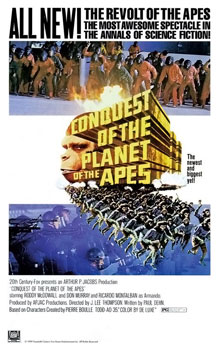
It's 1991 in North America, some 20 years since the talking apes, Zira and Cornelius, were murdered along with their baby...but it wasn't their baby. Things have changed around the world, a mysterious virus killing every single cat and dog on Earth, humans turning to apes/monkeys to be their pets. That changed quickly though, their mental capacities showing they're not so worthwhile as pets, but as slaves. It's been eight years, apes and chimpanzees used as janitors, delivery men, waiters and so many other tasks and jobs. That baby though that was supposed to have died? He didn't, and now he's 20 years old, still with loving-life Armando (Ricardo Montalban), who is now bringing the 20-year old intelligent, talking Caesar (Roddy McDowall) to the big city for the first time. Caesar is stunned and disgusted at what he finds, and when he becomes separated from Armando he's forced to adjust or reveal his secret.

Watching the Apes series in fairly quick succession, I've came away impressed. This fourth entry, this one from director J. Lee Thompson who had been in talks to direct the first movie, certainly qualifies. Is it a classic film? No, but fans of the series and science fiction in general will no doubt enjoy it. This series has impressed me because the original 1968 Planet of the Apes is a classic stand-alone science fiction film. It doesn't need any sequels. There are some questions we'd like more answers about, more background, but we know the truth, what really happened. Following the first sequel, 'Beneath,' the series found a way to survive and evolve -- whether intentionally or just lucking into it -- by bringing all five movies full circle. It's a nice touch, and each movie is different from its predecessor. Similar themes, tones, even some actors make it from movie to movie, but in an age of repetitive sequels, it's cool to see original, different sequels like this.

For this third sequel, there's a time jump.....into the future of 1991!!! 'Conquest' was filmed on location in Los Angeles at Century City, an appropriate, sparse and ultra-modern look for the visual of what Earth would have looked like in 1991....from a 1972 audience. Basically the entire story takes place in this one complex, the human rulers trying to limit and control the problems among the ape slaves. The apes are getting smarter, showing more initiative, being more disobedient. Add the very intelligent and very disgusted/motivated Caesar to the mix, and we've officially got an issue. There are points where things feel rushed in an 88-minute movie, another 10 minutes maybe fleshing it out some, but continuing what the series has laid out, this is a particularly dark, brutal story. What we see is even a tamed version of the original ending. It's not graphic (these movies were still considered "family movies") but the violence can be disturbing at times.

As has been the case for the first three movies, the key is the characters, whether they be heroes, villains or somewhere in between. That's what I found interesting here. Do we want to root for the evil, despicable humans who abuse slaves? Or do we root for the revolting apes to....wipe out mankind? Hhhhmmm, well, that's a toughie. It can be an uncomfortable movie to watch at times because of that dynamic. McDowall returns to the series, playing Cornelius' son (so technically his own) Caesar. It's a very good part for McDowall, fiery and angry, the match that sets off the explosion that's been waiting to happen. Hidden away from what society has become by Montalban's Armando, Caesar hasn't seen the darkness the world has to offer, until now. The rage inside him begins to grow and when he gets the proper motivation for revenge, he begins to planning the revolution, assembling and building, waiting for his time. A very good part for McDowall, especially his monologue in the final scene.

Again stealing the show is Montalban as the likable, charming and idealistic Armando, more Caesar's surrogate father than owner. It's not a huge part, but it is definitely a memorable one, Montalban again stealing all his scenes. Don Murray is nicely cast as Breck, the sadistic governor of the city, convinced that a talking ape is out there and hellbent on finding and killing him. Hari Rhodes plays his assistant, McDonald, an intelligent, thoughtful man, who has a bond of sorts with Caesar after they meet, and Severn Darden plays Breck's enforcer on his other shoulder, Kolp. Natalie Trundy continues her participation in the series, playing Lisa, a female ape, after already playing a mutant and a doctor in previous movies. John Randolph appears briefly in an update of a monologue he had in 'Escape' as well.

The portrayal of the future can be uncomfortable to watch at times. Breck and his fellow officials wear black and dark clothing, his soldiers wearing completely black uniforms that make them look like Nazi stormtroopers. The apes on the other hand wear green and orange jumpsuits, the color jumping off the screen. As I mentioned, I was surprised by how this story developed. The actual conquest in the final act of the movie is intense to say the least. The ending is startling, even if it was edited to be a little more tame. Still, I liked this sequel a lot and can't wait to see where the series goes in its finale. As well, it's hard not to notice how much this sequel inspired the Apes reboot, 2011's Rise of the Planet of the Apes. Just saying.

Conquest of the Planet of the Apes (1972): ***/****

Tuesday, February 18, 2014

Winter's Tale

If there's ever a weekend meant for sappy, sugary sweet, lovey-dovey movies, it has to be Valentine Day weekend. Audiences had two options this past weekend when it comes to the romantically pleasant love story, Endless Love and 2014's Winter's Tale. Reviews were almost uniformly negative -- some scathingly so -- but I thought there was too much positive going on to make it that bad. Was I correct? Well, there are positives, but when it's bad.....it's bad.

In New York City in 1916, Peter Lake (Colin Farrell) is an accomplished thief who's run into a bit of trouble. In the city, he has no rivals, but a former boss and mentor of sorts, Pearly Soames (Russell Crowe), wants him dead, and he's willing to pay a hefty price to get it done. Every job Peter pulls off, he's being hunted by Pearly's criminal underworld thugs. Picking a safe at one luxurious NYC house, Peter is surprised to find the supposedly empty house not empty at all, a pretty 21-year old woman, Beverly (Jessica Brown Findlay), dying of tuberculosis and already having outlived the diagnosis from her doctors. Beverly doesn't scream or freak out, Peter undone some by her response. Instead, she invites him to sit down for tea, and they talk. Their connection is instantaneous, their attraction evident from the first words they share though. It almost feels like the universe has brought these two young people together for a reason. Could something be going on with far bigger implications? Are they meant to do something special?

I saw the trailers for this romantically-charged period piece this past fall and was intrigued. It looked sappy and overdone -- like Valentine's Day bait at most -- but I was intrigued. It was a love story that didn't look too cheesy. 'Tale' is based off a 1983 novel from author Mark Helprin, and it's rocking 4 out of 5 stars currently at Amazon (buy it HERE, because Amazon needs my help). As the release date drew closer, I was actually looking forward to seeing it. The premise -- and there's far more than my simple plot description above -- of 1910s New York City, a criminal underworld connection, true love, lost love, and quasi-time travel seemed like literature at its best, or at least something that appeals to me. It sure sounded like the Pete Hamill novel 'Forever' in some ways, a favorite of mine. And the end result? Wow. I don't know exactly where to start.

There is potential here. There is, but there is also a reason critics are tearing it to pieces. My favorite review goes to Richard Roeper -- read HERE -- who certainly enjoyed bringing up all the most cringe-worthy moments. This is a story about true love, the universe, good and evil, miracles, destiny, finding a purpose in life, accomplishing what you're supposed to accomplish. All well and good, right? Sure, it's a lot to deal with but it certainly could have worked. It doesn't. 'Tale' is too dreamy, too loving, too sugary sweet with voiceover narrations about stars, people dying and becoming stars, about angels ascending and descending from Earth and Heaven and Hell. The basic premise is that true love brings out a true miracle in everyone. Everyone has that one miracle, that one thing in life that is pure and good and perfect. In many cases, it's love. Crowe as Pearly is a demon who's job is to prevent those miracles. Working against him are creatures and beings trying to help individuals complete their mission.

Yeah, and there it goes. Things start to disintegrate quickly, and yes, there's just too much going on. The creature helping Peter accomplish his miracle -- is it to save Beverly? Hhhmmm, I don't know.... -- is an immaculate white horse that Peter calls 'Horse,' but it sounds dreamy with an accent. Oh, and the horse flies, sprouting wings as necessary to escape dangerous situations. Pearly especially wants to kill the horse. Oh, and Pearly says the horse is "actually a dog" which...we...never...actually...see. And it's never explained. Crowe overacts like his life depends on it, similarly rocking an Irish(?) accent, his demon turning into a maniacal-looking animal when it gets angry. Pearly also visits a special guest two times, Lucifer himself played by Will Smith. Yes, you read that right. Will Smith. His Lucifer has a touch of gray, wears big, gold earrings, a stylish black blazer and in 1916 NYC wears a Jimi Hendrix t-shirt. The scene where he blows up on Pearly, reprimanding him for an idea, is laughably bad. I'm assuming it was meant to be a big, frightening dramatic moment, and I laughed. Out loud.

What did work for me was the crux of the story, the relationship between Peter and Beverly. I'm a Colin Farrell fan so that helps, but the character is interesting. His backstory is glossed over too much (including an 1895 "flashback" and one scene with wise Indian Graham Greene) and his hair is just odd, but it is interesting, the doomed anti-hero (relative, he's a nice thief) trying to save his love. A twist about 3/4 of the way through the movie has him doomed to walk the Earth not knowing who he is, not able to remember who he is or why he's been forced to do this, but the high points for the character are his scenes with Beverly, Brown Findlay having a solid chemistry with Farrell throughout. Again, I liked the premise, the doomed lovers trying to reverse that doomed quality, to make things right. In execution, it doesn't always work well. There's simply too much going on, the story trying to be an end-all declaration on everlasting love. Helprin's novel is pretty massive so I'm assuming lots of exposition, explanation, development, maybe whole plotlines were excised. What's left is a shell of what could have been a good movie.

But the star power! The Star Power! The supporting parts are in name only, the script not doing anyone any favors, but the acting is surprisingly bad. William Hurt is awkwardly odd as Isaac, Beverly's worrying father who sleepwalks through his part, including one painfully forced scene with Peter where they discuss grammar and pronunciation. Jennifer Connelly is really over the top as Virginia, a single mom with a daughter (Ripley Sobo, a good little actress) dying of cancer in 2014 NYC who meets Peter, not questioning too much what's going on. And in the Hollywood legend department, Eva Marie Saint plays an old woman in 2014 who Peter meets and may have known before. Also look for Kevin Corrigan and Kevin Durand as two of Pearly's henchmen.

Bad is one thing, forced bad is another. The script in first-time director Akiva Goldsman's film makes some odd choices. Eva Marie Saint plays an editor-in-chief of an NYC newspaper who if my math is correct, is 104 years old!!! In the newspaper business!!! The universe "providing" is one thing, but come on. I'm really wavering here. I genuinely liked parts of this movie, but when it flops, it does so in a big way. I'm not going to recommend it, not as a genuinely good movie, but I also won't rip it as the all-time bomb it's being made out to be. Just don't go in expecting the skies to open up. You'll get some laughs out of it for sure. Intentional laughs? I doubt it. A two-star review teetering on less.

Winter's Tale (2014): **/****

Monday, February 17, 2014

The Spikes Gang

Growing up is tough, and yes, here we are with another coming of age movie. No, it's not a teenager in the 1980s, a little boy growing up in Germany during the Holocaust, but a sub-genre from one of my favorite genres, growing up in the wild west. Movies from The Culpepper Cattle Co. to True Grit and others, it's an always interesting sub-genre. We can definitely add 1974's The Spikes Gang to the list.

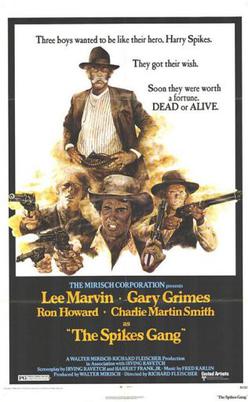
Living with his parents on an isolated farm in Texas, teenager Wilson Young (Gary Grimes) has had about enough of his father's strict, one might say cruel, treatment. Walking around out in the isolated brush country with his two friends, Les (Ron Howard) and Tod (Charles Martin Smith), Will finds the body of a seemingly dead man. He isn't though, the three teenagers nursing the severely wounded man back to health. They find out the man is Harry Spikes (Lee Marvin), a notorious bank robber who thanks the boys for their help and rides out. Not soon after, Will, Les and Tod all leave home, vowing to live life and explore the world and all it has to offer. Life on the road isn't everything it's made out to be though, the trio ending up in a Mexican prison with no hope...until now. Spikes lucks upon them, bribing the guard to let them out. His solution? He likes the boys and teaches them how to become bank robbers, forming the oddest gang of bank robbers around.

I was worried as I watched the credits for this Richard Fleischer-directed western. The soundtrack was a soft, folksy-sounding guitar playing, and I'm thinking I stumbled into a lyrical, whimsical 1970s western where everyone's nice and cute and the world is just dreamy. Well, I'm glad I stuck with it. There certainly are moments like that, the three boys hitting the road and ready to experience the world. That sentiment is quickly thrown out the window, and the movie gets better immediately. With no money and starving, Will decides to rob a bank out of nowhere. They get away with some money but Tod accidentally shoots a passerby trying to stop them. From there, the story's previously happy, go-lucky story degenerates, getting darker with each passing scene. Is that a good thing? Um, yes, my name is Tim. Have you read any of my reviews?

This is a gem of a western, one that deserves a much bigger reputation. Fans of westerns typically love or hate 1970s westerns, movies that ripped away the idea that the wild west was glamorous, romantic or anything like most John Wayne westerns. As an interesting touch, 'Spikes' was filmed in Almeria and Andalucia in Spain, the familiar locations for countless spaghetti westerns. So we've got an unsentimental American western interested in exposing the myths of the old west in locations made famous by spaghetti westerns, a genre similarly interested in blowing open the American west. How can you lose? The 96-minute western covers a lot of ground but never feels rushed, an episodic story a positive here. We see some quick appearances from Arthur Hunnicutt as a past-his-prime gunslinger/saddle tramp, Noah Berry Jr. as an unlikely ally, and it all works in perfect fashion.

Beyond the story, the movie works because of the cast. It starts with Lee Marvin as infamous bank robber Harry Spikes. This is a part equal parts charming/disarming and frightening in its reality. He genuinely likes the three boys, looking after them, feeding them, buying them clothes and guns, teaching them how to become outlaws, but he's also brutally honest about it. If they get hurt, he'll leave them. This is a dangerous profession he's chosen and the boys have chosen. It can end at any time, and all it takes is one bullet. Marvin's performance is a gem, one that deserves to be considered one of his best. It's funny, charming, disturbing at times, and he steals every scene he is in. This isn't a part that requires him to be in every scene, drifting in and out at times as needed. When he's on-screen though, it's impossible to look away.

With a lead performance like Marvin as Harry Spikes, it'd be easy for his teenage counterparts to get lost in the shuffle. These are three talented young actors though, and any such worry is unfounded. The best part is for Gary Grimes as Will, the unofficial leader of the trio. He's sick of his father's constant nagging (and occasional beatings with a belt), opting to hit the road. The transformation he goes through is the most profound, the darkest of the three. He was a specialist in the youngster role in 70s westerns, also starring in Culpepper Cattle Co. and Cahill, U.S. Marshal, ultimately retiring from acting in the late 1970s. It's a very human part with some startling developments late. The same year Happy Days premiered, Howard is also very good as Will's closest friend, a logical thinker who's almost the group's conscious. Martin Smith too is excellent as Tod, the most religious and worrisome of the trio.

I wasn't sure exactly where this 1974 western was heading although there were some hints at the finale. The ending is perfectly executed, a major twist revealing itself in the last 15 minutes. It isn't glossy, polished or romantic. This is the west as it was. Dark, nasty, bloody and all about survival. In other words, it's realistic and far from a happy ending. I loved this western, can't recommend it enough.

The Spikes Gang (1974): *** 1/2 /****

Friday, February 14, 2014

White House Down

In 1993 and 1994, it was Tombstone and Wyatt Earp. In 1998, it was Saving Private Ryan and The Thin Red Line. In 2011, it was Friends with Benefits and No Strings Attached. All similar movies released in a tight window, forcing audiences to choose which one (because who sees both?!?) to go see. Well, 2013 had its own deja vu entries, Olympus Has Fallen, and now, White House Down.

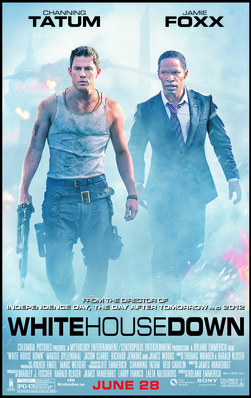
A veteran of the war in Afghanistan, a highly decorated one at that, John Cale (Channing Tatum) is now a Capitol Police officer assigned to the Speaker of the House, Eli Raphelson (Richard Jenkins). It's pretty straightforward, even boring, duty, John aspiring to be a Secret Service agent even though his credentials aren't quite there. He's also a divorced father, and he's managed to secure two passes for a White House tour, bringing his daughter, Emily (Joey King), to the President's home. While on the tour, John and Emily even meet the President, James Sawyer (Jamie Foxx), who even speaks briefly with the politically-obsessed Emily. Only minutes later though, a bomb goes off in the Capitol Building, and soon the shooting starts in the White House. A group of gunmen are trying to take the President hostage. Separated from his daughter, John must now try and find her and make sure she's safe while also doing his damnedest to save the President.

This action-heavy political thriller from director Roland Emmerich hit theaters last summer, just months after the similarly-themed Olympus Has Fallen. It did all right in theaters, struggling some in the U.S. but making over $200 million internationally. Why did it struggle? Was it released too close to 'Olympus'? My money is on 'no.' I saw Olympus, liked it a lot, admitting it was cheesy, pretty dumb, predictable, obvious and a hell of a lot of fun. 'White House' is all of those things except....well....it's awful. It isn't fun. It's stupid, mind-numbingly stupid. I guess I shouldn't be completely surprised. Emmerich is the master of the big, overblown but ultimately entertaining blockbusters -- Independence Day, 2012, Godzilla, The Day After Tomorrow -- but that trend seems on the downhill. 'Tomorrow' was just dumb, I didn't see 2008's 10,000 B.C., and 2012 was laughable. 'White House' most definitely continues that downhill trend.

Yes, I know this is a movie that's supposed to be fun and dumb and entertaining. It isn't meant to rewrite Film as an entire entity. But does it have to be so cliche-ridden? So forced? Much like 'Olympus,' the premise certainly has some promise. What's protocol when the President of the United States' home comes under attack, a house that is heavily fortified and seemingly impregnable? That's cool. The action is cool. A shootout on the White House lawn, a fortified limo being chased by armored and heavily armed SUVs? Yeah, I can get on board with that. But that's it. These really cool moments, some potentially great action scenes get shot right in the foot because of a script that absolutely refuses to try anything even remotely unique? Sorry, screenwriter James Vanderbilt, this script was the biggest reason this movie flops. Disappointing when I realized Vanderbilt wrote The Losers, Zodiac, Basic, all movies I really liked. Cliches in an action movie are one thing, but this tested me. Late in the movie, repetitive at 131 minutes, I only stuck with it for the sake of a review. Yeah, I'm pretty honorable like that.

I've come around on Channing Tatum. With the right movie, the guy can act. He's likable on-screen, is a solid presence and can more than carry his own in action sequence. I still don't think he's a great actor (potentially, he could be), leaning more toward the movie star angle. This is a mixed part for him. Again, the script does him no favors. He's a divorced father, his busy schedule making it hard to be a good parent for Emily (King is a solid, young actress), pissing off his ex-wife (Rachelle Lefevre). Oh, and he's kinda absent-minded, not detail-oriented, but aw shucks, he's an American hero and really, really wants to be a Secret Service agent!!! Wouldn't you know it? The Secret Service agent (Maggie Gyllenhaal) in charge of hiring agents is an ex-girlfriend! Trapped inside the White House, he's also the only trained personnel that thinks to dodge gunfire, the Secret Service agents just standing there and getting shot. Tatum is okay -- not great, not bad -- and is clearly doing his best to have some fun.

The rest of the cast comes from Stock Characters 101. Jamie Foxx is okay as President Barack Obama, um, I mean President James Sawyer, but I don't know if he was a great casting choice to begin with. James Woods is the bad guy because what else would James Woods be doing in this movie? He's okay, a little overdone, as Martin Walker, the treacherous head of the Secret Service. His small army of gunmen/terrorists are led by Jason Clarke's Stenz, a mercenary with vengeance on his mind. Clarke is over the top but at least interesting in the villain department. His fellow gunmen are pretty faceless, Jimmi Simpson providing some odd comedic relief as the hacker, Kevin Rankin the right wing nut, Killick, who's crazy because he has a thin mustache, doesn't wear a shirt, just body armor, and screams a lot. As for the assorted political types to go with Jenkins and Gyllenhaal (legitimate actors legitimizing the movie...to a point), also look for Michael Murphy and Lance Reddick.

There's just too many painful moments here, too much to prevent it from being tolerable. When you think you're safe, the ending feels like a Scooby Doo ending. "If it wasn't for you meddling Capitol police, I would have got away with it!" At one point, Woods asks Clark "Want some cake?" to which Clark answers "No!.....I've got diabetes!!!" What?!? Later, Foxx's President Sawyer, having opted for some Air Jordans for his getaway, kicks a terrorist trying to hold him down and yells "Don't....touch...my....Air....Jordans!" The attempts at catchy, fun lines are awful, especially Tatum's one-liner when he dukes it out with Clarke, as is the solution to the White House coming under attack. It's certainly one I questioned, but then again, by then, I was questioning a lot of things. I don't want to give away too much of the awesomeness. Feel the pain yourself.

This one stunk.

White House Down (2013): */****

Thursday, February 13, 2014

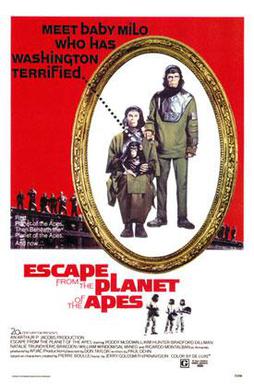
Escape from the Planet of the Apes

Sometimes a series is too successful to just let it end naturally. Following the success of Planet of the Apes and Beneath the Planet of the Apes, Fox Studios wanted another sequel, but there was a problem. Without giving too much away, the ending for 'Beneath' well....didn't really leave any opening for a follow-up. That's what screenwriters are for and ta-da! The series continued! A third movie in the series, 1971's Escape from the Planet of the Apes.

On a warm sunny day off the coast in southern California, a spaceship is discovered floating in the Pacific. The ship is brought ashore, the Army waiting to welcome the astronauts on-board but no one is sure where the spaceship came from or who is in fact on-board. Those waiting are stunned when the three astronauts remove their helmets, revealing themselves as apes. The three astronauts? Dr. Cornelius (Roddy McDowall), his wife, Dr. Zira (Kim Hunter) and Dr. Milo (Sal Mineo). The arrival of talking, intelligent apes stuns the world, forcing the government to decide what to do with the ape trio. Some are welcoming, Cornelius and Zira especially becoming instantly famous in pop culture. Others though aren't so welcoming, questioning where these apes came from and what is their intention in coming to Earth? Both sides need to find a happy medium, but some are sure the presence alone of these futuristic astronauts is a threat to the future of mankind.

So as we talked about, Beneath the Planet of the Apes didn't leave much of an opening for the series to continue, Charlton Heston insisting that be it for the series. Money is a powerful motivator though, isn't it? The series continues, but back on Earth in modern times. Director Don Taylor begins the second half of the series, catapulting the franchise in a different route for its final three films, composer Jerry Goldsmith returning as well with a great score. The premise linking 'Beneath' and 'Escape' is a tad contrived, a tad forced when you think about how 'Beneath' ended but for the sake of where the series is going, it's not so bad. Why does it stand out from the rest?

Two reasons. McDowall and Hunter. Playing Cornelius, McDowall returns to the series after being unable to to star in 'Beneath' because of a scheduling conflict. Less than pleased with her characterization in 'Beneath' (or maybe lack of), Hunter returned because she liked the script. The story is a departure from the first two movies, but this returning duo is perfect. Where we saw Heston's Taylor and James Franciscus' Brent struggling to adjust in a simian world, we now see Cornelius and Zira going through the same struggles in a human world. Where everything else has changed around them, having a spouse is a constant. Their chemistry is perfect, two intelligent individuals deciding what should be their next step, how best to survive in this human world. They have these perfect little moments, Cornelius trying on suits, Zira trying on stylish dresses, Cornelius standing up for his wife, Zira fighting for respect that carries the story surprisingly well on an emotional level.

It's cool to see Cornelius and Zira -- key supporting parts in the first two movies, still supporting parts -- step into the lead roles. That added dimension carries the movie. Who else to look for? Bradford Dillman and Natalie Trundy as Lewis Dixon and Stephanie Branton, two doctors and animal psychiatrists who become almost public relations representatives for Cornelius and Zira, but more importantly, they become trusted friends. Eric Braeden is Dr. Otto Hasslein, the scientific adviser to the President (William Windom), who questions that if these apes come from Earth's future...why did they leave?  It's Eric Braeden so yes, he's a villain. Mineo makes the most of his smallish part as Dr. Milo, the third ape to travel through time with Cornelius and Zira, while Ricardo Montalban is a scene-stealer as Armando, the charming, friendly owner of a circus who works with Lewis and Stephanie. Also look for Jason Evers and Albert Salmi as Braeden's two henchmen, while John Randolph is the head of the commission investigating what to do with the visiting simians.  

There are portions of this movie that are really sweet, great emotional moments that work because of the chemistry between McDowall and Hunter. Following the trend of the first two movies though, things take a turn for the dark though near the halfway point of the 98-minute movie. The time travel aspect comes up, if someone from the future knows what's going to happen, can we change it by wiping them out? We discuss issues of nuclear war, experimentation on animals, prejudices against races and cultures, but it is all handled in subtle enough fashion that it works. The ending is pretty heartbreaking in itself, but as the series has set us up for, there's a great twist in the final scene. Definitely stick with it to the final credits.

Another worthy Planet of the Apes movie, throwing us for a loop but all for the interesting. Coming up next, the final two films in the series, Conquest of Planet of the Apes and Battle for the Planet of the Apes, neither of which I've seen in one sitting. Stay tuned!

Escape from the Planet of the Apes (1971): ***/****

Wednesday, February 12, 2014

The Great Waldo Pepper

Ever heard of barnstorming? Well, you should have so shame on you. In the 1920s, flying circuses traveled across America, pilots performing ridiculously dangerous (some would say suicidal) stunts and tricks to amuse and dazzle audiences. A movie I stumbled across on Netflix does a really good job giving a look at the dangerous world of barnstorming, 1975's The Great Waldo Pepper.

It's 1926 in Nebraska and Waldo Pepper (Robert Redford), a very talented pilot trying to create a reputation and name for himself, is scraping by. He flies all over the state, doing tricks and aerial stunts for anyone who will pay to see it, offering 5-minute rides for $5, all the money going toward the development of a new single-wing plane built by his friend and engineer, Ezra Stiles (Edward Hermann). Waldo has a bit of a rivalry with another pilot, Axel Olsson (Bo Svenson), especially when Axel moves into his territory, but seeing the business struggle and the money start to dry up, the pilot duo teams up. Their idea? Do something that audiences have never seen before, a stunt that will assure them a reputation and audiences wherever they go. Waldo and Axel intend to walk on their wings while flying thousands of feet up in the air.

I could be wrong -- and I often am -- but I believe this 1975 aviation flick sat in my Netflix queue for the last 10 months or so after I watched another aviation flick, 1965's Those Magnificent Men in Their Flying Machines. It's also the third pairing between director George Roy Hill and star Redford, having worked previously together in Butch Cassidy and the Sundance Kid and The Sting. This is a movie that loves its story, loves where it came from. It loves flying, aviation, the pilots, the history, any and all of it. If there's a surprise, it's that near the halfway point the story takes a surprising turn for the dark. The tone early on is light, a tad jokey, composer Henry Mancini's score adding to the fun, entertaining mood. The differences in tone work overall after the initial shock (and the scene that switches it up is a SHOCKER). Light and fun meets dark and surprising, I wouldn't think that would work, but it does.

Above all else, 'Waldo' is definitely worth seeking out because of some ridiculous aerial sequences. If this movie was released in the modern CGI (computer generated images) era, there would be no, NO, actual footage of the pilots, their planes and their tricks. But how about 1975? There weren't special effects like that. Everything had to be done for real or with some real cheesy-looking effects. The footage here is astounding. Hill and cinematographer Robert Surtees put their cameras up in the air with the planes and let the pilots do their thing. With the cameras mounted on the planes (or flying with them close by), it feels as a viewer that we're flying with them. Point of view shots really add to that sense of realism. Making it cooler? Redford, Svenson and the cast are up there too, one more authentic touch to an already authentic feel. We see pilots doing loops, some upside down -- one called an outside loop -- and others walking on the wings of their bi-planes. On a purely visual level, the film is a great experience.

Right in the midst of his acting heyday before he turned to directing more, Redford is at his best as Waldo Pepper, the pilot who wants more. He's able to do the drama, the comedy, all of it, playing a charming, likable rogue who becomes almost obsessed with making a name for himself. I wasn't quite sure what to expect out of the story going in -- only knowing it was about an early era in aviation -- so it caught me off guard when such an interesting character was leading the way. Much of that success comes from the dark twist the story takes near the halfway point, Redford's Waldo getting another layer or two to the character. If there's a weakness, it's the scenes with his former love, played by Margot Kidder, the scenes slowing the pace down with some attempts at drama. Mostly though, the character is great. He missed out on the dogfights in World War I and desperately wants to get a chance to be a hero, to be idolized no matter the inherent risks in a suicidal job. An underrated performance from Redford.

With an episodic story, we get plenty of other characters Waldo meets along the way. I really liked the rivalry turned friendship between Waldo and Svenson's Otto, two very talented pilots who are good on their own but may be better working together. The most dramatic part goes to Bo Brundin as Ernst Kessler, the famous German ace from WWI, a hero in Waldo's eyes who questions why he's been deemed a hero internationally by the public. Redford and Brundin have a couple great dialogue exchanges later, building to a surprising ending, slightly open-ended but it's easy to draw conclusions. A young Susan Sarandon has a supporting part as Mary Beth, a young woman Waldo meets and becomes part of the act with Waldo and Otto. Geoffrey Lewis makes the most of his smaller part as Newt, Waldo's former commander and a current Air Commerce inspector. And last, look for Philip Bruns as Dillhoefer, the owner of the air circus always looking for the next big thing in aerial stunts.

A very pleasant surprise for any number of reasons from Redford's lead performance as extremely talented pilot Waldo Pepper to the one impressive aerial sequence after another, one better than the last, especially in the final scene. Period correct planes, cool aerial stunts, it's a gem.

The Great Waldo Pepper (1975): ***/****