The Sons of Katie Elder

The Sons of Katie Elder
"First, we reunite, then find Ma and Pa's killer...then read some reviews."

Wednesday, April 11, 2012

Come and See

A movie can try all it wants, but I don't think any one film can truly show the horror, brutality and downright viciousness of war. Some obviously are better than others, like Saving Private Ryan showing the sheer terror of combat or Army of Shadows illustrating the day-to-day fears and lives of the resistance fighters. One that mixes both and does it well is a Russian film, 1985's Come and See. 

It's 1943 in Belorussia, 14-year old Flor (Aleksey Kravchenko) wants nothing more than to join the Russian partisans fighting the invading German forces. Among the battle carnage, he finds a serviceable rifle and leaves home -- and his mother and two little sisters -- and joins with the local partisans. As the newbie in the group, he's quickly left behind when the group leaves their forest camp to attack a nearby German force. He's thrust into a war alone that is nothing like he imagined. The glory and honor of fighting for one's country? Flor is focused solely on surviving, navigating through a maze of everything hellish that war can throw his way.

A Russian-made WWII film isn't exactly in my wheelhouse when it comes to new films so when I stumbled across it on Netflix, I was more than a little curious. From director Elem Klimov, 'Come and See' is one of the most realistic, intensely uncomfortable movies I've ever sat through. It isn't a movie to be enjoyed or be entertained with. I think you're just supposed to watch it, forming your own emotions and opinions in the process. Watching Flor's journey across a war-torn countryside is like a trip through hell itself, maybe some sort of purgatory. The story is episodic, but it has the feel of a documentary with us as a viewer the fly on the wall of this WWII-situation. This is war at its most basic, most simple. There's no heroes or glory, just survivors.

What will set this apart from almost every other war movie ever made is Klimov's camera work. It doesn't feel like a polished studio production. Instead, there is a quasi-amateur, rogue director feel to it. There isn't much in the way of editing, long, uninterrupted takes dominating the 142-minute long movie. Klimov's camera is down on the ground in the mud with Flor and the partisans. It is right there alongside them and not from above or a long shot from a distance. Some of the scenes are truly remarkable to watch. The camera follows the action without any cuts, following Flor as he runs across the country with other fighters, following a German motorcycle as it enters a Belorussian town, following a small army of partisans marching through the dense forest. It's easy to take for granted these shots, but their scale is truly impressive considering how much work had to go into choreographing them.

With a Russian movie from the 1980s, there is one problem. Only three members of the cast are even listed with their characters' names. Kravchenko as Flor delivers a very real, very human performance. Klimov clearly fell in love with the 15-year old actor's face, using countless extreme close-ups of his face, an very expressive face at that. There's almost too many shots, Flor crying, Flor stunned, Flor confused. They almost look like a silent movie star. No words, just emotions, but the close-ups do get a little repetitious. In her only film ever, Olga Mironova plays Pascha, a teenage girl who Flor meets at the partisan camp and joins him as he travels following a German artillery barrage. Liubomiras Lauciavicius plays Kosach, the steely-faced partisan leader. Another key character, Flor's partisan companion through the middle portion of the movie, isn't listed in the cast.

Now while I can appreciate the intent of the movie, I can't tout it as the classic that many claim it to be. At almost two and a half hours, it is long, and those uninterrupted takes following the "action" gets tedious quickly. A plot synopsis could be written very quickly because the episodic storytelling only has three or four main set pieces. They're impressive -- no doubt about that -- but that only goes so far. I wanted to speed the movie up a bit as Flor's descent into madness becomes clearer and clearer. I hate using this as a reason because it sounds like a cop-out, but this is one slow-moving movie.

That said, there are moments here that won't be easily forgotten. Flor and Pascha crawl and drag themselves through a bog of the thickest, nastiest mud I've ever seen. A quick, startling shot from Pascha's POV shows the aftermath of a massacre at Flor's village. The German artillery barrage of the partisans' camp made me feel like ducking for cover, and Flor's terrifying night alongside a dead cow as German machine guns fire overhead (Klimov actually fired live bullets over his head) is unsettling to say the least. The most moving scene and one of the most gut-wrenching I've ever seen is a German death squad's attack on a Belorussian village Flor has stumbled into. It is a long, drawn out sequence as the Germans pick the village and the people apart slowly, herding the villagers into a church before throwing grenades in, lighting the place on fire with kerosene and then torching it with flamethrowers. The Germans meanwhile empty their guns into the building, laughing maniacally the whole time. An incredible sequence to say the least.

The ending too is more artsy but equally effective. Flor shoots a poster of Hitler half-buried in the mud as a montage of sequences run backwards across the screen. Basically, it's how WWII, Hitler and his rise to power came to be -- paratroopers jumping back into their planes, buildings falling up instead of down -- going back to 1933 and startlingly enough, back to a final shot of Adolf Hitler as an infant. What's the message? Could the lunacy and horror of WWII been avoided or changed? No, it happened, and nothing can be changed. But it doesn't help it all make any sense as millions of lives -- soldiers and civilians alike -- were lost. A flawed almost-classic, but one that needs to be experienced, whether you love or hate it.

Come and See <---trailer (1985): ***/****

Tuesday, April 10, 2012

The Alamo: 13 Days to Glory


In its history, Hollywood continues to go back to the well on certain historical events. The battle of the Alamo has been the focus of major studio productions like John Wayne's The Alamo in 1960 or more recently in the accurate, well-told 2004 version that flopped in theaters. It has even been shown as a background piece in movies focusing on the Texas revolution as a whole. Split the difference in years between the two major movies, and we get a TV movie from 1987, The Alamo: 13 Days to Glory.

It's February 1836 in San Antonio, Texas, and Colonel William Travis (Alec Baldwin) and Jim Bowie (James Arness) command a little over 100 volunteers, all the while awaiting the arrival of the Mexican army under the command of Antonio Lopez de Santa Anna (Raul Julia). When Santa Anna's army of several thousand men arrives, Travis, Bowie, Davy Crockett (Brian Keith) and their ragtag force retreat into the Alamo, an old Spanish mission, in hopes of stalling the army as long as possible. The fort is in ruins though, and Travis' command is far too small to defend it adequately. The Texans inside wait and wait for help, hoping reinforcements can arrive in time before Santa Anna's soldiers storm the walls.

Made for NBC in 1987, this made-for-TV movie is based off the novel of the same name from author Lon Tinkle. Veteran director Burt Kennedy takes the helm, working with a small budget that limited what he could do with the story. This is not the epic that Wayne made, '13 Days' instead made on a much smaller scale. There's never any sense of an enormous, overwhelming Mexican army waiting outside the walls, just a few extras in Mexican soldiers' uniform. Drawing further comparison to Wayne's version, the miniseries was filmed on location at Alamo Village, the set Wayne built for his 1960 film. It adds some needed realism to the scaled-down story with composer Peter Bernstein's score aiding the cause, especially in the final battle and the main theme.

Watching this since I was a kid, I have a soft spot for '13 Days' but I can still appreciate some of its truly bad, awful moments. Historical accuracy is one thing, but there are some real oddities here whether it be from a lack of budget or just a bad script. We see the same shots over and over again, a cannon being fired, the Alamo defenders firing in a volley, Mexican cavalry riding in front of Santa Anna's tent, just to name a few. There's also moments of mind-blowing stupidity, like Mexican artillery firing a cannon with a ramrod still in the gun's barrel. Other winners? Capt. Dickinson (Jon Lindstrom) tells wife, Susannah (Kathleen York), he'll be back at night to bring her into the Alamo. Oh, by the way, the Mexican army is on the edge of town. Colonel Fannin's relief column consists of about 15 men, a supply wagon and a cannon. Low budget for that one. It's those little things -- like David Ogden Stier's Col. Black, a fictional English officer fighting with the Mexicans -- that strike an odd, out of left field note.My favorite though is Alamo messenger Jim Bonham (Jim Metzler) calling Sam Houston (Lorne Green in a bizarre cameo) a coward. First, no such meeting ever occurred, but it is an unintentionally funny scene.

With such recognizable names as Crockett, Bowie, Travis and Santa Anna, '13 Days' goes 2-for-4 in the casting department. Keith and Arness are just too old to play Crockett and Bowie. Keith was 66 at the time, Arness was 64 while in 1836 Crockett was 50 and Bowie just 40 years old. They give it a valiant effort -- Keith's Crockett a mix of real-life David and legendary Davy, Arness' Bowie an imposing, intimidating figure -- but it never completely clicks. On the other hand, a young Alec Baldwin is a great choice to play Travis, a young, brash officer thrust into a command position, rising to the occasion with his life on the line. His line in the sand speech is one of the best from all the Alamo movies. '13 Days' is also one of the few movies to portray Santa Anna somewhat fairly, Julia doing a great job with the part. He's both an obsessed, possibly lunatic leader and also a president trying to save his country.

Thanks to Tinkle's novel, the TV miniseries also tries to turn the spotlight on some of the other Alamo defenders including Metzler's Bonham and Lindstrom and York as the Dickensons. York especially represents herself well as Susannah Dickinson, the strongest portrayal of the real life woman yet committed to the screen in an Alamo movie. There's also Travis' slave, Joe (Hinton Battle), Juan Seguin (Michael Wren), the Alamo messenger, and Eloy Casados as Gregorio Esparza, one of the Tejanos fighting in the Alamo. Other defenders include Tom Schanley as Danny Cloud, a Tennessean engaged to a local girl (shrill Laura Fabian), Tony Becker and Ethan Wayne (the Duke's son) as the Taylor brothers, George and Edward, Buck Taylor and Stan Ivar as Colorado Smith and Doc Sutherland, two more messengers, along with Gene Evans, Grainger Hines, Tom Everett, Jerry Potter and Jay Baker. With so many characters, most aren't given much development, just enough to introduce them and be somewhat interested in them.

With a few slower segments over its almost three-hour run-time, '13 Days' picks up in the final hour as reality sets in that no help is coming for the beleaguered defenders. It sets the tone well for men awaiting their death, wind whipping around the fort, silence hanging in the air. For its small scale and reliance on re-using shots repeatedly for action sequences, the final assault on the Alamo on March 6 is a surprisingly effective battle scene. You can watch the final attack HERE at Youtube. For the "big" shots, footage from 1955's The Last Command was used, some obvious editing showing how different the Alamo looked in the two films. The battle is easily the high point of the movie, making up for some of those slower portions. The defenders finally being overwhelmed supply some surprisingly emotional moments, again aided by the music.

Faults aside -- and there's a-plenty -- '13 Days' works fairly well because like most Alamo movies, it gets the message right. Outnumbered against an army of thousands and surrounded on all sides, less than 200 men decided to stick it out and fight, knowing death awaited them with that decision. When it would have been easy to surrender, they fought on. So even through the cheesiness, the bad casting, the general low budget feel, '13 Days' is still well worth a watch, especially for Alamo buffs.

The Alamo: 13 Days to Glory (1987): ***/****

Monday, April 9, 2012

Black Narcissus

For hundreds and thousands of years, missionaries have tried to spread their beliefs and principles to the unexposed, those who are unaware and might or might not be willing to change. Film has explored the life and goals of missionaries countless times -- some better and less pretentious than others, but I've watched one that defies description and any predecessor or anything since, 1947's Black Narcissus.

An order of sisters has received an invitation from an Indian general (Esmond Knight) to come to his region and work at a convent and work with the people. Sister Clodagh (Deborah Kerr), a young nun, has been chosen to lead the new convent and is sent to the isolated mission/convent in the Himalayas with four nuns traveling with her, all of them with special skills designed to make the transition easier. The five nuns arrive to find a world unlike anything they've experienced with Mr. Dean (David Farrar), the only white man around for miles, a sort of unofficial guide for them. Clodagh and the sisters settle in, but nothing seems to work for them. Their intentions are pure, but it seems they are doomed to failure from the start.

This is maybe the most beautifully shot movie in the history of movies. Let's get that out there early and let that sink in. Visually stunning, breathtakingly beautiful and frightening at the same time with the credit going to cinematographer and future director Jack Cardiff. Full of color -- from the whites and blues of the nuns' clothes to the vibrant colors of the Indian villagers -- almost every single shot could be freeze-framed and placed on your wall as a work of art. The mission built into the side of a cliff is almost other-worldly (even if the sets were in a studio with liberal and spot-on uses of matte paintings). The wind never stops blowing and the air is always clear at this mission that seems to float above the world. Call it over-analyzing, but it almost serves like a purgatory of sorts for these nuns where a decision must be made on which direction to take. More on the visuals to come.

What originally caught my eye when I read the description at TCM's website was actually a picture....this ONE. Besides the chill that went up my back when I saw it, I knew this wasn't going to be a typical "clean," white-washed missionary story of the 1940s. A character study of nuns and the Indian villagers, yes, but this movie is not that simply described. This movie has all the tension and scares of a Gothic horror movie. We're talking an incredibly uncomfortable movie to watch. With some major spoilers, check out the pictures at THIS review. I thought the movie was going one way, and then it goes another, turning on a dime. I started to question exactly where it was going, what it was building to and was genuinely surprised where it ended up. The last 20 minutes are a straight horror film from the choir singing (with composer Brian Easdale's score) to Cardiff's unsettling visuals.

The visuals, the uniquely dark storytelling, all of that has helped make Black Narcissus a classic over the 60-plus years. However the acting is just as worthy in bringing up even if it's somewhat overshadowed by the visuals and that sense of impending, building doom. Just 26 years old at the time, Deborah Kerr does an amazing job as Sister Clodagh, a young nun who's joined the order because of an incident from her past. Wearing her immaculate white uniform, her face wrapped up tightly, Kerr looks angelic in the part. She doesn't resent her posting, fully committing herself to making it work, but she immediately sees that basically everything in front of her is working against her. Farrar's Dean is an interesting counter, a somewhat mysterious Englishman who's drifted east to India. Why exactly? We never find out. A tortured soul just the same, he serves as a sounding board for Kerr's Clodagh.

Sister Clodagh's nuns include Sister Philippa (Flora Robson), the oldest of the nuns and one struggling with her reasoning for her faith, Sister Honey (Jenny Laird), the youngest and most naive of the group, Sister Briony (Judith Furse), the strongest physically and the healer, and Sister Ruth (Kathleen Byron), the most fragile one who starts to become unhinged mentally. As a group, they're uniformly solid, but it is Byron (with the creepiest, most unsettling eyes EVER) who steals the show. Star of The Jungle Book, Sabu plays the Young General, the son of the older General, a young man trying to learn as much as he can through the sisters. Eddie Whalely Jr. plays Joseph, the Indian boy working with the sisters as a translator, and May Hallatt as Ayah, the somewhat off live-in caretaker of the cliff-side mission. Also making an appearance without saying a word in a key part is the very white Jean Simmons (with heavy makeup) as Kanchi, the Indian girl with a reputation.

I very much enjoyed this movie, or at least as much as you're supposed to enjoy a creepy, moving and unsettling story of five nuns working a mission in the Himalayas. Maybe 'enjoy' isn't the right word. I think we're supposed to appreciate a movie like this more than anything. I don't know if I got the dark message 'Narcissus' worked toward or if I missed something, but it is a movie unlike any I've seen.

Black Narcissus <---TCM trailer/clips (1947): ****/****

Saturday, April 7, 2012

Death Rides a Horse

The middle film in Sergio Leone's famous Dollars trilogy, 1965's For a Few Dollars More, is considered one of the best spaghetti westerns ever made and is also my personal favorite of the genre. Two years later, 1967's Death Rides a Horse hit theaters, and hhmm, something sure seems familiar. Borrowing liberally from Leone's earlier western, it uses the same basic storyline with some almost identical scenes. Thankfully it does enough to stand on its own.

At an isolated ranch where $100,000 is being guarded one rainy night, a gang of bandits and killers descend on the ranch, taking the money as they kill the guards and family. All except one that is...a young boy. Some 15 years later, the boy has grown up, and Bill (John Phillip Law), is looking for the men responsible for his family's murder. A dead-shot with pistol or rifle, Bill is still inexperienced, but he has specific memories that will help him identify the killers without having seen their faces. As he travels though, he meets up with Ryan (Lee Van Cleef), an older gunman fresh out of prison. Their plans seem the same as both men are gunning for the same bandits. Will they work together or as foes?

Sounds like For a Few Dollars More, doesn't it? The young gunslinger teaming with the older, more experienced gun-hand isn't unique to just FAFDM, but it is an example of a movie that handles it really well. But in the wave of movies that were released after the Leone westerns, some similar stories popped up, and director Giulio Petroni uses that story as a jumping off point. Similar elements are there -- the dynamic between characters, the blood-tinted flashbacks -- but this is a movie that stands on its own. There's a reason it is remembered as one of the best spaghetti westerns around. And wouldn't you know it? This Lee Van Cleef guy is a big reason why.

By 1967, Van Cleef was a star thanks to the spaghetti western. He'd already starred in FAFDM, The Good, the Bad and the Ugly, and The Big Gundown, and with 'Death' adds another classic to his name. His Ryan is a slightly different version of Col. Mortimer, albeit a little more down on his luck. Even when his characters are in the right though, Van Cleef gave them a mean streak right up their back. He's an anti-hero, but one you're never sure of his intentions. Cool as gunfire starts, he knows what he wants and plans on getting it. Playing Colonel Mortimer for Leone is probably his most iconic role, but this is one of my favorites of his. Unfortunately John Phillip Law just can't match Clint Eastwood's part, but he does a respectable job as the revenge-seeking Bill. It's hard to tell if it's his acting or a bad dubbing, but wooden aptly describes the character. There is a chemistry with Van Cleef's Ryan though and that goes a long way in saving the story.

So who should our revenge-seeking gunmen go after? 'Death' fills out a cast will plenty of recognizable faces, all just waiting to be picked off. Law's Bill as a child saw little things he could remember about the killers; a tattoo, an earring, a scar, and now he's looking for those clues. The killers include Luigi Pistilli as Walcott, now a respectable banker (saw him clearly), American actor Anthony Dawson as Cavanaugh (chest tattoo of four aces), a saloon owner and town boss, with two bandit brothers, including Jose Torres as Pedro (scar over his left eye) and Angelo Susani as Paco (an earring from his right ear that dangles). Also look for Mario Brega as one of Walcott's henchmen, an actor continuing his trend of dying horrifically in spaghetti westerns, and Bruno Corazzari as another hapless henchmen. Don't forget about him in the finale. Where is he hiding?

All the touches of a successful spaghetti western are here from the anti-heroes and the despicable villains to the dusty border towns and extreme close-ups. For a movie that's 114 minutes though, it is not action-packed. The story builds up the tension as Bill and Ryan hunt down their revenge, but it's rarely dull. Just don't think you're seeing two hours of shootouts and gunfights. The ending though is one of the more memorable finales of the genre; Bill and Ryan in an isolated Mexican mountain village shooting it out with Walcott's men. A wind storm whips across the mountains, enveloping the town as sand, dirt and wind swirl around. If you were looking for action, this is the best place to find. Also worth mentioning, a twist that probably shouldn't come as a surprise, but it works nonetheless in terms of the two characters involved. Great finale, great ending.

Now in a spaghetti western, you'd be safe guessing that composer Ennio Morricone did the musical score, and here, you would be 100% correct. It never ceases to amaze me this man's talents. Some scores had touches of familiarity, but his 'Death' score is unlike any other he did and in general, one of his most underrated scores from a long and distinguished career. Listen to the main theme HERE for an idea. Another sample comes late in the movie -- dubbed Mystic and Severe -- which you can listen to HERE and watch in context HERE. Quentin Tarantino is a huge fan of the score, using both those music cues in his movies Kill Bill Vol. 1 and Inglourious Basterds. A great score though to keep things moving in a great spaghetti western. Van Cleef was rarely better in bad-ass mode, and you'll be hard-pressed to come up with too many that are better than this movie. You can watch the entire movie HERE at Youtube, but the quality isn't great.

Death Rides a Horse <---trailer (1967): *** 1/2 /****

Friday, April 6, 2012

The Assassination Bureau

I can't think of a movie that surprised me more recently than 1969's The Assassination Bureau. The Netflix description of an international company that performs murders/assassinations for hire sounded like a drama, maybe an action movie. Or as I figured out, maybe that's just my head jumping to conclusions. I assumed it was a drama or action flick. So imagine my surprise when I found out it instead was a period piece mixed in with a screwball comedy. Oddly enough? It works.

In the early 1910s in London, an aspiring journalist, Sonya Winter (Diana Rigg), approaches a newspaper headed by Lord Bostwick (Telly Savalas) with a story idea. She has evidence of a murder-for-hire company that could date back centuries and has managed to arrange a meeting with its leader, Ivan Dragomiloff (Oliver Reed). Her catch? She intends to put a contract on Ivan himself. Seeing a chance to do some housecleaning among his own company, Ivan oddly enough agrees, challenging the other members of Assassination Bureau, Limited to a proposal. Can he kill all of them before they kill him? Secrets and twists await, more than Sonya originally counted on.

Can you see now why I was more than a little confused? From director Basil Dearden, the story certainly doesn't scream out screwball comedy. But using the jumping off point of a murder-for-hire company and its inherent very dark comedy, 'Assassination' somehow and some way works. I was expecting a late 1960s thriller set in modern times and got the complete opposite, a period piece set in 1910s Europe. The story bounces from London, Paris, Vienna, Venice and Zurich with a colorful lavish look. The sets are impressive, the costuming period accurate, and the screwball aspect not overdone thankfully. 'Dark' and 'screwball' don't always work in terms of comedy, but Dearden's film manages to put the two together.

It is a unique plot device of having a "company" like the Assassination Bureau at work, keeping tabs on the world. Reed's Ivan leads a committee of international representatives from around Europe and Asia including Germany, England, France, Austria, Russia, Switzerland and several more. Their only policy is simple...there must be a moral reason for killing. Ivan lives up to that standard, but his committee doesn't live and die by its principles. Semi-twist coming....Savalas is his vice commissioner. Come on, did you think Telly Savalas was around to play a newspaper editor? His Lord Bostwick is interested in cash, control and power, not Ivan's ideological beliefs. Some of the Bureau's members include General von Pinck (Curd Jurdgens), the militaristic German, Lucoville (Philippe Noiret), the woman-chasing Frenchman, Weiss (Warren Mitchell), the efficient Swiss, Spado (Clive Revill), the life-loving Italian, and Muntzof (Vernon Dobtcheff), the moping Russian among a few others. Comedy, drama or action, 'Assassination' gets points for originality.

The murder-for-hire story was one thing. I can buy that as a dark comedy. But as that surprise washed over me, I think the biggest reason for my thinking was the casting of Oliver Reed. A notorious partier/drinker/carouser, Reed does not strike me as someone to star in a dark comedy with romantic comedy undertones. He was typically the definition of intense so it was a welcome surprise to see him play a lighter role, and he doesn't disappoint. He's genuinely funny, can woo Rigg's Sonya, and is a master of disguise as he unleashes his attacks on his committee members turned opponents. Rigg as Sonya is the aspiring journalist who doesn't seem to figure out that both sides are playing her...to a point. She makes a good pair with Reed too as they jump from country to country in Europe. Also look for Italian beauty Annabella Incontrera as Senora Spado, the wife of one of the Bureau members who's got her own plans.

With obviously a much darker edge, 'Assassination' reminded me in many ways of 1965's The Great Race. The highlights are the impressively scaled set pieces. The intro to the Bureau has shades of a comedic James Bond movie while a madcap chase through Lucoville's high class house of ill repute gets the screwball aspect of the chase going at full speed. The comedy is often off-screen, allowing Reed, Rigg and Savalas to sell the humor with their reactions. Resorting to some action genre conventions, the finale is full of action as Reed stumbles onto Savalas' plan to take over Europe, a nice tie-in for history fans with the start of WWI and a zeppelin playing a key role. So what can I say? Sometimes the movies that surprise you are the best ones. An underrated, funny flick with a great cast.

The Assassination Bureau <---Youtube clip (1969): ***/****

Thursday, April 5, 2012

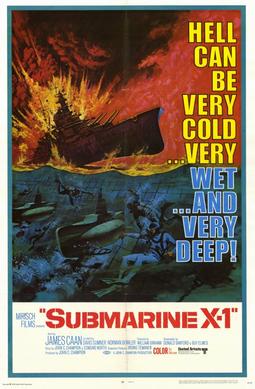
Submarine X-1

Hitting it big, James Caan had roles in 1971 and 1972 that catapulted him to stardom, the TV movie Brian's Song where he played Chicago Bears fullback Brian Piccolo and in The Godfather as fiery Sonny Corleone. But through the 1960s, Caan had to put his time in, taking less glamorous roles both in film and TV. Some were obviously better than others -- his supporting part alongside John Wayne in El Dorado standing out -- but most just weren't very good, especially 1969's Submarine X-1.

Commanding a British sub in the North Atlantic, Commander Richard Bolton (Caan) makes a costly decision in battle that costs the lives of 50 of his crew as the sub sinks in a battle with a heavily armored German battleship. Having survived with a handful of men, Bolton is given a new mission. He is to take a small group of sailors and train them like commandos for a dangerous mission using midget submarines. Unfortunately, some of the men are the survivors of his previous ship, and they still hold Bolton responsible for the casualties. Bolton pushes on though, forcing his men to go through the brutal training when the mission is finally revealed. Leading three midget submarines, Bolton will lead a sneak attack in the Norwegian fjords on the very battleship that cost him his last command.

 Like the spaghetti westerns, there's a certain charm to WWII movies made in the 1960s. There's a certain look and feel to these war flicks, seeing the same faces pop up, the same plot devices, the same locations. For the most part though, 'Submarine' is missing all those little things that can bring a movie up a notch...or at least make it bearable to watch. It is clearly filmed on a small budget with a relatively unknown cast in support of a young James Caan. It takes the well-worn formula of a team of commandos (however unlikely) on an impossible mission key to the war's success and....does nothing with it. Low budget (or cheap) isn't a bad thing, but when a movie has as little energy as this one, you're in for a long movie.

That thought is odd considering that 'Submarine' doesn't even break the 90-minute mark, clocking in at an epic 89 minutes. My first thought was that it was a no frills, bare-bones but still exciting story focusing on the training and execution of the mission, based off the true story of Operation Source. I was partially right. It's not interested in love interests or character development. The only problem? It's not that interested in the mission either. At least 35-45 minutes of this WWII story is shots of divers swimming underwater, the midget submarines gliding toward a target, the commandos cutting through nets to allow the subs to pass through. Sounds pretty exciting, doesn't it? It is the dullest dangerous and/or suicide mission I've ever seen in a commando movie. The only real obstacle in the mission is the net, and watching three commandos cut through it is not the spectacular visual you'd imagine. Go figure.

The only recognizable star here is a young Caan, but it's far from his best work. It's never explained why Caan is serving with the British, but if you look close you can see 'Canada' stitched on his shoulder so there's that. The script does him no favors, but he looks downright bored with the part. He delivers his lines as flatly as humanly possible, squinting much of the time like he's in pain. Then there's his three crews, some of the most nondescript commandos ever seen. The only ones we even get to know by name are Lt. Davies (David Sumner), an officer who holds a grudge against Bolton, Lt. Pennington (Norman Bowler), a second commander, Seaman Quentin (Paul Young), an enlisted man trying to prove himself, and Gogan (William Dysart), Bolton's right hand man. There is no character development...NONE, so we're given no reason at all to be interested in any one of these men. Any emotional impact is then thrown out the window.

There were moments I liked. The cold opening -- Caan and four survivors washing ashore -- is surprisingly effective. A German commando raid on Bolton's base in northern Scotland in the middle of the movie is exciting on a small-scale. The Germans send six commandos, not a lot if you ask me for what they're sent to do, but the mission doesn't go as planned, the one part of the movie with some energy and excitement. The mission itself attacking the German battleship in the Norwegian fjords is slow-moving even when the plan goes awry. The story is a blending of 1955's The Cockleshell Heroes and 1964's 633 Squadron, but it doesn't even touch those movies in terms of quality. An all-around stinker.

Submarine X-1 <---trailer (1969): */****

Tuesday, April 3, 2012

The Last Valley

A longtime member of my 'Saved DVDs' option at Netflix, 1971's The Last Valley was finally made available this week, and I was delivered a pleasant surprise as the opening credits rolled, besides the strong casting. The film is directed by James Clavell, someone I think of as an author more than a director. The director of only six films in his career, Clavell is at the head of a different but still impressive historical epic.

It is the middle of the Thirty Years War in the early 1600s and a war that started off about religion in Germany has expanded to other European powers. Walking across a famine-ridden country, a former teacher, Vogel (Omar Sharif) stumbles across a beautiful valley up in the hills seemingly immune from the touches of war. The villagers living in the valley are away for the time, but behind Vogel comes a small company of mercenaries led by the Captain (Michael Caine). Vogel convinces them to winter in the village/valley, the mercenaries forming the uneasiest of alliances with the village leader, Gruber (Nigel Davenport), and the people. Vogel finds himself working as a mediator, both sides not happy with the other as this little valley is thrust into the war for the first time.

In the era of historical epics, this is a late entry to the genre. Clavell wrote, produced and directed this historical epic that I can only describe as...different, in a good way. It doesn't really have a similar movie you can even remotely compare it to. It deals with religion and faith, the lunacy of war, the lunacy of religion, corruption, blind faith, and generally boasts a cynicism that would have been prevalent at the time in the minds of the audience. Without getting pretentious, 'Valley' tries to ask what is the point of fighting? What's the point of a religion that forces its believers to fight and die simply because someone tells them to do so? In all its darkness and cynicism, I liked this movie because of those different features. It doesn't settle for the status quo and impressing with scale. This movie has that impressive scale with a worthwhile message to boot.

If you're going to do a historical epic, do it right in the casting department. Two of the best names around for an epic -- Caine and Sharif -- don't disappoint in their performances. Caine especially delivers an underrated, moving performance as the Captain, a long-time mercenary who's grown weary of the futility of battle, war, and organized religion. He continues to fight, meeting confrontations head on rather than taking the easy way out and running away. His counter is Sharif as Vogel, an intellectual, a former teacher who wants to talk things out, negotiate rather than fight it out. The duo plays well off each other as their situation becomes harder to handle. Neither truly knows what, but both men are looking for something while trying to put their past behind them. At what cost will it come though?

The ensemble cast that backs the duo up does not boast much name recognition, but the characters from Clavell's script come to life with the cast, a wide variety of eclectic characters. Florinda Bolkan plays Erica, a woman in the village who moves in with the Captain, her personal/religious beliefs ready to cause a stir among these God-fearing folks. Davenport as Gruber is perfect, a simmering pot of violence and manipulation just waiting to strike. Per Oscarsson plays Father Sebastian, the village's Christian priest, a religious fanatic who must have things his way. Arthur O'Connell seems like an odd choice to play Hoffman, one of the elder villagers, with his daughter, Inge (Madeleine Hinde), drawing the eye of the mercenaries and Vogel.  I especially liked the dynamic among Captain's mercenaries, including the treacherous Hansen (Michael Gothard) and brutal right-hand man Graf (Ian Hogg) among a handful of other characters who would have benefited from more screen-time/development.

The story with a message and a solid cast is aided by two things; location shooting in Austria and the musical score from John Barry. It ends up sounding like an action- gothic horror score with hints of James Bond music. Oddly/bizarrely enough, it works really well. Go figure. Listen to 3 different parts HERE. 'Valley' shot on location in Austria for this mountain valley, and the end result is stunning. Watching the story unfold, it's easy to see why everyone involved is willing to work and fight for their homes, an idyllic green valley with sweeping fields and tree-covered hillsides. Clavell uses a wide camera lens to show the beauty of the Trins, Tol location and doesn't disappoint. Digging a little deeper, I question if there was symbolism going on here. Sharif's Vogel finds the village through a fog-covered forest surrounded by burned out, plague-infested villages. Is this village in the midst, seemingly untouched, some sort of heaven? Maybe not, but it's a cool thought to keep in mind as you watch this gothic historical epic.

My one complaint is that the sweeping story tends to drift a little too much at 125 minutes. It's never slow, but with so many characters and situations, the at-times episodic storytelling drags the pace down. 'Valley' seems to know where it's going though, and the ending -- in all its ambiguous doom and gloom -- works especially well. Its message is simple. War is stupid. Religion is stupid. Fighting for religion blindly? Inexcusable. Think for yourself and decide what's right, not what someone else tells you. Watch the whole movie HERE with Part 1 of 10.

The Last Valley <---trailer (1971): ***/****

Monday, April 2, 2012

Salt and Pepper

Ah, the Rat Pack, a name synonymous with an undeniable cool factor of the 1960s. Frank Sinatra, Dean Martin, Sammy Davis Jr., Peter Lawford and Joey Bishop. They performed in Las Vegas together, doing comedy and music, doing variety shows, releasing albums, and of course, they did movies. Flicks like Ocean's 11 or Robin and the 7 Hoods are fairly well known though. Starring just Davis and Lawford, 1968's Salt and Pepper doesn't have that same notoriety.

Running their swanky, groovy, hip (what other 1960s adjectives can I use?) club in Soho, Chris Salt (Davis Jr.) and Charlie Pepper (Lawford) are living the high life without a care or trouble in the world...until now. One night, a woman is murdered in their club, and when they meet investigator Balsom (Ernest Clark), Salt and Pepper find out there's more to the death. The woman was an intelligence agent carrying information about a key investigation, but what was it? The club owners can't recall, only remembering some gibberish she mumbled before dying. Well, knowledge or not, someone thinks Salt and Pepper know more than they're letting on as these bumbling friends are thrust into a world of espionage and murder.

With the exception of 1960's Ocean's Eleven, none of the Rat Packs movies are especially good. HERE is a list of all the flicks. And before someone yells back, yes, I'm aware these weren't supposed to be great, groundbreaking classic movies. They were intended as fun, popcorn flicks that were meant to entertain, watch the coolness of the Rat Pack on a big screen. Fun doesn't have to mean stupid though, and Salt and Pepper -- like the rest of those films -- is dumb. It's just too bad because with the talent in the Rat Pack, you'd figure they could get a decent script to work with. Reading that plot description above, does that sound like a screwball comedy that's even goofier than the spoof spy flicks of the 1960s? Not especially, but it is a screwball comedy, full of comedic double takes, ridiculously forced set pieces, and overacting around every corner.

The beauty of these bad Rat Pack movies -- whoever does make it from the group -- is that the stars are genuinely very good with each other. Part of that comes from the complete lack of acting. Davis is Salt and Lawford is Pepper in name only. Really, we're just watching Davis and Lawford run around London like their pants are on fire, not any actual characters. Still, there is a chemistry that can't be topped. This is two friends just hanging out having a good time. Davis Jr. is the showman, the one getting more of the laughs while Lawford plays the straight role and smooth ladies man, his Abbott to Davis' Costello. Their chemistry is really the only thing holding this movie together. At 102 minutes, it is a painfully slow movie at times (never something you'd want out of a comedy), but the two stars have a way of keeping things entertaining. Davis also gets a chance to sing, watch it HERE.

Through the general badness and stupidity of the movie, there are some good laughs provided. Have you ever actually seen someone do a double take or a spit take in real life? Yeah, me neither. But Davis makes it funny somehow, committing to the dumbness and just going with it. His general physicality -- all 5-foot-3 of him -- is fun to watch. His ability to underplay a scene works just as well, including a surprisingly funny car chase as Salt and Pepper get into a clown car lookalike that's rigged with all sorts of spy gadgets. The payoff is the best part, a sight gag of the ridiculous looking car floating down the Thames River. There are moments like that -- inexplicable though they are -- that stopped me from hating this movie, and it was close.

Spy spoofs are one thing, Derek Flint and Matt Helm proved that. But this one especially is ridiculous. The tone is all over the place, one scene deathly serious, the next refreshingly light. Davis and Lawford make somewhat tame sex jokes, have a misunderstanding about the use of the word 'fag,' and run around like chickens with their heads cut off. Oh, and they're trying to stop a plot that will have a rogue government take over England by unleashing nuclear missiles on English territories. Didn't see that one coming, did you? I certainly didn't. And for the cherry on top, there's a Keystone Cops-like British police officer, Crabbe (Michael Bates), chasing them around for all those lewd things they do at their club. If there's a weirder, more off the wall story than that, I'm drawing a blank. Who am I kidding though? It's a Rat Pack movie, not Lawrence of Arabia 2: The Return.

Salt and Pepper <---trailer (1968): **/****

Sunday, April 1, 2012

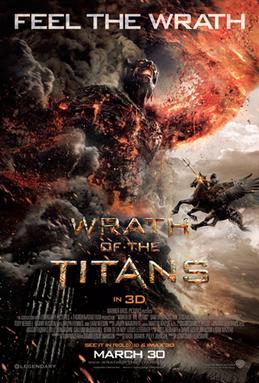
Wrath of the Titans

Released in 2010, Clash of the Titans was your pretty standard big budget, CGI-filled blockbuster with a huge if wasted cast. Read my review from last fall HERE if curious. It was entertaining enough in a generic blockbuster sort of way, interesting in the moment but fairly forgettable after that. If that's not a recipe for success, I don't know what it is. Enter stage left, the unnecessary sequel, 2012's Wrath of the Titans.

It has been 10 years since half-God, half-man Perseus (Sam Worthington) helped save the world from the warring gods, defeating the Kraken and preserving peace. But now the gods are at it again, all sorts of hellish creatures and demons escaping from the underworld. Now Perseus lives with his son, Helius (John Bell), and wants nothing to do with the situation, even when Perseus' father, Zeus (Liam Neeson), asks him for his help in defeating the enemy. When Zeus is betrayed by his own brother, Hades (Ralph Fiennes), and his son, Ares (Edgar Ramirez), god of war, only then does Perseus join the fight. Even the half-god, half-man has no idea what awaits him this second time around.

Here's my problem both with this movie and the movie industry in general. Yes, this will sound stupid, naive and did I say 'stupid'? Novel concept, but basically movie's are based off the $ they generate, right? The 2010 Titans was a pretty solid, self-contained story with ridiculous amounts of CGI, some halfway decent characters, and a solid cast. Not to say it was a classic -- it most definitely was not -- but it was enjoyable enough. Generic, a little dull at times, but good in that inoffensive sort of way. I'm doing a hell of a job selling it, aren't I? There were no unsolved stories, no real mystery so why make a sequel? You guessed it. 'Clash' made almost $500 million worldwide. So away we go with a sequel, and yes, I realize I'm shooting my theory in the foot because I'm admitting I paid to see it. I like movies. Sue me.

'Wrath' is basically the same exact movie as 'Clash' except with a few new characters, new love interest, and a wide assortment of weird, cool and odd mythological characters. My hope writing the review of 'Clash' was that with a sequel, characters would get to develop some and a possibly longer run-time would allow the movie and story to develop and breathe...a lot. No such luck, the sequel actually clocking in at seven minutes less (99 to 106) and still somehow managing to feel longer. Go figure....anyways, it's the same formula. Video game-like action, cardboard cutouts of characters, far too much reliance on CGI, and no real interest in a story. It's all disappointing because just like 'Clash,' 'Wrath' certainly has the potential to be really good. It's there. It just needed to be worked with even a little.

Getting little to no help from a script, the cast does their best to work things out. I still believe Worthington is a budding HUGE star just waiting for the right role. He's a bright spot again as Perseus, the hero fighting for his father and son, willing to throw it all on the line. It could have used more of his subtle humor in an otherwise deathly serious movie. A little campy humor couldn't have hurt. Neeson again is awesome as Zeus, Fiennes excellent as the sneering, waffling Hades, and Danny Huston plays Poseidon, the three most powerful Greek gods. Rosamund Pike steps into the love interest part, playing Andromeda, a female general and kick-ass fighter while Bill Nighy gets to be quirky and eccentric as Hephaestus, the scientist/creator of the weapons of the gods.

The best thing going for 'Wrath' is the casting of a quasi-sidekick for Perseus, Toby Kebbell playing Agenor, son of Poseidon so another half-God, half-man roaming the countryside looking for trouble. He injects some much needed energy into a sometimes surprisingly slow-moving story as the roguish anti-hero. Kebbell has some fun with the part, not playing it so straight-laced and button-down. It doesn't have to be physical humor, but something to lighten the mood up a bit, and Kebbell does it well. His exchanges with Worthington's Perseus provide some of the movie's better highlights. Can't say I'm excited for a third Titans movie, but if it's on the horizon, I hope Kebbell returns.

The shame of it all is that 'Wrath' has a chance to be good. We get creature fights with a fire-breathing, two-headed hell-dog straight from Hades, a trio of Cyclops warriors, a running fight with a Minotaur through catacombs and labyrinths that all look alike, and an epic showdown with Kronos, one of the first God/Titans who's been imprisoned for years. Now he's released as a gigantic, immense creature made of rock and spewing lava. Pretty cool finale with him facing Perseus. There's nothing to tie it all together though. The CGI looks good, but gets tedious quickly. The story drifts from episode to episode, and the characters aren't particularly interesting. Gotta go with the same rating as 'Clash.' Lots of wasted potential, but you can certainly do worse.

Wrath of the Titans <---trailer (2012): ** 1/2 /****