The Sons of Katie Elder

The Sons of Katie Elder
"First, we reunite, then find Ma and Pa's killer...then read some reviews."

Thursday, January 13, 2011

Ondine

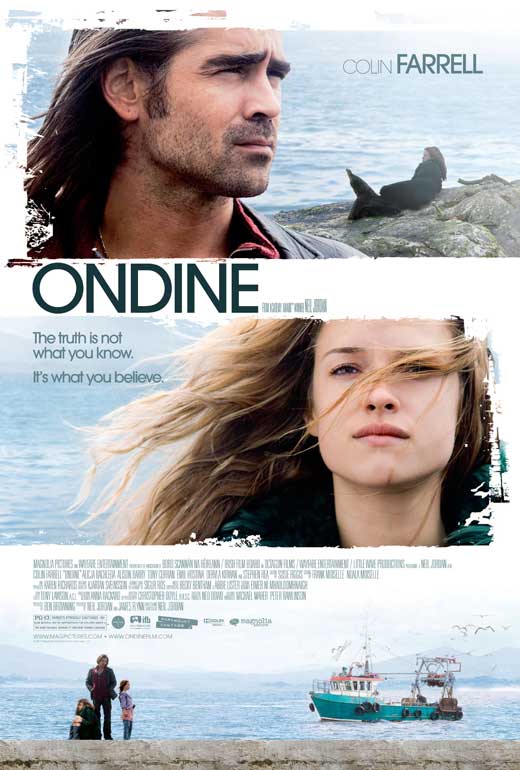
When I think of fairy tales typically, my head goes right to the Disney animated classics I grew up watching -- check that, the ones my sister watched and I tuned in too -- like Peter Pan, Alice in Wonderland, Sleeping Beauty, Snow White, Cinderella, and The Jungle Book.  Something about animation and cartoons plays well with the fairy tale concept that might be lacking in a live action movie.  Take 2009's Ondine, a modern day fairy tale set in Ireland.

Part of the appeal of the fairy tale for audiences -- children and adults alike -- is that in the end the good will always triumph over the bad in some fashion or another.  The princess will be saved and marry the handsome knight, the bad guy will be appropriately punished, and the humorous sidekicks will get the last laugh.  So how about a modern fairy tale that plays on some of your preconceived notions in its story?  Either you're going to buy into the story or not, and the movie's success is going to sink or swim with that idea.

A struggling fisherman in Ireland, Syracuse (Colin Farrell) is trying to get his life back on track after years of alcoholism that ended up destroying his marriage.  He's hit quite the unlucky streak though and can't seem to do anything right, until one day he lucks into the strangest of situations. While fishing and bringing his nets in, he finds a beautiful young woman in the nets. She claims her name is Ondine (Alicja Bachleda) but doesn't want anyone to know who she is or where she's from. Stranger though, Ondine seems like a good luck charm to Syracuse -- dubbed 'Circus' by the townspeople -- as he can do no wrong.  His daughter, Annie (Alison Barry), believes Ondine comes from the sea, but he doesn't know what to make of her.  All he knows is that as he cares for and looks out for her, he develops real feelings for her.  But what is she hiding, if anything?

Filming in Ireland is always a good start for a movie because there are few places as beautiful as that country.  Director Neil Jordan films his story like the little Irish town Syracuse lives in is another key character.  It's a small, tight knit town where everyone knows everyone (for better or worse). Granted, it isn't the sunniest movie around, but the lush, green Irish landscapes along the coast can be breathtaking to look at.  From start to almost finish, it is a low key movie with a soothing musical score from composer Kjartan Sveinsson setting the soft tone. There is a folksy, lyrical rhythm to the story that reminded me of so many movies from the late 1960s and early 1970s that almost lulled you into a sense of comfort.  If anything, the pacing can be a tad on the slow side as everything is set in motion.

The premise for the fairy tale is Ondine's situation.  Syracuse's daughter Annie believes she is a mermaid or a selkie, a creature from the sea. Jordan doesn't give too many clues as to Ondine's true self, keeping you guessing.  Is there any chance, even the slimmest of chances, that she is in fact a mythological creature venturing onto land to live with people? That's what kept me interested through some of the slower portions of the movie, that feeling of wanting background on Ondine.  When the truth comes out, you can't help but be disappointed, or at least I was in a big way.  I can't decide if it would have been better had Jordan actually kept us in the dark, let each individual viewer make up their own mind about the character.  Instead, the reveal caps off a disappointing last half hour that really comes out of left field.

Now however you may feel about the truth about Ondine and her background, the key to the character is her relationship with Farrell's Syracuse.  These are two lost souls struggling with their lot in life who end up finding each other.  Call it a fairy tale or just a good old fashioned love story, but the movie works because of Farrell and Bachleda and their chemistry together.  Farrell has a knack for playing these tortured individuals trying desperately to cope with their problems, and making those characters likable in the process.  Polish actress/singer Bachleda makes Ondine vulnerable, innocent and believable, always keeping you guessing. She's also drop dead gorgeous which never hurts.  Making her big-screen debut, Barry is a scene-stealer as young Annie, Syracuse's daughter waiting on a kidney transplant.  The young actress definitely has a career ahead of her if she so chooses.

If you could cut a movie down the middle and split it into two parts, that's what would work here.  The first 60 minutes are more of that lyrical, whimsical fairy tale with a lighter, emotional tone.  The last 45 minutes do a quick swerve in the other direction, taking the movie to a place where it probably didn't need to go.  I don't know the solution, but the finale dragged on and on with no end in sight.  When the end does come, it's disappointing.  Still, it's worth a mild recommendation mostly for the spot-on casting and the performances delivered by the three stars.

Ondine <---trailer (2009): ** 1/2 /****

Wednesday, January 12, 2011

My Outlaw Brother

From a young age, Mickey Rooney was almost always on stage in front of people. As a child actor, he starred in 78 comedies between 1927 and 1936 as Mickey McGuire before becoming more universally known as Judy Garland's on-screen partner in countless movies.  The early parts of his career are probably what he's most remembered for, but by the time he was 30 in 1950, Rooney started doing more dramatic roles, some obviously better than others.  Rarely the star, mostly a key supporting character, that's how I think of Rooney, an underrated character actor who always kept his parts interesting regardless of the quality of the movie.

One movie that wasn't particularly bad but wasn't particularly good either was 1951's My Outlaw Brother, a low budget western that has since lapsed into public domain.  It's typical of so many westerns made in the 1930s, 1940s and 1950s that studios churned out as quick as they could make them.  They usually offer a chance to see some well-known stars before they were stars in quirky but still entertaining stories that clearly didn't have very large budgets.  This isn't Rooney's best part as he was trying to establish himself as a more serious actor, but it's an interesting watch for western fans.

Assigned a dangerous mission, Texas Ranger Joe Walter (Robert Preston) must ride across the Rio Grande into Mexico to the small mountain town of San Clemente. There an American, Patrick O'Moore (Robert Stack), is working with an Indian bandit, El Tigre, terrorizing the country.  Walter must bring him out alive and back across the border so he can face justice. It looks and sounds like suicide, but with his trusty horse Sunny under him, Walter accepts and rides south.  Along the trail, he meets another ride heading to San Clemente and is more than a little surprised to find out the man is Patrick's younger brother from New York City, Denny (Rooney), who's going to visit his brother after many years apart.  Could this chance meeting help his odds?

The problem with most of these public domain movies is that the prints available on TV or the ones you can buy on DVD are pretty low quality after decades of mishandling and poor care.  That's the case here with a poor print that is at different times fuzzy or scratchy with the audio volumes dipping in and out.  With a decent print, the black and white filming would be halfway decent with some authentic looking locations. The movie was filmed at Estudios Tepeyac and when the story does venture outside, we get some cool locations, especially an abandoned mission where Patrick's hideout is.  The music is not memorable, and the story nothing new in the least either, but I was rarely bored.

You can attribute most if not all of that sentiment to the cast.  I don't know if he was a great actor (I've only seen him in four or five movies), but Preston is one of the most watchable movie stars I can think of.  Playing the Texas Ranger, he's an ideal for that laconic, capable, and tough character, guiding Rooney's inexperienced cowboy Denny along the trail.  Rooney got top billing, but Preston was really the star.  Stack doesn't fare as well as the possibly villainous Patrick.  He looks ridiculous duded up as a Mexican vaquero and ends up delivering a stiff performance that doesn't make you care one way or the other what happens to him.  There's a twist late about Patrick, but it comes out of left field and feels like a rushed ending wrapped up nicely with a bow.  Also look for Wanda Hendrix as Carmela Alvarado, a possible love interest, and Jose Torvay as a hot-tempered, vengeful blacksmith.

Some of Rooney's better parts would come in the years following My Outlaw Brother, but this feels like one where he's still trying to figure things out.  Is it a drama or a comedy? Is his character a brawler or a klutz?  And how in the hell does he manage to seduce Hendrix's Alvarado?  Rooney goes for a broader playing of Denny O'Moore, a city boy traveling into the wilderness for the first time and always getting into scrapes where he needs to be rescued.  A solid drinking game while watching this movie would be to take a shot for every time Rooney says 'Ow!'  You'd be wasted pretty quickly.  Still, he's got a good chemistry with Preston, and that helps carry the movie through its rougher patches.

Watch the full movie HERE starting with Part 1 of 9.

My Outlaw Brother (1951): **/****       

Tuesday, January 11, 2011

Breakfast at Tiffany's

I can't remember the last movie that threw me off as much as the 1961 classic Breakfast at Tiffany's. I'd never seen it before today and knew nothing about it other than the setting of 1960s New York City, the style, and of course, Audrey Hepburn.  My sister swears by this movie so really, that was my only exposure to it. So over the years, did I convince myself that the movie was something else, something vastly different?  I didn't know what to expect heading into the movie and was quickly surprised by the route this story took.  I don't even know where to start so bear with me.

My biggest preconceived notion of this movie heading into it was that it was the epitome of timeless style, the very beautiful Audrey Hepburn representing this ideal woman that all other women aspire to be. There are posters, books, puzzles, coffee cups, t-shirts, anything at all you care to name with Hepburn on it.  So why does this movie get held in such high regard?  Is it the style alone?  Because honestly, this is an incredibly depressing movie.  It's based on a novella from Truman Capote -- master of weirdness and eccentricity -- and is definitely a casualty of the decade/era it was released.  So here goes, I'll try and be fair.

Washed-up writer Paul Varjak (George Peppard) is moving into his newly furnished New York City apartment when he meets one of the other tenants in the building, Holly Golightly (Hepburn). To say the least, Paul doesn't know what to make of this young woman, a carefree individual who seems to float along wherever life will take her.  She is the oddest of oddballs and lives on a series of whims and gut feelings, not wanting to get pegged down wherever she is or whatever she is doing.  Paul is instantly intrigued (and probably a little attracted) by Holly, but he just can't figure her out.  They seem like such different people, but really, they're almost the same person and as Paul figures out, they belong together.  Can he convince Holly of that though?

Okay, for openers director Blake Edwards is handicapped by 1960s censors and limitations around his storytelling. He is limited by what he can actually do or have characters talk about so instead of actual revelations or explanations we get subtle roundabouts and hints at what is going on.  I was more than a little taken aback to find out that Hepburn's Holly is a call girl and Peppard's Paul is a gigolo.  Really?!? None of this is ever directly addressed, but it's fairly obvious to put 2 and 2 together to make four.  Weirder though, Holly is a call girl/escort who takes the money of the guy she's with and then bails on him, later calling him a 'rat' or 'super-rat.' Paul seems to have one customer -- Patricia Neal's 2-E, a middle-aged married woman -- after giving up a potentially lucrative writing career.

So the stylish duo is a call girl and a gigolo, not a movie breaker in the least, right?  Okay, it did take awhile to get used to that idea, especially in a movie released in theaters in 1961 and held in such high regard some 50 years later.  But that's the least of the problems if you ask me. At a certain point you just accept what the characters are.  It's that the movie doesn't know what it wants to say or where to go.  Are we supposed to support Holly or even like her? In reality, her character is not likable but as a wise IMDB poster explains...'She's pretty so we like her.' Is it a drama or a romantic comedy? Is it neither? Are we supposed to drift along and let the movie wash over us? I was surprised by where the movie went in the last half hour, but it was one in a long line of surprises.

Now where I can understand moviegoers falling in love with 'Tiffany's' is in the casting of Hepburn and Peppard.  Throw aside the fact that both characters are willing to sleep with you for cash.  There hasn't been a more classically beautiful actress in Hollywood before or since Audrey Hepburn.  She's that perfect blend of cuteness and being amazingly sexy. She's headstrong and funny, adorable and cute, vulnerable and exciting, all rolled into one.  The chemistry Hepburn has with Peppard is top-notch and is believable in a way that never makes you question if they're acting.  They're just good together, plain and simple.  Hepburn is the vision of beauty as Holly, a stylish icon that will not be soon forgotten in movie lore.  Yes, her character isn't always likable -- Peppard either to a lesser degree -- but credit to both actors for making Holly and Paul not despicable to the point where you hate them and the movie they're in.

Maybe this is a movie that will hit me differently after I digest it fully in a couple of days, but I doubt it.  As a whole, finished product, it is an odd movie and there's no other way to describe it.  Also in the cast is Buddy Ebsen as Doc, a man from Holly's past, Martin Balsam as O.J., her quasi-agent, and Mickey Rooney in one of the most grossly stereotypical performances I've ever seen, playing an Asian man living in Holly's building.  If it was intended as humor, it falls horrifically short. Too bad because Rooney is typically one of the most reliable character actors around.  All in all, I can't give this a positive rating, but if I was it'd be because I looked at it through romantic comedy-colored glasses.  Hepburn is perfect, Peppard is cool and NYC never looked so stylish.

Breakfast at Tiffany's <---trailer (1961): ** 1/2 /****

Sunday, January 9, 2011

The Extraordinary Seaman

When director John Frankenheimer got it right with his movies, he hit it out of the park.  We're talking movies like The Train, Seven Days in May, Grand Prix, The Manchurian Candidate, and Birdman of Alcatraz. These are movies that are classics or at least near-classics and should be must-watch for any movie fan.  Just about any director though has to have a couple duds on his/her resume, and until now I hadn't seen Frankenheimer's dud.  For all I know, he may only have the one, but 1969's The Extraordinary Seaman is one of the worst movies I've ever seen.

Reading through Turner Classic Movies' schedule each week, I typically look for actors/actresses I'm a fan of, or if nothing else a title that sounds interesting.  When I stumbled across the cast of this one, my first thought was how had I completely missed the boat on this one?  David Niven in the lead? Faye Dunaway and Alan Alda in supporting roles? Mickey Rooney too?  And it's a World War II story? I don't know at what point I realized this was an awful movie, but it didn't take long.  We're not talking a 'so bad it's good' type movie either.  No guilty pleasure, no real redeeming quality anywhere in sight.  Just plain awful and no amount of talent in the cast was going to save this clunker.

After their ship is sunk somewhere in the Pacific, four sailors (including Alda, Rooney and two relative unknowns) navigate their life boat to land where they seek help while trying to avoid any Japanese forces.  In their wanderings, the foursome stumbles upon an abandoned old gunship with no crew commanded by Commander Finchhaven (Niven) of the Royal Navy.  With his 'new crew,' the commander goes about readying his ship for sea and hopefully Australia.  The sailors, especially Alda's Lt. Krim, are suspicious of the British officer.  He drinks and drinks whiskey without ever getting drunk, never sleeps or eats, and never leaves the bridge of the ship.  What's going on with this possibly nutty officer on this crazy ship?

I feel stupid when I've watched a movie, hated it intensely, and then gone over to the IMDB and find it has a ridiculously high rating. Did I miss the boat on something or are movie viewers like monkeys who like what they're told to like?  So when I do watch a movie, hate it, and see that a majority of voters agree on how horrifically awful something is, it makes me feel better.  'Extraordinary' has earned itself a respectable 2.4 rating from 283 votes as of this review so clearly I wasn't missing anything major here.  It's just a bad movie, and that definitely made me feel slightly better about wasting 80 minutes of my life watching it.  I kept waiting for it to get better, but here's a secret for you...it doesn't.  Don't even bother.

My first thought when I saw the movie was only 82 minutes long was that it packed a lot into a very small window.  Yeah, I couldn't have been more wrong there.  Unsuccessfully trying to either make an existential dig at the lunacy of war or a slapstick comedy that is short on the laughs, Frankenheimer refuses to pick a direction to go in.  If there's a message, I missed it.  The same goes for any supposed laughs.  He uses an odd technique though, splicing in news reel footage of WWII and then editing in his cast.  The off-screen narration usually has some oddball link to what's happening to the characters, but it's incredibly random and doesn't add much to the story.  It's also overused to the point where I started fast-forwarding through huge stretches of the movie.  Actual run time is 82 minutes, but I'd say about 45-60 minutes is actual filmed scenes with a cast that deserves so much better.

So, yes, it's awful almost right from the start, but a cast like that has to save it a little bit, doesn't it?  That's what I figured.  It's not necessarily the cast's fault that what they're working with is one of the more bizarre scripts I've ever seen, but you've got to hold someone accountable.  Alan Alda is playing a younger version of Hawkeye Pierce, his M.A.S.H. character, with almost all of his eccentric mannerisms and oddities present.  Niven is sleep-walking through this part and doesn't bring any of his typical charm to the story.  I'm not sure why Faye Dunaway signed on for this because her character is completely unnecessary and has little involvement with the story.  She does look good so that might be the lone positive I take away from this movie.  Rooney is the lone one at least trying, his Oglethorpe character a paranoid cook convinced everyone is a Japanese spy.

What pulled me through this movie was some sort of explanation with David Niven's character.  SPOILERS When it is revealed, it's not surprisingly pretty underwhelming.  His family has a long tradition of dying in battle, and he did too...in 1914.  Apparently, his grandfather admiral can grant wishes from beyond the grave and forces Niven's Finchhaven to remain on Earth until he can redeem himself by sinking an enemy cruiser.  The only problem? The ending is so poorly handled that nothing is resolved at all.  No resolution for any of the characters is always a solid capper in my book.  What a bad, downright horrible movie. Talking about downright bad taste, read the caption on the poster above.  It's not often you hear Adolf Hitler thanked for something that claimed the lives of millions of people. 

The Extraordinary Seaman <---TCM clips (1969): */****   

Saturday, January 8, 2011

Exiled

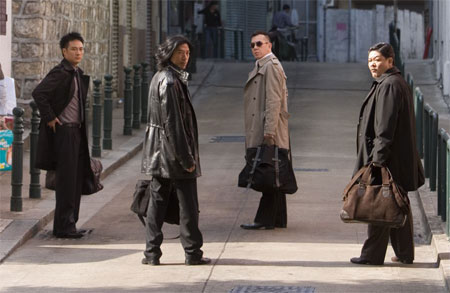
A few weeks ago I reviewed The Mission, a Hong Kong action movie from director Johnnie To. It was a solid action movie that I'd never heard of but ended up loving it.  As I was reviewing it, I saw many of the same names popping up repeatedly in another movie from To with similarly positive reviews.  The movie, 2006's Exiled, was available on Netflix so I gave it a try especially when the description included a mix of spaghetti western and Hong Kong action backgrounds.  Glad I did.

The Mission was the story of five bodyguards working together and gelling as a team only to discover one of the group has committed an act that can only be resolved through his death.  The ending was good but not great and left me wanting a little more closure.  Take it for what this is worth because I've read descriptions of the movie that both agree and disagree, but Exiled is an unofficial sequel to The Mission.  It basically picks up where the 1999 action movie leaves off, a few months later with similar characters but different names.  To has insisted in interviews this movie was not intended as a sequel, and he's probably telling the truth.  But it's just too similar, too close for it not to be. However you interpret it -- sequel or not -- the truth is it's just a really solid movie.

It's 1998 in Macao and China is about to regain control of the island.  Mob wars are starting up everywhere as mobsters and gangsters make plays for power.  Waiting outside a small apartment are four men, all hitmen assigned a mission concerning a former gangster named Wo (Nick Cheung). It's a case of two vs. two as Blaze (Anthony Wong Chau-Sang) and Fat (Suet Lam) have been ordered to kill Wo while Tai (Francis Ng) and Cat (Roy Cheung) are prepared to protect Wo even if it means a shootout. All five men are childhood friends who have gone their separate ways but end up working against each other.  Friendship ends up affecting the mission though as all four men decide to help Wo and his wife Jin (Josie Ho) escape certain death. Their decision has quick consequences though as the mob boss who hired them, Boss Fay (Simon Yam), doesn't appreciate their change of heart and orders them taken out.

Reuniting four of the five main characters from The Mission including another key figure, Exiled certainly feels like a direct sequel.  It certainly helps things get into a flow because if you've seen the first movie, you're already familiar with the characters and their disagreement.  Instead of Shin having a target on his back, we get Wo, a family man with a wife and infant.  The story does have some odd elements and drifts at times more than it probably should.  The idea of combining some spaghetti western background with the typically action-packed Hong Kong crime thrillers doesn't always mix smoothly -- a running gag with shooting an empty pop can is tedious, a flying door spins through a gunfight -- but the positives most definitely outweigh the negatives.

Maybe the biggest difference I noticed here was a bigger budget given to To.  The movie is more polished, more professional looking, most evident during the action scenes.  Stylish with uses of shadow and light, slow motion, blood squibs that look like a fiery mist, the movie's action is truly something to behold.  Roger Ebert complained in his review that thousands of bullets are fired and no one ever gets shot.  Well, I don't know what movie he was watching because the action is everywhere.  The opening apartment shootout is a little more understated than the rest, building up to the bigger set pieces like a restaurant shootout (watch HERE), the fallout at an illegal doctor's apartment (HERE), and the two-part finale that involves a heist of a gold transport and the showdown in the finale at a upper class hotel.  Like few other directors can do, To conjures up comparisons to Sam Peckinpah and The Wild Bunch with his action.  Not a bad comparison.

More than just the action, Exiled is a modern western of sorts, and not just a spaghetti western.  The characters are the modern day equivalents of wild west gunfighters, guns for hire who take on a job as long as it pays.  Then when the chips are down, their true colors come out.  Wong's Blaze is the unwilling leader, Ng's Tai as his temperamental right hand man, Lam and Cheung as the loyal sidekicks, and Wo the root of all their problems.  But just like movie portrayals of gunfighters -- especially The Magnificent Seven and The Wild Bunch -- these men have a code they live by, one that depends on honor, loyalty, and in the end doing what's right no matter the cost.  So here even though it'd be easier to just shoot it out over Wo's fate, the quartet bands together and does what they believe in, even knowing the extreme risks they're all taking.

What can separate a good action movie from a great action movie is the characters.  Just like The Mission, we're given a reason to support these characters even when they are not particularly likable.  We're given little background information, but we don't need much.  Wong is the quiet scene-stealer, Ng the fiery hot-head, and Yam is the nearly psychotic bad guy.  I can't say I liked the movie more than The Mission, but it was close.  Very stylized action -- including a great opening sequence straight out of a Leone western -- and overall a movie that's a lot of fun to watch.

Exiled <---trailer (2006): ***/****

Thursday, January 6, 2011

Salt

One of the best trilogies around, the Jason Bourne movies did their fair share of reinventing the action genre.  They weren't so much stories as one linear chase scene with an occasional flashback.  This was action at its leanest, chases on foot and in cars, shootouts with police, gunmen and assassins, and epically physical one-on-one hand to hand combat.  It was the rare trilogy that actually got better with each new movie.  If there was ever a female version of Jason Bourne, I think I saw it in 2010's Salt.

Salt star Angelina Jolie is that rare movie star who can effortlessly switch back and forth between genres, jumping from popcorn flicks like this one or the Tomb Raider series to heavy dramatic roles like Changeling or even using her voice in animated fare like Kung Fu Panda. She is in the news as much for her relationship with Brad Pitt and her kids and her charity work that her acting can get lost in the shuffle.  As an actress, she's underrated, but personally she's always looked the most comfortable in action movies, and Salt is no exception.

CIA agent Evelyn Salt (Jolie) is heading home to spend her anniversary with her husband (August Diehl) when she's called back to lead one more interrogation, a Russian, Orlov (Daniel Olbrychski) who claims to have news that could cripple the U.S.  Upon questioning, Salt thinks nothing of it but as she leaves the room, Orlov claims that an undercover Russian agent is going to assassinate the visiting Russian president in New York City later that day.  The agent's name? Evelyn Salt. She claims innocence to fellow agent and friend, Ted Winter (Liev Schreiber), but is kept as a prisoner by FBI agent Peabody (Chiwetel Ejiofor) until the truth can be figured out. Instead of sticking around to prove her innocence, Salt escapes, staying one step ahead of her pursuers.  Winters doesn't think she could be a Russian agent, but the evidence starts to build against her.  Maybe, just maybe, could Salt actually be a sleeper agent as part of a vast Russian conspiracy to cripple American interests?

I'm open to just about any type of movie, but I can always appreciate a simple, straightforward, big budget action movie that has no pretensions about being anything but an action movie.  No message, no ulterior motive, just over the top, ridiculous action that gets your adrenaline and blood flowing.  So like the Bourne movies, that's what Salt is.  At just 100 minutes, no time is wasted with back stories or subplots that go nowhere.  A few very brief flashbacks explain some of Salt's history, but they're over so quickly it doesn't slow any momentum down.  Yes, there is a twist late that really doesn't come as a surprise (it seemed really obvious to me), and there are plot holes that seem easy to fix, but the pacing is so lightning-fast you won't even notice until afterward.

Jolie proved her acting chops in the Lara Croft Tomb Raider series and just improved her credibility with other action flicks like Mr. and Mrs. Smith and Wanted (which sucked by the way).  She is more than credible here from the start, the secret agent who you're not quite sure of her intentions.  It doesn't hurt in the least that Jolie is drop-dead gorgeous although she does look freakishly thin at times.  But in the action scenes, she again handles her own without any obvious uses of a stunt double.  If there's a fight, she's part of it, taking down anyone and everything trying to stop her from completing her mission.  The character certainly keeps you guessing as to her intentions, and the ending leaves things open for a sequel. It would be unnecessary, but the last few minutes are very cool with a memorable final shot, Jolie: Action Star.  Schreiber and Ejiofor get the thankless parts of the schlubs who have to chase her, but both actors are pros and make the most of it.

So in Female Bourne, Jolie leads the police, CIA, Russians, FBI, Secret Service on a man hunt throughout New York City and Washington D.C.  The action is hands-down the best part of the movie with a wide variety of chases and fights.  An extended chase early has Jolie's Salt jumping from an overpass onto a passing semi-truck and being forced to jump to another high speed truck when a roadblock is set up in front of her.  Yes, there had to be some CGI and green screen work here because I don't care how badass Jolie is (and she is), there's no way a studio green lights an action sequence like that.  The computer/stunt work is handled so seamlessly though it's hard to even tell the difference.  That's all of the action here.  Of course it is all ridiculous and not at all realistic, but Salt makes you believe that maybe, just maybe, this could happen.

The story does take a surprising turn about 50 minutes in, and not necessarily for the better.  Director Phillip Noyce rights the ship quickly enough that it isn't a complete loss, but there's no denying that the second half of the movie just isn't as high-quality as the first half.  That's a relative complaint though because the first half is a solid blueprint of what an action movie can be.  For all the faults, see this one for Angelina Jolie in kickass mode as Jason Bourne, I mean Evelyn Salt.

Salt <---trailer (2010): ***/****

Wednesday, January 5, 2011

True Grit (1969)

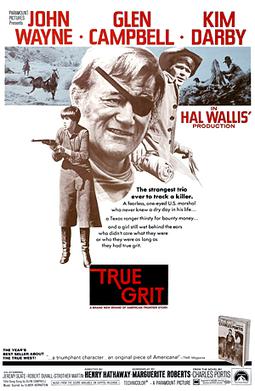
Through a career that spanned four decades by the time 1969 had rolled around, John Wayne had somehow only been nominated for one Oscar in his entire career.  His part in 1949's Sands of Iwo Jima earned him a Best Actor nod which he would lose to Broderick Crawford in All the King's Men.  My complaint isn't that Wayne lost, but he had some excellent parts during his career that included The Searchers, The Quiet Man, Red River, and She Wore a Yellow Ribbon among others.  Well, in 1969 Wayne won his first and only Oscar for his performance in True Grit, an award that obviously came about because of that movie but was almost a symbolic Lifetime achievement award.

Recently this flick has been in the news because the Coen brothers remade it with their movie hitting theaters in the last few weeks.  My worry was that it was a movie that didn't need to be remade so why touch it?  Honestly, the 1969 version isn't a great western, but it is remembered so fondly because of what it meant for John Wayne, his career and his fans.  It's a pretty standard oater and a good example of the type of movies Wayne made at this later point in his career.  Familiar story, good vs. bad, lots of recognizable faces, and nothing really groundbreaking.  But in the end, it's entertaining and a pleasant enough way to pass a couple of hours.

For those not familiar with the story, here's a basic description. The 1969 and 2010 versions are pretty identical story-wise, but here goes. Teenager Mattie Ross (Kim Darby) travels to Fort Smith, Arkansas in 1880 looking for help in tracking down the man, Tom Chaney (Jeff Corey), who gunned down her father in cold blood. She finds no takers other than U.S. Marshal Rooster Cogburn (Wayne), a one-eyed, drunk who is a few years past his prime.  With a Texas Ranger, La Beouf (country singer Glen Campbell), Mattie and Rooster head into the Indian territory to hunt down Chaney and bring him back, hearing rumors he has joined up with outlaw Lucky Ned Pepper (Robert Duvall) and his gang.

Call it his best performance if you want (I don't think it's even close, he had much better) but this may be the one Wayne is most remembered for.  Criticisms aside, and I don't have many, but he had better parts that showed off his ability, Wayne does deliver a great performance and one that he fully deserved his Oscar for.  To a certain point, he is playing a caricature of himself.  He later joked that if he knew all it would take to win an Oscar was put on an eye patch he would have done it years before.  Wayne was an underrated comedic actor, and his Rueben 'Rooster' J. Cogburn shows that off.  He's rough and ready but has a softer side to when it comes to Mattie who can both drive him nuts and have him develop a fatherly bond with her at the same time.  Watch his Oscar acceptance speech HERE for a simple, effective and very moving look at Wayne and this part which finally earned him some Academy Award consideration.

So Wayne is obviously the biggest selling point here, but the problem is what else is there to sell?  As good as Wayne is as Rooster, his two main supporting parts are about as awful as they can be. The Mattie character is key, and as was the case with the remake, annoying but endearing in an odd way.  You're supposed to root for in spite of how ridiculously annoying, how brutally honest she is.  Darby just can't manage it in one of the most grating performances I've ever come across.  You just can't get behind this character.  A similar problem exists for Campbell as Texas Ranger La Beouf.  First, this country singer can't act a lick.  His character is supposed to be the polar opposite of Rooster, but just like Darby's Mattie it's hard to find a reason to like him.  If nothing else, his character redeems himself in the end...twice actually.  Still, it's not enough to save the part.  Check out the remake for how these characters should and could have been played.

Having watched both versions in little less than a week, I had to laugh at the idea that the Coen brothers did something vastly different with their version. Working off the Charles Portis novel, whole scenes, whole exchanges of dialogue are exactly the same between the two movies.  The tone is obviously different -- more light-hearted here -- and the only huge difference is the period authentic dress, dialogue, and accuracy in general.  Director Henry Hathaway films this story in Mexico, California and Colorado and ends up with a beautifully photographed film that looks absolutely nothing like the setting it takes place in, but that's just a minor detail, right? Elmer Bernstein's score sounds like a mix of a lot of his movies, but not necessarily in a bad way.  You'll notice a lot of familiar notes if you're familiar with his work at all, but the main theme is a good one.

You can't help but compare the two, and all I could come up with involving both was that the story itself is lacking something.  Portis was known for straightforward stories that didn't pull punches.  If anything, True Grit is too simplistic, too straightforward.  At times, it's even a little dull.  This is a movie about characters, and for the most part they're interesting even if we don't like them.  Story gets lost in the shuffle at times, but sit back and enjoy getting to know the main characters.  Of the rest of the cast, Duvall makes basically a small cameo, Jeremy Slate and Dennis Hopper are two of his gang, and Strother Martin is a haggling horse trader who incurs Mattie's wrath.

True Grit <---trailer (1969): ***/****

Tuesday, January 4, 2011

King Arthur

Few stories have resonated through the centuries like the legend of King Arthur. There are some who question whether he actually existed or if this knight was just the stuff of legends passed down through the years.  However you want to interpret the person -- fictional or real -- the names instantly ring a bell when mentioned.  There's Arthur, Lancelot, Guinevere, the Round Table, and all Arthur's noble knights.  So how do you make a movie about a person/character who may or may not be real with little in the way of concrete information existing on him? Here's a doozy for you. Do the best you can, and fill in any necessary blanks with battle scenes.

That's basically 2004's King Arthur which claims to tell the most accurate account of the Arthurian legend. One of the biggest issues surrounding Arthur is when did he actually live?  Was he around in the Middle Ages and the Crusades searching for the Holy Grail? Was he around near the fall of the Roman Empire in the fifth and sixth centuries?  Directed by Antoine Fuqua (Training Day, Tears of the Sun), this action-packed historical epic goes with the second premise and does a fair share of rewriting when it comes to the legend.  This is not your grandparent's King Arthur with a romantic view of a vicious, incredibly dark historical time.  It's down and dirty, and everyone is at risk.

After serving a 15-year term as a protector of Britain, half-Roman, half-Briton Knight Arthur (Clive Owen) is ready to go home to Rome.  His men, Sarmatian men enlisted as Roman soldiers, similarly want to return home after many years of service while seeing their fellow knights drop one by one. With their release coming though, they are enlisted for one more dangerous mission, a trek into Woad territory (natives trying to expel the Romans) where a Roman family's villa stands.  Bring them back and they will be free. Arthur convinces his men to go along on the nearly suicidal mission, but even he doesn't know what awaits them.  The Woads wait in ambush for them, but news drifts down from the north.  A Saxon army (led by Stellan Skarsgard) is marching south, killing everything in its path.  Arthur and his knights must now band together with the Woads (blue paint warrior Keira Knightley leading) to not only accomplish their mission, but somehow survive and get home.

Historical epics are right up my alley, I'll give just about anything a try.  But with an action-heavy director like Fuqua and producer Jerry Bruckheimer in charge, you're going to get a ridiculously action-heavy movie that's short on story.  How often can you say that for a movie that runs 138 minutes? There is a ton of potential here because of the money clearly spent in getting the movie made.  The cast is impressive, the action is on a huge scale, Hans Zimmer's musical score appropriately epic, and the story is the stuff of legend no matter what pretensions the movie has about being the most accurate telling of Arthur's story.  But with all that said, it's a mess of a movie overall.  An exciting, interesting mess, but still a mess.

I'm not an Arthur aficionado who will complain about the mangling of the legend's story, but this pushes even beyond my basic knowledge of the story.  It doesn't have to be the romantic portrayal of Arthur and the Knights of the Round Table, but some of the choices here were just odd.  Arthur's remaining Knights serving their 15-year tour of duty for Rome are Sarmatians, a people from Eastern Europe with an Iranian background.  That's fine, but they all look very British.  Guinevere is a Woad, a Briton barbarian by all accounts who is an expert with a long bow and fights alongside the men.  By the by, Knightley in a skimpy leather battle attire is never a bad thing.  Merlin (Stephen Dillane) is not a magician, but a Woad medicine man who looks like a barbarian heathen. Skarsgard sleepwalks through his performance, and Til Schweiger is laughably bad as his son, the also-evil Saxon warrior. Now I'm not sure what was or wasn't accurate -- history is always open for interpretation -- but this one just went too far for me.

What does work is the portrayal of Arthur and his knights, mostly because the actors playing the parts are so talented, not because these individual parts are well-written.  Owen is a suitable Arthur, a commander who is not like his men but has earned their respect through his leadership and in battle.  His Knights include shifty and intelligent Lancelot (Ioan Gruffudd), expert bowmen, falconer and scout Tristan (Mads Mikkelsen), quiet but capable Gawain (Joel Edgerton), young hopeful Galahad (Hugh Dancy), boorish, brutish fighter Bors (Ray Winstone), and ferocious man of few words Dagonet (Ray Stevenson). As a fan of men on a mission stories, I was a sucker for this part of the story, and all of the characters left an impression on me, especially Gruffudd, Mikkelsen, and Winstone.  I would have loved to see a story that focused more on these characters as opposed to such a large-scale story, but overall they are the best part of King Arthur.

Finishing the movie, I was more than a little surprised to find out it had a PG-13 rating.  This movie is VIOLENT.  We're not taking Braveheart violence, but it's close.  Battle scenes are incredibly graphic with blood spurts, decapitations, limbs being hacked off, and countless uses of axes, knives, spears, arrows impacting and tearing bodies apart.  All that said, the action is top-notch.  If anything it's too good and too much.  A showdown between a huge Saxon patrol and Arthur's small crew on an iced over lake especially stands out as memorable. The last battle is almost 40 minutes long and becomes tedious.  It's well-handled with CGI kept to a minimum (always a positive), and the action is done on an impressive scale, but it all becomes too much after the 98th stabbing or beheading.  There are only so many ways to see a man die.

King Arthur <---trailer (2004): ** 1/2 /****

Monday, January 3, 2011

Wait Until Dark

Not being an actor, I can only imagine that it's a tough gig to be good at.  But just playing someone else is one thing.  What about when you're playing someone who has a physical disability, an ailment that forces you to do something that you actually can do? Think of playing a handicapped person getting around in a wheelchair, a deaf person who can't hear, or in the case of 1967's Wait Until Dark, playing a blind woman. Beyond preparing for something that you can only prepare for so much, an actor/actress has to sell it too because if the audience doesn't buy it, the movie is sunk.

The actress playing a blind woman in this 1960s thriller is the very beautiful and very talented Audrey Hepburn who I've only seen in three other movies.  Hepburn's great performance leads a list of positives to come out of this movie that I was happy to see was based on a play.  That's what this movie experience was like, watching a play without being a part of the audience.  It's an odd little movie, full of interesting and worthwhile performances in an incredibly unique, innovative setting.

Waiting for a drug shipment -- heroin smuggled in a child's doll -- mysterious Roat (Alan Arkin) is double-crossed by his carrier and now has to find the doll the drugs are being transported in.  He tracks them down to a married man, Sam Hendrix (Efrem Zimbalist Jr.), who lives with his wife in a small New York basement apartment.  Roat blackmails two convicts recently released from prison, Mike Talman (Richard Crenna) and Carlino (Jack Weston), into helping him get the doll back.  His plan is anything but simple and involves all sorts of trickery and deception. Roat gets Sam out of the apartment for an extended time thinking the doll has to be someplace in there.  The only thing standing in his way is Sam's wife, Susy (Hepburn), a woman who just a year before was blinded in a horrific car accident.

With the exception of the first 10 minutes of the movie, the whole story takes place in Sam and Susy's quaint, little NYC apartment and the empty street just outside their window.  In other words, it's easy to see this movie coming from a stage-based play.  In addition to the cast, the apartment ends up being another character -- a key one at that -- in the story.  Where could this small doll be hiding? There's only so many places it could be tucked away in, right? As Roat's plan reveals itself, Susy begins to question if the doll is even in the apartment.  At 108 minutes, the story does slow down a bit at times, but it's never long before things get back on track.

An obvious key to whether this movie sinks or swims is Audrey Hepburn as the recently blinded Susy Hendrix.  It's easy to forget looking at her that she was a damn good actress too, and she gets a chance to show off her chops here.  Because her character could fairly recently actually see everything she cannot see now, it adds a dimension to Susy.  She still struggles to adjust to this new life and does her best through all the ups and downs, the positive and the frustration.  It all works because Hepburn brings this incredible feeling of vulnerability to the part.  Duped by these three crooks, she literally can't see what's being done to her (and I don't mean that as some sort of dig).  Susy is worried for herself and for her husband. That's all.  A home invasion on any level is one thing, but being unaware of the fact because of a con job, that's hard to wrap your head around. She convinced me in her performance as a blind woman, and I wasn't alone as she was nominated for an Oscar for her part, eventually losing to Katharine Hepburn for Guess Who's Coming to Dinner?

So going up against the innocent, vulnerable Susy is a trio of crooks including two actors I don't normally think of as playing villains.  The exception of the three is Alan Arkin as Roat, the cold-blooded, callous leader who doesn't really care who gets hurt or how as long as in the end he gets his hand on his drugs.  I think Arkin's going for some sort of mix between a hippie and a beatnik with his odd hair cut and constant wearing of stylish 60s shades, but whatever he's going for, it works.  He's creepy as hell.  Crenna and Weston are the exceptions, actors who typically were on the good side with a majority of their roles.  To appease that feeling, director Terence Young doesn't make them out-and-out baddies.  They're blackmailed into helping Roat so it's not like they're enjoying it. Crenna still manages an icy edge to him that hints at his character's past, and Weston is his usual sweaty, bumbling self.

I won't say the fun of the movie because seeing a blind woman duped in her own home isn't fun, but the best, most unique part of the story is seeing Roat's plan unfold.  After a chilling introduction, we see a plan with Roat, Talman and Carlino all acting as if Susy has stepped into a murder case.  There's multiple characters, several twists and turns, and a constant attempt to throw her comfort level off, all aided by her lack of sight.  Susy's smart though, and even Roat couldn't plan for that because it's only a matter of time before she starts to piece things together.  It's an exciting thriller with one of the more unique stories around, give it a try! You can watch it at Youtube starting HERE with Part 1 of 11.

Wait Until Dark <---trailer (1967): ***/****