The Sons of Katie Elder

The Sons of Katie Elder
"First, we reunite, then find Ma and Pa's killer...then read some reviews."

Saturday, March 10, 2012

You Only Live Twice

With any of the actors who have played James Bond during their careers, there has been ups and downs, even with the best and coolest 007 around, Sean Connery. He starts off sprinting out of the gates with Dr. No, From Russia With Love, Goldfinger and Thunderball, four of my favorite Bond movies. Then there's 1967's You Only Live Twice, still a good, solid Bond movie, just not on the same level as his other entries.

While in orbit around Earth, an American space shuttle suddenly disappears, swallowed up by another large spacecraft. Just weeks after, a Russian space shuttle suffers the same fate, and both world powers seem on the brink of a nuclear war. In hopes of investigating the disappearances without being hunted down, MI6 agent James Bond (Connery) fakes his own death and goes to work. The last reports of the "abducting" spacecraft were somewhere near Japan so Bond heads there to investigate. The only problem? The spacecraft genuinely seem to have disappeared. There is little to no trace of them, but everything manages to find points to Spectre's involvement. With another American spacecraft launch fast approaching, time is running out for 007.

As a huge fan of movies, James Bond films are like westerns for me. I'm going to find something to like even in the bad ones. A bad Bond movie is still a Bond movie, and therefore better than many spy/espionage flicks. From director Lewis Gilbert, this is one of those middle of the road entries, not a classic and not a complete bomb, just somewhere in between. The franchise visits Japan for the first time, and the locations don't disappoint. Nancy Sinatra's theme -- listen HERE to 'You Only Live Twice' -- is one of the better Bond songs, and was sampled years later by Robbie Williams in Millenium. John Barry's score is as spot-on perfect as always. Even that impossible to duplicate 1960s style is there so what's missing? A franchise for the first time leaning toward a caricature of itself.

Of his six official Bond films and one unofficial (Never Say Never Again), I've always thought this was Connery's weakest effort. He had already stated he wouldn't be back for another film, and the same energy isn't there, both in his performance and the movie on a whole. It's not entirely his fault to be fair. The story has Bond "becoming" Japanese, going through several plastic surgery-like procedures and learning how to be a ninja in two or three days. It's one of the bigger stretches the Bond franchise has taken, and that's saying something. He isn't aided by some of the weaker Bond girls in any of the movies including Aki (Akiko Wakabayashi), a Japanese agent working at his side, Kissy (Mie Hama), his fake wife turned fellow agent, and Helga (Karin Dor), a Spectre assassin.     

Filling out the cast are some oppositely pretty cool performances that help balance out the weaknesses. Japanese actor Tetsuro Tamba plays Tiger Tanaka, Bond's Japanese counterpart who works with him in the investigation. Where some fans had an objection to a black Felix Leiter in Casino Royale, think of this one; an Asian Felix Leiter equivalent. Cool performance, an agent with ninja skills. Donald Pleasence makes a short but effective performance as Ernst Blofeld, the head of Spectre dead-set on taking over the world after the U.S. and Russia destroy themselves. Teru Shimada plays Mr. Osato, a business owner who's a front for Spectre's activities. Before playing Blofeld two films later in Diamonds Are Forever, Charles Gray makes a quick appearance as Henderson, a source Bond uses. And what would a 007 movie be without M (Bernard Lee), Miss Moneypenny (Lois Maxwell) and Q (Desmond Llewelyn)?

What does make 'Twice' memorable is the action, shot on a grand scale that few other Bond films can rival. The most obvious is the finale, Bond, Tiger, Kissy and a small army of ninja agents descending into a Spectre fortress hidden away in a dead volcano. Production designer Ken Adams designed and built a gigantic set that is a sight to behold. The finale is appropriately epic -- making up for some of the lower parts earlier -- as ninjas battle Spectre henchmen. How could that not be cool? An earlier aerial sequence is just as impressive, Bond in a mini-helicopter dueling with four full-size and heavily armed helicopters with some amazing aerial footage. Watch it HERE. There's also a car chase with a memorable payoff featuring the disposal of the nameless baddies, and in the originality department, Gilbert shoots an action chase on foot by helicopter, Bond running and fighting from Spectre henchmen on the top of a wharf warehouse.

Through it all, the problem is that is becomes a caricature of it all. 'Twice' provided much of the ammo for all the Austin Powers spoofs, and produced one of the great Simpsons episodes of all-time in You Only Move Twice featuring super-villain Hank Scorpio. Over the top is a valid description. It's still good, just not as good as the other more classic Connery-Bond pairings.

You Only Live Twice <---trailer (1967): ** 1/2 /****

Friday, March 9, 2012

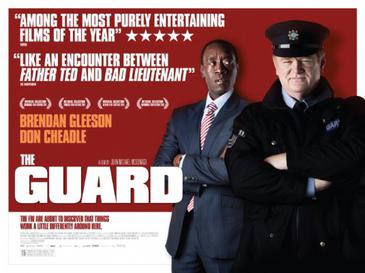
The Guard

One of my favorite actors currently starring in movies, Brendan Gleeson is from that oh so familiar sub-group of actors....the character actor! Duh dun duh! He's perfect in those supporting roles that typically have him play alongside the lead instead of being the all-important lead. Thankfully, some studios saw that the Irish actor is extremely talented. In 2008, he co-starred with Colin Farrell in In Bruges (a great movie), and has continued with a lead role a few years later in 2011's The Guard.

In his quiet town on the Irish coast on the North Atlantic, Sergeant Gerry Boyle (Gleeson) goes about his duties "policing" the town. He's unorthodox and doesn't have much of a filter in communicating, but he's a good cop nonetheless. With a new officer on staff, McBride (Rory Keenan), Boyle investigates an odd murder, an outsider shot in the head and left to rot. Boyle and McBride wonder if it's a possible serial killer, but there's bigger things afoot. An FBI agent, Wendell Everett (Don Cheadle), has arrived to help the investigation. Everett believes the murder was involved with a huge drug deal that could net half a billion dollars in cocaine. Now the country cop must deal with the American agent, the time wasting away as the deal approaches.

A dark, indie Irish comedy was a new one for me. I can't think of another Irish movie I've even seen, but I picked a good one to start with. According to Wikipedia (and when are they ever wrong?), 'Guard' is the most successful indie Irish film of all-time.  First-time director John Michael McDonagh is working with familiar territory here, the fish out of water agent/officer forced to work with the eccentric, hometown police officer. But familiar is not a bad thing because McDonagh and the cast make it worthwhile. It feels like you've seen it before, but still manages to have that unique, unseen quality. The kinda quirky tone and eccentric qualities to it all work (think Irish Fargo in a way), and the Spanish guitar-themed score just adds to the quirkiness.

There was some pre-Oscar buzz that Brendan Gleeson would be nominated for an Oscar for his role as Sgt. Gerry Boyle, but that never materialized. Maybe because it's a comedy, the performance didn't get a ton of publicity. And if it isn't an Oscar-winning part, it is a very good one just the same. Gleeson's Boyle is somewhat proud of his racist prejudices, drinks on duty, samples drugs, visits prostitutes, but as an officer he always gets the job done. All vices aside, he is a good cop...even if his techniques are a little off-the-wall. His lack of a censor or filter provides a ton of laughs. He isn't necessarily racist, just curious and generally inexperienced with anyone non-white and non-Irish. A sub-plot with his mother, Eileen (Fionnula Flanagan), helps humanize him too if you're having trouble liking the character. It's just more proof that characters actors are more than capable of becoming lead actors.

The more familiar territory does come with Gleeson's Boyle working with Cheadle's Wendell as the investigation into the drug deal develops. Boyle isn't angrily racist, he's just prejudiced by stereotypes. He assumes Wendell doesn't like to swim, grew up in the projects, and that all drug dealers are black and Mexican. To his credit, Wendell doesn't flip out on him. The dynamic though is what makes the buddy cop relationship work. Differences aside, they'll get the job done. Gleeson and Cheadle are two immensely talented actors in whatever role, comedy or drama, and their chemistry is what makes that familiar story worth watching. Toward the end, Boyle asks Wendell if he's been shot before, and the exchange about the pain involved is priceless. The button-down American agent and the eccentric Irish cop? Can't go wrong.

Developing his story, McDonagh has some fun with his villains too, making them more than just underworld thugs. The trio is led by Sheehy (Liam Cunningham) and includes London enforcer Cornell (Mark Strong) and sociopath killer O'Leary (David Wilmot). The basic characters have been done before, but never quite like this. Sheey leads his crew in a discussion of everyone's favorite philosophers and said philosopher's most famous line. Strong's Cornell almost blows up on cops he's cutting a deal with them, asking them why he'd skim off the top a few thousand dollars when a $500,000,000 drug deal is on the line, also claiming he got into drug trafficking, not carrying heavy things. Given an option to run or fight, Cornell states "It's like f'ing Christmas!" and opts to stay. They're villains, yes, and rather nasty ones, but they're not run of the mill by any means. Other solid parts include Michael Og Lane as Eugene, a youngster who always helps Boyle, and Dominique McElligott (of Hell on Wheels) as Aoiffe, a prostitute Boyle visits.

I was somewhat surprised by the direction the film takes in its last 20 minutes. It was already pretty dark comedically, but it leans just more straight dark dramatically in the finale. The confrontation on a dock at the drug deal is a good action scene, added by a spaghett-western like score playing over the shootout. But what's really surprising is the open-ended quality of the ending. It leaves it open to the viewer to decide what happens, much like 2008's In Bruges. What ending works for you is what it comes down to. A really good, really funny comedy.

The Guard <---trailer (2011): ***/****

Thursday, March 8, 2012

The Taking of Pelham One Two Three (1974)

A trend in movies that seems to be taking root lately is remaking movies that don't need to be remade. Classic movies that resonate with audiences and are still remembered fondly must be ripe for the picking. Studios figure audiences liked it then....well, they'll like it now. That was the case with 2009's The Taking of Pelham 123 (read my review HERE). It was a good enough movie, but it didn't need to be made. The original, 1974's The Taking of Pelham One Two Three is a classic in its own right and hard to improve upon.

It's a typical day in New York City when four men suddenly hijack a subway train, Pelham 1-2-3. They call in to the Transit Authority, talking to Transit cop, Lt. Zach Garber (Walter Matthau). The four men, led by Mr. Blue (Robert Shaw), have uncoupled one train with 18 passengers and have some demands. The city of NY has exactly one hour to produce $1 million dollars and put it right in their hands. If they don't? Blue and his cohorts will start executing one hostage per minute. Garber passes the news along, and the city comes to life, police, SWAT, everyone getting involved. Garber starts to wonder though, what are the hijackers up to? They're underground in a tunnel with nowhere to go and surrounded on all sides. How can they possibly hope to escape?

If an example of a 1970s crime drama/thriller was ever needed, 'Pelham' is a perfect example. It belongs up there with The French Connection, Death Wish and Marathon Man as some of the best crime genre movies to come out of the otherwise pretty stylish 1970s (in films at least). Director Joseph Sargent has made a gritty, realistic gem here, one uninterested in a stylish, flashy story. There isn't a wasted moment in its 104-minute run-time. Watching it feels like a pseudo-documentary with a camera placed in front of the real-life performers, not actors. It isn't interested in being flashy. It only wants to ratchet up the tension to the point where it's unbearable. Blue's hour-long countdown keeps ticking away, and NYC doesn't seem any closer to giving him his money. A police car with the money racing through the streets is one thrill after another, time running out and the executions drawing ever closer.

This would be a fitting time capsule for New York City in the 1970s. Almost the entire film was shot on location in NYC, even using an abandoned stretch of subway for the underground shots. But more than just the visual, 'Pelham' paints a picture of 1970s NYC. The Mayor (Lee Wallace) is sick when the hijack takes place, but with free-falling numbers in popularity polls drags himself out of bed. His wife (Doris Roberts) claims he just earned "18 sure votes." From the police commanders handling the situation to the beat cops delivering the money to the hostages wondering what's happening to Garber and his crew at Transit Authority, there's a cynicism, a dark humor hanging over the situation. David Shire's score isn't used much, but it's jazzy, quirky aggressive sound is perfect. This is NYC. A hostage situation? Eh, just one more problem to deal with.

Thanks to the talents of Matthau and Shaw, a hostage situation handled entirely by radio conversations is surprisingly exciting to watch. They communicate via radio, Shaw's Mr. Blue calmly delivering his demands to a world-weary but shocked Garber sitting in the Transit Authority office. There is an ease to these scenes, a flowing rhythm between these two actors that drives the action. Who better to play a cynical New Yorker than Walter Matthau? I can't think of a single person. And playing Mr. Blue, a hardcore mercenary looking for cash? Robert Shaw is ideal. His Blue even does a crossword while sitting in the train waiting for news. The rest of Blue's crew include a scene-stealing part for Martin Balsam as Mr. Green, a former motorman fired from his duties, Hector Elizondo as Mr. Grey, and Earl Hindman (Yes, Wilson from Home Improvement wants to kill you) as Mr. Brown. Also look for Dick O'Neill as Corelli, a supervisor in Transit Authority worried about the train schedule backing up, and Jerry Stiller as Rico, a police officer working with Matthau's Garber.

As the hostage situation develops, the story's momentum picks up. What exactly do these nuts intend to do? They're trapped, cornered, no way out. How could they possibly manage an escape? The final 20 minutes provide some good twists (including a secret about one of the hostages) and a couple surprising revelations about how things are wrapped up. The best though is the last scene, a final shot so perfect that only Walter Matthau could pull it off.

It's easy now to see how this 1974 crime thriller has influenced countless movies of its ilk since. The most obvious of course is Quentin Tarantino's Reservoir Dogs, naming his heist crew by colors and not their real names. But that's only the start. 'Pelham' gets right to the point and isn't worried about any side stories or truly developing the characters. Here's the situation, they're doing it, sit back and enjoy. Anything else would be needlessly extra. You can watch it HERE at Youtube (Part 1 of 11), but it isn't the greatest quality.

The Taking of Pelham One Two Three <---trailer (1974): *** 1/2 /****

Tuesday, March 6, 2012

The Alamo (1960)

From the time I was introduced to Fess Parker as Davy Crockett in the Disney episodes, I fell hook, line and sinker for the story of the siege and fall of the Alamo. Even as a kid, I was able to appreciate the courage, the sheer bravery of the defenders of the mission who sacrificed themselves. But while I love the Disney Davy Crockett episodes, one thing stands above. Right alongside The Great Escape as my favorite movie, 1960's The Alamo.

It's February 1836 and the Mexican province of Texas is fighting for its freedom against Mexico and its dictator Antonio Lopez de Santa Anna. Leading the Texas revolutionaries is General Sam Houston (Richard Boone) who leads a nonexistent army and needs time to assemble and train a fighting force. In the town of San Antonio stands the Alamo, an old mission built by Franciscan monks over a 100 years earlier, a mission never intended for military use. With hopes of buying Houston the time he needs, Lt. Colonel William Travis (Laurence Harvey), knife-fighter and adventurer Jim Bowie (Richard Widmark), and famed frontiersman and former Congressman Davy Crockett (John Wayne) and 180-odd volunteers have forted up in the Alamo and are quickly surrounded by Santa Anna's army of over 7,000 men.

For star John Wayne, The Alamo was a labor of love, a film he had wanted to make for 14 years. He not only stars in it but also produced it and directed, his first ever film as a director. The story of the battle of the Alamo had long appealed to him -- the bravery, the heroism, the sacrifice -- and it was a story he wanted and needed to tell. He spared no expense in this truly epic production. In Bracketville, Texas, Wayne had a complete Alamo mission built, not to mention the town of San Antonio too in the middle of the Texas desert. The set -- dubbed Alamo Village -- becomes an additional character, adding a sense of realism and authenticity that no studio set would have done justice. The actual Alamo mission constructed is a sight to behold, a behemoth fortress that puts in perspective how difficult it would have been for 180 men to defend against an army of thousands. Wayne's love child, most will disagree with me, but I think it's a nearly perfect movie.

Playing three legendary figures, Wayne, Widmark and Harvey all deliver layered, nuanced performances, all of them unique and different from the rest. As Davy Crockett, Wayne is a huge presence. It's far from his best acting roles -- The Searchers, She Wore a Yellow Ribbon -- but Crockett of the time was a legend in his own right. Who better to play him than one of Hollywood's biggest stars? Much of the tension in the movie comes from the rivalry over command between Widmark's Bowie and Harvey's Travis, both actors representing themselves flawlessly. Widmark is fiery and hot-tempered, Harvey condescending, intelligent and an idealist, but they share a common goal. All differences aside, both men are willing to sacrifice themselves for the cause they're fighting. I love the banter, the back and forth, the chemistry among the three. Making a two-scene cameo as Houston, Boone too doesn't disappoint, making those two scenes more than just throwaway fluff.

In terms of actual screentime, the big three dominate, but as a director, Wayne assembled quite a cast. Ken Curtis plays Capt. Dickinson, Travis' second-in-command, with Joan O'Brien as his loyal, equally brave wife, Susannah. Crockett's Tennessee volunteers include singer Frankie Avalon as Smitty, the youngest Alamo defender, Chill Wills (in an Oscar-nominated turn) as Beekeeper, the drinking, jovial fighter, Denver Pyle as Thimblerig, the thinker and gambler, Hank Worden as the Parson, a preacher, with Chuck Roberson (a talented stunt man and Wayne's double) and Rudy Robbins as two unnamed Tennesseans, engaging in their running bit; 'Do that mean what I think it do?....It do.'  Other defenders include Patrick Wayne as Lt. Bonham, the Alamo's famous messenger, John Dierkes as Jocko and his blind wife, Nell (Veda Ann Borg), Joseph Calleia as Juan Seguin, and Guinn Williams as Lt. Finn, and Jack Pennick as Sgt. Lightfoot. Two other worthwhile performances include singer Jester Hairston as Jethro, Bowie's slave, and the lovely Linda Cristal as Flaca, a young woman who shares a brief relationship with Wayne's Crockett.

Anyone remotely familiar with the historical facts knows that on March 6, 1836, the Mexican army assaulted the Alamo and wiped out the defenders to a man in a brutal, bloody massacre; extreme casualties on both sides. For a first-time director, Wayne puts together one of the all-time great battle sequences ever committed to film (if not the best ever). Almost five full minutes are shown as the Mexican army marches into formation around the doomed mission, an eerie silence hanging in the air for several seconds before the attack begins. The assault features hundreds of extras -- and in one scene, thousands -- as the garrison tries to repel the soldiers from the walls only to be ultimately overwhelmed. Cavalry, infantry, artillery, this defines the SPECTACLE of an epic. More than that, it is a moving sequence, each of the defenders we've come to know meeting their death. More details later on this, but Dimitri Tiomkin's score here is some of his best work. You can watch the battle sequence HERE, but to be appreciated, see it on a large, large screen.   

Wayne's film has its share of detractors, and the complaints are fair (even if I disagree with them). The original version is 192 minutes and has its slower moments. Speechifying abound from James Edward Grant's script, but I eat this stuff up. Big speeches about freedom, Republic, right and wrong. That's John Wayne at his best. What does work? The very real emotion of the movie. Countless scenes impact me the more I watch this movie. Travis addressing his men, knowing death awaits those who stay, is beautifully simple. Watch it HERE. I love too, that Crockett's men dismount before him. Overlooking a field covered with casualties, Pyle's Thimblering says 'Speaks well for a man who's willing to die because he believes right is on his side...speaks well.' The night before the final assault is the most effective though, the defenders sitting quietly as they wait for the inevitable in the morning. Bowie releases Jethro, but the former slave decides to stay and fight. Roberson's Tennessean delivers a simple monologue that is profound in its outlook on life. And best of all, Crockett is asked by Thimblering, "What are you thinking about?" to which Crockett answers "Not thinking....just remembering." The last 45 minutes features some of the most perfect dialogue, emotion, music and spectacle of any movie ever. The Green Leaves of Summer (listen HERE), one of the most beautiful songs ever, playing over this sends chills up and down my back at the thought of it.

A criticism of The Alamo is the complete lack of historical accuracy as pertaining to the actual 1836 battle, and that's true. Wayne never set out to do a spot-on, dead-on accurate telling of the story. The 2004 film -- The Alamo -- does that. Instead, Wayne wanted to tell the story honoring the men who fought and died. They fight because they believe in what they're fighting for. Surrounded on all sides with no hope of reinforcement, the Alamo defenders stay inside the walls, knowing certain death awaits. They go out fighting, go down swinging. That is what Wayne was going for. I have difficulty even processing that sort of heroism. Crockett's Tennesseans dismounting before him illustrates that. Crockett has seen some of his men die already and doesn't want to see anymore die, but his men don't look to him for a decision. They do it because they want to, not because they're told. Say what you want about Wayne as a director/star with a heavy-handed message, but he got that part right to a T.

Initial reviews were mixed for The Alamo, forcing Wayne to cut 30 minutes from his 192-minute long movie. Those cut portions include Intro Music, an Intermission and Entr' Acte, and Exit Music with about 15-20 minutes of scenes, some better than others. The scene that truly needed to be in the final print was Parson's death, a beyond moving, effective scene as the battle becomes very real for Crockett and his men. Watch it HERE. The actual prints of the 192-minute version seem lost to the ages, but many of the deleted scenes are available at Youtube. Watch several of them in one video, HERE. Among them is Scotty's death, and a birthday party held for Lisa Dickinson, played by Wayne's daughter Aissa. As a fan of the movie, it's great to see any of this footage.

So what else can I ramble about? That's probably enough. I love this movie and everything about it. Wayne gets the spirit right, showing the bravery and heroism of the Alamo defenders as they faced certain death and didn't shy away from it. A true epic with scale and spectacle to impress all moviegoers. Great cast, an amazing set of the Alamo mission, Tiomkin's phenomenal score, and a battle sequence that few can even approach in terms of quality. They don't make them like this anymore.

The Alamo <---trailer (1960): ****/****

Monday, March 5, 2012

Act of Valor

Released two weeks ago to big business in theaters, 2012's Act of Valor started off as anything but a highly successful major release. From director/producer duo Mike McCoy and Scott Waugh, the movie in its original incarnation was intended as a promotional video for the Navy SEALs. Having filmed actual SEALs in training and action, the duo changed their focus, instead making a feature-length movie devoted to the story of the SEALs. 

When the trailer first was released last fall, the buzz was about the casting, or more specifically, the lack of casting. Playing the movie SEALs are active duty Navy SEALs, playing variations on themselves. In terms of originality alone, this movie gets points. It makes writing a review somewhat difficult -- not too many names listed, as in none -- for the SEAL team, but the movie on its own stands alone. It has its flaws because SEALs do what they do for a reason. In other words, they're not actors. But as an action film honoring one of the armed forces most capable forces, it succeeds.

Preparing for their next deployment, a Navy SEAL team headed by Roarke and Dave ready their seven-man team for whatever awaits them. To a man, they have years of experience and extensive training that makes them the best in the world at what they do. Their first mission presents itself; the rescue of a CIA agent (Roselyn Sanchez) kidnapped by drug/gun smugglers in the Philippines. The mission is a success if a bloody one, but the team finds intelligence linking the smuggles to an extremist terrorist group. The evidence suggest a terrorist attack is being prepared and is close to being finish, an attack on U.S. soil that threatens millions of lives. Roarke and Dave's team must do whatever is possible to eliminate the entire terrorist cell before the attacks can be unleashed.

Meaning this in the most positive sense possible, 'Valor' is a propaganda film. It's a good propaganda film, but nonetheless it is what it is. It honors the Navy SEALs as the heroes they are, accomplishing missions that help save thousands of lives while putting their own lives on the line with each developing mission. 'Valor' has an authentic feel that comes from filming with the support of the SEALs. The uniforms, the weapons, the equipment, the strategy, all of it is as real as it gets. This isn't a story interested in personal background, character development, or a hard-hitting message. There are good guys and there are bad guys. The good guys? They're going to lay it all on the line to eliminate those bad guys.

So the cast description won't have any actual names for the SEALs, but 'Valor' is at its heart a 'men on a mission' movie. Roarke and Dave are the leaders of the 7-man team, both combat veterans and highly experienced soldiers. Roarke is expecting a child and comes from a military family, his grandfather killed in the closing days of WWII. Dave is his right-hand man and closest friend, a bond developing between the men and among the team as they survive one horrific mission after another. The rest of the team includes the sniper from the Mojave desert, the expert interrogator, the 30-year old who grew up among gangs in Los Angeles, the quiet, humble soldier, and so on. Stock characters you've seen before in war movies -- regardless the war -- before and will almost certainly see again. Roarke and Dave are the only two even given dialogue scenes having nothing to do with the combat missions. Would it have been a better movie with even a little character development? Probably so, but that would have taken away from the very pointed story intended by McCoy and Waugh.

Now casting characters in any movie with people who have never acted before can be a risky choice. If there is a flaw in Act of Valor, it is the scenes away from the action and violence...any dramatic scene in other words. These men have been trained within an inch of their lives to be the best at what they do. They have not been trained to be professional actors. The dialogue scenes feel like a high school play with amateur actors. 'I love you' is followed rather stiffly with a wooden delivery 'I love you too, baby.' Roarke and Dave talking about getting back home, seeing their wives and kids, about getting through the next mission? Those scenes are even awkward in their execution because no matter how good these men are as soldiers, they're just not actors. The terrorists include Christo (Alex Veadov), a disillusioned Russian, and Abu Shabal (Jason Cottle), a converted Muslim obsessed with taking war to the U.S.

Actors no, soldiers yes. 'Valor' will no doubt sink or swim as an action movie, even if that description seems to minimize their contributions on these missions that were based on real-life events. The missions are harrowing, uncomfortable, and unsettling rolled into one. The extremists they're hunting are in a triangle of Filipino gunrunners, Chechnyan terrorists, and Mexican drug cartels. The introduction to their skills -- a raid in the Filipino jungle to save Sanchez's CIA agent -- was my favorite action set piece, featuring one impressive action sequence after another. Their arrival is the best part; camouflaged faces poking up above the water level before descending below again to move in on their target. One SEAL waits for the team's sniper to pick off a guard, catching the corpse before it can hit the water, the splash alerting other guards. It's that sort of little thing that reeks of the reality of the situation. You couldn't make this up if you tried. All the action is impressive including later firefights at sea, at a poor village in Mexico housing the terrorists, and the finale near the U.S./Mexico border as the bombers try to get into the United States.

Mostly what I took away from this movie was a respect for the Navy SEALs and their very impressive skills. Because what they do is so important and so dangerous, we rarely see or hear about their successful missions. The names of SEALs killed in action since 9/11 illustrate at what cost these men do their jobs. The ending itself is very effective in its emotion. Call it pandering or heavy-handed, but it works. The reviews seem fairly mixed for this movie, but audiences are going out and seeing it. It isn't a great movie with its fair share of flaws. Where it does succeed? Honoring some of America's heroes who help save thousands of lives without the American public ever knowing what they've accomplished.

Act of Valor <---trailer (2012): ***/****   

Sunday, March 4, 2012

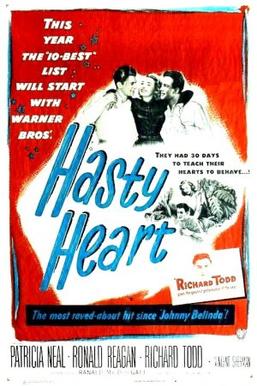
The Hasty Heart

A war is ending, and after months and possibly years of fighting, the light can be seen at the end of the tunnel. I can only imagine soldiers being so close to getting back home, only trying to make it through to the end safe and unscathed. What about those soldiers wounded and even killed in the closing days of a war? That would be the jumping off point for 1949's The Hasty Heart.

Serving in Burma in WWII with his Scottish regiment, Corporal Lachlan MacLachlan (Richard Todd) is wounded while on patrol and sent to a military hospital in the jungle. Shrapnel has torn up his kidney forcing doctors to remove it, but now his second kidney is showing signs of failure. Doctors only give him a few weeks to live but decide not to tell him. Instead, he's moved to another ward, this one run by Nurse Margaret Parker (Patricia Neal) with five international patients, soldiers from around the world, including Yank (Ronald Reagan).  The ward is asked to be kind and friendly to Lachlan, hopefully making the most of his last few weeks alive. Not knowing why his orders home are being held up, Lachlan isn't going to make it easy.

Based off a play from writer John Patrick, 'Hasty' is a great example of a play making the successful jump to film effortlessly. With a few quick departures outdoors, the entire movie -- at 102 minutes -- is set in the one ward occupied by Nurse Parker, Yank and four other recovering soldiers. It's easy to see this being a stage-based play. The story is a good one no matter whether it is a play or a film. Director Vincent Sherman personalizes the story as much as possible, bringing to life all the different characters and seeing their predicament. A little sappy, a little too sentimental at times maybe, but this isn't a cynical, world-weary look at the closing days and subsequent months following WWII. It is instead a story of the people involved, and the effect the war has had on them.

Earning a Best Actor nomination for the 1949 Oscars was an achievement in itself for actor Richard Todd, the only nomination he would get in an underrated career. Other performances from that year? Broderick Crawford in All the King's Men, Kirk Douglas in Champion, John Wayne in Sands of Iwo Jima, and Gregory Peck in Twelve O'Clock High. Not bad, huh? In just his third credited role as an actor, Todd leaves his mark. His Lachie comes from a tough background where he's always dealt with ridicule and scorn, fighting for everything he's earned. When these other patients warm up to him -- despite everything he throws at them -- he's thrown for a loop. It is a beautiful performance, especially when he does open up to his fellow prisoners. Todd makes this character human where it wasn't human just minutes before. He didn't win the Oscar, losing to Crawford's much showier part, but it is a well deserved nomination.

What struck me as odd with the nomination is that Todd received third billing behind both Reagan and Neal in the cast. It is a leading performance, but one of three 'Hasty' offers. Any one of the three offers a performance that could carry a movie on its own. The future 40th President of the United States, Reagan takes his chance to act here and runs with it. He was in a lot of B-movies that didn't always offer him a chance to act. He was just himself, but his part as Yank, an American soldier recovering from a bout with malaria, the unofficial leader of the ward is a solid one and layered. Like the other patients, he's genuinely trying to befriend Lachie only to meet roadblock after roadblock. Neal is Neal, easily one of the most underrated actresses of her generation. Her Nurse Parker is the epitome of what a nurse should be. She's thoughtful, caring and willing to work at helping her patients even when they want nothing to do with her.

The other patients are an international group that reflect the wide-ranging melting pot that were the soldiers fighting in Burma in 1944 and 1945. The group includes Tommy (Howard Marion-Crawford), an overweight Brit who jokes about his weight, Kiwi (Ralph Michael), a New Zealander who wants to get home and see his newborn baby, Digger (John Sherman), the quiet Aussie, and Blossom (Orlando Martins), the African soldier who can't understand a word of English. I liked the dynamic among the group. It reflects a group that's been with each other for awhile now, friendships quickly forming in a trying situation. Anthony Nicholls plays Lt. Colonel Dunn, the commander of the hospital who makes the decision to not tell MacLachlan the news.

I wasn't sure how they were going to wrap up 'Hasty' with several options available. Do you show Lachie's death? Do you hold back and leave it up to us as an audience to imagine it? Or the worst option, do you swoop in at the end and save him, offering a kidney transplant? On that subject, the movie says it can't be done, but I thought you could transplant a kidney. Eh, what do I know, I'm writing movie reviews. The important point is that Sherman chooses the right option...whatever that might be. Sorry, no spoilers. It's a fitting, very moving ending, especially a simple gesture Reagan's Yank makes to the Scotsman. A great movie on the whole.

The Hasty Heart <---TCM clips (1949): ****/****

Saturday, March 3, 2012

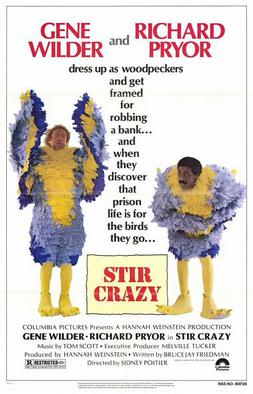
Stir Crazy

Go through Hollywood history, and it's easy to name some of the great comedy teams, not just duos. There's Laurel and Hardy, the Three Stooges, the Marx Brothers, Abbot and Costello, Dean Martin and Jerry Lewis, and one of the best, Richard Pryor and Gene Wilder. The duo starred together in four films, including 1980's Stir Crazy, a prime example of a stupid but entertaining 1980s comedy.

Having both lost their jobs on the same day, New Yorkers Harry (Pryor) and Skip (Wilder) decide to move west and put the nastiness of the city behind them. They take odd jobs for money, and their plan is working...for awhile. Taking a job in Arizona, they're mistaken for two bank robbers and sent to jail, earning 120 year sentences. Without much hope of an appeal, they settle in, finding out the prison is run by a -- surprise, surprise -- corrupt warden (Barry Corbin). Skip finds out he's a talented cowboy, and the warden sees a chance for some easy cash at the prison rodeo. Skip, Harry and their fellow inmates also see a choice opportunity...to escape.

I can't think of a more misleading plot review than that one. If I didn't know any better -- besides the New Yorker turned prisoner turned rodeo cowboy -- I'd peg this 1980 comedy as a drama. What's even weirder than that? Well-respected and award-winning actor Sidney Poitier is the director, one of nine movies he's directed during his career. This isn't a classic comedy to end all comedies. It's harmless and means well, and wants to do one thing and one thing only. It wants to make you laugh, and it succeeds there in a big way. The story has its fair share of meandering along with its episodic plot -- most of it routines for Wilder and Pryor to show off -- but it is always funny. Some of it leans toward more physical bits (both actors were great physical comedians) while also counting on them to sell their lines with some pitch perfect, immaculately delivered lines. A comedy that's fun. Novel concept, huh?

Four years since they first teamed in 1976's Silver Streak, Wilder and Pryor show why they were such a great team together. And that's the important thing; team. As comedic actors, they're both very capable of carrying a movie on their own. But like the best comedy teams/duos, they play off each other so well, setting each other up for jokes and laughs in every scene. Pryor's Harry is a nervous guy who sees things at their worst. Wilder's Skip is a naive idealist, constantly looking for the good in people. He doesn't seem to get that prison is a nasty place, and that "suggestions" to the warden aren't going to go over well. Harry is always looking out for his friend Skip as they navigate their new lives in the prison system, Skip always looking for stories and characters for his soon-to-be written novel. Some actors -- comedic or dramatic -- just work well together, and these two have some of the best chemistry I've ever seen. It's effortless, making the at-times stupid humor seem really smart. Dumb, smart, it doesn't matter. Pryor and Wilder make it good.

Like any memorable comedy, there's got to be something that sticks with fans after the movie concludes. 'Stir' has more than enough, those iconic scenes that keep you laughing whether you're watching the movie or not. The most iconic here is Harry and Skip first arriving in prison, Harry deciding they've got to show how "bad" they are, Skip falling in step. The physical mannerisms, the forceful deeper voices, it's priceless. Watch it HERE.There's too many to mention though, one just as good as the other. The running bit with the meanest prisoner around, Grossberger (Erland van Lidth), a serial killer, is perfect, Skip proving he's not so bad after all. Skip also survives countless torturing at the hands of the warden, shaking them off one by one like it's nothing, including a hanging torture that gets all the kinks out of his back. Long story short? Both Wilder and Pryor get a ton of chances to show off their ability.

The rest of the cast fills in nicely around the two, including Corbin and Craig T. Nelson as Warden Beatty and his head guard, Deputy Wilson. For the most part, they get to play the straight role to Wilder and Pryor's antics, doing so capably while keeping some personality in their roles. Georg Stanford Brown has a lot of fun with some stereotypes as Rory, the gay prisoner who likes Harry and ends up becoming part of the group along with Jesus, played by Miguel Angel Suarez and van Lidth as the immense Grossberger. Joel Brooks plays their incompetent lawyer, Garber, with JoBeth Williams playing his assistant, Meredith.

If there's an issue with the movie, it comes in the ending as 'Stir' struggles to get to any sort of finale. The prison rodeo drags on a little too long as Skip, Harry and the guys try to make their escape. The laughs are still there, but they're fewer and further between. Minor complaint though. The movie is a gem though thanks to the extraordinary talents involved.

Stir Crazy <---TCM clips (1980): ***/****

Friday, March 2, 2012

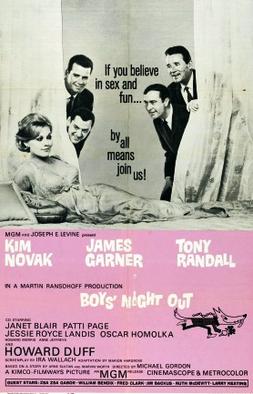
Boys' Night Out

Contrary to what more modern/current movies try and tell you, sex comedies don't have to be particularly raunchy to work. Okay, that sounds like a contradiction. American Pie -- already released 13 years ago -- jump-started a trend that had died away more or less through the 1990s, a trend that continued into the 2000s. Now none of this is to say earlier comedies were exempt, but they were a different sort of raunchy...censored raunchy...like 1962's Boys' Night Out.

Hanging out each Thursday night in New York City, four old friends, now all middle aged -- including Fred (James Garner), George (Tony Randall), Doug (Howard Duff) and Howard (Howard Morris) -- are in a bit of a mid-life rut. Somewhat jokingly they talk about renting a plush NYC apartment where they can bring their fictional mistresses to and escape from their everyday life. Well, Fred actually finds an apartment for a very low rent that the four can split for a reasonable rate, even finding a live-in girl, Cathy (Kim Novak), who will stick around for "companionship." The guys think they've got things made, except for Fred who starts to question what they're up to.  None of them have any idea what Cathy has in mind for them.

Sounds kind of ominous, doesn't it? It wasn't intended that way. After all, it is a screwball sex comedy from 1962. Kim Novak isn't exactly going to murder and hack them up now, is she? Finally seeing Novak in more than just Hitchcock's Vertigo recently, I'm fast becoming a huge fan. Her gimmick here is of a sociology student student studying adolescent, sexual behavior in suburban men. When they assume she's some sort of hooker/escort, she takes the bait. None of them actually sleep with her, Novak's Cathy playing them like a fiddle. She gives them each what they want; George to talk, Doug to be a handyman around the house, and Howard to eat to his heart's desire. All problems at home that Cathy easily fixes. These scenes are subtle, underplayed comedy at its best, funny without trying too hard to be funny.

Through some rather major flaws, I'll still be giving this romantic comedy a positive review, most of that being chalked up to the casting. I'm used to Garner in more action-driven stories, but he easily handles the jump to some lighter fare. Working with the very beautiful Novak, he looks right at home in any romantic scenes. And working with Novak, I don't imagine those scenes were too difficult to film. Randall, Duff and Morris (later Ernest T. Bass on The Andy Griffith Show) round out the middle-aged quartet, all bringing different styles and backgrounds to their characters, the wives played by Janet Blair, Patti Page and Anne Jeffreys. Playing Fred's mother, Jessie Royce Landis is very funny in a small part, organizing the wives for some investigating. Oskar Homolka plays Dr. Prokosch, Cathy's professor, William Bendix makes a small but memorable cameo as Slattery, the wise bartender, and Jim Backus is a real estate agent trying to unload his tainted apartment.

Now that we've got all these pleasantries out of the way, let's move on. Not raunchy because 1960s censors wouldn't allow it, 'Boys' still manages to be pretty high up on the "Nasty Meter." First off, Garner's Fred is divorced and the only single one of the bunch. The other three never actually have sex, hook up, even touch Novak's Cathy which is important. Still, they believe that each of the other ones has, they're just too embarrassed to say they're not. Here's the nasty part, for me at least. It's 1962, and the story calls for George, Doug and Howard to "share" Novak, one getting Monday, the other Tuesday and so on. It doesn't bother them that they're passing this girl around? Sloppy seconds, thirds and fourths. Sounds kind of scandalous for a 1962 comedy. Granted, none of them actually do, but come on. They seem far too comfortable with the situation.

And because this is a screwball, romantic/sex comedy, we need an ending....a stupid one. Lots of miscommunication and misunderstanding basically has everyone meeting in Cathy's furnished apartment, fighting it out and screaming, Cathy just trying to explain herself. All the positive momentum (friends sexually sharing a woman aside) is nearly for naught. The last 15 minutes are nearly unbearable to watch. Painfully over the top theatrics, and all could be solved with one quick explanation. What's the fun in that though? We'd never get the awkwardness, Fred turning his back on Cathy even though he loves her. Oops, spoiler alert. My bad. Are you surprised though? The final scene has everyone happy and back together, the wives apparently choosing to forget that their husbands sought out affairs, even if they didn't go through with it. Oh, happy day, it's a 1960s comedy and everything is hunky-dory!

The positive of most of the movie is that for most of 90 minutes, Boys' Night Out is very good. It treads the fine line between stupid and funny, letting the cast have some fun with this screwy situation. This was Garner at the top of his game, Novak is sexy with that smoky voice and effortlessly funny, and the rest of the cast fills out the movie nicely. Yes, the resolution is bad, really bad, but getting there is fun. Too bad the movie couldn't end when Fred and Cathy end up together at a rained out Little League baseball game. Then it'd be a really good, worthwhile movie. As is now, it's still good.

Boys' Night Out <---TCM trailer (1962): ***/****

Thursday, March 1, 2012

Four Rode Out

Think spaghetti western, and where does your head go? Mine goes to gunfights, duels and long, extended shootouts. Thank you, Sergio Leone, you set the bar incredibly high and basically ruined even the good but average spaghetti westerns (for me at least). That's a little harsh, but you get the idea. Then there's 1970's Four Rode Out, almost an anti-spaghetti from the casting to the almost complete lack of gunplay.  It wasn't even a problem....for awhile.

Having netted $120,000 after a successful bank robbery, bandit Fernando Nunez (Julian Mateos) sets out across the desert toward Mexico, but not before stopping to see his girlfriend, Myra (Sue Lyon). Her father catches them together and kills himself, but Nunez is blamed for the murder. He doesn't have much of a head start on Marshal Ross (Pernell Roberts), a veteran peace officer who intends to bring Nunez in and then retire for good. Ross intends to bring the bandit in on his own only to have a sinister Pinkerton agent, Brown (Leslie Nielsen) tag along, and Myra isn't far back either in hopes of saving her boyfriend.

This is not your typical spaghetti western, some reasons for good, others for really, really bad. From director John Peyser (I know, John freaking Peyser), 'Four' was filmed in Almeria, Spain and benefits from the on-location shooting in the desert with some familiar spots popping up here and there. It has little to no actual gunfighting with only a few shots even fired, and by my count two or three of those shots were to mercifully put horses out of their misery. It is low budget, focusing exclusively on the four main characters. The first 45-50 minutes are a positive start, familiar ground but entertaining. Even in the second half, there are some worthwhile twists in character and story that showed at least some effort was made, but more on that in a bit.

A haven for American actors looking for work, the spaghetti western again opens its doors to fading stars. For the audience, that's a good thing. Former Bonanza star Pernell Roberts brings the same easy-going confidence to his part that he did in the much better Ride Lonesome some 11 years earlier. Is this part on the same level? No, not by a long shot, but in a pretty dreary western, he stands out from the rest. The same goes for Leslie Nielsen, not yet a star of the spoof genre. His Mr. Brown, a somewhat suspicious Pinkerton agent, ends up being the most villainous of all the characters. Nielsen shows a dark side that I hadn't seen in any of his other roles, and he looks to be enjoying himself. His scenes with Roberts actually have some tension, two actors probably wondering what they're doing in a movie like this. As Myra, Lyons leans toward the wooden side in her acting, and Mateos is okay but overshadowed as Nunez.

The lack of any shootouts or actual gunplay is not a deal breaker, but 'Four' does have some that make up for it. The score is from songwriter and musician Janis Ian who also makes an appearance in the opening credits as a guitar player. Her songs are good enough, pretty typical of the American folk music so prevalent in the late 1960s and 1970s. Good enough doesn't qualify in a western either, much less one this dark. Long scenes of the quartet riding across the desert are almost unendurable with Ian's folks songs playing. There also seems to be different variations of running lengths, mine coming in at 95 minutes. Others are listed at 90 and 99. A few scenes felt like there was some awkward cuts, but I didn't notice anything significant missing, no huge plot holes left unexplained. Some odd bleeps pepper the story, basically anytime 'whore' is said. Was the DVD print recorded off a TV showing possibly?

At its most basic, the second half of the story reminded me of Anthony Mann's The Naked Spur. All differences are put aside when Ross, Brown, a wounded Nunez and a pissed off Myra must work together to get across the desert. They have little water, and their chances seem slim. The story shifts to the bizarre at times -- including a surreal wedding -- and dull/boring at others. Watching dehydrated folks walking across sandy ridges ain't too interesting, just saying. The ending is about as downbeat as you'd expect, but there were wasted moments even amongst the badness for a better ending. Disappointing when considering the first 45 minutes were fairly entertaining. Roberts and Nielsen make this worth checking out for diehard western fans only.

Four Rode Out <---Part 1 of 9 (1970): **/****