The Sons of Katie Elder

The Sons of Katie Elder
"First, we reunite, then find Ma and Pa's killer...then read some reviews."

Thursday, February 13, 2014

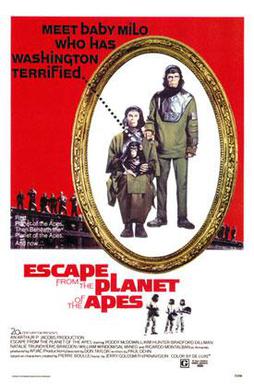
Escape from the Planet of the Apes

Sometimes a series is too successful to just let it end naturally. Following the success of Planet of the Apes and Beneath the Planet of the Apes, Fox Studios wanted another sequel, but there was a problem. Without giving too much away, the ending for 'Beneath' well....didn't really leave any opening for a follow-up. That's what screenwriters are for and ta-da! The series continued! A third movie in the series, 1971's Escape from the Planet of the Apes.

On a warm sunny day off the coast in southern California, a spaceship is discovered floating in the Pacific. The ship is brought ashore, the Army waiting to welcome the astronauts on-board but no one is sure where the spaceship came from or who is in fact on-board. Those waiting are stunned when the three astronauts remove their helmets, revealing themselves as apes. The three astronauts? Dr. Cornelius (Roddy McDowall), his wife, Dr. Zira (Kim Hunter) and Dr. Milo (Sal Mineo). The arrival of talking, intelligent apes stuns the world, forcing the government to decide what to do with the ape trio. Some are welcoming, Cornelius and Zira especially becoming instantly famous in pop culture. Others though aren't so welcoming, questioning where these apes came from and what is their intention in coming to Earth? Both sides need to find a happy medium, but some are sure the presence alone of these futuristic astronauts is a threat to the future of mankind.

So as we talked about, Beneath the Planet of the Apes didn't leave much of an opening for the series to continue, Charlton Heston insisting that be it for the series. Money is a powerful motivator though, isn't it? The series continues, but back on Earth in modern times. Director Don Taylor begins the second half of the series, catapulting the franchise in a different route for its final three films, composer Jerry Goldsmith returning as well with a great score. The premise linking 'Beneath' and 'Escape' is a tad contrived, a tad forced when you think about how 'Beneath' ended but for the sake of where the series is going, it's not so bad. Why does it stand out from the rest?

Two reasons. McDowall and Hunter. Playing Cornelius, McDowall returns to the series after being unable to to star in 'Beneath' because of a scheduling conflict. Less than pleased with her characterization in 'Beneath' (or maybe lack of), Hunter returned because she liked the script. The story is a departure from the first two movies, but this returning duo is perfect. Where we saw Heston's Taylor and James Franciscus' Brent struggling to adjust in a simian world, we now see Cornelius and Zira going through the same struggles in a human world. Where everything else has changed around them, having a spouse is a constant. Their chemistry is perfect, two intelligent individuals deciding what should be their next step, how best to survive in this human world. They have these perfect little moments, Cornelius trying on suits, Zira trying on stylish dresses, Cornelius standing up for his wife, Zira fighting for respect that carries the story surprisingly well on an emotional level.

It's cool to see Cornelius and Zira -- key supporting parts in the first two movies, still supporting parts -- step into the lead roles. That added dimension carries the movie. Who else to look for? Bradford Dillman and Natalie Trundy as Lewis Dixon and Stephanie Branton, two doctors and animal psychiatrists who become almost public relations representatives for Cornelius and Zira, but more importantly, they become trusted friends. Eric Braeden is Dr. Otto Hasslein, the scientific adviser to the President (William Windom), who questions that if these apes come from Earth's future...why did they leave?  It's Eric Braeden so yes, he's a villain. Mineo makes the most of his smallish part as Dr. Milo, the third ape to travel through time with Cornelius and Zira, while Ricardo Montalban is a scene-stealer as Armando, the charming, friendly owner of a circus who works with Lewis and Stephanie. Also look for Jason Evers and Albert Salmi as Braeden's two henchmen, while John Randolph is the head of the commission investigating what to do with the visiting simians.  

There are portions of this movie that are really sweet, great emotional moments that work because of the chemistry between McDowall and Hunter. Following the trend of the first two movies though, things take a turn for the dark though near the halfway point of the 98-minute movie. The time travel aspect comes up, if someone from the future knows what's going to happen, can we change it by wiping them out? We discuss issues of nuclear war, experimentation on animals, prejudices against races and cultures, but it is all handled in subtle enough fashion that it works. The ending is pretty heartbreaking in itself, but as the series has set us up for, there's a great twist in the final scene. Definitely stick with it to the final credits.

Another worthy Planet of the Apes movie, throwing us for a loop but all for the interesting. Coming up next, the final two films in the series, Conquest of Planet of the Apes and Battle for the Planet of the Apes, neither of which I've seen in one sitting. Stay tuned!

Escape from the Planet of the Apes (1971): ***/****

Wednesday, February 12, 2014

The Great Waldo Pepper

Ever heard of barnstorming? Well, you should have so shame on you. In the 1920s, flying circuses traveled across America, pilots performing ridiculously dangerous (some would say suicidal) stunts and tricks to amuse and dazzle audiences. A movie I stumbled across on Netflix does a really good job giving a look at the dangerous world of barnstorming, 1975's The Great Waldo Pepper.

It's 1926 in Nebraska and Waldo Pepper (Robert Redford), a very talented pilot trying to create a reputation and name for himself, is scraping by. He flies all over the state, doing tricks and aerial stunts for anyone who will pay to see it, offering 5-minute rides for $5, all the money going toward the development of a new single-wing plane built by his friend and engineer, Ezra Stiles (Edward Hermann). Waldo has a bit of a rivalry with another pilot, Axel Olsson (Bo Svenson), especially when Axel moves into his territory, but seeing the business struggle and the money start to dry up, the pilot duo teams up. Their idea? Do something that audiences have never seen before, a stunt that will assure them a reputation and audiences wherever they go. Waldo and Axel intend to walk on their wings while flying thousands of feet up in the air.

I could be wrong -- and I often am -- but I believe this 1975 aviation flick sat in my Netflix queue for the last 10 months or so after I watched another aviation flick, 1965's Those Magnificent Men in Their Flying Machines. It's also the third pairing between director George Roy Hill and star Redford, having worked previously together in Butch Cassidy and the Sundance Kid and The Sting. This is a movie that loves its story, loves where it came from. It loves flying, aviation, the pilots, the history, any and all of it. If there's a surprise, it's that near the halfway point the story takes a surprising turn for the dark. The tone early on is light, a tad jokey, composer Henry Mancini's score adding to the fun, entertaining mood. The differences in tone work overall after the initial shock (and the scene that switches it up is a SHOCKER). Light and fun meets dark and surprising, I wouldn't think that would work, but it does.

Above all else, 'Waldo' is definitely worth seeking out because of some ridiculous aerial sequences. If this movie was released in the modern CGI (computer generated images) era, there would be no, NO, actual footage of the pilots, their planes and their tricks. But how about 1975? There weren't special effects like that. Everything had to be done for real or with some real cheesy-looking effects. The footage here is astounding. Hill and cinematographer Robert Surtees put their cameras up in the air with the planes and let the pilots do their thing. With the cameras mounted on the planes (or flying with them close by), it feels as a viewer that we're flying with them. Point of view shots really add to that sense of realism. Making it cooler? Redford, Svenson and the cast are up there too, one more authentic touch to an already authentic feel. We see pilots doing loops, some upside down -- one called an outside loop -- and others walking on the wings of their bi-planes. On a purely visual level, the film is a great experience.

Right in the midst of his acting heyday before he turned to directing more, Redford is at his best as Waldo Pepper, the pilot who wants more. He's able to do the drama, the comedy, all of it, playing a charming, likable rogue who becomes almost obsessed with making a name for himself. I wasn't quite sure what to expect out of the story going in -- only knowing it was about an early era in aviation -- so it caught me off guard when such an interesting character was leading the way. Much of that success comes from the dark twist the story takes near the halfway point, Redford's Waldo getting another layer or two to the character. If there's a weakness, it's the scenes with his former love, played by Margot Kidder, the scenes slowing the pace down with some attempts at drama. Mostly though, the character is great. He missed out on the dogfights in World War I and desperately wants to get a chance to be a hero, to be idolized no matter the inherent risks in a suicidal job. An underrated performance from Redford.

With an episodic story, we get plenty of other characters Waldo meets along the way. I really liked the rivalry turned friendship between Waldo and Svenson's Otto, two very talented pilots who are good on their own but may be better working together. The most dramatic part goes to Bo Brundin as Ernst Kessler, the famous German ace from WWI, a hero in Waldo's eyes who questions why he's been deemed a hero internationally by the public. Redford and Brundin have a couple great dialogue exchanges later, building to a surprising ending, slightly open-ended but it's easy to draw conclusions. A young Susan Sarandon has a supporting part as Mary Beth, a young woman Waldo meets and becomes part of the act with Waldo and Otto. Geoffrey Lewis makes the most of his smaller part as Newt, Waldo's former commander and a current Air Commerce inspector. And last, look for Philip Bruns as Dillhoefer, the owner of the air circus always looking for the next big thing in aerial stunts.

A very pleasant surprise for any number of reasons from Redford's lead performance as extremely talented pilot Waldo Pepper to the one impressive aerial sequence after another, one better than the last, especially in the final scene. Period correct planes, cool aerial stunts, it's a gem.

The Great Waldo Pepper (1975): ***/****

Tuesday, February 11, 2014

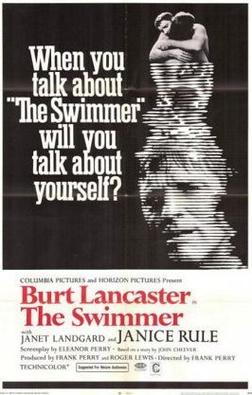
The Swimmer

Like certain works of classic literature, movies and films can intimidate. I've avoided certain novels over the years because they're written by a certain author, about a certain subject, or in some cases, because that book is MASSIVE in size. As far as movies go, I've long been aware of 1968's The Swimmer. I've wanted to see it, but it hasn't been readily available and I'll be honest. It sounded like an imposing movie I was going to have some trouble with. Well, I caught up with it. Here we go.

On a warm late summer day in an affluent Connecticut suburb, Ned Merrill (Burt Lancaster) walks out of the woods wearing nothing but a swim suit. He jumps into a neighbor's pool and does a couple laps, getting out and catching up with some of his old neighbors. As he dries off, overlooking the valley, Ned comes up with an idea. Stretching all the way back to his home, Ned realizes all his neighbors have a backyard swimming pool, one after another leading right up to his own. In theory then, he could swim all the way across the county right back to his home. It sounds pretty harebrained but Ned is off and running and swimming. One by one, he swims in each of his neighbors' pools, but he may not like what's waiting for him at the end of his trek.

This is a movie with a message, and dammit, it's going to get that message across one way or another! From director Frank Perry (and an uncredited Sydney Pollack), 'Swimmer' is a very interesting movie if not a very good movie. It is based off a short story by author John Cheever, one that is a criticism -- if not a condemnation -- of the culture that developed in America following World War II. A generation returning from war wanted to return to a better life. Families moved outside cities, suburbs becoming a known thing. Houses had to be perfectly furnished with all sorts of appliances, and maybe most importantly, a swimming pool in the backyard. A condemnation of that materialistic desire is a tad obvious, a little noble, mostly interesting and bogged down in a reliance on artsy/art-house style.

If there's a strength to take away from this flick, it's Lancaster in the titular role. This is a film that the Hollywood legend considers one of his best. Considering how many great parts he had in a great career, that means something. This is a part that meant a lot to him, a movie that meant a lot to him. Playing Ned Merrill, the All-American dad and husband, Lancaster runs the gamut. We're introduced to a man on top of the world. It's a beautiful day, sunny and no clouds, and he's got an idea to "swim" across the county. As the day develops, as he gets closer to home, we learn everything isn't so peachy. His perfect life is far from it. No spoilers though, check out the movie for yourself. Lancaster is ideal casting though. He spends the entire movie in an almost-Speedo swimsuit and is in ridiculously good shape for a 55-year old actor. Lancaster does a lot without dialogue, his face and emotions doing more than words can. His physical mannerisms wither as the truths reveal themselves as he gets closer to home.

The story in 'Swimmer' is one episode after another, Lancaster's Ned (or Neddie to a lot of people) visiting friends who apparently haven't seen him in quite awhile. He talks about his wife, his daughters and his business and gets odd stares when people hear him talk about the family. It's one perfectly manicured house after another, immaculate house and pools with crystal blue water. The people welcome him...at first, and then the emotions switch. Friendly smiles and welcoming hugs and handshakes become stares and screaming and frustration. Some of those folks he meets along the way include Charles Drake, Kim Hunter, pre-plastic surgery Joan Rivers, and plenty other familiar faces if not instantly recognizable names. The movie's most dramatic scene (and most revelatory) is with a middle-aged woman, Shirley, played to perfection by Janice Rule, who holds quite a grudge against Ned.

There are positives but for me they mostly get bogged down in some stylistic choices that handicap the story. The soundtrack from Marvin Hamlisch -- for lack of a better description -- is too 1960s for its own good, dreamy, jazzy and soft rock, like we're watching a dream sequence. The look of the film is interesting, artsy and eerily beautiful, the transitions between pools adding to the dream-like qualities. One bizarre aside has Ned walking through the woods with Julie (Janet Landgard), his family's former babysitter who he meets at her parents' pool. Julie admits she had a crush on Ned growing up, the revelation sending the story down a weird, uncomfortable path. This all comes after an extended slow motion sequence where Ned and Julie run around a horse obstacle track. Bizarre much?

That's what the movie comes down to me. I think the message is worthwhile. The mystery and the tension kept me interested right until the end. Nothing is ever spelled out, a good and bad thing. I'd like a little more closure, a little more resolution. Unfortunately, the message gets bogged down in stylistic choices that are overbearing, acting that ranges from amateurish to over the top bad and a dream-like quality that never quite delivers. Worth a watch to experience it, say you've seen it, Burt Lancaster's performance the best thing going here.

The Swimmer (1968): **/****

Monday, February 10, 2014

The Monuments Men

I'm weird when it comes to movies. When I catch wind of a film in production, of an actor being attached to a project, stumbling across a trailer, I look forward to said movie like a crazy person. We're talking kid on Christmas Eve excited. Over the years, I've looked forwarded to The Alamo, Skyfall, Casino Royale, the Dark Knight series, the Fast and Furious movies, and most recently released in theaters, 2014's The Monuments Men. Where does it fall among that list? Read on.

It's mid-1943 and the tide of World War II is quickly turning to the Allies, the Axis retreating on almost all fronts. An American officer, Frank Stokes (George Clooney), with an art background is proposing a plan to President Franklin Delano Roosevelt as the tide turns, presenting an idea for a small squad of specialists and experts in art, architecture and history and dropping them into the war zone in France. Their goal is simple, try and save as much famous and historical art, statues, structures and buildings across Europe. Germany, the Third Reich and the Nazis -- led by Hitler and Goring -- have been stealing and stockpiling priceless pieces of art for years, more than that stealing hundreds and thousands of years of history and culture. Stokes gets his right-hand man, James Granger (Matt Damon), and goes to work assembling his small team. The war is definitely turning though, the Germany army retreating all along the front. Countless pieces of art, treasures and items of historical significance are at risk, the Germans having received an order from Hitler to destroy everything they can.

This story is a prime example of how powerful history can be. There are countless stories out there just waiting to be told. This WWII story with Clooney directing (and co-writing the script with Grant Heslov) is based off a true story and the book of the same name (check it out HERE by author Robert M. Edsel). The fact that this really happened -- the Germans hoarding history's treasures, the Allied effort to recover said treasures -- is pretty crazy in itself, a hugely interesting and entertaining premise. I loved the book, a window into a chapter of WWII that was almost completely forgotten by history until the last 20 years or so. It was fascinating and terrifying all at once, unlikely heroes in an unlikely situation. I was worried then when Clooney's film was pushed back from an original December 2013 release to a February 2014 release. Should I have been worried?

Unfortunately, yes. It's a good movie that entertained me. The truth is though with the story at hand, the real-life incidents, the flesh and blood people, it could have been a classic. A true classic, and it isn't. The positives are obvious. There is a throwback feel to the story reminiscent of so many good 1960s World War II movies. Clooney clearly has a ton of respect for his subject matter and rightfully so. What these Monuments Men accomplished in a live war zone is remarkable, and yes, there were casualties. For a cliffsnotes version of what the force/organization accomplished, read HERE. This is a movie interested in really illuminating what these men accomplished. They were soldiers, if not the classic idea of what a soldier is. The movie is gorgeous, filming on location in Germany adds a perfect sense of authenticity to the story. The score from Alexandre Desplat is okay, nothing too memorable, a little too adoring at times. There's a lot going for it but.....

There's also a lot of negative to mention. A couple hours after watching 'Monuments,' it's hard exactly to say why. The task in transitioning Edsel's book to a manageable film is daunting. We're talking almost double-digit characters traversing across Europe over a year-plus. The result in Clooney's 118-minute long film? A generally disjointed feel with no real unifying link to the characters and set pieces. Episodic is a more than apt description, one episode, one bit or routine bouncing to another as quick as it arrived. The early portions are rushed, characters introduced far too quickly. The middle portions drag as if the script doesn't know exactly how to get to where it wants to go. The finale definitely is the saving grace, the Monuments Men traveling deep into Germany to rescue extraordinary amounts of art. It's disappointing because I expected so much more. The drama is good but not great, wandering too much aimlessly, and most of the attempts at wry, subtle humor fall short.

The movie's savior and strongest attribute is the cast that almost makes up for the disappointing script. If Clooney is attached to a project, it instantly has cache for me. He's good, not great, leading the ensemble as Lt. Frank Stokes (based on George Stout), the creator of the Monuments Men. Damon has the more scene-stealing part as James Granger (based on James Rorimer), the art director at the Metropolitan Museum in NYC. His subplot with Claire Simone (Cate Blanchett), a volunteer who survived years in Paris in efforts to protect invaluable pieces of art, is a cool departure from the story, including a great scene where Claire (based on Rose Valland) reveals a huge secret to Granger. The rest of the Monument Men include Campbell (Bill Murray), an architect, Garfield (John Goodman), a sculptor, Clermont (Jean Dujardin), a French artist, Savitz (Bob Balaban), an art expert of sorts, Jeffries (Hugh Bonneville), a disgraced Englishman, and Epstein (Dimitri Leonidas), a young soldier who grew up in Poland, now working as the group's translator.

While the formula is tweaked, the premise here at its heart is a 'men-on-a-mission' movie, Clooney's Stokes assembling a small group of specialists to help pull off an impossible mission. The formula is rushed too much to the point I never really felt I knew any of the characters. I felt like we were supposed to root for them because it was Bill Murray, because it was John Goodman, not because we get to learn anything about them as individuals. Like so much of portions of the movie, I came away disappointed with the characterization. The acting is uniformly good but cold for lack of a better description. Some parts work very well, especially Goodman and Dujardin teaming up as the group is split up to cover more ground. Murray and Balaban are the odd couple, almost constantly arguing, but overall, it's just more wasted potential.

I'm wavering here. This movie seemed like a gimme for me, a sure thing review at 3.5 or 4 stars, but it wasn't. Some moments work perfectly, like a Christmas montage as we see the war starting to wear on all the Monuments Men, a message from Murray's daughter playing on a phonograph. A late interrogation between Clooney's Stokes and an SS officer is foreboding and subtle at the same time. the last 30-40 minutes pick up the momentum, providing the movie's strongest moments. Getting there though can be a trial at times. Most of the issues can be chalked up to the script that falls short in so many ways. A disappointingly average film that should have been so, so much better.

The Monuments Men (2014): ** 1/2 /****

Friday, February 7, 2014

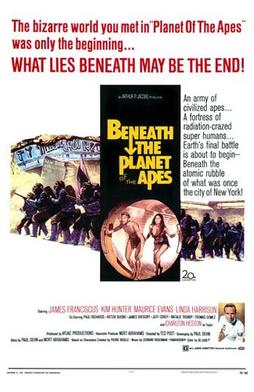
Beneath the Planet of the Apes

Well, let's not mess with a good thing. I love the original Planet of the Apes, and it's been years since I caught up with its four sequels. While none of the sequels live up to the original's success, these are good movies (even if there was no need for any sequel). My personal favorite has always been the first sequel, 1970's Beneath the Planet of the Apes

Following where the previous NASA mission explored in deep space, a spaceship crashes on the same far-off planet, astronaut Brent (James Franciscus), trying desperately to survive. When the ship's commander (Tod Andrews) dies from his wounds, Brent is all alone among the wreckage. Thinking he's alone on this planet, Brent is shocked when a woman rides over the hill on a horse packed with supplies. The woman is Nova (Linda Harrison), and she's clutching the dog tags of Taylor (Charlton Heston) in her hand. Unable to speak, Nova can't communicate what happened to Taylor, Brent only knowing that he's landed on the right planet. Nova takes him to Ape City though, leaving the stranded astronaut stunned at what he's found. Now on the run, Brent and Nova must stay one step ahead of the gorilla army, an invasion planned for the mysterious Forbidden Zone.

Picking up exactly where the original 'Apes' left off, 'Beneath' is an interesting follow-up. Following the immense success of the first movie, Fox Studios went ahead with a sequel that star Charlton Heston wanted nothing to do with. That contract thing though, it gets in the way of what you want to do. Heston agreed to play a small part (he's only on-screen for about 10 minutes) with the demand that one sequel was all there would be. Well, he got his first part of the deal, but there were three more sequels to come. What's the result here? A solid sequel that stays true to the formula laid out by the first one, adding some new layers in the second half of a 95-minute movie. Early on, it feels almost like a scene-for-scene remake -- Brent going through what Taylor did -- but it's the second half that brings the movie up a notch or two.

Replacing Heston in the lead role is Franciscus, a good actor who never became a huge star in film or television. He was a familiar face though who does a solid if unspectacular job as Brent. The biggest issue with the character is what I mentioned earlier, Brent is just too similar to Taylor to really leave his own mark. Still, I liked Franciscus, and Brent does get his chance to step into the spotlight in the final act as we find out what's in the Forbidden Zone. Also returning from the first movie is Kim Hunter as the friendly, helpful intelligent Dr. Zira, Maurice Evans as the cynical, truth-hiding Dr. Zaius, David Watson replacing Roddy McDowall (other obligations) as Cornelius', Zira's husband and fellow scientist. Also joining the cast is James Gregory as General Ursus, the commander of the army who's obsessed with leading an invasion into the Forbidden Zone.

So what exactly is out there, hiding away in the Forbidden Zone? SPOILERS in this paragraph SPOILERS Chased by a squad of gorilla cavalry, Brent and Nova ride into the Forbidden Zone, hiding away in a subterranean cavern that ends up being the subway tunnels underneath New York City. They find a community of mutants who survived the original atomic blasts and now worship a Doomsday bomb that was built strong enough to destroy the world. What to do, what to do? The mutants have no way of protecting themselves while the invading gorilla army intends to wipe out anything they find in the Forbidden Zone. Brent, Nova and Taylor are caught in the middle to look for a solution, however dangerous. Look for Paul Richards as Mendez, leader of the mutants, with Victor Buono, Jeff Corey, Natalie Trundy, Don Pedro Colley and Gregory Sierra his Mutant Cabinent of sorts.

Where 'Beneath' sets itself above the other sequels is in the road the story goes down in the final act. A familiar story up to that point, it takes a big turn....for the better. I don't want to give spoilers away because like the original, the ending resonates more if you're surprised at where it goes. You know me by now, I'm a sucker for a dark, brutally cynical ending. This one sets the bar pretty high, unceremonious in how it knocks off certain characters, the final twist coming and going in a flash. That's it. That's all. Movie over. An underrated sequel for sure, well worth checking out for science fiction fans, especially for fans of the Apes series. Next up, Escape from the Planet of the Apes!

Beneath the Planet of the Apes (1970): ***/****

Thursday, February 6, 2014

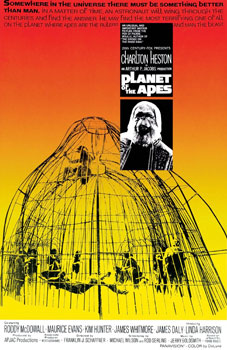
Planet of the Apes (1968)

Ah, science fiction, sometimes I forget how good a genre it can be. For Christmas, my girlfriend got me the Planet of the Apes: Legacy Collection, five films making up one of my favorite film series. It is a series that got progressively worse, continuing because audiences liked them, not because they were particularly classic movies. That said, I like them all a lot and always will, especially the first film, the one genuine classic in the bunch, 1968's Planet of the Apes.

A U.S. spacecraft is traveling in deep space, its four-person crew commanded by cynical astronaut George Taylor (Charlton Heston). Their mission involves exploring the far reaches of space, but a malfunction awakens Taylor and two other survivors as their ship crash lands on a seemingly empty planet. Taylor, along with fellow astronauts Landon (Robert Gunner) and Dodge (Jeff Burton), gather what little supplies they have and head out into this unexplored world, looking for any sign of life. Walking for days inland, they finally do find life, a human-like race that is primitive to say the least, dressed in animal furs and unable to speak. The scientific find is one thing, but the trio of astronauts is in for a far bigger shock. The humans begin to run away from an unseen threat, and then they're there. Taylor and Co. run with them, stunned to see talking apes, dressed in military uniforms on horseback and armed to the teeth. What the hell is going on? What kind of planet have the astronauts found?

It's easy to forget how much impact this 1968 sci-fi classic has had on the science fiction genre as a whole. From director Franklin J. Schaffner, 'Planet' is the first of five movies (in the original series at least) that was followed by a short-lived TV show, an attempt at a reboot (2001's Planet of the Apes), and a far more successful reboot (2011's Rise of the Planet of the Apes). I'm curious to see where the most recent series goes, but this original entry will no doubt be the one all others are compared to. It's smart, original, unsettling and keeps you guessing until the end. There are some moments in the second half that drag a little bit, but the moments that work are science fiction perfection. I plan on watching and reviewing all the Apes movies so keep an eye out, and here we go!

Obviously when you're going into a movie titled Planet of the Apes, you kinda know the twist, right? There's a planet...well, of apes. Still, Schaffner's film (working off a novel from Pierre Boulle) builds the tension to almost unbearable levels in making its revelation. In a mission that isn't completely explained, NASA sends four astronauts (one dies during the voyage) deep into space at the speed of light, working off a theory that it will advance them in time. It does, some sort of malfunction bringing the spaceship into a planet's orbit, the crew crash-landing in a huge lake. We follow them for the next 30 minutes as they venture into a seemingly empty world, Lake Powell in Utah providing a beautiful, creepy, eerie backdrop. Composer Jerry Goldsmith's score is spot-on (listen to an extended sample HERE), using regular musical notes and cues but mixing it in with a variety of odd noises that sound natural and spooky, building up that fear of the unseen and unknown.

It is around the 32-minute mark we are shockingly introduced to the world run by apes. We learn over the course of the movie more about this culture with a hierarchy of government (gorillas = military/power, chimps = educators/science, orangutans = political/authority), a history going back thousands of years, beliefs and faith in a religion and a God-like being, all these little things that make the reveal all that more involving, unsettling and fascinating. As Taylor explores this world as a prisoner -- all humans are slaves -- we meet Dr. Zira (Kim Hunter) and Dr. Cornelius (Roddy McDowall), two intellectuals and scientists, interested in learning and advancing. In Heston's Taylor, they see a chance to learn, but also a threat to everything they know, believe in and hope for. Also look for Maurice Evans as Dr. Zaius, an intellectual who knows what threats history and humans hold, the film's biggest villain, James Whitmore as the President of the Assembly, James Daly as a prosecutor trying to prove Taylor is a mutant. The idea of something so well thought out, so innovative, that simian culture is an obvious but underrated reason for the movie's success. It doesn't hurt either that the makeup for the apes is immaculately impeccable.

Charlton Heston is the man. That is all. He's one of my favorites, and I think he gets a bad wrap at times because at times, he could be a tad wooden, even playing similar roles one after another. Fair to a point, but he's a Hollywood legend for sure. In a long, distinguished career, Heston piled up memorable roles, but this is one of his best. His George Taylor is smart, cynical and willing to question anyone and everything. So when he crash lands on a planet run by intelligent apes? Yeah, he's going to have some issues. His complete shock at what he's found is genuine, Heston committing to the part. At a certain point, his goal is simple, just survive on a planet and in a community that is equal parts curious and scared to death of him. He shows off his acting too, as he's struck mute for an extended portion of the movie. I love the cynical, questioning nature of the character, and the iconic lines from 'Get your paws off me, you damn dirty apes!' (one of the most iconic lines ever) to his final line still resonate 40-plus years later.

Lost at times in the science fiction world and mystery of what we've found are some great moments among the characters. I love the dynamic between Heston's Taylor and Hunter's Dr. Zira. Their dialogue scenes, with McDowall's Cornelius too, have an easy, charming back and forth to them. It just looks easy. This is where some of the ideas and messages of 'Apes' come from. Within a different culture, we see the same questions that humans ask about evolution, survival, faith, beliefs, religion, destiny and finding your niche in life. In an underrated cast that doesn't boast a ton of star power, Hunter and McDowall really step up to the plate in support of one of Heston's best performances. Also look for Linda Harrison as Nova, a woman who bonds with Taylor, even if she is mute, Lou Wagner as Lucius, Zira's nephew who helps Taylor late in the movie, and Buck Kartalian as Julius, a gorilla guard who works with Zira with their human slaves. 

Well, here we are. The ending that rewrote the twist ending, something movies from every genre have tried to duplicate ever since. If you've made it this far into a Planet of the Apes review, I'm guessing that A. You either know the ending or B. Want to know the ending. No spoilers here. If you haven't seen 'Apes,' you deserve to go in fresh without any knowledge of what's coming. It is a great finale, one that deserves its fame and notoriety. A pretty perfect ending to a pretty perfect science fiction flick.

Planet of the Apes (1968): ****/****

Wednesday, February 5, 2014

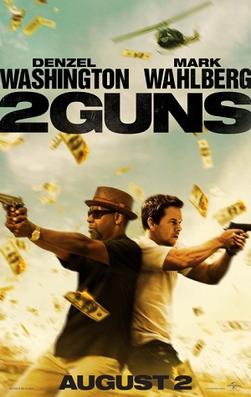
2 Guns

I love a good crime thriller. Don't you? You can decide how dark one should be, how action-packed, even how funny it is. Maybe all of the above even. If there was ever a decade that helped put the crime thriller on the map, it was the 1970s. Watching 2013's 2 Guns -- which I liked a lot -- I felt almost like it was a tribute film, a buddy crime thriller reminiscent of so many good 1970s thrillers.

Low-level criminals Bobby Beans (Denzel Washington) and Michael 'Stig' Stigman (Mark Wahlberg) have been working together, providing odds and ends for a drug cartel for almost a year now. When a deal with cartel kingpin Papi Greco (Edward James Olmos) doesn't go quite as planned, Bobby goes along with Stig's plan that he's been brewing about for months. Greco keeps a ridiculous amount of money as the Tres Cruces bank, somewhere around $3 million. Bobby and Stig are both keeping a secret from each other though, Bobby an undercover D.E.A. agent, Stig an undercover agent with Navy Intelligence. With backing from their supervisors, they pull off the robbery but get far more than they expected. Someone is setting them up. There isn't $3 million in the bank, and it doesn't belong to Greco. There's $43 million, and its powerful owner (Bill Paxton) wants it back at all costs.

It was hard not to like this movie. From director Baltasar Kormakur (who worked with Wahlberg on Contraband), 'Guns' is based off a graphic novel of the same name. It received mixed reviews last summer, but audiences seemed to like it, piling up a $131 million box office. The appeal is obvious, a buddy flick along the U.S./Mexico border with drug cartels, shootouts, corrupt government agencies, some cool car chases, and two very likable leads. Watching the DVD special features, writer Blake Masters clearly is a fan of the genre, mentioning Sam Peckinpah and Butch and Sundance as influences. The graphic novel author, Steven Grant, is the same way, a huge fan of where this genre has come from. Above all else, this is a really fun movie. It's content to be fun too, and there's absolutely nothing wrong with that.

Before I figured out what the story was about, my initial reaction was.....come on, do I really need to spell it out? It's Denzel Washington and Mark Wahlberg, two of my favorite actors, working together!! How can that go wrong? I submit that IT CANNOT. That's the beauty of films like this. You get two or three or four actors/actresses, hand them a script and let them go. These are fun parts that Washington and Wahlberg clearly had some fun bringing to life. Buddy/road movies like this have a perfection in following their formula. Two guys working together, not quite trusting each other but they don't have any other options, and everyone is against them. Their personalities are different -- Bobby quieter, smooth and charming, Stig a motor-mouthed, likable tough guy -- but really? They're not so different. Similar backgrounds, similar loyalties when it comes to getting the job done.

It doesn't hurt that both Washington and Wahlberg are two very likable actors on-screen. Nowhere is that more evident than their dialogue together. These are fast-paced, lightning-quick delivered scenes that certainly reflect two guys who've spent too much time together doing shady deals for drug cartels. The opening scene has Stig in a diner trying to order breakfast for Bobby, Bobby correcting everything that's said and then arguing about why the other one was so very wrong. It's a formula that's used a handful of times in some contagiously funny scenes, Stig trying to convince Bobby that they're actually friends, Bobby stubborn as ever in opening up some. Just a fun to watch and listen to chemistry that gives a humorous edge to the crime aspect of the story.

As for the rest of the cast, they're there to keep us guessing. Who's good? Who's bad? Who's got some tricks up their sleeve? Olmos is having some fun as Papi Greco, smooth and slimy, always ready to turn on anyone for a payday. Paula Patton gets the eye candy role (the topless eye candy, very essential to the story) as Deb, Bobby's quasi-girlfriend and contact officer within the D.E.A., Robert John Burke as Jessup, their commanding officer. Paxton gets to ham it up as Earl, the man who wants his money back, greasy hair, thin mustache and quirky to a T. James Marsden is good too as Quince, Stig's commanding officer within Navy Intelligence trying to put together a hugely successful case. Even Fred Ward makes a quick appearance as a Navy Admiral who may be able to help Stig. Definitely some fun, cool parts.

I just liked this movie, plain and simple. It reminded me of everything from Charley Varrick (robbing mafia money) to The Outfit (low level hoods) to Bring Me the Head of Alfredo Garcia (the border setting). There is absolutely nothing wrong with a movie wanting to be entertaining with absolutely no other intentions. By the time the story builds to a showdown at Greco's Mexican villa, it's just too perfect. About 28 different sides in a glorious shootout with a whole lot of money on the line. It's hard not to like movies about this. A buddy/road movie with tones of film noir, 1970s crime thrillers and that oh so perfect pulpy feel, how can you lose?

2 Guns (2013): ***/****

Tuesday, February 4, 2014

Macho Callahan

I take pride in the fact I've seen a lot of westerns. It's my favorite genre, and I do my best to see as many as I can from lousy B-westerns to more polished, big budget ventures. The beauty of having that genre you like though is that if you keep on looking and exploring, you're going to find those little-known gems that don't have a big reputation. I can add 1970's Macho Callahan to that list.

It's late in the Civil War, a man named Macho Callahan (David Janssen) just released from solitary treatment at a brutal Confederate prison camp deep in Texas. He's been waiting to put into operation his plan for a mass escape, and in execution, it works. In a bloody breakout, Callahan escapes the hellish prison camp, managing to meet up with his former partner, Juan (Pedro Armendariz Jr.), with some revenge on his mind. How exactly did Callahan -- not a soldier -- end up in the prison camp? Well, now he's searching for the man, Duffy (Lee J. Cobb) that ended up putting him there. Callahan and Juan must first track Duffy down though, but it's not going to be easy. There is a reward on Callahan's head, a rather lucrative one, and every bounty hunter, gunman and two-bit killer in the state is looking for him.

Wow. This was one nasty, dark, brutal western. The spaghetti westerns had helped tweak the western genre in a big way already in the late 1960s (and continuing into the 1970s), giving it that cynicism, that darkness that just hadn't been there in most American westerns. Well, this entry from director Bernard L. Kowalski is one of the darkest, dirtiest, meanest westerns I've ever seen, and that's a good thing. Part of it is the look of the film, all the characters dirty, sweaty and sporting all sorts of unkempt hair and beards. It sounds simple, but that goes a long way. 'Callahan' looks and feels like we're there with the characters, a visceral, authentic peek into the not so glamorous wild, wild west. I liked composer Patrick Williams' score too, not used a ton but doing a good job of building that tension and doom.

It's more than just the look though. It's something else. This is a movie with a vicious mentality. This is brutality at its worst. This is a meanness that permeates the movie. That starts in the opening, quite-startling sequence set in the Confederate prison camp. The place looks filthy, disease and grime hanging in the air. We see a cook gutting a cow, its entrails falling from the body. The prisoners waste away, waiting for their chance to escape. This sequence was disturbing in its tension, in its reality, but it sets the tone immediately, especially with the bloody, gruesome escape. That incredibly dark mood sticks around throughout the movie. The violence is bloody and graphic and uncomfortable. No one...NO ONE, is safe. Characters are killed off with the snap of a finger. At one point, Janssen's Callahan even shoots a buffalo. There's just something hanging in the air here. No romance, no beauty, no charm of the old west. This is life, where survival reigns above all else.

A TV star from The Fugitive, Janssen doesn't scream western star, but his brooding, intense Callahan is a pretty interesting lead character. Early on, he's almost completely blinded by his desire for revenge. There's more to the character of course, and without giving away much in the way of spoilers, it comes courtesy of Jean Seberg's Alexandra, a widow who wants nothing to do with Callahan but is forced to travel with him and Juan on the trail. It's not quite a love story, but feelings do develop, two lonely people finding a friend of sorts in a nasty world. Janssen also has a solid chemistry with Armendariz Jr., a familiar western dynamic between two partners, two bandits who seem to be constantly on the run. I really liked the duo, neither stars but both very capable actors.

The rest of the cast is just as solid. Along with Lee J. Cobb, look for James Booth, Bo Hopkins, Diane Ladd, David Carradine, Richard Anderson and Matt Clark. Some of the parts are bigger than others, some just a scene or two. As I mentioned earlier though, 'Callahan' isn't interested in reputation or star power. Characters are killed without warning from beginning to end here, keeping you guessing from scene-to-scene what's going to happen. This isn't glorious, romantic death either, but an unceremonious, lightning-quick fate. One second you're there. The next second you're not.

I don't know if saying I liked this movie is an apt description. It's a tough movie to like, but to watch and experience it a little bit? Yeah, that's more appropriate. Things drag some in the second half of the 99-minute movie, but as the ending approaches, momentum picks up to the inevitable, appropriately unceremonious ending. No big shootout, no big gunfight, just an ending. There's touches of the surreal too, Callahan, Alexandra, Juan and a baby bear on the trail. Don't question. Just go with it. The whole movie is a trip.

Macho Callahan (1970): ***/****

Monday, February 3, 2014

Glengarry Glen Ross

Where do you stand on cursing/swearing in movies? Do you blush if someone drops an F-bomb? Do you laugh when profanity is used as a noun, verb, adjective, even a preposition? Well, let's say this. If you're easily offended by swearing -- and I mean a lot of swearing -- then 1992 Glengarry Glen Ross may not be your type of movie.

At a small real estate agency in Chicago, the four-man salesmen staff is about to get a little shock. They're called in one night for a special meeting, a representative from their big boss arriving with a message. That rep, Blake (Alec Baldwin), delivers a simple ultimatum. The salesmen have exactly one week to prove themselves, selling as many units as humanly possible. At the end of the week, the one in the lead will be awarded a car, the second will receive a set of steak knives, and the other two? They'll be looking for work. Doesn't get any simpler than that, does it? Already working on a day-to-day basis with questionable leads to follow and a tough sell, this group has their work cut out for them. Let the hijinks begin.

This is a movie that sat in my Netflix queue for quite awhile. The cast was ridiculously talented, the story certainly interesting, and the reviews were almost uniformly glowing. Well, I caught up with it, and I can honestly say it wasn't what I thought it was going to be. That's not a negative, just a surprise on my end. I had a picture of high-end real estate, an agency in downtown Chicago dealing with huge deals of millions of dollars and gazillionaires. What is it? A far smaller, low-end agency with a cramped, cluttered office where the salesmen use all sorts of underhanded, duplicitous means to finish off a sale. These four salesmen are truly desperate, knowing their jobs and livelihood depend on one week of being able to do their jobs. Talk about pressure.

From director James Foley, 'Ross' is based off a play from David Mamet (who also wrote the screenplay). It clocks in at 100 minutes and generally has the style and feel of a stage-based play. The story takes place over a span of maybe 12, 18 hours and is based in only two locations, the real estate office and the Chinese restaurant across the street where the salesmen go for a bite to eat and get a drink. The rhythm develops like a play, the cast getting a chance to show their stuff in extended scenes of dialogue, setting things up and then letting it all develop. This is a movie about the dialogue, no doubt about it, Mamet's script a gem. The dialogue is fast and furious, the talented cast delivering it in almost machine gun succession, rapid fire that never slows down. 'Ross' isn't a movie about the effects or the style. It's about the acting, the chemistry, the script and the dialogue. Straightforward in its objectives, it's the better for it.

How about that for a slow burn? I haven't even mentioned the cast beyond Baldwin's one-scene, scene-stealing appearance. Haha take that! Foley is working with quite the cast in terms of pure acting power. The real estate salesmen include Ricky Roma (Al Pacino), the fiery, criminally smooth operator and frontrunner for the award for best salesmen, Shelley Levene (Jack Lemmon), the oldest salesmen in the group and maybe the most desperate because of a recent cold streak in sales, George Aaronow (Alan Arkin), the tag-along of sorts, worried about the challenge but letting everyone else lead the way in opinions, and Dave Moss (Ed Harris), the most heated and the one maybe most willing to do something desperate for the job. As the circus master of this crew, Kevin Spacey bides his time as Williamson, their boss who tries to keep them in check while taking an almost constant barrage of criticism from his employees. Also look for Jonathan Pryce as a possible customer working with Roma who has a serious issue with a sale.

Each character gets his chance to shine, none of them disappointing. I was most impressed with Pacino and Lemmon, but that's like saying which pizza is the best. They're all really good, but some are just slightly better. The dialogue crackles from the get-go and never slows down. It can be uncomfortable at times, this crew just ripping each other apart for any number of reasons, from lack of sales to botching a call. Baldwin's cameo gets things going at a 100 miles per hour, demanding that these salesmen 'Always be closing.' It never really slows down. The dialogue is always going, but the camera just follows the conversational acting, letting the conversations and arguments and fights breathe and develop on their own. The movie is 100 minutes long, but it flies by.

I really liked where this one went about the halfway point. You think you know where it's going, and it pulls the rug out from under you. The ending especially caught me by surprise. Oh, and random pop culture tidbit, Lemmon's excellent performance as aging Shelley Levene was quite the inspiration for Gil Gunderson, the disheveled salesmen on The Simpsons.

Glengarry Glen Ross (1992): ***/****