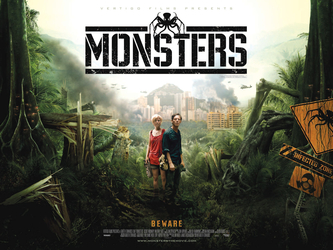
A sci-fi, possibly post-apocalyptic story made on a relatively small budget with an unknown cast. From trailers and some reviews, 2010's Monsters sounded like it had a ton of potential, a film I was definitely looking forward to trying. The end result? A mixed bag. The parts that work are home runs. Overall though? Mostly a swing and a miss.
It's been six years since a NASA space probe carrying a form of alien life crashed into Mexico. The aliens have set up shop (of sorts) in a zone that's been dubbed the Quarantine Zone with the U.S. military guarding the border on either side, both north and south. More or less, the aliens have been limited and kept under control, but there doesn't appear to be a way to truly defeat and wipe them out. South of the quarantine zone, photojournalist Andrew Kaulder (Scoot McNairy) is contacted by his employer and given a key task. The boss' daughter, Samantha (Whitney Able), is also south of the zone but needs to get into the U.S. The only way there? Through the Quarantined Zone, navigating a war-torn land where immense aliens lie in hiding.
I can't think of a movie I've seen even somewhat recently that is so good in parts and so bad in others. So let's get that out of the way. I won't be giving it a positive review, but there are parts on their own that are definitely worth checking out. If director-writer-cinematographer Gareth Edwards could have made a whole movie about the parts that work, 'Monsters' would be a near-classic. Composer Jon Hopkins' score is a gem -- listen to the theme HERE -- that is equal parts soothing and calm in an ethereal way and unsettling in its ability to be quiet and underplayed. The cast is mostly limited to McNairy and Able (more details later), and we get the sense of what a world would be like years after an alien invasion of sorts. If there was ever an art-house alien invasion flick, this would be it.
Those are the parts I love. It is an understated, underplayed story that plays almost like a documentary. Other than the early explanation via title cards, we learn little about how the aliens came to be, how the fighting went, how the situation came to be as we see it. Leaving certain things to the imagination doesn't always work out, but here it does. It adds a sense of mystery. The opening sequence shows a military convoy fighting an alien, setting the stage for the movie in an unsettling beginning. From there on though, the focus is through the eyes of Kaulder and Samantha. We see a war-torn land where the carcasses of long-dead aliens remain. We see an already poor country in Mexico brought to the brink of destruction, the people left in the Zone struggling for survival. It never panders for emotion or goes for an obvious message in those scenes. Now, if only the rest of the movie could have taken that idea to heart.
It, of course, does not. Why must directors/producers/writers insist on adding a not-so-thinly veiled message into their films? Usually, that message is about current events in some form or another, and here, it's immigration. More specifically, illegal immigration between the United States and Mexico along the Rio Grande. To keep the aliens in the Zone and out of the U.S., the military has built an immense, heavily fortified wall all along the border. Subtle it is not. Thankfully, the issue isn't overly used to the point I wanted to rip my ears off, but basically any mention of the "alien fence" came across as heavy-handed and obvious to me. It's a movie about a Quarantined Zone still occupied by humans who are trying to survive against aliens stranded on our planet. Why does it have to be something else? Why can't it just be what it is? Nah, that makes too much sense.
That ends up being at least half of the film's downfall. But I'm trying to keep you on your toes so I'm going to bounce back to the positive, starting with the portrayal of the aliens. The creatures are a mix of the Cloverfield monster, the War of the World creatures, and the aliens from The Mist. Like in Cloverfield, we never truly see them head-on to get a great, clear look at them. We see and hear them in the distance, see them skimming along under the water's surface, see them moving in the dark. It's that sense of mystery I mentioned earlier that gives 'Monsters' that needed edge. As an audience, we're allowed to make up our minds to a point. What exactly is going on with these creatures? Are they even violent creatures or did we make them that way with our attacks meant to eliminate them? That mystery can go either way, but for me in this instance, I really liked it. A very effective scene is in the finale as we get our best look at the creatures, but that's undone by the final scene. As for that part....
The review is getting a tad long, and I feel like I'm rambling a bit, but I have to make one more point. Playing the only two main characters, McNairy and Able are all right as Kaulder and Samantha. My biggest issue with the characters is that they're just not likable. They are done no favors by a script that limits everything they do. Kaulder is separated from a woman he had a child with (wouldn't you know? It's nearing his birthday) while Samantha is heading home to be married (wouldn't you know? She's having second thoughts). A story with a ton of potential about this post-apocalyptic situation degenerates into a story ripped right out of a romantic comedy. Will Kaulder and Samantha end up together? Will they figure out what they want in life? Gag me. What a ridiculous twist. The final nail is the closing scene, an open-ended finale that disappoints. So know what you're getting into. At just 94 minutes, it never overstays its welcome, but it's never a truly worthwhile watch.
Monsters (2010): ** 1/2 /****
The Sons of Katie Elder
"First, we reunite, then find Ma and Pa's killer...then read some reviews."
Wednesday, December 19, 2012
Monday, December 17, 2012
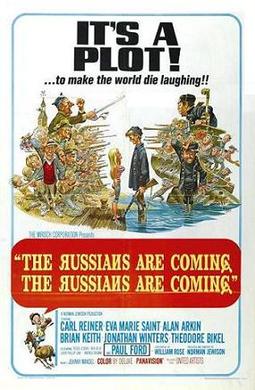
The Russians Are Coming The Russians Are Coming
From a screenplay by William Rose, 1963's It's a Mad Mad Mad Mad World is one of my all-time favorite comedies with its ridiculous cast, madcap comedy and general zaniness. Three years later, Rose tried to duplicate the success with the similar formula. Unfortunately, 1966's The Russians Are Coming The Russians Are Coming doesn't match up.
Off the East Coast and near Gloucester, a Russian sub is run aground by a captain (Theodore Bikel) who wants to get a good look at America. The Russians send a landing party to shore commanded by Lt. Rozanov (Alan Arkin) to find some sort of help....secretly of course. The little island is quiet though, everyone basically minding their own business. Rozanov and his eight-man patrol first go to the house of a vacationing writer, Walt Whittaker (Carl Reiner), and his family. As they ever so secretly and quietly seek help -- a powerboat to help pull the sub off a sandbar -- rumor spreads through the island like wildfire. Anyone and everyone who can carry a weapon takes to the streets to find the Russians.
Now, I'm no dummy. I knew going into this movie it was a comedy. Having watched it, I know it is a comedy. But reading that description, nothing at all screams comedy about it, and I think that may be the biggest thing working against this Norman Jewison-directed comedy. A madcap, screwball comedy about a bunch of strangers traveling a couple hundred miles to unearth some buried money? That's funny. A madcap, screwball comedy about a tiny New England island trying to hunt down some marauding Russians? Yeah, not so much. My first reaction was for the film to do a complete 180. An action movie, a drama, a politically-charged thriller with this basis premise would be a gem, full of tension and anxiety.
That's me in my own head though. The basic premise of the story just isn't funny then. I may have chuckled here and there, but I don't remember actually laughing out loud once. The comedy and laughs weren't there for me. As posses sprout up all over the island and everyone starts to freak out, the story bounces among five or six different developing situations (for the lack of any better description). Reiner's Walt tied up to a rather large woman (Tessie O'Shea) by the Russians and trying to escape? The town drunk chasing a horse (the entire movie) so he can warn the island Paul Revere-style what's going on? Screwball is one thing. Just stupid another.
If there is any saving grace here -- however slim -- it will be the cast. Now granted, none of the performances are that good or that funny, but come on.....star power! Reiner's Walt is married to Eva Marie Saint with some decent back and forths between the veteran actors. Young Sheldon Collins plays their shrill son, Pete. Arkin is a bright spot as Rozanov, but I think it's mostly because he gets to play a straight man to all the hijinks and shenanigans. His Russian accent is pretty funny too. Brian Keith and Jonathan Winters get to ham it up as the Sheriff and his deputy, but the biggest ham is Paul Ford as the island veteran leading the hunt with his ancient sword. Also look for John Phillip Law as one of Rozanov's sailors who instantly falls in love with the Whittaker's babysitter (Andrea Dromm).
Sorry to say, but I came away vastly disappointed with this comedy. At 126 minutes, it's just too long and even tedious. Making it worse, any scene with Russian being spoken doesn't feature subtitles. I don't care if it's made-up, jokey subtitles, but put something on the screen for long dialogue scenes! The romance between Law's sailor and the babysitter is painful to watch at times too. Apologize for the somewhat shorter review than usual, but I was completely unimpressed with this comedy.
The Russians Are Coming (1966): **/****
Off the East Coast and near Gloucester, a Russian sub is run aground by a captain (Theodore Bikel) who wants to get a good look at America. The Russians send a landing party to shore commanded by Lt. Rozanov (Alan Arkin) to find some sort of help....secretly of course. The little island is quiet though, everyone basically minding their own business. Rozanov and his eight-man patrol first go to the house of a vacationing writer, Walt Whittaker (Carl Reiner), and his family. As they ever so secretly and quietly seek help -- a powerboat to help pull the sub off a sandbar -- rumor spreads through the island like wildfire. Anyone and everyone who can carry a weapon takes to the streets to find the Russians.
Now, I'm no dummy. I knew going into this movie it was a comedy. Having watched it, I know it is a comedy. But reading that description, nothing at all screams comedy about it, and I think that may be the biggest thing working against this Norman Jewison-directed comedy. A madcap, screwball comedy about a bunch of strangers traveling a couple hundred miles to unearth some buried money? That's funny. A madcap, screwball comedy about a tiny New England island trying to hunt down some marauding Russians? Yeah, not so much. My first reaction was for the film to do a complete 180. An action movie, a drama, a politically-charged thriller with this basis premise would be a gem, full of tension and anxiety.
That's me in my own head though. The basic premise of the story just isn't funny then. I may have chuckled here and there, but I don't remember actually laughing out loud once. The comedy and laughs weren't there for me. As posses sprout up all over the island and everyone starts to freak out, the story bounces among five or six different developing situations (for the lack of any better description). Reiner's Walt tied up to a rather large woman (Tessie O'Shea) by the Russians and trying to escape? The town drunk chasing a horse (the entire movie) so he can warn the island Paul Revere-style what's going on? Screwball is one thing. Just stupid another.
If there is any saving grace here -- however slim -- it will be the cast. Now granted, none of the performances are that good or that funny, but come on.....star power! Reiner's Walt is married to Eva Marie Saint with some decent back and forths between the veteran actors. Young Sheldon Collins plays their shrill son, Pete. Arkin is a bright spot as Rozanov, but I think it's mostly because he gets to play a straight man to all the hijinks and shenanigans. His Russian accent is pretty funny too. Brian Keith and Jonathan Winters get to ham it up as the Sheriff and his deputy, but the biggest ham is Paul Ford as the island veteran leading the hunt with his ancient sword. Also look for John Phillip Law as one of Rozanov's sailors who instantly falls in love with the Whittaker's babysitter (Andrea Dromm).
Sorry to say, but I came away vastly disappointed with this comedy. At 126 minutes, it's just too long and even tedious. Making it worse, any scene with Russian being spoken doesn't feature subtitles. I don't care if it's made-up, jokey subtitles, but put something on the screen for long dialogue scenes! The romance between Law's sailor and the babysitter is painful to watch at times too. Apologize for the somewhat shorter review than usual, but I was completely unimpressed with this comedy.
The Russians Are Coming (1966): **/****
Sunday, December 16, 2012
Big Jake
From his starring screen debut in 1930's The Big Trail to his final film in 1976's The Shootist, John Wayne
became one of Hollywood's most beloved stars. For me, he will always be
one of my favorites. Some look to The Searchers, She Wore a Yellow
Ribbon and The Shootist as his best roles (and they are), but one of my
favorites from the Duke is a change of pace western from 1971, Big Jake.
It's 1909 along the Texas/Mexico border when an outlaw, John Fain (Richard Boone), leads his gang of murderers and cutthroats in a vicious attack on the expansive McCandles Ranch. Ten people are killed, and ranch owner Martha (Maureen O'Hara) sees her grandson kidnapped. Fain demands a ransom of $1 million, leaving a note that says simply "Follow the map." Knowing her grandson could be killed no matter what she decides, Martha seeks out her estranged husband, Jacob (Wayne), to take the ransom money into Mexico and get his grandson (who he didn't know) back. With help from his two sons, James (Patrick Wayne) and Michael (Christopher Mitchum), and an old friend, Apache Sam Sharpnose (Bruce Cabot), Jacob agrees, setting off to bring his grandson back alive or his captors dead.
Without a doubt, this is the most graphically violent movie of Wayne's career. Others like The Alamo are violent, but nothing quite like this. For western fans alone, that feature makes this George Sherman-directed western worth watching. Sidenote: With Sherman sick and unable to be on-location during shooting, Wayne directed much of the movie. In a career that spanned five decades, this is certainly a departure for the Duke. It is trying to be more modern, using some heavy-duty blood squibs. Even when the violence isn't on-screen, it is beyond startling and even disturbing in some scenes. Somewhat oddly, there is still an oddly comic tune at times that feels out of place alongside the sometimes extreme violence.
Wouldn't you know it though? I grew up watching this film -- still have an old VHS recording off TBS along with the bare-bones DVD -- and will always remember it fondly. Beyond the on-screen violence, there is something different about this western that's hard to put my finger on. I think I like it because of its general eccentric nature; the violence mixed with the odd humor. 'Jake' was shot on location in Mexico in Durango and Zacatecas, giving it a real sense of authenticity. Many Wayne westerns -- The War Wagon, Sons of Katie Elder, The Undefeated -- were shot in Mexico, and wouldn't you know it? Mexico looks like Mexico, giving a great backdrop to the story. The always reliable Elmer Bernstein turns in an eclectic score that covers a lot of ground, but in a good way. Listen to the main theme HERE, but that's just a taste of what Bernstein's score has to offer. Another case of the little things aiding the bigger cause.
What else though? I love the interaction between Wayne and his two sons he hasn't seen in years. Estranged from his family (for unknown reasons), he only comes back at his wife's request. Wayne's introduction is priceless, O'Hara's Martha saying she needs a man as unpleasant as the mission he'll undertake. Cut to Wayne squinting down the barrel of a rifle in an extreme close-up with Bernstein's score playing. Jake is believed to have been killed years before, forcing him to hear many people say "I thought you were dead." Nope, still kicking, traveling through Texas and Mexico with his fiercely loyal dog. Seeing his sons again provides some of the movie's genuinely funny moments and also some surprisingly effective dramatic moments. Neither Patrick Wayne or Mitchum are out of this world actors, but they hold their own, as does a scene-stealing Cabot as an aging Apache.
The cast is far from done there, especially an underused Richard Boone as the calculating, brutal John Fain. Most villains cower in Wayne's shadow, but not Boone. Their scenes together are beyond perfect, few though they may be. Watch THIS scene for proof (apologies for the low quality). Fain's gang includes O'Brien (Glenn Corbett), a half-breed gunslinger, Pop Dawson (an unrecognizable Harry Carey Jr.), Kid Duffy (stuntman Dean Smith), a deadshot with a rifle, John Goodfellow (Gregg Palmer), a machete-wielding psycho, Trooper (Jim Burk), an Army deserter, and Will Fain (Robert Warner), John's brother who favors a shotgun. Singer Bobby Vinton makes a brief appearance as Jake's third son. Also look for recognizable western faces John Doucette, John Agar, Jim Davis, Hank Worden, Chuck Roberson (Wayne's stunt double), and Roy Jenson. Wayne's real-life son, Ethan Wayne, plays the kidnapped Little Jake.
Following the startling opening attack at the McCandles Ranch, things more or less settle down until the finale in the action department. After dealing with some pistoleros who want to get their hands on the $1 million ransom, Jacob and Co. head to the ruins of an old Spanish mission for the exchange. On a stormy night, the sequence that follows is a gem. It's brutal and vicious -- with at least two surprises -- but it always stays on a small-scale level where you know what's going on. The mission and plaza was supposedly used in the 1910s by revolutionary Pancho Villa for executions, adding a dark edge to the scenes. The gunplay isn't remembered as one of the all-time bests, but the finale is one of my favorites, partially due to the action, some to the script with its great one-liners.
Whatever the reasoning, I love this movie. I know it's not a great movie, but I love it just the same. John Wayne fans should appreciate this one, and western fans on the whole as well.
Big Jake <----trailer (1971): ****/****
Rewrite of review from July 2009
It's 1909 along the Texas/Mexico border when an outlaw, John Fain (Richard Boone), leads his gang of murderers and cutthroats in a vicious attack on the expansive McCandles Ranch. Ten people are killed, and ranch owner Martha (Maureen O'Hara) sees her grandson kidnapped. Fain demands a ransom of $1 million, leaving a note that says simply "Follow the map." Knowing her grandson could be killed no matter what she decides, Martha seeks out her estranged husband, Jacob (Wayne), to take the ransom money into Mexico and get his grandson (who he didn't know) back. With help from his two sons, James (Patrick Wayne) and Michael (Christopher Mitchum), and an old friend, Apache Sam Sharpnose (Bruce Cabot), Jacob agrees, setting off to bring his grandson back alive or his captors dead.
Without a doubt, this is the most graphically violent movie of Wayne's career. Others like The Alamo are violent, but nothing quite like this. For western fans alone, that feature makes this George Sherman-directed western worth watching. Sidenote: With Sherman sick and unable to be on-location during shooting, Wayne directed much of the movie. In a career that spanned five decades, this is certainly a departure for the Duke. It is trying to be more modern, using some heavy-duty blood squibs. Even when the violence isn't on-screen, it is beyond startling and even disturbing in some scenes. Somewhat oddly, there is still an oddly comic tune at times that feels out of place alongside the sometimes extreme violence.
Wouldn't you know it though? I grew up watching this film -- still have an old VHS recording off TBS along with the bare-bones DVD -- and will always remember it fondly. Beyond the on-screen violence, there is something different about this western that's hard to put my finger on. I think I like it because of its general eccentric nature; the violence mixed with the odd humor. 'Jake' was shot on location in Mexico in Durango and Zacatecas, giving it a real sense of authenticity. Many Wayne westerns -- The War Wagon, Sons of Katie Elder, The Undefeated -- were shot in Mexico, and wouldn't you know it? Mexico looks like Mexico, giving a great backdrop to the story. The always reliable Elmer Bernstein turns in an eclectic score that covers a lot of ground, but in a good way. Listen to the main theme HERE, but that's just a taste of what Bernstein's score has to offer. Another case of the little things aiding the bigger cause.
What else though? I love the interaction between Wayne and his two sons he hasn't seen in years. Estranged from his family (for unknown reasons), he only comes back at his wife's request. Wayne's introduction is priceless, O'Hara's Martha saying she needs a man as unpleasant as the mission he'll undertake. Cut to Wayne squinting down the barrel of a rifle in an extreme close-up with Bernstein's score playing. Jake is believed to have been killed years before, forcing him to hear many people say "I thought you were dead." Nope, still kicking, traveling through Texas and Mexico with his fiercely loyal dog. Seeing his sons again provides some of the movie's genuinely funny moments and also some surprisingly effective dramatic moments. Neither Patrick Wayne or Mitchum are out of this world actors, but they hold their own, as does a scene-stealing Cabot as an aging Apache.
The cast is far from done there, especially an underused Richard Boone as the calculating, brutal John Fain. Most villains cower in Wayne's shadow, but not Boone. Their scenes together are beyond perfect, few though they may be. Watch THIS scene for proof (apologies for the low quality). Fain's gang includes O'Brien (Glenn Corbett), a half-breed gunslinger, Pop Dawson (an unrecognizable Harry Carey Jr.), Kid Duffy (stuntman Dean Smith), a deadshot with a rifle, John Goodfellow (Gregg Palmer), a machete-wielding psycho, Trooper (Jim Burk), an Army deserter, and Will Fain (Robert Warner), John's brother who favors a shotgun. Singer Bobby Vinton makes a brief appearance as Jake's third son. Also look for recognizable western faces John Doucette, John Agar, Jim Davis, Hank Worden, Chuck Roberson (Wayne's stunt double), and Roy Jenson. Wayne's real-life son, Ethan Wayne, plays the kidnapped Little Jake.
Following the startling opening attack at the McCandles Ranch, things more or less settle down until the finale in the action department. After dealing with some pistoleros who want to get their hands on the $1 million ransom, Jacob and Co. head to the ruins of an old Spanish mission for the exchange. On a stormy night, the sequence that follows is a gem. It's brutal and vicious -- with at least two surprises -- but it always stays on a small-scale level where you know what's going on. The mission and plaza was supposedly used in the 1910s by revolutionary Pancho Villa for executions, adding a dark edge to the scenes. The gunplay isn't remembered as one of the all-time bests, but the finale is one of my favorites, partially due to the action, some to the script with its great one-liners.
Whatever the reasoning, I love this movie. I know it's not a great movie, but I love it just the same. John Wayne fans should appreciate this one, and western fans on the whole as well.
Big Jake <----trailer (1971): ****/****
Rewrite of review from July 2009
Saturday, December 15, 2012
The FBI Story
Released in 1959, The FBI Story is an interesting flick, but not always for the right reasons. Made with the support of J. Edgar Hoover and the FBI, the final product has that whitewashed, diluted feel to it. Hoover apparently ran roughshod over the making of the movie, and it shows. Some things stand out, but for the most part, it's one big dull pat on the back.
Working as a field agent in the infancy of the Federal Bureau of Investigations, Chip Hardesty (James Stewart) proposes to his long-time girlfriend, Lucy (Vera Miles), and agrees to resign his post. His timing could not be worse as the FBI is making drastic changes to become a more effective, more efficient government office. Chip maintains his status as an agent right as the U.S. is heading into some of its most tumultuous times in its young history. Chip sees all the good that he is able to accomplish through his work -- even with the danger -- while Lucy worries away at home with their growing family.
The biggest fault this movie has is that J. Edgar Hoover had any involvement at all with it. The FBI director apparently ordered film director Mervyn LeRoy to re-shoot certain scenes, insisting they show the FBI in a more positive light. So while Hoover attempted to make a movie that showed his agency for all its heroism and righteousness, the end result is a disgustingly positive "look" into the inner workings. These are Superheroes! G-Men! Infallible and can't be touched. The potential is there -- seeing the 1950s crime scene techniques, the depths an investigation will go to -- with some cool scenes, but it has an incredibly fake, forced feel. I can just see Hoover smiling like a nut thinking 'Oh, audiences will love this," almost like he's holding a door open to let us see. Nice try, Mr. Hoover.
In terms of the story, think of this movie as The FBI Story: The Forrest Gump Version. From when he joins the FBI in the mid 1920s, Stewart's Chip takes part in just about every important, watershed moment in FBI history. The Ku Klux Klan, murdered Native Americans for oil rights, shifty Communists, the gangsters of the 1930s, Axis agents in WWII, this guy does everything. The problem? In a 149-minute movie (a very long 149 minutes), none of these events are given their due. 'Story' covers 30-plus years in history, glazing over the most important -- and usually entertaining -- portions with broad strokes. All of those things are worthy of a movie on their own, but here we're treated to little windows, just snippets, of what was going on. Again, maybe chalk it up to Hoover trying to show everything the FBI has ever done? Who knows for sure.
Unfortunately, the solution to the above-problem is simple. Yes, it's a 149-minute long movie. I would guess anywhere from 90-100 minutes is actually about the FBI. The rest? As one IMDB reviewer so eloquently put it...."Father Knows Best: With Guns." Mindlessly tedious scenes with Chip, Lucy and their family are painful to watch. It even makes the FBI snippets insanely exciting (and they're really not). Chip goes on assignment. Lucy complains, buckles and lets him go. Chip goes on assignment..........and repeat eight or nine times. It's not interesting the first time so time No. 8 isn't any better. To top it off, Stewart and Miles (one of my least favorite actresses) don't have a ton of chemistry. She comes across as shrill, and Stewart to quirky-goofy at times in their home scenes.
Any more problems? Sure, why not! Other than Stewart and Miles, 'Story' has little in the way of star power. The movie doesn't call for a cast of thousands, all big name celebrities, but on the other hand, some more recognizable faces couldn't hurt. Murray Hamilton is good if underused as Chip's partner, Sam Crandall, who climbs the FBI ladder with him. Larry Pennell plays George Crandall, Sam's son who grows up wanting to be an FBI agent like his father. Also look for Nick Adams in a small part early as a mentally unhinged individual who plants on a bomb on a commercial airliner. Unfortunately, no one else truly stands out. Disappointed here overall. You know it's bad when even Jimmy Stewart can't save a movie, but this FBI-backed story just has too many holes and flaws.
The FBI Story (1959): **/****
Working as a field agent in the infancy of the Federal Bureau of Investigations, Chip Hardesty (James Stewart) proposes to his long-time girlfriend, Lucy (Vera Miles), and agrees to resign his post. His timing could not be worse as the FBI is making drastic changes to become a more effective, more efficient government office. Chip maintains his status as an agent right as the U.S. is heading into some of its most tumultuous times in its young history. Chip sees all the good that he is able to accomplish through his work -- even with the danger -- while Lucy worries away at home with their growing family.
The biggest fault this movie has is that J. Edgar Hoover had any involvement at all with it. The FBI director apparently ordered film director Mervyn LeRoy to re-shoot certain scenes, insisting they show the FBI in a more positive light. So while Hoover attempted to make a movie that showed his agency for all its heroism and righteousness, the end result is a disgustingly positive "look" into the inner workings. These are Superheroes! G-Men! Infallible and can't be touched. The potential is there -- seeing the 1950s crime scene techniques, the depths an investigation will go to -- with some cool scenes, but it has an incredibly fake, forced feel. I can just see Hoover smiling like a nut thinking 'Oh, audiences will love this," almost like he's holding a door open to let us see. Nice try, Mr. Hoover.
In terms of the story, think of this movie as The FBI Story: The Forrest Gump Version. From when he joins the FBI in the mid 1920s, Stewart's Chip takes part in just about every important, watershed moment in FBI history. The Ku Klux Klan, murdered Native Americans for oil rights, shifty Communists, the gangsters of the 1930s, Axis agents in WWII, this guy does everything. The problem? In a 149-minute movie (a very long 149 minutes), none of these events are given their due. 'Story' covers 30-plus years in history, glazing over the most important -- and usually entertaining -- portions with broad strokes. All of those things are worthy of a movie on their own, but here we're treated to little windows, just snippets, of what was going on. Again, maybe chalk it up to Hoover trying to show everything the FBI has ever done? Who knows for sure.
Unfortunately, the solution to the above-problem is simple. Yes, it's a 149-minute long movie. I would guess anywhere from 90-100 minutes is actually about the FBI. The rest? As one IMDB reviewer so eloquently put it...."Father Knows Best: With Guns." Mindlessly tedious scenes with Chip, Lucy and their family are painful to watch. It even makes the FBI snippets insanely exciting (and they're really not). Chip goes on assignment. Lucy complains, buckles and lets him go. Chip goes on assignment..........and repeat eight or nine times. It's not interesting the first time so time No. 8 isn't any better. To top it off, Stewart and Miles (one of my least favorite actresses) don't have a ton of chemistry. She comes across as shrill, and Stewart to quirky-goofy at times in their home scenes.
Any more problems? Sure, why not! Other than Stewart and Miles, 'Story' has little in the way of star power. The movie doesn't call for a cast of thousands, all big name celebrities, but on the other hand, some more recognizable faces couldn't hurt. Murray Hamilton is good if underused as Chip's partner, Sam Crandall, who climbs the FBI ladder with him. Larry Pennell plays George Crandall, Sam's son who grows up wanting to be an FBI agent like his father. Also look for Nick Adams in a small part early as a mentally unhinged individual who plants on a bomb on a commercial airliner. Unfortunately, no one else truly stands out. Disappointed here overall. You know it's bad when even Jimmy Stewart can't save a movie, but this FBI-backed story just has too many holes and flaws.
The FBI Story (1959): **/****
Labels:
1950s,
James Stewart,
Murray Hamilton,
Nick Adams,
Vera Miles
Thursday, December 13, 2012
Hate Thy Neighbor
With characters like the Man With No Name, Django, Sabata, Sartana and several others, the spaghetti western genre became famous (infamous depending on the reviewer) for highly memorable lead characters. Then there's 1968's Hate Thy Neighbor -- what a great title -- where the interesting lead has been dropped in favor of two much more interesting bad guys.
Running from a gang of gunmen, a man is killed -- along with his wife -- for a map of a nearby but hidden goldmine. The gang's leader, Gary Stevens (George Eastman), is working for a local businessman/rancher with a sadistic streak, Chris Malone (Horst Frank). Together, they intend to find the location of the goldmine and split whatever they find. Their plan hits a roadblock though when the dead man's brother, Ken Dakota (Spiros Focas), shows up to pick up his nephew who survived the shooting. Dakota finds out not only that his brother was murdered, but who did it. Now, it's just a matter of time before the three paths collide.
This is a spaghetti western lost in the shuffle over the years. I suppose that happens when some 600 movies were made from one genre over about 10 years. Some were good, some were bad, and some were awful. This one has no star power and doesn't do a ton to differentiate itself from the pack. There are some interesting camera angles, and the score from Robby Poitevin is okay in the moment if not particularly memorable. The story is familiar (countless spaghettis relied on revenge as a story-driver), but at the same time it's never dull. Clocking in just 84 minutes, there is little in the way of wasted time, and I enjoyed it to the end, eccentricities and all.
As far as lead characters go, I'm straining to think of one who was more dull than Focas' Ken Dakota. Okay, that's not fair. His name is pretty cool, but that's about it. He shows up looking for answers about his brother's death, and sort of meanders along getting those answers. I don't know if it's his fault, but the script gives him nothing to do, and Focas isn't exactly a charismatic actor. He's too goody-two shoes for a spaghetti western anti-hero. His budding romance with Peggy (the always lovely Nicoletta Machiavelli) and his fatherly relationship with nephew, Pat (Claudio Castellani), feel like they've been hijacked from an after school special. The final scene could even be the freeze frame of a 1980s sitcom episode. Basically it feels like an American western in its portrayal of the hero.
Thankfully, director Ferdinando Baldi seems to recognize that his hero is just a means to an end. He needs someone to set off the bad guys, and these bad guys carry the movie. Besides having maybe the most boring, Dilbert-like character name (Gary Stevens? Really? That's the best you could come up with?), Eastman is a scene-stealer as Gary. He's got a smile like a rattlesnake and will gun his enemies down without a second thought. As the classier, suaver villain, Frank is the perfect counter to Easman's tougher villain. Their life and death rivalry is something else. Reviews point to their cat-and-mouse game back and forth, and it certainly works. Each would like nothing more than to kill the other, but as is so often the case with greed, they need each other....for the time being. I would have loved a movie focusing exclusively on these two, but I'll take what's here.
It's Frank's Chris Malone that provides some of the movie's most memorable, eccentric moments. Like a Roman lord, he has his "slaves" fight to the death in a corral. They're given a wooden shield worn over their wrist and a Wolverine-like blade on their other hand. Guarded on all sides by riflemen, a duo fights to the death and Malone and his wife (Ivy Holzer) watches from their elevated seats. There are two different fights in the ring, and they're doozies worth the price of admission alone. Malone also unleashes an elaborate torture on Gary to get some information out of him that includes hanging upside down, a pit of snakes and hungry rats gnawing at the ropes holding him up. Diabolically evil much?
Two other parts worth mentioning, one normal, one typically eccentric. Paolo Magalotti plays Jose, Malone's trusted right-hand man, and makes the most of the pretty standard part. A highlight? Jose and his men save Gary from hanging by distracting his guards via some Spanish guitar action. Odd? Yes, but a hilariously bad scene. As for the typically eccentric, Robert Risso plays Duke, Ken's sidekick, a shotgun-wielding, accordion-playing undertaker/coffin maker. I can honestly say I've never typed a sentence like that before. So while the main character's interest levels are lacking, the rest of the movie certainly makes up for it. Well worth giving a watch!
Hate Thy Neighbor (1967): ***/****
Running from a gang of gunmen, a man is killed -- along with his wife -- for a map of a nearby but hidden goldmine. The gang's leader, Gary Stevens (George Eastman), is working for a local businessman/rancher with a sadistic streak, Chris Malone (Horst Frank). Together, they intend to find the location of the goldmine and split whatever they find. Their plan hits a roadblock though when the dead man's brother, Ken Dakota (Spiros Focas), shows up to pick up his nephew who survived the shooting. Dakota finds out not only that his brother was murdered, but who did it. Now, it's just a matter of time before the three paths collide.
This is a spaghetti western lost in the shuffle over the years. I suppose that happens when some 600 movies were made from one genre over about 10 years. Some were good, some were bad, and some were awful. This one has no star power and doesn't do a ton to differentiate itself from the pack. There are some interesting camera angles, and the score from Robby Poitevin is okay in the moment if not particularly memorable. The story is familiar (countless spaghettis relied on revenge as a story-driver), but at the same time it's never dull. Clocking in just 84 minutes, there is little in the way of wasted time, and I enjoyed it to the end, eccentricities and all.
As far as lead characters go, I'm straining to think of one who was more dull than Focas' Ken Dakota. Okay, that's not fair. His name is pretty cool, but that's about it. He shows up looking for answers about his brother's death, and sort of meanders along getting those answers. I don't know if it's his fault, but the script gives him nothing to do, and Focas isn't exactly a charismatic actor. He's too goody-two shoes for a spaghetti western anti-hero. His budding romance with Peggy (the always lovely Nicoletta Machiavelli) and his fatherly relationship with nephew, Pat (Claudio Castellani), feel like they've been hijacked from an after school special. The final scene could even be the freeze frame of a 1980s sitcom episode. Basically it feels like an American western in its portrayal of the hero.
Thankfully, director Ferdinando Baldi seems to recognize that his hero is just a means to an end. He needs someone to set off the bad guys, and these bad guys carry the movie. Besides having maybe the most boring, Dilbert-like character name (Gary Stevens? Really? That's the best you could come up with?), Eastman is a scene-stealer as Gary. He's got a smile like a rattlesnake and will gun his enemies down without a second thought. As the classier, suaver villain, Frank is the perfect counter to Easman's tougher villain. Their life and death rivalry is something else. Reviews point to their cat-and-mouse game back and forth, and it certainly works. Each would like nothing more than to kill the other, but as is so often the case with greed, they need each other....for the time being. I would have loved a movie focusing exclusively on these two, but I'll take what's here.
It's Frank's Chris Malone that provides some of the movie's most memorable, eccentric moments. Like a Roman lord, he has his "slaves" fight to the death in a corral. They're given a wooden shield worn over their wrist and a Wolverine-like blade on their other hand. Guarded on all sides by riflemen, a duo fights to the death and Malone and his wife (Ivy Holzer) watches from their elevated seats. There are two different fights in the ring, and they're doozies worth the price of admission alone. Malone also unleashes an elaborate torture on Gary to get some information out of him that includes hanging upside down, a pit of snakes and hungry rats gnawing at the ropes holding him up. Diabolically evil much?
Two other parts worth mentioning, one normal, one typically eccentric. Paolo Magalotti plays Jose, Malone's trusted right-hand man, and makes the most of the pretty standard part. A highlight? Jose and his men save Gary from hanging by distracting his guards via some Spanish guitar action. Odd? Yes, but a hilariously bad scene. As for the typically eccentric, Robert Risso plays Duke, Ken's sidekick, a shotgun-wielding, accordion-playing undertaker/coffin maker. I can honestly say I've never typed a sentence like that before. So while the main character's interest levels are lacking, the rest of the movie certainly makes up for it. Well worth giving a watch!
Hate Thy Neighbor (1967): ***/****
Wednesday, December 12, 2012
Soldiers of Fortune
Here we are again. The straight-to-DVD release. Okay, not completely fair. Given a very limited theatrical release in August (apparently, that's according to IMDB), 2012's Soldiers of Fortune is an awful movie. I was sucked in by a great cast, but came away looking to get back 93 minutes of my life.
A veteran of 20-plus Special Ops mission, Capt. Craig McKenzie (Christian Slater) saves his friend and partner, Reed (Freddy Rodriguez), on a mission in Afghanistan, disregarding orders to abandon the mission in the time being. Both men are dishonorably discharged and find out that life back in the real world isn't so easy. McKenzie though is offered a job for a unique company. Extravagantly rich businessman pay exorbitant funds to a mysterious corporation (with ties to freedom fighters) to feel the thrill of real combat. These men need protection though on their mission, and McKenzie and Reed step in for what they hope to be a payday. Working with a group of five very rich men, they go on a training crash course, but none of them know what the mission holds.
I watched this trailer, and all the while, I knew it wouldn't be good. Still, there was something oddly appealing about it....mostly because of the cast. Not surprisingly though, the trailer was a tad misleading. It presents a story of these millionaires going on "a mission" where they get to play toy soldier. In actuality? They're actually going on a mission to an island in Eastern Europe run by a psychotic officer, Col. Lupo (Gennadi Vengerov), and his army of mercenaries. To do so, the millionaires pay a hefty fee that goes to the freedom fighters battling Lupo. Convoluted, stupid, and almost insulting in its idiocy, the story takes whatever small potential it has, balls it up and throws it out the window.
A mind-boggingly stupid story is one thing. But how about that stupid story with every action stereotype ever thrown into the story? This is The Expendables, but not good (and that movie wasn't great itself). The script is laughable, packing a convoluted, contrived backstory, introduces our millionaires, requisite training montage, and then the half-baked mission that goes awry instantly. The Col. Lupo appears as a dictator caricature with equally psychotic daughter, Magda (Sarah Ann Schultz), at his side, and backing from the mysterious CIA agent, Mason (Colm Meaney). Stereotypes and cliches can be acceptable -- even congratulated -- when used correctly, but this ends up being horrifically hilarious. At one point, McKenzie ends up fighting a black jump suit wearing Mason on top of a cliff. By then, I was fast-forwarding as fast as the DVD would allow.
Just to clear things up, I won't be giving this a positive review (stunning, I know), but the lightest shred of decency does come from the casting. The fun is in the millionaire quintet, all on the dangerous mission for a reason. Start with Sean Bean as Roman St. John, an extravagantly decadent guy who usually travels with an entourage of beautiful women. Then, Ving Rhames (rocking an epic accent) as Grimaud Tourneur, an arms deal who wants to be a part of combat. Third, Dominic Monaghan as Tommy Sin, a ridiculously successful video game designer wanting to experience the real thing. Next up, Charlie Bewley as Vanderbeer, a youngster running a hedge fund. And last, James Cromwell as Sam Hausman, an aging businessman who's experienced just about everything the world has to offer. None of the parts are particularly good or even well-written, but seeing Bean, Rhames, Monaghan and Cromwell together provides a few bright spots, however few.
That's about it though. Chrisian Slater looks beyond bored, ranging back and forth between upset, really upset, and I'M YELLING SO I MUST BE UPSET mode. Oksana Korostyshevskaya plays Cecelia, the group's on-island source, leaving little impression. Filmed in the Ukraine for about $8 million, 'Fortune' tries to make the most of its limitations, but it falls short in a big way. The action scenes are dull, relying on massive explosions to distract us I assume. Packing a lot into 94 minutes -- convoluted story, betrayals, lots of characters -- ends up being its death knell. It seemed like a movie that could, would and should be enjoyable, but it isn't. Steer clear.
Soldiers of Fortune (2012): */****
A veteran of 20-plus Special Ops mission, Capt. Craig McKenzie (Christian Slater) saves his friend and partner, Reed (Freddy Rodriguez), on a mission in Afghanistan, disregarding orders to abandon the mission in the time being. Both men are dishonorably discharged and find out that life back in the real world isn't so easy. McKenzie though is offered a job for a unique company. Extravagantly rich businessman pay exorbitant funds to a mysterious corporation (with ties to freedom fighters) to feel the thrill of real combat. These men need protection though on their mission, and McKenzie and Reed step in for what they hope to be a payday. Working with a group of five very rich men, they go on a training crash course, but none of them know what the mission holds.
I watched this trailer, and all the while, I knew it wouldn't be good. Still, there was something oddly appealing about it....mostly because of the cast. Not surprisingly though, the trailer was a tad misleading. It presents a story of these millionaires going on "a mission" where they get to play toy soldier. In actuality? They're actually going on a mission to an island in Eastern Europe run by a psychotic officer, Col. Lupo (Gennadi Vengerov), and his army of mercenaries. To do so, the millionaires pay a hefty fee that goes to the freedom fighters battling Lupo. Convoluted, stupid, and almost insulting in its idiocy, the story takes whatever small potential it has, balls it up and throws it out the window.
A mind-boggingly stupid story is one thing. But how about that stupid story with every action stereotype ever thrown into the story? This is The Expendables, but not good (and that movie wasn't great itself). The script is laughable, packing a convoluted, contrived backstory, introduces our millionaires, requisite training montage, and then the half-baked mission that goes awry instantly. The Col. Lupo appears as a dictator caricature with equally psychotic daughter, Magda (Sarah Ann Schultz), at his side, and backing from the mysterious CIA agent, Mason (Colm Meaney). Stereotypes and cliches can be acceptable -- even congratulated -- when used correctly, but this ends up being horrifically hilarious. At one point, McKenzie ends up fighting a black jump suit wearing Mason on top of a cliff. By then, I was fast-forwarding as fast as the DVD would allow.
Just to clear things up, I won't be giving this a positive review (stunning, I know), but the lightest shred of decency does come from the casting. The fun is in the millionaire quintet, all on the dangerous mission for a reason. Start with Sean Bean as Roman St. John, an extravagantly decadent guy who usually travels with an entourage of beautiful women. Then, Ving Rhames (rocking an epic accent) as Grimaud Tourneur, an arms deal who wants to be a part of combat. Third, Dominic Monaghan as Tommy Sin, a ridiculously successful video game designer wanting to experience the real thing. Next up, Charlie Bewley as Vanderbeer, a youngster running a hedge fund. And last, James Cromwell as Sam Hausman, an aging businessman who's experienced just about everything the world has to offer. None of the parts are particularly good or even well-written, but seeing Bean, Rhames, Monaghan and Cromwell together provides a few bright spots, however few.
That's about it though. Chrisian Slater looks beyond bored, ranging back and forth between upset, really upset, and I'M YELLING SO I MUST BE UPSET mode. Oksana Korostyshevskaya plays Cecelia, the group's on-island source, leaving little impression. Filmed in the Ukraine for about $8 million, 'Fortune' tries to make the most of its limitations, but it falls short in a big way. The action scenes are dull, relying on massive explosions to distract us I assume. Packing a lot into 94 minutes -- convoluted story, betrayals, lots of characters -- ends up being its death knell. It seemed like a movie that could, would and should be enjoyable, but it isn't. Steer clear.
Soldiers of Fortune (2012): */****
Monday, December 10, 2012
Drive
Some movies defy descriptions. Is that good thing or a bad thing? It could go either way, but 2011's Drive most definitely leans in the positive direction. A throwback to the film noirs of the 1940s, a throwback to the crime thrillers of the 1970s, a love story, and one of the most graphically violent films I've ever seen. However I describe it though, I can say I definitely loved it.
Working for his friend, Shannon (Bryan Cranston), at his mildly successful garage, Driver (Ryan Gosling) lives in Los Angeles and leads an almost monk-like life. He works for Shannon, doubles as a stunt driver for Hollywood productions, but that's just the start. He also provides a unique service to any would-be criminals, working as a getaway driver with a very strict set of rules and demands. Driver more or less drifts along from day to day, that is until he meets Irene (Carey Mulligan) and her son, Benicio (Kaden Leos), his next door neighbors. His brief reverie is broken up though as Irene's husband is paroled from jail, and Shannon cuts a deal with a mobster, Bernie (Albert Brooks), to buy a used stock car so Driver can utilize his driving skills on a race track.
From Danish director Nicolas Winding Refn, 'Drive' makes a risky choice that ends up paying huge dividends. This may sound odd, but this is a film that tries to be cool. It wants to be cool. It wants you as a viewer to think it's cool, and it tries really hard to get to that point. I usually resent movies that try so ridiculously hard to be so stylish, but for Refn, he succeeds on just about every level. It is cool. It is stylish. It's a freaking ridiculously cool movie. Drive is a film noir, a crime thriller, a love story, and an ultra-violent film that rips you out of your seats. I debated for months whether to check it out -- having heard some lukewarm reviews -- and I'm glad I finally sought it out.
Let's delve into that style some. Originally intended as a big-budget, blockbuster film, Drive was eventually released as a lower budget, far artsier film. Refn filmed on location in Los Angeles, and the visual look of the film is a stunner. This is where the art house tag applies to 'Drive.' It's colorful but takes advantage of shadows and light like a noir from the 1940s. Slow motion is utilized to startle and upset, to build tension in an insanely simple way. The opening title card is in hot pink, and oddly enough, it works. The soundtrack from composer Cliff Martinez has a New Age, ethereal feel to it (a la so many 1980s soundtracks). Listen to a sample HERE. 'Drive' also features a theme song of sorts, an odd but perfectly appropriate indie rock song called A Real Hero. It shouldn't work in the context of the story, but it does. The whole soundtrack has an odd appeal to it, a techno-electronica sound that feels like a throwback to the 1980s (yes, again), but it works. I loved the look, loved the music.
As for star Ryan Gosling, I'm not a huge fan of him as an actor, but this is a great performance from him. I think it's more than just the acting because in terms of words actually spoken, Gosling says about 121 words the entire movie. It's all reactions and expressions, physical movements and saying as much as humanly impossible with his eyes instead of speaking. I loved this character. We know basically nothing about him other than that he's a freaky talented driver and he utilizes in weird ways; as a getaway driver. His rules are simple; you get 5 minutes to pull the job -- no more, no less -- and he'll make sure you get away. He bonds instantly with Irene and her son, seeing potential for something there. What? Who knows. Other reviews point to Gosling's performance reflecting similar performances from actors like Steve McQueen and Clint Eastwood. I'm hard pressed to disagree. You can act without giving huge, grandiose speeches (McQueen and Eastwood certainly proved that), and Gosling's acting is understated and simple. When he sees Irene and Benicio threatened, he comes to life. Does he see a release, an out, a happiness in them? Yeah, probably, but it's also easy to see himself. Maybe he was that little boy years ago.
Gosling's nearly silent, monk-like lead performance is clearly the role that makes this film special, but I loved all of the performances. Mulligan is a great counter to Gosling, a similarly understated, emotionally torn apart performance with young Leos representing himself well. Mulligan's Irene loves her husband, Standard (Oscar Isaac), recently paroled and owing some nasty people a lot of money. Enter Driver. Brooks isn't a typical choice to play a villainous mobster, but his unlikely casting is a gem. His Bernie is typically an unwilling killer, but he'll do it just the same. Cranston's Shannon is probably the most human of all the characters, maybe Driver's only true friend. Ron Perlman is not surprisingly very intimidating as Nino, Bernie's partner in all sorts of nasty mob stuff. James Biberi is Cook, a gangster who gets set up with Driver and Standard with Christina Hendricks as Blanche, his moll. Also look briefly for Russ Tamblyn as Doc, helping Driver out of a jam.
One of the more impressive things about this movie is the job Refn (and Hossein Amini's script off James Sallis' novel) does in completely throwing the viewer for a loop. The first 45 minutes almost lull you to sleep with long, quiet scenes that feature little dialogue. And then here comes the VIOLENCE! As fellow reviewer David J. Fowlie says, this movie is Michael Mann meets Walter Hill meets Sam Peckinpah. We're talking gory, over the top violence that is both startling and uncomfortable to watch while also hard to look away from. Heads exploding courtesy of a shotgun blasts, impalings on all sorts of brutal, blunt and sharp instruments, and several other deaths I don't want to spoil. I think this violence lands in heavier fashion than some ridiculously over the screen violence is that it's personal. I was stunned by how much I came to like these characters. The violence may be incredibly graphic (even cartoonish), but it is visceral in the same way. Go figure, but it ain't for the squeamish.
This is a film that could be analyzed scene-for-scene, but I don't want to get into the gory details from one scene to another. It reminds me of so many other movies, but it manages to create its own identity in the process. The story reflects a film noir, the style reflects so many crime thrillers, the music the 1980s, and Gosling's main character is straight out of a French crime story from Melville (specifically Le Samourai). I loved everything about it, and I like it more two days later having thought about it some more. The only thing I had an issue with is the final scene -- open-ended for your consideration! -- that is rather ambiguous. It's up to you for your decision so it's not a deal-breaker by any means. It all comes back to the Driver though, an anti-hero with no past, no real ties to the world, doing something because he thinks it's right.
A late scene spells it out, a bloodied Driver standing on the top level of a parking garage on the phone to set up a meeting to wrap up all the loose ends. It's filmed in the dead of night, the lights from Los Angeles lighting up the background as the two characters (no spoilers about who's at the other end of the phone) hash it out in a meeting that will no go smoothly. His Driver is a doomed character if there ever was in a great movie that flies out of the gate, settles in nicely and then sets you up time and time again before that ending. I loved it. Glad I caught up with it.
Drive (2011): ****/****
Working for his friend, Shannon (Bryan Cranston), at his mildly successful garage, Driver (Ryan Gosling) lives in Los Angeles and leads an almost monk-like life. He works for Shannon, doubles as a stunt driver for Hollywood productions, but that's just the start. He also provides a unique service to any would-be criminals, working as a getaway driver with a very strict set of rules and demands. Driver more or less drifts along from day to day, that is until he meets Irene (Carey Mulligan) and her son, Benicio (Kaden Leos), his next door neighbors. His brief reverie is broken up though as Irene's husband is paroled from jail, and Shannon cuts a deal with a mobster, Bernie (Albert Brooks), to buy a used stock car so Driver can utilize his driving skills on a race track.
From Danish director Nicolas Winding Refn, 'Drive' makes a risky choice that ends up paying huge dividends. This may sound odd, but this is a film that tries to be cool. It wants to be cool. It wants you as a viewer to think it's cool, and it tries really hard to get to that point. I usually resent movies that try so ridiculously hard to be so stylish, but for Refn, he succeeds on just about every level. It is cool. It is stylish. It's a freaking ridiculously cool movie. Drive is a film noir, a crime thriller, a love story, and an ultra-violent film that rips you out of your seats. I debated for months whether to check it out -- having heard some lukewarm reviews -- and I'm glad I finally sought it out.
Let's delve into that style some. Originally intended as a big-budget, blockbuster film, Drive was eventually released as a lower budget, far artsier film. Refn filmed on location in Los Angeles, and the visual look of the film is a stunner. This is where the art house tag applies to 'Drive.' It's colorful but takes advantage of shadows and light like a noir from the 1940s. Slow motion is utilized to startle and upset, to build tension in an insanely simple way. The opening title card is in hot pink, and oddly enough, it works. The soundtrack from composer Cliff Martinez has a New Age, ethereal feel to it (a la so many 1980s soundtracks). Listen to a sample HERE. 'Drive' also features a theme song of sorts, an odd but perfectly appropriate indie rock song called A Real Hero. It shouldn't work in the context of the story, but it does. The whole soundtrack has an odd appeal to it, a techno-electronica sound that feels like a throwback to the 1980s (yes, again), but it works. I loved the look, loved the music.
As for star Ryan Gosling, I'm not a huge fan of him as an actor, but this is a great performance from him. I think it's more than just the acting because in terms of words actually spoken, Gosling says about 121 words the entire movie. It's all reactions and expressions, physical movements and saying as much as humanly impossible with his eyes instead of speaking. I loved this character. We know basically nothing about him other than that he's a freaky talented driver and he utilizes in weird ways; as a getaway driver. His rules are simple; you get 5 minutes to pull the job -- no more, no less -- and he'll make sure you get away. He bonds instantly with Irene and her son, seeing potential for something there. What? Who knows. Other reviews point to Gosling's performance reflecting similar performances from actors like Steve McQueen and Clint Eastwood. I'm hard pressed to disagree. You can act without giving huge, grandiose speeches (McQueen and Eastwood certainly proved that), and Gosling's acting is understated and simple. When he sees Irene and Benicio threatened, he comes to life. Does he see a release, an out, a happiness in them? Yeah, probably, but it's also easy to see himself. Maybe he was that little boy years ago.
Gosling's nearly silent, monk-like lead performance is clearly the role that makes this film special, but I loved all of the performances. Mulligan is a great counter to Gosling, a similarly understated, emotionally torn apart performance with young Leos representing himself well. Mulligan's Irene loves her husband, Standard (Oscar Isaac), recently paroled and owing some nasty people a lot of money. Enter Driver. Brooks isn't a typical choice to play a villainous mobster, but his unlikely casting is a gem. His Bernie is typically an unwilling killer, but he'll do it just the same. Cranston's Shannon is probably the most human of all the characters, maybe Driver's only true friend. Ron Perlman is not surprisingly very intimidating as Nino, Bernie's partner in all sorts of nasty mob stuff. James Biberi is Cook, a gangster who gets set up with Driver and Standard with Christina Hendricks as Blanche, his moll. Also look briefly for Russ Tamblyn as Doc, helping Driver out of a jam.
One of the more impressive things about this movie is the job Refn (and Hossein Amini's script off James Sallis' novel) does in completely throwing the viewer for a loop. The first 45 minutes almost lull you to sleep with long, quiet scenes that feature little dialogue. And then here comes the VIOLENCE! As fellow reviewer David J. Fowlie says, this movie is Michael Mann meets Walter Hill meets Sam Peckinpah. We're talking gory, over the top violence that is both startling and uncomfortable to watch while also hard to look away from. Heads exploding courtesy of a shotgun blasts, impalings on all sorts of brutal, blunt and sharp instruments, and several other deaths I don't want to spoil. I think this violence lands in heavier fashion than some ridiculously over the screen violence is that it's personal. I was stunned by how much I came to like these characters. The violence may be incredibly graphic (even cartoonish), but it is visceral in the same way. Go figure, but it ain't for the squeamish.
This is a film that could be analyzed scene-for-scene, but I don't want to get into the gory details from one scene to another. It reminds me of so many other movies, but it manages to create its own identity in the process. The story reflects a film noir, the style reflects so many crime thrillers, the music the 1980s, and Gosling's main character is straight out of a French crime story from Melville (specifically Le Samourai). I loved everything about it, and I like it more two days later having thought about it some more. The only thing I had an issue with is the final scene -- open-ended for your consideration! -- that is rather ambiguous. It's up to you for your decision so it's not a deal-breaker by any means. It all comes back to the Driver though, an anti-hero with no past, no real ties to the world, doing something because he thinks it's right.
A late scene spells it out, a bloodied Driver standing on the top level of a parking garage on the phone to set up a meeting to wrap up all the loose ends. It's filmed in the dead of night, the lights from Los Angeles lighting up the background as the two characters (no spoilers about who's at the other end of the phone) hash it out in a meeting that will no go smoothly. His Driver is a doomed character if there ever was in a great movie that flies out of the gate, settles in nicely and then sets you up time and time again before that ending. I loved it. Glad I caught up with it.
Drive (2011): ****/****
Sunday, December 9, 2012
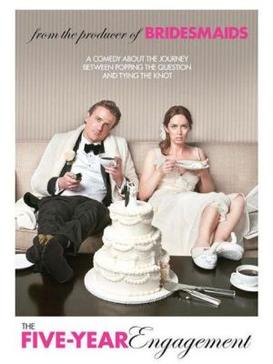
The Five-Year Engagement
There are romantic comedies -- good and bad -- and relationship dramas. While they may deal with similar subjects, the approach to them is basically just the opposite. Laughs as opposed to some sort of real drama, right? So while I liked parts of 2012's The Five-Year Engagement, I have trouble reviewing. It tries to be both, but handicaps itself in the process.
Having been dating for a year now, Tom (Jason Segel) and Violet (Emily Blunt) are deeply in love. Nearing their year anniversary, Tom proposes to Violet, and she accepts, setting off a whirlwind series of events all geared toward their wedding (obviously, duh? I'm struggling here). Soon after the proposal though, different detours start getting thrown at the soon-to-be married couple. Violet's sister gets pregnant with Tom's best friend's baby -- they get married -- and Violet is offered a position in the psych department at the University of Michigan. Tom, leaving his job, and Violet decide to put their wedding on hold for now, pulling up their roots and moving. But upon moving, one detour becomes another and that wedding seems a long way off all of the sudden.
This is a funny movie. It is. When I laughed, I laughed a lot. This is also a movie that tries to be realistic and dramatic and somewhat true to life. So which is it? 'Engagement' can't decide. It tries to be both and fails in both measures. Director Nicholas Stoller -- co-writing with Segel -- can't make up his mind. There are some really odd, out of place attempts at physical humor (a car door opens and smashes Violet in the face, Violet gets shot in the leg with a crossbow, Tom lands on a snow-covered fire hydrant, Tom loses a toe to frostbite) that just don't mesh with the rest of the story. We see these attempts at laughs work in some cases and fall epically short in others, and then we do a 180 into the drama as the couple tries to work through their problems. A movie that picked one route would have been better.
My biggest reason for giving this flick a shot was the Segel and Blunt casting. As actors on-screen, I've liked both of them in just about anything I've seen them in. For the most part, they have a believable, at times lovable on-screen chemistry. Tom is a successful chef at a San Francisco restaurant while Violet is seeking her doctorate, Tom deciding he's willing to sacrifice his job to see that Violet can pursue her dreams. That not surprisingly produces some fireworks as Tom begins to hate their new arrangement while Violet doesn't know what to say to fix things. What starts off as a loving relationship quickly deteriorates, and 'Engagement' is driven to the point where neither character is particularly likable. The success no doubt depends on how much you are or aren't rooting for this couple, but by the end, it just gets tedious.
A saving grace from the tedium is the very funny supporting cast. Our engaged couple meets a whole lot of people over the course of 5 years, some of them very funny. Look for Chris Pratt as Alex, Tom's best friend, and Alison Brie as Suzie, Violet's sister who ends up with Alex. Pratt especially is a scene-stealer, the inappropriately honest best friend turned responsible father. Rhys Ifans has some fun as Winton, Violet's psych professor and co-worker, with Mindy Kaling, Kevin Hart and Randall Park as her fellow doctorate students. Providing some of the film's best laughs, Brian Posehn plays Tarquin, Tom's deli co-worker and friend in Ann Arbor, while SNL alum Chris Parnell plays Bill, the knitting, hunting friend.
Maybe the worst thing going for 'Engagement' is that at 124 minutes, it is just too long. It has the same problem Bridesmaid did last year. It is funny in snippets but gets bogged down in too many characters, situations and developing detours. Yes, it's five years for the engagement, but maybe 25 minutes could be cut away. We see the problems Tom and Violet are having again and again and again. Cut some of those scenes out, especially when it becomes increasingly easier to not like these two. As for the funny scenes, they're great, especially Tom's first hunting trip with Bill, Tarquin's rehearsal dinner toast, Alex's engagement party slide show to Billy Joel's We Didn't Start the Fire, and a montage of wedding preparing done by the guys. Unfortunately, the funny is held down by the much longer portions that just ain't funny. There's a good movie somewhere in there.
The Five-Year Engagement (2012): ** 1/2 /****
Having been dating for a year now, Tom (Jason Segel) and Violet (Emily Blunt) are deeply in love. Nearing their year anniversary, Tom proposes to Violet, and she accepts, setting off a whirlwind series of events all geared toward their wedding (obviously, duh? I'm struggling here). Soon after the proposal though, different detours start getting thrown at the soon-to-be married couple. Violet's sister gets pregnant with Tom's best friend's baby -- they get married -- and Violet is offered a position in the psych department at the University of Michigan. Tom, leaving his job, and Violet decide to put their wedding on hold for now, pulling up their roots and moving. But upon moving, one detour becomes another and that wedding seems a long way off all of the sudden.
This is a funny movie. It is. When I laughed, I laughed a lot. This is also a movie that tries to be realistic and dramatic and somewhat true to life. So which is it? 'Engagement' can't decide. It tries to be both and fails in both measures. Director Nicholas Stoller -- co-writing with Segel -- can't make up his mind. There are some really odd, out of place attempts at physical humor (a car door opens and smashes Violet in the face, Violet gets shot in the leg with a crossbow, Tom lands on a snow-covered fire hydrant, Tom loses a toe to frostbite) that just don't mesh with the rest of the story. We see these attempts at laughs work in some cases and fall epically short in others, and then we do a 180 into the drama as the couple tries to work through their problems. A movie that picked one route would have been better.
My biggest reason for giving this flick a shot was the Segel and Blunt casting. As actors on-screen, I've liked both of them in just about anything I've seen them in. For the most part, they have a believable, at times lovable on-screen chemistry. Tom is a successful chef at a San Francisco restaurant while Violet is seeking her doctorate, Tom deciding he's willing to sacrifice his job to see that Violet can pursue her dreams. That not surprisingly produces some fireworks as Tom begins to hate their new arrangement while Violet doesn't know what to say to fix things. What starts off as a loving relationship quickly deteriorates, and 'Engagement' is driven to the point where neither character is particularly likable. The success no doubt depends on how much you are or aren't rooting for this couple, but by the end, it just gets tedious.
A saving grace from the tedium is the very funny supporting cast. Our engaged couple meets a whole lot of people over the course of 5 years, some of them very funny. Look for Chris Pratt as Alex, Tom's best friend, and Alison Brie as Suzie, Violet's sister who ends up with Alex. Pratt especially is a scene-stealer, the inappropriately honest best friend turned responsible father. Rhys Ifans has some fun as Winton, Violet's psych professor and co-worker, with Mindy Kaling, Kevin Hart and Randall Park as her fellow doctorate students. Providing some of the film's best laughs, Brian Posehn plays Tarquin, Tom's deli co-worker and friend in Ann Arbor, while SNL alum Chris Parnell plays Bill, the knitting, hunting friend.
Maybe the worst thing going for 'Engagement' is that at 124 minutes, it is just too long. It has the same problem Bridesmaid did last year. It is funny in snippets but gets bogged down in too many characters, situations and developing detours. Yes, it's five years for the engagement, but maybe 25 minutes could be cut away. We see the problems Tom and Violet are having again and again and again. Cut some of those scenes out, especially when it becomes increasingly easier to not like these two. As for the funny scenes, they're great, especially Tom's first hunting trip with Bill, Tarquin's rehearsal dinner toast, Alex's engagement party slide show to Billy Joel's We Didn't Start the Fire, and a montage of wedding preparing done by the guys. Unfortunately, the funny is held down by the much longer portions that just ain't funny. There's a good movie somewhere in there.
The Five-Year Engagement (2012): ** 1/2 /****
Friday, December 7, 2012
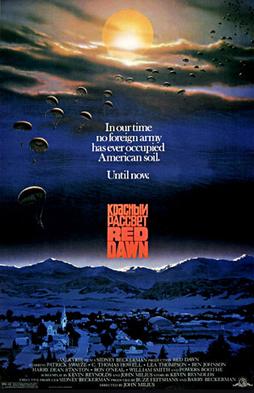
Red Dawn (1984)
Just about any movie can -- and most likely will -- be remade at some point. After a debacle of a free screening of the new Red Dawn movie (I missed it, didn't get there early enough), I consoled myself with the original, a 1980s classic that is still as good as ever. Guilty pleasure? Eh, maybe, I maintain it's just a good movie. Enter 1984's Red Dawn.
It's an October day like any other in the town of Calumet, Colorado. As classes start at the local high school though, parachutes appear in the sky, hundreds of them. What exactly is going on? It's Russian and Cuban paratroopers dropping in as an advance element of the invasion of the U.S. The school and town gets shot up in the process with many casualties, but a group of teenagers including Jed (Patrick Swayze), a former jock working with his Dad, and his younger brother, Matt (Charlie Sheen), manage to escape the town and head for the Rockies where they'll be relatively safe. A month goes by though as they hide, and then the news hits. The invasion was a success -- to a point -- but the fighting has now gone stagnant. Well behind Russian/enemy lines, Jed, Matt and their friends decide to take the attack to their invaders, becoming a partisan group of resistance fighters.
From tough guy writer/director John Milius, 'Dawn' is definitely a product of the times, but in good ways. With the Cold War still very much alive between the U.S. and Russia, this potential invasion story hits home. People had wondered and questioned for years if this was where the conflict was heading. In the years since, 'Dawn' has gained a reputation as a so bad it's good movie, even a guilty pleasure. Yes, I suppose it qualifies, but I tend to disagree. The acting is over the top at times, the ultra-patriotism evident everywhere, and some scenes do produce some unintentional laughs, but I maintain this is just a good movie. If it is a little heavy-handed at times, so be it. It is entertaining as hell from the start, and that doesn't change by the end.
The screenplay from Milius and Kevin Reynolds wastes no time setting the stage. Less than two minutes into the movie, parachutes are descending on Colorado, sending Calumet into chaos. People are running for their lives as paratroopers start shooting anything that moves. Talk about a tone-setter. As an opening, it's hard to beat. 'Dawn' has its fair share of memorable moments, probably most famously the teenagers yelling 'Wolverines!' after successful attacks on invading forces (Wolverines was the school mascot). Aided by Basil Poledouris' score, the action scenes -- of which there are plenty -- and dramatic scenes are balanced out perfectly. Listen to the main theme HERE. The film was shot on location in New Mexico in the mountains, giving it a hard-edged look that benefits the ever-darkening story as well.
It is an 80s movie, and the cast certainly reflects that. I have a theory about Swayze in 1980s movies. He's in every great movie from the decade. If you can't find him, you're not looking hard enough. A 32-year old playing a recent high school graduate? Right. But who cares?!? It's Patrick Swayze, and he's ridiculously cool! Along with Sheen, the Wolverines include Lea Thompson, C. Thomas Howell, Jennifer Grey, Darren Dalton, Brad Savage and Doug Toby. Swayze and Sheen as brothers stand out, as does Howell as Robert, the Wolverine so bent on revenge for his parent's death he becomes a hardened killer. Also look for Powers Boothe as Col. Andy Tanner, a downed fighter pilot who fights with the Wolveines, in a scene-stealing part. In smaller parts, old pros Ben Johnson and Harry Dean Stanton (as Jed and Matt's imprisoned Dad) certainly make positive impressions too.
On repeated viewings, I've come to like this movie more and more. I think you can chalk that up to the darkness of the story. Yes, there's a fair share of fantasy here; school kids getting guns and taking on invading forces, becoming heroes in the process. But actually considering the story, it's incredibly dark. Case in point? The Wolverines start getting picked off one-by-one. The Russian invaders call in a specialist, a hunter, Strelnikov (William Smith), to brutally hunt them down, using any tactics he has at his disposal. We see the war from basically the opposite side of how the U.S. has fought in any conflict. We're being attacked. We're defending. When the Wolverines kill Russians, Americans are killed in retaliation, but on we fight. In a sympathetic part, Ron O'Neal plays Colonel Bella, a former revolutionary now fighting from the opposite perspective, an officer trying to quell an uprising.
This darkness comes through in the final 45 minutes, building to a surprising but highly effective ending. I love Swayze and Sheen's conversations they have in between fights. Swayze's Jed puts it best as these two friends/brothers plan their line of attack, knowing their odds are slim. He states "It's not easy being brothers, huh?" Shakespeare? No, but it works. As the Russians turns the tables on the Wolverines, that is 'Dawn' at its best. I love the ending as well, Jed and Matt taking the attack to the Russian base. It's a great ending, and not surprisingly, a patriotic one. Heavy-handed guilty pleasure? Maybe, but I think it's just a really good movie.
Red Dawn (1984): *** 1/2 /****
It's an October day like any other in the town of Calumet, Colorado. As classes start at the local high school though, parachutes appear in the sky, hundreds of them. What exactly is going on? It's Russian and Cuban paratroopers dropping in as an advance element of the invasion of the U.S. The school and town gets shot up in the process with many casualties, but a group of teenagers including Jed (Patrick Swayze), a former jock working with his Dad, and his younger brother, Matt (Charlie Sheen), manage to escape the town and head for the Rockies where they'll be relatively safe. A month goes by though as they hide, and then the news hits. The invasion was a success -- to a point -- but the fighting has now gone stagnant. Well behind Russian/enemy lines, Jed, Matt and their friends decide to take the attack to their invaders, becoming a partisan group of resistance fighters.
From tough guy writer/director John Milius, 'Dawn' is definitely a product of the times, but in good ways. With the Cold War still very much alive between the U.S. and Russia, this potential invasion story hits home. People had wondered and questioned for years if this was where the conflict was heading. In the years since, 'Dawn' has gained a reputation as a so bad it's good movie, even a guilty pleasure. Yes, I suppose it qualifies, but I tend to disagree. The acting is over the top at times, the ultra-patriotism evident everywhere, and some scenes do produce some unintentional laughs, but I maintain this is just a good movie. If it is a little heavy-handed at times, so be it. It is entertaining as hell from the start, and that doesn't change by the end.
The screenplay from Milius and Kevin Reynolds wastes no time setting the stage. Less than two minutes into the movie, parachutes are descending on Colorado, sending Calumet into chaos. People are running for their lives as paratroopers start shooting anything that moves. Talk about a tone-setter. As an opening, it's hard to beat. 'Dawn' has its fair share of memorable moments, probably most famously the teenagers yelling 'Wolverines!' after successful attacks on invading forces (Wolverines was the school mascot). Aided by Basil Poledouris' score, the action scenes -- of which there are plenty -- and dramatic scenes are balanced out perfectly. Listen to the main theme HERE. The film was shot on location in New Mexico in the mountains, giving it a hard-edged look that benefits the ever-darkening story as well.
It is an 80s movie, and the cast certainly reflects that. I have a theory about Swayze in 1980s movies. He's in every great movie from the decade. If you can't find him, you're not looking hard enough. A 32-year old playing a recent high school graduate? Right. But who cares?!? It's Patrick Swayze, and he's ridiculously cool! Along with Sheen, the Wolverines include Lea Thompson, C. Thomas Howell, Jennifer Grey, Darren Dalton, Brad Savage and Doug Toby. Swayze and Sheen as brothers stand out, as does Howell as Robert, the Wolverine so bent on revenge for his parent's death he becomes a hardened killer. Also look for Powers Boothe as Col. Andy Tanner, a downed fighter pilot who fights with the Wolveines, in a scene-stealing part. In smaller parts, old pros Ben Johnson and Harry Dean Stanton (as Jed and Matt's imprisoned Dad) certainly make positive impressions too.
On repeated viewings, I've come to like this movie more and more. I think you can chalk that up to the darkness of the story. Yes, there's a fair share of fantasy here; school kids getting guns and taking on invading forces, becoming heroes in the process. But actually considering the story, it's incredibly dark. Case in point? The Wolverines start getting picked off one-by-one. The Russian invaders call in a specialist, a hunter, Strelnikov (William Smith), to brutally hunt them down, using any tactics he has at his disposal. We see the war from basically the opposite side of how the U.S. has fought in any conflict. We're being attacked. We're defending. When the Wolverines kill Russians, Americans are killed in retaliation, but on we fight. In a sympathetic part, Ron O'Neal plays Colonel Bella, a former revolutionary now fighting from the opposite perspective, an officer trying to quell an uprising.
This darkness comes through in the final 45 minutes, building to a surprising but highly effective ending. I love Swayze and Sheen's conversations they have in between fights. Swayze's Jed puts it best as these two friends/brothers plan their line of attack, knowing their odds are slim. He states "It's not easy being brothers, huh?" Shakespeare? No, but it works. As the Russians turns the tables on the Wolverines, that is 'Dawn' at its best. I love the ending as well, Jed and Matt taking the attack to the Russian base. It's a great ending, and not surprisingly, a patriotic one. Heavy-handed guilty pleasure? Maybe, but I think it's just a really good movie.
Red Dawn (1984): *** 1/2 /****
Subscribe to:
Posts (Atom)