The Sons of Katie Elder

The Sons of Katie Elder
"First, we reunite, then find Ma and Pa's killer...then read some reviews."

Friday, June 3, 2011

49th Parallel

One of the greatest actors of his time, Laurence Olivier was in countless classics, almost always turning in performances that are still remembered today. While I can appreciate his ability as an actor, I've never been a huge fan of his.  Truthfully, I just haven't seen him in much even though he has been in over 60 films.  Held in high regard, 1941's 49th Parallel is one of those films, and oddly enough, one that fans and critics alike seem to watch. It's a prime example of a WWII propaganda film, but not in a good way.

There of course is some background with the propaganda machine that produced this movie. Director Michael Powell was approached by the British government in 1940 to make a film about mine-sweeping, but instead he decided to make a film that he hoped would "scare the pants off the Americans." Still a year away from the Japanese attack on Pearl Harbor, the United States was very much a neutral country. World War II was hanging in the balance as Germany swept across Europe, swallowing up countries at a lightning pace. Powell's motivations were legitimate, but now watching this movie over 70 years later, the effort is almost laughable.

Patrolling and attacking along the Canadian coast in the Atlantic, U-37 (a German U-boat) is gaining notoriety for attacking every ship it comes across.  Hiding out in Hudson Bay from patrolling ships and planes, the submarine is attacked and sunk, leaving only a small landing party alive on-shore to fend for themselves.  As the ranking officer, Lieutenant Hirth (Eric Portman) takes charge, searching with five other survivors for some sort of safety. With little options of where to go or what to do, Hirth decides to head for the U.S./Canadian border (the 49th Parallel) and seek asylum in the still-neutral United States. Thousands of miles stand between them though, and the countryside is alive with people looking for the escaped Germans.

I'm not quite sure what I expected heading into this movie. Maybe I confused it with another movie. Maybe I misread the year. I do know that I didn't expect such an obvious, sometimes painful effort at a propaganda film.  The story is an episodic one broken up by long fades to black.  The survivors make their way across Canada in hopes of reaching freedom. They attack a far-off, lonely trading post. They rest at a village of German farmers, and even come across a pacifist (Leslie Howard) living in the wilderness. The whole purpose of the film is to show how evil, how despicable, how cutthroat these Germans are, doing anything they need to survive. All sides in WWII were capable of atrocities, but the effort here falls short...or far maybe, depending on how you look at it.

Trying to convince neutral Americans that their country should join the war, Powell and the screenplay deliver one of the most heavy-handed attempts I've ever seen at propaganda. The Germans are perfectly evil, reveling in the cold-blooded murders of Canadian shipping, admitting they're killing women and children somewhat proudly. Portman's Hirth and his fellow survivors open fire into a crowd of innocent people, and later he orders the execution of one of his own men, Vogel (Niall MacGinnis), for questioning why they're doing what they're doing. It is a frightening performance for Portman, and a strong one, but it is too exaggerated, too stereotypically and cartoonishly evil to register.

In his efforts, Powell does a somewhat funny thing in demonizing the Germans. He humanizes some of them during their travels. Raymond Lovell plays Lt. Kuhnecke, a capable officer who is killed off almost immediately. MacGinnis' Vogel seeks solace in the farming community, becoming a popular baker and wanting to leave Hirth and the others behind. Instead, Hirth orders his execution at the hands of his most loyal followers/survivors (including Peter Moore, John Chandos, and Basil Appleby). The thought process is an interesting one, showing that all Germans aren't obsessed, driven Nazis, but wouldn't that work against Powell's intentions? Or does it do just the opposite? I guess it does show that the most extremist Nazis were capable of horrific acts, even against their own. It may make sense, but it gives the film an odd two-way feel that never quite clicks into place.

The episodic nature of the story allows for some interesting casting as I mentioned earlier in the intro.  Nominated countless times for Academy Awards and winning several over the course of his career, Olivier's performances are legendary, but this ain't one of them. He plays Johnnie, a French-Canadian trapper who incurs the wrath of Hirth's squad. His attempt at an accent will assuredly produce some chuckles, and the performance is basically one big stereotype to begin with. Howard is more interesting as Philip Armstrong Scott, a pacifist who questions everything about the war.  Raymond Massey saves the best for last, an AWOL Canadian soldier who Hirth meets on the road as he nears the border. The posters push Olivier, Howard and Massey as the stars (even giving Olivier a love interest that doesn't actually exist), but don't be confused. The performances from that trio are more of the cameo nature than leading roles.

This is a movie that is almost....almost...saved by its ending. It is the type of ending that has a mean streak in it a mile wide, the Allies showing the Axis forces who's really the boss.  It delivers a nice little twist, but leading up to it, the movie's flaws are just too much. Visually uninteresting with long monologues, preachy and heavy-handed in its approach (even for a propaganda film), I struggled mightily to make it through this one.

49th Parallel <---trailer (1941): **/****

Thursday, June 2, 2011

Seven Angry Men

One of the most controversial people in American history was a driven, even obsessed abolitionist who made a name for himself in the years before the Civil War, John Brown. I have always been fascinated by Brown mostly because his belief that all men should be free. The only problem was his extreme execution of these beliefs. His actions were those of an extremist, an individual who was going to get what he wanted no matter the cost. His reasoning was sound, but his actions bordered on the insane.

Complete hogwash in terms of historical accuracy, 1940's Santa Fe Trail is the only movie I can even think of that has Brown playing a major role. He played a huge role in starting the Civil War -- the bloodiest conflict in American history -- but has generally been forgotten in the pages of history books over the last 150-plus years. At the height of his popularity, actor Raymond Massey played the infamous abolitionist in a movie that while entertaining, is about as accurate as saying that the sun is green and the moon is made of cheese. It is a performance that is downright terrifying at times. Some 14 years later, once again bearing a striking resemblance to the real-life Brown, Massey reprised the role of John Brown in 1955's Seven Angry Men.

It's 1856 and brothers Owen (Jeffrey Hunter) and Oliver (Larry Pennell) are traveling to Kansas to work with their father, John Brown (Massey), in his efforts to help the territory enter the United States as a free state. Four other Brown brothers are already waiting as the family is reunited, all in hopes of making Kansas a place where slaves are illegal.  Their father, John, though is willing to do anything necessary to ensure that with the coming vote.  Sticking with his father through thick and thin -- even going against his wife, Elizabeth (Debra Paget), and her intentions -- Owen quickly realizes how obsessed the man really is. John has bigger, grander plans than just Kansas though. He has his sites set on Harpers Ferry, Virginia, and the U.S. Military arsenal there where he hopes to arm an army of freed and escaped slaves.

The Civil War is one of the most interesting times in American history, but the build-up to the bloodiest war ever fought on American soil is just as interesting.  In the five years before the war, Kansas was dubbed 'Bleeding Kansas' as abolitionists fought pro-slavers over the future of the state, whether it would enter the United States as a free or slave state. Brown's raid on Harpers Ferry (read about it HERE) is similarly one of the most fascinating chapters in American history (to me at least). However miserably the raid failed, Brown's intentions are amazing when you think about it. The topic can be a touchy one (Kansas and Harpers Ferry) so it's easy to understand why movies have generally steered clear of it, but the history is incredibly interesting.

The tone of the two movies -- Santa Fe Trail and Seven Angry Men -- are basically polar opposites, but the positive you can take from both movies is Raymond Massey's acting performances as John Brown. As I mentioned earlier, he bears a striking resemblance to the real-life Brown. His acting though is so much more, bringing this obsessed, completely and blindly driven man to life. His intentions were genuine -- all men should be free regardless of color -- but his actions were deplorable, believing in an Old Testament form of justice. Making him more interesting/believable/frightening is that Brown (an ultra religious man) believes God is using him as his vessel on Earth to do what he needs to get accomplished. Scary much?

So director Charles Marquis Warren has those two great things working for him -- interesting history, more interesting historical person -- and what does he focus his story on? The budding relationship of Brown's son, Owen, his right hand man, and a fellow abolitionist, Elizabeth, who believes John's actions are despicable. Do you think there's a chance they might put their differences aside and get hitched? They talk about these problems a lot, and then share some very passionate 1950s movie kisses and some scandalous embraces. Because of that, Massey's John Brown gets pushed to the background far too often.  In the rest of the cast is Dennis Weaver, James Best, John Smith and Pennell as the brothers who actually make an impression. Also look for James Edwards as Green, a freed black man fighting with the Browns, and Leo Gordon in heavy mode as pro-slaver leader gunning for Brown.

I wanted to like this movie more than I did, but it just has so many things working against it. A B-movie or even an A-level movie on a smallish budget can overcome a lot with some basic things; avoid overacting, don't get too exaggerated, keep the music in a non-blaring mode. 'Angry' misses on all counts. Carl Brandt's score is painfully obvious, almost willing you to feel certain emotions. The love story is equally bad, and I can't decide if that's on the actors, the script or the director. Maybe worst of all is that the movie just doesn't know what it wants to say. Is John Brown a hero or a traitor? The ending has the Battle Hymn of the Republic playing over Brown's execution just minutes after vilifying the man. Which one is it? Massey is great, and the relatively forgotten history is interesting, but otherwise this one is worth passing on.

Seven Angry Men <--- TCM clips (1955): **/****        

Wednesday, June 1, 2011

The Great Escape

I have two favorite movies, neither of which I'm able to pick one over the other.  I love them both, and all other movies come after it, first is 1960's The Alamo which I've reviewed before and then there's 1963's The Great Escape. Introduced to it at a young age when I showed an interest in history, I've probably seen it 25 or 30 times straight through, and another 75 or 100 catching bits and pieces. For me, it is that rare perfect movie. Great story, impressive cast, exciting action, and one of the best soundtracks ever. You can't ask for much more.

In World War II, both the Allies and Axis forces had to deal with how to handle prisoners of wars. In Germany, the Luftwaffe, the German Air Force, was placed in charge of these Allied prisoners, placing them in P.O.W. camps all over their occupied territory. These prisoners -- as was their sworn duty -- tried countless escapes over the length of the war in typically small groups, sometimes getting as many as a dozen out. But one true story set the bar for heroism and courage among the prisoners, the true story of 76 prisoners escaping Stalag Luft III in March 1944. Literally hundreds of prisoners were involved in the effort as the escape even had an impact on D-Day some three months later.

It's 1943, and a new prison camp has been built. The German Luftwaffe has taken the worst prisoners from all their camps and thrown them in this new camp that features all the security aspects they've learned from previous camps.  In this "perfect" camp, the Germans (Hannes Messemer is the commandant) intend to watch these men very carefully. Leading the prisoners is Roger Bartlett (Richard Attenborough), dubbed 'Big X' for his leadership at the top of the 'X Organization,' a team of prisoners working together to bust out as many captured soldiers as they can. Bartlett has bigger plans though this time around. Instead of just getting two or three prisoners out, he intends to get 250 out of the camp with a large-scale plan that includes three extremely long tunnels under the barbed-wire fence. The plan seems impossible, but the prisoners go to work, slowly working their way toward escape.

Do you know the line 'They don't make them like they used to?' This movie applies. Director John Sturges (one of my favorites and an underrated filmmaker overall) turns in his all-time best film, one that stands at or near the top in the lexicon of World War II movies. It is based in fact, sticking to the details and truths in the story, without getting bogged down.  There is action, humor (never overplayed, just natural humor arising from the situation), and characters you love and are generally rooting for. Composer Elmer Bernstein turns in a score that is one of the greats, especially the main theme, listen HERE. Bernstein's score both drives the story as needed and keeps it grounded in the quieter, emotional scenes (including one where a tunnel is discovered and its tragic consequences).  Sturges filmed in Germany -- as his assistant said, 'Germany looks like Germany.' An entire camp was built, an exact duplicate of the actual camp, bringing this 1963 epic up another notch in terms of realism and authenticity.

Sturges' movies were famous for their male-dominated ensemble casts, but this may be his most impressive. Start with Steve McQueen as Hilts, the motorcycle-riding 'Cooler King,' the role that shot him to international stardom. Then there's James Garner as Hendley, the scrounger, and Attenborough as Bartlett, the prisoner's top man, a brilliant mind who comes up with this improbable plan. Not bad, huh? Oh yeah, there's also James Donald as Ramsey, the senior British officer, Charles Bronson and John Leyton as Danny and Willie, the tunnel kings, James Coburn as Sedgwick, the manufacturer, Donald Pleasence as Blythe, the forger, David McCallum as Ashley-Pitt, "dispersal," and Gordon Jackson as MacDonald, the intelligence officer. Other prisoners include Nigel Stock, Jud Taylor and Angus Lennie in a small but essential part as Ives, Hilt's progressively wire-happy partner. A more impressive cast could be impossible to assemble.

What is amazing is that even with all those stars -- some on the rise, some already established -- is that they all register, they all make a lasting impression in a positive way. More on McQueen later, but Attenborough delivers a career-best as Big X, the driven even obsessed leader who wants to take the war back to the Germans, not sitting out the war comfortably as his captors intend. Garner's Hendley bonds with Pleasence's Blythe in some of the movie's most touching scenes, two very different people forming a friendship. Bronson and Leyton as the tunnel kings certainly make an impression, carving three tunnels out of the Earth 30 feet below the surface. Bronson is at his best, a Polish flyer with claustrophobia who hides his fear of small, enclosed spaces and digs. Coburn doesn't get a ton to do compared to the others, but is his usual, laconic self. There is not a weakness in the cast from top to bottom.

When movie fans think of The Great Escape, they usually go right to Steve McQueen, a rising star who got his crack at the big time here and didn't disappoint.  His Capt. Virgil Hilts is one of his most iconic roles, the loner, trouble-making American prisoner who attempts escape attempt after attempt.  What's funny is that his character basically disappears for vast stretches of the movie, only to reappear after a stint in the cooler and steal every scene he is in. This is McQueen at his laid back, scene-stealing best. With all the notable actor's actors around him, he is the unquestioned star thanks in great part to the finale, a motorcycle chase across Germany with his captors in hot pursuit. It is one of the greatest chases sequences ever, caped with one of the most impressive stunts ever, a 7-foot jump by stunt man Bud Ekins over a high-strung barbed-wire fence. McQueen is my favorite, but this is always his best to me.

With a final run-time of 2 hours and 53 minutes, Sturges' true story doesn't have to rush along at a lightning pace...but does anyway. The first 105 minutes or so focus exclusively on the escape attempt, putting all the little details together that need to happen. The first and biggest of course is the digging of the tunnels, 30 feet down and over 300 feet straight out. A track is built to transport prisoners/diggers, and wooden boards are needed to shore up the entire length of the tunnel. Up above, forgers create documents, tailors make clothes, Intelligence gathers information, all part of an elaborate system of security and watchmen to make sure nothing is discovered by their ever-vigilant German guards. It would have been easy for this movie to get bogged down in these details, but The Great Escape revels in them, making the mundane and possibly boring, exciting at a breakneck pace.

It is a movie called 'The Great Escape' though, and it is at its most exciting once the prisoners do escape, 76 of them in the dead of night spread out all over the German countryside. The escape attempt covers the last hour of the movie, an incredible extended sequence that is hard to top. It is almost entirely dialogue free, Bernstein's score playing over the action the whole way. Finally free of their camp, the prisoners make their efforts to hopefully reach freedom, some by train, some by bikes, others by planes, and in Hilts' case, a stolen German motorcycle.  Sturges was an action master, and this may be his tour de force sequence.

I could go on and on with this movie, and I've already sort of done so. My head is full of little tidbits of information that I've picked up over the course of repeated viewings.  Above all else through the drama, the facts, and the action is that Sturges gets the tone right from Paul Brickhill's source novel, and most importantly, the true story it is based on. These men did the impossible in an impossible situation. Knowing their chances of escape back to freedom were slim, they plodded on when they could have just as easily quit. If you didn't know and just read the details -- check out the Wikipedia entry HERE for more details -- you would say there's no way this happened, but somehow, some way, it did. The ending hits you square in the stomach as it should, but the movie ends on a positive note; McQueen's Hilts once again in the cooler, bouncing his baseball off the wall.  You may capture him again, but you'll never stop him from trying.

A perfect movie, one of the best around, and one of my two favorite movies.

The Great Escape <---trailer (1963): ****/****

Tuesday, May 31, 2011

Slap Shot

Growing up, I watched and played just about any sport on God's green Earth. Baseball, basketball, football, soccer, and everything in between.  Still do. But one sport I never embraced to this day is hockey. Part of that has to do with the Chicago Blackhawks being a black hole for hockey until recently.  More than that though, I was just never interested. That's the big reason I'd never seen 1977's Slap Shot before this weekend. Hockey just doesn't get me like so many other sports.

This was a sports movie that is often at the top of the list of the best sports movies ever made.  After seeing none of it for years, I was excited to see this one.  Star Paul Newman teams with director George Roy Hill for the third time (joining Butch Cassidy and the Sundance Kid and The Sting), and the Netflix recommended rating said I would love the movie. It's a foul-mouthed, filthy, raucous, at times hilarious comedy. So what happened? By the end, I was bored to tears. What's going on?

A grizzled, long-time veteran of hockey's minor leagues, Reggie Dunlop (Newman) is a player/coach for the Charlestown Chiefs. He's on the last legs of his career, sticking with hockey mostly because he knows little else to do.  The local mill is closing soon though, and Dunlop fears the team will feel the repercussions, finding out that team General Manager Joe McGrath (Strother Martin) knows the team will fold at the end of the season. With nothing to lose, Reggie starts to work his magic in trying to save the franchise. For one, he floats a rumor that an investor in Florida is interested in buying the team. Second, he turns the team's style into good, old-fashioned goon style hockey, letting the Hanson brothers wreak havoc on opponents. Fans eat up the new brutal style, filling arenas wherever the Chiefs go. Could the team somehow be saved?

I am a sucker for sports movies....any sports movie.  Underdog sports story? Yeah, count me in. Then throw in a story not of the highest level of sports, but the dingy, ratty minor leagues, and you've got a winner. That's what produces the biggest laughs here, the cheap goings on in the day-to-day running of a barely successful minor league hockey franchise. There's Martin's GM McGrath selling off equipment his team needs during the season. There is the clueless radio play-by-play man (Andrew Duncan), asking ridiculous questions and generally not knowing anything about the team. There is the newspaper beat writer (M. Emmet Walsh) who eats up everything Reggie feeds him. Throw in the always cheesy 1970s sense of style, and it all works together nicely, bringing this never glamorous life to the big screen in a generally funny way.

It's the rare movie where Paul Newman gets overshadowed, but it happens here. Meet the Hanson Brothers, the thugs of the Chiefs and the fan favorites in Charlestown and the most hated players in every road team's arena. There is Jeff, Steve and Jack -- ages 18, 19, and 20 -- hockey players with no real skill, but they're goons on the ice...and they're great at it. These three brothers are hysterical. They scream like lunatics at Reggie's pre-game speeches. They drive remote control cars in their hotel rooms. Their looks (including low, shoulder-length hair and wearing their thick, bottle rim glasses) just provide the capper. The brother trio produces the movie's best laughs, especially their on-ice antics.  

So the Hanson brothers steal the movie, but Newman in the lead is no slouch. It's just not his best work either although it is remembered as one of his best parts/movies.  For a movie known as a foul-mouthed comedy, it spends too much time on Reggie's love life, especially with his separated wife, Francine (Jennifer Warren). The Chiefs' best player, Ned Braken (Michael Ontkean), is also annoying as hell, a player who wants to play the right way and objects to Reggie's new thuggish plan. One of the most unlikable characters I can think of.  The Chiefs' roster is where the movie has some fun, including "Killer" Carlson (Jerry Houser), a player who embraces his inner goon, Yvon Barrette as the smallish goalie, Denis, the French Canadian making an attempt at speaking English, and Brad Sullivan as ladies man Morris, among several other laugh-worthy teammates.  

I liked this movie for awhile. The opener is very strong, Carr "interviewing" French-speaking Denis, watch it HERE. The humor is pretty low-brow at times, the type of stuff you would hear in locker rooms of any sports team.  It's funny because it is real. This is how things go, but soon after the Chiefs turn to thuggery on the ice, the movie's humor goes away and never resurfaces.  There's so much spent on the forced drama angle -- Braden and his long-suffering wife (Lindsay Crouse) -- instead of the hockey and the interesting characters. I found myself bored with the last 45 minutes, fast forwarding through whole scenes. The humor gets left behind and Capt. Buzzkill arrives in the form of some dramatic moments.

Then there is the ending, one of the most bizarre finales I can think of (and not in an especially good way). It's just ridiculous, and even stupid (which is saying something considering the low-brow humor there to begin with) as the Chiefs battle for the league's championship. It borders on the surreal, and doesn't make much sense anyways, no matter how you look at it. The actual ending -- the last shot -- has a heavy dose of drama again, a message that feels out of place here.  I certainly wanted to like this movie, and I did like parts of it a lot, but mostly I came away disappointed.

Slap Shot <---trailer (1977): **/****

Monday, May 30, 2011

Eye of the Devil

How long does it take for a movie to grab your attention? You always read reports that a movie has about five minutes to bring you in because you've already made your decision whether it is going to be good or bad.  I'm impatient in any number of things, but with movies, I have a tad bit more patience. I've seen some awful flicks saved (partially at least) by great twist or surprise endings. At the other end of the spectrum, 1966's Eye of the Devil grabbed me instantly. I had to know what the odd opening sequence meant.

I'll get into the specifics more later about the pre-credit sequence that opens the movie. As someone who typically steers clear of horror movies, I couldn't pass this one up stumbling across it on TCM's schedule recently.  The cast is mostly what caught my eye because the story description certainly didn't sound too interesting.  This isn't a horror movie of 2011 with shock value and gore, instead building up suspense and tension with its gothic feel. What to make of it? I have no idea. It was weird, but I think...think...I liked it.

A well to-do businessman in Paris, Phillipe de Montfaucon (David Niven) must return home when news of his estate's vineyards dying reaches him. A few days later, his wife, Catherine (Deborah Kerr), joins him at the estate -- called Bellenac -- with their two children. Catherine begins to see strange, unexplainable things one night but can't find anyone to answer her questions. She even sees members of something that looks like a cult gathering in the expansive estate home, but just can't figure it out. Her mother-in-law, Countess Estelle (Flora Robson), seems to know what's going on but won't tell her a thing. She begins to worry for her safety, her children's, and also of her husband. Could he possibly be involved with these strange happenings? More importantly, if he is involved, can Catherine save him?

For starters, let's start at the start...words are fun.  Before a credits sequence or a title cards, we get a lightning quick montage, edited within an inch of its life that immediately sets the tone for the rest of the movie. Now as I look for it, I of course cannot find a clip of this sequence.  It is an odd assortment of quick images -- a dove pierced with an arrow, a woman's eye, a man's head, a train speeding down the tracks, among many others -- that is edited together so quickly it can be hard to make anything out of it. The sequence feels like something A Clockwork Orange would have used 5 years later. Regardless of the background though, it pulls you into the movie. You want to, you need to know what those disparate images mean and how they're related.

Cheap thrills are one thing, and genuine fear and uneasiness are another. Gory, shocking, 'Gotcha!' moments are part of the reason I dislike horror movies so much. There is a subtlety to older horror movies that more recent ones are just missing. Some complaints are that director J. Lee Thompson does go to the old horror cliche book a few too many times, but for the most part the scares are genuine. The off-center camera angles telegraph everything that's going to happen, and the dark, spooky shadows always reveal something hidden away.  But still, the scares are there. 'Devil' is filmed in black and white, and it definitely has a gothic feel, especially in this immense, extravagant, lavish French manor that looks like it's out of the 1700s.  Throw in composer Gary McFarland's eerie, Church choir-like score, and you've got all the makings.

I'll admit it. I'm a sucker for big names when I see a cast listing. Why else would I watch a basically unknown British horror movie from the 1960s?  David Niven and Deborah Kerr in the starring roles sounded perfect for me so surprisingly enough, I thought they were the weakest parts of the cast.  Niven sleepwalks through his role, disappearing for long stretches of the movie. Kerr basically looks nervous the whole movie, screaming occasionally.  The rest of the cast makes up for it. Master of understated creepiness Donald Pleasence plays a creepy priest, Pere Dominic, Robson is the tortured woman who knows the whole truth, and Edward Mulhare is a longtime friend of Kerr's Catherine. The best thing going for 'Devil' is David Hemmings and Sharon Tate as Christian (an albino archer?) and Odile, brother and sister who always know more than they let on.

You know that feeling on Christmas Eve when you see your presents wrapped up nicely under the tree? Now, I loved my presents -- always have -- but the anticipation and mystery is part of the appeal.  More and more, I find that's the case with movies that hold out on you until the finale with a huge, major revelation. The build-up here is all the fun because the reveal disappoints.  Think mix between The Wicker Man and The Omen, but that's all I'll say. The ending never quite explains everything either, hinting at and beating around the bush, but never laying everything out.  I definitely was creeped out by this movie, but the ending left me disappointed unfortunately.

Eye of the Devil <---TCM trailer (1966): ** 1/2 /**** 

Sunday, May 29, 2011

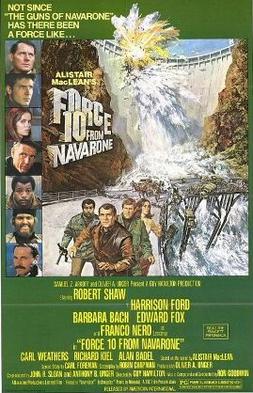
Force 10 from Navarone

Certain war movies rise above the genre, establishing themselves as classics that are more action and adventure romps than hard-hitting war movies. Released in 1961, The Guns of Navarone is definitely one of those, a WWII commando story that is considered to be one of the best WWII movies ever and one that helped liven up the genre heading into the 1960s. Based on a novel by Alistair MacLean, 'Navarone' was very popular, and while it wasn't exactly timely, some 17 years later, a sequel was released, 1978's Force 10 from Navarone.

Sequels are almost always a mixed bag when it comes to any sort of quality or appreciation from the fans. This is the oddest sort of sequel, one released long after the original with no returning cast members.  An aging Gregory Peck and David Niven would have looked quite ridiculous as WWII commandos, wouldn't they? Instead, a whole new cast steps in, taking over parts made famous by other actors.  Is that a bad thing? I never thought so. I read MacLean's Force 10 (the novel) as a kid, pursued the movie, and loved it. It was a favorite of AMC among other channels, and I've lost track of how many times I've watched it. Not as good as the original, but still an underrated WWII flick that doesn't deserve some of the hate it's gotten over the years.

Several months removed from their successful mission in Navarone, Capt. Keith Mallory (Robert Shaw) and Cpl. Dusty Miller (Edward Fox) are called back in to perform another mission. They are to be sent into Yugoslavia to kill an enemy agent, the man who blew their cover in Navarone and is now hiding out as a member of the partisans fighting the Germans. It's believed the man's name is Lescovar (Franco Nero), but Mallory and Miller must make sure. They'll travel with an American commando unit, Force 10, commanded by Lt. Colonel Barnsby (Harrison Ford) who resents having two more men traveling with his own. Almost from the start though, the mission seems doomed to failure, and Barnsby must turn to Mallory and Miller for help. Against impossible odds, they team together to pull off their mission, but also Barnsby's, one that could turn the tide of war in Yugoslavia.

Before the credits even roll, this movie is fighting an uphill battle with any viewer who knows and loves the original Guns of Navarone.  That movie is a classic, and no matter what this one does, it isn't going to live up to expectations. And just to be clear, Force 10 isn't as good as 'Guns.' It's not even close. Viewed as a stand-alone film, I'd like to think this movie would be held in higher regard by viewers and critics alike. It does nothing particularly new for the WWII commando genre, the script is limiting, bouncing around too much, and the production feels like a small budget was used. Call it sentimentality, but I like this movie a lot in spite of its flaws. And like any movie, there are flaws. It is being able to look past them and just enjoy yourself.

The men-on-a-mission movie, where ensemble casts go to thrive. Without the Hollywood legend name recognition of 'Guns,' director Guy Hamilton (of James Bond fame) does not disappoint assembling his cast. One of my all-time favorite actors, Robert Shaw steps in for Gregory Peck as Capt. Mallory, commando extraordinaire, if a little aged. A year removed from the giant success that was the original Star Wars, Harrison Ford looks ridiculously young as Lt. Colonel Barnsby, the commander placed in an impossible situation. Fox is a scene-stealer as Miller, putting his own personal spin on the part Niven played. Joining the team is Carl Weathers as Sgt. Weaver, an accidental tag-along on the mission. Also, watch for Bond alums Richard Kiel as Drazak, an immense Chetnik fighter hunting Mallory and Barnsby's team, and Barbara Bach as Maritza, a tough partisan playing both sides seemingly.

Complain about anything you want, but that assembling of talent is impressive no matter how you cut it. The tone here -- thanks to the cast changes -- is lighter, especially between Shaw's Mallory and Fox's Miller. They bicker like an old married couple, but never pushing the humor too much. It's subtle, some great one-liners thrown about if you're paying attention. This was also Shaw's last completed movie before his death later in 1978. With so many characters, it can't be helped that not everyone is given much to do. Characters drift in and out as needed. It barely resembles MacLean's novel to begin with. Here's what it comes down to though. We've got Quint (Shaw), Han Solo/Indiana Jones (Ford), Django (Nero), Apollo Creed (Weathers), a Bond villain in Jaws (Kiel), the Jackal (Fox), and a Bond girl (Bach). Talk about a great group. Can you name a more eclectic cast than that one?

Different versions of the movie exists (odd for a movie from the late 1970s), but they all clock in at around two hours. The widescreen version on the DVD is the longest at 126 minutes. The story certainly takes its time moving along, an almost episodic pacing keeping things going. There really isn't a pointed, one-way plot, just a series of adventures and misadventures. Some parts just work better than others, but once the missions are established, the movie picks up steam. The ending especially is impressive, Mallory, Barnsby and Co. working together to prevent three divisions of German armor and infantry from wiping out the last remaining partisan brigade. It's typical men on a mission fare, an impossible mission against impossible odds. There's no way they get the job done....unless...oh, wait. This is a movie. Of course they get the job done.

Force 10 from Navarone is a solid if unspectacular (and highly entertaining) WWII commando movie. I've always thought it would be more popular if it wasn't attached in anyway to the original Guns of Navarone, but it is what it is.  Great cast, fun story, whistle-worthy score from Ron Goodwin (listen to a sample HERE), good action, a gratuitous nude scene of Barbara Bach, and a few laughs here and there. Can you ask for much more? It's fun from start to finish.  

Force 10 from Navarone <---trailer (1978): ***/****

Saturday, May 28, 2011

The Journey

One of the 1950's most popular films, 1956's The King and I was loved by audiences, award shows, and critics alike.  Maybe the biggest reason for the movie's popularity -- besides the Rodgers and Hammerstein music and the epic story -- was the pairing of its two stars, Yul Brynner and Deborah Kerr.  I haven't seen the movie in years but still remember their chemistry. It was only a matter of time before they were paired in a movie together again, that coming three years later with 1959's The Journey.

The story is based during the Hungarian Revolution of 1956. My background in said revolution is that there was in fact a revolution in Hungary in 1956.  As much as I like history, you just can't read and learn about everything.  The setting -- while specific -- is applicable to any world conflict. It is based in individuals in a bad situation trying to reach some sort of safety, some feeling of normalcy.  Through these situations, you often bond through your trials. For all its uniqueness concerning a conflict in a far-off part of the world though, 'Journey' isn't always the most exciting movie, resorting to its star power to carry it through the slower portions.

It's 1956 in Budapest, Hungary, and an English woman, Diane Ashmore (Kerr), arrives at the airport trying to get out of the country and back home to England.  She's given some tough news though; the Hungarian people are revolting against their Russian/Soviet rulers, and all traffic in and out of the country has been canceled. However, transportation has been arranged for Diane and 13 other international passengers trying to leave Hungary. They will board a bus and drive the 250 miles to safety at the Austrian border. Before they reach the border though, they're stopped and inspected by the local commander, a Russian major, Surov (Brynner), who won't let them pass until everyone is approved. Diane starts to worry because she knows a secret about a fellow passenger on board, Fleming (Jason Robards), that threatens to get them all shot.

This is an all-around kind of weird movie. It isn't like so many other movies, but not always in a good or bad way. It is just different. Director Anatole Litvak films his movie in Hungary on some of the locations where the actual revolution took place just three years before in 1956. It certainly gives the movie a feeling of realism, of authenticity that couldn't have been duplicated on a Hollywood backlot (even if it does look like a studio at times). Instead, much of the story is set in a small hotel and its surrounding buildings.  There is a washed out look to The Journey that I suppose could have been the TCM print, but I don't know for sure. I can't put my finger on it, but something about the film just didn't click with me.

With two leads like Kerr and Brynner at the forefront of the movie, it's understandable that you want them to carry the movie as much as possible.  Their performances are the least of the movie's problems.  Their chemistry together is hard to disagree with. They're just good together.  Kerr is quiet and composed, eventually pushed to the point of nerves taking over while Brynner is bigger than life, able to dominate the screen just by standing there.  But in developing these characters, the story requires them to fall for each other. The final 20-30 minutes come along, and they're fighting off urges that I just didn't see building up throughout the movie. It's dialogue and more dialogue and more dialogue. The movie is a tad long at 126 minutes, taking quite awhile to get where it's going.

As if Kerr and Brynner weren't enough to satisfy most moviegoers, Jason Robards makes his feature film debut as Fleming, the mysterious passenger on-board who has all the other passengers concerned what he's up to. SPOILERS STOP READING SPOILERS Kerr is trying to sneak him out of the country, past lovers reunited after he escaped from a Russian prison. END OF SPOILERS Robards is one of the more underrated actors from the era, and he shows off the talent we'd all get to see in the coming years. Filling out the international list of passengers is Robert Morley as the scene-stealing, stiff upper lip Englishman, Deverill, E.G. Marshall and Anne Jackson as an American couple traveling with their kids (including a 5-year old Ron Howard), and other characters from Egypt, France, Germany, and in an interesting twist, a Jewish man. There was potential here for more development among these characters, and yes, I know the focus is on the leads. The 14 passengers though screamed out for a mini-series, something that would have given them a chance to shine. Also look for Senta Berger in a bit part as a serving girl at the hotel.

Maybe the biggest problem 'Journey' has going for it is a lack of focus. Brynner's Surov is investigating these international passengers, but nothing ever seems to get done. He spends most of the time riding his prized horse, eating and drinking with the passengers who are scared to death of him, and all the while, Kerr's Diane worries he'll figure out what's going on. By the way, he does....and pretty quickly.  There is no urgency though at all, and the movie's pacing suffers.  The ending makes up for it some in terms of surprise and shock value, a moving finale that definitely caught me off guard. I just wish more of the movie could have been like that.

The Journey <---trailer (1959): ** 1/2 /****

Friday, May 27, 2011

Knock on Any Door

With as many movies as are readily available for viewing, you can't help but take certain movies, stars, and directors for granted at times. There are the instantly recognizable names (typically for good reasons), and recognizable names for all the bad reasons. But there's all sorts of names that are just there, quality movies that don't always get the press or publicity that others do. One of those names is director Nicholas Ray, a solid director who never reached iconic status. His movies are almost always solid with a few near-classics in his repertoire. Making his debut in 1949, Ray started with a courtroom drama, Knock on Any Door.

The natural drama and tension that comes as a result of a courtroom setting is basically a perfect place to base a movie in. If a director can't produce drama, tension and a bundle of nerves, maybe movies aren't for them. The back and forth of a lawyer questioning a witness, the science of getting a jury on your side, the desperate play which in a lot of ways can be a life and death situation, it is all screaming 'DRAMA!' For Ray's debut, the courtroom scenes are the best thing going for the movie. Unfortunately, it takes too long to get to those courtroom scenes, wasting time in some very 1950s melodrama that could have been ripped from a badly written soap opera. Making it worse, the ending gets a little preachy, trying to deliver a message that feels contrived and forced. Other than that, the movie is a solid debut.

A lawyer working for a firm that sees him as a future name partner, Andrew Morton (Humphrey Bogart) is faced with a difficult decision. A young man, Nick Romano (John Derek), who Andrew has defended before -- several times actually -- is again in trouble, but this time for a much more serious charge. Romano (dubbed 'Pretty Boy' by the newspapers) is on trial for robbing a bar and then murdering a police officer who tried to stop the robbery. Romano's record is checkered with past run-ins with the law so Morton has his work cut out for him. The case seems like a slam dunk against Romano, but Morton feels an obligation to defend him. His only tactic may be condemning society for turning Romano into the small-time thug that put him in this situation. But even making it a character issue, will that be enough?

 As a fan of both Bogart and Ray, I was excited to stumble across this one on TCM's schedule a few weeks ago. A courtroom drama with Bogie as a defense lawyer sounded like a slam dunk. And to be fair, the courtroom angle of the movie is the best thing going for Ray's debut. The negative comes from how long it takes to get to the actual trial. Most of an hour is spent in flashback-mode, giving plenty of background about Derek's Nick Romano. He grows up in Skid Row, turning to a life of crime to get by mostly because he doesn't want to work. He falls in love and marries good girl, Emma (Allene Roberts), only to push her away with his actions. My impression was that these scenes were meant to humanize Romano, even make us sympathize with him, but it fails. This is a despicable character in my mind. He has all the chances in the world to better himself and turns his back on every single one of them. The scenes are dull, repetitive and as mentioned before, melodramatic. It kills any momentum heading into the actual trial.

Then there's the courtroom. Playing a defense lawyer has to be the modern equivalent of playing a Shakespearean main character. These are parts tailor-made for above average actors (and actresses to be fair) to just go to town, throw everything at the wall and see what sticks. These are flashy parts. Think of Gregory Peck in To Kill a Mockingbird, James Stewart in Anatomy of a Murder, Tom Cruise in A Few Good Men, Maximillian Schell in Judgment at Nuremberg. These are parts that allow actors to stretch out, get settled and show off their skills. Bogart is one of the all-time greats so seeing him work the jury, the witnesses, the district attorney, even the judge is a thing of beauty. The back and forth as Bogie tries to get a not guilty verdict. Then there's the whole interest of if Romano is guilty. Ray keeps you guessing until the very end as to his innocence or guilt. The reveal is a little hammy, a little overdone, but it still works. It's just too bad that so much time was spent getting there.

Playing the noble defense lawyer, defending the downtrodden and beaten down, Bogart does not disappoint. He so often played the tough lead, the thug, the hired gun, the escaped convict, that it was great to see him playing a more polished, upper class role. The background on Bogie's Morton is that he's like Romano, the young man he is defending. He comes from Skid Row and rose above it, working his tail off to amount to something in life. He feels some obligation to Romano because he sees some of himself in him, a potential, a chance to make a good life for himself. As unlikable as Derek's Romano is, Bogart's Morton cancels it out. You like Morton, respect his ability in the courtroom to do what he needs to do. Bogart and Derek dominate the movie, not leaving much for the supporting cast. George Macready is the apparently slow-witted district attorney gunning for Romano, saving the big guns for late, Candy Toxton is Andrew's wife who has maybe 4 lines in the whole movie, Barry Kelley as Judge Drake, and Dewey Martin and Davis Roberts as two witnesses in Morton's case.

If there's one thing I don't like in my movies, it is a message that is delivered in such a heavy-handed fashion that it loses any meaning.  Not subtle or sly in its delivery, we're talking beat you over the head until it is battered into your brain. That's what Ray throws at you in the courtroom finale. Bogie gets his shot to blow away the audience and doesn't disappoint, delivering his angry monologue with fervor and passion. He condemns anyone and everyone, the individual, the family, the system, the government for creating a society where Skid Rows exist and young men have to turn to a life of crime to get by. He blames so many people and their lack of interest, initiative in making the world a better place, turning a blind eye to the plight of society that I completely tuned the message out. A message is one thing, but screaming that message at the viewer is the complete opposite end of the spectrum (and not in a good way). The final two shots of the movie help the movie end on a moving note, but that heavy-handed attempt just rubbed me the wrong way.The movie is a mixed bag, the courtroom scenes and Bogart making it worthwhile (barely).

Knock on Any Door <---TCM clips (1949): ** 1/2 /****

Thursday, May 26, 2011

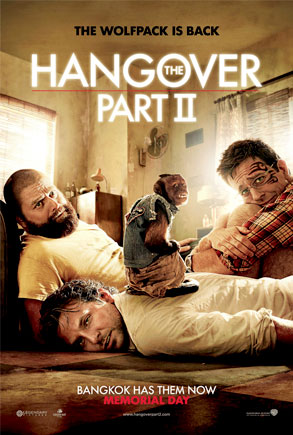
The Hangover Part II

So 2009's The Hangover was pretty fun, right?  Yeah, I thought so. It was that perfect blend of really smart humor, really raunchy humor, and just a genuinely good, funny movie that became the highest-grossing R-rated comedy of all time.  It was only a matter of time, wasn't it?  I was one of the masses to go to a midnight show last night for 2011's The Hangover Part II, a sequel to the comedy that regardless of reviews or word of mouth will no doubt make boatloads of money. 

For starters, yes, I did like the movie. I like the cast, and there were some genuine laughs.  But the second I heard a sequel was hitting theaters, my first thought was "Really? Where are they going to take this?"  Well, my concerns were legitimate. The Hangover Part II is literally the same movie as the original with Bangkok, the capital of Thailand (or Thighland according to one character), stepping in for Las Vegas.  I don't mean similar or with shades of its predecessor. I mean THE...EXACT...FREAKING...MOVIE almost scene for scene.  Oh wait, it's raunchier, a lot filthier, and it still manages to be funny. But don't expect an update or a tweak on the original. It's the same damn movie.

After the debacle at the bachelor party of their friend, Doug (Justin Bartha), groom-to-be Stu (Wes Helms) wants nothing to do with another bachelor party before he marries his fiance, Lauren (Jamie Chung). The wedding will be in a remote part of Thailand, and the whole crew is making the epic trip there. Phil (Bradley Cooper) is more than disappointed there will be no bachelor party, but he goes along, and of course, Alan (Zach Galifianakis) is along too. The Wolfpack is reunited. They celebrate lightly on the beach only to wake up the next morning in a dingy, sweaty, nasty Bangkok hotel room. Lauren's 16-year old brother, Teddy (Mason Lee), is missing (short a finger apparently), and there's no sign of him. Stu, Alan, and Phil remember none of what happens and start to put the pieces together, all in hopes of keeping the wedding on.

That may have been the most needless plot description I've written in over 600 reviews these last few years. If I was in a lazier mood or hadn't enjoyed the movie, I would have either linked to the original's review or maybe more cynically, just said 'See the first The Hangover and repeat (in Bangkok).' This is my problem with most things in Hollywood.  The original movie was great, a truly funny movie that was original and unique and damn entertaining.  It was so good they just had to go back to the well.  I get it, this movie will make a bajillion bucks, and it's as close to a sure thing as is out there.  But director Todd Phillips -- and I can't make this point enough -- makes the same EXACT movie.

To a certain point, you just know you're in trouble when the lines 'It's happening again' is used several separate times.  Still, above all else and any complete lack of originality, The Hangover 2 is an enjoyable movie. The whole gang is back. The next-morning scene of the trashed Bangkok hotel room -- while not as perfectly made as the Vegas shot -- is a gem.  The reveal of what happened (Stu's facial tattoos, Alan's head has been shaved) is the gimmick because we want to know how it happened. Mr. Chow (Ken Yeong) is back for more chaos, and the debauchery continues. The Wolfpack is reunited, searching for 16-year old Teddy and hoping to find him before the wedding. The best is saved for the end, the reveal of what actually did happen, all courtesy of the pictures on Teddy's phone.  That is the one thing that is significantly improved from the original. The pictures are priceless.  Alan also has a reveal about the pictures from the first movie that is priceless.

Thankfully, the whole cast is back for more. Lame retread of a successful story, yes, but the appeal of the first movie and now the sequel was the interaction among the cast. Cooper's Phil is the unofficial leader of the group, basically a likable a-hole.  Helms' Stu is wondering if his future father-in-law is going to approve of him EVER, and is the dupe of all the worst stuff (see Face Tattoo if you missed that). Galifianakis' Alan is the weirdo, glad to be back with his "friends," especially with his man-crush on Phil.  Their chemistry and interactions make this sequel worth watching, a fair share of surprises revealed along the way. Their misadventures are amped up, and the shady underworld nature of Bangkok adds a whole other level to the story. Joining the cast is Paul Giamatti as Kingsley, an American businessman up to no good who needs the guys to bring him Mr. Chow. And yes, Mike Tyson is back for an odd, somewhat falls short cameo as himself.

All criticisms aside, I did like this movie. It is a blatant rip-off of the original that never tries to take another step forward.  The mystery and misadventures produce a fair share of laughs, and it's fun seeing the cast reunited.  Galifianakis not surprisingly steals the show again, but the whole cast is worth mentioning.  But as I watched the movie and things moved along, a thought came to me (I know, they're rare). At what point will Hangover 3 be out? It will be stupid, a retread of a retread, and will almost assuredly make lots of money. I'll probably be seeing that one too.  But I feel duped because I've paid to see the same movie twice...two years apart.  Funny from start to finish so it gets a positive review even if it does lack some of the energy of the first The Hangover.  Still good though.

The Hangover Part II <---trailer (2011): ***/****