The Sons of Katie Elder

The Sons of Katie Elder
"First, we reunite, then find Ma and Pa's killer...then read some reviews."

Sunday, August 16, 2009

The Unforgiven

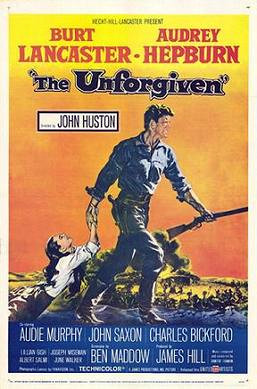
Some westerns are content to go for the lowest common denominator, an entertaining story with ridiculous amounts of action. I don't mean that as negatively as it sounds, I own a lot of movies like that. But some westerns strive for something else whether it be getting a message across or trying to make a statement about the times. These can be hit or miss because sometimes they strive to do too much, but every so often they find that balance, like John Huston's 1960 adult western The Unforgiven.

Based on a novel by author Alan Le May, who also wrote The Searchers, you have to figure you're not getting a typical shoot 'em up western. And in general, westerns were getting away from the old stereotypes, especially in the 1950s with some adult, psychological westerns like Anthony Mann's movies teaming up with Jimmy Stewart (all highly recommended). The Unforgiven doesn't settle for anything easy in it's story about a western family dealing with the revelation that their adopted daughter may be a Kiowa.

The Zacharys are a frontier family working their spread in the Texas panhandle and looking to put together a cattle herd to drive north to Wichita. The patriarch of the family since his father died years before, Ben (Burt Lancaster) is the leader, the oldest brother who keeps everyone else in check. His mother, Mattilde (Lillian Gish), runs the house and makes sure the family stays together. Helping Ben around the spread are his two younger brothers, Cash (Audie Murphy), a fiery, hot-tempered cowboy, and Andy (Doug McClure), the youngest brother who's still growing up. Then, there's Rachel (Audrey Hepburn), their adopted sister who their father supposedly found after her parents were massacred by Kiowas.

One day, a mysterious rider (Joseph Wiseman) rides into town with some revealing news. He says that Rachel has Indian blood in her, and that the story her father told was a lie. Everyone around turns on the Zacharys, and the news even tears the family itself apart with Cash refusing to live in the same house as a 'red-skinned' Indian. Even Ben's longtime partner and neighbor Zed Rawlings (Charles Bickford) refuses to deal with the family. All the while, Ben must hold the family together, even when the Kiowas come to take Rachel back.

Any movie, including a western, that deals with racism as straight forward and honest as this one is going to be polarizing. The Unforgiven can be brutally honest in that sense. We're introduced to all these characters, get to know them, and across the board they seem like good people. But the moment the possibility arises that one among them could be an Indian, they turn on each other. That could have been what the times were like, but it's a story that could be set in any decade or time in American history. It works because it doesn't try to whitewash the story.

Credit for that goes to Huston and his cast, an impressive listing of actors. It's not Lancaster's best part, but he's solid in the lead role. Hepburn is a bit of an odd choice as Rachel, but she pulls it off even if she looks little to nothing like a young Kiowa woman. This movie is known as much for the behind the scenes issues with Hepburn, but her role as Rachel works because she makes the character easy to identify with and very sympathetic.

Surprisingly enough with Lancaster and Hepburn in the leads, it's Audie Murphy that has the best part. His Cash Zachary is a deeply flawed character, a racist at the most basic who wants nothing to do with Indians of any sort, even his own adopted sister. Always known for playing the good guy in a white hat, the WWII hero plays completely against part here as the racist cowboy and comes across the best because he puts it all into the part. Of the rest of the cast, Gish and McClure round out the family, a believable representation of a frontier family, and John Saxon has a cool if small part as Johnny Portugal, an Indian horse wrangler/breaker, including this well choreographed chase scene.

Judging the movie apart from its story is a lot easier because Huston presents such a well-package western. Visually, he gets the spectacle down, the epic feel of what living in the west was like. The movie was shot in Durango, Mexico where many westerns were filmed, and it looks beautiful. The west was full of big, wide open spaces and Huston utilizes that feeling with some memorable long shots, some seemingly from miles away on a rock butte or hill. Composer Dimitri Tiomkin's score isn't as consistently strong as some of his others, but his music in those scenes fits perfectly.

A western that's dark and gloomy and doesn't pull any punches with its story dealing with racism and prejudices in the wild west. The movie benefits from some great performances, including a career-best part from Audie Murphy, and location shooting in Durango. This isn't as well known as Alan Le May's other highly respected western The Searchers, but it deserves more recognition than it's gotten in the years since.

The Unforgiven (1960): *** 1/2 /****

Saturday, August 15, 2009

To Catch a Thief

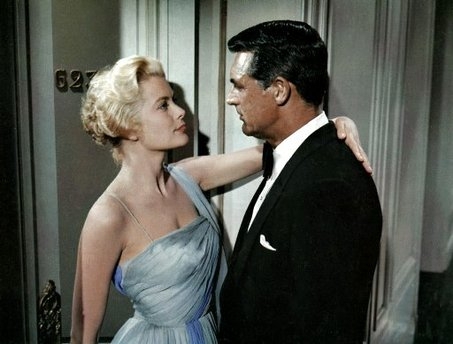
What do you think of when you hear the name 'Alfred Hitchcock'? Most movie fans go right to the thrillers, suspense and psychological thrillers he made during his well-documented career. But not all Hitchcock's movies qualified as any of those three sub-genres, like 1955's To Catch a Thief, a definite change of pace compared to movies like Psycho, Vertigo, or North by Northwest.

If anything, this is the director at his lightweight best showing he doesn't always have to be dealing with international intrigue or murderers hunting people down. With a good story, filming locations on the French Riviera, and perfect chemistry between leads Cary Grant and Grace Kelly, it's hard not to like this movie.

Former jewel thief Mark Robie (Grant) is living in his villa on the French Riviera without a concern in the world. But the newspapers start to report on the return of 'the Cat,' a famed jewel thief identified as Robie, who is starting to pull off elaborate robberies of all the rich women in the Riviera. If someone has expensive, lavish jewelry, the Cat will find them. Forced to prove his innocence and working with French police, Robie goes undercover to try and root out the actual thief before more crimes get pinned on him. It's during his investigation he meets Francie Stevens (Kelly), a rich, young American woman traveling with her mother who happens to travel with her fair share of expensive jewelry.

It's not long before Francie figures out who Robie is and with a naive sense of what's going on, wants to help him find the impersonator, the actual thief. But who knows, could Mark Robie actually be using his time away as a cover while he's actually pullling off these jobs? Hitchcock drops just enough hints to make viewers wonder if maybe Robie isn't on the straight and narrow path.

While the jewel thief is obviously the main focus of the movie, the treat is watching Grant and Kelly interact. So often movies from the 1950s just threw two actors together and forced chemistry on them. Not so here as the duo has an obvious chemistry. Cary Grant is one of the coolest, most suave actors to ever come out of Hollywood, and this is Grant at his coolest. He never looks like he's trying too hard, and it works. I know I believe it because most of the time Cary Grant is playing, well, Cary Grant. I was also impressed with Grace Kelly who I didn't care for in High Noon or Mogambo. But Hitchcock is able to get something out of her that other directors weren't because just like in Rear Window, she's dead-on here as Francie Stevens.

It's their back and forth, their interplay, like this exchange with some subtle fireworks that makes the story come to life even if Grant was 25 years older than the future Princess of Monaco. Hitchcock always had strong female characters in his movies, often thin, pale blondes like Kelly and Kim Novak among others, and Kelly's Francie is certainly no damsel in distress. With some help from the other players like Jessie Royce Landis as Francie's mother and John Williams as a straight-laced insurance agent, there's even some comedic moments as Grant's Robie continues his investigation. Charles Vanel co-stars as Bertani, an old friend of Robie's from his days in WWII in the French resistance, and Brigitte Auber as Danielle, a young French girl with a crush on Robie.

With such a respected director like Hitchcock, you can't help but notice how polished this movie is from start to finish. Filmed entirely on the French Riviera, it might as well be a vacation preview for any would-be travelers. Cinematographer Robert Burks even won the Oscar for Best Cinematography, and it's clear why, the movie's visuals are ridiculously good-looking. The colors come alive whether it be Robie and Francie walking on the beach or a mountain lane car chase. It seems like making a movie that looks good would be easy, but some directors take it for granted. Not Hitchcock, and not here.

Definitely one of my favorites from Hitchcock right up there with North by Northwest and Vertigo thanks to Cary Grant and Grace Kelly's chemistry, a script ripe with great one-liners, and a general sense of this is how a movie should be made.

To Catch a Thief <-----trailer (1955): ****/****

Friday, August 14, 2009

A Glenn Ford double feature

Glenn Ford doesn't get a lot of credit as a major western star like a John Wayne, Clint Eastwood, or Randolph Scott. Maybe it's because he was only in one western that is considered a classic, the original 3:10 To Yuma, but Ford turned out a strong list of quality westerns especially later in his career in the 1950s and 1960s. TCM did a Glenn Ford Day as part of their Summer Under the Stars recently, and I was able to catch two westerns I'd missed in the past both from the second half of his career.

1967's A Time for Killing is a good example of how American westerns tried to respond to the cynical, darker spaghetti westerns from Italy. It's the closing days of the Civil War when a group of Confederate prisoners led by Captain Dorrit Bentley (George Hamilton) escape from a Union stockade near the U.S./Mexico border. Heading south, they ambush a supply train and take a prisoner, Emily Biddle (Inger Stevens), the fiance of the Union major, Wolcott (Ford), tracking them.

Bentley's Confederate escapees are a pretty slimy bunch, not too say that Wolcott's Union patrol is any better. It's the end of a long, bloody war, and these men on both sides are exhausted and just want to go home. I was caught off guard by how far the movie went to show those depths. Even when Bentley finds out the war is over, he keeps the news from the men, and Walcott disobeys orders and follows the fugitives into Mexico. The movie was filmed in Old Tucson and Utah and looks great, appropriately gritty and dusty.

While Ford is good as Major Tom Wolcott, the officer trying to rescue his fiance, it's Hamilton who leaves the deepest impression. His Bentley is an ultra-patriot who refuses to believe the war is over and will continue to take that war to the Yankees. Before her tragic death that was ruled a suicide, Stevens made a string of quality westerns late in the 60s, and she's very good here, holding her own with both Ford and Hamilton. The background players include Kenneth Tobey, Max Baer in a role slightly different from Jethro on Beverly Hillbillies, Timothy Carey, Harry Dean Stanton, Todd Armstrong, and for all you trivia buffs out there, Harrison Ford in just his third movie.

Made two years later, Heaven With a Gun is a more traditional western, but it does make efforts to change with the times when dealing with sex and violence. How many westerns have started with a stranger riding into a town and no one knows who he is or what his motives are? It'd probably take quite a few posts just to list all those movies, but that's how 'Heaven' begins with Jim Killian (Ford) riding into Vinegaroon, a town divided between cattle ranchers and sheepherders. Looking to make up for his violent past, Killian sets up a church in town with hopes of uniting both sides.

His main opposition is Asa Beck (John Anderson), a cattle rancher who with his son, Coke (David Carradine) will have nothing to do with sheepherders and refuses to even listen to Killian's ideas. On the other hand, Killian gets help from everyone else in town including Madge (Carolyn Jones), the saloon/brothel owner, Leloopa (Barbara Hershey), a young Indian girl Jim cares for after her father is killed, and Bart Patterson (William Bryant), a local ranch owner. Also worth mentioning are two supporting parts for J.D. Cannon as a hired gun, Mace, and Noah Beery Jr as Garvey, one of Beck's most trusted hands.

The script calls for some random nudity that feels just thrown into the script for the sake of some topless saloon girls, and the violence is pretty vicious even if it's not shown. Much of it is off-screen, but it's pretty grim whether you see the results or not. The sex and violence then makes the ending seem a little off for me. Killian is trying to stop Beck and his gunhands from massacring the sheepherders and cattle ranchers who are now working together. It doesn't work overall and comes across as too forced, like the money just wasn't there to set up a shootout.

The constant through both movies is Ford's steadying influence on the story. He was usually cast as the good guy, but later in his career they added a wrinkle to that old standby, the good guy who used to be a bad guy and is looking to repent. It's hard to judge Ford as an actor because in roles like this he didn't have to show a lot of range. But like John Wayne did in his later years, Ford nails these parts. He's likable on-screen with a very natural presence. I liked both movies, Time for Killing a lot and Heaven With A Gun despite the ending.

A Time for Killing <---fan-made trailer (1967): ***/****
Heaven With a Gun (1969): ** 1/2 /****

Thursday, August 13, 2009

The Code

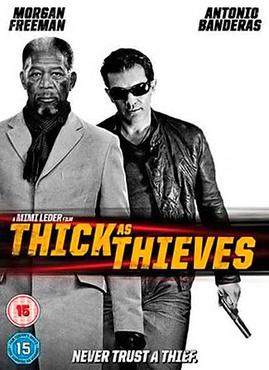
Usually when I see a straight to DVD movie, I try and steer clear of it. But every so often, I see one that catches my eye with some unlikely casting or a worthwhile story. I thought The Code might qualify in both categories with Morgan Freeman and Antonio Banderas as the leads in a heist movie. After an interesting start, this one derailed in a big way about halfway through.

Looking for one last big score to settle a debt with the Russian mob, infamous art thief Keith Ripley (Freeman) recruits another master thief, Gabriel Martin (Banderas), to help him out. To settle his debt, Ripley must steal two Faberge eggs worth $20 million apiece from a well-guarded Russian jeweler's fortress of a vault. To get the job done, Ripley and Gabriel must get past obstacles that include voice and fingerprint recognition, highly sensitive motion sensors, heavily-armed guards and a vault that closes on its own if open too long. Their plan progresses smoothly until Gabriel ends up with Ripley's goddaughter, Alex (Radha Mitchell), with the mobsters finding out about their relationship. All the while, Ripley's long-time nemesis on the NYPD, Lt. Weber (Robert Forster), is hot on their trail.

If you're like me, that sounds promising but something doesn't translate in the execution. The build-up to the heist works although it is a bit rushed, and the heist itself works for the most part. There's a couple 'what the f*ck?' moments that I'm still not sure on, but those were the least of my worries. What is disappointing is that the script is conscious of past heist movies as Ripley and Gabriel discuss Rififi and Topkapi with Gabriel even mentioning he only watches heist movies. But it never delivers, and thanks to some stupid twists in the last half hour I came away with a bad taste from The Code.

With heist/robbery movies, it's pretty much assumed that some twists and surprises are part of the story. It seems the directors, producers and scriptwriters know this too because they're always trying to out-do and one-up themselves. So when the twists do come, they're usually too forced and out of left field. The Code has two such twists, the first of which is absolutely ridiculous, the second working a little bit better although it sounded like something out of the Ocean's 11 movies. I dislike twists for the sake of twists that basically make the rest of the movie pointless, and both twists here do just that.

Looking at the casting, this is the type of role Freeman can sleepwalk through. He's usually better in supporting roles but does all right here as the lead. Freeman doesn't come off as intimidating though, which the role requires some, but as the master thief with no match it works. Banderas as the younger recruit seems odd, and I'm convinced he has a clause in his contracts that a sex scene is required with his female co-stars. In general, Banderas doesn't come across well here. Really, it's the supporting cast that is pretty good.

I'd only seen Mitchell in Pitch Black, which I enjoyed, and in a few supporting roles, but along with Freeman she's the high point of the movie. She's a lawyer struggling with the recent death of her father who when she meets Banderas' Gabriel develops an immediate chemistry. The viewer's never quite sure of her intentions, and the script calls for her to look good in any number of tight/short outfits. As the detective on Ripley's trail, Forster is good as the weary officer who knows a job is coming but not the details of it. Rade Serbedzija, a face you'll recognize even if the name doesn't ring a bell, makes a brief appearance as Petrovich, the Russian mobster who wants the Faberge eggs.

Maybe it's just the straight to DVD stigma, but The Code never lives up to any expectations, and they weren't that high to begin with. Set in New York and other than a few locations where it's obviously NYC, the movie was filmed in Bulgaria, I guess for cheaper shooting costs. The script, the annoying, tries too hard musical score, and more than a fair share of ridiculous plot holes, The Code just wasn't that good despite efforts from star Morgan Freeman. Can't recommend this one at all.

The Code (2009): * 1/2 /****

Tuesday, August 11, 2009

Gran Torino

To be fair off the bat, I only saw two of the roles that were nominated for Best Actor at the Oscars this year, Mickey Rourke in The Wrestler who I would have given the award and Brad Pitt who was solid in The Curious Case of Benjamin Button. No disrespect to them or the other three nominees including winner Sean Penn, but how was Clint Eastwood not nominated for his part in Gran Torino?

In the second half of his career, Eastwood has become as well-respected for his work behind the camera as a director as he is for his on-screen work. He's directed a handful of classics like Unforgiven, Mystic River, Million Dollar Baby and several others that are entertaining if not considered classic. Directing Gran Torino, Eastwood shows again what he is capable of from the director's chair with a moving, often heartbreaking story of a recent widower.

Walt Kowalski (Eastwood) has just lost his wife, Dorothy, and now must adjust to his new life. A Korean War veteran and a longtime worker in the Detroit automobile factories, Walt is an angry, racist old man. There's not an ethnicity or culture he doesn't have something to say about, all of it seemingly negative. The day of his wife's funeral a new family moves in next door, the Vu's, a Hmong family settling in Detroit. At first, he wants nothing to do with them, but one night members of an Asian gang come up to the house to recruit young Thao (Bee Vang) into the gang. There's a bit of a ruckus and the fight spills over to Walt's lawn. He intervenes, pointing his M1 rifle at them, growling 'Get off my lawn' to the gangbangers.

Kowalski things nothing of it, but the next day Hmong neighbors from all over the neighborhood are bringing him gifts for saving Thao from trouble. Surprisingly enough, Walt embraces two of the Vu family, Thao who has to work for him after trying to steal his prized 1972 Gran Torino, and Sue (Ahney Her), Thao's older sister who can look past some of Walt's racial feelings and starts to call him 'Wally' much to his chagrin. But even as he grows close to the young Vu's, there's still the threat of the gangbangers around.

What works so well for the Walt character is the changes he makes over the course of the movie. At first, he wouldn't help or touch the Vu family with a ten-foot stick, but he comes to like them and is able to look past some of his own memories, often painful ones, and prejudices he acquired from the Korean War. Walt becomes a bit of a guardian angel for the family. He has trouble bonding with his own two sons and their families, but for some reason Kowalski clicks right away with the Vu clan.

Starring with Eastwood, Vang and Her make their acting debuts and are very impressive. Reading some reviews, I was surprised to read the criticism of these two young actors because I thought they were great. Vang is only overmatched in one scene late in the movie that is a bit uncomfortable to watch, but otherwise he comes across very well, especially in the scenes with Walt as their unlikely friendship grows. Her's Sue is equally strong, not afraid to talk to Walt and even call him 'Wally' when he seemingly has nothing positive to say. It's more proof of Eastwood's ability, bringing the best possible out of these two actors making their debuts.

Another key performance comes from Christopher Carley as Father Janovich, a priest just out of the seminary who bonded with Walt's wife in the months leading up to her death. Janovich made a promise to her to try and help Walt, ultimately getting him to go to confession. Their exchanges as Janovich tries to convince Kowalski come across as realistically as possible with experienced Walt going up against a youngster trying to figure out what life and death really is. With a movie heavy on dialogue and the developing relationships and friendships between characters, these scenes ring true with the four main actors.

All I can think of with Eastwood not even getting a nomination is that he's playing a similar character to the one he's played his whole career. But even considering that, it's fair to judge him like that. This is crotchety, curmudgeonly Eastwood for sure, growling his way through some conversations, but there's a heart to the character. Realizing his time on Earth may be coming to end, Walt tries to make amends and right some of the wrongs he's done and seen in his time. Like his part in Million Dollar Baby, Walt Kowalski is one of Eastwood's best parts, and I say he deserved if nothing else a nomination for best actor and/or best director.

Being a huge Eastwood fan, I'm not sure why I took so long seeing this movie, but I'm glad I did. It's an authentic movie from start to finish with a story that feels true. If you let it slip by like I have these last couple months, go catch up with Gran Torino. Movie fans won't be disappointed.

Gran Torino <-----trailer (2008): ****/****

Monday, August 10, 2009

Underwater!

In the 1950s, how did movie producers get audiences to come out to the theaters when families could just stay home and watch TV in the comforts of their living rooms? They went two ways, gimmicky, like 3-D, and for the spectacle. Show the audience something they couldn't or wouldn't see on the television, and they'd come out in droves.

And who better to go for the spectacle than producer Howard Hughes, almost the definition of eccentric millionaire always trying to top himself and his movies. That's what the Hughes-produced 1955 adventure Underwater! tried to do. With a story heavily reliant on underwater shooting as stunt doubles/swimmers explore coral reefs and shipwrecks, Hughes certainly gets points for creativity and effort. But the story never rises above any other typical sunken treasure story as the movie stays firmly in the B-movie genre.

Working in the Caribbean, Johnny Gray (Richard Egan) meets his old friend Dominic (Gilbert Roland). Dom convinces Johnny to go diving with him and while searching, the duo discovers a sunken wreck with clues to its identity; a Spanish ship from the 1600s that was supposed to be carrying a gold shipment back to Spain. After a lot of convincing with Johnny's wife Theresa (Jane Russell), the trio sets out to raise the money and equipment it will take to salvage the old wreck. They recruit a rich woman, Gloria (Lori Nelson) who owns a boat and quickly falls for Dominic, and a priest with knowledge of the Caribbean's sunken treasures, Father Cannon (Robert Keith). The search doesn't go smoothly though as a shark hunter (Joseph Calleia) is suspicious of their activities.

From reading director John Sturges' biography, it seems the script was never quite finished during the shooting. All producer Hughes was sure of was that the underwater diving footage would be the key part of the movie. The diving sequences are pretty good as stunt doubles for Russell, Egan and Roland explore the Caribbean depths. But everything else suffers because of it. All of the budget must have been spent on the cast and diving scenes because the rest of the movie has Gloria's boat in a tank with a pretty obvious painted background a few feet behind the ship. The same goes for indoor scenes with low budget boat and restaurant sets. You get a long shot of a beautiful bay with a boat and people visible, but the cut goes to a clearly indoor tank set.

Since he discovered Russell in the mid 1940s with The Outlaw, Hughes clearly had a bit of a crush on the young actress. The movies where they worked together seemed to be an excuse for Hughes to dress Russell up in any number of skimpy and/or tight outfits, and Underwater! is no different. No complaints because she's gorgeous, but just felt the need to point it out. Her Theresa has a Spanish accent that goes in and out from scene to scene, but is anyone actually paying attention to the dialogue? As old friends Johnny and Dominic, Egan and Roland look to be having a good time without having to put too much effort into it. Nelson and Keith are wasted in background parts, and Calleia doesn't have much to do as the shark hunter who pops in and out of the story.

There isn't much conflict throughout the story although efforts are made. Johnny and Theresa are newlyweds with some issues, but that's resolved. Dominic gets the bends late in the movie, but it's pretty clear they're not going to kill off Gilbert Roland. The story is just sort of there. It never tries to be anything other than a thin story around all the impressive underwater sequences.

That said, I enjoyed it. Underwater! serves more as a vacation brochure than anything, and the cast does seem to be having a good time. Besides Jane Russell in a swimsuit is nothing to scoff at. A classic by no means, but definitely a movie you can shut your brain off and enjoy for 90 minutes.

Underwater! <------trailer (1955): ** 1/2 /****

Saturday, August 8, 2009

The Wrong Man

So imagine this, one day you're coming home from work only to have two police detectives stop you and take you to the precinct. They've got eyewitnesses who can put you at the scene of several different hold-ups and even pick you out of a line-up. Your handwriting sample is even eerily similar to the note left at the crime scene, and your alibi doesn't hold up. Everything, and so it seems everyone, is against your innocence. What do you do?

That's the question facing Christopher Emmanuel 'Manny' Balestrero (Henry Fonda) in Alfred Hitchcock's The Wrong Man from 1956. Manny is the typical husband who with his wife Rose (Vera Miles) has a nice little life with their two kids and house. Manny works as a bass player at a local club at nights and while he doesn't pull in a ton of money, his family is happy and well cared for even if money isn't always readily available. One day, he does to the insurance agent to see how much he can borrow so Rose can have her wisdom teeth removed.

So starts the process as the tellers at the agency think he's the man who held them up several months before. The police get involved and before you know it, Manny is looking at serious jailtime for a handful of stickups that he swears he was not a part of. But even with his supposed innocence, the evidence starts to build up making the viewer wonder if maybe he is guilty. Who better to star in that part than Henry Fonda? Other than his shocking portrayal of a villain in Sergio Leone's Once Upon a Time in the West, I can't think of another movie where Fonda was the bad guy. He's Joe America so how could he be responsible for all these accusations?

Director Alfred Hitchcock is dealing here with a story and circumstance that he perfected over the years; that of a man thrust into a situation where he doesn't always know what is going on and must find a way to right the ship. Think of The Man Who Knew Too Much or North by Northwest as two other examples. He excelled with stories like this and keeps the viewer guessing. Hints are dropped throughout that maybe Manny did go through with the crimes. Could he have done it? After all, we've just met the guy and at least in my case, made the assumption that Fonda, in character or not, couldn't have been a stick-up artist.

By the end of the movie though, everything is just wrapped up too nicely with a little bow on top to cap it off. I don't know what I was expecting from the ending, maybe a twist like so many of Hitchcock's other films, but it doesn't reveal itself here. I guess the enjoyment is supposed to come from the build-up as the evidence mounts against Manny, and the effect it has on his wife Rose who starts to unravel under all the pressure. Speaking of that, Miles delivers a strong performance as Rose, a sort of common housewife who just wants what is best for her family and starts to blame herself for all their problems.

Other names in the cast include Anthony Quayle as Frank O'Connor, Manny's lawyer, and Harold J. Stone and Charles Coooper as the two lead detectives on the case who want to believe Manny's claims of innocence even when nothing seems to point in that direction.

I wanted to like The Wrong Man more, and parts are very good, but the ending just doesn't do it for me. Hitchcock opens the film with some on-screen narration, saying it's a true story so that the ending is what happened in real life. But for me, I guess having seen enough other Hitchcock movies I had the wool pulled over my eyes waiting for the big reveal, the big twist that never comes. Still a strong effort from Hitchcock thanks to the performances of Fonda and Miles, but it's not top tier Hitchcock thriller.

The Wrong Man <----trailer (1956): ** 1/2 /****

Friday, August 7, 2009

The 'burbs

Before he was one of the most bankable and most well-respected stars in Hollywood, Tom Hanks was just another actor in the 1980s with a handful of comedies and a TV sitcom under his belt. Seeing what a huge star he is now, it can be interesting to look back on some of those 80s comedies, one of which never fails to make me laugh, 1989's The 'burbs.

More of a dark comedy with a fair share of silly touches, The 'burbs explores the basic idea that no one knows their neighbors too well. Who knows what's going on in their basement in the middle of the night? Then add to the setting the normal weirdness of living in the suburbs, and you've got something going there. Movies like Rear Window and Disturbia used similar storylines, but both of those movies were played seriously. 'burbs puts your average suburbanite in an odd situation and lets the story play out with sometimes hysterical results.

Taking a week off from work, Ray Peterson (Hanks) plans to sit around the house and be lazy with his wife Carol (Carrie Fisher) and 'get back to normal.' But next door, the neighbors, the Klopeks, seem to be up to something crazy, with blinding lights and odd sounds coming from their basement. Ray's neighbor Art (Rick Ducommun) is convinced that the Klopeks are part of some sort of satanic cult, killing people and burning their bodies in the basement and then burying the bones in the backyard. Ray is more than a little skeptical, but the clues continue to come up. Even then, it's only when one elderly neighbor disappears that Ray starts to believe something fishy is going on.

With some help from across the street neighbor, Mark Rumsfield (Bruce Dern), a Vietnam vet, Ray and Art plan to investigate the Klopeks house and see exactly what's going on. The fun and mystery of it all is that you're never quite sure what's going on at the Klopek's house. Sure, there are clues that there's something funny transpiring, but Art and Rumsfield are more than ready to jump to conclusions. The movie is set entirely on this one cul-de-sac and never leaves this stretch of houses. It's self-contained in the suburbs, and overall gives a good sense of the general weirdness of a suburban neighborhood.

What works so well when it comes to the laughs is that no one tries too hard. Most of the laugh out loud humor comes from the dialogue, little throwaway lines here and there that you almost miss. Here's IMDB's memorable quotes with some semi-SPOILERS. The story waits until the last 30 minutes to really ratchet up the craziness as Ray and Art jump over the fence to investigate while the Klopeks are away on a day trip. The comedy goes from dialogue to physical, including one bit with Art trying to knock out the Klopeks' alarm system among several other winners.

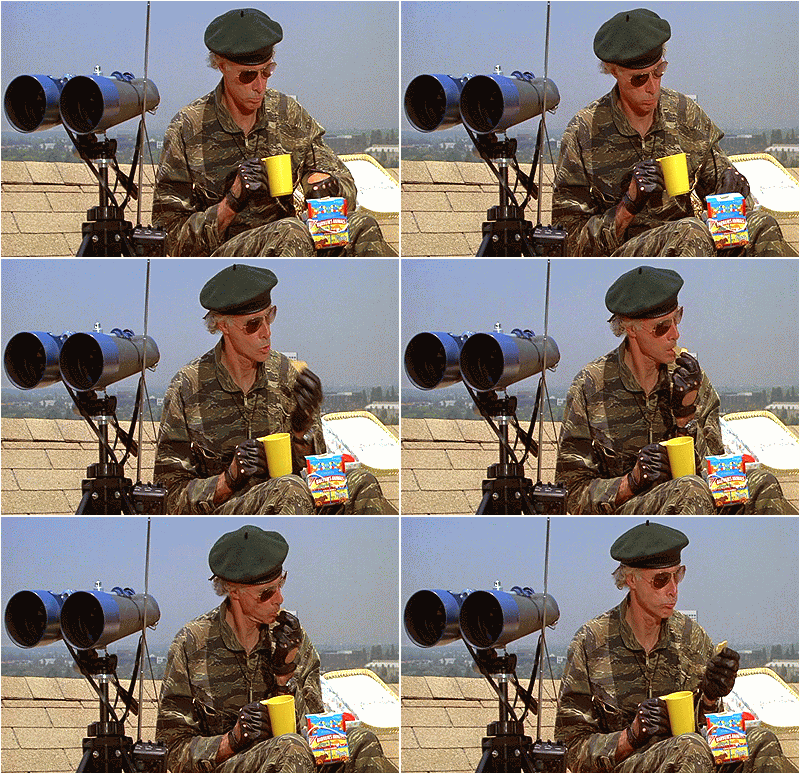
With Hanks playing straight man to all these suburban shenanigans, it's the rest of the ensemble cast that makes the movie memorable. Hanks is good as the everyman trying to lead his life, but he leaves most of the laughs to Ducommun and especially Dern. Playing a Vietnam vet, Dern is hysterical, not afraid to ask questions or do things the rest of his neighbors are not. With his trophy wife Bonnie (Wendy Schaal), Rumsfield is my favorite of the Mayfield Place neighbors. A vet of '18 months in the bush,' he still wears the uniform and is outfitted with all sorts of weapons. Setting up an observation post late in the movie, Rumsfield quietly sits on his roof, drinking some coffee and eating animal crackers. He doesn't say a word, but it's priceless regardless. Here's another of my favorites, Dern 'directing the operation' with some pitch-perfect delivery.

While Ducommun and Dern steal the show, the rest of the cast doesn't disappoint. Fisher plays the worrying wife who along with Schaal's Bonnie is convinced nothing is going on. Corey Feldman provides some good laughs as Ricky Butler, the street's resident stoner who loves nothing more than watching his neighbors' crazy antics. Then, there's the Klopeks, who I've debated revealing. So if you don't want to know who they are, skip ahead to the next paragraph. Henry Gibson is Dr. Werner Klopeck with a great entrance about halfway through the movie with Brother Theodore as his brother Reuben and Courtney Gains as Hans, the red-headed youngster with the gnarly-looking sideburns.

So is this the movie for everyone? Probably not. The humor can be kind of off the wall, but if you have a dark sense of humor The 'burbs is probably right up your alley. Great cast especially Hanks, Ducommun and Dern with some truly laugh out loud moments.

The 'burbs <----trailer (1989): *** 1/2 /****

Harry in Your Pocket

Well, it's August now so that means Turner Classic Movies is doing its annual Summer Under the Stars festival every day of the month. That can be good and bad depending on the star of the day, and even then they tend to show more mainstream, well-known star vehicles. So with James Coburn Day earlier this week, I'd seen all but one movie on the schedule, 1973's Harry in Your Pocket.

I was skeptical going in because Coburn made some classics, some above average movies, and then there's a gap until you hit rock bottom with a handful of movies I couldn't stand. I'll file this one right under the above average category. As a favor to an old friend, master thief/pickpocket Harry (Coburn) agrees to form a wire mob team, a group of pickpockets working together. Harry and his friend Casey (Walter Pidgeon) must recruit a few other members and decide on Ray (Michael Sarrazin), an inexperienced, low-level thief, and Sandy (Trish Van Devere), a young woman looking for some quick money.

A story about pickpockets might not seem like a huge thrill ride, but everything works smoothly after a somewhat slow start where everyone is introduced. The movie breaks down the techniques, the mannerisms, the planning that goes into a simple and quick theft of a man's wallet. Harry's one rule is simple, 'I don't carry the goods.' It's with his help of the team, Casey picking their mark, Sandy providing the distraction with some short skirts, and Ray taking the handoff, that Harry and Co. start to rack up some serious money.

Of course, that'd be too easy overall, wouldn't it? Harry takes a shine to Sandy who's dating Ray. Ray sees all this developing and doesn't go along easily. On top of that, Ray wants to branch off on his own but is worried he'll lose Sandy to Harry in the process.

Leading the cast, Coburn at his smooth, coolest best. In his better parts, Coburn gave effortless parts where it often seemed he wasn't even trying. As the expert pickpocket, he pulls off that kind of part here. Just by being there, Pidgeon gives 'HiYP' a ton of credibility. Whether you know him or not by name, I can guarantee you've seen him in a movie or two. An underrated actor who is excellent here as Coburn's aging sidekick. Sarrazin and Van Devere are the two youngsters, representing themselves well against two great presences in Coburn and Pidgeon.

Throw in a catchy 70s score from Lalo Schifrin, and you've got a well-rounded, well-told story. The movie doesn't appear to have been released on DVD or VHS so keep your eye out at the TCM website for another showing. Worth it for Coburn fans to see the laconic actor in one of his many silky smooth anti-heroes. You can check out the first 10 minutes here, and then another scene as Harry discusses strategy with his crew.