The Sons of Katie Elder

The Sons of Katie Elder
"First, we reunite, then find Ma and Pa's killer...then read some reviews."

Monday, March 14, 2011

The Devil's Own

There is nothing particularly pleasant about Irish history, but in movies, books like Angela's Ashes, or just straight pop culture (St. Patrick's Day is right around the corner!), there is often a romantic portrayal of an idyllic, romantic country that seems dropped here from another world. The lush, green landscapes, the thick Irish brogue, the people so full of life, it's all played up. From an Irish family, I know some about the history, but in terms of violence and chaos, Irish history is something else.

The IRA -- the Irish Republican Army -- is one of those things I've always been aware of without ever knowing much about it.  Depending on how you look at the situation that caused their creation, the IRA were freedom fighters who undertook a guerilla war against the British government in the 1910s and 1920s, but still exist today in different forms.  Just like Ireland itself, there is a romanticism involved in the portrayal of the IRA and their actions while others view them as murdering, despicable terrorists. I guess it all just depends on your beliefs/principles going in.  If nothing else, some movies try to be fair with a somewhat balanced portrayal, like 1997's The Devil's Own.

After watching his father get brutally gunned down in front of him, Frankie McGuire grows up with a hatred inside him, eventually joining the IRA and becoming one of their most notorious enforcers, wanted by the British army, intelligence community, and law enforcement. After years of making a reputation for himself, 28-year old Frankie (Brad Pitt) is on the run, the rest of the men in his unit getting picked off one-by-one. In desperate need of some help to fight back, he heads from Belfast to New York City, using some pull in the IRA to stay with an NYPD cop, Tom O'Meara (Harrison Ford), and his family while he waits on a shipment of Stinger missiles. O'Meara knows nothing of Frankie's background, but bonds quickly with the young Irishman, welcoming into his family.  But Frankie's reputation may put them all on the grid and in danger before he can complete his mission.

Thankfully dealing with an IRA enforcer as a main character, director Alan J. Pakula (his last movie before he died in 1998) doesn't paint this story in black and white, good and bad. Instead, there are shades of gray that force the characters in the movie to make difficult decisions while also making the viewer make a decision. Is Pitt's enforcer a villain or a hero? He kills in a cause he believes, but does that make it right?  The same for Ford's NYPD patrol sergeant. As a longtime member of the force, he prides himself on always being a fair, honest cop. He does what's right and is proud of it. But when his partner (Ruben Blades) makes a questionable call in the field, he's forced to make a difficult choice that goes against everything he believes and has worked for. We're not talking deep, biting analysis of the two stars, but enough to keep it interesting.

Playing on a movie convention as old as movies themselves, Pakula hitches this movie up to Ford and Pitt in the starring roles. The convention is basically a sure thing when handled right, two men with different backgrounds working or living together, bonding through their previously unknown similarities, and then being forced into a tricky situation that will pit them against each other, testing their friendship. Ford is the older, wiser mentor of sorts while Pitt is the young hot shot. Pakula tweaks the familiar formula with Pitt's younger character actually having the darker side, the history of over 20 killings as an enforcer. Ford's O'Meara, a 23-year veteran of the force, has fired his gun four times in the line of duty but has never shot anyone. So with the familiar big brother-little brother, father-son relationship, there is a wild card in the relationship.

No matter the type of story -- drama or comedy, action or romance -- it is always fun to see stars from different generations work together in film.  Ford was the established star here with Indiana Jones, Star Wars, The Fugitive all under his belt.  Pitt on the other hand was the rising star, still finding himself and what roles worked and didn't work.  So much like their roles in real life, the two bona-fide stars play off each other well.  The best, strongest part of the movie is this relationship that develops between them. If it doesn't work or feels forced, the movie is going to sink with it. It does work. No matter their backgrounds, both men are good men who have their personal beliefs, their principles they live by. It's just a matter of how far they're willing to go to prove these things.

What's missing though is some sort of heart as the story develops.  You like the characters (or I did), but the story kept me at a distance.  There's nothing that unique about it, and you know where it's going long before it gets there.  SPOILERS STOP READING SPOILERS If there was any doubt, Pitt's character is the tragic character, the doomed man who will no doubt end up dying bloody.  The ending still disappoints even knowing how it's going to end. Ford and Pitt have a great scene together in the finale that almost saves things but not completely.  END OF SPOILERS As for the rest of the cast, Blades is okay as Ford's longtime partner, Treat Williams is generically bad as a businessman/arms dealer working with Pitt, Margaret Colin as O'Meara's wife, Mitch Ryan as the police chief, and Natascha McElhone as Megan, Frankie's contact and possible love interest.  Composer James Horner also has a typically solid, very moving/appropriate and heavily Irish themed score. Overall, a slightly above average movie that had potential to be better but is still worth a watch.

The Devil's Own <---trailer (1997): ** 1/2 /****

Saturday, March 12, 2011

Bus Stop

An icon of beauty and style, Marilyn Monroe isn't always thought of as a true, dramatic actress.  In comedy, she was perfectly suited, often playing the sexy if ditsy blonde. Depending on the movie, it can take more acting ability to nail the comedy than the drama, but I've always thought Monroe was a solid actress across the board. It was only later in her shortened career that she turned to more dramatic roles consistently, including 1956's Bus Stop.

Before I jump into the review, I'm going to say this about the movie.  I hated it. Truly hated it. I sat through it for Monroe alone, and little else.  The story and plotting was beyond ridiculous, forced and hackneyed for the sake of the story and little else.  The leading man was such an exaggerated, annoying character that I found myself rooting for something horrible to happen to him. And at 96 minutes, this movie could not have ended quickly enough. The one saving grace? Monroe, showing off her tremendous beauty and an ability to act in a dramatic role.

The owner of a successful ranch in Montana, 21-year old Beauregard 'Bo' Decker (Don Murray) is traveling to Phoenix with veteran ranch hand Virgil (Arthur O'Connell) to take part in a high-stakes rodeo competition. Decker is looking for the big payoff at the end, and hopefully finding a wife to come live with him. After a long bus trip, they arrive in Phoenix where Bo sees Cherie (Monroe), a saloon performer making her way west slowly but surely to Hollywood. It's love at first sight for the young cowboy, and he decides that she will be his wife. The only problem? No one told Cherie anything about the arrangement, and she can't manage to shake off the persistent efforts of Bo.

The premise sounded interesting enough even if the description at TCM's website emphasizes Bo's kidnapping of Cherie late in the movie as a huge plot point. It sounds like a screwball comedy but is played like a straight drama. See any problems there? There's no comedy, but the drama is so off-the-wall it never clicks or gels in the least. The movie is just there, never choosing a side or what it's about. If there was some slapstick comedy, maybe it works. If there was a sense of danger as to what Bo might actually do, we're talking about a decent thriller.  Instead, we get this, a 96-minute movie that doesn't go anywhere and doesn't say anything.

I've written before about the likability of main characters and movies sinking or swimming on that decision. Do you like the main character at all? Are we supposed to? Unfortunately for Bus Stop, I hated Murray's Bo, but I'm pretty sure we're supposed to like him, root for him in some way. If I'm wrong, and he's meant to be a big joke, then what was the point of the whole movie? This was Murray's first feature film, and all the talent he would show in later roles just isn't there.  I can't decide if its his character or the acting...or both. Beauregard is a 12-year old in a 21-year old's body. He is overbearing, obnoxious, a stalker, bull-headed, stubborn, and downright annoying.  If you're going for a lovable cut-up who never grew up, so be it, but not like this.  It's too much.

What's worse is that the story and all the characters around him allow all this. Is it the awful script that requires things to move along so no one stops Bo? Did anyone care? If this movie was released in 2011, it would be about a young man stalking a young girl, desperately trying to convince her to love him. At different points, he breaks into her apartment and lies down next to her, gets engaged without telling her, and plans on getting married the next day. When that doesn't work, he actually lassoes her as she tries to escape, and NO ONE stops him. The cries of help didn't alert anyone that she's distressed? He's convinced that he can make her fall in love with him. The Bo character gets a chance at redemption late (after he gets the crap kicked out of him by Robert Bray's bus driver character), but it's too late to save the movie, and too quick of a transformation for this man-child.

So unfortunately while Murray's character needed to be taken out and shot about 10 minutes into the movie, the rest of the cast is above average. Looking pale as a ghost and sporting an Ozarks hillbilly accent, Monroe shows off her acting chops, carrying the movie through its rougher patches. She looks great too which never hurts, and even gets to sing a song soon after her introduction. O'Connell is all right, Bray is a bonus because he beats down Murray, Betty Field having some fun as sassy diner owner Grace, and Eileen Heckart as funny sidekick Vera to Monroe's Cherie. But all things considered, Monroe is the only reason to invest 96 minutes here. Murray is awful and single-handedly ruins the movie.

Bus Stop <---trailer (1956): */****

Friday, March 11, 2011

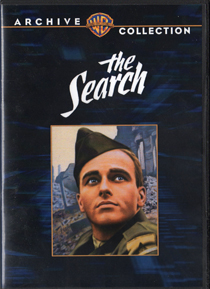
The Search

During a family trip to Washington DC growing up, I remember clearly the visit my Mom and I made to the Holocaust Museum.  We went out of curiosity, both of us history buffs in one way or another, and I remember being blown away by it. Visiting the museum is an experience I won't easily forget because by the time we left I felt physically ill.  Knowing what happened during WWII and actually seeing it are two different things. The number '6 million' is just that a number until you see the faces of those brutally wiped out. I've been back several times to Washington since, and don't plan on ever going back to that museum.

Some topics are just more difficult than others to translate to the movies, and the Holocaust is one of them. Still, there have been countless attempts in both film, television, and miniseries since the end of WWII, many of them very good. Almost always there's a message of hope, but these are not easy movies to watch. Of all the millions killed though, what about the millions more who survived somehow and were scarred the rest of their lives? What about the collateral damage of the war? How did Europe survive? Released just three years after the end of World War II, 1948's The Search is one of the best movies I've ever seen documenting a post-war reconstruction, both on the cities and countries, but on those people -- especially the kids -- who survived the ordeal.

World War II has ended, and the reconstruction of Europe has begun. Concentration camps have been liberated meaning countless thousands and millions of people now have to be dealt with, among them thousands of orphaned children. One little boy, Karel Malik (Ivan Jandl), is a survivor of Auschwitz and is now mute because his mind has regressed in a way to protect itself. Karel runs away from the American Red Cross workers trying to help him, eventually meeting American soldier/engineer, Ralph Stevenson (Montgomery Clift). Not sure what to do with the boy, the soldier takes him in, trying to rehabilitate him, get him used to the world again. They bond quickly, the American soldier even hoping to bring him home to America. But all the while -- unknown to them -- Karel's mother (also a survivor of the death camps), Hannah (Jarmila Novotna) is searching displaced children's camps one by one, desperately searching for her son.

With all the stories of soldiers in combat, large-scale conflicts where millions of lives were lost, the effect of war on the civilians can so often be left behind. Seeing that effect on one little boy who's not even 10-years old provides one of the more moving war stories I've ever seen. Director Fred Zinnemann shows a post-war Europe, the ruined cities, the empty streets, the squalor in the conditions, the desperate fight for survival from day-to-day. It's hard to fathom it all, that kids who should have been in grammar school were forced to live like that.

In an age where it seems every child actor ever has no real acting ability and just hams it up, seeing little Jandl's performance is remarkable.  He was honored with an Academy Award as a juvenile for his part. His life story following the movie is tragic because the Czech government saw how much hope he gave to audiences, and basically imprisoned this little boy for the rest of his life.  But on this performance alone, it's one of the best I've ever seen given by a child actor (he was 12 at the time). His eyes are so expressive, you see the pain, the pure terror in them, the atrocities he had to see.  Getting a second chance to see the world isn't always an awful place, he opens up to Clift's Steve character, becoming healthy again, first learning to speak again, and then learning to speak English word by word.

In just his second feature film, Clift shows his remarkable talent as well.  This is a part that in the wrong hands wouldn't have worked because it would be easy to overshadow the Karel role.  Clift never goes that far. His part is quiet, easy-going, and caring as he tries to help this boy however he can. There was potential here to get sappy, to go down the road of blatant propaganda, the American savior swooping in and making everything right.  It never goes that way thankfully.  Clift is interested in helping this one boy, meeting him one day on the streets and offering him a second sandwich he brought along for lunch. There's an ebb and flow to it all, seeing how much the boy can handle and in what way to do it. In a career shortened by his death at the age of 45, this is one of his best.

So separately these two performances could carry a movie on their own, and combining them? Well, you've got a real winner. The early going in the movie takes a little time to get moving as everything falls into place. Once Karel -- Jimmy as Steve names him -- and Steve meet, the pace quickens. Scenes of him trying to get Jimmy to speak (starting with just 'yes' and 'no') are heartbreaking in their effectiveness, tugging at your heart strings like there's no tomorrow. It just gets worse/better (depending on how you look at) as Jimmy learns English one word at a time with some help from Steve and fellow soldier Jerry Fisher (Wendell Corey). The performances from Novotna as Karel/Jimmy's mother is equally moving, one woman desperately searching for her son, and Aline MacMahon as Mrs. Murray, a Red Cross worker trying to help thousands of people, fill out the supporting cast.

Cynic that I am when it comes to most things, I started worrying about the end of the story pretty soon after Steve meets little Karel.  It has to have a happy ending, this perfect little story, doesn't it?  The tone early on shows that the story isn't afraid to pull punches so I wondered if it would be a satisfying ending.  Thankfully, my concerns were unfounded.  In one of those endings that has you worried these characters are going to miss each other by the slimmest of seconds, everything fits together.  I'm not talking a tear in your eyes, I'm talking streaming down your face.  Moving, powerful, and gut-wrenching all at once, this was a great movie, and one that all moviegoers should get a chance to see.

The Search <---trailer (1948): ****/****

Thursday, March 10, 2011

Seven Thieves

Pick a movie genre, any movie genre at all. Watch enough of that type, and you're going to start seeing repeats.  I'll pick one of my favorites, the heist flick. Here's just a few genre conventions that come to mind.  The last job before backing off that will inevitably go bad. The impossible to rob vault/casino/fortress that is still somehow robbed in the end. The team of experts and specialists briefly putting aside their differences for the greater good, money. The inevitable fallout post-heist when the team turns on each other. Somewhere along the road, a movie had to use these conventions first, but I can't place it. I've seen a lot of heist movies, and eventually they all become the same thing.

The key of course is to bring something new to the table, anything at all.  A twist you didn't see coming, a character that keeps everyone around them suspicious to their motives.  We're not talking rewriting the formula here, just tweaking it to something a little different, a little more exciting. So now in 2011, the movies have had their chance to expand on the formula. But in 1960, it was still something new when bad guys and crooks were allowed to be the main characters far more often than during Hollywood's Golden Era.  Unfortunately for 1960's Seven Thieves, every cliche, every stereotype, every genre convention is used in this often dull, disappointing heist flick.

Visiting the French Riviera, discredited American professor Theo Wilkins (Edward G. Robinson) sends for a friend from his past to come visit him. Paul Mason (Rod Steiger) obliges his old friend, visiting Theo in Monte Carlo and Cannes. The aged professor has a plan for the convict just recently released from a 3-year prison sentence, one that could likely land him back in prison. Theo has assembled a small team to pull of a dangerous heist in the Monte Carlo Casino, but he trusts none of them and needs help from Paul in leading and organizing the job, all the little details that so many others would forget about. Wary of actually being able to pull off the job, Paul agrees almost exclusively as a favor to his old friend, and starts working on how exactly how to put it all together, a huge lump sum of money waiting at the end.

Movies slip through the cracks over the years, and even with the impressive cast here, Seven Thieves couldn't avoid that fate. Generally forgotten, the cast is still worth mentioning and was the main reason I stumbled across it on Netflix. Steiger is always watchable in a weird, eccentric way, and Robinson is a consummate pro no matter the depth of the project he's working on. Joining his team are Joan Collins as Melanie, a dancer/stripper in a cheap Cannes club, Eli Wallach as Pancho, Melanie's protective guardian, Alexander Scourby as Raymond, the inside man at the casino, Michael Dante as Louis, all-around ladies man and safecracker, and Berry Kroeger as Hugo, the strong man and unpredictable muscle.

Robinson assembles this team, but something feels like it was missing in the process.  For one, their parts in the actual heist seem sketchy at best.  Other than wearing slinky outfits and generally being sexy (watch her "scandalous" dance scene HERE), Collins' main role in the job is to open a window. Wallach's Pancho has no real use other than pretending to be a Baron which he ends up failing at. Scourby looks nervous, Dante struggles with heights, and Kroeger is capable of who knows what. Something doesn't add up with director Henry Hathaway not hitting the right notes at all with this team of specialists. 

I guess my biggest problem here is that the movie is just plain dull.  There's no sense of urgency, no feeling of danger. The crew is never really dealing with the threat of being captured. The job itself is criminally simple compared relative to the security they're facing. Are there no guards in this casino at all?  More than that, this is a visually dull movie. Hathaway films in black and white, giving it a romantic, throwback feel to the story.  But that's it. The cast clearly never went to France (Monte Carlo or Cannes), instead relying on long establishing shots that zoom in to green-screen shots of the actual cast "enjoying" beautiful France. Hathaway's filming style isn't so much a style either with the veteran director simply placing his camera in front of the cast and letting them go to work. I'm all for a build-up of tension, but there's nothing here. Just long, uninterrupted shots of the cast talking.

A saving grace for even the crappiest of heist movies can be what everyone wants to see...the actual heist. Compared to the rest of the movie, 'Seven''s heist is nothing special, too simplistic, just too easy after all the build-up about how difficult the job will be. The Ocean's 11 remake channels it in a way, improving on it by leaps and bounds.  A bad heist is one thing, but Hathaway drops the ball in the finale. Wallach's Pancho is supposed to take a pill that will knock him out, mimicking death. He falters, Robinson injects him, and then pockets the still-pristine pill.  SPOILERS STOP READING SPOILERS Robinson actually dies of a heart attack, and I'm thinking "Oh, here we go, big twist." He took the pill, faked his death and will now steal away with the winnings. Yeah, I wish. There's no twist, and Seven Thieves features one of the stupidest endings I can think of in a story/movie of this nature. It limps to the finish, content to go back into the forgotten closet of movies that could have been so much better.

Seven Thieves <---trailer (1960): **/****

Wednesday, March 9, 2011

The Expendables

For several years, the Hollywood rumor mill turned out rumors and reports one after another about an epic action movie meant to be a throwback to the mindless, popcorn entertainment of the 1980s. It was supposed to reunite basically every great action star in a movie that would blow the cast away from every other movie out of the water. No one was going to stop this behemoth, and it would be a modern classic to rival all action movies. So what happened? Names were attached and let go, things change, but by 2010, the movie was finished and released. What movie? The Expendables.

Director and star Sylvester Stallone has been a fan favorite among audiences since he made Rocky Balboa a household name, and criticize him for whatever you want, the man knows what audiences want to see. The Expendables is a prime example, an action-heavy story with cool settings, cooler characters, some impressive hand to hand combat, and in general a sense, an awareness of how cool the whole thing is. So while I liked this movie, I can't help but feel disappointed in some ways.  It is entertaining. It is a lot of fun. But even a couple days later, something was missing that I just can't put my finger on. Still, the action is solid, and the cast impressive no matter how many bigger names dropped out.

After pulling off a successful hostage rescue on the high seas, veteran mercenary and very talented Barney Ross (Stallone) is approached by a shady, mysterious operator, Church (Bruce Willis), with a new proposition for Barney and his team. The mission is dangerous and maybe even suicidal, but the pay-off will be huge. Barney and his team must sneak onto a small South American island and assassinate the brutal dictator who has taken over with his small army.  The odds are impossibly stacked against them as Barney's Expendables will have to take on a small army of soldiers and security. But as they scout out the mission, Barney finds out there's more going on than is being told to them. A former CIA agent (Eric Roberts) is pulling the strings on the island. What have they gotten themselves into? Do they accept the mission, risking almost certain death?

From the first time I heard about this movie a few years back, I was psyched. A men-on-a-mission movie with a cast jam-packed with action stars of the past decades? Count me in. Joining Stallone's team are right-hand man and throwing knife master Lee Christmas (Jason Statham), martial arts expert Yin Yang (Jet Li), rough and ready brawler Toll Road (MMA fighter Randy Couture), and muscle-headed, shotgun-wielding Caesar (Terry Crews). As cool as this group is though, beyond Stallone and Statham, the other three are wasted. They're introduced, disappear, and then reappear at the end for the last suicidal mission. Helping the cause is that Stallone and Statham are perfectly cast alongside each other, throwing one-liners left and right, bitching and moaning like an old married couple. So it's good and bad with the chance for more there.

What's disappointing more than the lack of screen-time for the other three are the actors who weren't cast. Now were these names ever seriously attached to the project? Who knows, but in pre-production when all the rumors were being leaked, names like Chuck Norris, Willis, Steven Seagal, Jean-Claude Van Damme, Arnold Schwarzenegger were all mentioned.  One by one, they seemed to drop out, Willis and the Governator eventually taking small cameo parts. I don't even know how it all would have worked, but I would have loved to see the attempt. It's hard to judge a movie based on what could have been, but this movie was in the news so much, it's nearly impossible not to think of the potential here.

Making this movie, Stallone promised action, action, and more action.  You get it here, and he wasn't kidding. I didn't time this or anything, but I'd wager no more than five minutes goes by in between action sequences.  Gun fights, vicious hand to hand combat, aerial attacks (Statham in badass mode there), car chases, gigantic explosions, The Expendables has it all. My question, and I'll pause here...is it too much action? It's non-stop fun, no question about that. But it gets repetitive. How many times can you see Statham throw a knife into someone's throat/chest? The hand to hand scenes also have a case of Jason Bourne editing, sequences cut so quickly it's hard to keep up. A showdown between quick, agile Li vs. big, brawling Dolph Lundgren should have been epic, but you can barely see what's going on. For the most part, it's all good. But when it's bad, the action trends toward that horrific editing that ruins what you're actually seeing.

I get it. I understand the appeal of those mindless action movies. They're great. No thinking required, just enjoy.  But at 103 minutes (and take away 7 or 8 more for the end credits), the movie is just too short. It feels rushed like Stallone did not know what to do in between action scenes. With this good of a cast, explore the background more of these mercenaries, and hell, even the bad guys. Oh, stereotypical evil, scorned CIA agent gone rogue? Why, what else? How'd this team get together? Even better, some quick scenes explore the mindset of these hired killers. Are they fated to die horrifically in combat? Can anything save them? What drives them to do this, the adrenaline rush, or are they just good at it? I'm not talking a deep, involved look at the mind of a mercenary that sacrifices the action. I'm just looking for a good mix of both, still clocking in at around 2 hours. Is that too much to ask?

Even with all the names mentioned above, that's about half of all the names worth mentioning.  Mickey Rourke is underused but still is a scene-stealer as Tool, a former member of the team and now their contact who hooks them up with assignments. Roberts is Roberts as evil CIA agent, a part he plays to smarmy, slimy perfection. Former wrestler Steve Austin is Roberts' main henchman, looking tough and growling as necessary. Willis and Schwarzenegger are wasted completely, but it's a cool, one-scene appearance. Giselle Itie is the ridiculously gorgeous eye candy, the Expendables' link on the island.

So as I read back over this, I'm seeing how negative this review sounds.  There are flaws here, big flaws you could drive a truck through. But for all my complaints, I can't think of one good reason not to watch this movie. If you like action and some dark humor, you are going to like this movie. Stallone and Statham were the main reasons, but The Expendables is just too fun to pass up. Besides, you don't want to be behind when the rumored sequel comes out in a couple years.

The Expendables <---trailer (2010): ***/****

Monday, March 7, 2011

La Strada

For all my efforts trying to watch as many movies as I can, I can't help it that some slip through the cracks.  Stars, genres, directors, some of each.  Just because I'm not familiar with a name/movie doesn't mean I'm not aware of them. For example, I recognize Italian director Federico Fellini and could name two or three of his movies. But other than that he was a highly influential director with a unique movie-making style, I know little to nothing about him.

The one Fellini movie I'd seen until recently was 8 1/2 which was supposed to be weird, different, and existential, dreamlike in its execution.  It was just too much for me, and I was never able to get into the movie.  It is definitely a movie I would revisit only because it's so universally acclaimed I feel like I missed out on something.  Never one to completely shut down on a director, I gave Fellini's 1954 movie La Strada a chance this weekend, and I ended up liking it if nothing being blown away by it. You've got to start somewhere, right?

The oldest daughter of a single mother trying to raise a family of four kids, Gelsomina (Giulietta Masina) has always been a little different from other people, but no one knows why. In an effort to help her family, her mother sells the teenage girl to Zampano (Anthony Quinn), a traveling performer who moves from town to town performing his act. Very naive, very innocent Gelsomina is thrust into a world she just can't comprehend, growing up quicker than she ever anticipated.  Zampano looks out for her at times but generally treats her poorly. She doesn't know any way out of the situation, even when she meets a fellow circus performer, the Fool (Richard Basehart), who could possibly be an outlet for her, an escape from this prison of a life she finds herself in.

I've made no bones about my preference for movies that are more realistic and therefore more downbeat and generally cynical.  But of all the movies I've seen, this is one of the darkest.  This is a world without much hope in it, especially for the innocent (is she mentally handicapped in some way? The story hints at it subtly) Gelsomina.  It is a dog eat dog world where anyone and everyone will turn on you if it possibly helps them.  If anything, it's even too dark for a cynical moviegoer like me. With a few exceptions, there always has to be hope in the end, something positive to strive for however slim.  There's none of that here, Fellini's movie's outlook on life and survival getting dimmer and dimmer with each passing minute as the climax approaches.

Not too complain about subtitles because I don't mind reading and watching a movie, but the dubbing distracted me from the performances. Always a very physical, verbose actor, Quinn lives up to his reputation, delivering a fiery part as Zampano, a character that's hard to judge. But with his very distinct voice, it's off-putting when you hear someone else's voice come out of that mouth. The same goes for Basehart, which by the way, how did the very American-looking Basehart end up playing an Italian circus performer? Somebody explain that to me.

Three performances dominate the movie for better or worse.  Quinn never disappoints, and he certainly doesn't here.  Never afraid to play an unlikable character, he plays maybe his most despicable character in a long career. There is nothing redeeming about his Zampano, and a shady past is hinted at often.  Gelsomina's sister was sold to him the year before but died. What happened to her? Most likely he just abandoned her somewhere.  Basehart is more hit or miss, the existential link to the story, a fool, a circus performer who wonders aloud about life and its meaning, what everyone's purpose truly is.  He is a talented actor, no doubt about it, but even just being there he feels out of place.

The brightest spot here is Masina as Gelsomina.  By no means a classical beauty, she brings something different to this very tragic character.  From the moment she is introduced, you just know she's doomed in one way or another.  Fitting well with Fellini's very visual style, Masina says so much with her eyes (maybe the saddest eyes I've seen in a movie ever), not wasting time with long passages of dialogue. It is so easy to feel bad for this character because you're rooting for her. You want her to escape, to live her life, to go back to that convent that seemed to appeal to her.  But in this incredibly dark world of Fellini, life doesn't always end up so rosy. One of the darker movies I've come across, and not necessarily for the better.

La Strada <---TCM clips (1954): ** 1/2 /****

Sunday, March 6, 2011

Dead End

I knew them only by name for years, seeing them pop up in the TCM schedule occasionally on Saturday mornings.  I had little interest in seeing any of the movies mostly because they sounded pretty awful, but also because movies from the 1930s are so hit or miss.  It's that in between stage where feature films too often felt like larger scale plays as studios dealt with how to make silent movies into sound pictures.  Dubbed the Dead End Kids, this "tough" group of child/teenage actors became huge stars under a couple different names, but if 1937's Dead End is any indication of their stardom, I'm going to continue to steer clear of them.

This is a movie based on a successful stage-based play that has the potential to make the jump from stage to film, but it was a painful movie for me to get through.  There are three different storylines all working against one another -- including the most painful, the Dead End kids -- and never really giving any reason for any one of them to be interesting.  It's a story that follows the goings and happenings on a warm summer day in New York City, a street at a junction where the rich live on one side in their posh, high-rise apartments and the poor in their ratty, decrepit apartments. Oh, the rich and the poor, prepare yourself for a pretentious message on the classes! Eh, maybe not. I don't think this movie could have managed a message if it wanted.

It's a humid, nasty NYC summer day when a man returns to the street he grew up on. He's gone on to other things, earning the nickname Baby Face Martin (Humphrey Bogart). As a gangster/killer out west, Martin's supposedly killed eight people, but he's back now and he wants to see his mother (Marjorie Main) and his old girlfriend, Francie (Claire Trevor). An out of work architect, Dave (Joel McCrea), grew up with Martin and recognizes him, encouraging him to move along before any trouble arises. Then down at the end of the street near the river, a gang of kids and teenagers, the Dead End Kids, harass a doorman to a posh apartment and generally cause mayhem whenever they can because...well, they're idiots.

Let's get the positive (yes, singular) out of the way first because it won't take long.  This is Humphrey Bogart before he was a big star, before he was a household name. In the 1930s, he often played tough guy supporting roles, similar to the ones he would play later but from a leading role.  His talent though is obvious whether it be in a starring role or from a supporting part. It's too bad his part is smaller here, not requiring much of him other than wearing a suit, smoking an occasional cigarette and generally looking tough.  He goes 3-for-3 in that department by the way.  Unfortunately, much of the focus is on the other two plots that do end up crossing paths with Bogie's, but not enough.

Instead, we get lots of interaction with the Dead End Kids, a "tough" street gang of kids/teenagers who like to cause havoc wherever they go. I'm not going to break each character down one by one because they're all interchangeable.  They've got tough street names like Tommy, Spit, T.B. (because he's got tuberculosis...haha that's hilarious), and Milty. A typical conversation goes something like this. "Oh, yeah?!?"...."Yeah!"....."Yeah?!?"...."Well say that again!"...."Oh yeah," and then they push and shove for awhile before running away from a doorman or a cop or an adult.  Listening to these teen actors attempt their awful New York accents is like nails on a chalkboard. Any time they come on screen is nauseating and quickly had me reaching for the fast forward. Awful, awful stuff. How this act appealed to audiences I'll never know.

So on to our intrepid hero, Joel McCrea playing Dave, an out of work architect who now takes odd jobs around town for some cash.  As we meet him, he's painting a sign for a faux-Italian restaurant, and getting a good chuckle out of it at that.  He's currently going out with rich babe, Kay (Wendy Barrie), but also knows that regular girl, Drina (Sylvia Sidney), has a crush on him. Oh, also, Drina's little brother is one of the Dead End Kids....oh no! More drama!  Basically, Dave has nothing going for him, and he has this pretentious air about him that makes him the guardian of this street.  He's the most milquetoast main character/hero I can think of, and because of that, I ended up liking Bogie's killer more than McCrea.  None of this is a criticism of McCrea who I think is a fine actor, but this is not his best part.

Okay, there were a couple more positives to take away, however small they may have been.  Playing the doorman to the swanky rich person apartment is Ward Bond, future member of the John Ford stock company and all around good tough guy actor. He's one of my all-time favorite character actors, and even seeing him for a few scenes here and there made this movie more memorable.  Also, the studio set is pretty cool, claustrophobic and cluttered, making the setting interesting at least if not the goings-on.  A pretty bad movie overall, and one I won't be revisiting anytime soon.

Dead End <---trailer (1937): */****

Saturday, March 5, 2011

Son of the Morning Star

One of the more controversial and debated figures in American history is George Armstrong Custer, the cavalry officer who infamously led his men to massacre against the Plains Indians in 1876 at the Little Big Horn. Was he a heroic leader or an idiotic, glory-happy fool? Movie portrayals of Custer have covered that gamut, both in literal retellings of the story and also those based on Custer but with a different name. Errol Flynn played him as a noble, brave officer with no faults. Robert Shaw was more of a middle ground, a strong leader who nonetheless had flaws that led to his downfall. At the other end of the spectrum is 1991's Son of the Morning Star, a more revisionist look at the Custer legend in the form of a TV miniseries.

I've long been aware of this miniseries, both in its book form (this non-fiction epic) and here as 3-hour TV movie. Right up there with the siege of the Alamo, Custer's Last Stand at the Little Bighorn has always fascinated me. I don't know why, but something about a last stand expresses a courage (however foolhardy) and a look at life that is hard to express.  Netflix has it available to watch on Instant watch so I was finally able to catch up to this hard-to-find movie. Like the man its based on, it is a deeply flawed telling with problems that threaten to derail the whole thing. In the end though, the positives outweigh the negatives.

In the months following the Civil War as the United States looks to expansion into the west, George Armstrong Custer (Gary Cole) is posted to a frontier fort in command of the 7th Cavalry. The Civil War hero makes the most of his posting, becoming a famed Indian fighter as his regiment battles the Sioux and Cheyenne on the plains.  In the process though of creating his reputation, Custer rubs many around him the wrong way, from his regiment's officer to politicians and generals back in Washington DC to the public at large. His fame continues to grow, and it goes to his head to a point, convincing himself that he is invincible.  But as the Indian wars escalate, a fight is on the horizon in the Black Hills in the Dakotas, and Custer and the 7th seem destined to play a major role in the conflict. Glory and possibly death awaits them on the Little Big Horn River.

My first reaction of Gary Cole playing Custer was of confusion. I'm used to him in Office Space, The Brady Bunch movies, and any number of other worthwhile comedies.  He was still a virtual unknown in 1991 and brings Custer to life. He doesn't try and make him a likable character, not in the least. His Custer is a gloryhound, a braggart, a bit of an idiot even. He is also a capable leader with drive and motivation, sure that he can handle everything put in front of him. What works is that Cole (committing to a brutally honest portrayal of Custer as in the book) goes all the way in playing this historical figure. He doesn't pull up and go for sympathy. This is Custer, the hero, the fool, the man, and through all its flaws, you get the sense of who the man really was.  He was good and bad. He wasn't just a hero or just an incompetent braggart. George Custer was all of those things.

The biggest complaint though here is one I usually have with revisionist takes on history. It tries too hard to strip away all the romance and legend, telling a historical story with all its warts and blemishes. Call it white man's guilt, but this story goes for a more politically correct angle. The Plains Indians are the noble warriors, and the cavalry troopers are the bloodthirsty, murdering white men. Too much time is spent on the narration from either side too, Rosanna Arquette as Libby Custer and Buffy Sainte-Marie as a young Indian girl who saw Custer's involvement in the Plains war. The Crazy Horse (Rodney A. Grant, Wind in his Hair from Dances With Wolves) subplot goes nowhere and is wasted. Instead of showing both sides of the story -- white vs. Indian -- the Crazy Horse part feels tacked on. Custer's officers, Major Reno (Michael Medeiros) and Capt. Benteen (David Strathairn) are bumbling, conniving, and even cowardly. The story even claims Custer had a child with an Indian woman. It's an attempt that just tries too hard to feel and be authentic, robbing the movie of what could have been classic status.

With any movie telling a story that somewhat knowledgeable viewers will be aware of (the Alamo, the Titanic, the JFK assassination), the threat is that audiences will lose interest because they know (or should know) the ending before the film starts. Director Mike Robe accomplishes that with the second part of his miniseries. The first 90 minutes are somewhat tedious, setting everything up and establishing all the characters and background. Almost nine years are covered so it has a rushed feel.  The second half deals exclusively from January 1876 to the Little Big Horn massacre, allowing the story to at least take a breath. As Custer and the Seventh Cavalry ride out to certain death (of course they don't know it at the time), Robe creates a sense of impending doom that hangs over these men. Knowing that most of these men will be massacred, it's an unsettling feeling watching them ride toward that death. It's a powerful ending, especially the portrayal of the final battle.

The romantic portrayal of Custer's Last Stand is the regiment's commander at the summit of a hill, his men all around him, firing into the mass of Indian warriors below before they're finally overwhelmed by sheer numbers. The actual battle? More chaotic, more horrific, more downright terrifying. Son's depiction of the battle is the most authentic and historically accurate version I've seen.  The massacre was more of a running firefight as the Seventh desperately tried to escape the overwhelming numbers of the immense Indian camp they intended to attack. You can watch portions of the battle at Youtube (here's Custer's death), but just in terms of illustrating how terrifying a battle is, I can't come up with more than two or three other movies that put you right there with the men in battle, right there as the bullets and arrows whiz past you. Credit to Craig Safan's epic and moving score (listen to the main theme HERE) for bringing it all together. If I can recommend anything here, stick with this movie. The pay-off is worth it.

Gary Cole as Custer dominates the movie, but for the most part the supporting parts more than hold their own. Arquette is just bearable as his wife, Libby. Stanley Anderson plays President Grant, Terry O'Quinn is General Terry, and Dean Stockwell is General Sheridan. Strathairn (with ridiculous blonde albino wig) and Medeiros make the most of parts that require them to be sniveling weaklings. Tim Ransom is excellent as Tom Custer, George's little brother and a two-time Congressional Medal of Honor winner, Tom O'Brien cool as veteran scout Charlie Reynolds, and Sheldon Peters Wolfchild memorable as Crow scout Bloody Knife.

This review's starting to ramble a bit so let's wrap it up. You can watch the whole miniseries at Youtube, starting with Part 1 of 19. It's not perfect, most of my complaints coming from the first half of the miniseries.  The second half is nearly perfect.  A well-made if flawed miniseries that deserves more recognition than it gets.

Son of the Morning Star (1991): ***/****

Friday, March 4, 2011

Arabesque

Released late last summer, The Tourist looked like plenty of movies released before it, pairing A-list stars Johnny Depp and Angelina Jolie in a story of international intrigue that had the duo globe-trotting across Europe with some mysterious baddies on their tail.  It sounded pleasant enough, even when Golden Globes host Ricky Gervais roasted the movie for its "well-deserved nominations." The formula is a tried and true one though, pair two huge stars together and basically let them just have fun together, allowing audiences to wonder what it'd be like to be a huge movie star.

Director Stanley Donen is guilty of going back to the well a couple times for this gem, first with 1963's Charade and then basically remaking that movie three years later with 1966's Arabesque. Starring Cary Grant and Audrey Hepburn, Charade is a genuinely good movie, switching back and forth between genre conventions, keeping you on your toes and guessing as to what's going to happen next. Using a similar story with the male/female roles reversed, Arabesque struggles to be even half as good a movie. Still, it's completely mindless and entertaining enough. But where Charade had a touch of seriousness to the proceedings, this quasi-sequel/remake is pure camp. Just know what you're about to watch.

Working at a university in England, American professor David Pollock (Gregory Peck) is approached to decipher a Hittite inscription by Arab businessman and all-around rich guy, Beshraavi (Alan Badel). He declines until he's approached by a Prime Minister from another Arab country (no names included), Hassan Jena (Carl Duering) to investigate the inscription.  Pollock is immediately thrust into a life and death situation where both sides want the much-needed information hidden in the Hittite message. Working closely with mysterious beauty, Yasmine (Sophia Loren), David isn't even sure who he can trust, especially when everything seems to point to an assassination attempt. Can he figure out when, who and where though before he gets knocked off?

Oh, no worries about Gregory Peck getting knocked off. He makes it, as does Sophia Loren. There is no threat at any moment in this movie where Peck's Pollock or Loren's Yasmine is even remotely in danger. So even as they're chased across London by people trying to drown, shoot, drug, smash, and in general, murder them, the movie loses some sort of edge because you know nothing is going to happen. That's maybe my biggest problem here. I was looking for something more along the lines of Charade, and it's just different enough to be disappointing.

Mindless is one thing, I love movies that make no demands on me as a somewhat coherent individual.  But this one pushed me too far. The plot relies almost exclusively on a MacGuffin, a generic item that doesn't necessarily mean anything until it's necessary for it to mean something. Long story short? It's something everyone wants and will do horrible things to get it. The script here is 75 minutes of twists and turns -- not all of which make complete sense -- as Peck and Loren run around in a panicked state trying to piece things together. Then once Donen's had enough, he reveals what the inscription really is.  It's not what you think by the way. The story is hard to follow and even ridiculous at times, taking away from that whole mindless aspect I so typically enjoy.

If this movie has a saving grace (I'm still not sure), it's that Peck and Loren are the ultimate professionals and commit to making the most of their characters and the story itself. Peck gets to ham it up some which is great as he throws away his titled, often wooden acting style (I'm a huge Gregory Peck fan, I can get away with criticizing him). He's funny and has some great throwaway lines which made me laugh.  Then there's the beautiful Sophia Loren, always very watchable and an underrated actress to boot. Lost in the shuffle of her constantly being half-naked or wearing next to nothing is that she is a great comedic actress, hamming it up right alongside Peck. Their chemistry together -- and what exactly Loren's character is up to -- makes the movie watchable above all else.

Other than that, nothing much worth mentioning here. Badel is a reliable smarmy villain who will get his due in the end, and Kieron Moore pops in here and there to play a rabid revolutionary playing all sides with John Merivale playing a constantly duped henchman who can't do anything right. The whole movie is ridiculous enough, all of it leading to an ending that in its stupidity is pretty entertaining. That's the movie. Stupid and entertaining with Peck and Loren clearly having a lot of fun. Instantly forgettable, but is that necessarily a bad thing?

Arabesque <---trailer (1966): ** 1/2 /****