The Sons of Katie Elder

The Sons of Katie Elder
"First, we reunite, then find Ma and Pa's killer...then read some reviews."

Wednesday, July 6, 2011

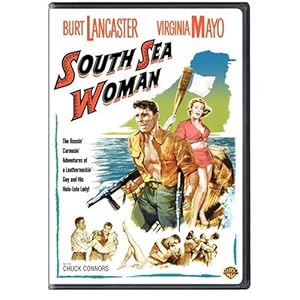
South Sea Woman

Working with stars like James Cagney, Gregory Peck and Burt Lancaster among others, it would have been easy for Virginia Mayo to get lost in the shuffle of the casts in her movies. She could have been a pretty background piece that didn't distract from the movie, letting her male co-stars do the heavy lifting.  Mayo started her career as a dancer and singer but transitioned into film. Not in many classic movies, she never achieved huge stardom but through the 1940s and 1950s, Mayo was almost always a good choice to play a strong female character without getting overwhelmed by her co-stars.

Released in 1953, South Sea Woman is a good indication of Mayo's talent.  Working alongside Lancaster for a second time after their pairing in The Flame and the Arrow with Chuck Connors playing the other lead role, she always remains at the forefront of this oddity of a movie.  The TCM description read 'A Marine sergeant battles Nazi agents to help a showgirl escape war torn China.' Having watched the movie now, I can say that is one of the most inaccurate plot descriptions I've ever read. Did the person who write that even see the movie? Regardless of its inaccuracy, the premise -- however wrong -- seems fairly serious, but this is a WWII comedy. Confused much? I certainly was in the first 15 minutes or so.

Brought up on a variety of charges at a court martial trail, Marine Corps. Sergeant James O'Hearn (Lancaster) faces over 100 years in jail and even possible execution if he is found guilty.  The veteran sergeant though remains completely quiet at his trial, prepared to face any and all charges which include everything from destruction of countless robberies, theft, and the most severe, desertion from his post.  Nothing rattles O'Hearn even as the trial begins, the story revealing itself how he got into this spot. One of his Marines, Pfc. Davey White (Connors) was trying to marry a camera girl in a bar in Shanghai, Ginger (Mayo), who O'Hearn thinks is into the young Marine for all the wrong reasons.  In hopes of helping White, O'Hearn ends up getting left behind when his unit sails, setting off a chain of events that no court is seemingly going to believe.

So for starters we've got a courtroom drama done in flashback mode with more comedic moments than you could ever count on concerning a story about two Marines and one beautiful woman all set around December 7th, 1941 when Japan attacked Pearl Harbor. It all seems like a natural fit for a story, doesn't it? I was skeptical when TCM host Robert Osborne explained that this seemingly WWII drama was in fact a comedy, but I went along for the ride. It is an uneven movie, and the humor isn't physical or slapstick thankfully. It's the natural humor that can arise out of perilous situations that ends up working the best. It never gets too heavy-handed, and when the time comes there's a sharp turn back to the dramatic.  Fun while it lasted though.

Throw all these different elements together, and you're certainly going to get your money's worth.  The movie is only 99 minutes, but director Arthur Lubin certainly packs a lot into that running time. The courtroom testimony -- including witnesses Mayo, Leon Askin, and Veola Vonn among others -- serve as a set-up for the flashbacks which tend to be episodic in nature. Lancaster, Mayo, and Connors certainly cover a lot of ground, running from gangsters, stowing away on a Chinese sailboat, getting shipwrecked on a remote island paradise, and then getting back into the war effort around Guadalacanal.  As crazy as it sounds though, 'Woman' never feels disjointed. The story just keeps flowing along with that nice balance of drama and comedy.

If you're going to make a dramatic comedy or a funny drama, you can do a whole lot worse than Burt Lancaster, one of those few actors who can handle both genres within the same movie. He's a genuinely funny performer, whether it's a subtle line delivery (like wooing Vonn's Madame's three non-English speaking nieces) or physical movement like masquerading as a hula dancer while still wearing his Marine-issued boots and a grass skirt. Mayo is similarly able to handle being really sexy while still being funny. So often, it's one or the other.  She has a great chemistry with both of her male co-stars.  This was Connors' first major role, and he more than handles his own with Lancaster. They play off each other well, rivals always willing to fight who are also close friends.

The courtroom drama and its flashbacks (which dominate the movie, the trial is only a jumping off point) develop and head toward that drama in the finale which surprised me.  The ending though -- and a key revelation about one character -- did provide a twist I didn't see coming as O'Hearn and White get back into the war effort in a big way.  Other performances include Barry Kelley, Paul Burke, and Raymond Greenleaf  as officers of the court, Bob Sweeney as the defense and Hayden Rorke as the prosecuting lawyer, and Arthur Shields, William O'Leary and John Alderson as members of O'Hearn's makeshift crew he assembles when stealing a yacht. Even a young Strother Martin has an uncredited part as a Marine at the trial.  

Odd little movie, but one that works surprisingly well when considering all the different elements assembled here.  Through drama or comedy though, the reason to see it is the cast, especially Burt Lancaster, Virginia Mayo and a very young Chuck Connors.

South Sea Woman <---TCM trailer (1953): ***/****

Tuesday, July 5, 2011

The Black Scorpion

When the proposal came to her offering her a spot in the movie, actress Mara Corday must have felt some deja vu, even more so when she actually arrived on set to begin filming. Just two years earlier, she had starred in 1955's Tarantula, the B-movie classic of a giant tarantula terrorizing the American southwest.  Then in a radical change, she starred in 1957's The Black Scorpion, a story with a giant scorpion terrorizing Mexico City. Completely different, right? See where one movie is a tarantula and the other a scorpion?

Because I'm not that lazy, I'm not going to just cut-n-paste my review from Tarantula and rename it.  Okay, I am that lazy, but I'm not going to do it.  I could though.  It's virtually the same movie with a different creature.  Like so many B-movie creature features from the 1950s though, there is a certain charm to the badness, thrown in with some groan-inducing moments here and there for good measure.  Silly, fun and entertaining, three things I'm looking for when I see a movie titled The Black Scorpion.

Recruited to investigate a massive volcanic eruption in an area outside Mexico City, geologists Hank Scott (Richard Denning) and Arthur Ramos (Carlos Rivas) head into the affected area looking for some answers. They quickly find that as hard as the area has been hit, stranger things are happening that defy logic. Farm animals are missing, and bodies turn up dead but with no sign of foul play. It doesn't take long to find out what's going on. A giant scorpion escaped from some sort of prehistoric cave in the volcano upon the eruption and is now terrorizing the countryside, killing everything in its path. With help from local law and even the army, Hank and Arthur strategize how to defeat the creature, only to find out there isn't one scorpion, but many.

As I mentioned with Tarantula or the other recent creature feature reviews, no matter how badly done or executed the creation of said creature is, it's going to be a little scary unless it is completely botched.  Little regular scorpion? Creepy. Gigantic, man-eating scorpion with no real weakness? Genuinely terrifying even if the stop-motion technology limits his attacking. Animating the creature is Pete Peterson who does a fine job bringing the scorpion to life and all his buddies who prove to be no match for him. When the scorpion movies, it isn't as stilted or stiff as so many other movies, moving smoothly across the land. I still maintain if people would run instead of standing still screaming there would be less of a problem. But maybe that's just me.

Certain parts of these movies always provide some interesting tidbits.  Working with a mostly Mexican film crew and supporting cast, director Edward Ludwig appropriately enough filmed in Mexico. Most of the filming was done on indoor sets, but that's not necessarily a bad thing here.  The venture into the scorpions lair/cave is a pretty cool sequence (watch part of  it HERE) as Arthur and Hank descend several hundred feet into an enormous cavern that rests only a few hundred yards from the now-active volcano.  The coolest part was the end though when Ludwig films his finale in Olympic Stadium in Mexico City, the site of the 1968 Olympics.  Now when the scorpion does show up, it's clearly a miniature model being used, but its a unique, very cool use of on-location shooting. Check out the finale HERE with obvious SPOILERS of course.

Now onto an annoying tidbit I've noticed in these creature features, and maybe its just bad timing that I have seen three or four similar movies in a short span of time. There's always the heroic lead, the beautiful love interest, the trustworthy sidekick, and the most annoying of all, the precociously obnoxious little Mexican boy, played here by Mario Navarro, later of The Magnificent Seven. He plays Juanito, a little runt of a kid who apparently has no adult supervision.  Where other little kids in these movies are just annoying in the background, Juanito continually sneaks into situations where he will eventually be attacked and needed to be rescued. The annoying levels are taken to a whole new level here, and as bad as this is going to send, unfortunately Juanito makes it in the end. At least there wasn't a tearful close-up as he mourns the death of the dying creature.

The casts for movies like this are so often workmanlike efforts that don't call for much in the way of actual acting. My usual thought is 'Don't be awful, don't distract from the creature.' Denning -- later The Governor on Hawaii Five-O -- plays the lead capably enough with Rivas his minority sidekick. Corday is the love interest, a Mexican ranch owner who falls for Hank. Carlos Muzquiz plays Dr. Velasco, an expert on geology and scorpions (apparently they go hand in hand) with Arturo Martinez playing Major Cosio, the armed forces representative.

Some other high points include Denning's Hank and his not so subtle attempts at seducing Corday's Teresa which somehow work.  Worried about these giant scorpions attacking all over the Mexican countryside seems like a minor disturbance to horny Hank as he seems more worried about Teresa and what she's wearing.  It's funny stuff and really throws you for a curve, but I laughed...intentional or not.  It's a good enough movie if not quite on par with the better flick from two years prior, Tarantula.

The Black Scorpion <---trailer (1957): ** 1/2 /****

Monday, July 4, 2011

The Thin Red Line

With just five movies to his names over a 39-year span, director Terrence Malick's movies have been few and far between to say the least. He doesn't take just any movie. He takes on projects that appeal to him. Malick is a director that was probably born a generation too late because he would have fit perfectly with the French auteurs of the 1950s and 1960s.  Not making a movie for 20 years after 1978's Days of Heaven, Malick returned in 1998 with a heavily anticipated WWII film based off a James Jones novel, The Thin Red Line.

The timing of the release no matter how anticipated this movie was could not have been much worse.  'Red Line' was released in early 1999 after a limited release in December '98, just five months removed from Steven Spielberg's Saving Private Ryan was shown in theaters.  It's not fair to compare the two movies, but the damage was done. Malick's film is the complete opposite of Private Ryan, and in the years since has been lost in the shadow of the Spielberg film.  I revisited The Thin Red Line, remembering enjoying it through several viewings. Instead this time around, I found a deeply flawed, even boring movie that I struggled to get through.

To write a plot synopsis of a Malick movie would be a waste of words so I'm not going to bother. He doesn't have stories in the linear sense. The Jones novel and this film are based on the fighting at Guadalcanal in 1942, but for Malick's purposes and his screenplay the setting is unnecessary. It could as easily have been Iwo Jima, Tarawa, Okinawa or any number of other Pacific islands that saw fighting in WWII. This isn't a story about the scope of war or the immensity of it all.  This is soldiers at their most basic, the thoughts racing through their heads as they take part in the unnatural act of killing another human being. Malick's screenplay does its best to delve into that aspect of war but ends up assembling an uneven, odd finished product that I can only qualify as an 'art house World War II movie.'

A trademark of Malick's in all his films is narration filling in for actual dialogue which is so often nuts and bolts conversation in his screenplays. When used correctly, narration can carry a movie, bringing emotion and power to a story that simple dialogue just couldn't do. Among the cast at different points just about everyone gets a crack at their own narration, but most prominently used are Jim Caviezel, Ben Chaplin, and John Dee Smith who appears only at the beginning and the end but narrates throughout. First, all three of these narrators are Southerners with a heavy drawl, making it nearly impossible to distinguish which one of them is which in their narration.

More than some tough accents to get used to though is the fact that these narrations are so poetic, so lyrical, so ethereal and from another world that very little of it registers.  I've seen the movie several times, but only an exchange or two sticks with me.  Chaplin's Pvt. Bell constantly thinks of his wife, the love and desire he feels for her.  It is so mind-numbingly tedious that I completely lost interest anytime he started talking, his thoughts drifting back to the time he spent with her (played in flashback by Miranda Otto). All of the soldiers -- who end up being dirt-covered, nameless individuals -- wonder about life, love, death, God, pain, suffering, righteousness, faith, and so much more. It is well written, but it is so unnatural that it sounds like a poetry jam. The eerily calm toning and pacing will no doubt put some viewers to sleep. Malick is in absolutely no rush to speed things up to get where he wants.

That's the problem I've had with this movie though since I first saw it. What is Malick trying to accomplish? What's he trying to say? Anti-war message for sure, but in what way?  We see the horrendous physical and psychological efforts war and combat can take on the individual. We see the inner turmoil tearing soldiers apart as they battle with their inner demons. But the tone of the movie is so odd I don't quite know what the intention was. 

The background of this film is interesting in itself, worthy of its own review. When Malick came out of the woodwork to make a movie, actors -- big, big name stars -- lined up to fill out the cast for this WWII story. Rumors persist of some epic five or six hour movie. Malick had to make cuts to his final movie, completely editing out parts for Bill Pullman, Gary Oldman, Viggo Mortensen, and Mickey Rourke among others. As is, the finished product is 170 minutes long and still features an interesting cast full of recognizable names. Along with those mentioned earlier, there's Nick Nolte, Sean Penn, John Cusack, Elias Koteas, Woody Harrelson, Adrien Brody and Thomas Jane. That's some of the cast. Check out the IMDB page for a complete listing. Even George Clooney and John Travolta make brief, pointless cameos.

With so many speaking parts, only a few get a chance to leave an impression -- positive or negative. Caviezel is the best as Pvt. Witt, a man who just doesn't belong in the army. His Heaven is the little Pacific village he deserts to, but he's torn away and brought back to the fighting as he's reunited with his company. He joins the fighting but doesn't quite know why. Sean Penn is great as Sgt. Welsh, the veteran sergeant who serves as the sounding board for all his men. His scenes with Caviezel's Pvt. Witt provide some of the movie's most memorable and more importantly, most moving movements as they question what they're accomplishing. Koteas too is a scene-stealer among the faceless soldiers as Capt. Staros, Charlie Company commander who refuses to waste his men in a frontal assault that has little hope of succeeding and feels the wrath from above.

That's probably the most frustrating part of this movie for me. There are moments of perfection that you just sit back and revel in, let them wash over you. Malick's directorial eye is never in question, his movies beyond gorgeous. Some directors work best with scripts and actors. Malick is a visual director, here Australia filling in for Guadalcanal. This is a story of nature and its beauty torn apart by the fighting. Malick is quite content to show a hillside with its long, green grass blowing in the wind.  Add in the musical score from Hans Zimmer, and you've got a winner. His main theme with the Melanesian choirs send chills down my back every time I hear it. Listen HERE. The rest of the score is more subdued than Zimmer's more well-known scores, but it soothes, it meditates, playing almost constantly in hushed tones over the action in some cases and the narration in others (Try HERE). There is something soothing about this movie in its execution and its message. It just can't keep up the momentum throughout.

Certain moments of this movie have stuck with me over the years. Almost an hour is spent in excruciating detail as C Company tries to take a Japanese bunker on a grassy hillside. Later, a running firefight takes the company through a ravaged Japanese camp, Zimmer's score combining with the action to make it one of the great realistic battle sequences ever, the aftermath as moving as the actual fighting. Witt's conversations with Welsh have always stuck with me, and Witt's final scenes as C Company goes on a patrol bring the movie full-circle in an inevitable way that you know is coming.

Is the movie pretentious and even tedious at times? Oh hell yes. There were times I wanted to fast forward through vast stretches of narration and shots of nature. The narration is done to death by the end of the movie, little lines of dialogue straight from a poet that I didn't even always comprehend what I'm hearing. But with all that said, I just can't give this movie a negative rating. The moments that work are so good they overpower and overshadow the weaker moments.  You have to know what you're getting into when you watch this movie, and even then, there's no guarantee you will like it. It is a movie experience though, and one every movie fan should at least try.

The Thin Red Line <---trailer (1998): ***/**** 

Sunday, July 3, 2011

Uprising

Thanks to Andrzej Wajda's World War II trilogy -- especially 1957's Kanal -- I feel like I've got a better grasp of the Warsaw Ghetto and the Warsaw uprising of 1944. Watch enough WWII movies and read enough books about the war and you're going to hear about the Warsaw Ghetto because of the immensity of the place and the thousands of people who lived there.  But it is a part of history and WWII that so often gets lost in the background, overshadowed by major campaigns and important players in the war. Part of that you can chalk up to a story that in its historical accuracy is not going to appeal to the masses.

The Polish take on the Ghetto is one thing, but in a bigger picture Holocaust movies are going to find success in niches among audience members. An NBC TV miniseries originally shown in 2011, Uprising is one of the few ventures into the true story of the Warsaw Ghetto and the subsequent uprising in 1944 as the Polish Jews rebelled against their German occupiers. Like so many war stories, there will be no happy ending, and that's part of the appeal to me. It's honest, it's depressing, and it tells a story that couldn't be faked.  There are historical inaccuracies, generalizations made for the sake of time and simplicity, but the heart of the story works, and that's the most important thing.

It's 1939 and Adolf Hitler's Germany army sweeps across Poland, forcing a surrender within a month. In Warsaw, over 350,000 Polish Jews are forced to move into a ghetto where they are kept apart from the city at large in a walled-off portion of the city under German guard. Among the thousands of Jews is Mordechai Anielewicz (Hank Azaria), a musician and teacher, and Antek (David Schwimmer), an intellectual and long-time friend of Mordechai. The months turn into years and both men -- among thousands of other people -- grow tired of their German occupiers while the head of the Jewish council, Adam Czerniakow (Donald Sutherland), struggles to fight for the rights of the Jews. A Jewish resistance mounts in the city to fight off the German soldiers, but the German high command sends an officer, General Jurgen Stoop (Jon Voight), into Warsaw to wipe out the rebellion to a man.

Generally historically accurate with a few detours here and there toward poetic license, Uprising at its best gets the heart and message right. The Polish Jews were not alone in their efforts as is shown, receiving help from outside forces into the Polish underground.  The point of the story though was to show the bravery, the courage, and the persistence shown by the Polish Jews in the face of almost certain defeat.  Heavily outnumbered, under-supplied and fighting a losing battle, the resistance fought on for over 40 days before finally being overrun and ultimately defeated.  Courage is one thing, but maintaining that courage when staring death in the face takes it to a whole other level.  They fought on when they could have abandoned the cause. Thousands paid for that decision with their lives, digging their heels in and fighting back.

The TV miniseries isn't as popular as it was in the late 1970s and 1980s, but it is still that great middle ground between an hour-long TV show and a feature film.  A positive you can always take away is the ability to assemble strong casts for more speaking roles than you might see in a typical movie. Uprising may not have the star quality, but the cast turns in solid, all-around performances. Azaria and Schwimmer are the leads, stepping up to the plate as the resistance leaders.  Among the other resistance fighters are Leelee Sobieski as a young woman, the last surviving member of her family, Stephen Moyer as Kazik, the jokester, fighter and ladies man to go with Sadie Frost, Radha Mitchell, Eric Lively, Alexandra Holden, John Ales, and Andy Nyman as a Jewish police officer working with the resistance. Sutherland and Voight have parts that are cameos more than major parts with Cary Elwes playing a German filmmaker making a documentary about the Ghetto.

With the exception of the premium cable channels, TV can be censored within an inch of its life. My worry going in to this miniseries was exactly that, a story of a part of the Holocaust that would be as vanilla and boring as humanly possible.  No worries here because this miniseries did not pull any punches.  The story is dark, filthy and cynical. The firefights back and forth are bloody and surprisingly graphic for a show aired on national TV. Not just blood for the sake of blood either, the battles are moving. You see the characters develop and change over the course of years. At times, the portrayals are a little much, making the Poles the saintly individuals with no flaws and the Germans as the sadistic, irredeemable pigs. It's a little stereotypical, but the portrayal of the Germans wasn't too far-fetched. It doesn't feel like a miniseries though, and that's always a good thing.

Clocking in at just under three hours, director Jon Avnet manages to cram five years worth of story into 177 minutes. For the most part, he does a good job balancing it out, spending a half hour or so establishing everything and then quickly jumping right into the resistance effort and eventually the Warsaw Uprising.  The pacing is good, always moving along and always entertaining. There are only a few instances where things feel rushed, but one of them ends up being a major flaw. The explanation is going to have some major SPOILERS though so be forewarned.

The uprising eventually turns toward the Germans as the resistance is eventually overwhelmed. Azaria's Mordechai and the remaining members of his company are cornered in an underground bunker while others narrowly escape into the ruined streets above. Sobieski's Tosia leads an escape while the others await the German attack. The only problem? We don't see it...at all.  There's not even a flashback of the attack, a quick montage, a couple shots of their dead bodies much less the actual attack. Azaria is the main character yet he's dispatched off-screen with no explanation. Was the movie running too long? Was something cut? He deserved better, and it seems like a missed effort. As a tribute to the character and the resistance, I feel like as a viewer we needed to see these valiant freedom fighters in their last ditch effort.

It's nothing by any means that derails the movie, just a complaint. The ending is a downer, but with a touch of an uplifting note.  As heavy as the casualties were on both sides in the uprising, there were Polish Jew survivors, just not many. Not always spot-on in terms of accuracy, Uprising still manages to get the message across, the spirit of the Polish resistance.  An underrated, well-handled miniseries dealing with one of history's generally forgotten tragic chapters.

Uprising <---Youtube clips (2001): ***/****

Saturday, July 2, 2011

Tarantula

With a wave of creature features hitting theaters and drive-ins during the 1950s, studios churned them out as quick as they could.  Usually they were workmanlike efforts, rarely flashy but always professionally done.  They were movies that didn't call for a lot of directorial style.  One director though who managed to rise above the B-movies and make a name for himself was Jack Arnold, director of Creature from the Black Lagoon, Revenge of the Creature, It Came From Outer Space, The Incredible Shrinking Man, and 1955's Tarantula.

I think what works so well about these movies -- however poorly done or cheesy they are in their execution -- is that they play on feelings, worries and nerves that most audiences can relate to.  What lies in the depths of the oceans or hidden away in a volcano? Or what about ordinary, everyday things, like spiders?  In this case, it's that simple. A tarantula at its largest is only three or four inches long, but there's just something about them that sends shivers up your spine (okay, maybe it is just me). So even with some cheesy effects to make it look bigger, what about a tarantula over 100 times larger than your typical arachnid?  Okay, it isn't particularly scary, but it is creepy and it makes for a good movie.

In a small, isolated desert town in Arizona, Dr. Matt Hastings (John Agar) is called in to investigate a mysterious death. The man's partner, a scientist, Professor Deemer (Leo G. Carroll), explains the death as a bizarre, rapidly moving and rare genetic condition that caused the body to contort. Hastings isn't buying it but when Deemer welcomes a new assistant, a beautiful medical student from California, Stephanie (Mara Corday), the good doctor starts to investigate. Is the professor up to something that he's trying to cover up?  As Hastings starts to poke around, weird occurrences start to pop up all over.  What can they chalk it up to? Hastings has an inkling, but he can't prove  it outright, much less explain it to other people. Can he get his evidence in time?

Without going into a lot of detail (and if you've made it this far I'm hoping you know what's going on), it is in fact....a giant tarantula terrorizing the countryside in this B-movie.  Carroll's Deemer is in fact up to no good, even if his intentions are genuine. He's looking for a way to provide food and nourishment for a rapidly overcrowded world.  Smart doctor that he is, he test his radioactive nutrient on animals including rats, guinea pigs, and of course, a tarantula which escapes as it is still growing.  Tarantulas need to eat, and there you go. You've got your badass creature, a tarantula several hundred feet tall with an insatiable appetite.  Now how do we go about killing it?

This is a movie I can understand some movie fans wanting to be remade, but I like the low-budget charm of this 1955 popcorn flick.  The tarantula is in fact, a tarantula.  Thankfully the studios did not make a life-size spider or a miniature that could be blown up to make it look bigger.  The movements of an actual spider were filmed and then inserted over footage shot in real-time, making it appear that the tarantula is actually interacting with the much, much smaller cast.  Considering how bad it could have looked had Arnold chosen a different route, it's easy to look past the sometimes-cheesy look of these scenes. Still, it's a gigantic tarantula with booming music playing over its attacks. How is that not scary at least a little bit?

Blah blah blah spider movie with a cast. Who cares?  Well, I do.  B-movie star John Agar is his typical solid self as Dr. Matt Hastings.  As an actor, he didn't have the greatest range, but I just don't understand why Agar never amounted to more after bursting onto the scene in two John Ford westerns and another with John Wayne (Sands of Iwo Jima). He's a good actor if not a flashy one and a solid leading man here. Corday is the babe, the love interest although not much comes of that.  Carroll is the scientist with the right intentions who ends up unleashing a crime against nature on the world. Also look for Nestor Paiva as Sheriff Andrews and Ross Elliott as Joe Burch, the nosy newspaper reporter looking for a scoop.

As a fan of pointless movie trivia, I'll add this too.  Look for Clint Eastwood in an uncredited role and one of his first movies overall. Even Dirty Harry had to start somewhere.  I lost a bet in the last year or two that Eastwood was even in this movie, and it is a quick appearance. Stick around until the end as he plays a fighter pilot called in to battle the gigantic tarantula.  This is a fun movie all-around and a good example of what a science fiction B-movie from the 1950s can be when handled correctly. Watch the movie at Youtube starting HERE with Part 1 of 8. Pretty decent quality too for a 1950s Youtube version.

Tarantula <---trailer (1955): ***/****

Friday, July 1, 2011

Montana

Within the western genre are a long list of sub-genres that just about every entry applies to in one way or another.  Six typical western plots include empire building, revenge, the gunfight (movies built around a gunfight), historical (the Alamo, the Little Big Horn), the big ranch, and finally cowboys and Indians.  One of my favorite sub-entries is the cattle drive which can fit into at least two of those categories.  Centennial had The Longhorns in the miniseries, Lonesome Dove is an all-time classic and one of my favorites and countless others pepper the horizon (Cowboy, Culpepper Cattle. Co, The Tall Men).

For all the westerns about cattle though, what about that other dreaded animal that made its presence known on the western trails?  Yes, that's right. We're talking about sheep.  Range wars were fought and waged for years because of this conflict. Cattle owners despised sheep because the animals destroyed the grazing pastures, eating the grass from its roots.  No one believed either side could co-exist so instead they fought with deaths on each side. The cattle vs. sheep premise at the heart of 1950's Montana, an odd little western but an interesting one at that.

Leading his herd of sheep into Montana territory and all its grazing lands, Morgan Lane (Errol Flynn) is put on the defensive when one of his herders is murdered while on watch. Having been booted from the area before for his work with sheep, Lane isn't about to take what the cattle owners are throwing at him. Instead, he goes into the nearest town posing as a traveling salesman and begins to woo Maria Singleton (Alexis Smith), one of the most influential women in the area and an owner of vast stretches of land. She has no idea that Lane is a sheepherder and leases him land that will prove ideal for grazing sheep or cattle. Maria finds out though as the confrontation builds between the sheepherders and the cattle ranchers, and Lane's ready for a fight.

There is a polish to these Warner Bros. westerns from the 1940s and 1950s (and even a few earlier in the 1930s) that dates these movies, and not always in a good way.  I love spaghetti westerns and all their grittiness. I love American westerns from the 1960s and 1970s that tried to paint the 19th Century American west as it really was; violent, dirty, and sweaty.  These earlier westerns though always have the cast and extras dressed immaculately, the towns are always  orderly and nicely constructed, and the bad guy will always...always lose. I don't dislike these westerns by any means, I just don't enjoy them as much. That's one problem with Montana. It's too clean, too nice, and just too polished.

The oddities come fast and furious with this western. Flynn's previous westerns usually tipped the scales at around two hours, some clocking in at longer lengths than that.  Montana on the other hand doesn't even break the 80-minute mark, much less at 90 minutes.  It is only 76 minutes long and feels far too short. The ending comes together far too quickly with a rushed feel.  Other oddities? Flynn sings a duet with co-star Smith that feels out of place. Maybe not in the musical Oklahoma, but in this western? It's a flop. I want Flynn kicking ass, not singing.  Also, Austrian actor S.Z. Sakall as Papa Schultz, a traveling salesman Flynn's Lane poses with as his partner. His accent is so heavy it is indecipherable, and the attempts at humor never amount to anything. Thankfully he disappears about halfway into the movie never to return. No explanation either, just a good, old fashioned disappearance.

Looking for a positive from this otherwise average western is the casting of a strong female lead in Alexis Smith as cattle baron Maria Singleton. As I've mentioned in a handful of other western reviews, female members of the cast are too often there just to be saved. In the process of being saved, they whine, complain and look scared. In other words, they're useless characters.  Give them something to do! Women helped tame the west too. For the most part, Smith gets to do that. Flynn's character dupes her on two different occasions so maybe she isn't the sharpest tool in the shed, but she's formed a cattle empire with two partners that rules over the Montana territory. Maria is tough and willing to fight for what she wants.  Granted, by the end she wavers in the face of true love, but Smith gets points for the effort. Can't blame her for the script forcing her back into the 'need a man' ways.

As for the rest of the movie, it's okay if nothing special.  This is Flynn on the backside of his career, but he's still that lovable rogue that audiences loved in the 1930s when he shot to stardom. Regardless of the role, it's hard not to like him. The rest of the cast leaves little impression other than Paul E. Burns as Tecumseh, an old timer who has lived in Montana since the 1850s, and Charles Irwin as Mac, one of Lane's top sheepherders. There are better movies out there and there are much worse. It's a decent enough way to pass 76 minutes, but not a memorable western. Worth watching once if nothing else.

Montana <---trailer (1950): **/****

Thursday, June 30, 2011

Operation Mad Ball

One of Jack Lemmon's most famous roles came in 1955 as the quiet, mousey, anti-confrontational Ensign Pulver in Mister Roberts starring alongside Henry Fonda and James Cagney. By the end of the movie, his character has transformed into his polar opposite; confident, sure of himself, and not worried about rustling some feathers.  This was explored some in the all-around bad and unnecessary sequel Ensign Pulver unfortunately.  So while in no way related to either 'Roberts' or 'Pulver,' 1957's Operation Mad Ball made me think of the character Pulver as he plays off a variation of that previous character.

As I'm discovering more and more with the comedies I see, I'm never quite sure how to review them. They're meant to be funny of course, but humor is one of the most subjective things about movies.  What's funny to me can fall flat with everyone else in the audience.  With an action movie, you can talk about the fight sequences or the car chase. With heavy dramatic movies, it's the performances and the actors.  What about comedies? Should I just list all the scenes and bits that made me laugh or chuckle?  Now that would be an invigorating read, wouldn't it?  Basically this is an apology to any readers. I like comedies. I like watching them. Reviewing them? Not so much.

It's September 1945 in France at an Allied hospital near Normandy. World War II has been over for several months now in the European theater, and boredom and tedium have set in for the soldiers. At this hospital is Private Hogan (Lemmon), a highly intelligent wheeler dealer who doesn't actually like work but can get just about anything done if he puts his mind to it. One of his fellow soldiers (Roger Smith) would like nothing more than to meet his girlfriend in a private setting, but only Hogan can arrange it. What starts off as a small romantic evening turns into an extravaganza, a gigantic party with seemingly everyone in camp involved. Can Hogan pull it off though? The company adjutant, gung-ho Captain Lock (Ernie Kovacs), already has Hogan on his radar, and he threatens to bring everything crashing down around the scrounging, wheeling and dealing private.

This war flick was aired recently on Turner Classic Movies as part of a one-night tribute to Ernie Kovacs, the ahead of his time comedian from the 1950s who was tragically killed in a car accident in 1962 at the age of 42.  I've seen him in a role here and there but didn't always come away impressed.  To be fair, I think this is the first movie of his I've seen where he plays a dominant role.  As a character you're not supposed to like, he hits this one out of the park.  His Capt. Lock is that guy you're supposed to hate.  He's not as bumbling as he could have been, but you know in the end Hogan will get the best of him. Kovacs shows a knack for subtle humor and more obvious humor in the form of physical comedy. Some of his facial expressions are priceless.  The best though is his final scene, a look of ultimate despair on his face as to what's happening.

As the story moves along, I was reminded of a MASH episode where Hawkeye needs a new pair of boots and starts to trade things so he can get a pair. One trade turns into another until there's a long line of trades waiting to happen, all of them contingent on the other. That's this movie. A scrounger, a wheeler-dealer, a crafty negotiator, Hogan plays his cards right and almost always gets what he wants. The story isn't the most pointed one around because it needs some detours to show the ridiculous amount of detail the enterprising private goes through to pull off the party. Lots going on overall, including a love interest, Nurse Lt. Bixby (Kathryn Grant), a clueless commanding officer (Arthur O'Connell), a worthy foe for Hogan in a quick-witted French widow, Madame LaFour (Jeanne Manet), and a great bit with a German P.O.W. (Kort Falkenberg) posing as a corpse that Lock thinks is still alive.

One of the all-time greats when it comes to acting -- drama, comedy, it doesn't matter -- Jack Lemmon is the show here.  His Private Hogan is the type of soldier who would be a great officer...if he wanted to or even applied himself. Instead, he's pleased with his low responsibility duties that allow him time for his "extracurricular activities."  Lemmon is a scene-stealer in the sense that even when he's low-key, you're drawn to him.  His crew of fellow low-ranking soldiers include Mickey Rooney, a pre-Bewitched Dick York, James Darren, Smith, an uncredited Paul Picerni, and L.Q. Jones among others.  Rooney is memorable especially as a high-strung Southerner, often rhyming all his speech with a 'Fiddle-dee-doo, fiddle-dee-daa' sing-song style of talking, and York too shines as Lock's secretary/assistant who works as a spy and inside source for Hogan's antics and plans.  Good performances at the top and strong supporting parts to back it all up.

What else to say, what else to say? I liked this easygoing post-World War II comedy. It is filmed in black and white -- always a bonus in my mind -- and never tries to be anything other than fun and entertaining.  It succeeds. At 105 minutes, it's that perfect length for a comedy of its ilk.  Good movie, great cast, and a fun movie overall.

Operation Mad Ball <---trailer (1957): ***/****

Wednesday, June 29, 2011

Transformers: Dark of the Moon

I'm not quite sure why I went to the midnight showing of Transformers: Dark of the Moon late last night/early this morning. It still seems ridiculous to pay $11 to see a movie regardless of how much I actually like going and seeing new movies (a lot by the way). The first Transformers movie was tolerable even if I didn't love it, and the sequel -- Revenge of the Fallen -- has to be one of the most painful experiences I've ever had in a movie theater. But here I sit having watched the third one, and who would have thought of this? I liked it.

No, I didn't love it, and I probably don't ever need to see it again, but for a one-time viewing I can admit it. I....actually....enjoyed.....a.....Transformers....movie. Wooo, it's almost therapeutic admitting that. Each movie in this trilogy at its best is a disposable summer blockbuster and epic that is supposed to entertain, excite and dazzle.  The master of everything extravagant, over the top and needlessly ridiculous, director Michael Bay actually tightens his final movie. Yes, some of the humor is still a little much, and as cool as the finale is, it does goes on for far too long. Compared to Revenge of the Fallen though, it's a masterpiece in filmmaking.

After teaming with Optimus Prime (voice of Peter Cullen) and the rest of the Autobots to save the world twice, Sam Witwicky (Shia LaBeouf) is struggling to adjust to adult life. He's living in Washington DC with his new girlfriend, Carly (Victoria Secret model Rosie Huntington-Whiteley), but he can't manage to find a decent job. He's thrust back into the battle between the Autobots and the Decepticons once again when Megatron (voice of Hugo Weaving) unleashes a plan that threatens to destroy the Earth. Dating back to the original Moon landing in 1969, the government has managed to keep a secret about this battle between factions. But now it threatens to tear the world apart. Trying to save Carly and teaming up with Bumblebee and the NEST team, Sam joins the fight in hopes of finding some way to defeat the seemingly impregnable Decepticons.

I'll say this now, and get it out of the way. This review is going to ramble some, but I'll do my best to keep it on point and somewhat focused....unlike the movie. At 157 very long minutes, this movie is just too long however you cut it. The first 90 minutes are surprisingly un-Michael Bay like with a minimum of action. To his credit, Bay pulls back the reins on the humor department, actually turning to some character development and surprise, surprise, some decent dialogue. Who would have thought of that? Still, there's too many characters, far too much going on at all times, and flaws galore, but I still found myself liking the movie in spite of its flaws.

Maybe the biggest surprise is how far LaBeouf has come from the first movie. By this second sequel, I found myself actually liking the character and rooting for him. The early parts of the movie actually humanize him a bit so you feel like rooting for him. Some of LaBeouf's acting eccentricities are still there, but they just work better here.  Whether it is his relationship with Carly or his feeling of loss not seeing Bumblebee, there is actual emotion in the script. It sounds so simple, but after the generally organized chaos of the first two movies, I'm stunned. Set the bar low enough and see what happens? Good things! He has a solid chemistry with the very beautiful, Barbie doll-like Huntington-Whiteley and manages to provide some of the movie's funnier moments as he copes with being an adult.

I can't explain it, but Bay is able to assemble some serious talent for his scripts that typically have 800 or 900 speaking parts. The best and newest additions to the trilogy were Frances McDormand as a CIA defense agent and John Malkovich as Sam's eccentric, partially crazy boss. Neither part requires either actor to do any heavy lifting, but both consumate professionals look to be having a lot of fun -- especially Malkovich. Patrick Dempsey joins the cast as Dylan, an extraordinarily rich businessman working with the Decepticons. Those are the best additions, but a majority of the cast returns too.  Josh Duhamel and Tyrese Gibson return as Colonel Lennox -- leader of NEST -- and Epps, since retired from the unit but back to join the fight with Sam when needed. John Turturro gets to ham it up as since-retired special agent Simmons, but in a slightly more subdued way than 'Revenge.' A small part for Hangover star Ken Jeong is everything that's wrong with Bay, his sense of humor and his lowest common denominator for laughs while Alan Tudyk is a scene-stealer as Dutch, Simmon's assistant. Also a bonus, Sam's parents (Kevin Dunn and Julie White) are relegated to much smaller parts.    

Living in Chicago the last couple years, it was hard to miss Michael Bay and his production descend on the Windy City. News and media covered it extensively, and as a Chicagoan I was definitely looking forward to seeing how the city looked on the big screen.  It was worth the wait. I wasn't checking my watch, but I'm guessing at least the last hour takes place exclusively in downtown Chicago on Wacker Drive along the Chicago River. It is an orgy of action and CGI (superbly well-done by the way) that doesn't know when to quit, but it is something else to watch. Seeing the city torn to pieces was more than a little odd, but the combination of all these gigantic robots duking it out with Sam, Carly, Lennox, Epps and their teams maneuvering through the city is great. The action is top-notch that could have easily been edited/shortened, but I don't think either of those words is in Michael Bay's lexicon.

The movie certainly starts off on a high note as some history is explained, tying the first Moon landing in 1969 into the battle between the Autobots and Decepticons. It's that type of conspiracy theory that's absolutely ridiculous but is still a lot of fun to watch and just go along for the ride. 

Comparing the three movies there isn't/wasn't a huge difference among them so I'm struggling to put my finger on why I liked this movie. Some of it has to do with the on-location shooting in Chicago, some of it Bay actually toning things down, and even the cast making the most of an average script. Composer Steve Jablonsky turns in a solid, exciting and action-driven score, and Linkin Park adds their new song -- Iridescent -- to the soundtrack. The action is crazy, the CGI amazingly real, and even when I'd felt like I'd been sitting in the theaters for days watching the movie, I still enjoyed it. A classic it is not, but it is the definition of a summer blockbuster flick that goes perfect with a jug of popcorn. That's all I was looking for.

Transformers: Dark of the Moon <---trailer (2011): ***/****

Tuesday, June 28, 2011

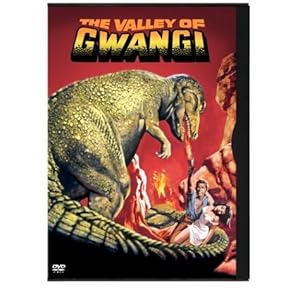
The Valley of Gwangi

Just yesterday I reviewed a dinosaur movie that's one of the worst all-time movies I'd ever seen.  Now I liked it, but not for any good reasons where you'd feel safe recommending the movie.  However poorly executed it was, the premise of dinosaurs existing in modern times is an interesting one. Jurassic Park and its sequels surely speak to that.  But one that works on the same premise as Dinosaurus! is a much better movie released in 1969 that sounds ridiculous, but is nonetheless exciting, The Valley of Gwangi.

I don't really know why I like this movie so much. I saw it for the first time when I was 11 or 12 on AMC and then saw it on multiple viewings on the same channel as part of their Halloween movie marathons over the years.  It is the genre it based in which makes it interesting; a science fiction western.  Take the basic story from Dinosaurus!, subtract about 75 years, transplant the story to Mexico, and have cowboys tangling with prehistoric creatures.  It sounds as crazy as this summer's release Cowboys and Aliens.  For whatever reason though, it just works as a legitimately good movie, not a guilty pleasure.

Years after riding away from a job working with girlfriend/fiance, T.J. (Gila Golan) and her rodeo/wild west show/circus, cowboy Tuck Kirby (James Franciscus) reunites with her as the show travels through Mexico and Central America at the turn of the 20th Century. Their parting was less than ideal so Tuck is welcomed back in a half-hearted fashion. T.J.'s show has a new feature though, a miniature horse unlike anyone has ever seen. The horse escapes though into the desert with T.J., Tuck and all her cowboys following as they eventually discover a hidden valley that's gone unmolested for thousands of years. Inside they find things that no one could have planned on, a valley full of dinosaurs and prehistoric creatures. One of them is a local legend, an allosaurus given the name Gwangi. Can these cowboys capture the creature and put him on exhibit, or will the allosaurus kill them all in the process?

If the story sounds a little familiar, it should. Replace Gwangi with an immense gorilla, and you've got King Kong 2.  That is the movie at its most basic, but director Jim O'Connolly improves on the premise. In the 1950s and 1960s, creature features were a dime a dozen in theaters and drive-ins, but how many can you think of in a wild west setting?  Just on terms of originality, the movie gets points for being unique.  'Gwangi' was shot on location in Spain, using several familiar spots for any fans of spaghetti westerns, especially the bullring and the hidden valley. It's a gorgeous movie to watch, something I might normally take for granted with a movie like this.  As a topper, I'm a sucker for a good soundtrack, and there's an underrated one from composer Jerome Moross which you can listen to HERE and into Parts 2 and 3 at Youtube.

In a handful of other reviews, I've mentioned the work of special effects master Ray Harryhausen, but right up there with his work from Jason and the Argonauts is his work here in 'Gwangi.' The stop-motion filming technique for his creatures seems a little dated now in 2011, but there's a charm to watching his work in a film.  He gets to show off much of his repertoire here, especially with the title character, Gwangi, a blue allosaurus hell bent on killing everything around it. One scene especially impresses as T.J., Tuck and the cowboys try to capture Gwangi with their lassos. Watch it HERE in its entirety. That's just a taste though as Harryhausen covers the gamut from the miniature horse to an attacking pterodactyl, a freaked out elephant to a charging triceratops.

The story itself is in no rush to overwhelm you with all these dinosaurs and prehistoric creatures. Definitely a slow burn here as anything and everything is laid out.  Then about 35 minutes in, it's dinosaur time and the rest of the movie focuses on the cowboys tangling with all these creatures.  It does look dated, but these sequences are still pretty cool.  The finale is also very impressive as Gwangi goes on a rampage in the crowded Mexican village, finally cornering himself in a still-to-be built cathedral.  Harryhausen had an overload of talent, and this is the master at some of his best work.

If you were wondering, Gwangi and Harryhausen's creatures are the real stars of the movie, but the cast is nothing to sneeze at.  Franciscus was never a big star, but I've always liked him and here as heroic Tuck Kirby he is no exception. Model turned actress Golan is okay as T.J. but nothing special. There's also B-movie star Richard Carlson as Champ, Laurence Naismith as Professor Bromley, Gustavo Rojo as head cowboy Carlos, Freda Jackson as Tia Zarina, a gypsy witch, Dennis Kilbane and Mario De Barros as Rowdy and Bean, two of T.J.'s cowboys, and Curtis Arden as Lope, the requisite young Mexican boy.

There are a ton of fan videos and clips available to watch at Youtube for anyone looking to see more of Harryhausen's creatures.  I'd recommend checking the whole movie out though, and not just those specific scenes.  It is a movie that is a lot of fun and rises above just being a creature flick B-movie. Really, how can you go wrong with a sci-fi cowboy movie? Okay, don't answer that. Just watch the movie.

The Valley of Gwangi <---trailer (1969): ***/****