The Sons of Katie Elder

The Sons of Katie Elder
"First, we reunite, then find Ma and Pa's killer...then read some reviews."

Tuesday, June 21, 2011

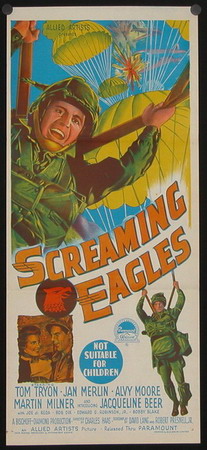
Screaming Eagles

Thanks to the Stephen Ambrose book and the Steven Spielberg/Tom Hanks produced miniseries Band of Brothers, the 101st Airborne Division has become synonymous with WWII.  History buffs and casual fans alike are aware of the famous division that played such a large role in the European theater following the D-Day invasion all the way until the end of the war. The miniseries is one of the all-time greats, and one that any history fan will enjoy.  It is of course not the only story of the division out there, just the most well known.

Countless WWII stories set in the European theater of war have mentioned the division and their exploits, like Battleground, Saving Private Ryan, and The Longest Day.  Some are just glancing encounters as these paratroopers navigate through the hell of the Normandy invasion or some six months later at the siege at Bastogne.  Wherever it is set though and whatever the situation, it's hard not to appreciate their acts of bravery and courage of these men.  A little movie from 1956 was one of the first to tell their story, its title dedicated to the division's nickname, Screaming Eagles

It is early June 1944, and Privates Mason (Tom Tryon) and Corliss (Martin Milner) arrive at their new unit at a camp in England, D Company from a battalion in the 101st Airborne Division. Standoffish from the get-go, the always ready to fight Mason quickly alienates himself from his squad mates.  The rest of the squad wants him transferred, but the platoon commander, Lt. Pauling (Jan Merlin), wants to do otherwise. He knows the invasion of Europe is coming soon, and that every man will be needed. Pauling convinces the men to give Mason another chance and tells the troublesome private to get in line.  Then the orders come through, the 101st will be dropped inland of Normandy, Pauling's platoon receiving an assignment to hold a key bridge along the road to the beach. Their past personal problems aside, Mason and the platoon gear up for the coming fight.

I've mentioned before that a movie can be generally forgotten over the years. A good clue is to look at a movie's IMDB page. Click on the left where a typical movie is chock full of little tidbits about the movie, anything ranging from quotes to cast to business and trivia.  'Screaming' has little to nothing. It is a small budget, B-movie from director Charles F. Haas that clocks in at just 79 minutes. My first reaction was that it was a TV show from the 1950s edited into a movie that could have been released in theaters. Nope, just a small movie.  It certainly has the look of a TV show, but what are you going to do? There's nothing really special about the movie, but it's good enough. Ringing endorsement if there ever was one, huh?

Reading about this movie when it popped up on TCM's schedule, I was intrigued by the cast. There weren't big names, but there were a lot of recognizable names. Some of these names didn't even ring a bell, but as I look through their filmography, I recognize quite a lot of them from the other movies they starred in (if nothing else).  Tryon had a quick window in the late 1950s and early 1960s where he was in movies and TV, starring here as troublemaker Pvt. Mason.  He's somewhat wooden, and his character motivations as to why he's such an ass are never really explained. Merlin is especially good as Lt. Pauling, the officer just trying to keep his men together as the well-trained unit they are. Other members of the platoon include Mark Damon and Robert Blake (but look quick or you'll miss them), Pat Conway, Paul Burke, Alvy Moore, and Joe Di Reda.

With a movie that isn't even 90 minutes long though, an obvious problem occurs.  An introductory title card explains this is the story of 15 men and their exploits in WWII.  Okay, fair enough, a story about 15 paratroopers.  Most of them are never identified though....until after they're dead.  Another soldier states "Oh, they got Hernandez" and that's it.  I realize with a 79-minute B-movie that character development and fleshing out all the roles isn't the most important thing, but even a token effort would have been appreciated. Lt. Pauling reciting off the names of the killed members of the platoon would have registered a little bit then.

For a pretty straightforward war story, I enjoyed 'Screaming' once the paratroopers actually dropped into Normandy.  One officer is killed almost immediately, and Lt. Pauling is blinded when a gun goes off in his eyes. Mason is placed in charge of being his watchdog, guiding the officer wherever they go. The story again is not developed much there, but it gives Mason a chance to amount to something, to see that this doesn't have to be a one-man war. He can't just look out for himself. He has to watch out for the men around him too.  I liked the movie though, and if you can catch it again on TCM's schedule, it's worth a watch.

Screaming Eagles (1956): ** 1/2 /**** 

Monday, June 20, 2011

Paratrooper

Is there anything more ridiculous that a person can do than jump out of a plane with a parachute? I say this as someone who would like to sky-dive at some point in my life, knowing the inherent and fairly obvious consequences that could result from said experience. Now let's add something to the equation. What about jumping out of a plane and landing somewhere where thousands of men with guns would like nothing more than to kill you?  Okay, so maybe not my best lead ever, but I thought it was good enough for a movie appropriately titled Paratrooper, released in 1953.

This British war flick was aired recently as part of TCM's Memorial Day programming (like many of my recent reviews), and was one I'd never heard of before stumbling across it on their website. The story sounded a lot like a book I was given as a little kid by my Dad, a book he had read as a kid about a commando raid in France trying to knock out a German radar station. As is the case with this movie, it was appropriately named 'Radar Commandos.' The story sounded interesting enough, the talent behind the camera impressive, and the cast had a couple names I'll always check out.

It's 1940 in England, and American volunteer via Canada, McKendrick (Alan Ladd) volunteers to be part of a newly formed unit of paratroopers. He doesn't tell anyone, but he has an aviation background, and more than that, experience with parachuting out of a plane. Joining the completely volunteer unit, McKendrick just wants to blend in and do his job like all the other volunteers. His superiors quickly see his talent and his ability to lead, but he wants nothing to do with a promotion. The training revs up as the paratroopers practice jumping out of planes. Their orders are coming though as the fighting intensifies against the Germans. First up on their list is a German radar station in France, but that's just the start. A heavily guarded German airfield also awaits them.

This is a lot like so many movies I've seen over the years. It's not bad mostly because the talent involved on both sides of the camera just wouldn't allow a truly bad movie.  On the other hand, it's not very good either. It is dull at times -- surprising considering the subject matter -- and so cliche-ridden in other segments that the story struggles to get off the ground. Director Terence Young would go on to direct three of the best James Bond films (Dr. No, From Russia With Love, and Thunderball), but this WWII venture doesn't have the same urgency or even a fraction of the entertainment value. Cliches are one thing though -- I love cliches, just about all of them -- but Paratrooper is undone by some just bizarre moments that seem out of place, some things I may be reading too much into and others that are just bad.

In an effort to save some money (I'm assuming), some green screen shots are used so painfully obvious and out of place that they're laughable. Ladd and fellow cast members stand close to the camera while footage of paratroopers training or tanks driving by is shown behind them. Ladd's McKendrick is also given a love interest...sort of... who really wants nothing to do with him but ends up falling for him because gosh darnit, he's just a good guy. Ladd has little chemistry with 22-year old Susan Stephen who was 18 years younger than him so that's always nice. Then there's Stanley Baker, typically a sure thing, playing a jump instructor. His acting isn't in question here...just his voice. He is dubbed so bizarrely that every time he speaks it just sounds odd. Just weird little things that pepper throughout the movie.

A saving grace in even a bad movie can be the casting, and above all else that's what drew me into Paratrooper. I was disappointed then because the script doesn't allow for much in the way of actualy character development. The more I see of Alan Ladd I lean toward thinking of him as a one-note actor. He's so calm, so even-keeled that his characters could be accused of being asleep. Ladd rarely shows emotion, and here his character's internal struggles and demons come across as a minor problem as opposed to something that's tearing him up. Leo Genn is your prototypical cold British officer, calculating and good at what he does but not particulary interesting. Harry Andrews gets to yell and scream as the unit's platoon sergeant, and Baker makes a quick appearance as the jump instructor. I recognize a bunch of other faces, English actors who always dotted these movies as background players, but like the leads, they don't make much of an impression.

Through all the tedium in the story, there are some solid moments. The attack on the radar station is well-handled if a little chaotic. I can't decide if that was the intention or just a by-product of some lazy filmmaking, but it's a cool sequence. The same goes for the raid at the German airfield in North Africa. The violence isn't gratuitious, but it is pretty graphic for a movie released in 1953 including a couple uses of blood squibs.  Unfortunately by the time these action sequences come around, I was bored with the movie, its story and its characters. Average in every way, but there are worse options to kill 90 minutes.

Paratrooper (1953): **/****

Sunday, June 19, 2011

Ashes and Diamonds

It's easy enough to get wrapped up in Hollywood and all the American-made movies that saturate the market.  They're all around us, and you can't help but pay attention, but one of the best things I've come to realize as a movie fan is that there are hundreds and thousands of movies made outside the United States worth watching. It sounds so simple, but the perception among so many studios is that us slow, dumb Americans only enjoy movies with sex and violence. Therefore, we don't always see all the amazing movies out there. Over the last couple of weeks thanks to TCM's Sunday Night Imports programming, I've been able to catch up with an amazing trilogy of WWII movies from Polish director Andrzej Wajda, concluding most recently with 1958's Ashes and Diamonds.

Where America had James Dean before his tragic death at 24 years old in 1955, Poland had star Zbigniew Cybulski, a young actor who rose to fame with his starring role in Wajda's trilogy-concluding WWII story. For starters, there is a physical resemblance between the two young actors. Cybulski was slim, had a similar hairstyle, and his style had this casual cool quality to it, not to mention some seriously badass sunglasses. More than that, he played similar roles; rebels that did not go along with the societal norms, ratcheted up even more in a story set in the closing days of WWII.  Above all else though, Cybulski died at a young age (39 years old to Dean's 24 years), adding to the appeal and interest in a star who was taken well before his time. This was the first movie I've seen with him, and if it was any indication of his talent, he's got a fan in me.

A member of the Polish resistance fighting the Communist government in May 1945, Maciek (Cybulski) and fellow freedom fighter, Andrzej (Adam Pawlikowski), are part of an ambush gone wrong. Their target was a Polish communist, Szczuka (Waclaw Zastrzezynski) who's returned to Poland after years in the Soviet Union. He wasn't in the car he was supposed to be though, and Maciek and Andrzej end up killing two innocent workers. Just hours later though with pressure from their superiors to finish the job, Maciek finds out that Szczuka is staying in a hotel in the city. Andrzej gives him his orders. They have to leave town by the next day, and the Communist leader is only there for a short time, giving him a small window of opportunity to get the job done. Maciek meets a waitress, Krystyna (Ewa Krzyzewska), as he waits and begins to question the point of all this killing. What does it accomplish? What does it say about him? Can he go through with it?

A few months ago, I had not even heard of Wajda or his movies, but am I ever glad I stumbled across his name in an anthology of must-see war movies.  The trilogy is unlike any other grouping of war movies I've ever seen.  'Ashes' is a fitting end as probably the most polished and stylized of the three.  Like the others, Wajda films in black and white, taking advantage of some incredible lighting situations, playing with darkness, light and shadow to bring his story to life.  The story, the situation, the characters, those are still the main focus. Setting his story on May 8, 1945 certainly adds a different element to the story. Germany has surrendered, but in Poland the fight is just beginning as many Poles refuse to go along with their Communist rulers.

Like the other two movies in the trilogy, 'Ashes' has an ability to drop you into these war-time situations and immediately sympathize and feel for these characters.  Cybulski's Maciek could be Dean ripped straight out of Rebel Without a Cause, physically and emotionally.  In a movie where I'm sure this wasn't the original intent, Maciek is an incredibly cool if tragic character.  A veteran and survivor of the Warsaw Uprising, he's been part of the Home Army for years, killing and fighting in a hopeless fight for Polish freedom. With no end in sight of fighting anytime soon, Maciek keeps on fighting, the killing, the death, the blood seemingly not taking an effect on him.  He takes on the tasks as they come, but each man has his limit. There's only so much he can take, and as the order comes through again, Maciek decides that maybe this is enough.

His issue comes after he met Krystyna, a beautiful young waitress.  Maciek immediately is attracted to her, but it quickly turns into something else with a genuine emotional connection.  This is where the character is taken to a higher, better level, catapulting him into the realm of the tragic character. He went along for so long fighting because he knows nothing better. Now with this girl, he sees a future, something better. What about his duty though? A confrontation with Andrzej throws his conscience into turmoil. What should he do? He did agree to kill this man, but what will one more death mean in the grand scheme of things?  Knowing this character and his beliefs and convictions, you know how it will end. In a world where there is no black or white -- just shades of gray -- there are no easy decisions, and the cost may be too much in the end. Cybulski does an incredible job with this character.

My only complaint with this final installment in Wajda's trilogy (other than the Polish setting in WWII there's no unifying link) is that it drifts a little more than the previous two films.  Both 'A Generation' and 'Kanal'  are right around 90 minutes long, incredibly streamlined movies that don't depart from their focus, that final message. Surprisingly, 'Ashes' does take little detours here and there, especially some middle scenes with Maciek and Andrzej's source in the Mayor's office (Bogumil Kobiela) and a drunken reporter (Stanislaw Milski) attending the mayor's dinner banquet. Those scenes tend to drag a little, and while they're not unnecessary, it takes the story away from Maciek and his situation which I found infinitely more interesting. Minor complaint, I can't always be positive now, can I?

As I know I mentioned in my reviews of Wajda's other two movies in the trilogy, I love his brutal honesty, his realistic portrayals of the waste and dumb luck in war. How is that one person can make it through an entire war unscathed? Another person can be in the wrong place at the wrong time and a bullet finds them, ending their life in the blink of an eye. SPOILERS STOP READING SPOILERS 'Ashes' follows suit with the previous two movies. Maciek ends up completing his mission, killing the Communist leader in one of the most stunningly gorgeous shots I've ever seen.  He's killed the next day though when freedom is within reach as he accidentally bumps into three soldiers who see he's carrying a gun. Mortally wounded, he escapes, struggling through a garbage dump, finally collapsing in a trash heap as he bleeds out. This is no glamorous death. It's just death. An incredible ending in its honesty and realism. END OF SPOILERS

If you can find Wajda's Polish WWII trilogy, I can't recommend these three movies enough. A Generation is the weakest of the three, but that's not saying much. It's better than 95% of the other war movies much more readily available on DVD.  Kanal is the best of the three, but 'Ashes' isn't far behind.  Read it however you want, but they're just good movies. Snobs who don't want to see subtitled foreign movies are missing out. Movie fans -- any movie fan at all -- needs to see these movies.

Ashes and Diamonds <---TCM clips (1958): *** 1/2 /****

Saturday, June 18, 2011

Invasion Quartet

What's funny about war? Very little. For a war movie to be funny, there has to be some sort of dark, black humor on the subject. Something that makes you chuckle or laugh at the ridiculousness of war.  I've mentioned it before but Catch 22 is one of the few examples I can think of where a war movie is legitimately funny.  It is smart funny though not physical or lowbrow humor.

A little-known comedic war movie released in 1961, Invasion Quartet was a part of Turner Classic Movie's recent Memorial Day Salute. The IMDB rating was a lowly 4.9 at the time (can't even reach a 5 overall? Ouch), and the trailer at the TCM website looked painfully unfunny.  Still, I've got to take advantage when I can. I'd never heard of it, and who knows how long it will be before the movie is shown again?  Now that I've seen it and pointed that out, it will probably be within a week or two. I didn't hate it (well, all of it), and I didn't love it. It's pretty harmless all things considered with at least a little potential wasted if nothing else.

Wasting away in an army hospital on the English coast, wounded officer Freddie Oppenheimer (Bill Travers) would like nothing more than to get to a front line position or at least be approved for active duty. Thanks to losing his leg below the knee, that's just not going to happen. Another prisoner, a Frenchman named Debrie (Gregorie Aslan), is in a similar boat having lost his right hand in combat. The duo come up with a plan when an immense German artillery piece -- dubbed Big Hermann -- across the English Channel keeps blasting away at the surrounding countryside.  What if they put together a commando unit, sailed across the channel, posed as German soldiers, and knocked out the gun? Recruiting another patient, Godfrey Pringle (Spike Milligan), by lying to him about their ultimate goal, and a Home Defense colonel (John Le Mesurier), this odd little quartet goes about planning their raid.

Mostly because 'Invasion' doesn't try to be anything other than a mindless war comedy, I can't completely rip into it.  If it tried to be a classic, epic, sprawling comedy, then I'd give it both barrels.  But as is, it is a relatively harmless WWII comedy that has some funny moments sprinkled in with some decidedly unfunny moments.  Director Jay Lewis only has six films to his name, and one of those is a documentary, another is a short film. The movie is shot in black and white so in my messed up head, there's a certain old school charm to the movie.  It starts off on a high note, an animated credits sequence reminding me of some 1960s MGM Pink Panther cartoons, and even once the characters are introduced I was enjoying the movie. It never goes anywhere though, and ends up taking quite a few steps backward.

Like so many generally forgotten movies from years past, I'm guessing we can chalk a lot of Invasion's forgotten status because of its less than inspiring cast. These are faces you would recognize, but maybe not know who they are (myself included).  Travers and Aslan have a great chemistry together, Travers' Oppenheimer the prim, proper and conniving Brit, Aslan's Debrie the lover of life Frenchman. An early bit with them posing as the other one to get medical clearance is a high point.  Le Mesurier is subtle in his humor, the WWI vet constantly referring to his past war exploits and is a welcome addition to the group.  Thorley Walters plays Cummings, a fifth member of the commando team who gets left behind by accident. Now if you're keeping up, that accounts for 1, 2, 3 and 5 members of the team. What about the fourth?

That's British comedian Milligan as the finnicky, clueless Godfrey Pringle. I have no background with Milligan other than what I read at his Wikipedia entry. He was a British comedian that shot to fame in the years following WWII, and by all accounts is a funny guy...just not in this movie. His character is the Jerry Lewis character here for lack of a better description. Around for slapstick humor and some side gags, Pringle ends up being an obnoxious character all around. How Oppenheimer and Co. get him on the mission is funny, but the recurring gag gets old because of the character's complete and total idiocy.

The potential is there in a lot of scenes for this movie to amount to something more, but it never quite gets there. The quasi-Guns of Navarone plot-line is a good jumping off point, but even the "raid" is somewhat boring.  My favorite part of the movie was British Intelligence's efforts (including John Wood, Alexander Archdale, and Bernard Hunter) to figure out what's going on. They keep receiving cryptic messages from Pringle who believes he's a legitimate commando. Intelligence of course tries to decipher the messages, none of them having any clue as to what's going on but not willing to admit it.  The ending does provide a good chuckle, but generally the movie flatlines through its 90-minute running time. Funny at times, boring at others, it's a mixed bag. What else would you expect from a war comedy?

Invasion Quartet <---TCM trailer (1961): **/**** 

Friday, June 17, 2011

127 Hours

It was the type of story you just couldn't believe the first time you heard it.  Too gruesome, too brutal, too far-fetched, but it happened.  In 2003, adventurer/climber/guide Aron Ralston went canyoneering in Utah who was forced to amputate his own arm when he fell in a canyon and had his right hand pinned by a large boulder. With no food and no water after several days of being trapped, Ralston actually amputated his own right arm below the elbow and survived. I was curious when I heard the story was being made into a feature-length movie, but I came away very impressed with 2010's 127 Hours.

Throw everything else away here; acting, story, direction, soundtrack, camerawork.  This is a movie about one of the most basic elements of living...surviving.  I guarantee when people read this story back in 2003 a majority wondered what they would have done in that situation?  Would you have had the will to live so much that you would cut off your own arm with a dull pocket knife to survive?  How far would you go to keep on living?  I think that's maybe the biggest appeal of this movie. It's a person to person thing, and no one really knows how they would respond in such a hellish situation.

Leaving in the dead of night one April 2003 weekend, canyoneer Aron Ralston (James Franco) has several days of biking, hiking and exploring ahead of him.  He leaves with a backpack full of supplies and drives out into Canyonlands National Park, a beautiful but basically desolate and vacant part of the American west.  Aron loves everything about it, the beauty, the history, the solitude. That's what he quickly realizes. In all the vast stretches of land, Aron is very alone. Descending into a canyon, he trips and falls down to the bottom, a large boulder pinning his right arm to the canyon wall.  He has a little water, a little food, and the supplies and equipment he was carrying. The hours turn into days though, and Aron begins to realize he will have to make a drastic choice if he hopes to live.

Director Danny Boyle has a personal style to his movies, and usually that's a good thing. This is a true story though that I never thought called for too much in the way of stylization.  The story of Aron's struggles to survive stands on its own, and that's basically my only complaint with the movie.  Split screens, ironic soundtrack choices, ultra-fast montages, none of them were needed.  None of these issues overpower the movie or detract from it in a major way, but like anything, it is the little details that bug you.  His eye behind the camera (with 2 cinematographers) is never in question.  Filming in Utah, the movie is stunning in its portrayals of the American west. Even when the story is tied to Aron's struggle in the canyon, there is an eerie beauty to his surroundings, both the land and rock formations to go with the nature that surrounds him.

It speaks to the strength of this year's Oscar nominees for Best Actor that James Franco didn't win (I'm gonna get around to The King's Speech one of these days) his first Academy Award.  This is that type of performance that actors must dream about. The camera's focus is on him and him alone, and Franco makes the most of it.  The emotion, the physicality, the mental strain, he brings them all to life. There's that momentary panic followed by the realization of the predicament he's in. Trying to maintain some sense of reality, Aron talks into his digital camera, telling the people he's left behind what's happened and the thoughts racing through his head. It is a sink or swim performance because if you don't believe in Franco or like the actual performance, you're going to dislike this movie.  I loved it, and hopefully it's another sign of a long, successful career to come.

What worked so well (and kind of negated the overly stylized moments) is the reflection Aron does on his life, some through just thinking, some through hallucinations and dreams.  One of my first thoughts when I heard about this movie was how would a director make it an even somewhat interesting feature film?  It's a guy trapped under a rock.  My concern or worries were unfounded. Some of the movie's most powerful moments come from those reflections. Aron's messages to his family taped on his digital camera are heartbreaking. He thinks he's going to die, and believes this will be his final hours of life. A darkly comic scene has Aron posing as a talk shot guest, talking about his faults and the stupidity of his self-confidence that he told no one where he was going and therefore no one knows where to look for him. The best though for me was one late dream/hallucination of Aron's as he draws closer to giving up. In front of him sitting on a couch and standing around it are all his friends and family. They say nothing, just sitting there, almost willing him to do what he has to do.  That of course leads to....

Yeah, the cutting of his own arm is an incredibly uncomfortable sequence to watch. It's not gratuitous, but it is graphic (how could it not be I guess). Actually thinking about what he's doing is the most amazing thing of the story right up there with the will to live and the limits we'll go to in hopes of continuing to live.  Some of the mystery is taken away because we know what Aron will do, and that he will ultimately survive. In no way though does that take away the power and the beauty of the aftermath. With Sigur Ros' Festival playing, the rescue is one of the most beautiful, moving scenes I've ever watched. The ending is beyond moving. You feel like you've been through Aron's trials with him, and seeing him rescued is a release.  The epilogue is eloquent in its simplicity, the title cards popping up telling us what became of Aron.  It's a great, simple, beyond beautiful ending.

Franco is the unquestioned star here of course, but the hallucinations/flashbacks allow for some interesting casting. Treat Williams plays his father, a key scene early explaining Aron's love of nature as father and son watch the sunrise over the desert horizon. That is a scene straight out of poetry, pure Americana there.  Kate Mara and Amber Tamblyn play Kristi and Megan, two hikers Aron meets on the trail before his accident. Lizzy Caplan makes a quick appearance as Aron's sister, providing motivation for Aron because he wants to be at her wedding. Clemence Poesy plays Rana, a past girlfriend he regrets the way their relationship ended.

As I write this review, I find myself liking the movie more than I did while watching it. I enjoyed watching it, don't let me confuse you.  But thinking of the moments that work so well, I loved parts of the movie. It is a story of survival, of one individual absolutely wanting and needing to keep on living. Power of the human spirit, a will to live, call it what you want. The story is great, Franco's performance amazing, and overall one of those truly inspiring stories you come across.

127 Hours <---trailer (2010): ****/****

Thursday, June 16, 2011

The Tanks Are Coming

In the midst of a directing career that saw over 30 feature films, WWII veteran Sam Fuller did his fair share or writing too, much of it is based in war stories and sometimes his own experiences. Fixed Bayonets and Merrill's Marauders are underrated classics, and The Big Red One is a direct retelling of Fuller's tour of duty in WWII with the famous division. His writing efforts aren't always remembered as well, but as was the case with 1951's The Tanks Are Coming, the talent is obviously there.

This WWII movie comes in the same year as two other Fuller flicks, Fixed Bayonets as I mentioned before and also the underrated and underappreciated The Steel Helmet.  It's tough to compare three different movies released in such quick succession, but 'Tanks' is probably the weakest of three.  That's not to say it is a bad movie. Far from it, it's pretty good overall.  The positives come from the Fuller story the screenplay is based on. It is cliched, but it never goes as far as flag-waving thankfully.  It is content to tell its story without pandering.

It is July 1944, just a month removed from the D-Day invasion. As the Allies prepare to unleash a spearhead right at the German lines, a tank battalion in the 3rd Armored Division readies itself to lead the attack. One of the advance tanks though is hit early on, the top sergeant killed.  A veteran tanker, Sgt. Sullivan (Steve Cochran), is transferred in to take over the tank and its surviving crew, picking up at the point of the column where they left off. Pushing his crew and his tank to the limit as they battle German forces, Sullivan rubs everyone the wrong way. His men believe he's a gung-ho hero seeking medals. His superiors think he's foolhardy and needlessly adventurous in combat. Is Sullivan pushing too hard, or is he just trying to make his men the best they can be?

As part of TCM's Memorial Day marathon a few weeks back, I caught this generally forgotten WWII movie for the first time. Part of the reason it gets lost in the waves of WWII pictures has to be the cast, generally a bunch of unknowns and supporting players.  Sullivan's crew includes Paul Picerni as Kolowicz, the machine gunner who clashes immediately with the sergeant, George O'Hanlon (later George Jetson's voice) as Tucker, the tank driver who can't get enough booze, Eugene Baxter as Marconi, and Robert Boon as Heinie, a German-American soldier with an agenda. Oddly enough, Baxter and Boon aren't even credited, especially odd when you consider how much they're in the movie. Among the tankers there's Ike (James Dobson), maybe the most annoying pip-squeak of a soldier ever, and Lemcheck (Harry Bellaver), the grouchy mechanic. Fuller fans will notice the director/writer's trademarks, using the names Kolowicz and Lemcheck in many of his movies.  

Looking through his filmography, I can say I've seen Cochran in several movies, but he didn't leave much of an impression obviously. This was an interesting part for him in a role that's a staple of the war movie genre.  He's that tough sergeant, damn good at what he does and dead-set on instilling everything he knows into his men.  His Sgt. Sullivan doesn't care much whether his men like him or hate his guts, as long as they do their job and stay alive, he's pleased (even if he'll never let on or show that). Other than an odd accent that sounds half Irish and half drawling Southerner, this was an interesting lead character. The story softens Sullivan up a bit by the end unfortunately, but it's not exactly a surprise. SPOILERS STOP READING SPOILERS I thought for awhile Sullivan would get killed in the end, but I guess for a B-movie in 1951 it just wasn't in the cards END OF SPOILERS

Directed by Hollywood veteran Lewis Seiler, 'Tanks' is an odd mix of elements all things considered. It isn't a patriotic flag-waving movie like so many WWII stories released in the years following the war's conclusion. On the other hand, it isn't cynical or overly dark. I think it finds a nice middle ground. 'Tanks' never glamorizes the war, the fighting, the combat. The soldiers aren't indestructible superheroes. They gripe and complain, they fight amongst each other, and mostly they just want to survive and go home. For a lower budget movie, the scale is somewhat limited, but a good mix of stock footage (edited in pretty seamlessly) and actual action scenes keep things moving.  I think the movie would have gone up a notch or two if it had the guts to kill off Sullivan, but as is, the ending is still pretty good. Look for Philip Carey and Robert Horton as two commanding officers in the battalion.

For all the positive elements, there's also the negative. Dobson's Ike character is beyond obnoxious, and for some reason the camera keeps going back to him for comic relief.  It's never actually funny, but they keep trying. Ike and Lemcheck are on another tank crew, but they're always hanging around too, probably because Sullivan's crew isn't always that interesting.  Then there's Mari Aldon as Patricia, a war correspondent who has a past with Sullivan. She's in exactly two scenes, and isn't even around long enough to be considered a love interest. Just little complaints on their own, but they do throw off the tone and pacing a bit.

Not great but far from bad either.  Good story from Fuller, and a solid lead performance from Cochran. If you can track down a copy, it's worth a watch if not a purchase. A made-to-order DVD is available through the Warner Archive if you're dying to see it. 

The Tanks Are Coming (1951): ** 1/2 /****

Wednesday, June 15, 2011

Death Race

One of the great cult films of all time, 1975's Death Race 2000 is a great example of a low-budget pile of schlock actually amounting to something.  By all accounts, it is a horrific movie that should by no means actually work.  It does though, mostly because of the badness.  It's so funny, so stupid, so cheap, and ultimately so mind-blowingly ridiculous that you end up liking the movie.  I'm not a huge, die-hard fan of the Roger Corman produced flick, but I liked it enough. Still, I was rather skeptical when 2008's Death Race was released.

My usual reaction to any remake is what's the point? Is a new version of an old movie going to add anything or improve on something? In the case of the original Death Race, a lot was left to be desired, but because of the low-budget factor you went along for the ride. The 2008 remake thankfully does switch things up, adding some cool touches to the same basic premise.  The cast is solid -- especially two key supporting roles -- and the action is fun, the premise more than interesting, and in the end, it's an entertaining action flick. With a movie like this, I'm not looking for Academy-Award winning stuff, just to have fun.

It's 2012 and the American economy has collapsed, and a new entertainment venue has emerged to keep the masses happy. Private corporations run the prison system, and one warden, Hennessy (Joan Allen), has put together 'Death Race,' a three-stage race where hardened killers, rapists and crooks compete against each other in heavily armored cars featuring tons of vicious weapons. Jensen Ames (Jason Statham) is a former race car driver framed for the murder of his wife who's sent to Hennessy's Terminal Island prison. She needs Jensen to pose as the most infamous of the drivers, Frankenstein, a man so scarred by previous races he wears a mask at all times. All he needs to do is race, win once, and he'll get his walking papers. Jensen agrees, knowing the warden won't keep her promise, but this man with revenge on his mind has other plans.

From a low-budget drive-in movie from 1975 to a high-octane, big-budget action movie, everything has been ratcheted up a notch or two or ten.  The film's look is grayish and washed out, almost like some sort of post-apocalyptic hell.  The story is straightforward and fairly obvious, but with a movie called 'Death Race' you're not exactly looking for Shakespeare, are you?  The action is pretty much non-stop once the background is established. Following the good old Roger Corman (who produced the original and remake) formula for success, director Paul W.S. Anderson has assembled a movie with tons of violence, tough guy actors, and ridiculously gorgeous female cast members who are required to look ridiculously gorgeous. When handled right, that always sounds like a good movie to me.

Say what you want about Jason Statham's acting range, but the guy is one of the coolest action stars out there.  He's usually right in that silent to ultra-silent category, using words like they pain him to say anything. I think he's made some poor decisions with the movies he's taken (the Crank movies, In the Name of the King), but I've always liked him. As Jensen Ames, he doesn't need to show much range. He is pissed at the world, and he's going to get his revenge one way or another. Tyrese Gibson takes over for Sylvester Stallone as Machine Gun Joe, a rival driver in the race and Jensen/Frank's biggest competition. The same goes for Gibson as it does Statham. He isn't the best actor around, but he's always a presence and looks like he's having a hell of a good time.  Natalie Martinez is the completely unnecessary eye candy as Case, Jensen's navigator. Her character is the equivalent of a GPS with a Barbie doll body. Her line deliveries are so bad it's laughable. Watch the slow motion scene where she steps out of a classic car though, and you'll see why she was hired. Not a complaint by any means either.

With this type of schlock, I had to wonder. Were Joan Allen and Ian McShane blackmailed into doing this movie?  These are two supremely talented actors so what are they doing here? As actors, they legitimize the movie just by being there. They don't have to do anything or say a word, and the movie is better for it.  Of course, they don't just stand there. Director Anderson takes advantage, giving them two great supporting parts. Allen has one of the most amazing line deliveries I've ever heard (see if you can figure it out at IMDB's Memorable Quotes HERE). She is icy, steely-eyed, and ruthlessly brutal. McShane gets all the great lines and hams it up with the best of them as Coach, Jensen's pit-boss who has lost track of how many years he's been in prison. His last line is the best though, listen toward the end of the race. Coach's pit crew includes Jacob Vargas as Gunner, the mechanic, and Frederick Koehler, as Lists, the mousey genius. Jason Clarke plays Ulrich, Hennessy's top guard and henchman.

In a movie dominated by the bloody three-stage race, my issue comes from the editing as it so often does with action movies of the last 10 years or so. The driving sequences are so hyper, so frantically cut that the scenes are almost indecipherable.  You can barely see what's going on with all the shaky cam, smoke and explosions.  Because of that, the driving scenes even get a little tedious.  How many times can you see one car blast away with machine guns and rockets at another? There are some cool surprises for the racers, but even that gets old fairly quickly.

Predictable, yes, but the last 15 minutes do provide a couple of solid twists.  You know those twists are coming because of some rather obvious hints, but they work regardless.  And if nothing else, the remake does try something different with its ending as opposed to going for the same one as the original.  It's a good enough movie to be judged on its own from the original, and that's always a good sign for a remake.

Death Race <---trailer (2008): ** 1/2 /****   

Tuesday, June 14, 2011

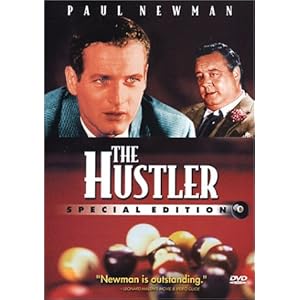
The Hustler

Airing for five seasons between 1959 and 1964, The Twilight Zone produced countless classic episodes, shows that have lived on over the last 50-plus years.  I can think of a dozen or so that I could rattle off, one better than the next. One that always stuck with me though starred Jonathan Winters and Jack Klugman as an established pool shark, a legend, and the up and coming shark looking to make a name for himself. Somewhere, sometime in my head, I convinced myself that it was the basis for 1961's The Hustler. Not quite, but the basic premise and set-up is similar.

Even more than three years since his death in 2008, it's hard to believe that Hollywood acting legend Paul Newman passed on.  He was and is one of the greats, a movie star and an actor. What is odd though -- for me -- is that I was always a fan of his without actually seeing many of his movies.  As I seek more of them out, I've come to a realization. Newman's performances are rarely if ever in question. His acting is almost always top-notch. It's the movie as a whole though that doesn't always quite live up to expectations. I'm not quite sure where 'The Hustler' falls.

A pool hustler who travels the backroads and little towns looking for a game, Eddie Felson (Newman) has his sights set on a living legend in pool halls, Minnesota Fats (Jackie Gleason). He gets his wish, playing Fats in a marathon game of straight pool, even going up as much as $18,000 at one point. Eddie pushes too far though and keeps playing, losing it all and putting him right back where he started. Eddie meets Sarah (Piper Laurie), a similarly jaded individual with her fair share of problems, the two bonding through their problems and finding someone else exactly like the other. Eddie starts to scrape together money, hoping to get a rematch with Fats, even signing on with shady gambler/bookie/businessman, Bert Gordon (George C. Scott), to bankroll him. All Eddie wants is a shot at Fats, the money doesn't mean much. He wants the fame, the reputation, the recognition, but for him, it may be too late.

Cool Hand Luke is my favorite Newman movie, and probably my favorite role of the actor's, but I think this may be his best acting performance overall.  I've always liked Newman as an actor because he's very natural onscreen, but he is also actually acting. He's capable of humor and high drama and everything in between.  This is a part that certainly leads to the high drama.  Eddie -- dubbed Fast Eddie for his hustling ability -- is at first just a young rising star who wants his shot at the legend. It's quickly apparent that his ego and pride is going to get the best of him.  He is obsessed, hitting rock bottom immediately. His character is so blinded by his drive that he doesn't realize he's destroying himself in the process of trying to better himself.  Newman dives into this character head first, committing from the get-go, and he brings this tragic character to life vividly.

There is a style to so many 1960s movies that is just hard to explain. They're cool because they're cool, and they know it. They don't have to try to be stylish or edgy. They just are. Director Robert Rossen here turns in one of the most effortlessly stylish and cool movies I can think of. The movie is shot in black and white which I'm always a fan of. It's easy to say now because I've already seen the movie in B&W, but it's hard to imagine it in color. As is, the movie is stripped down and bare-bones. It just works that way, reflecting what's going on in Eddie's head. Anything extra or not essential gets thrown by the wayside. The best parts of the movie are shot in smokey, dingy pool halls, but there is an unexplained coolness to them. Maybe just because its the 1960s, maybe it is the jazzy score from Kenyon Hopkins, the movie is fun to watch.

With a movie that runs 134 minutes, there are moments of perfection followed by stretches of dullness and boredom. The introduction is classic in the pre-credits sequence, and the epic duel between Eddie and Fats is a landmark sequence that goes on for most of a half hour (Newman and Gleason doing a lot of their own trick shots too, impressive). I would have never thought watching pool would be fascinating, but 'Hustler' proves otherwise. Gleason is a scene-stealer, and he basically has about 14 lines of dialogue. He's impeccably cool and calm, understated and confident in his ability. Just when Eddie thinks he has him, Fats cleans up, puts his jacket back on and is ready for a new round. You feel intimidated just watching him, much less playing him. Gleason disappears then until the end, but he makes every second onscreen count.

This early pool marathon session does two things, it sets the story off at a brisk, exciting pace (the good), and then lets the story sink some (that's the bad for those slow readers out there) in terms of pacing.  After the game, the story just lags, boring me as Eddie meets equally troubled Sarah (Laurie does a fine job with the part). The character study is interesting, seeing what makes this man tick, but I got bored seeing it develop. Scott's reappearance late as Gordon is a movie-saver, adding a dark, seedy element to the story. The ending is quite a downer, but in an appropriate way, a fitting end for Eddie. I loved Newman's performance, liked other parts of the movie, and was bored in still others. A mixed bag, but still a good movie.

The Hustler <---trailer (1961): ** 1/2 /**** 

Monday, June 13, 2011

Men of the Fighting Lady

Before his death in 1997, author James Michener's name was synonymous with epics in novel form.  Centennial, Texas, Alaska, Hawaii, Chesapeake, The Journey, all huge novels that fans have come to love. But before he turned to those epics, he wrote several smaller books set in the Korean War which haven't received the publicity of his other works but are nonetheless worthwhile. Similar to Michener's Bridges at Toko-Ri (and the film version), 1954's Men of the Fighting Lady is based off his novel The Forgotten Heroes of Korea.

This is an oddity when it comes to war movies for a lot of reasons.  For one, it is based during the Korean War, but other than a few shots taken at the Commies, this movie could as easily have been based in WWII.  Second, there's something missing, or maybe there's too much?  At just 79 minutes, this is one of the shortest war movies I can think of, right up there with the heavily hacked and edited Red Badge of Courage.  Reading about a true incident a key scene is based on, did director Andrew Marton fill out a story around that single incident? Or to the opposite, did he have a longer movie that was cut down to this running time? I'm looking for some sort of answer and can't find a thing. Maybe it's just an oddity among war flicks?

On board the U.S.S. Oriskany, author James Michener (Louis Calhern) comes to visit his old friend, Commander Dowling (Walter Pigeon), the medical officer on board, in hopes of landing a story. Dowling has one for him, a story concerning the fighter pilots in the still-new jets on board being used against the North Koreans and Chinese in the fighting on land. Michener sits back and listens to the story of the fighter squadron and its pilots, what drives them to do what they do, constantly putting themselves in needlessly dangerous situations when the job doesn't always call for it. Why do they do it? Do they get some sick, perverse enjoyment out of it?  Or are they just doing their duty as expected?  Looking for answers from his old friend, Michener is surprised by what he finds.

Now in 2011, a movie about fighter pilots and their newly developed jet planes seems old hat. Who hasn't seen Top Gun? And in a lot of cases, who hasn't seen Top Gun 20 or 30 times? Guilty.  But in 1954, this newly developed plane had to be impressive to audiences.  Even compared to the fighter planes from WWII, these new designs were remarkable.  Much of the story focuses on these pilots and their life aboard ship waiting for their missions.  Marton uses a ton of stock footage (bordering on too much) of these planes on those missions.  At first, it's cool. It's different, original, and the footage is impressive.  You can always have too much of a good thing though because soon enough, the footage of raids and air strikes gets tedious.

Clocking in at well under 90 minutes, the ensemble cast here in 'Fighting Lady' features some solid names, but unfortunately their efforts aren't always as developed as I'd like. There are a handful of really interesting characters but thanks to the limitations on time, some get the short end of the stick.  The squadron includes Frank Lovejoy as Lt. Commander Paul Grayson, the squadron leader who pushes his men to the limit, but he's always at the forefront of the charge, Keenan Wynn as Lt. Commander Ted Dodson, a veteran flier who begins to question Grayson's tactics, Van Johnson as Lt. Howie Thayer, the amiable pilot trapped in the middle of two warring factions in the squadron, and Dewey Martin as Ensign Schechter, the young pilot who begins to side with Dodson. Lovejoy's commander is especially pushed to the background in the last 45 minutes, odd considering how key his character was to the first half of the movie.

Two extended sequences bring this movie up from same old same old to a near-classic.  The first is based on a real-life incident that Michener wrote about. Returning from a patrol, Martin's Schechter and his plane are struck, the shrapnel blinding the pilot in the process.  Trying to guide the wounded pilot back to the carrier hundreds of miles out, Johnson's Thayer leaves formation and flies with Schechter, giving him step-by-step commands so that he can make it back. Van Johnson is one of my favorite actors, but this may be his most impressive part, and Martin is no slouch either.  Johnson's dialogue is natural and nervous, pulling anything from his sleeve that may help.  The tension builds and builds until its almost unbearable. By the time they reach the carrier, I was willing Martin and his crippled plane to land safely. This extended sequence goes on for most of a half hour, but it never lacks for energy, tension or entertainment. You can watch the whole thing HERE and continue into Parts 7 and 8.

The second sequence isn't based as much on playing to that weird adrenaline rush you get from terrifying situations. It's based in that most basic idea of being separated from your loved ones during holidays.  Soldiers, sailors, Marines, pilots, they all experience it.  It's Christmas in this story, and the Navy has arranged for many of the families of the crew to tape quick messages to their husbands, brothers, sons and boyfriends. The timing of course couldn't be worse. A pilot was killed in action just a day before so when his family's message is played for the crew, a silence hangs over the crowd. There's a moment where you realize what you're watching where it all hits home. This family has no idea their Dad and husband is dead. In terms of pure emotion, this scene hit me like a bag of rocks.

There's two ways to fix this movie (in my weird head anyways). I say this having liked it and planning to give it a positive review. It plays in two ways, an extended TV episode or a badly shortened feature length. In a shorter version, I think it could work nicely the same way a longer, more developed movie would.  More character development would be at the top of the list of possible improvements.  But as is, I really liked the movie, as much for the drama as the cast. Flawed but above average.

Men of the Fighting Lady <---trailer (1954): ***/****