What's funny about war? Very little. For a war movie to be funny, there has to be some sort of dark, black humor on the subject. Something that makes you chuckle or laugh at the ridiculousness of war. I've mentioned it before but Catch 22 is one of the few examples I can think of where a war movie is legitimately funny. It is smart funny though not physical or lowbrow humor.
A little-known comedic war movie released in 1961, Invasion Quartet was a part of Turner Classic Movie's recent Memorial Day Salute. The IMDB rating was a lowly 4.9 at the time (can't even reach a 5 overall? Ouch), and the trailer at the TCM website looked painfully unfunny. Still, I've got to take advantage when I can. I'd never heard of it, and who knows how long it will be before the movie is shown again? Now that I've seen it and pointed that out, it will probably be within a week or two. I didn't hate it (well, all of it), and I didn't love it. It's pretty harmless all things considered with at least a little potential wasted if nothing else.
Wasting away in an army hospital on the English coast, wounded officer Freddie Oppenheimer (Bill Travers) would like nothing more than to get to a front line position or at least be approved for active duty. Thanks to losing his leg below the knee, that's just not going to happen. Another prisoner, a Frenchman named Debrie (Gregorie Aslan), is in a similar boat having lost his right hand in combat. The duo come up with a plan when an immense German artillery piece -- dubbed Big Hermann -- across the English Channel keeps blasting away at the surrounding countryside. What if they put together a commando unit, sailed across the channel, posed as German soldiers, and knocked out the gun? Recruiting another patient, Godfrey Pringle (Spike Milligan), by lying to him about their ultimate goal, and a Home Defense colonel (John Le Mesurier), this odd little quartet goes about planning their raid.
Mostly because 'Invasion' doesn't try to be anything other than a mindless war comedy, I can't completely rip into it. If it tried to be a classic, epic, sprawling comedy, then I'd give it both barrels. But as is, it is a relatively harmless WWII comedy that has some funny moments sprinkled in with some decidedly unfunny moments. Director Jay Lewis only has six films to his name, and one of those is a documentary, another is a short film. The movie is shot in black and white so in my messed up head, there's a certain old school charm to the movie. It starts off on a high note, an animated credits sequence reminding me of some 1960s MGM Pink Panther cartoons, and even once the characters are introduced I was enjoying the movie. It never goes anywhere though, and ends up taking quite a few steps backward.
Like so many generally forgotten movies from years past, I'm guessing we can chalk a lot of Invasion's forgotten status because of its less than inspiring cast. These are faces you would recognize, but maybe not know who they are (myself included). Travers and Aslan have a great chemistry together, Travers' Oppenheimer the prim, proper and conniving Brit, Aslan's Debrie the lover of life Frenchman. An early bit with them posing as the other one to get medical clearance is a high point. Le Mesurier is subtle in his humor, the WWI vet constantly referring to his past war exploits and is a welcome addition to the group. Thorley Walters plays Cummings, a fifth member of the commando team who gets left behind by accident. Now if you're keeping up, that accounts for 1, 2, 3 and 5 members of the team. What about the fourth?
That's British comedian Milligan as the finnicky, clueless Godfrey Pringle. I have no background with Milligan other than what I read at his Wikipedia entry. He was a British comedian that shot to fame in the years following WWII, and by all accounts is a funny guy...just not in this movie. His character is the Jerry Lewis character here for lack of a better description. Around for slapstick humor and some side gags, Pringle ends up being an obnoxious character all around. How Oppenheimer and Co. get him on the mission is funny, but the recurring gag gets old because of the character's complete and total idiocy.
The potential is there in a lot of scenes for this movie to amount to something more, but it never quite gets there. The quasi-Guns of Navarone plot-line is a good jumping off point, but even the "raid" is somewhat boring. My favorite part of the movie was British Intelligence's efforts (including John Wood, Alexander Archdale, and Bernard Hunter) to figure out what's going on. They keep receiving cryptic messages from Pringle who believes he's a legitimate commando. Intelligence of course tries to decipher the messages, none of them having any clue as to what's going on but not willing to admit it. The ending does provide a good chuckle, but generally the movie flatlines through its 90-minute running time. Funny at times, boring at others, it's a mixed bag. What else would you expect from a war comedy?
Invasion Quartet <---TCM trailer (1961): **/****
The Sons of Katie Elder
"First, we reunite, then find Ma and Pa's killer...then read some reviews."
Saturday, June 18, 2011
Friday, June 17, 2011
127 Hours
It was the type of story you just couldn't believe the first time you heard it. Too gruesome, too brutal, too far-fetched, but it happened. In 2003, adventurer/climber/guide Aron Ralston went canyoneering in Utah who was forced to amputate his own arm when he fell in a canyon and had his right hand pinned by a large boulder. With no food and no water after several days of being trapped, Ralston actually amputated his own right arm below the elbow and survived. I was curious when I heard the story was being made into a feature-length movie, but I came away very impressed with 2010's 127 Hours.
Throw everything else away here; acting, story, direction, soundtrack, camerawork. This is a movie about one of the most basic elements of living...surviving. I guarantee when people read this story back in 2003 a majority wondered what they would have done in that situation? Would you have had the will to live so much that you would cut off your own arm with a dull pocket knife to survive? How far would you go to keep on living? I think that's maybe the biggest appeal of this movie. It's a person to person thing, and no one really knows how they would respond in such a hellish situation.
Leaving in the dead of night one April 2003 weekend, canyoneer Aron Ralston (James Franco) has several days of biking, hiking and exploring ahead of him. He leaves with a backpack full of supplies and drives out into Canyonlands National Park, a beautiful but basically desolate and vacant part of the American west. Aron loves everything about it, the beauty, the history, the solitude. That's what he quickly realizes. In all the vast stretches of land, Aron is very alone. Descending into a canyon, he trips and falls down to the bottom, a large boulder pinning his right arm to the canyon wall. He has a little water, a little food, and the supplies and equipment he was carrying. The hours turn into days though, and Aron begins to realize he will have to make a drastic choice if he hopes to live.
Director Danny Boyle has a personal style to his movies, and usually that's a good thing. This is a true story though that I never thought called for too much in the way of stylization. The story of Aron's struggles to survive stands on its own, and that's basically my only complaint with the movie. Split screens, ironic soundtrack choices, ultra-fast montages, none of them were needed. None of these issues overpower the movie or detract from it in a major way, but like anything, it is the little details that bug you. His eye behind the camera (with 2 cinematographers) is never in question. Filming in Utah, the movie is stunning in its portrayals of the American west. Even when the story is tied to Aron's struggle in the canyon, there is an eerie beauty to his surroundings, both the land and rock formations to go with the nature that surrounds him.
It speaks to the strength of this year's Oscar nominees for Best Actor that James Franco didn't win (I'm gonna get around to The King's Speech one of these days) his first Academy Award. This is that type of performance that actors must dream about. The camera's focus is on him and him alone, and Franco makes the most of it. The emotion, the physicality, the mental strain, he brings them all to life. There's that momentary panic followed by the realization of the predicament he's in. Trying to maintain some sense of reality, Aron talks into his digital camera, telling the people he's left behind what's happened and the thoughts racing through his head. It is a sink or swim performance because if you don't believe in Franco or like the actual performance, you're going to dislike this movie. I loved it, and hopefully it's another sign of a long, successful career to come.
What worked so well (and kind of negated the overly stylized moments) is the reflection Aron does on his life, some through just thinking, some through hallucinations and dreams. One of my first thoughts when I heard about this movie was how would a director make it an even somewhat interesting feature film? It's a guy trapped under a rock. My concern or worries were unfounded. Some of the movie's most powerful moments come from those reflections. Aron's messages to his family taped on his digital camera are heartbreaking. He thinks he's going to die, and believes this will be his final hours of life. A darkly comic scene has Aron posing as a talk shot guest, talking about his faults and the stupidity of his self-confidence that he told no one where he was going and therefore no one knows where to look for him. The best though for me was one late dream/hallucination of Aron's as he draws closer to giving up. In front of him sitting on a couch and standing around it are all his friends and family. They say nothing, just sitting there, almost willing him to do what he has to do. That of course leads to....
Yeah, the cutting of his own arm is an incredibly uncomfortable sequence to watch. It's not gratuitous, but it is graphic (how could it not be I guess). Actually thinking about what he's doing is the most amazing thing of the story right up there with the will to live and the limits we'll go to in hopes of continuing to live. Some of the mystery is taken away because we know what Aron will do, and that he will ultimately survive. In no way though does that take away the power and the beauty of the aftermath. With Sigur Ros' Festival playing, the rescue is one of the most beautiful, moving scenes I've ever watched. The ending is beyond moving. You feel like you've been through Aron's trials with him, and seeing him rescued is a release. The epilogue is eloquent in its simplicity, the title cards popping up telling us what became of Aron. It's a great, simple, beyond beautiful ending.
Franco is the unquestioned star here of course, but the hallucinations/flashbacks allow for some interesting casting. Treat Williams plays his father, a key scene early explaining Aron's love of nature as father and son watch the sunrise over the desert horizon. That is a scene straight out of poetry, pure Americana there. Kate Mara and Amber Tamblyn play Kristi and Megan, two hikers Aron meets on the trail before his accident. Lizzy Caplan makes a quick appearance as Aron's sister, providing motivation for Aron because he wants to be at her wedding. Clemence Poesy plays Rana, a past girlfriend he regrets the way their relationship ended.
As I write this review, I find myself liking the movie more than I did while watching it. I enjoyed watching it, don't let me confuse you. But thinking of the moments that work so well, I loved parts of the movie. It is a story of survival, of one individual absolutely wanting and needing to keep on living. Power of the human spirit, a will to live, call it what you want. The story is great, Franco's performance amazing, and overall one of those truly inspiring stories you come across.
127 Hours <---trailer (2010): ****/****
Throw everything else away here; acting, story, direction, soundtrack, camerawork. This is a movie about one of the most basic elements of living...surviving. I guarantee when people read this story back in 2003 a majority wondered what they would have done in that situation? Would you have had the will to live so much that you would cut off your own arm with a dull pocket knife to survive? How far would you go to keep on living? I think that's maybe the biggest appeal of this movie. It's a person to person thing, and no one really knows how they would respond in such a hellish situation.
Leaving in the dead of night one April 2003 weekend, canyoneer Aron Ralston (James Franco) has several days of biking, hiking and exploring ahead of him. He leaves with a backpack full of supplies and drives out into Canyonlands National Park, a beautiful but basically desolate and vacant part of the American west. Aron loves everything about it, the beauty, the history, the solitude. That's what he quickly realizes. In all the vast stretches of land, Aron is very alone. Descending into a canyon, he trips and falls down to the bottom, a large boulder pinning his right arm to the canyon wall. He has a little water, a little food, and the supplies and equipment he was carrying. The hours turn into days though, and Aron begins to realize he will have to make a drastic choice if he hopes to live.
Director Danny Boyle has a personal style to his movies, and usually that's a good thing. This is a true story though that I never thought called for too much in the way of stylization. The story of Aron's struggles to survive stands on its own, and that's basically my only complaint with the movie. Split screens, ironic soundtrack choices, ultra-fast montages, none of them were needed. None of these issues overpower the movie or detract from it in a major way, but like anything, it is the little details that bug you. His eye behind the camera (with 2 cinematographers) is never in question. Filming in Utah, the movie is stunning in its portrayals of the American west. Even when the story is tied to Aron's struggle in the canyon, there is an eerie beauty to his surroundings, both the land and rock formations to go with the nature that surrounds him.
It speaks to the strength of this year's Oscar nominees for Best Actor that James Franco didn't win (I'm gonna get around to The King's Speech one of these days) his first Academy Award. This is that type of performance that actors must dream about. The camera's focus is on him and him alone, and Franco makes the most of it. The emotion, the physicality, the mental strain, he brings them all to life. There's that momentary panic followed by the realization of the predicament he's in. Trying to maintain some sense of reality, Aron talks into his digital camera, telling the people he's left behind what's happened and the thoughts racing through his head. It is a sink or swim performance because if you don't believe in Franco or like the actual performance, you're going to dislike this movie. I loved it, and hopefully it's another sign of a long, successful career to come.
What worked so well (and kind of negated the overly stylized moments) is the reflection Aron does on his life, some through just thinking, some through hallucinations and dreams. One of my first thoughts when I heard about this movie was how would a director make it an even somewhat interesting feature film? It's a guy trapped under a rock. My concern or worries were unfounded. Some of the movie's most powerful moments come from those reflections. Aron's messages to his family taped on his digital camera are heartbreaking. He thinks he's going to die, and believes this will be his final hours of life. A darkly comic scene has Aron posing as a talk shot guest, talking about his faults and the stupidity of his self-confidence that he told no one where he was going and therefore no one knows where to look for him. The best though for me was one late dream/hallucination of Aron's as he draws closer to giving up. In front of him sitting on a couch and standing around it are all his friends and family. They say nothing, just sitting there, almost willing him to do what he has to do. That of course leads to....
Yeah, the cutting of his own arm is an incredibly uncomfortable sequence to watch. It's not gratuitous, but it is graphic (how could it not be I guess). Actually thinking about what he's doing is the most amazing thing of the story right up there with the will to live and the limits we'll go to in hopes of continuing to live. Some of the mystery is taken away because we know what Aron will do, and that he will ultimately survive. In no way though does that take away the power and the beauty of the aftermath. With Sigur Ros' Festival playing, the rescue is one of the most beautiful, moving scenes I've ever watched. The ending is beyond moving. You feel like you've been through Aron's trials with him, and seeing him rescued is a release. The epilogue is eloquent in its simplicity, the title cards popping up telling us what became of Aron. It's a great, simple, beyond beautiful ending.
Franco is the unquestioned star here of course, but the hallucinations/flashbacks allow for some interesting casting. Treat Williams plays his father, a key scene early explaining Aron's love of nature as father and son watch the sunrise over the desert horizon. That is a scene straight out of poetry, pure Americana there. Kate Mara and Amber Tamblyn play Kristi and Megan, two hikers Aron meets on the trail before his accident. Lizzy Caplan makes a quick appearance as Aron's sister, providing motivation for Aron because he wants to be at her wedding. Clemence Poesy plays Rana, a past girlfriend he regrets the way their relationship ended.
As I write this review, I find myself liking the movie more than I did while watching it. I enjoyed watching it, don't let me confuse you. But thinking of the moments that work so well, I loved parts of the movie. It is a story of survival, of one individual absolutely wanting and needing to keep on living. Power of the human spirit, a will to live, call it what you want. The story is great, Franco's performance amazing, and overall one of those truly inspiring stories you come across.
127 Hours <---trailer (2010): ****/****
Thursday, June 16, 2011
The Tanks Are Coming
In the midst of a directing career that saw over 30 feature films, WWII veteran Sam Fuller did his fair share or writing too, much of it is based in war stories and sometimes his own experiences. Fixed Bayonets and Merrill's Marauders are underrated classics, and The Big Red One is a direct retelling of Fuller's tour of duty in WWII with the famous division. His writing efforts aren't always remembered as well, but as was the case with 1951's The Tanks Are Coming, the talent is obviously there.
This WWII movie comes in the same year as two other Fuller flicks, Fixed Bayonets as I mentioned before and also the underrated and underappreciated The Steel Helmet. It's tough to compare three different movies released in such quick succession, but 'Tanks' is probably the weakest of three. That's not to say it is a bad movie. Far from it, it's pretty good overall. The positives come from the Fuller story the screenplay is based on. It is cliched, but it never goes as far as flag-waving thankfully. It is content to tell its story without pandering.
It is July 1944, just a month removed from the D-Day invasion. As the Allies prepare to unleash a spearhead right at the German lines, a tank battalion in the 3rd Armored Division readies itself to lead the attack. One of the advance tanks though is hit early on, the top sergeant killed. A veteran tanker, Sgt. Sullivan (Steve Cochran), is transferred in to take over the tank and its surviving crew, picking up at the point of the column where they left off. Pushing his crew and his tank to the limit as they battle German forces, Sullivan rubs everyone the wrong way. His men believe he's a gung-ho hero seeking medals. His superiors think he's foolhardy and needlessly adventurous in combat. Is Sullivan pushing too hard, or is he just trying to make his men the best they can be?
As part of TCM's Memorial Day marathon a few weeks back, I caught this generally forgotten WWII movie for the first time. Part of the reason it gets lost in the waves of WWII pictures has to be the cast, generally a bunch of unknowns and supporting players. Sullivan's crew includes Paul Picerni as Kolowicz, the machine gunner who clashes immediately with the sergeant, George O'Hanlon (later George Jetson's voice) as Tucker, the tank driver who can't get enough booze, Eugene Baxter as Marconi, and Robert Boon as Heinie, a German-American soldier with an agenda. Oddly enough, Baxter and Boon aren't even credited, especially odd when you consider how much they're in the movie. Among the tankers there's Ike (James Dobson), maybe the most annoying pip-squeak of a soldier ever, and Lemcheck (Harry Bellaver), the grouchy mechanic. Fuller fans will notice the director/writer's trademarks, using the names Kolowicz and Lemcheck in many of his movies.
Looking through his filmography, I can say I've seen Cochran in several movies, but he didn't leave much of an impression obviously. This was an interesting part for him in a role that's a staple of the war movie genre. He's that tough sergeant, damn good at what he does and dead-set on instilling everything he knows into his men. His Sgt. Sullivan doesn't care much whether his men like him or hate his guts, as long as they do their job and stay alive, he's pleased (even if he'll never let on or show that). Other than an odd accent that sounds half Irish and half drawling Southerner, this was an interesting lead character. The story softens Sullivan up a bit by the end unfortunately, but it's not exactly a surprise. SPOILERS STOP READING SPOILERS I thought for awhile Sullivan would get killed in the end, but I guess for a B-movie in 1951 it just wasn't in the cards END OF SPOILERS
Directed by Hollywood veteran Lewis Seiler, 'Tanks' is an odd mix of elements all things considered. It isn't a patriotic flag-waving movie like so many WWII stories released in the years following the war's conclusion. On the other hand, it isn't cynical or overly dark. I think it finds a nice middle ground. 'Tanks' never glamorizes the war, the fighting, the combat. The soldiers aren't indestructible superheroes. They gripe and complain, they fight amongst each other, and mostly they just want to survive and go home. For a lower budget movie, the scale is somewhat limited, but a good mix of stock footage (edited in pretty seamlessly) and actual action scenes keep things moving. I think the movie would have gone up a notch or two if it had the guts to kill off Sullivan, but as is, the ending is still pretty good. Look for Philip Carey and Robert Horton as two commanding officers in the battalion.
For all the positive elements, there's also the negative. Dobson's Ike character is beyond obnoxious, and for some reason the camera keeps going back to him for comic relief. It's never actually funny, but they keep trying. Ike and Lemcheck are on another tank crew, but they're always hanging around too, probably because Sullivan's crew isn't always that interesting. Then there's Mari Aldon as Patricia, a war correspondent who has a past with Sullivan. She's in exactly two scenes, and isn't even around long enough to be considered a love interest. Just little complaints on their own, but they do throw off the tone and pacing a bit.
Not great but far from bad either. Good story from Fuller, and a solid lead performance from Cochran. If you can track down a copy, it's worth a watch if not a purchase. A made-to-order DVD is available through the Warner Archive if you're dying to see it.
The Tanks Are Coming (1951): ** 1/2 /****
This WWII movie comes in the same year as two other Fuller flicks, Fixed Bayonets as I mentioned before and also the underrated and underappreciated The Steel Helmet. It's tough to compare three different movies released in such quick succession, but 'Tanks' is probably the weakest of three. That's not to say it is a bad movie. Far from it, it's pretty good overall. The positives come from the Fuller story the screenplay is based on. It is cliched, but it never goes as far as flag-waving thankfully. It is content to tell its story without pandering.
It is July 1944, just a month removed from the D-Day invasion. As the Allies prepare to unleash a spearhead right at the German lines, a tank battalion in the 3rd Armored Division readies itself to lead the attack. One of the advance tanks though is hit early on, the top sergeant killed. A veteran tanker, Sgt. Sullivan (Steve Cochran), is transferred in to take over the tank and its surviving crew, picking up at the point of the column where they left off. Pushing his crew and his tank to the limit as they battle German forces, Sullivan rubs everyone the wrong way. His men believe he's a gung-ho hero seeking medals. His superiors think he's foolhardy and needlessly adventurous in combat. Is Sullivan pushing too hard, or is he just trying to make his men the best they can be?
As part of TCM's Memorial Day marathon a few weeks back, I caught this generally forgotten WWII movie for the first time. Part of the reason it gets lost in the waves of WWII pictures has to be the cast, generally a bunch of unknowns and supporting players. Sullivan's crew includes Paul Picerni as Kolowicz, the machine gunner who clashes immediately with the sergeant, George O'Hanlon (later George Jetson's voice) as Tucker, the tank driver who can't get enough booze, Eugene Baxter as Marconi, and Robert Boon as Heinie, a German-American soldier with an agenda. Oddly enough, Baxter and Boon aren't even credited, especially odd when you consider how much they're in the movie. Among the tankers there's Ike (James Dobson), maybe the most annoying pip-squeak of a soldier ever, and Lemcheck (Harry Bellaver), the grouchy mechanic. Fuller fans will notice the director/writer's trademarks, using the names Kolowicz and Lemcheck in many of his movies.
Looking through his filmography, I can say I've seen Cochran in several movies, but he didn't leave much of an impression obviously. This was an interesting part for him in a role that's a staple of the war movie genre. He's that tough sergeant, damn good at what he does and dead-set on instilling everything he knows into his men. His Sgt. Sullivan doesn't care much whether his men like him or hate his guts, as long as they do their job and stay alive, he's pleased (even if he'll never let on or show that). Other than an odd accent that sounds half Irish and half drawling Southerner, this was an interesting lead character. The story softens Sullivan up a bit by the end unfortunately, but it's not exactly a surprise. SPOILERS STOP READING SPOILERS I thought for awhile Sullivan would get killed in the end, but I guess for a B-movie in 1951 it just wasn't in the cards END OF SPOILERS
Directed by Hollywood veteran Lewis Seiler, 'Tanks' is an odd mix of elements all things considered. It isn't a patriotic flag-waving movie like so many WWII stories released in the years following the war's conclusion. On the other hand, it isn't cynical or overly dark. I think it finds a nice middle ground. 'Tanks' never glamorizes the war, the fighting, the combat. The soldiers aren't indestructible superheroes. They gripe and complain, they fight amongst each other, and mostly they just want to survive and go home. For a lower budget movie, the scale is somewhat limited, but a good mix of stock footage (edited in pretty seamlessly) and actual action scenes keep things moving. I think the movie would have gone up a notch or two if it had the guts to kill off Sullivan, but as is, the ending is still pretty good. Look for Philip Carey and Robert Horton as two commanding officers in the battalion.
For all the positive elements, there's also the negative. Dobson's Ike character is beyond obnoxious, and for some reason the camera keeps going back to him for comic relief. It's never actually funny, but they keep trying. Ike and Lemcheck are on another tank crew, but they're always hanging around too, probably because Sullivan's crew isn't always that interesting. Then there's Mari Aldon as Patricia, a war correspondent who has a past with Sullivan. She's in exactly two scenes, and isn't even around long enough to be considered a love interest. Just little complaints on their own, but they do throw off the tone and pacing a bit.
Not great but far from bad either. Good story from Fuller, and a solid lead performance from Cochran. If you can track down a copy, it's worth a watch if not a purchase. A made-to-order DVD is available through the Warner Archive if you're dying to see it.
The Tanks Are Coming (1951): ** 1/2 /****
Wednesday, June 15, 2011
Death Race
One of the great cult films of all time, 1975's Death Race 2000 is a great example of a low-budget pile of schlock actually amounting to something. By all accounts, it is a horrific movie that should by no means actually work. It does though, mostly because of the badness. It's so funny, so stupid, so cheap, and ultimately so mind-blowingly ridiculous that you end up liking the movie. I'm not a huge, die-hard fan of the Roger Corman produced flick, but I liked it enough. Still, I was rather skeptical when 2008's Death Race was released.
My usual reaction to any remake is what's the point? Is a new version of an old movie going to add anything or improve on something? In the case of the original Death Race, a lot was left to be desired, but because of the low-budget factor you went along for the ride. The 2008 remake thankfully does switch things up, adding some cool touches to the same basic premise. The cast is solid -- especially two key supporting roles -- and the action is fun, the premise more than interesting, and in the end, it's an entertaining action flick. With a movie like this, I'm not looking for Academy-Award winning stuff, just to have fun.
It's 2012 and the American economy has collapsed, and a new entertainment venue has emerged to keep the masses happy. Private corporations run the prison system, and one warden, Hennessy (Joan Allen), has put together 'Death Race,' a three-stage race where hardened killers, rapists and crooks compete against each other in heavily armored cars featuring tons of vicious weapons. Jensen Ames (Jason Statham) is a former race car driver framed for the murder of his wife who's sent to Hennessy's Terminal Island prison. She needs Jensen to pose as the most infamous of the drivers, Frankenstein, a man so scarred by previous races he wears a mask at all times. All he needs to do is race, win once, and he'll get his walking papers. Jensen agrees, knowing the warden won't keep her promise, but this man with revenge on his mind has other plans.
From a low-budget drive-in movie from 1975 to a high-octane, big-budget action movie, everything has been ratcheted up a notch or two or ten. The film's look is grayish and washed out, almost like some sort of post-apocalyptic hell. The story is straightforward and fairly obvious, but with a movie called 'Death Race' you're not exactly looking for Shakespeare, are you? The action is pretty much non-stop once the background is established. Following the good old Roger Corman (who produced the original and remake) formula for success, director Paul W.S. Anderson has assembled a movie with tons of violence, tough guy actors, and ridiculously gorgeous female cast members who are required to look ridiculously gorgeous. When handled right, that always sounds like a good movie to me.
Say what you want about Jason Statham's acting range, but the guy is one of the coolest action stars out there. He's usually right in that silent to ultra-silent category, using words like they pain him to say anything. I think he's made some poor decisions with the movies he's taken (the Crank movies, In the Name of the King), but I've always liked him. As Jensen Ames, he doesn't need to show much range. He is pissed at the world, and he's going to get his revenge one way or another. Tyrese Gibson takes over for Sylvester Stallone as Machine Gun Joe, a rival driver in the race and Jensen/Frank's biggest competition. The same goes for Gibson as it does Statham. He isn't the best actor around, but he's always a presence and looks like he's having a hell of a good time. Natalie Martinez is the completely unnecessary eye candy as Case, Jensen's navigator. Her character is the equivalent of a GPS with a Barbie doll body. Her line deliveries are so bad it's laughable. Watch the slow motion scene where she steps out of a classic car though, and you'll see why she was hired. Not a complaint by any means either.
With this type of schlock, I had to wonder. Were Joan Allen and Ian McShane blackmailed into doing this movie? These are two supremely talented actors so what are they doing here? As actors, they legitimize the movie just by being there. They don't have to do anything or say a word, and the movie is better for it. Of course, they don't just stand there. Director Anderson takes advantage, giving them two great supporting parts. Allen has one of the most amazing line deliveries I've ever heard (see if you can figure it out at IMDB's Memorable Quotes HERE). She is icy, steely-eyed, and ruthlessly brutal. McShane gets all the great lines and hams it up with the best of them as Coach, Jensen's pit-boss who has lost track of how many years he's been in prison. His last line is the best though, listen toward the end of the race. Coach's pit crew includes Jacob Vargas as Gunner, the mechanic, and Frederick Koehler, as Lists, the mousey genius. Jason Clarke plays Ulrich, Hennessy's top guard and henchman.
In a movie dominated by the bloody three-stage race, my issue comes from the editing as it so often does with action movies of the last 10 years or so. The driving sequences are so hyper, so frantically cut that the scenes are almost indecipherable. You can barely see what's going on with all the shaky cam, smoke and explosions. Because of that, the driving scenes even get a little tedious. How many times can you see one car blast away with machine guns and rockets at another? There are some cool surprises for the racers, but even that gets old fairly quickly.
Predictable, yes, but the last 15 minutes do provide a couple of solid twists. You know those twists are coming because of some rather obvious hints, but they work regardless. And if nothing else, the remake does try something different with its ending as opposed to going for the same one as the original. It's a good enough movie to be judged on its own from the original, and that's always a good sign for a remake.
Death Race <---trailer (2008): ** 1/2 /****
My usual reaction to any remake is what's the point? Is a new version of an old movie going to add anything or improve on something? In the case of the original Death Race, a lot was left to be desired, but because of the low-budget factor you went along for the ride. The 2008 remake thankfully does switch things up, adding some cool touches to the same basic premise. The cast is solid -- especially two key supporting roles -- and the action is fun, the premise more than interesting, and in the end, it's an entertaining action flick. With a movie like this, I'm not looking for Academy-Award winning stuff, just to have fun.
It's 2012 and the American economy has collapsed, and a new entertainment venue has emerged to keep the masses happy. Private corporations run the prison system, and one warden, Hennessy (Joan Allen), has put together 'Death Race,' a three-stage race where hardened killers, rapists and crooks compete against each other in heavily armored cars featuring tons of vicious weapons. Jensen Ames (Jason Statham) is a former race car driver framed for the murder of his wife who's sent to Hennessy's Terminal Island prison. She needs Jensen to pose as the most infamous of the drivers, Frankenstein, a man so scarred by previous races he wears a mask at all times. All he needs to do is race, win once, and he'll get his walking papers. Jensen agrees, knowing the warden won't keep her promise, but this man with revenge on his mind has other plans.
From a low-budget drive-in movie from 1975 to a high-octane, big-budget action movie, everything has been ratcheted up a notch or two or ten. The film's look is grayish and washed out, almost like some sort of post-apocalyptic hell. The story is straightforward and fairly obvious, but with a movie called 'Death Race' you're not exactly looking for Shakespeare, are you? The action is pretty much non-stop once the background is established. Following the good old Roger Corman (who produced the original and remake) formula for success, director Paul W.S. Anderson has assembled a movie with tons of violence, tough guy actors, and ridiculously gorgeous female cast members who are required to look ridiculously gorgeous. When handled right, that always sounds like a good movie to me.
Say what you want about Jason Statham's acting range, but the guy is one of the coolest action stars out there. He's usually right in that silent to ultra-silent category, using words like they pain him to say anything. I think he's made some poor decisions with the movies he's taken (the Crank movies, In the Name of the King), but I've always liked him. As Jensen Ames, he doesn't need to show much range. He is pissed at the world, and he's going to get his revenge one way or another. Tyrese Gibson takes over for Sylvester Stallone as Machine Gun Joe, a rival driver in the race and Jensen/Frank's biggest competition. The same goes for Gibson as it does Statham. He isn't the best actor around, but he's always a presence and looks like he's having a hell of a good time. Natalie Martinez is the completely unnecessary eye candy as Case, Jensen's navigator. Her character is the equivalent of a GPS with a Barbie doll body. Her line deliveries are so bad it's laughable. Watch the slow motion scene where she steps out of a classic car though, and you'll see why she was hired. Not a complaint by any means either.
With this type of schlock, I had to wonder. Were Joan Allen and Ian McShane blackmailed into doing this movie? These are two supremely talented actors so what are they doing here? As actors, they legitimize the movie just by being there. They don't have to do anything or say a word, and the movie is better for it. Of course, they don't just stand there. Director Anderson takes advantage, giving them two great supporting parts. Allen has one of the most amazing line deliveries I've ever heard (see if you can figure it out at IMDB's Memorable Quotes HERE). She is icy, steely-eyed, and ruthlessly brutal. McShane gets all the great lines and hams it up with the best of them as Coach, Jensen's pit-boss who has lost track of how many years he's been in prison. His last line is the best though, listen toward the end of the race. Coach's pit crew includes Jacob Vargas as Gunner, the mechanic, and Frederick Koehler, as Lists, the mousey genius. Jason Clarke plays Ulrich, Hennessy's top guard and henchman.
In a movie dominated by the bloody three-stage race, my issue comes from the editing as it so often does with action movies of the last 10 years or so. The driving sequences are so hyper, so frantically cut that the scenes are almost indecipherable. You can barely see what's going on with all the shaky cam, smoke and explosions. Because of that, the driving scenes even get a little tedious. How many times can you see one car blast away with machine guns and rockets at another? There are some cool surprises for the racers, but even that gets old fairly quickly.
Predictable, yes, but the last 15 minutes do provide a couple of solid twists. You know those twists are coming because of some rather obvious hints, but they work regardless. And if nothing else, the remake does try something different with its ending as opposed to going for the same one as the original. It's a good enough movie to be judged on its own from the original, and that's always a good sign for a remake.
Death Race <---trailer (2008): ** 1/2 /****
Labels:
2000s,
Ian McShane,
Jason Clarke,
Jason Statham,
Joan Allen,
Tyrese Gibson
Tuesday, June 14, 2011
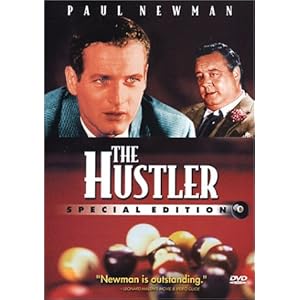
The Hustler
Airing for five seasons between 1959 and 1964, The Twilight Zone produced countless classic episodes, shows that have lived on over the last 50-plus years. I can think of a dozen or so that I could rattle off, one better than the next. One that always stuck with me though starred Jonathan Winters and Jack Klugman as an established pool shark, a legend, and the up and coming shark looking to make a name for himself. Somewhere, sometime in my head, I convinced myself that it was the basis for 1961's The Hustler. Not quite, but the basic premise and set-up is similar.
Even more than three years since his death in 2008, it's hard to believe that Hollywood acting legend Paul Newman passed on. He was and is one of the greats, a movie star and an actor. What is odd though -- for me -- is that I was always a fan of his without actually seeing many of his movies. As I seek more of them out, I've come to a realization. Newman's performances are rarely if ever in question. His acting is almost always top-notch. It's the movie as a whole though that doesn't always quite live up to expectations. I'm not quite sure where 'The Hustler' falls.
A pool hustler who travels the backroads and little towns looking for a game, Eddie Felson (Newman) has his sights set on a living legend in pool halls, Minnesota Fats (Jackie Gleason). He gets his wish, playing Fats in a marathon game of straight pool, even going up as much as $18,000 at one point. Eddie pushes too far though and keeps playing, losing it all and putting him right back where he started. Eddie meets Sarah (Piper Laurie), a similarly jaded individual with her fair share of problems, the two bonding through their problems and finding someone else exactly like the other. Eddie starts to scrape together money, hoping to get a rematch with Fats, even signing on with shady gambler/bookie/businessman, Bert Gordon (George C. Scott), to bankroll him. All Eddie wants is a shot at Fats, the money doesn't mean much. He wants the fame, the reputation, the recognition, but for him, it may be too late.
Cool Hand Luke is my favorite Newman movie, and probably my favorite role of the actor's, but I think this may be his best acting performance overall. I've always liked Newman as an actor because he's very natural onscreen, but he is also actually acting. He's capable of humor and high drama and everything in between. This is a part that certainly leads to the high drama. Eddie -- dubbed Fast Eddie for his hustling ability -- is at first just a young rising star who wants his shot at the legend. It's quickly apparent that his ego and pride is going to get the best of him. He is obsessed, hitting rock bottom immediately. His character is so blinded by his drive that he doesn't realize he's destroying himself in the process of trying to better himself. Newman dives into this character head first, committing from the get-go, and he brings this tragic character to life vividly.
There is a style to so many 1960s movies that is just hard to explain. They're cool because they're cool, and they know it. They don't have to try to be stylish or edgy. They just are. Director Robert Rossen here turns in one of the most effortlessly stylish and cool movies I can think of. The movie is shot in black and white which I'm always a fan of. It's easy to say now because I've already seen the movie in B&W, but it's hard to imagine it in color. As is, the movie is stripped down and bare-bones. It just works that way, reflecting what's going on in Eddie's head. Anything extra or not essential gets thrown by the wayside. The best parts of the movie are shot in smokey, dingy pool halls, but there is an unexplained coolness to them. Maybe just because its the 1960s, maybe it is the jazzy score from Kenyon Hopkins, the movie is fun to watch.
With a movie that runs 134 minutes, there are moments of perfection followed by stretches of dullness and boredom. The introduction is classic in the pre-credits sequence, and the epic duel between Eddie and Fats is a landmark sequence that goes on for most of a half hour (Newman and Gleason doing a lot of their own trick shots too, impressive). I would have never thought watching pool would be fascinating, but 'Hustler' proves otherwise. Gleason is a scene-stealer, and he basically has about 14 lines of dialogue. He's impeccably cool and calm, understated and confident in his ability. Just when Eddie thinks he has him, Fats cleans up, puts his jacket back on and is ready for a new round. You feel intimidated just watching him, much less playing him. Gleason disappears then until the end, but he makes every second onscreen count.
This early pool marathon session does two things, it sets the story off at a brisk, exciting pace (the good), and then lets the story sink some (that's the bad for those slow readers out there) in terms of pacing. After the game, the story just lags, boring me as Eddie meets equally troubled Sarah (Laurie does a fine job with the part). The character study is interesting, seeing what makes this man tick, but I got bored seeing it develop. Scott's reappearance late as Gordon is a movie-saver, adding a dark, seedy element to the story. The ending is quite a downer, but in an appropriate way, a fitting end for Eddie. I loved Newman's performance, liked other parts of the movie, and was bored in still others. A mixed bag, but still a good movie.
The Hustler <---trailer (1961): ** 1/2 /****
Even more than three years since his death in 2008, it's hard to believe that Hollywood acting legend Paul Newman passed on. He was and is one of the greats, a movie star and an actor. What is odd though -- for me -- is that I was always a fan of his without actually seeing many of his movies. As I seek more of them out, I've come to a realization. Newman's performances are rarely if ever in question. His acting is almost always top-notch. It's the movie as a whole though that doesn't always quite live up to expectations. I'm not quite sure where 'The Hustler' falls.
A pool hustler who travels the backroads and little towns looking for a game, Eddie Felson (Newman) has his sights set on a living legend in pool halls, Minnesota Fats (Jackie Gleason). He gets his wish, playing Fats in a marathon game of straight pool, even going up as much as $18,000 at one point. Eddie pushes too far though and keeps playing, losing it all and putting him right back where he started. Eddie meets Sarah (Piper Laurie), a similarly jaded individual with her fair share of problems, the two bonding through their problems and finding someone else exactly like the other. Eddie starts to scrape together money, hoping to get a rematch with Fats, even signing on with shady gambler/bookie/businessman, Bert Gordon (George C. Scott), to bankroll him. All Eddie wants is a shot at Fats, the money doesn't mean much. He wants the fame, the reputation, the recognition, but for him, it may be too late.
Cool Hand Luke is my favorite Newman movie, and probably my favorite role of the actor's, but I think this may be his best acting performance overall. I've always liked Newman as an actor because he's very natural onscreen, but he is also actually acting. He's capable of humor and high drama and everything in between. This is a part that certainly leads to the high drama. Eddie -- dubbed Fast Eddie for his hustling ability -- is at first just a young rising star who wants his shot at the legend. It's quickly apparent that his ego and pride is going to get the best of him. He is obsessed, hitting rock bottom immediately. His character is so blinded by his drive that he doesn't realize he's destroying himself in the process of trying to better himself. Newman dives into this character head first, committing from the get-go, and he brings this tragic character to life vividly.
There is a style to so many 1960s movies that is just hard to explain. They're cool because they're cool, and they know it. They don't have to try to be stylish or edgy. They just are. Director Robert Rossen here turns in one of the most effortlessly stylish and cool movies I can think of. The movie is shot in black and white which I'm always a fan of. It's easy to say now because I've already seen the movie in B&W, but it's hard to imagine it in color. As is, the movie is stripped down and bare-bones. It just works that way, reflecting what's going on in Eddie's head. Anything extra or not essential gets thrown by the wayside. The best parts of the movie are shot in smokey, dingy pool halls, but there is an unexplained coolness to them. Maybe just because its the 1960s, maybe it is the jazzy score from Kenyon Hopkins, the movie is fun to watch.
With a movie that runs 134 minutes, there are moments of perfection followed by stretches of dullness and boredom. The introduction is classic in the pre-credits sequence, and the epic duel between Eddie and Fats is a landmark sequence that goes on for most of a half hour (Newman and Gleason doing a lot of their own trick shots too, impressive). I would have never thought watching pool would be fascinating, but 'Hustler' proves otherwise. Gleason is a scene-stealer, and he basically has about 14 lines of dialogue. He's impeccably cool and calm, understated and confident in his ability. Just when Eddie thinks he has him, Fats cleans up, puts his jacket back on and is ready for a new round. You feel intimidated just watching him, much less playing him. Gleason disappears then until the end, but he makes every second onscreen count.
This early pool marathon session does two things, it sets the story off at a brisk, exciting pace (the good), and then lets the story sink some (that's the bad for those slow readers out there) in terms of pacing. After the game, the story just lags, boring me as Eddie meets equally troubled Sarah (Laurie does a fine job with the part). The character study is interesting, seeing what makes this man tick, but I got bored seeing it develop. Scott's reappearance late as Gordon is a movie-saver, adding a dark, seedy element to the story. The ending is quite a downer, but in an appropriate way, a fitting end for Eddie. I loved Newman's performance, liked other parts of the movie, and was bored in still others. A mixed bag, but still a good movie.
The Hustler <---trailer (1961): ** 1/2 /****
Labels:
1960s,
George C Scott,
Jackie Gleason,
Paul Newman,
Sports
Monday, June 13, 2011
Men of the Fighting Lady
Before his death in 1997, author James Michener's name was synonymous with epics in novel form. Centennial, Texas, Alaska, Hawaii, Chesapeake, The Journey, all huge novels that fans have come to love. But before he turned to those epics, he wrote several smaller books set in the Korean War which haven't received the publicity of his other works but are nonetheless worthwhile. Similar to Michener's Bridges at Toko-Ri (and the film version), 1954's Men of the Fighting Lady is based off his novel The Forgotten Heroes of Korea.
This is an oddity when it comes to war movies for a lot of reasons. For one, it is based during the Korean War, but other than a few shots taken at the Commies, this movie could as easily have been based in WWII. Second, there's something missing, or maybe there's too much? At just 79 minutes, this is one of the shortest war movies I can think of, right up there with the heavily hacked and edited Red Badge of Courage. Reading about a true incident a key scene is based on, did director Andrew Marton fill out a story around that single incident? Or to the opposite, did he have a longer movie that was cut down to this running time? I'm looking for some sort of answer and can't find a thing. Maybe it's just an oddity among war flicks?
On board the U.S.S. Oriskany, author James Michener (Louis Calhern) comes to visit his old friend, Commander Dowling (Walter Pigeon), the medical officer on board, in hopes of landing a story. Dowling has one for him, a story concerning the fighter pilots in the still-new jets on board being used against the North Koreans and Chinese in the fighting on land. Michener sits back and listens to the story of the fighter squadron and its pilots, what drives them to do what they do, constantly putting themselves in needlessly dangerous situations when the job doesn't always call for it. Why do they do it? Do they get some sick, perverse enjoyment out of it? Or are they just doing their duty as expected? Looking for answers from his old friend, Michener is surprised by what he finds.
Now in 2011, a movie about fighter pilots and their newly developed jet planes seems old hat. Who hasn't seen Top Gun? And in a lot of cases, who hasn't seen Top Gun 20 or 30 times? Guilty. But in 1954, this newly developed plane had to be impressive to audiences. Even compared to the fighter planes from WWII, these new designs were remarkable. Much of the story focuses on these pilots and their life aboard ship waiting for their missions. Marton uses a ton of stock footage (bordering on too much) of these planes on those missions. At first, it's cool. It's different, original, and the footage is impressive. You can always have too much of a good thing though because soon enough, the footage of raids and air strikes gets tedious.
Clocking in at well under 90 minutes, the ensemble cast here in 'Fighting Lady' features some solid names, but unfortunately their efforts aren't always as developed as I'd like. There are a handful of really interesting characters but thanks to the limitations on time, some get the short end of the stick. The squadron includes Frank Lovejoy as Lt. Commander Paul Grayson, the squadron leader who pushes his men to the limit, but he's always at the forefront of the charge, Keenan Wynn as Lt. Commander Ted Dodson, a veteran flier who begins to question Grayson's tactics, Van Johnson as Lt. Howie Thayer, the amiable pilot trapped in the middle of two warring factions in the squadron, and Dewey Martin as Ensign Schechter, the young pilot who begins to side with Dodson. Lovejoy's commander is especially pushed to the background in the last 45 minutes, odd considering how key his character was to the first half of the movie.
Two extended sequences bring this movie up from same old same old to a near-classic. The first is based on a real-life incident that Michener wrote about. Returning from a patrol, Martin's Schechter and his plane are struck, the shrapnel blinding the pilot in the process. Trying to guide the wounded pilot back to the carrier hundreds of miles out, Johnson's Thayer leaves formation and flies with Schechter, giving him step-by-step commands so that he can make it back. Van Johnson is one of my favorite actors, but this may be his most impressive part, and Martin is no slouch either. Johnson's dialogue is natural and nervous, pulling anything from his sleeve that may help. The tension builds and builds until its almost unbearable. By the time they reach the carrier, I was willing Martin and his crippled plane to land safely. This extended sequence goes on for most of a half hour, but it never lacks for energy, tension or entertainment. You can watch the whole thing HERE and continue into Parts 7 and 8.
The second sequence isn't based as much on playing to that weird adrenaline rush you get from terrifying situations. It's based in that most basic idea of being separated from your loved ones during holidays. Soldiers, sailors, Marines, pilots, they all experience it. It's Christmas in this story, and the Navy has arranged for many of the families of the crew to tape quick messages to their husbands, brothers, sons and boyfriends. The timing of course couldn't be worse. A pilot was killed in action just a day before so when his family's message is played for the crew, a silence hangs over the crowd. There's a moment where you realize what you're watching where it all hits home. This family has no idea their Dad and husband is dead. In terms of pure emotion, this scene hit me like a bag of rocks.
There's two ways to fix this movie (in my weird head anyways). I say this having liked it and planning to give it a positive review. It plays in two ways, an extended TV episode or a badly shortened feature length. In a shorter version, I think it could work nicely the same way a longer, more developed movie would. More character development would be at the top of the list of possible improvements. But as is, I really liked the movie, as much for the drama as the cast. Flawed but above average.
Men of the Fighting Lady <---trailer (1954): ***/****
This is an oddity when it comes to war movies for a lot of reasons. For one, it is based during the Korean War, but other than a few shots taken at the Commies, this movie could as easily have been based in WWII. Second, there's something missing, or maybe there's too much? At just 79 minutes, this is one of the shortest war movies I can think of, right up there with the heavily hacked and edited Red Badge of Courage. Reading about a true incident a key scene is based on, did director Andrew Marton fill out a story around that single incident? Or to the opposite, did he have a longer movie that was cut down to this running time? I'm looking for some sort of answer and can't find a thing. Maybe it's just an oddity among war flicks?
On board the U.S.S. Oriskany, author James Michener (Louis Calhern) comes to visit his old friend, Commander Dowling (Walter Pigeon), the medical officer on board, in hopes of landing a story. Dowling has one for him, a story concerning the fighter pilots in the still-new jets on board being used against the North Koreans and Chinese in the fighting on land. Michener sits back and listens to the story of the fighter squadron and its pilots, what drives them to do what they do, constantly putting themselves in needlessly dangerous situations when the job doesn't always call for it. Why do they do it? Do they get some sick, perverse enjoyment out of it? Or are they just doing their duty as expected? Looking for answers from his old friend, Michener is surprised by what he finds.
Now in 2011, a movie about fighter pilots and their newly developed jet planes seems old hat. Who hasn't seen Top Gun? And in a lot of cases, who hasn't seen Top Gun 20 or 30 times? Guilty. But in 1954, this newly developed plane had to be impressive to audiences. Even compared to the fighter planes from WWII, these new designs were remarkable. Much of the story focuses on these pilots and their life aboard ship waiting for their missions. Marton uses a ton of stock footage (bordering on too much) of these planes on those missions. At first, it's cool. It's different, original, and the footage is impressive. You can always have too much of a good thing though because soon enough, the footage of raids and air strikes gets tedious.
Clocking in at well under 90 minutes, the ensemble cast here in 'Fighting Lady' features some solid names, but unfortunately their efforts aren't always as developed as I'd like. There are a handful of really interesting characters but thanks to the limitations on time, some get the short end of the stick. The squadron includes Frank Lovejoy as Lt. Commander Paul Grayson, the squadron leader who pushes his men to the limit, but he's always at the forefront of the charge, Keenan Wynn as Lt. Commander Ted Dodson, a veteran flier who begins to question Grayson's tactics, Van Johnson as Lt. Howie Thayer, the amiable pilot trapped in the middle of two warring factions in the squadron, and Dewey Martin as Ensign Schechter, the young pilot who begins to side with Dodson. Lovejoy's commander is especially pushed to the background in the last 45 minutes, odd considering how key his character was to the first half of the movie.
Two extended sequences bring this movie up from same old same old to a near-classic. The first is based on a real-life incident that Michener wrote about. Returning from a patrol, Martin's Schechter and his plane are struck, the shrapnel blinding the pilot in the process. Trying to guide the wounded pilot back to the carrier hundreds of miles out, Johnson's Thayer leaves formation and flies with Schechter, giving him step-by-step commands so that he can make it back. Van Johnson is one of my favorite actors, but this may be his most impressive part, and Martin is no slouch either. Johnson's dialogue is natural and nervous, pulling anything from his sleeve that may help. The tension builds and builds until its almost unbearable. By the time they reach the carrier, I was willing Martin and his crippled plane to land safely. This extended sequence goes on for most of a half hour, but it never lacks for energy, tension or entertainment. You can watch the whole thing HERE and continue into Parts 7 and 8.
The second sequence isn't based as much on playing to that weird adrenaline rush you get from terrifying situations. It's based in that most basic idea of being separated from your loved ones during holidays. Soldiers, sailors, Marines, pilots, they all experience it. It's Christmas in this story, and the Navy has arranged for many of the families of the crew to tape quick messages to their husbands, brothers, sons and boyfriends. The timing of course couldn't be worse. A pilot was killed in action just a day before so when his family's message is played for the crew, a silence hangs over the crowd. There's a moment where you realize what you're watching where it all hits home. This family has no idea their Dad and husband is dead. In terms of pure emotion, this scene hit me like a bag of rocks.
There's two ways to fix this movie (in my weird head anyways). I say this having liked it and planning to give it a positive review. It plays in two ways, an extended TV episode or a badly shortened feature length. In a shorter version, I think it could work nicely the same way a longer, more developed movie would. More character development would be at the top of the list of possible improvements. But as is, I really liked the movie, as much for the drama as the cast. Flawed but above average.
Men of the Fighting Lady <---trailer (1954): ***/****
Sunday, June 12, 2011
Silver River
By 1948, times had changed for Hollywood legend Errol Flynn. The swashbuckling, high seas adventures just weren't there anymore, and his best roles were behind him. Flynn would continue acting right up until his death in 1959, but after 1945's Objective Burma!, he didn't have another classic (or even near-classic) to his name. He is one of Hollywood's more interesting stars and personalities, a hard lifestyle taking its toll on him as he died young at just 50 years old. The movies continued though in the late 1940s and into the 1950s, including one last hurrah with an old directing pal.
The movie is 1948's Silver River, teaming Flynn with frequent collaborator director Raoul Walsh. The actor-director combo worked together often in the 1940s, producing some really solid efforts like They Died With Their Boots on, Northern Pursuit, Desperate Journey, Uncertain Glory, and Objective Burma! Working together one last time with 'River,' it has all the markings of a big budget 1940s western. The scope and scale is impressive, with money clearly not an issue here. More than all the little details is something that sets this otherwise ordinary western apart. Flynn plays a bad guy...sort of...kind of. I'll explain later.
Cashiered out of the U.S. Cavalry for a supposed act of cowardice and treachery at the battle of Gettysburg, Captain Mike McComb (Flynn) heads west looking for a second chance. With him is Pistol Porter (Tom D'Andrea), another soldier blamed for the act, but before they go west, the duo finds their way into piles and piles of some cash from the army. They plan to head to Nevada where they set up a gambling house, initially tangling with a miner (Bruce Bennett) and his feisty wife, Georgia (Ann Sheridan). Feeling like he's been burned for doing nothing wrong in the past, McComb now doesn't care who gets caught in his path. He starts to build an empire dollar by dollar and business by business. But has his seemingly limitless power gone too far?
This has all the positives and negatives of a lot of the Flynn westerns I've seen, and more than that (not to pile on Errol Flynn, one of my favorites) 1940s westerns in general. They're BIG. The sets are large, the musical score loud and obvious, the cast features hundreds of extras in the background along with the requisite big names leading the way, and it's fun to watch if not particularly taxing. The stories get to be too soapy though, too theatrical. Maybe the biggest thing working against it is that the story -- especially with Silver River -- keep you at a distance. There's no real heart or emotion to the story, and the actors always seem to be playing the same variation of themselves. With a movie that moves slowly along at 110 minutes, that lack of interest in what happens to characters can be a problem, if you're into that sort of thing. I'm weird that way.
The supporting cast is pretty hit or miss here. I liked Ann Sheridan working with Flynn in Edge of Darkness, but something doesn't ring true here. As a love interest, it feels forced, things moving along because the story requires it. She hates Flynn's McComb, then really hates him, despises him...and BAM! She loves him with a passion. Because I sometimes lack a delicate way of saying things, I'll just say it. She's got a dudely factor going on her. Not a tomboy or anything, more like she is a DUDE. The always reliable Thomas Mitchell carries the movie in its slower moments as Plato Beck, a drunken lawyer who becomes McComb's right-hand man. It is basically a fat juicy fastball for Mitchell, playing a character he played in countless other movies. D'Andrea has the thankless part as the humorous sidekick, Bennett is solid but not flashy with Barton MacLane and Monte Blue as McComb's chief rivals, neither making an impression more than 'Hey, cool mustache.'
Enough with all that, let's get to Errol Flynn, the definition of a heroic, swashbuckling adventurer, playing a bad guy. The story isn't quite rags to riches, but it is close if nothing else. The opening is a cool sequence, Flynn's McComb burning a million dollars in U.S. Army payroll rather than let it fall into Confederate hands at Gettysburg in July 1863. He's crucified for it, and kicked out of the army. He feels taken advantage of and starts to look out for No. 1 alone, everyone else be damned. We're not talking a brutal, vicious bad guy callously shooting down innocent people, but for Flynn, it is most definitely a departure. People get trampled and left by the wayside because of his actions. As a big fan of Flynn and all the movies I've seen him in, it was fun to see him play against perception, and he looks to be having some fun with it too.
I should have been skeptical though as McComb takes a turn for the legitimately evil department. From his director's chair, Walsh starts tapping the breaks on the old evil speedometer. SPOILERS STOP READING SPOILERS McComb basically gets Bennett's husband character killed and then swoops in on his grieving widow. First, he tries to correct his mistake but fails. If you're making the character bad, just do that. Don't go half-hearted toward it. His rise and fall doesn't come as a surprise, but in the end, he redeems himself because he sees what a jackass he's been. For a rise and fall from glory story to work, the fall has to be believable. Think Scarface. EPIC fall there, and some of that effort would have been good. Still, it's fun to see Errol Flynn play against type, and that makes the movie watchable on its own.
Silver River <---trailer (1948): ** 1/2 /****
The movie is 1948's Silver River, teaming Flynn with frequent collaborator director Raoul Walsh. The actor-director combo worked together often in the 1940s, producing some really solid efforts like They Died With Their Boots on, Northern Pursuit, Desperate Journey, Uncertain Glory, and Objective Burma! Working together one last time with 'River,' it has all the markings of a big budget 1940s western. The scope and scale is impressive, with money clearly not an issue here. More than all the little details is something that sets this otherwise ordinary western apart. Flynn plays a bad guy...sort of...kind of. I'll explain later.
Cashiered out of the U.S. Cavalry for a supposed act of cowardice and treachery at the battle of Gettysburg, Captain Mike McComb (Flynn) heads west looking for a second chance. With him is Pistol Porter (Tom D'Andrea), another soldier blamed for the act, but before they go west, the duo finds their way into piles and piles of some cash from the army. They plan to head to Nevada where they set up a gambling house, initially tangling with a miner (Bruce Bennett) and his feisty wife, Georgia (Ann Sheridan). Feeling like he's been burned for doing nothing wrong in the past, McComb now doesn't care who gets caught in his path. He starts to build an empire dollar by dollar and business by business. But has his seemingly limitless power gone too far?
This has all the positives and negatives of a lot of the Flynn westerns I've seen, and more than that (not to pile on Errol Flynn, one of my favorites) 1940s westerns in general. They're BIG. The sets are large, the musical score loud and obvious, the cast features hundreds of extras in the background along with the requisite big names leading the way, and it's fun to watch if not particularly taxing. The stories get to be too soapy though, too theatrical. Maybe the biggest thing working against it is that the story -- especially with Silver River -- keep you at a distance. There's no real heart or emotion to the story, and the actors always seem to be playing the same variation of themselves. With a movie that moves slowly along at 110 minutes, that lack of interest in what happens to characters can be a problem, if you're into that sort of thing. I'm weird that way.
The supporting cast is pretty hit or miss here. I liked Ann Sheridan working with Flynn in Edge of Darkness, but something doesn't ring true here. As a love interest, it feels forced, things moving along because the story requires it. She hates Flynn's McComb, then really hates him, despises him...and BAM! She loves him with a passion. Because I sometimes lack a delicate way of saying things, I'll just say it. She's got a dudely factor going on her. Not a tomboy or anything, more like she is a DUDE. The always reliable Thomas Mitchell carries the movie in its slower moments as Plato Beck, a drunken lawyer who becomes McComb's right-hand man. It is basically a fat juicy fastball for Mitchell, playing a character he played in countless other movies. D'Andrea has the thankless part as the humorous sidekick, Bennett is solid but not flashy with Barton MacLane and Monte Blue as McComb's chief rivals, neither making an impression more than 'Hey, cool mustache.'
Enough with all that, let's get to Errol Flynn, the definition of a heroic, swashbuckling adventurer, playing a bad guy. The story isn't quite rags to riches, but it is close if nothing else. The opening is a cool sequence, Flynn's McComb burning a million dollars in U.S. Army payroll rather than let it fall into Confederate hands at Gettysburg in July 1863. He's crucified for it, and kicked out of the army. He feels taken advantage of and starts to look out for No. 1 alone, everyone else be damned. We're not talking a brutal, vicious bad guy callously shooting down innocent people, but for Flynn, it is most definitely a departure. People get trampled and left by the wayside because of his actions. As a big fan of Flynn and all the movies I've seen him in, it was fun to see him play against perception, and he looks to be having some fun with it too.
I should have been skeptical though as McComb takes a turn for the legitimately evil department. From his director's chair, Walsh starts tapping the breaks on the old evil speedometer. SPOILERS STOP READING SPOILERS McComb basically gets Bennett's husband character killed and then swoops in on his grieving widow. First, he tries to correct his mistake but fails. If you're making the character bad, just do that. Don't go half-hearted toward it. His rise and fall doesn't come as a surprise, but in the end, he redeems himself because he sees what a jackass he's been. For a rise and fall from glory story to work, the fall has to be believable. Think Scarface. EPIC fall there, and some of that effort would have been good. Still, it's fun to see Errol Flynn play against type, and that makes the movie watchable on its own.
Silver River <---trailer (1948): ** 1/2 /****
Labels:
1940s,
Errol Flynn,
Raoul Walsh,
Thomas Mitchell,
westerns
Saturday, June 11, 2011
Kanal
One of history's largest events in terms of how it changed the world, WWII nonetheless has stories that have been lost in the history books. One of the biggest omissions was the Warsaw Uprising in 1944 as the Polish resistance rebelled against their German occupiers, fighting a losing battle that would ultimately cost the lives of over 16,000 Polish resistance fighters and over 100,000 innocent civilians brutally massacred by German forces. It is a story of courage in the face of impossible odds, a really incredible story when you think about it in terms of the sheer lunacy of the conflict. Courage, honor, bravery, impossible odds, all seems like the perfect blueprint for a feature film.
It is the closing days of the Warsaw Uprising as the German forces close in on the remaining Polish resistance in the city. One company of resistance fighters is commanded by Lt. Zadra (Wienczyslaw Glinski) who has seen his ranks ripped to pieces, where there were 70 fighters the day before are now 40 walking wounded and under-supplied fighters. Holding back one last German advance, Zadra receives orders from headquarters to withdraw, retreating further into the ruins of downtown Warsaw. The only relatively safe way to fall back is through the sewers under the city. His few remaining fighters drop down to the sewer and all its horrors, always trying to stay one step ahead of their German pursuers.
As was the case with Wajda's A Generation, I was incredibly impressed with the tone of the movie, brutally honest and not at all interested in any easy answers, happy endings or genre conventions. SPOILERS STOP READING SPOILERS The opening monologue introduces Zadra's company and its more notable members. The narration pauses, explaining the situation and stating simply "These are the tragic heroes...watch them closely in the remaining hours of their lives." Surprised much? Seconds into the movie we're told as an audience that all these people will be dead by the end of the movie. You just don't see that reckless abandon in storytelling in so many American films. In a sick sense, you're drawn in. What will happen to these men and women? How will they die? It's a brilliant little touch that immediately rips you into the movie.
I don't remember being struck on so many levels watching a film as I did with this movie. Visually, it is stunning in its darkness, starting with the ruins of Warsaw before descending into the filthy horrors of the sewers (Kanal is translated as 'sewer,' hence the title). Wajda films in black and white, adding such a feeling of stark reality that a color film would have struggled to do. Wajda shoots in long, unedited tracking shots that are impressive in their simplicity. We see a long line of feet and legs moving as Zadra's company moves into position. Another follows the weary faces and bodies of the survivors as they trudge through the sewers. The best is the opening shot, a long scene that introduces many of Zadra's fighters. No quick cuts, no close-ups, just one shot with no edits. There's nothing flashy about any of this, just a focused, moving look at this little told part of history.
In its simplicity, Kanal caught me by surprise in its presentation of its characters. As was the case with A Generation, I had no personal background with almost all of these actors and actresses. You don't see them as their other roles, just the people they're playing here. Glinski as the commanding officer is the unquestioned lead, the driving force of the movie. Some of his company include Korab (Tadeusz Janczar, also starred in 'Generation') and Daisy (Teresa Izewska), two lovers trying to help each other survive. Korab is wounded and quickly losing any touch with reality. There is also Michal (Vladek Sheybal), a composer turned fighter searching for his family, Emil Karewicz as Lt. Wise, Zadra's quickly disintegrating second in command, Tadeusz Gwiazdowski as Sgt. Bullet, the note-taker and documentarian of the company, Stanislaw Mikulski as Slim, one of the company's most capable fighters, and Teresa Berzowska as Halinka, a teenage girl who finds love as death nears. I apologize if I confused the names. The print I saw had different names in the subtitles than the IMDB cast listing.
The first 30-45 minutes are classic on their own, but the movie reaches elite status once Zadra's company retreats into the sewers. If you're claustrophobic, this is not the movie for you. It is an unsettling, uncomfortable movie to watch. It looks like the cast is actually walking through excrement up to their waist. You can feel the heat, smell the stench, know the horror these men and women went through. Avoiding their German pursuers, the company is separated into smaller groups, many getting lost in the winding, poorly marked sewers. The violence when it comes is not graphic, just shocking and surprising. Blood squibs and limbs being ripped apart when a movie connects on an emotional level, and there Kanal succeeds on so many levels.
With his movies, Wajda clearly had an agenda, a message he wanted to get across. There will be no happy endings, no ride into the sunset with everything tied up nicely with a bow. SPOILERS again SPOILERS The opening monologue gives away the fact that all of Zadra's company will be killed so there's not a huge surprise by the end. Somehow though, the shock still hits home that each of these men and women will be dead soon. Realities of war certainly hit home. Korab and Daisy walk in a daze, Korab bleeding out with each step. Michal loses his grasp of reality, marching off into the sewers playing a flute. Halinka kills herself when she realizes Wise has lied to her about his family. Wise reaches safety only to find the rest of the survivors captured by the Germans, execution waiting them all. Slim is killed trying to dismantle a German grenade booby trap.
Last, Zadra reaches safety with Bullet only to find out that his sergeant has lied about the whereabouts of the long-since separated company. Solely driven by his desire to save his company, Zadra guns the man down, and with a chance to move on instead makes a decision that will kill him. Armed with only a pistol, he descends back into the sewer to search out his company that no longer exists. One of the most moving, unsettling endings I've ever seen in one of the best war movies I've ever seen. You can watch it at Youtube, starting HERE.
Kanal <---TCM clips (1957): ****/****
Friday, June 10, 2011
Paratroop Command
It's that face you recognize but don't necessarily know the name. He plays that background character, that supporting part that doesn't dominate the screentime but still plays a key part in a movie. Yes, we're talking another review about character actors. Name recognition in a big movie star has suckered me into countless movies, but often enough, it is the supporting cast that has pulled me into a movie. Today, our character actor of the day is Richard Bakalyan.
A movie and TV actor who's still chugging along at 82, Bakalyan made a career of those supporting roles. I first noticed him as one of the few American prisoners in Von Ryan's Express, but he's been in a ton of other movies. He was in Chinatown, Fox and the Hound and several other Disney movies, countless TV shows in guest starring roles, and even a couple of bad beach movies. Never a huge star, he didn't get many chances at a leading role, but when he did, he didn't disappoint, like 1959's Paratroop Command.
Jumping into North Africa with his squad, a private, Charlie (Bakalyan), is separated from his unit almost immediately. He finally catches up with them after they've knocked out a German machine gun nest and mistakenly shoots one of his squad-mates who is dressed as a German soldier. Separated from the rest of the men so quickly, the survivors think Charlie had turned tail and run, scared at the thought of fighting. Now, it gets piled on as they believe he's murdered one of their own in cold-blooded fashion. As the unit moves forward, also jumping into Italy and Sicily. Alienated from his squad who would like nothing more than to see him get picked off, Charlie begins to believe he's a bad luck charm. As the fighting rages on, can he prove he is a good soldier?
I caught this movie several years back on AMC, and then rewatched it again recently as part of a Memorial Day Marathon. It is only available now in a hard-to-find VHS tape and is not shown regularly so actually tracking the movie down can be difficult. This is certainly different from most WWII movies I've reviewed here mostly because the budget seems to be about $20 bucks or so. Director William Witney has the California hills stand in for Africa and Italy in locations you will almost assuredly have seen in countless western TV episodes and movies, not to mention "Korea" from M.A.S.H. The movie is just 77 minutes long and isn't interested in any wasted subplots. The story still manages to bounce around quite a bit, but it's always entertaining.
With that small budget, certain movies would be limited. For 'Paratroop,' the scale certainly isn't on a grand scale. We see these "invasions" from the point of view of this one squad, never getting a bigger picture of the battle or the conflict. The squad's officer (Ken Lynch) briefs his men (and us as the viewer) just seconds before they will jump out of the planes as to what to expect from the coming fight. The firefights are on a squad-level scale, not a large-scale battlefield. It's a few men with machine guns vs. Germans with machine guns. Survival at its most basic. For a low budget B-movie, the action is handled surprisingly well too, and there's a lot of it. Just don't go in looking for a BIG war movie, and you'll enjoy this one.
Made on that smaller scale, some movies lose perspective because they try to make the finished product something bigger, something grander. 'Paratroop' stays grounded in its attempt, and gets points for staying on an appropriate level. If anything, the story and tone can go much darker, much more realistic than a film with higher aspirations and a bigger budget. How many WWII movies do you see (from the 1950s much less) where an American soldier guns down another American soldier? Even if its accidental, that's not exactly audience-friendly. After Charlie's accidental shooting, some fellow soldiers even start to gun for him in combat situations. This isn't a cynical Vietnam movie where officers are getting fragged by their own men. This is a 1959 WWII movie made on a modest budget. The movie is that much better for it.
Dark in terms of story and tone, the ending comes as the biggest surprise. SPOILERS from here on out SPOILERS The squad is dropped into Salerno with the mission of finding a hidden German tank battalion somewhere in the Italian countryside. They have to find it, call it in, and get the hell out quickly. They find it easily enough, but are quickly on the defensive against a much larger German force. The squad starts dropping like flies, and for a 1959 movie, the violence is surprisingly graphic with a fair share of blood used. Most surprising? Charlie's redemption. Needing to get the radio generator to the Lieutenant, he walks into a mine to clear a path for a wounded squad-mate. Just because it's a B-movie doesn't mean it can't be effective. It's a great, moving ending. END OF SPOILERS
Looking past the obvious limitations of a B-movie on a small budget, 'Paratroop' has been generally forgotten because the cast features very few recognizable names, much less big time stars. Bakalyan is the tragic lead, the paratrooper that nothing can go right for. Usually relegated to those background parts, it's always fun to see character actors get their shot at a lead, especially here. Lynch's Lieutenant (no other name provided) is the officer trying to keep all his men on the same page. The rest of the squad includes Jack Hogan as trigger-happy Ace, gunning for Charlie, Jimmy Murphy as the squad sergeant, Jeff Morris as Pigpen, and James Beck as Cowboy, and even an uncredited and unlisted Robert Conrad. An all-around above average WWII B-movie.
Paratroop Command (1959): ***/****
A movie and TV actor who's still chugging along at 82, Bakalyan made a career of those supporting roles. I first noticed him as one of the few American prisoners in Von Ryan's Express, but he's been in a ton of other movies. He was in Chinatown, Fox and the Hound and several other Disney movies, countless TV shows in guest starring roles, and even a couple of bad beach movies. Never a huge star, he didn't get many chances at a leading role, but when he did, he didn't disappoint, like 1959's Paratroop Command.
Jumping into North Africa with his squad, a private, Charlie (Bakalyan), is separated from his unit almost immediately. He finally catches up with them after they've knocked out a German machine gun nest and mistakenly shoots one of his squad-mates who is dressed as a German soldier. Separated from the rest of the men so quickly, the survivors think Charlie had turned tail and run, scared at the thought of fighting. Now, it gets piled on as they believe he's murdered one of their own in cold-blooded fashion. As the unit moves forward, also jumping into Italy and Sicily. Alienated from his squad who would like nothing more than to see him get picked off, Charlie begins to believe he's a bad luck charm. As the fighting rages on, can he prove he is a good soldier?
I caught this movie several years back on AMC, and then rewatched it again recently as part of a Memorial Day Marathon. It is only available now in a hard-to-find VHS tape and is not shown regularly so actually tracking the movie down can be difficult. This is certainly different from most WWII movies I've reviewed here mostly because the budget seems to be about $20 bucks or so. Director William Witney has the California hills stand in for Africa and Italy in locations you will almost assuredly have seen in countless western TV episodes and movies, not to mention "Korea" from M.A.S.H. The movie is just 77 minutes long and isn't interested in any wasted subplots. The story still manages to bounce around quite a bit, but it's always entertaining.
With that small budget, certain movies would be limited. For 'Paratroop,' the scale certainly isn't on a grand scale. We see these "invasions" from the point of view of this one squad, never getting a bigger picture of the battle or the conflict. The squad's officer (Ken Lynch) briefs his men (and us as the viewer) just seconds before they will jump out of the planes as to what to expect from the coming fight. The firefights are on a squad-level scale, not a large-scale battlefield. It's a few men with machine guns vs. Germans with machine guns. Survival at its most basic. For a low budget B-movie, the action is handled surprisingly well too, and there's a lot of it. Just don't go in looking for a BIG war movie, and you'll enjoy this one.
Made on that smaller scale, some movies lose perspective because they try to make the finished product something bigger, something grander. 'Paratroop' stays grounded in its attempt, and gets points for staying on an appropriate level. If anything, the story and tone can go much darker, much more realistic than a film with higher aspirations and a bigger budget. How many WWII movies do you see (from the 1950s much less) where an American soldier guns down another American soldier? Even if its accidental, that's not exactly audience-friendly. After Charlie's accidental shooting, some fellow soldiers even start to gun for him in combat situations. This isn't a cynical Vietnam movie where officers are getting fragged by their own men. This is a 1959 WWII movie made on a modest budget. The movie is that much better for it.
Dark in terms of story and tone, the ending comes as the biggest surprise. SPOILERS from here on out SPOILERS The squad is dropped into Salerno with the mission of finding a hidden German tank battalion somewhere in the Italian countryside. They have to find it, call it in, and get the hell out quickly. They find it easily enough, but are quickly on the defensive against a much larger German force. The squad starts dropping like flies, and for a 1959 movie, the violence is surprisingly graphic with a fair share of blood used. Most surprising? Charlie's redemption. Needing to get the radio generator to the Lieutenant, he walks into a mine to clear a path for a wounded squad-mate. Just because it's a B-movie doesn't mean it can't be effective. It's a great, moving ending. END OF SPOILERS
Looking past the obvious limitations of a B-movie on a small budget, 'Paratroop' has been generally forgotten because the cast features very few recognizable names, much less big time stars. Bakalyan is the tragic lead, the paratrooper that nothing can go right for. Usually relegated to those background parts, it's always fun to see character actors get their shot at a lead, especially here. Lynch's Lieutenant (no other name provided) is the officer trying to keep all his men on the same page. The rest of the squad includes Jack Hogan as trigger-happy Ace, gunning for Charlie, Jimmy Murphy as the squad sergeant, Jeff Morris as Pigpen, and James Beck as Cowboy, and even an uncredited and unlisted Robert Conrad. An all-around above average WWII B-movie.
Paratroop Command (1959): ***/****
Subscribe to:
Posts (Atom)