I thought it was appropriate this time of the year with the holidays to throw traveling under the bus. Once you get to your location, traveling is typically okay, but it's the getting there that's the "fun" part...even more so with the recent news about the intense TSA searches. And honestly, everyone has their horrible travel stories, myself included. It's a ritual of growing up almost. But what about the trip where absolutely NOTHING went the way you planned? I've been lucky and never had a trip quite like that. But after seeing 1970's The Out-of-Towners, I feel like I experienced the worst trip imaginable.
One of the first things that jumped into my head when watching the movie was the premise that it was a comedy. A trip where nothing goes right isn't exactly a formula for a hilarious movie. But with a script by Neil Simon and two stars that more than do justice to the story, they make the most out of a story which in the wrong hands would have produced groans more than laughs. Is it a classic? I don't think so. It gets to be almost surreal in the way the story throws one obstacle after another at this poor couple. We should all just hope nothing like this ever happens again in real life.
With a huge job interview that could end up getting him a major promotion, family man George Hellerman (Jack Lemmon) is flying from his home in Ohio to New York for an overnight trip with his wife, Gwen (Sandy Dennis). George has everything planned down to the minute including a romantic dinner and dancing and a night at one of the nicest hotels in New York City, all before going to his interview the next morning at 9 a.m. But almost from the start, George's highly-detailed plans are derailed when the airplane is delayed landing at Kennedy Airport. Things get worse when the plane is re-routed to Boston because of inclement weather, and as the cherry on top...their luggage is nowhere to be found. George and Gwen couldn't imagine what other shenanigans await them.
Without giving everything away, here's just some of what awaits this couple on their short trip to NYC. Start with luggage getting lost, sent to Boston instead of NYC, riding on a crowded train with no food to NYC, starving the whole way because they were looking forward to a classy restaurant, mugged twice, hotel reservation canceled, walking through the city in the rain, unhelpful police, no money, and the most unfriendly, unhelpful people in the history of the world. At a certain point as a viewer, you just want to roll over and take a nap. Sure, it's just a movie, but how could any two sane, normal people survive this much being thrown at them? The laughs come out of their reactions because no one should have to go through even half this stuff.
If you're looking for someone to play a nervous, twitchy, disheveled man, there's nowhere better to start than with Jack Lemmon, one of my all-time favorite actors and not just limited to comedies. Nervous about this upcoming interview and already the owner of an ulcer in his stomach, his Frank Hellerman is basically a ticking time bomb, waiting for that one last thing that will push him over the edge. Of course at a certain point, if he'd just calm down and listen for once maybe some of his problems would be solved, but that would make for a short movie, wouldn't it? As his wife Gwen, Dennis basically the female equivalent of Lemmon here if a little more patient. She's got all the twitching and awkward shrugs down perfectly, and her 'Oh my God' delivery produced laughs each and every time it was delivered. They're a believable married couple, and that definitely helps.
Now at a certain point, it would just have to become too much to handle, right? Where this Arthur Hiller-directed comedy hits new heights is in the last 30-45 minutes. After sleeping the night in Central Park, George and Gwen wake up, wondering what they should do. This is where the movie goes to new heights as the story takes on an almost-surreal feel to it. Both of the Hellermans are near just throwing in the towel and heading for home. Check out IMDB's Memorable Quotes (and there's a lot of them), and at least half come from a quick 15-20 minute window late in the story. I laughed more in that quick turnaround than the rest of the movie combined, including my favorite, Dennis running to Lemmon shouting 'I found breakfast, honey! A box of Cracker Jack on a bench!' That's just good stuff.
It's kind of a one-track movie so there's not much more to praise or criticize here. It's a good movie definitely upgraded because of the performances of Jack Lemmon and Sandy Dennis. Lemmon especially stands out, his ranting and raving on a street corner worth the price of admission on its own. And just when you think nothing else bad can happen, well, I won't spoil it here. Just stick around for the ending. It's well worth, and was repeated years later in an episode of Seinfeld. You can check the whole movie out at Youtube starting with Part 1 of 9.
The Out-of-Towners <---TCM trailer (1970): ***/****
The Sons of Katie Elder
"First, we reunite, then find Ma and Pa's killer...then read some reviews."
Sunday, January 2, 2011
Saturday, January 1, 2011
The Mission
Peruse through my reviews over the last year and a half, and you're sure to find a fair share of men on a mission movies. It is a type of movie that crosses all sorts of genre lines and boundaries. Just thinking off the top of my head, I can think of these movies that are westerns, WWII, spies, heists, and many more. Thanks to Netflix though, I've been expanding my movie horizons, and that's how I stumbled onto 1999's The Mission.
It is a Hong Kong action movie that's gained a bit of a cult status over the last 10 years, and for good reason. This is a good movie. I haven't really seen any Asian action movies with the exception of Infernal Affairs and The Good, the Bad and the Weird, but just from quickly reading up about them, there a ton of good ones to recommend. Stylish and action-packed, there's not much to dislike about them. Okay, the DVD I got had the video quality of a widescreen bootleg, but that's the distributor's fault, not the movie.
When his brother, Mr. Lung (Eddy Ko), narrowly survives a hit attempt, Frank Lung (Simon Yam) hires a team of bodyguards to work together to protect his older brother until the threat can be eliminated. Leading the group of bodyguards is a well-known name in the underworld, a hair stylist named Curtis (Anthony Wong Chau-Sang) who has a reputation as being loyal, capable and always finishing what he's hired for. The other four hires come from all walks of life with different backgrounds, but they intend to see this job through. The quintet gels quickly, preventing several more hit attempts, but just when it seems they're unstoppable Frank delivers a twist to Curtis. One of the four had an affair with Mr. Lung's wife and has to be eliminated. What will the group do? Turn one of their own in, or stick together and shoot it out?
Director/producer extraordinaire Johnnie To has done it all in the movie business in Hong Kong from action movies to romantic comedies and everything in between. If this is an example of all his movies, the guy's got some serious talent. One reviewer pointed out this is the type of crime thriller French director Jean-Pierre Melville would have made in the late 1960s and early 1970s, and the description is dead-on. This is a bare-minimum type of movie, sparse sets with little decoration, brief dialogue with characters exchanging looks and glances that say more than words ever could, and characters who do unpleasant things not because they like it, just because they're good at it. And at just 83 minutes, not a minute is wasted along the way. To sets out the outline and goes with it, not a stray storyline anywhere in sight.
Maybe the biggest positive when watching foreign movies is you have little history or background with most -- if not all -- of the cast. They're playing a character that you can either like or dislike, but that's all. The five bodyguards reminded me in a lot of ways of The Magnificent Seven, honor bound only by their word and little else. Chau-Sang is the leader of few words, a hair stylist of all things who does these security details and unsavory jobs on the side. He looks like anything but a killer, and that's what he's counting on. Rounding out his team are Roy (Francis Ng), a club owner with a temper, Shin (Jackie Lui Chung-yin), the youngster trying to gain a name for himself, Mike (Roy Cheung), a quiet, assured man with a gun, and James (Suet Lam), the chubby killer and black market guns supplier. They click right away and work beautifully as a team, becoming friends in the process. That just makes it nastier when they might have to turn on one of their own.
What impressed me here -- among many other things -- was the execution of the action scenes. The opener (the attempt on Mr. Lung) is unexplained. We're just dropped into a standoff in a bar without knowing who any of the participants are. Once the team is formed, we see them working together on several more botched attempts on Mr. Lung. One, an attempt in a poorly lit alleyway -- watch HERE -- is chaotic without being confusing. You're always aware where everyone is, and what they're trying to do. The highlight later is a tension-packed attempt in a mall about to close. Gunmen wait around every corner and beam, and Curtis and his team stoically stand still waiting for their chance. Check it out HERE. From the director's chair, To lets these action scenes develop and amps up the intensity by just sitting back and letting that natural tension take over.
Of course, I can't say I loved everything about this movie. The flaws though are minor ones, and in the grand scheme of things won't change me from giving a very positive rating. For one, the musical score sounds out of place to me. I'm glad some blaring soundtrack that buries the action and story wasn't used, but this score was too soft, too quiet. The other problem was the ending. It could have been the subtitles -- which I'm sure missed some things -- or maybe just my missing something, but I'm not exactly sure what happened. If what I think happened actually went down, we don't have a problem with the ending. But all in all, a great action movie I'm glad I stumbled upon.
The Mission <---trailer (1999): *** 1/2 /****
It is a Hong Kong action movie that's gained a bit of a cult status over the last 10 years, and for good reason. This is a good movie. I haven't really seen any Asian action movies with the exception of Infernal Affairs and The Good, the Bad and the Weird, but just from quickly reading up about them, there a ton of good ones to recommend. Stylish and action-packed, there's not much to dislike about them. Okay, the DVD I got had the video quality of a widescreen bootleg, but that's the distributor's fault, not the movie.
When his brother, Mr. Lung (Eddy Ko), narrowly survives a hit attempt, Frank Lung (Simon Yam) hires a team of bodyguards to work together to protect his older brother until the threat can be eliminated. Leading the group of bodyguards is a well-known name in the underworld, a hair stylist named Curtis (Anthony Wong Chau-Sang) who has a reputation as being loyal, capable and always finishing what he's hired for. The other four hires come from all walks of life with different backgrounds, but they intend to see this job through. The quintet gels quickly, preventing several more hit attempts, but just when it seems they're unstoppable Frank delivers a twist to Curtis. One of the four had an affair with Mr. Lung's wife and has to be eliminated. What will the group do? Turn one of their own in, or stick together and shoot it out?
Director/producer extraordinaire Johnnie To has done it all in the movie business in Hong Kong from action movies to romantic comedies and everything in between. If this is an example of all his movies, the guy's got some serious talent. One reviewer pointed out this is the type of crime thriller French director Jean-Pierre Melville would have made in the late 1960s and early 1970s, and the description is dead-on. This is a bare-minimum type of movie, sparse sets with little decoration, brief dialogue with characters exchanging looks and glances that say more than words ever could, and characters who do unpleasant things not because they like it, just because they're good at it. And at just 83 minutes, not a minute is wasted along the way. To sets out the outline and goes with it, not a stray storyline anywhere in sight.
Maybe the biggest positive when watching foreign movies is you have little history or background with most -- if not all -- of the cast. They're playing a character that you can either like or dislike, but that's all. The five bodyguards reminded me in a lot of ways of The Magnificent Seven, honor bound only by their word and little else. Chau-Sang is the leader of few words, a hair stylist of all things who does these security details and unsavory jobs on the side. He looks like anything but a killer, and that's what he's counting on. Rounding out his team are Roy (Francis Ng), a club owner with a temper, Shin (Jackie Lui Chung-yin), the youngster trying to gain a name for himself, Mike (Roy Cheung), a quiet, assured man with a gun, and James (Suet Lam), the chubby killer and black market guns supplier. They click right away and work beautifully as a team, becoming friends in the process. That just makes it nastier when they might have to turn on one of their own.
What impressed me here -- among many other things -- was the execution of the action scenes. The opener (the attempt on Mr. Lung) is unexplained. We're just dropped into a standoff in a bar without knowing who any of the participants are. Once the team is formed, we see them working together on several more botched attempts on Mr. Lung. One, an attempt in a poorly lit alleyway -- watch HERE -- is chaotic without being confusing. You're always aware where everyone is, and what they're trying to do. The highlight later is a tension-packed attempt in a mall about to close. Gunmen wait around every corner and beam, and Curtis and his team stoically stand still waiting for their chance. Check it out HERE. From the director's chair, To lets these action scenes develop and amps up the intensity by just sitting back and letting that natural tension take over.
Of course, I can't say I loved everything about this movie. The flaws though are minor ones, and in the grand scheme of things won't change me from giving a very positive rating. For one, the musical score sounds out of place to me. I'm glad some blaring soundtrack that buries the action and story wasn't used, but this score was too soft, too quiet. The other problem was the ending. It could have been the subtitles -- which I'm sure missed some things -- or maybe just my missing something, but I'm not exactly sure what happened. If what I think happened actually went down, we don't have a problem with the ending. But all in all, a great action movie I'm glad I stumbled upon.
The Mission <---trailer (1999): *** 1/2 /****
Friday, December 31, 2010
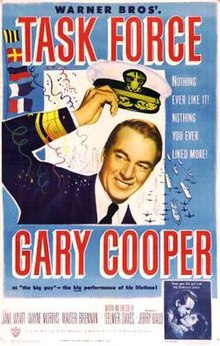
Task Force
All those things were bouncing around in my head as I watched 1949's Task Force this week. It tells the partial story of the development of carriers in the Navy and their involvement with pilots and aviation to advance the Navy's capabilities. They started off as basically sailing airfields on the oceans where rickety planes could land when necessary and developed into immense, very necessary war machines by World War II. A character mentions early on that when trying to land on the flat top of a carrier deck it looks a lot like a tombstone with your name on it, the ship bucking and rolling with the sea. The movie is certainly informative about the subject, but it's missing something, and I wish I could give it a higher rating.
As a young pilot in the Navy, Jonathan Scott (Gary Cooper) is among the first pilots to be trained in carrier landings. Through all the difficulty in this extremely dangerous training, he sees the benefits of a plane being able to land on a ship as it sails across the ocean, and the Navy has a convert. The higher-ups in the Navy don't see the benefit a carrier would have weighed against the huge costs and risks involved. With help from his commanding officer, Capt. Pete Richard (Walter Brennan), Scott continues to work toward the development of carrier task forces in the U.S. Navy, often causing ripples when he should sit back and shut up. Aided on the home front by his wife, Mary (Jane Wyatt), Scott continues on as the Navy continues to develop, unknowingly working toward the coming conflict in WWII where carriers will play a key role in the Pacific theater.
I'll say this first so no one accuses me of hating America or anything similar, but I do like Gary Cooper. I don't love him though. So many of his parts are so bland, so vanilla, that I don't consider myself a huge fan of his. I've never avoided a movie of his because I saw his name and thought 'Hey, that guy sucks!' but at the same time I don't always seek him out. His part here as Capt. Jonathan Scott falls somewhere in the middle of the movies I've seen with him. It's not a particularly lively performance, and he comes across as a bit too whiny for my liking. He has some good interactions with Brennan (solid as ever) and his marriage with Wyatt's Mary doesn't feel as out of place as so many other armed forces marriages in movies, but something's just missing overall in the movie, and that's not a criticism of Cooper or his acting.
All I can wrap my head around is that this movie is basically a documentary about the history of the Navy carrier, but instead of a voiceover provided we get actors stepping into the roles. If anything, Cooper's part is the tour guide, navigating the viewer through this story. He does provide a voiceover of how things are changing for the Navy, but it becomes tedious. If I wanted to watch a history of the U.S. Navy, I'd turn on the History Channel and get caught up with a better made documentary about the subject. As is typical with these movies, a title card thanks the Navy for all their help in making the movie, and cynical guy that I am I couldn't wonder how much control the government and the armed forces had in what the story did and didn't cover. As for Cooper's part, it's a lose-lose battle for him in a part that could have been filled by any cookie-cutter actor.
What saves the movie late is the depiction of the Navy in the days, weeks and months following the sneak attack on Pearl Harbor December 7th, 1941. Pearl Harbor and the battle of Midway are both covered in detail in the movie's last 45 minutes. The problem is though that no matter how good these segments are, there are whole movies devoted to these stories (1976's Midway is a personal favorite) that cover the subject better. Still, that's not a fair criticism of Task Force because director Delmer Daves is doing what he can with what's in front of him. It's easy to forget now some 70 years later, but the course of the war changed at Midway, and if the U.S. had lost that battle WWII might have gone a very different route. As Brennan's character explains, 'The west coast better be ready to fight on the beaches.' One of the darker times in American history, and one where the armed forces came through in a must-win situation.
This isn't a bad movie at all, it's just not a great movie either. It certainly has some potential with an interesting story, but it focuses on trying to tell too big of a story instead of keying in on the most interesting parts of the story. The movie on the whole lacks any real heart, any reason for us to get invested with the story and its characters. It is informative but not very exciting in getting its info out. Worth watching for WWII buffs probably.
Task Force <---trailer (1949): ** 1/2 /****
Labels:
1940s,
Delmer Daves,
Gary Cooper,
Walter Brennan,
WWII
Monday, December 27, 2010
True Grit (2010)
My usual stance on remakes is why bother remaking a good movie? There's hundreds and thousands of bad movies made over the years that would benefit from a do-over. So with that idea, I was both excited and skeptical when I heard the news that the Coen brothers were remaking the 1969 western True Grit. It's a solid western best known for John Wayne's performance, one that earned him the only Oscar of his already impressive career. I love westerns, but this was one -- even with its flaws -- that really didn't need to be remade. Well, my curiosity got the best of me, and all suspicions aside I did want to see this 2010's True Grit.
Joel and Ethan Coen have shown a knack for making great movies out of the simplest ideas. With the talent involved and a strong source novel to work off of by Charles Portis, it would be hard for such two talented directors to mess this up. I read all the reviews and the on-set reports when the movie was being filmed. The remake would stick closer to the period appropriate dialogue of the novel and not the 1969 version, it would have little of the comedy Coen fans have come to expect, and most of all it would be consistently period authentic. I was more skeptical because the trailer looked to mimic the movie, not the book. And what did I take away? It's a completely unnecessary remake of a movie, but an entertaining and well-made (if a little cold) remake.
After her father was murdered by a hired hand, Tom Chaney (Josh Brolin), 14-year old Mattie Ross (Hailee Steinfeld) travels to Fort Smith, Arkansas to pick up her father's body. Of course, she has some other plans. Chaney rode out of town after the murder and disappeared into the Indian Territory, but no law intends to follow him. Mattie hires a fat, one-eyed drunk of a U.S. Marshal with a hard-earned reputation, Ruben 'Rooster' Cogburn (Jeff Bridges), to bring Chaney to justice so he can hang for what he did. A Texas Ranger, LaBoeuf (Matt Damon), is also on Chaney's trail and decides to tag along with Cogburn who inteds to leave the strong-willed Mattie behind. Mattie has other ideas, joining them on the trail as they head into the territory after her father's killer.
Starting with the claims that the Coens insisted on period accuracy, well, it's spot on. The dialogue sounds like conversations someone would have had in the late 1860s and early 1870s in Arkanas and Oklahoma, a tribute to Portis' source novel. The pitch, sound and even the give and take of the dialogue sound more authentic than just about any other western I've seen. That's the whole movie, authentic down to the smallest details. The west was a nasty place where men would spend days and weeks on the trail without a chance at a bath or a soft bed. That lack of niceties reflects on how they looked as you'll see in the movie. Everything from the clothes to the hats to the guns and firearms is real. This is no glamorized look at what the romantic wild west was like. This was a time where only the tough survived because if you weren't, you'd be dead in minutes.
If you're going to hire an actor to play a role that many consider to be among John Wayne's best, you had better choose someone who is up to the task. Wisely, Jeff Bridges does not play Rooster Cogburn like Wayne did, putting his own spin on this already well-known character. Yes, the basics are there, the ratty eye-patch, the constant drinking, the unkempt look. Bridges still manages to make Rooster endearing through all his flaws and faults with an honesty and a code of honor that's helped him survive several years working as a U.S. Marshal. He isn't a particularly heroic man, but he does what's necessary to get the job done, principles be damned. Bridges is one of my favorite actors, and I'm glad he was given a chance to play a role like this. Immediately talk of Oscar buzz started around his performance. I don't know if it's Oscar worthy, but with a part that could have blown up in his face, he made it his own.
One of the biggest flaws of the 1969 True Grit is the casting of the Mattie and LaBoeuf characters, but here the casting of those two integral parts is a strong point of the movie. Young 14-year old Steinfeld is a scene-stealer as strong-willed, downright stubborn Mattie Ross. She intends to see her father's killer brought to justice, and nothing is going to stop her. Every so often, a glimmer of the fact that she's still a kid shines through, including one early campfire scene. More than that though, what works so well is her ease in scenes with such accomplished actors. She has a great chemistry with Bridges especially and shares a great scene with Damon late in the movie. As for Damon as the Texas Ranger, he too puts his own unique spin on the part. He's got a twang to his voice and provides a suitable counter to Cogburn's drunken antics. Brolin's part as Tom Chaney amounts to an extended cameo, and also look for the underrated Barry Pepper as Lucky Ned Pepper, the leader of the gang Chaney signs on with.
So what's missing from the movie? I've thought about it, and just can't come up with anything. I read Portis' novel years ago and don't remember it making much of an impression on me so I can't say if the tone is dead-on. It's a beautiful movie, starkly filmed in Texas with Carter Burwell's period-appropriate score playing in the background. The story can be a little slow getting where it wants, but even then it's about 20 minutes shorter than the 1969 version. There isn't much in the way of action, but when it comes around, it's startling and violent although not as graphic as other Coen brothers movies. Some major things have changed -- including one key character's demise and another surprising twist in an epilogue -- but for the better. The ending (like much of the movie overall) left me cold even considering it is scary in how appropriate it is for both the characters involved and the story overall.
Now no matter how good the 2010 version is it's impossible not to compare it to the 1969 version which I'm planning on reviewing in a week or so. My biggest question is the iconic scene where Cogburn charges across a field, reins in his teeth, a six-shooter in either hand at Pepper's gang with the famous line 'Fill your hands, you son of a bitch!' Thankfully Bridges and Co. nail the scene and the following fall-out. So how do I rate this movie? I liked it but didn't love it. It's nothing particularly new, but it is a good old-fashioned western story, good guys vs. bad guys. It is completely unnecessary, but I liked it in the end because of the immense talents involved in making it.
True Grit <---trailer (2010): ***/****
Joel and Ethan Coen have shown a knack for making great movies out of the simplest ideas. With the talent involved and a strong source novel to work off of by Charles Portis, it would be hard for such two talented directors to mess this up. I read all the reviews and the on-set reports when the movie was being filmed. The remake would stick closer to the period appropriate dialogue of the novel and not the 1969 version, it would have little of the comedy Coen fans have come to expect, and most of all it would be consistently period authentic. I was more skeptical because the trailer looked to mimic the movie, not the book. And what did I take away? It's a completely unnecessary remake of a movie, but an entertaining and well-made (if a little cold) remake.
After her father was murdered by a hired hand, Tom Chaney (Josh Brolin), 14-year old Mattie Ross (Hailee Steinfeld) travels to Fort Smith, Arkansas to pick up her father's body. Of course, she has some other plans. Chaney rode out of town after the murder and disappeared into the Indian Territory, but no law intends to follow him. Mattie hires a fat, one-eyed drunk of a U.S. Marshal with a hard-earned reputation, Ruben 'Rooster' Cogburn (Jeff Bridges), to bring Chaney to justice so he can hang for what he did. A Texas Ranger, LaBoeuf (Matt Damon), is also on Chaney's trail and decides to tag along with Cogburn who inteds to leave the strong-willed Mattie behind. Mattie has other ideas, joining them on the trail as they head into the territory after her father's killer.
Starting with the claims that the Coens insisted on period accuracy, well, it's spot on. The dialogue sounds like conversations someone would have had in the late 1860s and early 1870s in Arkanas and Oklahoma, a tribute to Portis' source novel. The pitch, sound and even the give and take of the dialogue sound more authentic than just about any other western I've seen. That's the whole movie, authentic down to the smallest details. The west was a nasty place where men would spend days and weeks on the trail without a chance at a bath or a soft bed. That lack of niceties reflects on how they looked as you'll see in the movie. Everything from the clothes to the hats to the guns and firearms is real. This is no glamorized look at what the romantic wild west was like. This was a time where only the tough survived because if you weren't, you'd be dead in minutes.
If you're going to hire an actor to play a role that many consider to be among John Wayne's best, you had better choose someone who is up to the task. Wisely, Jeff Bridges does not play Rooster Cogburn like Wayne did, putting his own spin on this already well-known character. Yes, the basics are there, the ratty eye-patch, the constant drinking, the unkempt look. Bridges still manages to make Rooster endearing through all his flaws and faults with an honesty and a code of honor that's helped him survive several years working as a U.S. Marshal. He isn't a particularly heroic man, but he does what's necessary to get the job done, principles be damned. Bridges is one of my favorite actors, and I'm glad he was given a chance to play a role like this. Immediately talk of Oscar buzz started around his performance. I don't know if it's Oscar worthy, but with a part that could have blown up in his face, he made it his own.
One of the biggest flaws of the 1969 True Grit is the casting of the Mattie and LaBoeuf characters, but here the casting of those two integral parts is a strong point of the movie. Young 14-year old Steinfeld is a scene-stealer as strong-willed, downright stubborn Mattie Ross. She intends to see her father's killer brought to justice, and nothing is going to stop her. Every so often, a glimmer of the fact that she's still a kid shines through, including one early campfire scene. More than that though, what works so well is her ease in scenes with such accomplished actors. She has a great chemistry with Bridges especially and shares a great scene with Damon late in the movie. As for Damon as the Texas Ranger, he too puts his own unique spin on the part. He's got a twang to his voice and provides a suitable counter to Cogburn's drunken antics. Brolin's part as Tom Chaney amounts to an extended cameo, and also look for the underrated Barry Pepper as Lucky Ned Pepper, the leader of the gang Chaney signs on with.
So what's missing from the movie? I've thought about it, and just can't come up with anything. I read Portis' novel years ago and don't remember it making much of an impression on me so I can't say if the tone is dead-on. It's a beautiful movie, starkly filmed in Texas with Carter Burwell's period-appropriate score playing in the background. The story can be a little slow getting where it wants, but even then it's about 20 minutes shorter than the 1969 version. There isn't much in the way of action, but when it comes around, it's startling and violent although not as graphic as other Coen brothers movies. Some major things have changed -- including one key character's demise and another surprising twist in an epilogue -- but for the better. The ending (like much of the movie overall) left me cold even considering it is scary in how appropriate it is for both the characters involved and the story overall.
Now no matter how good the 2010 version is it's impossible not to compare it to the 1969 version which I'm planning on reviewing in a week or so. My biggest question is the iconic scene where Cogburn charges across a field, reins in his teeth, a six-shooter in either hand at Pepper's gang with the famous line 'Fill your hands, you son of a bitch!' Thankfully Bridges and Co. nail the scene and the following fall-out. So how do I rate this movie? I liked it but didn't love it. It's nothing particularly new, but it is a good old-fashioned western story, good guys vs. bad guys. It is completely unnecessary, but I liked it in the end because of the immense talents involved in making it.
True Grit <---trailer (2010): ***/****
Labels:
2010s,
Barry Pepper,
Coen Brothers,
Hailee Steinfeld,
Jeff Bridges,
Josh Brolin,
Matt Damon,
westerns
Sunday, December 26, 2010
The Keys of the Kingdom
Some actors toil away for years trying to make it big in Hollywood. All they’re looking for is that one big shot to step into the limelight. Others don’t spend much time at all on the climb up the ladder. In 1944, Gregory Peck made his debut in two movies featuring two great roles. In just his second movie overall, 1944’s The Keys of the Kingdom, he made such a positive impression that he earned an Oscar nomination for Best Actor. He didn’t win the award, but he surely deserved it.
The background of the movie is a sign of the times in the 1940s and early 1950s as studios made big budget stories about historical figures involved with religion, faith, and personal beliefs. Name a prominent historical figure with some involvement in religion over the years and chances are you can find a film from a major studio made about them. As a person who doesn't have much use for organized religion, I usually try to steer clear of these movies as they shove some sort of rhetoric down your throat. Thankfully, this one didn't do that, instead just focusing on the story of one man and his struggles and triumphs through his faith and personal beliefs.
After graduating from the Catholic college he's attending, Francis Chisolm (Peck) has no intention of continuing on to becoming a priest, but when something from his personal life changes his outlook on things, he opts for the priesthood. From the start though, he questions if he's right for it and struggles in his first two years. A bishop (Edmund Gwenn) who knows him well recommends him for a position in China where a Catholic priest is needed to start up a mission that has failed in the past. Francis agrees to take the position and uproots himself to China where his work is cut out for him. Upon arriving, he receives help from one of the few remaining converts, Joseph (Benson Fong), the young priest starts the work of building the mission and gaining converts who genuinely believe, not just because they're looking for food or shelter.
The story here is rare in that it covers over 40 years in Francis' life, but it never seems or feels rushed. The important moments in his life and his struggles as a Catholic priest working as a missionary in China are all covered and given due course. We see him in his ups and downs, his good and bad, the people he meets and who affect his life as much as he does theirs. It is filmed in black and white -- I don't know how color would have worked here -- and the producers clearly spared no expense. The mission set is ridiculously cool, and in general all the main sets are extravagant and textured. They don't just look like wooden planks painted and propped up behind the actors. Story and sets together, quite a combination here. It seems obvious, but I'm always surprised how many movies take that for granted.
In just his second movie, Peck shows off an acting ability that would help catapult him to stardom. Later in his career, he would gain a reputation as being somewhat stiff on-screen, playing the same character repeatedly with his strong, deep voice and commanding presence. I like Peck in just about everything he's done and can usually see past those criticisms, but I thought I should point them out. Here, none of that's a problem. His Francis is a lively, passionate man trying to do what he believes is right in an extremely difficult situation. He's driven to do that at all costs no matter how difficult, willing to sacrifice for his converts who have come to trust him because of his actions and beliefs. The character reminded me of a younger Atticus Finch, and that's never a bad thing.
This was Peck's movie from the start, but he is supported very capably by a cast full of studio players. Thomas Mitchell plays Willie Tulloch, Francis' best friend back home, a doctor who is proud of his atheist beliefs. You can see why Willie and Francis are friends, they bond through their differences, neither man trying to convince the other of their convictions. Vincent Price is Angus Mealey, Francis' childhood friend and fellow priest who is on a different road, a route where he climbs the ladder quickly in the church. It's a good comparison to see the vast differences in the two men. Rose Stradner is a scene-stealer as Reverend Mother Maria-Veronica, a sister who struggles with her faith at times and how easily it comes to Francis. She has a very moving, touching scene at the end of the movie that's worth watching on its own. Also look for Roddy McDowall playing a young Francis, Cedric Hardwicke as a bishop in bookends of the movie questioning if Francis should be forcibly retired, and Leonard Strong as Mr. Chia, an opposing force of Francis' who ends up becoming fast friends with him.
I was surprised by how much I liked this movie. It doesn't try too hard delivering its message, a credit to the strengths of the cast who play the movie straight. There's no hamming it up for the camera or speechifying at awkward moments. The Chinese are not stereotyped like so many other movies do. They're not shifty Asians capable of horrible things, and they're not ignorant peasants who must be taught how to do everything. They're just people looking for something different in life. Above all else though, watch this for Gregory Peck. You won't be disappointed in the 28-year old actor's secondary debut.
The Keys of the Kingdom <---trailer (1944): *** 1/2 /****
After graduating from the Catholic college he's attending, Francis Chisolm (Peck) has no intention of continuing on to becoming a priest, but when something from his personal life changes his outlook on things, he opts for the priesthood. From the start though, he questions if he's right for it and struggles in his first two years. A bishop (Edmund Gwenn) who knows him well recommends him for a position in China where a Catholic priest is needed to start up a mission that has failed in the past. Francis agrees to take the position and uproots himself to China where his work is cut out for him. Upon arriving, he receives help from one of the few remaining converts, Joseph (Benson Fong), the young priest starts the work of building the mission and gaining converts who genuinely believe, not just because they're looking for food or shelter.
The story here is rare in that it covers over 40 years in Francis' life, but it never seems or feels rushed. The important moments in his life and his struggles as a Catholic priest working as a missionary in China are all covered and given due course. We see him in his ups and downs, his good and bad, the people he meets and who affect his life as much as he does theirs. It is filmed in black and white -- I don't know how color would have worked here -- and the producers clearly spared no expense. The mission set is ridiculously cool, and in general all the main sets are extravagant and textured. They don't just look like wooden planks painted and propped up behind the actors. Story and sets together, quite a combination here. It seems obvious, but I'm always surprised how many movies take that for granted.
In just his second movie, Peck shows off an acting ability that would help catapult him to stardom. Later in his career, he would gain a reputation as being somewhat stiff on-screen, playing the same character repeatedly with his strong, deep voice and commanding presence. I like Peck in just about everything he's done and can usually see past those criticisms, but I thought I should point them out. Here, none of that's a problem. His Francis is a lively, passionate man trying to do what he believes is right in an extremely difficult situation. He's driven to do that at all costs no matter how difficult, willing to sacrifice for his converts who have come to trust him because of his actions and beliefs. The character reminded me of a younger Atticus Finch, and that's never a bad thing.
This was Peck's movie from the start, but he is supported very capably by a cast full of studio players. Thomas Mitchell plays Willie Tulloch, Francis' best friend back home, a doctor who is proud of his atheist beliefs. You can see why Willie and Francis are friends, they bond through their differences, neither man trying to convince the other of their convictions. Vincent Price is Angus Mealey, Francis' childhood friend and fellow priest who is on a different road, a route where he climbs the ladder quickly in the church. It's a good comparison to see the vast differences in the two men. Rose Stradner is a scene-stealer as Reverend Mother Maria-Veronica, a sister who struggles with her faith at times and how easily it comes to Francis. She has a very moving, touching scene at the end of the movie that's worth watching on its own. Also look for Roddy McDowall playing a young Francis, Cedric Hardwicke as a bishop in bookends of the movie questioning if Francis should be forcibly retired, and Leonard Strong as Mr. Chia, an opposing force of Francis' who ends up becoming fast friends with him.
I was surprised by how much I liked this movie. It doesn't try too hard delivering its message, a credit to the strengths of the cast who play the movie straight. There's no hamming it up for the camera or speechifying at awkward moments. The Chinese are not stereotyped like so many other movies do. They're not shifty Asians capable of horrible things, and they're not ignorant peasants who must be taught how to do everything. They're just people looking for something different in life. Above all else though, watch this for Gregory Peck. You won't be disappointed in the 28-year old actor's secondary debut.
The Keys of the Kingdom <---trailer (1944): *** 1/2 /****
Labels:
1940s,
Gregory Peck,
Roddy McDowall,
Thomas Mitchell,
Vincent Price
Saturday, December 25, 2010
Three Came Home
With all the World War II movies I’ve seen, some of my favorites have been prisoner of war stories. My favorite all-time movie is The Great Escape, but there’s also Bridge on the River Kwai, Stalag 17, and King Rat among others. They all share a common link though beyond just P.O.W.’s, and that’s that all the prisoners are males. Well, not all of them, like 1950’s Three Came Home.
Time to hit all you loyal readers with a history lesson. Regardless of who was your captor during World War II, the experience was no doubt a hellish one. But it was a relative hell if that makes any sense. Germany signed the Geneva Convention which listed certain requirements for the treatment of prisoners. The United States and many other countries also signed FYI. One country that didn’t? Good old Japan, basically giving the Japanese free reign to treat prisoners however they so chose. Add in the cultural belief that to be taken prisoner was a slight on who you were as a person, and prisoners of war in Japanese POW camps were a step far below most other experiences. And if you were a woman? God help you.
It’s 1941 in Borneo and American writer Agnes Newton Keith (Claudette Colbert) lives peacefully with her husband Harry (Patric Knowles) and 4-year old son, George (Mark Keuning). The Japanese are advancing though, and Borneo is on their path to dominance. It’s not long before they arrive, throwing all British and American civilians into prison camps throughout the countryside. Agnes and George are separated from Harry and thrown into a different camp that while unpleasant is not under the worst conditions. It’s not long before all the surviving prisoners are moved to a harsher camp where survival is that much more difficult. Through it all though, Agnes wants to survive and be reunited with her family as a whole.
Just the other day I reviewed a WWII movie heavy on the propaganda in 1943’s Air Force. What can be hard to distinguish when dealing with propaganda movies is the enemy side and their portrayal. Now by all accounts, the Japanese and their war crimes didn’t need to be exaggerated. Whether in battle or in their treatment of prisoners, the Japanese were brutal both in victory or defeat. Prisoners captured in the heat of battle were often brutally slaughtered, and those unlucky enough to survive getting to the prison camps lived in horrific conditions with little to no medical treatment and less in the way of food and clothes. That’s not to say there weren’t war crimes committed by all sides, but the Japanese were almost certainly the worst. So translate this to movies released in 1950s, the portrayals were often toned-down, not showing what the actual experience was like.
I guess that was my issue with Three Came Home, a solid movie that never rises to anything on a special level. Yes, the experiences these men and women went through were horrific, but mostly we hear how bad all these things are without actually seeing them. Besides one incident where a Japanese guard tries to rape her, Colbert’s Agnes doesn’t experience anything worse than the mystery of whether her husband has survived. Food is limited, and living conditions are obviously leave something to be desired, but as a viewer you never get a real sense of how bad life in a prison camp as a woman really was. Is that the fault of the censors, or did the screenplay just not show the P.O.W. experience and how horrific it was?
Going into this movie, my only other experience (a good one at that) with Colbert was Drums Along the Mohawk. Well, I’ve now seen two good parts for the lovely Claudette Colbert. This isn’t the portrayal of a gung-ho mother trying to take the war back at the Japanese. In fact, the actual war is an afterthought here, seeming like a long way away from the conflict at hand. This is a woman pulled away from the life she loves, now reduced to just surviving and making sure her young son has everything he needs so that can he survive and grow up to. All the while, she goes forward with the hope and not the knowledge that her husband is somehow doing the same, surviving through all the hell in front of him.
With a link to another classic POW movie, The Bridge on the River Kwai, is Sessue Hayakawa as the regional commandant of all the prison camps. This is a very humane portrayal of a man that in many other movies would have been demonized. In River Kwai, his Colonel Saito is a fair and balanced portrayal of a man under pressure. The same goes here, a commander in an uncompromising situation trying to make the best of it, and for everyone, not just him and his men. But overall – even considering the time it was released in – I would have made a harsher movie, one that dug deeper into the prisoner of war experience. Still, it's a good movie, and one you can watch at Youtube HERE.
Labels:
1950s,
Claudette Colbert,
Prisoners of War,
Sessue Hayakawa,
WWII
Friday, December 24, 2010
Das Boot
About a month and a half ago, I reviewed The Enemy Below and while I enjoyed it, I liked it more as a realistic look at submarine warfare as opposed to having any real interest in the characters or the story. Well, I thought that 1950s war movie was a realistic look at submarine warfare, but compared to the movie I’m about to review, we’re talking a whitewashed, children’s look at the wars under the waters. Some 20 years later first made as a six-part German miniseries and later turned into a feature-length film for a U.S. release, 1981’s Das Boot.
Reviewing enough war movies, you’re going to watch some that are told from the perspective of a soldier/sailor/civilian/politician different from your own nationality. For the most part, I’ve watched American-made war movies told from the American perspective. On a simple level, I’m rooting for the American soldier to win in the end, beating the Germans or the Japanese, whoever the enemy is in front of them. So with a story that follows a patrol of a German U-boat in 1941, am I rooting for the Germans against British troops and sailors? Surprisingly enough, it isn’t an issue with this classic film. This isn’t a movie about nationalities or who’s right and who’s wrong. It is a story and depiction of men and the horrific impact war has on everyone it touches.
It’s 1941, and Germany has been at war for two-plus years already. Hitler’s U-boat fleet is meeting defeats on a grand scale for the first time as the British Navy figures out how to not only defend themselves but hunt down the dangerous boats. A veteran captain (Jurgen Prochnow) has been given command of a new U-boat – U-96 – with a young, inexperienced crew working under him. A correspondent, Lt. Werner (NAME), has been assigned to the captain’s ship to document the lives and trials of these heroic German soldiers. So tagging along, the U-96 leaves port and heads for open water to join in on the hunt for British and Allied convoys in the North Atlantic.
If you were ever curious as to what life on a WWII-era submarine was like, this is the movie for you. Director Wolfgang Petersen films this epic story in the cramped, extremely claustrophobic gangways of the submarine, his cameras filming right alongside the German crew, not outside like a passing onlooker. You are THERE with this crew. We see the overcrowded living quarters of the crew, the food supplies hanging wherever there is room, the lone toilet for the whole ship, all the little things that WWII sub movies often overlook. There are asides where some of the crew leaves the ship, or the sub surfaces and skims across the water, but a majority of the movie is set within the sub. By the end of the movie, I felt uncomfortable just for having watched the movie. Actually living in a submarine for weeks and even months at a time? I’ll take a pass on that.
Some of the best war movies don’t glamorize what war is really like. The best description I’ve ever heard about the life of a soldier is ‘long periods of extreme boredom shattered by moments of pure terror.’ That is the tone of the movie. U-96 patrols and patrols looking for targets unsuccessfully, actually almost colliding with another U-boat before even seeing an enemy ship. They hear reports of other ships finding British convoys and successfully sinking tons of ships, but meanwhile they keep on just looking for targets.
No aspect of any war ever seems really intelligent, but submarine warfare in WWII seems stupider than most other aspects of war somehow. A ship that sails under the water sneaks up on large groups of ships, fires a handful of torpedoes hoping to sink a ship or two, and then hauls ass to get out of there before a protective escort of ships with heavier firepower hunt you down and try and blow you to hell with depth charges. What I took away from this movie is that, the pure and extreme terror that overtakes the individual as they possibly await their death. Hundreds of feet below the surface submarine crews can’t run because the ships above can make more speed than them. Those ships fire depth charges into the water that are triggered to explode at a certain depth, possibly ripping the submarine apart. The best segments of Das Boot document this, silence broken by explosions that hit like punches to your midsection. The tension is everywhere, and it’s executed so well you feel butterflies in your stomach.
So it’s realistic, incredibly unsettling, and very professionally done. What’s wrong with this movie? Originally it was a 6-hour miniseries, but the DVD version clocks in at 209 minutes. As good as the movie is, at times it is a very long 209 minutes. In illustrating the life of boredom these sailors live, Petersen pushes too far at times. I was bored watching them be bored. I would have used these scenes to give some more background on the captain (Prochnow does deliver an amazing performance) and his crew. We’re interested more in the danger of the situation than the characters and what’s happening to them. Give us a personal reason to get invested in the movie, and the quality improves. Who knows though, maybe that wasn’t Petersen’s intention. No matter his intention or my complaints, it’s still an incredible look at submarine warfare in WWII.
Das Boot <--- trailer (1981): ***/****
Thursday, December 23, 2010
Too Bad She's Bad
So I like movies with shootouts, car chases, and some sort of raunchy humor. Okay, it's not that simple, but those three things always help. Guys like certain movies and hate others the same way women like some types of movies and despise others. One genre of films that stereotypically lean more toward a female audience is the romantic comedy. It's fair to say that many of the movies I like can be pretty cookie-cutter, but I use that as a criticism here of romantic comedies which seem to churn out the same old story in new packaging every couple of weeks. That's not to say they're all bad, but I'll admit to not seeking them out too often.
One that I came across thanks to TCM's weekly foreign imports feature (TCM Imports) was 1954's Too Bad She's Bad, an Italian romantic comedy with a bit of slapstick and screwball laughs thrown in too. Maybe because it's a foreign comedy -- and to call it a straight comedy isn't fair -- I look at it differently, but thanks to some strong casting and a type of humor that doesn't overdo it, I enjoyed it. If nothing else, it's different. It isn't a cookie-cutter story of some ridiculously hot 30-year old woman who can't find a man, or an eccentric middle-aged man who finds his true love who can see past his oddness. Although SPOILER ALERT the girl gets the guy, or is it the guy gets the girl? Eh, not important. It's a good movie.
Spending years saving up enough so he can invest in his own taxi cab, cabbie Paolo (Marcello Mastroianni) takes a far for two young men and a pretty girl, Lina (Sophia Loren), who want to drive from Rome to Anzio to spend a day at the beach. Paolo isn't aware the trio plans to steal his cab and leave him stranded but quickly finds out, foiling their plan. The two men get away and Lina slips away in the traffic when he tries to take her to the police station. Paolo can't afford the damages and starts to look for any of the three with Lina popping up repeatedly on his path. Just looking for some cash though, he gets deeper and deeper into a web of thieves with Lina's family all taking a shine to him. Worse than that? Through all the craziness, Paolo realizes he likes Lina too.
Now for starters, any movie that was filmed in Rome in the early 1950s is going to get at least a passing grade from me. It's post-war Rome following WWII and is as beautiful and romantic a European city as I can think (okay, maybe Paris). Director Alessandro Blasetti films much of his movie on the streets of Rome and with the exception of the Coliseum doesn't use any easily recognizable locations. He shoots on the streets with the people, giving us a view of early 1950s Rome that only exists in pictures. Alessandro Cicognini's musical score not surprisingly relies on Italian music to set the stage but never goes overboard. My only complaint is that the English subtitles are in white letters, making it difficult to read at times against Blasetti's black and white camerawork. I never missed anything major but did find myself focusing more than usual on the subtitles just trying to keep up.
So you're casting a female part that requires the character to be so downright beautiful and charming that no matter how many unpleasant situations she gets you in the guy still wants to be around her. If there was ever a part built for Sophia Loren this is it. Just 20 years old at the time, Loren had already been in over 15 movies with parts ranging from small supporting parts to bigger roles like this. Looks aside, she shows off some great comedic chops and impeccable timing as we get to know her Lina character. Her thieving ways continue to get her into trouble, but there's not a situation created yet Lina can't talk her way out of. My only complaint comes from a certain trend/style of the time...hairy armpits on a woman. Loren is drop dead gorgeous, but there's not a woman alive that look works for.
Two male parts balance out Loren, one holding a slight edge over the other. Mastroianni's incredibly gullible, even naive Paolo is too clueless for words at times. Duped on repeated occasions by the lovely Lina, he continues to believe everything she tells him. He has a knack for physical humor with some cliched mannerisms and reactions of a fiery Italian man, but he produces laughs, not groans with his actions. The part I liked more was Lina's father, Vittorio, played by Italian director and star Vittorio De Sica. He raised a family of thieves that supports itself by selling anything valuable they steal with Lina his protege with the most talent. Vittorio is smooth as silk, convincing you that what he's stealing means nothing, almost like he's helping you out. It's clear from watching him where Lina got her talent for some truly underhanded things, but they're so charming and likable you don't even notice.
Where does that leave us? Ah, the ending, quite a mix of so many things with not all of them working. A scene in a police station is played for some genuine laughs that goes on too long, leading to a bit of domestic violence leading to marriage. It makes sense, don't you think? An odd ending for sure to an otherwise enjoyable (whudda thunk it?) 1950s Italian romantic comedy.
Too Bad She's Bad <---low quality Youtube clip (1954): ***/****
One that I came across thanks to TCM's weekly foreign imports feature (TCM Imports) was 1954's Too Bad She's Bad, an Italian romantic comedy with a bit of slapstick and screwball laughs thrown in too. Maybe because it's a foreign comedy -- and to call it a straight comedy isn't fair -- I look at it differently, but thanks to some strong casting and a type of humor that doesn't overdo it, I enjoyed it. If nothing else, it's different. It isn't a cookie-cutter story of some ridiculously hot 30-year old woman who can't find a man, or an eccentric middle-aged man who finds his true love who can see past his oddness. Although SPOILER ALERT the girl gets the guy, or is it the guy gets the girl? Eh, not important. It's a good movie.
Spending years saving up enough so he can invest in his own taxi cab, cabbie Paolo (Marcello Mastroianni) takes a far for two young men and a pretty girl, Lina (Sophia Loren), who want to drive from Rome to Anzio to spend a day at the beach. Paolo isn't aware the trio plans to steal his cab and leave him stranded but quickly finds out, foiling their plan. The two men get away and Lina slips away in the traffic when he tries to take her to the police station. Paolo can't afford the damages and starts to look for any of the three with Lina popping up repeatedly on his path. Just looking for some cash though, he gets deeper and deeper into a web of thieves with Lina's family all taking a shine to him. Worse than that? Through all the craziness, Paolo realizes he likes Lina too.
Now for starters, any movie that was filmed in Rome in the early 1950s is going to get at least a passing grade from me. It's post-war Rome following WWII and is as beautiful and romantic a European city as I can think (okay, maybe Paris). Director Alessandro Blasetti films much of his movie on the streets of Rome and with the exception of the Coliseum doesn't use any easily recognizable locations. He shoots on the streets with the people, giving us a view of early 1950s Rome that only exists in pictures. Alessandro Cicognini's musical score not surprisingly relies on Italian music to set the stage but never goes overboard. My only complaint is that the English subtitles are in white letters, making it difficult to read at times against Blasetti's black and white camerawork. I never missed anything major but did find myself focusing more than usual on the subtitles just trying to keep up.
So you're casting a female part that requires the character to be so downright beautiful and charming that no matter how many unpleasant situations she gets you in the guy still wants to be around her. If there was ever a part built for Sophia Loren this is it. Just 20 years old at the time, Loren had already been in over 15 movies with parts ranging from small supporting parts to bigger roles like this. Looks aside, she shows off some great comedic chops and impeccable timing as we get to know her Lina character. Her thieving ways continue to get her into trouble, but there's not a situation created yet Lina can't talk her way out of. My only complaint comes from a certain trend/style of the time...hairy armpits on a woman. Loren is drop dead gorgeous, but there's not a woman alive that look works for.
Two male parts balance out Loren, one holding a slight edge over the other. Mastroianni's incredibly gullible, even naive Paolo is too clueless for words at times. Duped on repeated occasions by the lovely Lina, he continues to believe everything she tells him. He has a knack for physical humor with some cliched mannerisms and reactions of a fiery Italian man, but he produces laughs, not groans with his actions. The part I liked more was Lina's father, Vittorio, played by Italian director and star Vittorio De Sica. He raised a family of thieves that supports itself by selling anything valuable they steal with Lina his protege with the most talent. Vittorio is smooth as silk, convincing you that what he's stealing means nothing, almost like he's helping you out. It's clear from watching him where Lina got her talent for some truly underhanded things, but they're so charming and likable you don't even notice.
Where does that leave us? Ah, the ending, quite a mix of so many things with not all of them working. A scene in a police station is played for some genuine laughs that goes on too long, leading to a bit of domestic violence leading to marriage. It makes sense, don't you think? An odd ending for sure to an otherwise enjoyable (whudda thunk it?) 1950s Italian romantic comedy.
Too Bad She's Bad <---low quality Youtube clip (1954): ***/****
Labels:
1950s,
Italian cinema,
Sophia Loren,
Vittorio De Sica
Tuesday, December 21, 2010
The Blue Dahlia
Many movies made about the Vietnam War don’t focus in on the actual conflict that went on in Vietnam in the 1960s and 1970s, but instead key in on what happens to the soldiers when they return home, how the war has affected them in ways not previously thought of. War has an impact on the soldiers involved no matter the conflict or what century it took place, but Vietnam was the first where the public was aware of these issues. A WWII movie, The Best Years of Our Lives, dealt with this pertaining to World War II veterans returning home. A film noir released in 1946, The Blue Dahlia, has three main characters returning to the United States, all dealing with the return in their own way.
When I first read about this movie at Turner Classic Movie’s website, I assumed it was related to ‘The Black Dahlia,’ the Hollywood flop from five or six years ago that was forgotten almost as soon as it was released in theaters to critical panning. Well, other than the use of ‘Dahlia’ in the title, there is no common link. Blue Dahlia is a solid, well-made film noir about a murder mystery in the Los Angeles club scene where everyone is shady and willing to backstab anyone else for their own gain. It isn’t held in as high regard as many other noir classics, but it is a very solid entry into a very deep genre of movies in film noir.
Returning to the States after receiving a medical discharge, former Navy pilot John Morrison (Alan Ladd) can’t wait to get home and see his wife, Helen (Doris Dowling). He finds something else though waiting for him as his wife has adopted a new partying lifestyle, including starting a relationship with slippery club owner, Eddie Harwood (Howard Da Silva). Morrison’s wife has a dark secret she reveals to John, sending him into a fit of rage that even has him thinking about killing her. Instead, he walks out on her, leaving his past life behind. The next morning though John hears radio reports that his wife has been murdered, and he’s wanted for questioning. With help from his former Navy buddies (William Bendix and Hugh Beaumont), Morrison goes about proving his innocence and finding his wife’s actual murderer.
The post subplot (soldier condition) is centered around William Bendix’s Buzz character, a tail gunner on Morrison’s bomber in the Pacific. Along with John and Beaumont’s George, Buzz received a medical discharge after sustaining a serious wound that tore away part of his skull. He now has a metal plate on the back of his head and is struggling with his readjustment to a more normal life. He freaks out at loud noises and any sort of music playing and has a temper that’s ready to snap at the drop of a hat. For a movie released in the years since the end of World War II, it’s refreshing to see such honesty in dealing with an issue that would have been affecting thousands of similar-minded soldiers all over the U.S.
As for the main plot with the murder mystery, director George Marshall knows what he’s doing. First off, if you think Alan Ladd’s character is the guilty party, shame on you. It’s Shane for goodness sake! He isn’t going to kill his wife! Several possible suspects are presented ranging from the obvious to the dark horse that most viewers will think did it to the actual murderer. I thought I had this one figured out, but the joke was on me. ‘Dahlia’ certainly does its best to keep you guessing, a nice touch amidst the typical noir conventions that viewers have come to expect.
Of the few movies I’ve seen Ladd in other than Shane, I’ve always been a fan of this underrated actor. He apparently did all sorts of things to take away attention from his lack of height (he was only 5’6), but his on-screen presence makes up for it. Ladd has this quiet intensity in his characters that give a feel of not knowing quite what the man is capable of. Here, he is pushed too far by his wife, and even though she is at fault for something horrific in her past, Ladd’s Morrison knows she deserved better than the fate she met. A worthy leading part for Ladd as he carries the movie.
The supporting cast is not made up entirely of home runs, but for the most part the casting works. Bendix especially shines as Buzz while Beaumont (later Mr. Cleaver in Leave it to Beaver) isn’t given as much to do. Da Silva is a great villain, a man with his hand in all sorts of shady dealings. Veronica Lake plays a less essential character early on who ends up playing a key role in the murder investigation as it develops. Ladd and Lake end up in a somewhat forced romantic relationship that ends up wrapping all the separate subplots together nicely in the end.
The Blue Dahlia <---trailer (1946): ** ½ /****
Labels:
1940s,
Alan Ladd,
Film Noir,
George Marshall,
William Bendix
Subscribe to:
Posts (Atom)