The Sons of Katie Elder

The Sons of Katie Elder
"First, we reunite, then find Ma and Pa's killer...then read some reviews."

Saturday, September 19, 2009

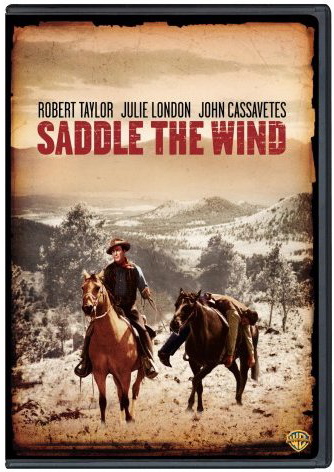
Saddle the Wind

With my review a couple weeks back of Duel in the Sun, I pointed out how much certain westerns seem related to many Greek tragedies. When you think about it, it's pretty easy to turn one into the other. As families spread across the U.S. in the 1800s, just about everybody had problems/conflicts that could only be resolved amongst the members of the family. Before westerns got too cynical in the 1960s, many American westerns used the Greek tragedy formula, including 1958's Saddle the Wind.

The key to pulling off that transformation from Greek tragedy to the wild west is in the relationships. 'Saddle' has this in a quasi-love triangle between two brothers who own a ranch in a mountain valley and the saloon girl one of the brothers brings home to be his wife. It's the type of story that if you can't predict how it ends, you definitely have not seen enough movies or read enough books. Director Robert Parrish and writer Rod Serling of The Twilight Zone do just enough with the story though to make it different, including a twist on the ending you can see coming a mile off.

In a lush, green mountain valley, two ranch owners live peacefully, Dennis Deneen (Donald Crisp), a grizzled old rancher who has come to despise violence and everything it brings, and Steve Sinclair (Robert Taylor), a reformed gunfighter trying to move on from his checkered, bloody past. Coming back from selling part of their herd, Steve's younger brother Tony (John Cassavetes) returns home with a fiance in tow, a saloon girl, Joan Blake (Julie London) who supposedly sees a better life than she's used to. Tony has also purchased a new pistol with a hair-trigger to boot.

Everything seems fine at the Sinclair's Double S ranch but in the span of a few days, two people arrive in town, both causing trouble in their own way. There's Larry Venables (Charles McGraw), a gunslinger as fast as Steve's ever seen gunning for the older Sinclair, and Clay Ellison (Royal Dano), a former Union soldier who says part of the valley rightfully belongs to him. Steve is forced to deal not only with these two problems, but also from Deneen and then his hot-tempered younger brother.

The family conflict comes across as authentic with a nice dynamic between Taylor and Cassavetes. Steve grew up caring for his younger brother, who in the process started to idolize his gunfighting older brother and now that he's full grown, he intends to be just as fast with a six-gun as Steve. Tony's intentions are good, he just wants to protect his brother (who doesn't wear a gun now), but caught up in the moment, a new side of him is revealed. Thrown into the mix is London's saloon girl who quickly sees maybe she didn't make a wise decision siding with fiery Tony.

Except for his lead role in Bataan, I've never been a huge fan of Taylor. He comes across as too wooden sometimes, but his role as Steve is the best I've seen yet. The reformed gunslinger is nothing new in a western, but Taylor brings humanity to the part as a man who genuinely regrets his past actions. As for Tony, who better to play hot-tempered, quick on the trigger brother than Cassavetes? Bordering on the obsessed with his drive, Cassavetes is the anger to Taylor's calm. London plays a strong woman, too often left behind in westerns, and even gets to serenade Cassavetes in an awkward, out of place scene.

There aren't any true villains here, but McGraw and Dano at least provide the lighter fluid for this fire. Gravelly voiced McGraw is intimidating and gruff as the new gunslinger in town and Dano as the beaten-down farmer looking to make something for his family provide strong support. Crisp makes the most of his part as the stodgy old ranch owner while recognizable character actors Richard Erdman, Ray Teal, and Douglas Spencer round out the supporting cast.

As is the case with the more story-oriented westerns, the action/gunplay is left by the wayside for most of the movie. Two gunfights are high on tension, but they're over in the blink of an eye, and the final shootout isn't much of a shootout at all. This isn't a complaint, I just felt the need to point it out so anyone watching the movie isn't expecting 100 minutes of western shootouts. It's a well-told story though with believable characters and good performances from Taylor, Cassavetes, and London. I couldn't find a trailer, but here's two scenes from later in the movie with semi-SPOILERS, one and two.

Saddle the Wind (1958): ***/****

Thursday, September 17, 2009

Violent City

Charles Bronson's career can be broken down into two easy categories, a pre-mustache stage and a with-mustache stage. In the early half of his career, Bronson played roles with some depth that allowed him to show off his range. But in the late 60s sometime after Once Upon a Time in the West, a nicely maintained mustache showed up and from then on in, Bronson became more well known as a vigilante with any number of movie roles.

Of course it's not fair to say Bronson was a one-trick pony, he made some quality movies in the 70s, but the role of a vigilante is surely what he was typecast as in the second half of his career. He was also pretty adept at playing the stone-faced tough guy, like in 1970's Violent City, an Italian crime thriller based and shot in New Orleans. This was the first of two hitman movies he would make, including the much-better The Mechanic several years later.

There are problems here that stem from the location shooting with director Sergio Sollima admitting he loves shooting in America on the DVD special features. And to his credit, Sollima found some unique spots for his location shooting. But in too many sequences, he's clearly in love with the city and just wants to show it off. One sequence that goes on too long has Bronson boating through the swampy marshlands outside the city. It serves no real purpose other than to show the area and in the process slows the movie down to a halt.

Bronson plays Jeff Heston, a freelance hitman. He's hired by a race car driver (who's not even in the cast listing now that I look) to perform a hit, but in the aftermath, his employer turns on Heston. Before he's arrested, Jeff discovers this and plans to get revenge on his boss and girlfriend, Vanessa (Jill Ireland), who looks to be involved in the double-cross. Jeff does his time in prison and is released only to find more problems have come up. Vanessa is now married to a New Orleans mafioso, Weber (Telly Savalas), who wants Jeff's services as a hit man for the sake of 'the family.' A lifelong 'orphan,' Jeff wants nothing to do with the mob and has to fend for his life as he plots his revenge. I'll give Italian crime thrillers and spaghetti westerns their due, they don't take the easy ending too much.

Nothing new here with the revenge plot and a fair share of betrayals and double crosses. Sollima starts things off with a bang though, a wordless 10-minute car chase in St. Thomas in the Virgin Islands that wraps up with a nice little shoot-out SPOILERS sort of, it's the start of the movie. The complete lack of dialogue works in the opening scenes, but in subsequent scenes, the lack of conversation is noticeable and not in a good way. Another chase, this time on foot through New Orleans, takes place about halfway through, but up until the finale Violent City is somewhat short on action.

Bronson had his fair share of critics during his career, but I'm not one of them. With the right part, he could really show off his chops. He wasn't just a tough guy, but he so often played parts like that people forget what he could actually do. This isn't his best role, but he is still a strong lead. Bronson's wife Ireland starred with him in 16 movies by my count, and while she's not the greatest actress overall, this is one of her better ones. So often playing prim and proper, Ireland plays the femme fatale to perfection. In a large cameo role, Savalas hams it up as the mafioso trying to hire Bronson.

It is an Italian crime thriller so what would it be without a score from Ennio Morricone? Listen to more of it here and here. Sollima said Morricone fell asleep during a screening of the movie, but when he turned in the score it was just right for the story and tone of the movie. With a movie like this that I had some trouble getting into, Morricone's score certainly helped. Good performances from the three leads, strong Morricone score, some good action, and a surprising ending. Not a great movie, but an enjoyable enough way to spend 100 minutes.

Violent City <----trailer (1970): ** 1/2 /****

Wednesday, September 16, 2009

Return of the Magnificent Seven

Made six years after the original, 1966's Return of the Magnificent Seven might as well been made 60 years after the original. Westerns were no longer the rage in the U.S. so the sequel was filmed in Spain and has much more the feel of the spaghetti western genre. The only returning actor, Yul Brynner, leads the cast with two new actors portraying characters who survived the original, and Elmer Bernstein's score comes back as well. And while it doesn't have the same depth or charm as the original, the first Mag7 movie is still a good one.

The sequel picks up 10 years after the conclusion of the first movie. Chico (Julian Mateos instead of Horst Buchholz) is still living in the village he helped save with his wife Petra (Elisa Montes) and son. But one day, a gang of bandits ride into the village and basically kidnap every male and march them out into the desert. Petra goes for help, finding Chris (Brynner) in a nearby border town. Assembling a new group of seven, with Vin (Robert Fuller instead of Steve McQueen), Chris rides south to rescue Chico and the other men from the village.

What they find is a small city being built in the middle of the desert, the workings of an eccentric rancher, Francisco Lorca (Emilio Fernandez). Lorca needs all these men to build the town and most importantly, a church, in honor of his two sons who were killed on the location during a recent uprising. Chris and the six bully Lorca out of the way, but the Mexican rancher won't go quietly, forcing the Mag7 to hole up and try to defeat Lorca and all his gunhands.

The new Magnificent Seven: With two more sequels to go, I'll get this out of the way now. You can't cast a movie with the caliber of actors that were in the first one. Brynner is back, and we do get some background information on him which is cool to find out about. McQueen was reportedly offered the part of Vin but chose not to reprise the role unfortunately. It's an average western as is, but with him, it might move up a notch. Fuller is capable enough but doesn't bring a ton of personality to the part. And in the upgrade department, Mateos makes a good Chico. For one, he's actually Hispanic, not German.

On to the new members of the seven, led by Warren Oates and Claude Akins, two great character actors ideally suited for key supporting roles here. Oates plays Colbee, a gunslinger with a wandering eye for the women, signing up with Chris when he hears about a village occupied by only women. It's a funny part, but one with some darkness to it as Colbee explains some of his background with Chris. Akins is Frank, a gunman looking to get himself shot up for the guilt he holds from something in his past. Also joining the group are Virgilio Teixeira as Luis, a Mexican bandit Chris frees from jail, and Jordan Christopher as Manuel, a young Mexican boy inexperienced with guns looking for somewhere to belong.

The Villain: Eli Wallach set the bar about as high as it could go with his part as Calvera so it would be difficult to live up to the original. Emilio Fernandez (Mapache in The Wild Bunch) just isn't as strong an opponent as Wallach's Calvera, and that's with about five times the amount of gunmen with him. His back story is interesting, but it makes him seem like a weak old man, not an intimidating, half-crazy madman. Fernando Rey has a small part as the wise village priest.

Overall, that's the problem with this first sequel. At 95 minutes, 'Return' is 33 minutes shorter than the first movie. The script seems thrown together in a rush job once the seven are assembled. Then, once the situation is laid out, it's basically 35 minutes of siege fighting as Lorca and his men attack the seven in a half-built church. The action scenes are well put together, if a little ridiculous (especially the finale), but with little build-up they're just there. The same issues are there with Chris and Vin questioning what they've done all these years, surprisingly enough producing some emotional moments.

Part of me wants to say that if this movie was just released on its own with no predecessor, it'd be a more highly regarded movie. But following in the rather large footsteps of the original, it would be almost impossible to match the enjoyment and excitement. 'Return' is worthwhile and an entertaining western in spite of some flaws, but don't expect a classic going in and you should be okay.

Return of the Magnificent Seven <-----trailer (1966): ** 1/2 /****

Monday, September 14, 2009

State of Play

In a time when newspapers nationwide are going down the drain, it's interesting (and nice to see) that a movie with an impressive ensemble cast deals with the inner workings and conflicts of what goes on in a newspaper's newsroom. State of Play struggled at the box office, but hopefully it does better in rentals because director Kevin McDonald (The Last King of Scotland) has put together a strong thriller that balances the every day work of journalists with the intrigue of behind the scenes Washington D.C.

When dealing with the current state of newspapers in a movie, there's certain things that can't be avoided; the online vs. print rivalry, a good story vs. tabloid stories that might sell more papers, the morality of publishing a story, conflict of interests, and of course, big business. Will anyone let us print this story? State of Play clearly did its research in handling these subjects whether it be the look of the fictional Washington Globe's cluttered, chaotic newsroom to the rivalry between a print writer and a young blogger. It's the little things that make the movie more believable, and much easier to get into the world of what's going on.

Old-school newspaper reporter Cal McAffrey (Russell Crowe) is very good at what he does, but with the changing times of newspapers, he refuses to change with the technology. So when two dead bodies turn up, Cal goes to the scene for his story. Across town, a woman is killed in a subway station, or was she? It turns out the woman was an aide to Congressman Stephen Collins (Ben Affleck) and as more information becomes available, she was also having an affair with Collins. His editors start to put the squeeze on Cal because during his college years he was roomate with who else? Collins.

The two cases/stories start to evolve and working with a young online writer, Della Frye (Rachel McAdams), Cal begins to accumulate a lot of evidence that the two cases are seemingly related. Collins and his aide were working on a case against PointCorp, a private corporation full of ex-military personnel who serve in the Middle East and around the world providing security. Could PointCorp have really ordered a hit on Collins' aide? Would they really go that far? So starts a twisting, turning story that kept me guessing right until the end.

Working as a team, Crowe and McAdams work well together, a journalistic Odd Couple. Crowe's Cal is wary of working with the young blogger but comes to see her as a colleague, a fellow reporter. It can be tricky making journalists' work compelling to watch because much of it is tracking down phone numbers and calling people, knocking on doors trying to get information, but with a handy montage the job is that much easier. The journalistic detective work provides much of the bulk of the story, but it never drags as a possible conspiracy unfolds.

As the Making of Documentary discusses, it would be hard not to compare this to All The President's Men, the true story of how Bob Woodward and Carl Bernstein took down the Nixon administration that was turned into a movie starring Robert Redford and Dustin Hoffman. State of Play pays homage to its predecessor while putting its own spin on the story. One scene in particular jumps out as Cal hides in a parking garage from a man believed to be a PointCorp assasin. Shot among the shadows, it's a great scene that sent a chill down my back at the surprise intro of the killer. And overall, the movie has a good balance between the newspaper side and the thriller aspect without overdoing or overstaying its welcome on both.

Crowe and McAdams together leading the movie is a good example of what strong casting can do, but the supporting cast here is just as important. Helen Mirren is pitch perfect as Cameron, the Washington Globe editor who must balance selling newspapers with getting that perfect story out there. Robin Wright makes the most of a smaller part as Anne Collins, Stephen's wife who has a past with Cal also. Affleck may be a little young for the part, but he pulls it off well as the suave, sophisticated Congressman seemingly on the rise. Jason Bateman as a seedy PR guy and Jeff Daniels as a fellow representative looking to help Collins also leave a good taste in your mouth.

As a reporter for a paper here in Chicago, I couldn't help but smile when I saw this movie's trailer. Journalists as heroes saving society from the government?! Count me in! The story is an exciting one that easily brings the viewer in and keeps them involved trying to unravel those deep, dark, scary Washington DC conspiracies and mysteries. Great ensemble cast and a story based off a BBC miniseries makes this one well worth a watch.

State of Play <----trailer (2009): ***/****

Sunday, September 13, 2009

The Naked and the Dead

When I think of author Norman Mailer, one thing comes to mind. Big books, real big books. I haven't read any of Mailer's stories, partly because I get intimidated when I see a paperback I could knock someone out with if using it as a weapon. His take on WWII in the Pacific, based on his own service, was a huge hit upon its release and surprise, surprise, turned into a movie of the same name, The Naked and The Dead.

Now looking at a reissue of Mailer's novel, the Amazon listing has it as over 700 pages so any movie version is going to have to cut things out. The 1958 movie clocks in at 131 minutes so I tried to keep that in mind while watching it. TCM's Robert Osborne said the novel upon its initial release was a huge success because of its 'salty language' with plenty of four-letter words and its frank way of dealing with some touchy subject matters. Of course, a movie from 1958 had to strip much of that away with censors. So right off the bat, the movie already has two strikes against it, but I'll move on.

The story centers around an American infantry battalion on an unnamed Pacific island midway through the war. Three main characters step to the front, giving the viewer a good sense of all the different ranks in the battalion. First, there's Sgt. Sam Croft (Aldo Ray in a part he was born to play), the leader of an intelligence and recon platoon that is understrength after several campaigns on the front lines. His men hate him almost to a man, and he gives them good reason. Croft is sadistic, killing unarmed prisoners callously and then prying the gold teeth out of their mouths. Second, there's Lt. Robert Hearn (Cliff Robertson), a young officer with connections back home. Translation = Earns a job far from the front lines. And third, there's General Cummings (Raymond Massey), the battalion commander obsessed with casualty estimates and striking fear into his men's hearts, often for pointless power trips.

I liked the idea of seeing the war from different perspectives, from the high-ranking general to the men on the front line. With war movies, it's typically one or the other. But in the execution, something doesn't translate. The first 70 minutes are extremely reliant on dialogue scenes meant to flesh out the main characters. Maybe this was the purpose, but none of the three are particularly likable. Croft is pure evil, Hearn is a cocky, arrogant spoiled son of a you know what, and Cummings borders on the crazy. These early scenes drag on too much.

The pace picks up when a twist to the storyline is thrown in. On this Japanese-held island, Cummings' advance has slowed to a halt. He puts into action a plan that should break the stalemate, but he needs behind the lines info. Croft and his platoon are selected to go behind the Japanese lines and set up an observation post for their advancing battalion mates. After pissing off Cummings, Hearn is given command of the platoon. So now, they're not only tangling with Japanese patrols, but a fight for power between Hearn and Croft.

The patrol segment is by far the better part of the movie. There's a natural tension as Croft and his men walk through the jungle (Panama substitituing for the actual Pacific) trying to get to their objective while avoiding the Japanese. What I enjoyed most in the movie was Croft's platoon which includes Richard Jaeckel, William Campbell, James Best as the bible-thumping, drawling medic, Jerry Paris and Rat Packer Joey Bishop as two Jewish soldiers, Robert Gist, and L.Q. Jones at his overacting best. Jaeckel and Jones are really the only ones given any development, and reading the book reviews it seems the platoon's back story was sacrificed from the 700-page plus behemoth.

For a WWII movie, the action is pretty sparse and when it comes along, it's pretty disappointing. The gunfire sounds like prop guns and the explosions look as staged as a movie explosion can be. As mentioned before with the censors, the violence is often off-screen, like a Japanese patrol burning in a lit-up field, and comes off as too tame. It's hard to judge a movie for the time it was made in, but if this movie was released in the 90s we're talking a Pacific version of Saving Private Ryan.

So compared to other WWII movies in the 50s and 60s, this one is pretty average but a lot of my complaints come from the censors. Director Raoul Walsh tried to make the definitive, honest look at a platoon of soldiers in the Pacific in WWII, but it is hamstringed by any number of forces working against it. Worth a watch for Aldo Ray's performance and the list of character actors who make up his platoon, but otherwise this one's only worth it for diehard war movie fans.

The Naked and The Dead (1958): **/****

Friday, September 11, 2009

The Guns of Navarone

Author Alistair MacLean was a master of thrillers, suspense and adventure in his long career. Of all his books though, two have become classics unto themselves thanks to the movies that resulted from their stories, 1969's Where Eagles Dare and 1961's The Guns of Navarone. Both movies share similarities, but when comparing them 'Navarone' is the better movie and has helped serve as a blueprint for adventure movies ever since.

In both MacLean novels, the setting is WWII with an almost suicidal men on a mission story. Everything points against an expert team getting the job done, but somehow they pull through in the end. No real spoilers there. In Navarone, it's 1943 and the war is still up for grabs. In the Mediterranean on the Greek island of Kheros, 2,000 British soldiers are trapped with no way of escaping. Allied Intelligence learns the Germans are planning an assault on the island with only a week to prepare. The Allies plan to rescue the men on Kheros, but there's a problem. The only way to get ships through is a channel near the island of Navarone where two huge radar-controlled guns will sink anything in range.

With time running out, Commodore Jensen (James Robertson Justice in a great cameo appearance) assembles a crack team of operators to get to the German-held island of Navarone and destroy the guns. First up, Captain Keith Mallory (Gregory Peck), a guerilla fighter in Crete who's survived 18 months behind enemy lines and who has a special talent that will come into play. Joining Mallory is his partner in Crete, Andrea Stavros (Anthony Quinn), a Greek officer extremely capable with his hands, a knife or a sniper rifle who also has an ax to grind with Mallory. The duo will lead the team of British commandos that include Maj. Roy Franklin (Anthony Quayle), Cpl. Miller (David Niven), the explosives expert, Pvt. Butcher Brown (Stanley Baker), a specialist with machines and knives, and Pvt. Spyro Pappadimos (James Darren), a young soldier adept at killing.

The commando team must sail to Navarone and get onto the island by scaling a 400-ft cliff. They will receive help from 2 Greek resistance fighters, Maria (Irene Papas) and Anna (Gia Scala), but even with that help, they must deal with horrific weather conditions, German patrols getting ever closer, and the mounting evidence that a traitor is among the group.

In the trailer (link later), Peck somewhat arrogantly states that this may be the most exciting adventure movie you will ever see. I'd normally have an issue with someone telling me that, but I find it hard to disagree with the statement. At a somewhat leisurely 156 minutes, the movie flies by with director J. Lee Thompson letting the tension and momentum build as the team tries to overcome the odds to blow up the guns and save the men on Kheros. The movie puts together a series of great set pieces, including the team arriving at Navarone in a heavy storm and then having to scale a supposedly unguarded 400-ft cliff. Thompson doesn't rush these scenes and lets them develop.

For an adventure movie, there isn't a ton of action. It's more of a build-up with anticipation of what could happen if something goes wrong. You're constantly on edge that at any moment the Germans could close in and capture the team. So with an average amount of action, it's the actors who benefit the most. Peck is an ideal choice for the unlikely leader who must step into a command position, and Niven would seemingly be out of place in a WWII adventure movie, but he's perfect. Early on, Niven's Miller is a mood-lightener with his almost constant one-liners. It's as the movie progresses, that Niven becomes the conscience, debating about the futility of what they're doing. Great parts for both actors.


And while Peck and Niven are very good lead, Anthony Quinn makes this movie special. His Andrea Stavros is a man of few words who lets his actions speak for themselves. He lost his wife and children early in the war and seeks revenge on the Germans and also Peck's Mallory who he holds responsible. One of the coolest scenes has Stavros holding off a German patrol with only a sniper rifle on a mountainside. He later meets the team, arriving at the predestined location before them, greeting Mallory and Miller with a calm 'Good evening, gentlemen' while he smokes a pipe. In a long line of great characters, this is one of Quinn's best.

Watching this movie every year or so, it never gets old. Aided by one of Dimitri Tiomkin's best scores and a great script from producer Carl Foreman, it truly is one of the best action/adventure movies ever. Also look for a young Richard Harris early as an exhausted 'bloody' pilot. Exciting from beginning to end with a chaotic final act, The Guns of Navarone is one of the best men-on-a-mission movies you'll ever watch. If you haven't seen it, the DVD is a cheap one and worth a blind buy. If you don't want to buy it, check out Youtube where you can see it part-by-part.

The Guns of Navarone <-----trailer (1961): ****/****

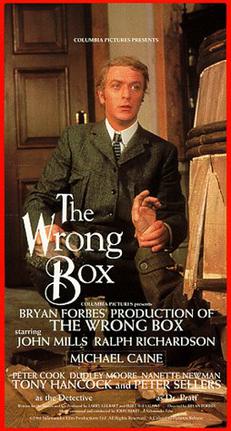
The Wrong Box

Like any sense of humor, British humor can be an odd thing. There's the very dry laughs where the proper Englishman chuckles softly to himself, but then's there is also the Monty Python, Benny Hill slapstick that's played for the out loud laugh. A movie virtually unknown to American audiences, 1966's The Wrong Box, provides a perfect pairing of both senses of humor with a great cast and a tale of confusion and trickery.

The story begins simply enough with the signing of a 'tontine' where 20 young men are entered into a lottery. Their fathers pay $1,000 pounds for their sons which will be put into a bank account and allowed to grow. The last surviving son will be rewarded with all of the money. So it begins and the years pass, 63 to be exact, with the boys growing up and some meeting their maker in an inspired scene that had me rolling. Then, it comes down to 2 brothers, the Finburys, Masterman (John Mills) and Joseph (Ralph Richardson), who live next to each other but haven't spoken in 40 years.

Joseph is away on vacation with his two nephews, Morris (Peter Cook) and John (Dudley Moore), so when Masterman finds out they're the only two remaining men, he sends for him with a very made-up deathbed message. Masterman intends to kill his brother and give all the money to his grandson, Michael (Michael Caine), to help pay off the family debt and also put him through medical school. Morris and John catch wind of the news and are thrust into an awkward situation when the train they're riding on crashes, and they believe Joseph was killed. The money is so close, and they believe all they need is Joseph to outlast Uncle Masterman for a few days. Not so fast though, Joseph is very much alive.

So starts a story that bounces around and all over the place with far too many cases of misunderstanding and scheming to even mention here. If it all sounds ridiculous, it is but don't be scared away. The humor comes out of these ridiculous situations and the crazy reactions these individuals have to 'solve' their problems. Having the two brothers live next to each other provides for an easy use of general confusion as boxes intended for the other house goes to the wrong one. Some unnecessary but still funny title cards help move things along.

What makes this work from start to finish is the casting. Mills and Richardson as the two longlost brothers are dead-on. Mills is made up to look like he is on death's doorstep but he's really anything but as the scheming, murdering brother, and Richardson nails the part of the clueless brother who collects facts and bores people to death with everything he's learned. Caine is even funny in an early part as the straight man, including a possibly forbidden love with his cousin Julia (Nanette Newman) who lives with Uncle Joseph. The best part of Caine's role is his scenes with Peacock the butler (Wilfrid Lawson), the weary, tired, slow-moving house attendant who hasn't been paid in 7 long years.

In the more slapstick scenes, Cook and Moore as the bumbling but still devious brothers provide their fair share of laughs, especially Moore who can't curb his interest in working class women. And in a small but still funny cameo, Peter Sellers plays Dr. Pratt, a clueless drunk of a doctor who provides Morris with a death certificate for his dead grandfather which you can check out here and here. I've never been a huge fan of Sellers, I just don't get some of his humor, but he's too much here, making the most of his two-scene appearance.

The movie isn't available in DVD format, and VHS tapes can be a little expensive to track down but good news from Youtube! A user has kindly made The Wrong Box available broken up into 10-minute segments. The link earlier is Part 1, and you can go from there if you wish to watch the rest of the movie. It's not well known at all here in the States, but I'm glad I stumbled across it. Dry and slapstick humor, it's laugh out loud however you look at it.

The Wrong Box (1966): ***/****

Thursday, September 10, 2009

Revolver (1973)

Watching Quentin Tarantino's Inglourious Basterds recently, part of the fun was picking out the director's musical choices for his soundtrack. I recognized a good amount of the tracks, including many from Ennio Morricone, but one really caught my attention for the first time, Morricone's 'Un Amico.' It's used perfectly in Tarantino's WWII movie so I investigated and found out it was originally used in a 1973 Italian thriller called Revolver.

It's a movie from director Sergio Sollima who made no bones about getting his political beliefs into his movies. Some work better than others, The Big Gundown is a classic, because sometimes the political preaching can get to be a little much, especially in westerns where that element is unnecessary to add to a story's depth or lack of. I liked Revolver because Sollima's feelings are mostly left out of it, and what's there is actually a worthwhile commentary on society.

The problem isn't with the political undertones, but the pacing of the first hour. It's the type of movie that throws everything at you with seemingly unrelated storylines and lets the plot develop. That's fine in itself in some cases, but the story is so muddled at times with Revolver I was never quite sure what was going on for the first 60 minutes. The story rights itself when things are explained and makes that last half of the movie much better and much more enjoyable.

Coming home one day, prison warden Vito Cipriani (Oliver Reed) finds his wife (Agostina Belli) is gone from their apartment. The phone rings, and a mysterious voice at the other end says she's been kidnapped, and the only way he'll get her back is to free a prisoner, Milo Ruiz (Fabio Testi), from his jail. Vito struggles with what to do but ultimately decides to do it. The only problem? When he frees Milo, the criminal has no idea who would want to help him out of prison.

In another storyline that seems to have no link, a higher-up politician is murdered while leaving his office by an assasin on a motorcycle. It's not long before the police find him, kill him and destroy the motorcycle and have a friend of the killer, folk singer Al Niko (Daniel Beretta), identify what's left of the body. Of course, the stories do connect at the movie's midpoint, and it generally works. Some unexplained scenes now make sense, and the unfolding of the rest of the plot comes together.

The somewhat political message of the movie is that society has ways of guarding itself against danger, laws, police, government, but that sometimes all it takes is for one man to take a revolver and right a wrong. Reed's Vito is put in this situation when faced with a decision on trading Testi's Milo in exchange for his wife in a prisoner exchange. He knows Testi will most likely be killed so as a warden and former police officer can he rationalize one life for another? That question certainly makes for an interesting resolution.

While other characters bounce in and out of the story, it's Reed and Testi that carry the movie. On the DVD, an interview with Sollima talks about how you can throw just about everything else away. It's a movie about a good guy, Reed, who's not so good, and a bad guy, Testi, who's not so bad. Known as much for his drinking ability as his acting career, Reed is an incredible presence here, a brooding, intense, driven man who will stop at nothing to get his wife back safely. Testi, often known for his looks more than anything, provides a strong balance as the criminal thrown into the middle of a situation he has little to no control over. All other things aside, the movie is about these two men and their unlikely partnership, a buddy movie on steroids if you will.

Other nice touches include the French and Italian shooting locations, and a gritty style Sollima had by then become known for. Here's the opening, which features 'Un Amico' with lyrics which isn't as effective as the song itself. The rest of the Morricone score isn't his best and seems too similar to some other scores he'd done. But the main track is a keeper and is used perfectly in the opening and especially in the final scene. While it may have been difficult getting there at times, the ending is worthwhile to say the least.

Good casting and an intriguing storyline but it takes too long getting there. Worth a watch but don't expect a classic. Here's the DVD interviews in two parts, one and two, with Sollima and Testi interviewed. SPOILER ALERT though, don't watch the interviews if you don't want the ending ruined.

Revolver <----trailer (1973): ** 1/2 /****

Monday, September 7, 2009

Hart's War

Following WWII, a whole sub-genre of movies came out dealing with a part of the war that you'd think would be hard to turn into a movie, the prisoner of war story, examples being The Great Escape and The Bridge on the River Kwai. There were others, but those two have stood the test of time over the years. But at a certain point, the stories must have dried up. Then came 2002's Hart's War.

A mix between a courtroom drama and a prisoner of war story, the movie walks that fine line between both types and is mostly successful although there are major problems with the ending. Money was clearly spent on making Hart's War look and feel authentic from the winter locations in the Czech Republic to the gaunt appearances of the actors. As much as I love 1963's The Great Escape, I can admit those prisoners sure looked like they were living a decent life. Not so much here.

It's December 1944 and Lt. Thomas Hart (Colin Farrell) is escorting an officer to the front lines. A Senator's son, Hart is destined to work at a desk until the end of the war so he takes his chance to get away from HQ. But on the road, his jeep is attacked by German paratroopers posing as American MPs and he is sent to a German Luft Stalag, a prison camp. Right away, something is wrong because the ranking American officer Colonel McNamara (Bruce Willis) bunks Hart with the enlisted men even though there is an open bunk in the officers barracks.

That's the least of Hart's problems though when two new prisoners are brought to the camp, two black fliers, Lt. Lincoln Scott (Terrence Howard) and Lt. Archer (Vicellous Reon Shannon). The prisoners' true colors come out, and it's not long before Archer is framed for robbery and summarily shot by the German guards. It looks like a frame-up organized by Sgt. Vic Bedford (Cole Hauser), the ringleader of the racist prisoners. Only a few days pass before Bedford's dead body is found in the compound, Lt. Scott standing over the body. In a court martial/murder trial, Lt. Hart (a 2nd year law student at Yale) is assigned defense council for Scott in a case that looks like it will have no hope of being fair.

The first hour or so hits all the right notes of a tense prisoner of war drama. Like Hart, the viewer is seeing everything for the first time. The conditions are cramped, the food is of low-quality, and it's freezing cold in the German winter. Even when the murder/courtroom drama is introduced, the movie still stays on the right track. It's a twist that comes with about 30 minutes to go where the story comes apart. It even goes beyond Lt. Scott's trial in a twist that doesn't quite make sense and stretches the imagination just a bit too far.

SPOILERS if you don't want to know the twist, stop reading SPOILERS Col. McNamara is using the trial as a diversion for an escape attempt combined with some sabotage of a nearby munitions plant. There's no real hints of what's to come, and when it does come on-screen, it's never fully explained. For example, where did McNamara and Co. get their hands on German uniforms, and then rifles and explosives for God's sake? It's a prison camp deep in Germany, and I don't care how bad the war is looking, German guards wouldn't trade cigarettes for rifles and explosives. End of SPOILERS.

Anywho, on to the rest of the movie. The casting is good, especially Farrell in one of his first starring roles. His Hart is a torn character, one trying to prove himself because of who his father is but also what he did under interrogation after being captured. He's put on the defensive right away, and at least for me, he's the one I was rooting for in the end. Being appointed defense counsel, Hart is put in a lose-lose situation, especially when he finds out the trial is a sham. As his opposite, Willis has the less developed character but still makes the most of it. McNamara is a career soldier, a West Pointer who wants to prove he's still in the war.

Two other parts are key to the movie's success, especially Howard as Lt. Scott. Locked away in a cell for long portions of the movie, Howard rises to the occasion when given the chance. His testimony on the stand is one of the best scenes in the movie and really illustrates what black soldiers/fliers had to go through in the South during WWII. The one good thing about the ending is Scott's reaction which could have come off as cheesy and cliched, but Howard sells it. The other important part is Marcel Iures as Colonel Visser, the German commandant who does everything he can to keep the camp running and in order, even if that means helping an inexperienced Hart at the trial.

As a fan of WWII POW movies, I wanted to love this movie and for about an hour I did just that. I really got the feel of what living in a prison camp must have felt like, especially that feeling of claustrophobia and being packed into an environment you can't get out of. The courtroom drama is not as good but still worthwhile, and that's what makes the sudden shift in story so disappointing. A good movie, but certainly a flawed one.

Hart's War <-----trailer (2002): ***/****