The Sons of Katie Elder

The Sons of Katie Elder
"First, we reunite, then find Ma and Pa's killer...then read some reviews."
Showing posts with label Sam Waterston. Show all posts

Friday, October 17, 2014

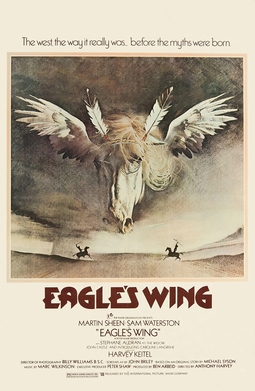
Eagle's Wing

Keep on looking, and eventually you'll continue to find movies you've absolutely heard nothing about that still appeal to you. Now if I could just win that dang lotto, I could spend all my time looking for hidden gems like that. Here's a good example. Cool cast, genre I love, interesting premise. What's the final verdict on 1979's Eagle's Wing?

It's in the 1830s in the wild expanses of the New Mexico desert. An inexperienced frontiersman and former soldier, Pike (Martin Sheen), is on his own after his partner is killed during a run-in with an Indian war party. Riding across the desert looking for what's next, Pike stumbles across a Comanche burial, a beautiful white stallion picketed nearby. Pike manages to escape with the horse, but he's not the only one interested in the horse. A Kiowa warrior, White Bull (Sam Waterston), has also seen the horse and wants it more than anything else, a run-in on the trail more than likely with such a prize on the line. That's not all though. A stagecoach and burial hearse loaded with gold and jewelry, not to mention a small group of beautiful women, is traveling across the desert at the same time. What will happen when these disparate individuals all meet up?

So ever heard of this one? Yeah, me neither. From director Anthony Harvey, 'Wing' is considered a Euro-western (I guess) as it was backed by an English studio and filmed on-location in Durango, Mexico. It received decent film reviews back in 1979 but struggled to find a footing in theaters. And wow, what a mixed bag in the end. Purely on a visual level, this flick is a stunner. You get a sense of how big the desert is, how immense the wilderness truly was when Indian tribes ruled the west and a few brave mountain men, traders and trappers navigated the country. A gorgeous film to watch, but does it rise to something else? Something more?

My biggest criticism is that 'Wing' isn't content to just be a western story with some interesting characters in an interesting historical time that doesn't always get its due in film. It has to be something more, like an allegory about human wants, needs and what drives them. Yes, it is an immaculate white stallion with impeccable speed on the line. It becomes more though. How far will these individuals go? Waterston's White Bull begins to abandon everything else he owns to keep the horse. Sheen's Pike risks bleeding to death with a wound rather than risk losing the horse. Members of a posse trailing them all turn to greed, murder and backstabbing. Maybe the premise would work better if handled a little differently, but the story never quite develops how I'd like. The second half of the movie (I saw a version about 105 minutes) is significantly better, but the finale disappoints too, open-ended without any real closure. So it's got that going for it!

And then there's the casting, some interesting, some good, and some just odd. First of all, Sam Waterston as an Indian warrior? It's not that this is a bad performance -- he doesn't speak much -- but seriously....Law and Order's resident district attorney Mr. McCoy as an 1830s Kiowa warrior? Tsk tsk, that's not ideal casting. For such a wily trailsman, White Bull also seems to make some insanely dumb decisions along the way. Sheen escapes with less damage, at times channeling his dream-like voiceover from Apocalypse Now, as the frontiersman quickly learning how to survive. Also worth mentioning? Harvey Keitel is around for about 30 minutes as Henry, a far-more experienced trader and frontiersman trying to teach Pike the ways of the wilderness.

Other characters include Judith (Caroline Langrishe), an Irish woman kidnapped by White Bull, a widowed woman (Stephane Audran) with the desert hearse, the two most persistent members of the pursuing posse (Jorge Russek and Manuel Ojeda), and Judith's brother, the Priest (John Castle). 

An interesting movie for sure. As I mentioned, the second half is significantly better with the pace quickening and the chase coming to its sorta conclusion. The premise is excellent, a handful of individuals with limited weapons and fewer supplies all pursuing each other, all for different reasons. I wish I liked it more, but as is, it's a decent western with some big positives and hard to avoid negatives.

Eagle's Wing (1979): ** 1/2 /****

Thursday, February 21, 2013

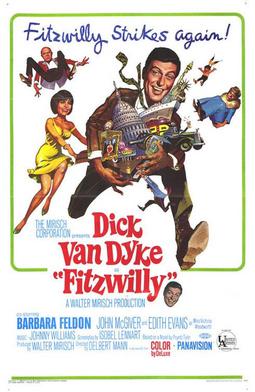
Fitzwilly

It can be weird seeing a star you know in a film you're just not expecting. I grew up watching Dick Van Dyke in his classic 1960s sitcom The Dick Van Dyke Show so while I know he's done plenty of movies, I picture him in the sitcom, not the movies. Well, that don't mean I won't give it a shot, and in the case of 1967's Fitzwilly, I'm certainly glad I did.

As long as he can remember, Claude Fitzwilliam (Van Dyke) has been the head butler for a rich, old widow, Miss Victoria Woodworth (Edith Evans). The problem though is simple; Miss Woodworth -- ever the lady -- isn't rich, but she doesn't know it. How does she maintain her lifestyle then? Well, she lives a somewhat luxurious lifestyle, but she's also generous, very generous, with her donations to charity. In steps Fitzwilly, a highly intelligent, very clever man who has organized Miss Woodworth's staff into quite the crew of con artists and thieves. Their goal is far from selfish though. They steal, bamboozle and con their way into all sorts of money, but always from insurance companies. There's a problem though. Miss Woodworth has hired a new secretary, Juliet Nowell (Barbara Feldon), who seems nosy and might just stumble into Fitzwilly and crew's operation.What to do, what to do?

One word came to mind while watching this comedy from director Delbert Mann, and that is simply...charming. It isn't anything dirty (in the least), obvious, stupid or even physical. The laughs are almost all under-played, focusing more on a line delivery or a reaction from a very talented and deep cast at said line. I've written this before about 1960s comedies, and I'd like to think it certainly applies here. It's almost a last age of innocence when it comes to big screen comedies. They don't try too hard, are content to be entertaining without being offensive, and offer plenty of good, old-fashioned laughs. Just sit back and enjoy it. You shan't be disappointed.

Much of that charm comes from star Dick Van Dyke, and it's fun to see him out of a role I so closely associate him with, his classic sitcom. Sidenote: Yes, I've seen Mary Poppins so I have in fact seen him in other parts, but you know what I mean. It's far from a typical part for Van Dyke. He's a great comedic actor, but more than anything else, he's a great physical comedian, moving around effortlessly. Playing gentlemanly Claude, he doesn't get a chance to be a physical presence. Instead, it allows him to breathe in a quieter, more subtle part that still allows for plenty of laughs. He also has a great chemistry with co-star Barbara Feldon (also a TV star on Get Smart) who arrives on scene to cause some trouble, not knowing what's she gotten herself into. They start off as rivals -- both suspicious of the other -- and not surprisingly end up dealing with a mutual attraction. Obvious? Yes, but it's enjoyable throughout.

What I loved as much as Van Dyke and Feldon though was the supporting cast. A huge name on the stage in England, Evans is a scene-stealer as a not-so-rich old widow who nonetheless thinks she's rich and keeps donating money to charity after charity. Her scenes with Van Dyke and Feldon are perfection in their subtlety. And then there's Fitzwilly's crew of amateur crooks turned highly successful crooks with intricate plans and know-how. There are double-digit members of the crew, but some stand out more than others, none more than John McGiver as Albert, a longtime pickpocket struggling with the morality of what he's done. Also look for Noam Pitlik, a very young Sam Waterston, Anne Seymour, Nelson Olmsted, and Paul Reed. Also worth mentioning are John Fielder and Norman Fell as a dupes of separate Fitzwilly cons, and Harry Townes as Mr. Nowell, Juliet's father.

The script gives the deep cast a chance to show off, much of that coming in a series of reveals of how Fitzwilly and Co. pull their cons off in a variety of different and unique ways. The highlight though is the finale, the crew robbing a Gimbels Department store on Christmas Eve as hundreds of shoppers do their last-minute shopping. Fitzwilly has countless little touches to cause mass chaos, giving him a chance to convince Fell's security official to simply give him the money. One of many highlights? Albert Carrier's Pierre walking around pinching countless women's butts, setting off a domino effect of slaps to innocent men. It's a gem of an ending, the final scene providing some good, funny and story-appropriate twists.

I liked this one a lot. It benefits from some 1967 on-location shooting in New York City and a solid score from a young composer, John Williams, who would go on to be a halfway decent composer for some other movies.  It's funny from the start with Van Dyke, Feldon and Evans leading the way. Well worth tracking down a copy. I had good luck with the TCM print so keep an eye out for the monthly schedule.

Fitzwilly (1967): ***/**** 

Sunday, February 13, 2011

Hopscotch

Released a few years ago, Burn After Reading followed a CIA agent being pushed out the door after a long career. Angry at the world, that agent – played to perfection by John Malkovich – decides to write his memoirs of all the things he saw as a secret agent. Of course, this version was played for laughs, and a lot of them at that. So what if that similar premise was handled seriously? That’s 1980's Hopscotch.

A similar premise is one thing, but Burn After Reading wisely chose to go down one road and stick with it. Released 30 years earlier, Hopscotch tries to do that but instead wavers back and forth between comedy and drama. It still works to a point because let’s face it. Secret agents are up to some nasty, shady stuff. If they get burned or put out to pasture, think of all the available information they have at their disposal, info that a government or intelligence agency would not want released. But pick comedy or drama, not both.

After running his successful CIA station in Munich for years, Miles Kendig (Walter Matthau) is called back to Langley for a meeting with his boss, Myerson (Ned Beatty). He doesn’t know what to expect and is blind-sided upon entering the office when he told he’s being forcibly transferred. A field agent all his life, Miles is now going to be in charge of running the CIA file room deep in the cavernous basements of Langley. Miles decides he’s had enough and disappears for a few days without explanation. He visits an old flame in Austria, Isobel (Glenda Jackson), and goes to work. If the CIA doesn’t want him anymore, Miles intends to take them down a notch or two…or ten. He starts to write his memoirs, all his exploits of his years as a CIA agent. Instead of just writing them down though, he sends them to CIA and foreign intelligence agencies all over the world, starting a worldwide chase with Miles as the main target.

Walter Matthau is one of the most easily watchable movie stars in Hollywood history. He switches back and forth effortlessly between hysterical comedic performances and heavy dramatic parts that allowed him to show off his ability. Above all else in Hopscotch, Matthau always keeps it watchable. All I could picture with this 1970s spy flick was that if Jason Bourne ever made it into his 50s, this is what he would be like…albeit a little more crotchety and not so willing to fight his way out of most situations. It’s just good fun seeing Matthau’s Kendig go hopping around the world, duping his pursuers at every corner with his deep pockets full of secrets. If this was a cat and mouse chase, the cat would have given up long ago. Instead, Miles keeps pulling the string and the so-called intelligence agencies struggle keeping up.

But the good and bad of the Matthau character is that he’s really good at what he does with few rivals. Instead of a chase like Jason Bourne eluding his pursuers who are equally adept, we get Matthau laughing his way through his chase. He laughs off the situation, shrugging off Beatty and his thugs like they’re a fly buzzing around his ear. There’s never any real threat of danger regardless of much Beatty wants to get Matthau’s head on a platter. You know the bait will be laid out, the CIA will bite, and Matthau will pull the ball away like Lucy does to Charlie Brown. More than that, we never know what is being written about in his manuscript. Yes, government secrets, shady dealings, black ops that no one should know about, but give us a couple details here and there. Just having the MacGuffin doesn’t work. There’s got to be some pay-off.

Joining in on the chase are some solid performances from the supporting cast.  Beatty does what he does best, play the squirrelly, obsessed villain with a glint of crazy hovering in his eye.  He plays him straight, no redeeming qualities anywhere in sight, just a despicable government representative more worried about himself than anyone else.  Jackson as Matthau’s love interest is somewhat bland mostly because it’s hard to see Matthau as a love interest. Sam Waterston as Joe Cutter, Miles’ replacement is a scene-stealer, an agent torn between his friendship with the man they’re chasing and his duty/obligation to his employers. He gets some effortless laughs with his off the cuff, casual lines delivieries. Herbert Lom is criminally underused as Yahkov, a Russian agent along for the ride.

I liked the effort here and was never bored watching Hopscotch. At the same time though, I didn’t love it. There’s humor, yes, but then the drama quickly approaches and cancels it out. Instead of being really exciting or really tense, the movie just sits there. There’s no real energy even toward the end when the chase is coming to an end. There is a weak attempt at a semi-twist in the finale, but it falls short. An average spy flick that’s good for Matthau, Waterston and Lom, but for me, I’ll stick with Jason Bourne and Burn After Reading for now.

Hopscotch ß-trailer (197?): **/****

Thursday, March 11, 2010

Heaven's Gate

After winning Best Picture and Best Director for 1978's The Deer Hunter, Michael Cimino spent the next two years working on his next project.  It was an epic that would debunk many of the myths about the west in the latter half of the 1800s that many people took as an absolute truth.  Titled Heaven's Gate, it infamously became known as the movie that derailed Cimino's career and destroyed United Artists in the process.  The production did create one of my all-time favorite lines when the studio wanted to know how far behind schedule Cimino was on the sixth day of filming.  The answer?  'We're five days behind schedule.'

Released in 1980, Heaven's Gate has its fair share of similarities with The Deer Hunter.  How to put this nicely?  Cimino loved a very natural style (i.e.: slow, very slow) with stories that were in no rush getting to their destination.  And if they didn't get to that destination?  No worries.  Working with cinematographer Vilmos Zsigmond, Cimino creates a beautiful movie that completely utilizes the beauty of Montana.  But at a cost because the story is thrown by the wayside.  Long, lllllllong scenes of a rider approaching a cabin in a mountain valley drag on. For me, it got to the point where I got sick of looking at nature.  Just tell the damn story! 

After visiting St. Louis, Wyoming marshal Jim Averill (Kris Kristofferson) returns home to find a conflict brewing. The wealthy landowners/cattle barons are fed up with the poor farmers and settlers -- most of them immigrants trying to start a life -- who keep stealing their cattle and destroying the land.  One man, Nate Champion (Christopher Walken), serves as their enforcer, killing anyone believed of stealing cattle. At first, Jim doesn't seem interested in the problem.  He tries to convince his girlfriend Ella (Isabelle Huppert), the local owner of a brothel, to leave with him, but she refuses.  Champion is also interested in Ella, leaving her conflicted as what to do.  Her problem is solved when the landowners (led by an evil Sam Waterston) go the government for help and a list is circulated of 125 farmers who will be killed.  A small army of gunmen descend on the county ready to wipe out anyone who stands in their way.

This is now the longest movie I've ever seen at 219 minutes, replacing The Seven Samurai, and at times it felt longer.  God forbid, there's rumors of a 5-hour version out there somewhere.  It's easier to judge this movie in two segments; pre and post intermission.  Pre-intermission is awful and a painful experience.  Two scenes rival Deer Hunter's wedding scene, a Harvard graduation in 1870 that serves no purpose, and a dance scene that goes on and on.  Cimino is one of the most self-indulgent directors I've come across, seemingly wanting to show off what a great director he was. His budget was around $11 million, but it went $30 million beyond that.  Apparently, he shot almost 200 hours of footage.  He clearly went all out to show the reality of the developing west whether it be sets or costumes, but its almost overkill by the 2nd hour or so.

These scenes could have served a purpose in a shorter way, but instead they bring the already stagnant story to a halt.  That's the whole movie too, long, extended shots that don't do anything other than look good.  I'm curious about the 149-minute version because in a condensed form, the movie might be worth watching.  On the other hand, I have little interest in seeing this one again.

The one slight saving grace of the movie is post-intermission when Waterston's army of gunfighters goes on the hunt.  Parts are still too slow, but this nameless, faceless villain is a great choice.  Walken's Champion has a change of heart when he sees the tactics being used and goes out in a blaze of glory.  The farmers/settlers finally decide to do something and in a bloody battle take on the gunfighters.  Both sides take heavy casualties, but we know nothing about these people.  In several scenes, these foreign settlers yell at each other at meetings and then the battle comes along and they get blown away.  It's a remarkably well-done sequence (start HERE with SPOILERS of course) but on an emotional level does nothing, and isn't that the point of an epic scene like that?  To make any sort of emotional connection with the viewer, but that's this movie in a nutshell.

Filling out his cast, Cimino assembles an incredible list of actors including the already mentioned Kristofferson, Walken, Waterston, and Huppert.  There's also Jeff Bridges, Mickey Rourke, John Hurt, Brad Dourif, Geoffrey Lewis, Joseph Cotten, and Terry O'Quinn.  But with all that talent assembled, Walken and Huppert are the only ones to really distinguish themselves.  Kristofferson mumbles his way through all his lines, Hurt is required to be drunk, Rourke and Lewis show up, get introduced and are killed, and Cotten has a one-scene cameo.  I'll add Bridges to the list, he's solid as a saloon owner working with the farmers.  It seems like such a waste to bring all these talented actors together and then not give them much development.

I think I gave this movie a pretty fair shot from the start.  But my objections from The Deer Hunter rolled over to Heaven's Gate.  There are just too many plotholes you could drive an 18-wheeler through that are never resolved.  Like how/why did Kristofferson move west, apparently leaving a wife behind?  It's confusing at times, boring at other times, and generally a mess of a movie.  Tons of potential, TONS, but it just isn't a very good movie. 

Heaven's Gate <----trailer (1980): * 1/2 /****