The Sons of Katie Elder

The Sons of Katie Elder
"First, we reunite, then find Ma and Pa's killer...then read some reviews."

Monday, July 8, 2013

Silver Linings Playbook

Each movie awards season, some movies gain crazy amounts of momentum. Little films turn into BIG films thanks to some critical buzz, others because of word of mouth. Too put it lightly, I can be a little wary of these films, especially when everyone is shoving it down your throats. Case in point, 2012's Silver Linings Playbook. I needn't have worried. I liked it....a lot.

After an eight month stay at a mental institution, Pat Solitano Jr. (Bradley Cooper) is finally released and moves back in with his parents, Pat Sr. (Robert De Niro) and Dolores (Jacki Weaver), at their home in Philadelphia. The incident that put him in the institution still hangs over Pat though, and though he's trying his best, he's struggling to adjust. His parents have their own issues going on while Pat tries his best to get back together with his wife, proving he's changed. It doesn't go particularly well until he meets Tiffany (Jennifer Lawrence), a young widow who struggled with sex addiction following her husband's tragic death. Tiffany offers a solution though; she'll help Pat get back together with Nikki if he helps her in an amateur dance competition that requires a partner. He bristles at first but decides to go along. Maybe these two can end up helping each other.

One of the most talented directors currently working, David O. Russell delivers a gem here. He earned a Best Director nod, ultimately losing to Ang Lee for Life of Pi. While it is a drama, it has some very funny moments. It isn't a drama or comedy, refusing to be hamstrung by either genre description, and it's the better for it. The drama, laughs and emotions come from the personal reality of the story. While the amateur dance competition seems a little out of left field, it isn't an issue. It fits in with the story effortlessly. 'Playbook' also deftly handles a story that focuses so heavily on mental health issues. Pat, Tiffany and others struggle with depression, addictions and other assorted things that can't be seen like a disease or a sickness. There aren't easily seen symptoms, but the diseases are very, very real. It's a human drama, and a good one.

An awards season darling, 'Playbook' didn't catch all that buzz because of any huge style, crazy cinematography or groundbreaking new storytelling technique. Plain and simple, it's the acting with a nomination for each of the Best Acting categories. Cooper and Lawrence aren't close age-wise at all, Cooper 37 and Lawrence 21 at the time of filming, but the age difference isn't an issue in the least. Talk about chemistry, it's pretty perfect every time they have a scene together. They drive each other nuts but can't quite get away each other. Cooper does a fine job showing a pissed off frustration at the world while still being sympathetic. Lawrence was the lone Oscar winner, taking the Best Actress award, and she deserves it. There are moments where her armor is up, protecting herself, but revealing her worries and concerns in these horrifically dramatic moments that are difficult to watch. Very likable actors in just about every part they do, and as the hearts of the film here, they don't disappoint.

Also earning supporting nominations were De Niro and Weaver. Of the two, I was more impressed with De Niro, his Pat Sr. an epic Philadelphia Eagles fan who lives on superstitions and luck, struggling with his own past demons and current issues while trying to help out his son. He has a scene late that's perfect with Lawrence, a confrontation that gets defused in a great back-and-forth. Weaver's role is more familiar but still worth watching, a mother who worries and worries about everyone around her. In some other key supporting parts look for a subdued Chris Tucker as Pat's friend from the institution, Anupam Kher as Dr. Cliff, Pat's psychiatrist, John Ortiz as Ronnie, a friend of Pat's who's married to Nikki's nagging sister (Julia Stiles), and Shea Whigham as Jake, Pat's older brother who doesn't know how to deal with his brother's mental health issues.

I liked the movie throughout, but I wasn't sure early on exactly where it was heading. It's never slow, but an episodic story that runs 122 minutes does cover a lot of ground. I never thought I would write this in a review, but the story really comes together as the amateur dance competition and the training for it steps to the forefront. Go figure. All the different personal issues come together in a scene that could have gone poorly if handled a little differently. It's high on emotion -- maybe a little too much -- but like so much else here, it works. Maybe it shouldn't, but it does. The dance competition ends up being a great scene and a fitting finale. I'm not one who is typically in favor of a movie having a happy ending, but this is one where it is required/necessary. Great ending to a really good movie with a handful of worthwhile acting performances.

Silver Linings Playbook (2012): *** 1/2 /****

Sunday, July 7, 2013

Double Indemnity

In 1944, director Billy Wilder was a young, up and coming filmmaker with just three films to his name. The film noir genre was in its infancy too, a film popping up here and there that introduce audiences to things that would later become commonplace within the genre. With one fell swoop, Wilder put his name on the map in a big way and helped blow up the film noir in a huge way (that's a positive). The film? A classic, 1944's Double Indemnity.

An experienced and successful insurance salesman with 11 years under his belt, Walter Neff (Fred MacMurray) is very good at what he does, able to sell policies to people who didn't even want insurance. On one house visit where he's looking to re-up on an auto policy, Walter meets Phyllis Dietrichson (Barbara Stanwyck), a young woman who's married but it's far from a happy marriage. He is magnetically drawn to her and can't stop thinking about her. Getting to know her better, Walter finds out about Phyllis and her background with her husband (Tom Powers). Moral of the story? Phyllis wants out, and Walter is going to help. He intends to get her husband to unknowingly sign a life insurance policy and then kill him. A longtime salesman, he's got a perfect plan to pull it off and have him and Phyllis split the $100,000 payout. Could it actually work?

One of the great films from Hollywood's Golden Era (and Hollywood history in general), 'Indemnity' is one of those movies I just never sought out even though I knew its reputation. It was worth the wait. Watching it on a first viewing, it seems familiar -- if in a good way. Why? Because hundreds of movies have tried to duplicate its success in the 60-plus years since its release. The duped male anti-hero, the brutal femme fatale, the characters in general who are interested in me-first, everyone else....well, never. The entire genre in general was ahead of its time, but this was one of the first examples, and it definitely deserves its classic status.

Based off a 'ripped from the headlines' story, the script from director Wilder and another halfway decent writer, Raymond Chandler, is like much of the movie, far ahead of its time. In its incredible darkness, honest depiction of just how nasty people can be with money on the line, it feels like a movie that would have been right at home in the equally dark/sinister late 1960s and 1970s. The script lays it all out there, setting it up and letting Walter's predicament get the best of...well, everyone. The dialogue seems a little stilted at times, but it's sharp and quick and well-written for the most part (obviously delivered pretty well too).

The cast doesn't call for too many key roles, but on a bigger level, it doesn't need more characters. MacMurray and Stanwyck are perfectly cast, playing off each other so well. In past reviews, I've mentioned my troubles with watching MacMurray in darker roles because I'm used to him as the star of My 3 Sons or any number of Disney movies, but there's a sinister charm that works nicely here. Stanwyck is the equally sinister femme fatale, like a snake waiting to strike. A match made in movie heaven (eh, maybe hell. We know this won't end well). In a scene-stealing part, Edward G. Robinson is Keyes, the inspector at the insurance company tasked with seeking out payouts that aren't on the level. Robinson expressed some concern at the time that he was taking a supporting part, but he needn't have been worried. 

The development of Walter's plan is what sets this movie apart from the rest. Wilder and Chandler's script develops flawlessly, the tension building and building with each passing scene. The actual execution of the plan (oh, watch out, murder!) is tough to watch. We're clearly not rooting for them to succeed and murder someone, but at the same time, it's almost unbearable to watch because at the same time, you don't want them to get caught. It's the fallout afterward that is even tougher to watch. Wilder uses another ahead of its time technique, revealing in the opening scene courtesy of Neff that the plan will not succeed. That could be a dealbreaker for a lesser movie. We basically know the ending a minute into the movie, but it adds an interesting layer to the film. Okay, it's not going to work. How then is it going to crumble?

A classic movie from Hollywood's Golden Era for a reason. This would start Wilder on a ridiculously successful path that would help elevate him to one of Hollywood's all-time great directors. The style, the characters, the dark story and script, the score from composer Miklos Rozsa, it all works well, like puzzle pieces fitting together. Any movie that has influenced so many other films in the years following its release is/was clearly doing something right. Too bad I took so long catching up with it, but it is the rare film that was worth the wait.

Double Indemnity (1944): *** 1/2 /****

Thursday, July 4, 2013

The Girl Who Played with Fire

So I read Stieg Larsson's Millenium trilogy last year and watched both the American and Swedish versions of his first book, The Girl With the Dragon Tattoo. For me, it was a weird thing about the books. While I liked all three, my enjoyment went down with each passing book. I loved the first one, but I struggled to get through the second and third. Give me credit though, I'm persistent if nothing else, so here we go with 2009's The Girl Who Played with Fire.

It's been over a year since Lisbeth Salander (Noomi Rapace) helped journalist Mikael Blomkvist (Michael Nyqvist) take down a hugely successful Swedish businessman, and she's fallen off the map, traveling the world with her newfound wealth. Lisbeth is now returning to Sweden, purchasing a huge condo where she can live in peace. She hasn't reconnected with anyone from her past, but her name is on the national radar now. A freelancer working for Mikael is preparing an expose about sex trafficking, the women transported into the country and the men behind the business. One night, both the freelancer and his girlfriend are brutally murdered, and the evidence points to none other than Lisbeth herself. Having worked closely with her, Mikael knows there's no way that could be the truth. Something is going on, something dark and hidden away.

While the Larsson books are well-written and solid reads, it's easy to see that doing a film adaptation from one of the novels is a daunting task. The first book -- Dragon Tattoo -- is downright simple (and that's saying something) to what comes in the second and third books. There are countless characters, locations, backgrounds, twists, turns and everything in between getting from Point A to Point B. I don't envy getting the novel to the film, director Daniel Alfredson taking the helms here for the second film in the trilogy. It was difficult to follow the books at times because there was so much going on. The films? Well.....

'Dragon Tattoo' clocked in at 152 minutes, and this follow-up is shorter by 24 minutes. Something had to be cut from the novel to the film to make it even remotely feasible, but unfortunately 'Fire' cuts too much. I read the book, and I was confused half the time. The film plays like a cliff note's version of Larsson's novel. But, that's not why we're here. I'll do my best to just judge on its basis as a film alone. Even there though, I can't imagine trying to keep up with everything going on here. When I explain some of the cast later, I'll mention four or five names. If I did more than that, this review would go on for days. Significant cuts were made, and it's still too much and not enough at the same time. We meet characters, but that's it, never really learning much about them or in some cases, who they are. An extended cut was released on DVD with more than 50 minutes added, and I assume it's got to be at least a little better.

Anyways, back to the film as just that, a film. Like its predecessor, it is a well-crafted, unsettling and incredibly cool, visual movie. Based in Sweden, it has a snowy, washed out and cold look to it. Issues I had with the story and characters aside, it is a solid thriller. Composer Jacob Groth returns to handle the musical score, his music here more eerie, appropriate and memorable than I remembered in the first one. On a visual basis alone, it is a memorable movie. The twists and turns do keep us guessing so even when you're confused, it's still in an entertaining, confusing sort of way.

The best part though here in 'Fire' is the continuing development of the Lisbeth Salander character. Even when I struggled through the novels, I continued on because I was fascinated by the Lisbeth and Mikael characters. There's more going on here with Lisbeth's personal background than you could ever imagine. We meet someone from her past, a mysterious man named Zala (Georgi Staykov), who damaged her in ways you'd never expect. With her walls up again and general refusal to never let anyone get close to her, we see more about her as we learn about her years growing up. Playing her journalistic counterpart, Nyqvist isn't given as much to do here unfortunately other than look worried and follow the clues to Lisbeth and her own wandering investigation. What's key though is that we've gotten to know the characters pretty well thanks to the first novel, and even when the script struggles to spell things out, we hopefully go along for the ride.

I lied. I'm not going to go into anymore depth about the supporting cast. By my count, there's 16 others characters that I'd need to give some attention. Some are only around for a scene or two, others far more than that. By explaining who most of them are, I'd be ruining a lot of plot twists that offer a pretty decent surprise with less knowledge going in. I'll wrap this up. It's a good thriller that has some serious flaws. Some of that comes from having read the books, but even just judging it as a film, it's got those issues. It switches things up and does build to momentum in the second half. The cliffhanger is solid, hopefully leading right into the third film. Review to come at some point so stay tuned.

The Girl Who Played with Fire (2009): ** 1/2 /****

Wednesday, July 3, 2013

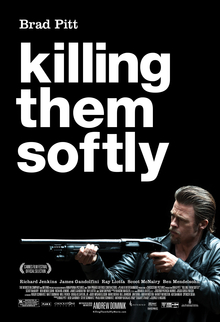
Killing Them Softly

As an author, the name George V. Higgins doesn't set off trip wires and alarms about all the classics he's written. His fans love him though, love him for his bestselling crime novels that brought the darkness, reality and extreme violence and betrayals of the criminal underworld to life. I'd seen -- but haven't read -- The Friends of Eddie Coyle and liked it. One of Higgins' novels, Cogan's Trade, received a big screen adaptation last year, 2012's Killing Them Softly.

With the help of a businessman, Squirrel (Vincent Curatola), an ex-con, Frankie (Scott McNairy) and a drug addict acquaintance, Russell (Ben Mendelsohn), have a plan to net some easy money. Frankie and Russell will rob an illegal high stakes poker game run by Markie Trattman (Ray Liotta), the owner of a ring of illegal games. In his past, Markie secretly took down one of his own games, and Squirrel intends to set him up as the fall guy for his upcoming job. The actual robbery goes down pretty smoothly, but the fall-out is severe. With mob ties to the card game, a feared enforcer, Jackie Cogan (Brad Pitt) is called in to handle the situation. He's got to find out who was involved, who was behind it, and who's lying to him. Brutality, intimidation, straight murder, Jackie isn't afraid to pull out all the stops to find out what he needs to know and get paid in the process.

What I liked most about this film noir-like crime flick is simple. Based off a novel Higgins wrote in the 1970s, 'Killing' feels like those down and dirty crime dramas of the 1970s. There is a throwback feel to it that works on an effortless level. Some of the style, especially Pitt with his slicked back hair and duded up look, has that retro feel. Mostly though, it's that ever-present sense of doom. In this criminal world as the movie presents, there is no hope, no light, no potential for happiness in the end. Anyone and everyone is trying to look out for No. 1. Betrayals, murder, backstabbing, all are fair if it helps you get somewhere or something. That ultra-dark cynicism plays well. We know from the start that none of what we are about to see will go down smoothly. Blood will be spilled and money will be made, but at what cost?

That sounds like it's right up my alley, doesn't it? An almost artsy feel of a 1960s/1970s French crime drama mixed with the tones of a barebones American crime drama from the 1970s? That's got to be good, right? Well, it never amounts to much. This movie plays like a dirtier, far more foul-mouthed version of something Aaron Sorkin would have written. 'Killing' is absolutely obsessed with dialogue. When written well, that can be enough to carry a movie, but the dialogue here gets tedious and serves no real purpose at a certain point. How many times can we hear Frankie and Russell talk about their sexual preferences before we just become numb to it all? I appreciate a slower, more character driven story that doesn't focus exclusively on action, but it's got to go somewhere. We get a long dialogue scene.........and another.........and another. An already short movie (in running time at least) at 97 minutes, it feels far longer, and I was using the fast forward option liberally.

What ends up being the biggest waste here is the cast. There's lots of dialogue here, but it feels like actors showing off but without any substance. Pitt is a bright spot (not a surprise) as brutal, quiet and effective Jackie, a man who has a special skill -- enforcing/killing -- and puts it to his advantage. McNairy and Mendelsohn are appropriately slimy while Liotta isn't given much to do unfortunately as Trattman, a marked man. James Gandolfini plays Mickey, a down on his luck hit man who Jackie recruits for another job, hamming, whoring and drinking it up. Richard Jenkins is maligned and beaten down as Driver, Jackie's link to the mob. Sam Shepard makes a bizarrely quick one-scene cameo as Dillon, an older enforcer with the biggest reputation around.

The story itself has some flaws, but I think director/writer Andrew Dominik makes a really bad style decision. Any transition scene -- car driving, men walking, whatever -- has a voiceover being played over the visual. We hear George W. Bush and Barack Obama talking about the economic crisis, country unity, working together. It all comes together in the end in the final scene, but it's not worth the payoff we get. Instead, it comes across as a heavy-handed, obnoxious stylish storytelling device that handicaps the movie. As a film, it just can't quite figure out what's going on. Is it darkly funny? Just dark? A metaphor for something bigger, more profound? All of the above, none of it? If you're going to tell a crime story, do it. Don't get all mixed up in a message about America's current economic state.

Too bad overall. Lots of potential, and when it works in small snippets, it reminds me of a mix between The Departed and No Country for Old Men. Too often though it doesn't do enough to give it a recommendation (even a mild one). Sorry to report I came away disappointed in a big way.

Killing Them Softly (2012): **/****

Monday, July 1, 2013

The New Centurions

Police movies seem to be about a dime a dozen these days. I just reviewed a few recently, from End of Watch to Bullitt, Crime Wave to The Offence and many more. I'd wager a majority of those films are about the detectives, the supervisors, the special investigators. On the other hand, it is the beat cops who usually play supporting roles. Well, not always (End of Watch is another exception). They get their shot at the spotlight in 1972's The New Centurions.

Fresh out of the police academy, Roy Fehler (Stacy Keach) and a new batch or rookies are assigned to precincts and departments across Los Angeles. A hopeful law student with a wife and daughter, Roy has become a cop in hopes of making some money and learning the business while studying for his law degree. He is paired with veteran beat cop Andy Silvinski (George C. Scott), a police officer who's seen everything good and bad the streets have to offer. They bond immediately and become fast friends, the veteran introducing the rookie to the ins and outs of the job, teaching how to handle anything that might present itself. As he gets used to the job though, Roy starts to realize he likes doing it, and that it's not just a job. His wife, Dorothy (Jane Alexander), wants him to leave the force, but he may be in too deep at this point. What to decide on? Your career or your family?

My above comment about police movies being a dime a dozen is not intended as a dig or insult. I very much like all those movies. Naturally, I was more than a little surprised then when I found this film from director Richard Fleischer at Netflix having heard absolutely nothing about it....ever. In an era when everyone and their mother was making police movies -- Bullitt, Dirty Harry, Branningan among many others -- it's refreshing to see one that isn't interested in the high profile cases, the so-called 'glamour' of the position. 'Centurions' focuses almost solely on the beat cops, their day-to-day jobs around the department, on patrol and in the streets, and most importantly in Roy's case, how the job affects all the other aspects of life. It's better because it is a more personal story, nothing big picture about the scandal/corruption in the force or a major case that leads the news every night.

On that personal level, the story leans toward the episodic and for the better. A movie that runs about 103 minutes covers a lot of ground, following Roy from his rookie days to his reassignment on the force to his return to the department where he started. It never feels rushed, but the story does keep moving and jumping from incident to incident. These scenes know when to cut things off, laying things out, showing us what's happening and then moves on, never overstaying their welcome. The best moments are Roy, Andy and the other departmental officers on night patrol, dealing with thieves and hookers to domestic disturbances and drunks. At times, things get a little too sunshine happy (an incident with six or seven hookers comes to mind), and composer Quincy Jones' score is a tad too 1970s funky at times, but for the most part, the positives are there. 

In the late 1970s and into the 1980s, buddy cop movies were everywhere, usually pairing a goofball newbie with a chiseled, no-nonsense veteran. Obviously, that's not the case here. I love the easy-going dynamic between Keach and Scott in every one of their scenes. Their dialogue never feels forced, their friendship anything but fake. It's natural throughout. On the force, we also meet veteran officers Clifton James and Ed Lauter to pair with a couple of newbies, Scott Wilson and a pre-CHIPs Erik EstradaJames Sikking plays a glory-hunting Vice squad officer as well.

I had an inkling where the story was going here, but I wasn't quite sure. As good as Scott is as the veteran cop, the focus is on Keach, and he doesn't disappoint. We see his struggles at home with his wife and later how he meets another woman, Lorrie (Rosalind Cash), a nurse who once patched him up following a shooting. Realistic throughout, the story takes a dark turn -- not surprisingly -- in the final act. The ending is quick, brutal and highly effective. It's a hidden gem among the cop genre, one that has that early 70s charm with a good cast and a not so typical story in a familiar genre. Well worth seeking out.

The New Centurions (1972): ***/****

Friday, June 28, 2013

Jaws: The Revenge

We're on shark overload here so we might as well finish strong. Well, as strong as a third sequel in a progressively awful series allows. The Jaws series starts off on an epically strong film, follows with a pretty decent sequel, and then wraps up with two of the worst movies around. Putting a capper on the series, here's 1987's Jaws: The Revenge.

It's been years since her family has had to deal with shark attacks, and Ellen Brody (Lorraine Gary) is able to move on now. She's a widow -- Chief Brody died from a heart attack -- but living on Amity Island still. Her life is thrown up in the air when her son, a deputy on Amity, is killed by a great white shark. Ellen is convinced that it is a shark seeking revenge from her family's past involvement (read = killing) of sharks. Looking to get away some from her own demons, she travels with her oldest son, Michael (Lance Guest), and his wife and daughter to their home in the Bahamas. Everyone tries to convince her that her worries are absurd, but she can't shake the fear. Resting and relaxing though, Ellen is again shaken to the core when.....the shark shows up in the Bahamas!

Okay, let's clear this up now. This third Jaws sequel and fourth movie in the series is really bad. It currently possesses a 2.7 rating on IMDB and deservedly so. Now that said, I think it was miles ahead of Jaws 3-D, easily one of the worst movies I've ever seen on so many levels. To its credit, 'Revenge' basically pretends that 3-D never actually happened, and that's fine by me. What's bad is really bad. Whenever the shark is shown, you can actually see stitches in the shark, its bottomless mouth, the underwater crane actually transporting the shark. Still, it was filmed in the Bahamas (and that always looks nice), and the familiar Jaws theme is still cool. It's not good, but it is also isn't as God awful bad as some reviews made it out to be.

Maybe in some sort of existential sense, the premise here is pretty cool. Through three movies, the Brody family has dispatched their fair share of great white sharks. Ridiculous science assumptions aside, wouldn't it be kinda cool if a shark actually possessed the ability to grasp revenge? No? Okay, maybe it's just me. Sharks are killing and swimming machines so what if they were able to hunt someone specifically? Eh, the more I think about it the stupider it gets. The execution makes it worse. Ellen, Michael and Co. travel to the Bahamas and within three days a shark swims the entire trip down there from Amity Island. Yes, it follows them. A shark can somehow sense where they're going thousands of miles away and FOLLOWS them. Yeah, that's just not good.

Let's move onto the acting, ranging from really bad/wooden to meh to out of place. Reviews point to Gary's marriage with a studio exec as a main reason she reprises her role as Ellen Brody. It's eerily similar to the part Roy Scheider played in Jaws 2, but not as good. The part consists of her worriedly looking at the ocean with a vacant stare. Guest isn't much better, but he's a tad more animated at least (Karen Young playing his wife, they do have sex a lot, and Judith Barsi as their precocious daughter). In the bizarre 'Was he blackmailed into this movie?' casting, Michael Caine plays Hoagie, an island pilot who takes a shine to visiting Ellen. He's surprisingly good, but that's because he's Michael Caine more than anything else. Caine infamously once said "I never saw it, by all accounts it's terrible, but I have seen the house it built, and it's terrific." Also look for Mario Van Peebles as Jake, a Bahama marine researcher working with Michael, a truly cliched, stereotypical part that grates at all times.

A bomb in reviews and at the box office, the studio made an even stupider decision, inserting a new ending into the finale. SPOILERS STOP READING SPOILERS You can watch the original theatrical ending HERE, lousy but classic cinema compared to what the new ending is. The new finale actually has a shark jump clear out of the water, roar (because sharks can apparently roar), gets harpooned by the boat and spontaneously explodes. Footage from the original Jaws is even inserted (nice touch, huh?). One character is brutally bitten/attacked by the shark but manages to somehow survive. Yes, it's ridiculous. It certainly closes the series on a high note. Try as I might though, I can't give it as bad a rating as Jaws 3-D. I just can't. It's awful, but not on that level.

Jaws: The Revenge (1987): * 1/2 /****

Thursday, June 27, 2013

Jaws 3-D

How do you make an unnecessary sequel even more unbearable? Add a gimmick! Here go we with one of the all-time worst sequels ever, 1983's Jaws 3-D. The original Jaws is a classic, Jaws 2 is pretty dumb but still entertaining, but this second sequel and third flick in the series is....Just....Plain....Awful.

Working at SeaWorld in Florida, Mike Brody (Dennis Quaid) is one of many employees readying for the opening of a new exhibit. It features underwater tunnels and a restaurant that allow park visitors to see what the ocean is like from an underwater perspective. The opening though has a minor hitch....a great white shark has been trapped in the enclosed water park, and it has already claimed a few victims. What to do? Working with his girlfriend and animal trainer Dr. Kay Morgan (Bess Armstrong), Mike and several other park workers manage to capture the shark, the first captured great white shark ever. Problem solved, right? Not so fast. The captured shark is the baby.....and it's mom is angry and also trapped in the park. Where exactly is this immense 35-foot shark hiding? Can they find it and kill it before it claims any more victims?

Oh, good Lord, this movie was awful. My viewing recently was the first time I'd ever really watched this sequel, and it will most definitely be the last. This dreck doesn't even have that quality of 'It's so truly bad that it's good and entertaining.' What's unfortunate is that the basic premise -- a killer shark trapped in a highly populated area -- has the potential to be at least mildly entertaining. That's all it is though, just potential. There are any number of deal-breakers here from the lousy acting to the poorly written script to the horrifically bad special effects, and I use that term ever so lightly. All instances that in itself would be bad, but wouldn't you know it? '3-D' offers all of the above for our viewing pleasure!

I'll kick things off with the 3-D element here. By 1983, studios had at least some semblance of technology available, but apparently director Joe Alves pissed someone off and didn't get any of that technology. The actual use of 3-D technology is laughable here. We get countless shots of dolphins, fish and assorted sea life swimming right at the camera. Watch out! They're going to swim right at us out of the television! That's just one thing though. At one point, the 35-foot shark swims directly at the camera, but it is so ridiculously fake-looking that I ended up laughing. The shark doesn't move, doesn't swim. It just appears to be floating at us menacingly. Then, when the shark -- SPOILERS STOP READING SPOILERS -- meets his maker, its blood and jaw come spiraling at us. I'm not a fan of 3-D anything (even when some money is spent on it), but when it's this bad.....wow, just wow.

Okay, moving on. Let's tackle the script here. Yes, you guessed it. It is awful. The shark is almost secondary to the story and takes a backseat to basically everything. The first 30 minutes are spent with Mike (son of Roy Scheider's Chief Brody) and Kay as they meet up with Mike's younger brother, Sean (John Putch), and try to get him to have some sex with slutty water skier Kelly Ann (Lea Thompson). There's never any rhythm to any of the story, just random attacks that we never really see clearly and then a bunch of explaining. The reveal that the shark they've caught is hysterical. Apparently the 35-foot shark is hiding in a ventilation pipe. Yep, it's just sitting there waiting to strike. Also look for Louis Gossett Jr. as the park manager, Simon MacCorkindale as hunter FitzRoyce with P.H. Moriarty as Tate, his hunting assistant.

There was an art to how the original Jaws presented the lurking shark and its impending attacks. John Williams' score here is thrown by the wayside, just the main 'Shark theme' making the transition here. It's stupid. We never really see any of the shark attacks, and all the tension goes out the window. What we see of the attacks are quick and hard to follow. It also ends on a highly inappropriate freeze frame. People have just died tragically and horrifically via shark attack, but Quaid's Mike jumps out of the water with a pump of his fist. A super-imposed dolphin jumps out of the water and twirls in the air. Yeah for survival! It goes beyond dumb and entertaining here. It's just dumb to the point I felt stupider having watched it.

Jaws 3-D (1983): */****

Wednesday, June 26, 2013

Jaws 2

Some movies are just too successful not to follow up. The first true summer blockbuster, 1975's Jaws was an instant classic, a film that's as successful in terms of story and characters as it is on a far more technical level. The question of course is that everything is wrapped up nicely in the original. We didn't need a follow-up, a sequel that explored more. On the other hand, money is a powerful motivator, isn't it? Let's continue with the series, 1978's Jaws 2.

It's been three years since Chief Brody (Roy Scheider) helped dispatch an immense great white shark terrorizing Amity Island, and things have gone relatively back to normal. His kids have grown up, and his wife, Ellen (Lorraine Gary), is working closely with development and construction on the island. In the midst of summer rush though, weird occurrences start to happen including the disappearance of two divers and a bizarre boating accident where the driver and water skier are both killed. A killer whale even washes up on shore with huge bites in its side. No one has witnessed anything funny though, but Brody is convinced that all the weird incidents, evidence and clues point to another great white shark patrolling the waters around Amity Island. Can he convince anyone else of what he believes before more lives are claimed?

Much like its classic predecessor, 'Jaws 2' seemed doom from the start. The Steven Spielberg directed film from 1975 was obviously able to right the ship, becoming a fan favorite and one of Hollywood's all-time best flicks. Making its follow-up though was far from a smooth ride. Filming started and went on for over a month before the studio decided it wanted to go in a different direction. In stepped director Jeannot Szwarc and the tone of the movie was lightened up a bit (as much as you can with a movie about a killer shark), some of the darker ideas left behind. Filming went on with some other issues developing, and the final product went on to gross over $200,000,000 at the box office.

If you're going to make an unnecessary sequel, might as well do it right. Less than pleased about having to play Chief Brody again, Scheider apparently had some pretty intense on-set incidents with director Szwarc and crew. You'd never guess from watching the finished product. In the original, Scheider was part of an ensemble, carving out his own niche alongside similarly scene-stealing Robert Shaw and Richard Dreyfuss. This is his film, and he embraces it (issues he was there at all aside). We see character development, especially considering how his earlier interactions with the shark impacted him. He becomes paranoid, even obsessed when the possibility of another shark arises. We see Brody's descent into that obsession, putting his job and family at risk. It's a character we like and sympathize with, and Scheider does a fine job.

Along with Scheider, Gary returns as Ellen Brody, Martin's wife who worries more and more about her paranoid husband. She believes him and supports him, but even she questions if he's lost his mind a little bit. Also returning is Murray Hamilton as Larry Vaughan, money-minded mayor of Amity Island.  Jeffrey Kramer plays Deputy Hendricks, Brody's goofy but well-meaning deputy.

Also setting it apart from the original is a more straightforward mentality. One of the most clever parts of the original is that we basically don't see the shark until the final third of the movie. The drama and tension builds until it's almost unbearable. Well, if you're watching a movie called 'Jaws 2,' you kinda know what it's about, right? No point in hiding the shark. The shark attacks are more aggressive, more in your face as we see the great white rip his victims to pieces (divers, swimmers, boaters, helicopters, stupid teenagers). Composer John Williams returns with his famous score, especially the main theme. Seeing the shark can be just as scary as the unknown, and we get our fair share of shark P.O.V. shots as he swims closer to his next meals. Similar to the original in the big picture, but it does enough to distance itself and create its own identity.

The biggest difference between the first two movies is the second hour. Instead of going on the hunt, Brody ends up being a rescuer. A bunch of horny, drinking teenagers, including Brody's son, Michael (Mark Gruner) and a tag-along younger son, Sean (Marc Gilpin), head out on their sailboats for the far-off lighthouse and more! The shark is in pursuit and wreaking havoc, Brody following behind in hopes of fending off the attacks. The build-up can be a little slow, but the last 45 minutes makes up for it. Also worthwhile to see how much it influenced future slasher films like Halloween and Friday the 13th among others. It's a solid ending to an enjoyable if unspectacular sequel.

Jaws 2 (1978): ***/****

Tuesday, June 25, 2013

Jaws

The ocean is a big old place. Anything could be lurking in that water, right? It's a criminally simplistic fear, that of the unknown and the ocean is a perfect example. In a film that was the first real example of a summer blockbuster, 1975's Jaws is the rare perfect movie. Scared of the water? I am, and I won't be going anywhere near the water after watching this one.

Amity Island is a quiet, little resort town off the coast of New England, a town readying itself for huge crowds of tourists and vacationers on the upcoming Fourth of July weekend. The new police chief, Martin Brody (Roy Scheider), has a problem though as the bloody remains of a teenage girl wash up on shore. The culprit seems obvious; a shark, but no one else is willing to back the Chief up. He gets help -- and a confirmation on the shark -- from marine biologist Matt Hooper (Richard Dreyfuss) who recommends the beaches be closed with the immense, hunting shark in the waters. More attacks come fast and furious though, leaving Amity no choice but to pay for an experienced, grizzled shark hunter, Quint (Robert Shaw) to kill the great white shark once and for all. But as the trio heads to open waters, even they can't imagine what awaits in their hunt.

From a director who would go on to create a halfway decent name for himself, Steven Spielberg, 'Jaws' seemed doomed almost from the start. Based off a novel by Peter Benchley (the rare film better than the book here), the production went overbudget, over schedule and over everything as issues with a mechanical shark delayed shooting. A $4 million budget turned into $9 million. The end result? A classic film that audiences loved, the final product making $470,000,000 million in box office. It spawned three sequels -- none of them even remotely as good -- and changed the way films were made and the type of films Hollywood looked to make, market, and release for audiences. Not a bad formula for success, huh? Not at all.

On a very basic level, 'Jaws' is a horror movie. What is scarier than a creature that seemingly can't be stopped? The dark, gloomy, shadowy water can hide anything, and in this case it is an immensely terrifying 25-foot great white shark. As Hooper explains, all this oceanic creature does is swim and eat, eat and swim, nothing else. Maybe the best thing that could happen to Spielberg's famous film is the mechanical issues he had in shooting the shark. Because there were such issues, Spielberg tried to minimize the shark's actual on-screen time. We don't even get a really clear look/view of the shark until 80 minutes into a 124-minute movie (and it's a doozy of an appearance, watch the iconic scene HERE). It's all about the dread and impending doom. We know the attacks are coming, but that doesn't take away from that sense of doom hanging over every scene. It becomes almost unbearable at times, but more on that later.

I'll get to the actors and more focus on the story, but an additional star here is composer John Williams and his score, maybe the most instantly recognizable score EVER. Who doesn't know the dun-dun-dun-dun-DUNNA-DUNNA! theme that's paired with all of the shark's attacks? What separates a really good score from a great score is that ability to bring you into a movie. Williams' score succeeds on that level in epic fashion. You hear that theme, and for me, I get goosebumps right up my back (and I've seen this movie a ton of times!). It is moving and epic, unsettling and adventurous, a score that runs the gamut over the course of the entire flick.

From the opening scene -- skinny-dipping teenager eaten in pre-dawn darkness -- through the attacks and up to the finale, there's not really a weak point. Are there some parts that are better than others? Yes, most definitely. As good as the first hour is, the second hour is by far the best thing going here as Brody, Hooper and Quint board Quint's beat-up, shark-hunting ship, the Orca, and head out on the hunt. The next hour produces some of the most exciting chases and action scenes ever; just three men on a small boat doing battle with a shark of epic proportions. On a more personal level, the chemistry among Scheider, Dreyfuss and Shaw is phenomenal. It is perfect and simple and natural, three very different individuals forced to work together to accomplish a pretty suicidal mission. The movie is at home most on the high seas, Spielberg filming the entire shark hunt on the ocean. It sounds simple to do so, but it doesn't feel like a studio. It looks and feels like....the OCEAN!

When you think 'blockbuster,' you don't normally go to hugely impressive acting. Working with a scene-stealing shark, the cast here is spot-on and without the benefit of huge A-list stars, just hugely talented, reliable actors. I love Scheider as Brody, land-loving, water-hating Chief who wants to do right by the people nothing else. Dreyfuss as the highly intelligent Hooper is a perfect mix between inexperienced Brody and highly experienced Quint. Shaw of course is the biggest scene-stealer of them all, his grizzled veteran of the sea who's seen it all and done it all. Shaw's monologue explaining his involvement with the USS Indianapolis is a scene to behold as well (watch it HERE). Talk about a captivating, eye-popping scene, it's unreal and unsettling to watch. Kudos Mr. Shaw. Also look for Murray Hamilton as Amity Island's greedy mayor and Lorraine Gray as Ellen, Brody's wife.

It's easy to look past it when we're talking about the shark, the characters, the music and such that Spielberg at a young age is already showing a knack for the director's chair. If it gets lost in the shuffle, it's a shame, but this is an interesting visual movie to watch as Spielberg keeps us on our toes with his camera. Calm, cool long shots with little editing. Close-ups of Quint's eye, of the equipment clicking as the shark goes for the bait, the little things. The moral of the review is simple, I love this movie. It's got it all and features several of the greatest one-liners ever (my personal favorite being the subtle, perfectly delivered 'We're going to need a bigger boat.') It is a classic that deserves any and all of the accolades its received over the years. Look for reviews in the coming weeks of the sequels too.

Jaws (1975): ****/****