The Sons of Katie Elder

The Sons of Katie Elder
"First, we reunite, then find Ma and Pa's killer...then read some reviews."

Friday, December 10, 2010

Faster

Making his rise to stardom as a wrestler, Dwayne Johnson (aka The Rock) has diverted on his career a bit over the last couple of years.  Instead of tough, hard-hitting characters, Johnson went down the route of making more family friendly movies, and good for him for being brave enough to do that -- while also making bajillions of dollars. Still, it's always good to see a big star go back to his roots, and he's done that with the recently released Faster.  Don't be thrown off by the struggles the movie has had at the box office, this is a bare bones, exciting, fast-paced action movie that won't disappoint.   

My first thought when I saw the trailer for this movie a couple months back was that it felt like a throwback to the 1970s when car chases, anti-heroes, and equally bad cops dominated movies.  Well, I wasn't too far off.  It doesn't feel like a throwback, this movie IS a throwback to the good old days of 1970s cop/anti-hero/road movies like The Vanishing Point, Death Race 2000, Two-Lane Blacktop and many more I'm forgetting.  Oh, also add in some pretty strong violence and you've got the 2010 version.  Nothing groundbreaking here, and there were some things that threw me off, but never enough to distract from a very enjoyable, highly entertaining action flick.

Released from jail after a 10-year sentence, a prisoner known only as Driver (Johnson) knows exactly where he's going.  He walks into an office and promptly shoots a telemarketer in the forehead, only to get back into his classic Chevelle and drive off.  Two police officers, Cop (Billy Bob Thornton) and Lt. Cicero (Carla Gugino), are called in to investigate and figure out what's going on. The Driver isn't done yet though, and some more bodies start to pile up.  Someone wants him dead though, hiring a young English hitman, Killer (Oliver Jackson-Cohen), to knock him off. Cop and Cicero continue to follow the clues, but Killer is hot on the trail too.  Who can get to Driver first, or will he get them instead?

Story-wise, 'Faster' is about as simplistic as you're going to find.  Dude needs to kill five people, cops want to stop him, killer wants to kill him.  Handled correctly though, you're going to find a quality finished product.  It reminded me a lot of 1978's The Driver, a story similar in characters and tone, even addressing the stars by their occupation (driver, cop, killer).  And as I mentioned, Faster could have been released in the 1970s and no one would have batted an eye.  There are no pretensions about delivering a message here, just a man looking for revenge (his reasoning is revealed, and you definitely side with the Driver here), wielding a bad-ass six-shooter Magnum and driving a classic early 1970s SS Chevelle.

I've always liked Dwayne Johnson, and he shows with his part here he's got some legitimate talent.  Granted, he says about 50 words the whole movie, but that's a minor thing.  The man is a beast and looks like he could kill an elephant by flexing his arms a couple times.  It is definitely good to see him return to his action roots, and hopefully he sticks with them.  Driver is an anti-hero, but not one without any redeeming qualities.  You're rooting for him, and as the bodies mount, he begins to question what he's doing and what purpose it serves.  That's my kind of anti-hero, one struggling from within about what if he's doing is right.  The ending and how it resolves everything (one somewhat obvious twist aside) is a little predictable, but not a movie killer.  Kudos to the Rock, and welcome back to action.

Then there's the two men on his trail, the cocaine-using, chain-smoking cop two weeks away from retirement (uh-oh, heard that before), and the maniacally egocentric but very talented hit man.  First, Thornton looks, feels, and is the perfect choice for Cop.  You just know he's got a checkered past as involved as the crooks he's chasing, and he may know more than he's letting on.  Jackson-Cohen is more hit or miss with a character that could have been cut out almost completely from the story without affecting much.  It's just an unnecessary character in a story that doesn't require him to be there.  Also watch for Tom Berenger as the warden, Lost's Maggie Grace (looking great) as Lily, Killer's fiance, Moon Bloodgood as Cop's ex-wife, and Lester Speight, Courtney Gains, John Cirigliano and Adewale Akinnuoye-Agbaje as the Driver's intended victims.

As the movie moved along to Clint Mansell's appropriately moody and memorable score, I couldn't help but think of Faster as a modern day western. Instead of six-shooters and horses, we've got classic cars and automatic weapons. Right down to the characters and their background is reminiscent of the western hero, the loner riding into town on his horse.  The three main characters are all deeply flawed and seem to know they're doomed but continue on the road they've chosen regardless.  You just know they're all going to meet at some point down the road, just not who's going to make it out alive.

Faster <---trailer (2010): ***/****

Thursday, December 9, 2010

Children of Men

When talking about movies and books, one thing my Mom has always been a fan of is dystopian stories like 1984, Fahrenheit 451, The Road, I Am Legend, and any number of other ones.  Well, the like for books about the end of the world or a world about to die rubbed off on me.  Like any genre, these flicks follow a formula that can get repetitive and dull, but when handled right everything clicks into place.  I remember thinking 2006's Children of Men looked like a good movie, but just never got around to seeing it (I notice that trend a lot with movies I want to see). Well, I caught up with it, and it was worth the wait.

Watching this movie, I had that feeling you get every so often when checking a movie out for the first time.  It's 40, 45 minutes in, story is moving along nicely, the characters are interesting, and the setting unique and entertaining, even thought-provoking.  So you sit back and think 'Hey, I really like this movie...I hope they don't mess it up.'  Well, director Alfonso Cuaron didn't mess it up.  This is a gem of a picture, a movie that struggled in theaters but will almost certainly become a cult favorite in the coming years.  It's got everything going for it, and as I write this five days after watching it, I like the movie more now than I did right after. How often can you say that?

In the year 2027, the world is slowly crumbling as the remaining population continues to deal with an unexplainable situation that has made the world sterile.  A child hasn't been born in 18 years, and the Earth is dying a slow death with no one to step in as the next generation.  A somewhat well-to-do government worker, Theo (Clive Owen), is approached by his ex-wife, Julian (Julianne Moore), who needs help. With the underground movement she's involved with, Julian needs to transport a young black girl, Kee (Clare-Hope Ashitey), out of the country. Still tortured by his past, Theo somewhat unwilling agrees to help, but quickly realizes he's stepped into something bigger.  Somehow, some way, Kee is pregnant, and there are some who want to use the teenage girl for personal gain.  All that stands in their way is a stubborn, resolute Theo.

I'm going to start by saying more movies should be made this way.  Nothing gets sacrificed at the expense of making something else stronger or better.  Cuaron establishes this premise and does just enough to let us know as viewers what has happened without going overboard on detail.  No reason is given for the world's infertility, and none is really needed.  It's happened. Deal with it.  There are allusions to the rest of the world being gone, countries destroying themselves through in-fighting and chaos.  There are pockets of humanity left, but can they hold out?  Who knows for sure, but we know that Great Britain is trudging on, struggling through what the world has become.  And in under 2 hours, Cuaron creates this incredible world, a place where England is the country we know, but somehow it isn't.  It's recognizable, and at times like a completely different planet.

Having seen a grand total of ONE of his movies, I can say that Cuaron is an incredibly talented director.  Lost amid the great story and interesting characters is a beautifully shot, incredible looking movie.  In the age of ultra-editing and choppy cuts through everything, he goes against the grain.  Several times through the movie, he uses long uncut shots that are hard to fathom.  We're talking shots that go on for minutes without a single cut, and not dialogue minutes, action minutes as Owens' Theo walks through downtown, or drives through a forest, or most impressively, maneuvers through a war zone.  Cuaron's camera follows the action in these incredible shots that must have been nearly impossible to set up with camera and crew, cast and stuntmen, explosions and gunfire.  Ambitious to even tackle or attempt shots like these, the director nails them again and again, especially the finale as Theo and Kee navigate through a war zone, a scene that has to be seen to be believed.

So the movie's all crazy cool camerawork and no heart, right?  That would be a big N-O.  I loved the cast, from Owens as the star to some great parts that amount to extended cameos.  Clive Owens is one of the more underrated stars in movies right now, and on top of that, he's ridiculously cool.  His Theo is the perfect anti-hero here, a man thrust into a position he wants nothing to do with but realizes he has to do so.  He's dealing with past demons that at times can cripple him, but he must overcome.  As for the rest of the cast, Cuaron certainly keeps you on your toes.  You never know who or when someone might be dispatched.  Moore is solid as Theo's ex-wife, an idealist who wants to right wrongs, Chiwetel Ejiofor as Luke, Julian's possibly treacherous right hand man, Ashitey as young, pregnant Kee, Danny Huston as a source of Theo's also working in the government, Pam Ferris as a former nurse working as Kee's protector, and Peter Mullan as Syd, a corrupt soldier who will look the other way for some cash.

And then there's a part from somebody called Michael Caine, a favorite here at 'JHP.' I could have sworn Caine was nominated for a Best Supporting Actor Oscar, but maybe I'm confusing movies.  Anyways, he at least deserved a nomination. It is a small part over two extended scenes -- maybe 15 or 20 minutes all told -- that shows what that caliber of actor can do with little screen time.  He plays Jasper, a hippie, pot-growing friend of Theo's who has come to terms with the end of the world and plans to enjoy his last years on Earth, laws, government and police be damned.  It is the type of part that makes you remember a movie for those little touches it adds to make it that much better, even if it is only a little bit.  That's this movie.  Lots of little things working together to form a gem of a finished product.

Children of Men <---trailer (2006): ****/****

Wednesday, December 8, 2010

The Five Man Army

Some movies just do their best to avoid you.  For me, one of them was 1969's The Five Man Army.  I don't know how many years back, but TCM devoted four Saturdays one month to showing spaghetti westerns, and I took my chance, watching just about all of them.  Besides the Clint Eastwood spaghettis and about 15 or 20 more, it is definitively harder to track down the rest (there were about 600 made overall) which I soon figured out.  One Saturday, I caught 'Army' and loved it, but could never track down a copy because it wasn't available anywhere.  Thankfully, someone was able to send me a VHS copy of the TCM print, and tada, I had my copy.

This isn't your typical spaghetti western with gunfighters shooting it out for women and riches in the desert.  As well, it was made with financial backing from MGM where most spaghetti westerns were made with backing from Italian studios.  Considering all the different elements of the story, it's a heist zapata spaghetti western with a men on a mission/mercenary setting for all the characters.  So all those things rolled together to form basically the coolest idea for a western ever.  Is it a classic?  No, but it isn't trying to be.  Good cast, great musical score, and action around every corner.

During the Mexican Revolution, a group of revolutionists catches wind of a gold shipment bound for Mexico City and hires an American to get the job done.  His name is simply, Dutchman (Peter Graves), and he goes about putting a team together to accomplish the mission.  His crew includes Augustus (James Daly), an explosives expert, Mesito (Bud Spencer), a mammoth strongman, Luis (Nino Castelnuovo), an acrobatic bandit and dead eye with a slingshot, and Samurai (Tetsuro Tanba), a master swordsman and knife thrower. The mission/robbery seems suicidal though as the five men must get aboard a heavily guarded armored train outfitted with 100 guards, machine guns and a cannon that can pick them off if they try and board.  All along the route, patrols of soldiers will be waiting for the signal to move in if trouble arises.  It seems impossible, but the Dutchman's got a plan.

A sucker for men on a mission movies, I fell for this one from the first time I saw it. 'Army' follows a familiar formula, but director Don Taylor (who reportedly only filmed part of the movie) handles everything so smoothly it is fun just to go along for the ride.  The movie follows the formula; recruit a team, introduce their specialties, reveal the mission, let the team loose on the mission, and the fallout with the survivors.  Taylor does just enough different to keep you on your toes, and does throw the audience a curveball here and there when he thinks they're too comfortable.  But at its most basic is an action-packed story that never waits too long in between gunfights and showdowns with Dutchman's crew, revolutionaries, bandits, and Mexican soldiers.

The calling card for 'Army' is easily the actual heist sequence when the Five Man Army hits the armored train.  To this point, we've only been given hints as to how they'll pull off this impossible job, but it all comes together in an almost wordless 26-minute sequence that is a masterful presentation of how to shoot a tense, exciting heist action sequence.  You can watch it starting HERE and continuing into Part 8, 9 and 10.  The movie was shot on location in Spain (you'll see some familiar locations from other spaghettis, including Once Upon a Time in the West), and nowhere does that benefit more than the heist sequence which features some crazy, absolutely ridiculous, and I imagine rather dangerous stunts.  But credit to the cast who seems to be doing a majority of their stunts, and on a moving train at that.  I love the movie on the whole, but the heist is the strongest and best part.

Filling out the Five Man Army is a great group of actors who were never huge stars.  Graves filmed this while on hiatus from his hit TV show Mission Impossible, and it's only fitting that the story is basically M:I in the wild west.  I like Graves a lot, and he's a good choice to play the tough, no-nonsense leader of this group of mercenaries.  His four men are all given a chance to shine, and none disappoint.  Daly is a scene-stealer as dynamite expert Capt. Augustus, delivering a monologue about the changing times in the west and how he doesn't expect any of them to survive.  Watch it HERE starting at the 4:30 mark. For a dumb old action movie, this speech says more than whole movies that cover the same time period. Spencer is awesome as ever as the immense, somewhat dim-witted Mesito, Castelnuovo is great as a shifty bandit you're never quite sure of, and Tanba doesn't say a word, letting his sword do his talking.  A great group, and a perfect team to pull off an impossible heist!

Watch enough spaghetti westerns, and it gets to be an easy thing to overlook composer Ennio Morricone and his great musical scores. His 'Army' score is an underrated one (listen to the main theme HERE) mixing the big and epic with the quieter and emotional.  Augustus' speech is aided by Morricone's soothing score being played under his words, but then the action sequence is boosted by this perfect action score that keeps the story flowing at all times.  Just another element of one of my favorite movies.  It is available to watch from start to finish starting with Part 1 of 11 in a great print on Youtube.  Enjoy it! 

The Five Man Army <---TCM trailer (1969): ****/****

Tuesday, December 7, 2010

I Escaped from Devil's Island

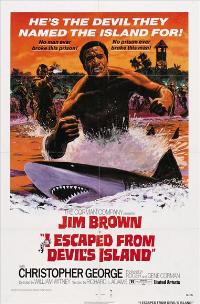
Just a few days ago I reviewed 1973's Papillon starring Steve McQueen and Dustin Hoffman, a story about one man's continuing desperate attempts to escape from the French Guiana penal system in South America.  It's a big movie with its two Hollywood stars and generally has a polished, professional look to it.  It has the feel that you're watching what a movie should be.  So what if you took out the good acting, music, script and general sense of talent with a similar story?  That's 1973's I Escaped From Devil's Island.

Director/producer extraordinaire Roger Corman was one smart cookie, making a career out of one-upping the major studios. So when news hit Hollywood that Papillon with McQueen and Hoffman was being released, Corman and his studio raced to film and finish this epically bad B-movie and get it in theaters first.  Well, he accomplished his goal, 'Devil's Island' reaching theaters a month before Papillon.  But you know what?  Timing only means so much.  Quality helps too regardless of the date released.  This is an awful movie with the lowest of production values, a story that meanders around like it's confused, and a general feel of extreme boredom.  Enough for you?

It's in the 1910s in French Guiana on Devil's Island, and prisoner Lebras (Jim Brown) is about to be sentenced to death via the guillotine.  But right as the blade is about to fall, Lebras is saved as his death sentence is commuted to life in prison.  For this man, it means the same thing, and he goes about preparing his escape.  Everything is stacked against him because no one has ever successfully escaped from Devil's Island.  But with help from a trio of fellow prisoners, Devert (Christopher George), a Socialist, Jo-Jo (Richard Ely), a gay pickpocket, and Dazzas (James Luisi), Lebras puts his plan into effect. Battling everything the jungle has to offer, the quartet desperately runs, hoping to reach freedom before vicious guards and trackers catch them, or worse, Mother Nature dispatches them.

I feel kind of stupid even writing that much about the plot from a movie where the title gives everything away.  Some reviews I've read point to the movie being pure entertainment, no pretensions about being anything else.  Maybe I was watching the wrong movie, but I was bored to tears.  Filmed on an extremely low budget, 'Devil's Island' is certainly mimicking the much better Papillon with everything from story and sub-plots to the clothes the prisoners and guards wear.  But shot on location in Acapulco, this one reeks of cheapness.  I've said in the past low budget isn't a bad thing, and I stand by that statement, but when a movie is this bad it's hard to defend.

So with a B-movie and its lower standards, Corman and director William Witney basically get away with murder.  This movie has it all...excessive cursing, graphic violence with bright red fake blood included, gratuitous nudity, and a feel of out and out nastiness from start to finish.  The guards are sadistically evil with no redeeming qualities (Richard Rust and Eduardo Rosas Lopez play the worst offenders of guards), half the prisoners are flamboyantly gay and still manage to find lipstick in the South American jungle, and each and every prisoner is ready to turn on the other at any moment.  Even with an exploitation movie, I was somewhat surprised by the content that made it through the censors.  This is a coarse, never subtle B-movie that if nothing else certainly pushes the limits of decency.

Browsing through movies you can watch through Netflix's site, I stopped on this one because I liked the two stars, former NFL star Jim Brown and Rat Patrol star Christopher George.  Both actors are certainly slumming it here.  Brown was never an actor's actor, never in a whole lot of "classic" movies.  He made movies that fans liked and kept them entertained.  This part at least tries to be entertaining, but with a lack of any coherent script to unite things, Brown's character, Ledras, is not given any sort of background or back story.  He growls a lot and does his fair share of fighting and bedding down the ladies.  George has the more interesting of the parts, a leader of a Socialist group of prisoners, but that sub-plot is dropped almost as soon as it's brought up.  The only other name actor I recognized was Paul Richards who plays the one-armed prison commandant who mumbles his way through his part.

So if you're still reading, hopefully by now you've figured out this is an awful excuse of a movie.  There are no real redeeming qualities anywhere in sight, and nothing really to recommend at all.  The music by composer Les Baxter is laughably bad and out of place, mixing cliched action sounds with a smooth, cool jazz score. I think the weirdest thing I can say about this movie is a unique form of a torture I'm familiar with, but have never seen in a movie.  A guard goes after a prisoner and gives him a tittie twister, and not a quick one. We're probably talking a minute or two, on-screen and in sight all the time.  Yes, that's all I can recommend.

I Escaped from Devil's Island <---clip (1973): */****    

Monday, December 6, 2010

Gallipoli

Time to get a little deep, a little thoughtful with this movie review (or at least the beginning).  I don't believe there is a smart way to fight a war dating back through history.  For hundreds of years, opposing armies stood in open fields across from each other and fired point blank into the others' ranks.  How anyone stood there staring 100 yards away at a wall of rifle and musket fire baffles me.  That was the gentlemanly way to fight though, and no one thought anything of it.  But years passed and technologies advanced so in World War I with armies using automatic weapons and machine guns, the strategies didn't advance.  Waves of soldiers jumped out of trenches and charged across open fields into a living hell of bullets and explosions.

Maybe because visually trench warfare isn't the most visually interesting thing to watch there have not been many movies made about World War I.  The ones that are out there are typically very good, including 1981's Gallipoli. It's hard to peg this one as a war movie though because it does not focus exclusively on the fighting that took place.  It is a patient movie that takes its time introducing two characters before getting them into the army.  But once director Peter Weir gets where he wants to, the movie really picks up steam as it leads to one of the more memorable finales I've come across in a war movie, especially a striking last shot that catches you off guard in its execution.

It's 1915 in western Australia and young Archy Hamilton (Mark Lee) is training as a sprinter and quickly making a name for himself as he climbs up the ranks, winning race after race. But the constant news of the war in Europe has made an impact on Archy, and after a win at a highly touted regional race, he travels to Perth with another young runner, Frank Dunne (Mel Gibson), and joins the army, the Australian and New Zealand Army Corps (ANZAC). The two friends are assigned different units, but after weeks of training their destination will be the same, the Gallipoli peninsula, where the fighting has bogged down into costly trench warfare.  The British, Australians, and New Zealanders have been cornered though against the defending Turkish forces, and both Archy and Frank know what could await them across the battlefield.

Directing less than 20 movies, Weir has nonetheless developed a reputation for making high quality, professional movies that typically deliver a message without hitting viewers over the head with that message.  That's why Gallipoli can be considered an anti-war movie, but not an obvious one.  For almost an hour, the war is mentioned and never seen, more of an idea than anything else.  Weir wants us to get to know these two main characters, and the story flows along at its best when they're together.  When separated, the movie bogs down a bit, including a long, unnecessary scene where Gibson's Dunne and his fellow soldiers explore Cairo that doesn't go anywhere.  The pacing can be frustrating at times because Weir clearly knows where he wants his story to end up, but not always how to get there.

Where Weir wants to end up is the Gallipoli campaign (a condensed version obviously) where thousands of lives were pointless wasted in suicidal charges that produced no tangible results.  Over the movie's last 20 minutes, Archy and Frank's unit is assigned one of these charges but thanks to some miscommunication end up having to go over the top of the trenches without artillery support directly into a line of waiting Turkish soldiers.  Assigned duties as a runner, Frank has orders that could halt the charge but only has seconds to do it in.  Watch the ending HERE with obvious spoilers. The race against time should have you on the edge of your seat, and that coupled with the images of soldiers preparing to die, leaving their prized possessions behind, writing a last letter is a striking contrast.  It builds to a final shot that stuck with me long after the movie was over, a tribute to Weir's ability behind the camera.

Two years removed from the first Mad Max movie, Gibson was on his way to becoming a huge star, but he wasn't quite there yet.  Besides that he looks like he's about 10 years old (he was 25 at the time), the part is a sign of things to come concerning his acting ability.  He's got a presence you just can't teach, and a charisma that has you on his side from his first introduction.  I wish I could say the same for Mark Lee, his onscreen counterpart.  It isn't a particularly good or bad performance, instead it's just there.  Lee never gives us a reason to have any interest in this character.  Translate that into any scene where he shares time with Gibson, and he's overmatched.  If they're together, you're watching Gibson and not Lee.  Other worthwhile supporting parts include Robert Grubb, Tim McKenzie and David Argue as three of Frank's friends who also enlist, and Bill Hunter as Major Barton, an Anzac officer caught in between what he owes his men and the orders he's been given from above.

One other thing particularly jumped out at me, the music.  It's an odd 1980s mix of electro synthesizers and classical opera, some of which you could hear in the ending clip provided before.  The odd combination really shouldn't work because it's just too different, but somehow it does.  It can sound out of place, but the music still somehow sets the mood and tone as needed.  Who woulda thunk it?  Not this guy, but it's another positive in an underrated WWI movie.

Gallipoli <---trailer (1981): ***/****

Sunday, December 5, 2010

The Angel Wore Red

I've always enjoyed reading about history, but certain times, incidents, conflicts, and even eras have passed me by.  I just never read or learned much about some things more than others.  High up on that list is the Spanish Civil War of which I know little more than Spain had a Civil War, and an awareness of controversial general Francisco Franco. Part of the problem with major events in history I'm curious about is where to even start?  There's so much going on, and countless books to choose from.  Well, it may not count as an official introduction to the Civil War, but 1960's The Angel Wore Red takes place with the conflict as its backdrop.

I was surprised reading reviews at the IMDB that this is a generally panned movie.  I'd never even heard of it before it aired on TCM as part of an Ava Gardner tribute despite a pretty impressive cast. Complaints ranged from bad camera technique to awful dubbing to something as simple as the movie being too dark to be able to see anything.  If that's important to you, seeing.  Now, I'm not expert when it comes to movies, and I typically just try and enjoy the story.  A movie has to be pretty awful for me to be critical of many things as long as I'm entertained.  So is this a classic? By no means, but I liked it, and it's certainly a change of pace detailing a little told story.

Disillusioned with the direction the Catholic Church is taking and struggling with his own faith, young Spanish priest Arturo Carrera (Dirk Bogarde) leaves his position in the church.  His timing is horrible though as a rebellion breaks out the day he leaves with priests an easy target of the revolutionaries.  He seeks help from a prostitute, Soledad (Gardner), who isn't aware he's a priest, but Arturo eventually ends up arrested and thrown in jail to await execution.  An American newsman, Hawthorne (Joseph Cotten), intervenes though, convincing the rebels that a priest's presence could smooth over objections some of the troops are having. With concerns over Soledad's safety, Arturo goes along with the plan as the violence escalates, much of it revolving around a missing religious relic that both sides want to get their hands on.

Now with little knowledge of the Spanish Civil War and its background, I will say this is a poor introduction.  The revolution is obviously the backdrop to the story, but there's little explanation of what is actually going on with the exception of a few names thrown around here and there; notably the Socialist party and I think Franco once or twice.  Basically, I was confused with what was actually going on throughout the story, and it never really clears up.  It isn't a huge roadblock because once you get involved with the story you know the characters are in danger, and that's enough motivation.  Still, when I watch a historical movie I like to have some idea what's going on, but maybe that's just me.

What did work with the otherwise confusing story was a sub-plot that dealt with faith on both an individual level and on a larger scale that faith can have an impact on large, powerful groups of people.  Before a Spanish cathedral is destroyed, the cardinal saves a religious relic that's long been a part of Catholic history; a drop of blood believed to be from St. John.  It's believed that whoever has possession of the blood cannot be defeated so naturally both sides want control of it.  A diminutive priest (Aldo Fabrizi) who knows its location delivers a powerful, very moving monologue about the power of faith and how it can drive people to do things differently than they normally would have, putting themselves in the face of danger because they believe they will be all right. Amidst all the criticism of the movie as a movie, this sub-plot is untouched and the high point of the movie.

So two main characters are a Spanish priest and a young Spanish prostitute.  Naturally, I'd assume an English actor who doesn't look Spanish, and an American actress who could maybe pass as Spanish would play those two roles. Jokes aside though, Bogarde and Gardner are the least of the movie's worries.  Thankfully Bogarde doesn't attempt any hokey accent even if it does sound odd to listen to a Spanish priest speak with a very English accent.  Gardner plays a role she so often did, a woman with a reputation.  She plays these parts so well you can take it for granted at times what a good actress she was.  The disillusioned priest and the prostitute fall for each other in a relationship that never feels forced or unnecessary. They have a definite chemistry together that does a good job of anchoring the movie.

Looking at the criticisms are they fair looking back on the movie?  Yeah, I guess so.  The dubbing does seem odd at times -- especially Vittorio De Sica as General Clave -- and the movie is dark visually where it can be hard at times to make things out through the shadows.  But watching the movie, none of those things truly bothered me.  I was aware of them, yes, but that's it. Cotten ends up being the cliched American newsman (even wearing an eye patch) who delivers a cliched narration about war and how awful it is.  So as I write all this, I'm thinking this is all coming across as too negative, but I did like the movie mostly because of Bogarde and Gardner.

The Angel Wore Red <---TCM trailer (1960): ***/****

Saturday, December 4, 2010

Papillon

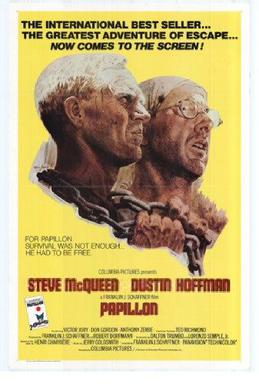
When it comes to my favorite movie stars/actors, three come to mind in no particular order, John Wayne, Steve McQueen and Clint Eastwood.  I go through phases where I watch five or six of their movies really quickly, and I can always go back to these movies on repeated viewings.  At some point I realized it's somewhat odd my three selections because as big a star as all of them were, the trio all dealt with a similar criticism over their careers and in the case of Wayne and McQueen, even after their deaths.  Through their movies, critics claim they always played a variation on themselves, or in simpler terms, they weren't acting. They were just being themselves.

I think it's a ridiculous claim for all three stars, especially McQueen.  When I've talked to people who think he wasn't much of an actor -- more of a presence than anything -- the first movie I usually bring up is 1973's Papillon (with The Sand Pebbles close behind). Based on the real-life exploits of Henri Charriere, the deeply brooding, incredibly dark movie gives McQueen a chance to get deep into his own personal demons in a performance that you can't take your eyes off of. There are extended scenes and sequences that could serve as an example of how to dominate a movie doing very little at all.  It is by no means an easy movie to sit through, one that makes you incredibly uncomfortable at times, but one worth watching.

Convicted in a French court for the murder of a pimp, Frenchman Henri Charriere (McQueen) is sentenced to life in prison in the French Guiana prison system in South America, a notorious system where diseases, horrific conditions, sadistic guards, and a short life expectancy await him. Aboard the ship bound for the prison, Henri -- known as Papillon because of the butterfly tattoo on his chest -- meets Louis Dega (Dustin Hoffman), a fellow Frenchman and an infamous forger responsible for thousands of families losing their life savings. For a price, Papillon offers to serve as Dega's bodyguard because the little forger is a target for his money.  The two form an unlikely friendship as they near French Guiana, but no matter what awaits them, Papillon -- still claiming his innocence -- has no intention of staying long. Escape is on his mind, and no matter what the system does to him, he intends to make it out.

Charriere's autobiography is an extremely difficult book to read (I've tried twice and gotten no further than 100 pages) so formerly blacklisted screenwriter Dalton Trumbo has his work cut out for him. With a movie that clocks in at 151 minutes, his screenplay gets a chance to breathe.  It is still at times a frustrating movie because not everything is spelled out for us as viewers.  There are jumps in story, characters drift in and out, and over a decade has to be covered in the two and a half hours.  But it's all part of the package here with a finished movie that leaves you wanting more.  It is an eerily beautiful movie through all its depictions of what the human body and mind can survive when pushed to its absolute limit.

Up to this point in his career, McQueen had made a name for himself by playing the loner, the rebel, the anti-hero so it isn't a stretch for him to play a convicted murderer desperately trying to escape prison.  But that's too simplistic a description because this performance is so much more.  Charriere is a French safecracker who acquired a reputation in the Paris underworld as a man who could be trusted.  As he prepares for this new phase in his life though, he not only looks ahead in preparation for awaits him but what he's leaving behind.  Two quick dream sequences -- incredibly moody, unsettling scenes -- show a man who regrets how he got to this point, including one perfect line reading when a court says he's been found guilty of a wasted life.  Watch it HERE. McQueen's face drops, knowing the statement is true, and says softly 'Guilty.'

While his whole performance is worth watching and recommending over and over again, one specific scene comes to mind.  Captured after a failed escape attempt, Papillon is sentenced to two years in solitary confinement.  Watch part of it HERE. From 5:25 on, watch a true actor do his job as good as humanly possible.  In a cell about four feet across and eight feet long, there is nothing to distract from McQueen in the scene. This is a man at his absolute lowest who just won't give up, won't stop trying to survive when it would be so much easier to just lie down and stop. We're watching a man slowly losing his mind, slowly disintegrating right in front of us, and it is tragic to witness it.  As good as McQueen was in The Sand Pebbles, I don't know if he was ever stronger than he was right there in that solitary cell in Papillon.

So McQueen's great, and that's it, right?  Not so fast.  In a role that could have been easy for him to get tossed aside, Dustin Hoffman delivers a subtle, very moving part as Louis Dega, the smallish in stature but incredibly intelligent forger who becomes friends with Papillon.  Hoffman was on his way to being one of Hollywood's strongest, most gifted actors, and this part is definitely one that allows him to show off his many talents.  As for the rest of the cast, Don Gordon, Anthony Zerbe, Woodrow Parfrey, and Robert Deman all impress too with smaller parts. I also have to mention Jerry Goldsmith's musical score, especially the main theme (listen HERE), one of the composer's all-time best scores.

Papillon <---trailer (1973): ****/****
   

Friday, December 3, 2010

The Crimson Kimono

Ahead of its time when it was released does not necessarily mean a movie will age well over the years.  What's new or innovative whether in film-making techniques or types of storytelling in the 1960s or 1970s is almost certainly not exciting or unique some 40 years later.  This can give a movie some cult status as fans embrace the nostalgia, but there's got to be something else for me to latch onto.  That's my main problem with 1959's The Crimson Kimono.

From director Sam Fuller comes this noirish detective story that pushed some late 1950s boundaries when it came to on-screen relationships.  No, we're not talking hardcore love scenes or anything, instead we're dealing with something that many might consider even more controversial....pause for dramatic effect...interracial relationships!!!!  Pretty scandalous, huh?  I guess it's an issue for some people, and in 1959 you can understand why it would have been controversial.  I didn't even think twice about the ending, but reading some reviews I was completely caught off guard by the then-scandalous ending.  You'll have to decide for yourself, but a supposedly controversial ending was the least of this movie's troubles.

One night after finishing a show, a stripper is murdered in Los Angeles on a busy street but no one saw who did it.  Called in to investigate the murder, detectives Charlie Bancroft (Glenn Corbett) and Joe Kojaku (James Shigeta) try to piece the evidence together. A handful of paintings with an artist's signature is the only clue so they manage to track down Chris (Victoria Shaw), a pretty co-ed at USC who drew the paintings. Her description of the possible murderer puts them on the right path, but that's the least of their problems.  Staying involved with the case as it unfolds, both Charlie and Joe fall hard for Chris.  So now instead of just worrying about tracking down the killer, the two detectives are wrapped up in the worst thing possible, the love triangle!

Fuller does a great job filming the movie in making Los Angeles another character in the story.  He films predominantly in the Japanese quarter of the city so you see (or at least I did) a part of LA that I was unfamiliar with.  We see the sub-culture, the shops, the businesses, the traditions as our two intrepid detectives go about solving a murder case.  Lots of great tracking shots through the city give the story a documentary-like feel as if it isn't a movie being filmed, instead a real police investigation.  It goes too far at certain points because the story feels tacked on, like Fuller realizing 'oh wait, we've got to wrap this up...okay wait, one more shot of a Japanese parade.' So as with most movies, it's the balance between good and bad, just finding that right middle ground.

In a career that covered a little over 30 movies, Fuller did his best work with stars who weren't superstars, Hollywood actors who were as tough as Fuller himself.  So not surprisingly, I was glad to see lesser stars like Corbett and Shigeta get a shot at starring roles.  Well, it's not all good.  Making his film debut, Corbett is pretty awful here.  He was typically at his best in supporting roles where his stern demeanor (some might call it stiff or wooden) didn't require him to carry scenes on his own. There are scenes where he's required to show emotion that sound more like a little kid lashing out at his parents more than a veteran detective on the case. Shigeta goes for calmer, cooler and smoother, and in the process almost puts you to sleep.  He speaks in a low mumble so it's nearly impossible to even hear him, much less be interested in the character.

There's potential with their background -- Korean War vets from the same unit turned detective partners -- but it gets lost in the shuffle of the love triangle and murder mystery.  Honestly, the murder mystery gets lost in the shuffle of the love triangle. Fuller almost completely disregards the drive and focus of the story at the expense of this semi-controversial love story between a white detective, a Japanese detective and a white co-ed.  What's worse is the portrayal of the Chris character.  Shaw is a pretty girl, but her character is awful.  She tells Charlie she'd be interested in seeing him post-investigation, makes out with him, and then doesn't understand why he's pissed when Joe professes his love for her, and she chooses him too.  I couldn't decide if it was poor writing or plain laziness, but it's bad regardless.  A love triangle is typically bad to begin with, and all these shenanigans don't help.

This builds to the finale when Charlie and Joe put their differences aside to oh yeah, catch the freaking killer.  Blah blah blah, someone gets caught, but the case leading up to it is so ridiculous with so many clues mysteriously jump from one clue to the next with most of it going unexplained how these two detectives actually got to that point.  Catch the bad guy, stare each other down, and Charlie lets his friend and partner take the girl.  The ending has Shigeta kiss Shaw passionately while Corbett walks away with drunken artist Anna Lee (decent in a supporting part).  An Asian man kissing a white woman? Let's hang him! By that point in the movie I was so frustrated it would have taken a lot more than that interracial kiss to impress me. It is available to watch on Youtube, start HERE with Part 1 of 8. 

The Crimson Kimono <---TCM clips (1959): * 1/2 /****

Thursday, December 2, 2010

Action in the North Atlantic

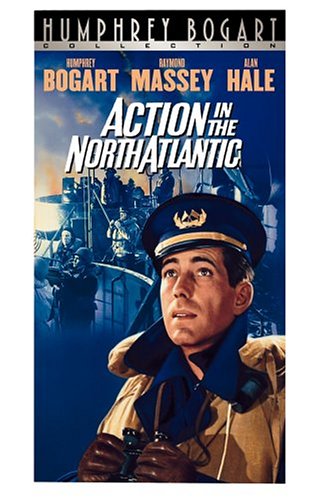
Early in World War II, one of the biggest issues facing United States involvement in the war was getting our troops, equipment and materiel across the Atlantic Ocean to the European mainland.  The problem wasn't the ships, there were plenty of those, but the German navy -- especially the U-boats -- which wreaked havoc on those ships, sending thousands of ships and even more men to the bottom of the ocean. But even as the sunk tonnage went up, the ships kept making the dangerous journey.  That's the story of 1943's Action in the North Atlantic.

Now for all you non-history buffs out there, 1943 was right in the midst of World War II when the war was still very much in the balance.  Hollywood did its best to turn out stories that would inspire on the home front and convince Americans that this was a war that needed to be won.  In other words, we're not talking a whole lot of subtlety here, just straight propaganda.  It would be interesting had this movie been made in the 1960s or even now in the 21st Century just to get a different perspective on the story.  But it didn't happen that way, and we get a movie that is very much a prisoner of the time it was made in.  Not always a bad thing.

Sailing to deliver a dangerous shipment of thousands of gallons of fuel, a ship of Merchant Marines commanded by Capt. Steve Jarvis (Raymond Massey) and first officer Joe Rossi (Humphrey Bogart) is attacked and sunk by a German U-boat.  Jarvis, Rossi and some of the crew survive and are picked up, welcomed home as conquering heroes.  It's not long before Jarvis gets a new ship with much of the same crew as they hope to help the war effort aboard the USS Seawitch.  Their first mission is an important one as they will sail as part of an immense convoy traveling from the US all the way to Russia with badly-needed supplies and materiel.  A convoy this big can't help but attract attention, and it seems like it will only be a matter of time before the Germans come around.

Dripping with propaganda and messages of hope, 'Atlantic' is a good example of the movies Hollywood churned out during the war.  The story itself is an interesting one that deserves to be told in an honest, straightforward manner.  Unfortunately, we get the portrayals of these American sailors as angelic men who could do no wrong, and their German counterparts as evil, sadistic bastards who laugh as they ram doomed Americans.  On the positive side, director Lloyd Bacon (Raoul Walsh is an uncredited director here) commits to this garbage all the way. It doesn't hit you over the head the way some early 1940s movies do in getting its message across.  Bogie's final monologue could have been too sappy, but in his hands it is the ideal capper to a solid story.

Now at 126 minutes final running time, 'Atlantic' could use some trimming.  With much of the story taking place at sea, we get some pretty seamless shots of actual ships sailing on the ocean with some well-handled miniature shots.  Of course, that only goes so far.  Stock footage is overused to the point where you can fast forward through large chunks of the story without missing a beat.  The movie is obsessed with showing you what life on a ship is like, but it gets tedious, and it does so quickly.  There's also the portrayal of the German U-boat chasing the Seawitch.  I'm guessing all-told, there is probably about 20-30 minutes of the Germans in the 2-hour movie.  They even speak German...but with no subtitles!  Do you know how boring a movie gets when you can't understand a thing anyone is saying? It's a 2-hour movie, and I watched it in about 90 minutes because the fast forward got a workout.

The saving grace is the cast, including one of my favorites in Bogart.  The man was a chameleon when it came to the roles he could play, and he shows it off here.  This isn't a part that requires a ton of heavy lifting, but Bogart handles it as smoothly as possible. He gets a love interest (easy on the eyes Julie Bishop) that feels tacked on and doesn't serve a real purpose, but Bogart also gets to play the up-and-up hero for a change too.  No concerns if he's the anti-hero just waiting to reveal himself, Bogie is the all-American hero here.  Massey is all right as Capt. Jarvis, but he doesn't have to do much other than growl and talk about how badly he wants to get revenge on the Germans.  I'm sure 1943 audiences ate it all up.

Working from a John Howard Lawson screenplay, 'Atlantic' at its best is when it is dealing with the daily lives of the crew, merchant marines who weren't officially part of the Navy but nonetheless did their best to aid the war effort. The interactions among the crew and the relationships, the friendships, the arguing that develop feel authentic from the start, and you like this motley group of sailors who include Alan Hale, Dane Clark, Sam Levene, Peter Whitney, and Dick Hogan. I don't know what it's like to work and live on a ship for days, weeks and months at a time, but this felt real to me, and not forced.  So in spite of its flaws, I'll still recommend this WWII flick.

Action in the North Atlantic <---trailer (1943): ***/****