It's one of those things. Good movie (some would say great to classic), impressive cast, a loyal following and positively reviewed almost across the board. Then.....then, you watch it, and it just isn't very good. All in the eye of the beholder, huh? Maybe I missed something, maybe I just didn't think it was very good, but here's 1983's The Big Chill.
A group of friends who attended the University of Michigan in the late 1960s have drifted apart over the years, some starting families, others pursuing careers, some doing both. They're about to be brought back together under far from ideal conditions. One of the friends, Alex, has committed suicide, the rest of the group all returning to Alex's hometown in Michigan for the funeral and service. For some, they see friends they haven't seen or talked to in years, but the relationships are still there, the bonds, the friendships, rivalries, all coming back in a flash. Staying together in one house over the weekend, the group of friends starts to see that everything isn't so rosy. Sex, drugs, music and some good old-fashioned bonding among longtime friends. Let the craziness and kookiness commence.
This was the first time I saw director Lawrence Kasdan's film that's earned a reputation over the years as one of the seminal movies of the 1980s. This is a story about a generation that grew up with Vietnam, hippies, Watergate, the drug culture, one of the most turbulent times in American history. Now in the early 1980s, they're all grown-up, their past craziness just that, a thing of the past. They have jobs, careers, family (for the most part). It is a story ripe with potential, one house serving as the setting for almost the entire movie. The soundtrack is pretty epic featuring everyone from The Rolling Stones to Marvin Gaye, The Temptations to Procol Harum and a whole lot in between. Style, interesting premise, lots of talent in the cast....and, yeah, I didn't really like it much at all.
For starters, let's talk about the very talented cast. There's Kevin Kline and Glenn Close as a married couple with a checkered past that has been left in the past, Tom Berenger as the big celebrity, the TV star with a hugely successful Magnum P.I.-esque show, JoBeth Williams his married crush who's having some marital struggles, Jeff Goldblum as a goofy journalist, William Hurt as the drug-addled Vietnam vet who struggles with...well, everything, Mary Kay Place as the single 30-something who has her biological clock ticking loudly, and then Meg Tilly as Alex's girlfriend who he'd been seeing for about three months. Some impressive names, but my goodness, I just didn't like these characters. We're thrown into the story without much in the way of introduction or background so I struggled immediately to keep up with what was going on. Yes, we learn some things with each passing dialogue scene (and there's plenty), but the early struggles proved to be the movie's doom.
Watching this movie in 2014, it's easy to see the influence 'Chill' has had on countless films and television shows in the 30 years since its release. Any movie about old friends reuniting has to at least tip its cap to this 1983 film in one way or another. As for my next statement, I say this as someone who grew up in a generation that complains about just about everything. But really, has there ever been a movie with so many whiny individuals? Is life just so awful? As they reunite, catch up after years apart, this group of friends proceeds to bitch and moan about how tough life is, how life didn't turn out how they thought it would, how things didn't develop as they thought they would. Boo-freaking-hoo. The entire second half of the movie plays like one big sob story. It helps to have some initial sympathy for these characters, but it's just never there. Wait, life is tough?!? Who knew? Get over yourself.
What was original in 1983 plays like cliched now. So through no fault of its own, 'Chill' was working against it immediately. At one point, the crew dances together as they clean up and do the dishes after dinner. Woo-hoo! Bonding! If it was meant to show them bonding again, we get it, but it feels forced and goofy. The story up until this point is based in some sort of reality, but the last 30 minutes or so derails with some just odd decisions. We're talking painfully awkward decisions that I just don't see a lot of real-life friends making. By the end though, I was beyond worrying too much. I went in with modest expectations but came away very, very disappointed. Maybe in five or six years when I'm in my mid-30s, I'll appreciate it more. For now, I just don't get the appeal.
The Big Chill (1983): * 1/2 /****
The Sons of Katie Elder
"First, we reunite, then find Ma and Pa's killer...then read some reviews."
Tuesday, April 22, 2014
Monday, April 21, 2014
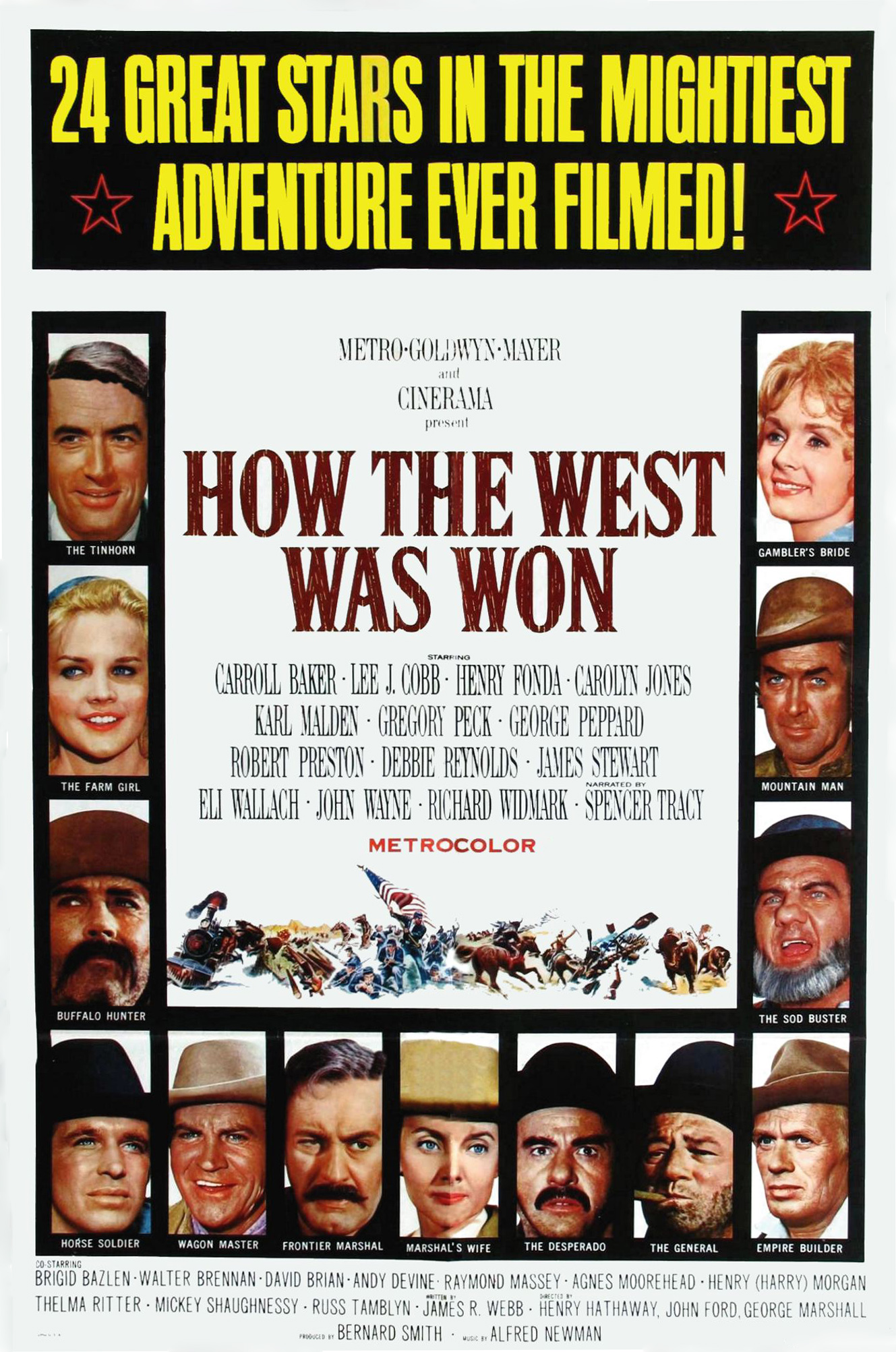
How the West Was Won
In the age of the epics -- the 1950s and 1960s -- some just stand above the rest. It's the stories, the cast, the scope. I don't love 1962's How the West Was Won but as far as epics go, there are very few in its neighborhood. There are obvious flaws, but when it works, it works in a big way. An impressive all-star cast, a story about the development of the American west and a shooting technique that is must-see. That's a winning formula.
A 162-minute film is broken up into five separate segments, the story following the Prescott-Rawlings family as it moves west and settles between the 1840s and the 1880s. It was directed by three different directors and covers a ton of ground. And away we go!
1. The Rivers (directed by Henry Hathaway): It's the 1840s, and the Prescott family, led by patriarch Zebulon (Karl Malden), is moving west and looking for a new life. In Zebulon's family is two daughters, Eve (Carroll Baker), looking for a new life in the west, and Lillith (Debbie Reynolds), wanting to stay in the far-more civilized East. In their dangerous travels on the rivers, they also meet Linus Rawlings (James Stewart), a mountain man with a canoe full of pelts.
Also starring: Lee Van Cleef, Walter Brennan, Agnes Moorehead, Brigid Bazlen.
2. The Plains (directed by Hathaway): Having worked for years on her own as a singer and dancer, Lillith Prescott (Reynolds) has just inherited a gold mine in the wake of the California gold rush. She heads west on a wagon train led by trail driver Richard Morgan (Robert Preston) with a gold-seeking gambler, Cleve Van Valen (Gregory Peck), also along too.
Also starring: Thelma Ritter.
3. The Civil War (directed by John Ford): The war between the states in its early months, young Zeb Rawlings (George Peppard) leaves home with the blessing of his mother, Eve, to join the Ohio volunteers in the fighting. Like so many others, he thinks the war will be full of glory and be over quickly. Zeb finds out how very wrong he is at the bloody battle of Shiloh.
Also starring: John Wayne (as General Sherman), Russ Tamblyn (as a Confederate deserter), Harry Morgan (as General Grant), Andy Devine, Ken Curtis, Raymond Massey (as Abraham Lincoln).
4. The Railroad (directed by George Marshall): In the years following the Civil War, railroad companies race across the U.S. to link the two coasts. Now in the cavalry, Zeb Rawlings (Peppard) finds himself balancing out what his duty requires of him with what he knows is right, the railroad, including brutal supervisor Mike King (Richard Widmark), pushing the Arapahoes to their limit.
Also starring: Henry Fonda as Jethro Stuart, a former mountain man.
5. The Outlaws (directed by Hathaway): Having left the cavalry behind, Zeb Rawlings is now a family man with two kids, now trying to leave his profession as a lawman behind. He receives a letter from his aunt, Lillith (Reynolds), and readies the family to move. As they travel though, Zeb runs into Charlie Gant (Eli Wallach), a notorious outlaw gunning for Zeb.
Also starring: Lee J. Cobb, Carolyn Jones.
This is a movie that's simply put, BIG. It was filmed in Cinerama, three cameras filming each scene and then splicing the action together. The result? An immense look at the expansion of the west. Shots look like panoramic paintings, putting a whole new scope on the growth and development of the American west. It is a beautiful movie. Certain sequences especially stand out -- the camera on a raft trying to survive river rapids, an Indian attack on a wagon train, a stampeding buffalo herd trampling a railroad camp, a runaway train during an attempted robbery -- over the course of the movie, but visually there just isn't a weak spot. I love composer Alfred Newman's score -- listen to an extended sample HERE -- as it gives a moving background to the story. Countless gorgeous filming locations, providing a great backdrop while also transitioning from segment to segment.
It had been years since I watched this movie straight through in one sitting before my recent revisit of this 1962 epic. As you compare the five separate segments, I don't think it's really in question which one is the strongest. It's John Ford's Civil War segment, doing in 20 minutes what entire movies couldn't do in bringing the Civil War to life. Quick, dark, visually striking and unsettling, it is a gem of a sequence, especially Peppard meeting Tamblyn's Confederate deserter after the battle. The second strongest segment for me is the opening 'Rivers' with Stewart, Baker, Reynolds and Malden all leaving a positive impression. All five segments could be stretched out to a feature length film on their own, but these two especially stand out. They get their message across in a quick window and in both cases left me wanting more. Kudos to Ford and Hathaway for their work here.
What struck me more on the rewatch was the other three segments. They are by no means bad segments, but they're just not as good as the other two. I've always thought the weakest was the Plains segment, things feeling too rushed in general. The same qualifies for the Railroad and Outlaws portions. By the time you take away the Entr'Acte, intermission, and Finale music, we're looking at a movie with five segments covered in about 150 minutes (give or take). None of these three are given a chance to breathe to the point they feel downright rushed. As for some other positives? I loved the transitional scenes -- narrated by Spencer Tracy, directed in uncredited fashion by Richard Thorpe -- that set things up, explaining how America has changed, how its people change. These quick montages provide the heart of the movie, almost like a documentary in some ways. Like any movie that tries to accomplish so much, there's good and bad. The positives -- especially the Civil War middle -- is enough to outweigh the negatives thankfully.
One of my biggest worries in reviewing this 1962 epic was that the cast is too big. There's no way I was gonna be able to get all those names tagged with a 200-character limit. Who stands out? Stewart i excellent as Linus Rawlings, Fonda is good in a quick part as Jethro Stuart, and Baker is very strong too. The best parts though are Debbie Reynolds as Lillith and George Peppard as Zeb, the two hearts of the family. One or both is in every segment, the audience seeing them age, learn and adapt as America grows with them. Their scenes together in the Outlaws portion ring especially true. However you cut it though, just an impressive cast from top to bottom, one of the best ever assembled for a Hollywood film.
A doozy of a movie for what it's trying to accomplish. It falls short at times, but this is a movie worth watching for what it represents alone. This is a throwback film, a true epic that strives to be something great. If it doesn't live up those high hopes, so be it. The effort is admirable, a fascinating story of America growing up over an extremely turbulent portion of its history. Oh, and Debbie Reynolds singing A Home in the Meadow (listen HERE) is a truly beautiful song, a fitting one for the movie.
How the West Was Won (1962): ***/****
A 162-minute film is broken up into five separate segments, the story following the Prescott-Rawlings family as it moves west and settles between the 1840s and the 1880s. It was directed by three different directors and covers a ton of ground. And away we go!
1. The Rivers (directed by Henry Hathaway): It's the 1840s, and the Prescott family, led by patriarch Zebulon (Karl Malden), is moving west and looking for a new life. In Zebulon's family is two daughters, Eve (Carroll Baker), looking for a new life in the west, and Lillith (Debbie Reynolds), wanting to stay in the far-more civilized East. In their dangerous travels on the rivers, they also meet Linus Rawlings (James Stewart), a mountain man with a canoe full of pelts.
Also starring: Lee Van Cleef, Walter Brennan, Agnes Moorehead, Brigid Bazlen.
2. The Plains (directed by Hathaway): Having worked for years on her own as a singer and dancer, Lillith Prescott (Reynolds) has just inherited a gold mine in the wake of the California gold rush. She heads west on a wagon train led by trail driver Richard Morgan (Robert Preston) with a gold-seeking gambler, Cleve Van Valen (Gregory Peck), also along too.
Also starring: Thelma Ritter.
3. The Civil War (directed by John Ford): The war between the states in its early months, young Zeb Rawlings (George Peppard) leaves home with the blessing of his mother, Eve, to join the Ohio volunteers in the fighting. Like so many others, he thinks the war will be full of glory and be over quickly. Zeb finds out how very wrong he is at the bloody battle of Shiloh.
Also starring: John Wayne (as General Sherman), Russ Tamblyn (as a Confederate deserter), Harry Morgan (as General Grant), Andy Devine, Ken Curtis, Raymond Massey (as Abraham Lincoln).
4. The Railroad (directed by George Marshall): In the years following the Civil War, railroad companies race across the U.S. to link the two coasts. Now in the cavalry, Zeb Rawlings (Peppard) finds himself balancing out what his duty requires of him with what he knows is right, the railroad, including brutal supervisor Mike King (Richard Widmark), pushing the Arapahoes to their limit.
Also starring: Henry Fonda as Jethro Stuart, a former mountain man.
5. The Outlaws (directed by Hathaway): Having left the cavalry behind, Zeb Rawlings is now a family man with two kids, now trying to leave his profession as a lawman behind. He receives a letter from his aunt, Lillith (Reynolds), and readies the family to move. As they travel though, Zeb runs into Charlie Gant (Eli Wallach), a notorious outlaw gunning for Zeb.
Also starring: Lee J. Cobb, Carolyn Jones.
This is a movie that's simply put, BIG. It was filmed in Cinerama, three cameras filming each scene and then splicing the action together. The result? An immense look at the expansion of the west. Shots look like panoramic paintings, putting a whole new scope on the growth and development of the American west. It is a beautiful movie. Certain sequences especially stand out -- the camera on a raft trying to survive river rapids, an Indian attack on a wagon train, a stampeding buffalo herd trampling a railroad camp, a runaway train during an attempted robbery -- over the course of the movie, but visually there just isn't a weak spot. I love composer Alfred Newman's score -- listen to an extended sample HERE -- as it gives a moving background to the story. Countless gorgeous filming locations, providing a great backdrop while also transitioning from segment to segment.
It had been years since I watched this movie straight through in one sitting before my recent revisit of this 1962 epic. As you compare the five separate segments, I don't think it's really in question which one is the strongest. It's John Ford's Civil War segment, doing in 20 minutes what entire movies couldn't do in bringing the Civil War to life. Quick, dark, visually striking and unsettling, it is a gem of a sequence, especially Peppard meeting Tamblyn's Confederate deserter after the battle. The second strongest segment for me is the opening 'Rivers' with Stewart, Baker, Reynolds and Malden all leaving a positive impression. All five segments could be stretched out to a feature length film on their own, but these two especially stand out. They get their message across in a quick window and in both cases left me wanting more. Kudos to Ford and Hathaway for their work here.
What struck me more on the rewatch was the other three segments. They are by no means bad segments, but they're just not as good as the other two. I've always thought the weakest was the Plains segment, things feeling too rushed in general. The same qualifies for the Railroad and Outlaws portions. By the time you take away the Entr'Acte, intermission, and Finale music, we're looking at a movie with five segments covered in about 150 minutes (give or take). None of these three are given a chance to breathe to the point they feel downright rushed. As for some other positives? I loved the transitional scenes -- narrated by Spencer Tracy, directed in uncredited fashion by Richard Thorpe -- that set things up, explaining how America has changed, how its people change. These quick montages provide the heart of the movie, almost like a documentary in some ways. Like any movie that tries to accomplish so much, there's good and bad. The positives -- especially the Civil War middle -- is enough to outweigh the negatives thankfully.
One of my biggest worries in reviewing this 1962 epic was that the cast is too big. There's no way I was gonna be able to get all those names tagged with a 200-character limit. Who stands out? Stewart i excellent as Linus Rawlings, Fonda is good in a quick part as Jethro Stuart, and Baker is very strong too. The best parts though are Debbie Reynolds as Lillith and George Peppard as Zeb, the two hearts of the family. One or both is in every segment, the audience seeing them age, learn and adapt as America grows with them. Their scenes together in the Outlaws portion ring especially true. However you cut it though, just an impressive cast from top to bottom, one of the best ever assembled for a Hollywood film.
A doozy of a movie for what it's trying to accomplish. It falls short at times, but this is a movie worth watching for what it represents alone. This is a throwback film, a true epic that strives to be something great. If it doesn't live up those high hopes, so be it. The effort is admirable, a fascinating story of America growing up over an extremely turbulent portion of its history. Oh, and Debbie Reynolds singing A Home in the Meadow (listen HERE) is a truly beautiful song, a fitting one for the movie.
How the West Was Won (1962): ***/****
Friday, April 18, 2014
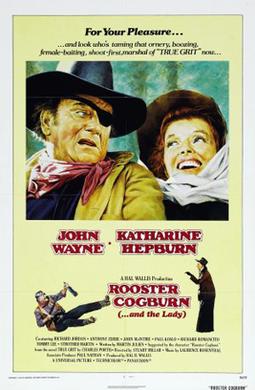
Rooster Cogburn
By the 1970s, there weren't too many bigger and better Hollywood legends than John Wayne and Katharine Hepburn. Both stars had been just that, stars, non-stop since the 1930s and by the mid 1970s were in the later parts of their careers. But even with all those classics films, classic roles and interesting pairings of stars, the duo had never worked together...until 1975's Rooster Cogburn, also known as Rooster Cogburn...and the Lady.
Still working as a U.S. Marshal, Rooster Cogburn (Wayne) is up to his old tricks again. Not too interested in how the law says he should bring suspects in, Cogburn has been suspended for his overzealous ways...for now. He's given his badge and title back if he promises to bring in a dangerous gang of killers led by a maniacal outlaw, Hawk (Richard Jordan). The outlaw's gang murdered an army convoy carrying nitroglycerin, shipments of rifles and a Gatling gun. Their goal? Knock off a federal depository up in the mountains. Cogburn is on their trail quickly, but he's got a problem. In Hawk's wake, the marshal finds an older woman, a missionary of sorts, Eula Goodnight (Hepburn), who saw her father and his mission almost wiped out by the gang. Cogburn hopes to bring her back to safety, but Eula has other plans. She intends to go with, helping bring her father's killers to justice.
I'm usually completely against sequels, especially when the first movie wraps up everything so nicely. That's the case with 1969's True Grit, a western that brought Wayne his only Oscar win for a long, distinguished career. It isn't a great western, but it has stood the test of time because of Wayne's scene-stealing part as Marshal Rooster Cogburn. This 1975 follow-up from director Stuart Millar takes the formula and takes it a step forward, pairing Wayne with Hepburn in a similarly scene-stealing part. Much the same way 'Grit' resonates, so does 'Rooster.' It's typical of many other late Wayne entries, straightforward and entertaining, likable, fun good guys versus dastardly bad guys, and just a lot of fun throughout. Laurence Rosenthal's score is solid, tweaking Elmer Bernstein's score from the original. Listen HERE for the theme. The Oregon locations go a long way too, the backgrounds for the shots providing a stunningly good-looking backdrop to the story.
Who are we kidding though? This is a movie that exists solely to put John Wayne and Katharine Hepburn together. The wait was worth it, the two Hollywood legends stepping to the plate in a big way. They make it look effortless. We learn some more about Rooster (including his first name), but he's still the same fat, one-eyed marshal who likes a good drink and is a tough as nails peace officer. Hepburn is not quite a spinster, but an older woman who looks to religion for answers, nagging Rooster about his drinking, his language, his boasting, a little bit of everything. The chemistry is on display from their first scene until the final scene. They argue, they bond, they talk about their pasts, finding there's plenty of differences between them, but there's also more similarities than they would have originally thought. Along for the trip is Wolf (Richard Romancito), an Indian boy in his teenage years, a capable rider who looks up to Rooster.
If you're going to have a great hero to lead the way, you need an equally bad villain to put in his way. In steps Richard Jordan, an underrated actor who never became a huge star. His Hawk is beyond intense, his upcoming robbery of a gold depository becoming almost an obsession. In some nice touches with Hawk and his gang, we learn about some past meetings with Cogburn. In his gang, look for Anthony Zerbe as Breed, a tracker/scout who used to ride with Rooster, now on the outlaw trail, and Hawk's maligned right-hand man, Luke, played by 1970s tough guy Paul Koslo. John McIntire makes a quick but memorable appearance as Judge Parker, the court representative who always has to deal with Rooster. Strother Martin hams it up in a one-scene appearance as McCoy, a cantankerous veteran of the sea now renting his raft for river crossings.
Heading into this movie, if you're looking for any sort of groundbreaking western, you're going to be disappointed. The focus is clearly on Wayne and Hepburn, the highpoints their scenes sitting around a campfire, talking while riding on a wagon, moving along the trail. The potential was there for a darker western with more shoot 'em up and gunplay, but for the most part Jordan as Hawk is underused. This is a good, old-fashioned western that plays like comfort food. Just sit back and enjoy this one.
Rooster Cogburn (1975): ***/****
Still working as a U.S. Marshal, Rooster Cogburn (Wayne) is up to his old tricks again. Not too interested in how the law says he should bring suspects in, Cogburn has been suspended for his overzealous ways...for now. He's given his badge and title back if he promises to bring in a dangerous gang of killers led by a maniacal outlaw, Hawk (Richard Jordan). The outlaw's gang murdered an army convoy carrying nitroglycerin, shipments of rifles and a Gatling gun. Their goal? Knock off a federal depository up in the mountains. Cogburn is on their trail quickly, but he's got a problem. In Hawk's wake, the marshal finds an older woman, a missionary of sorts, Eula Goodnight (Hepburn), who saw her father and his mission almost wiped out by the gang. Cogburn hopes to bring her back to safety, but Eula has other plans. She intends to go with, helping bring her father's killers to justice.
I'm usually completely against sequels, especially when the first movie wraps up everything so nicely. That's the case with 1969's True Grit, a western that brought Wayne his only Oscar win for a long, distinguished career. It isn't a great western, but it has stood the test of time because of Wayne's scene-stealing part as Marshal Rooster Cogburn. This 1975 follow-up from director Stuart Millar takes the formula and takes it a step forward, pairing Wayne with Hepburn in a similarly scene-stealing part. Much the same way 'Grit' resonates, so does 'Rooster.' It's typical of many other late Wayne entries, straightforward and entertaining, likable, fun good guys versus dastardly bad guys, and just a lot of fun throughout. Laurence Rosenthal's score is solid, tweaking Elmer Bernstein's score from the original. Listen HERE for the theme. The Oregon locations go a long way too, the backgrounds for the shots providing a stunningly good-looking backdrop to the story.
Who are we kidding though? This is a movie that exists solely to put John Wayne and Katharine Hepburn together. The wait was worth it, the two Hollywood legends stepping to the plate in a big way. They make it look effortless. We learn some more about Rooster (including his first name), but he's still the same fat, one-eyed marshal who likes a good drink and is a tough as nails peace officer. Hepburn is not quite a spinster, but an older woman who looks to religion for answers, nagging Rooster about his drinking, his language, his boasting, a little bit of everything. The chemistry is on display from their first scene until the final scene. They argue, they bond, they talk about their pasts, finding there's plenty of differences between them, but there's also more similarities than they would have originally thought. Along for the trip is Wolf (Richard Romancito), an Indian boy in his teenage years, a capable rider who looks up to Rooster.
If you're going to have a great hero to lead the way, you need an equally bad villain to put in his way. In steps Richard Jordan, an underrated actor who never became a huge star. His Hawk is beyond intense, his upcoming robbery of a gold depository becoming almost an obsession. In some nice touches with Hawk and his gang, we learn about some past meetings with Cogburn. In his gang, look for Anthony Zerbe as Breed, a tracker/scout who used to ride with Rooster, now on the outlaw trail, and Hawk's maligned right-hand man, Luke, played by 1970s tough guy Paul Koslo. John McIntire makes a quick but memorable appearance as Judge Parker, the court representative who always has to deal with Rooster. Strother Martin hams it up in a one-scene appearance as McCoy, a cantankerous veteran of the sea now renting his raft for river crossings.
Heading into this movie, if you're looking for any sort of groundbreaking western, you're going to be disappointed. The focus is clearly on Wayne and Hepburn, the highpoints their scenes sitting around a campfire, talking while riding on a wagon, moving along the trail. The potential was there for a darker western with more shoot 'em up and gunplay, but for the most part Jordan as Hawk is underused. This is a good, old-fashioned western that plays like comfort food. Just sit back and enjoy this one.
Rooster Cogburn (1975): ***/****
Thursday, April 17, 2014
Outbreak
Released way back in 2011, Steven Soderbergh's Contagion was one of the best movies I saw in 2012. A seemingly unstoppable virus is tearing its way across the world. Can it be stopped? Smart, well-written, well-acted and stylish, it was a great movie. Released 16 years earlier, 1995's Outbreak deals with a very similar story and formula. Where does it stand in comparison?
A longtime disease specialist/virologist working for the U.S. Army Medical Research Institute of Infectious Diseases (USARMIID), Sam Daniels (Dustin Hoffman) and his team have been sent to Zaire to deal with a new disease that wiped out an entire village. What they find is terrifying, a virus that replicates quickly, claiming victims within a 24-hour period. Daniels' crew manages to contain the disease within the village, taking samples and clearing out before the disease can spread. Just days later though, a patient in a hospital in Boston has the symptoms similar to the disease. Then there's another in California, and then a whole town. How did the disease spread so quickly? Can it be stopped before it wipes out thousands and maybe millions? Daniels and his team go to work, but there may be more at work within the government than they know trying to stop them.
From director Wolfgang Petersen, 'Outbreak' is a good example of a modern disaster film that doesn't have to resort to gimmicks to be good. When disaster films were at their most popular in the late 1970s and early 1980s, they became cliched quickly, trying to one-up each other one after another. That's not really an issue here, a pretty smart script laying out a situation that could really happen. Viruses and diseases are constantly evolving. Can the medical field and the government stay ahead of those evolutions? 'Outbreak' blends that intelligent premise with an all-star cast and lets things take off. For the most part, I liked it....for awhile. That's for a little later though. For now, here's some positives.
In much the same way I enjoyed Contagion, 'Outbreak' is at its best in dealing with the social implications involved here. We see how the USARMIID and the CDC respond, trying to react as quickly as possible. We see the government planning ahead for all possible contingency plans, however dark they may be. Petersen's got an eye for it, covering a ton of ideas and scenarios in relatively quick fashion. While there's a lot of characters and situations, it doesn't feel rushed. The disease spreads quickly, the virus jumping and developing quickly. It's all cut together at a lightning-pace, bouncing among all the different affected parties. Things take a turn for the dark when a California town is a breakout point, patients piling up at an alarming rate. The USARMIID, CDC, military and government descend on the town, other advances being made to track down the source. How did this disease spread? Those are the coolest moments, a frightening premise to think about in our current world.
Now for that all-star cast!!! It's interesting watching Dustin Hoffman do just about anything on-screen, and he's a great lead here. Unfortunately some of his character background is dealing with his recently divorced wife, Robby (Rene Russo), who's taken a job at the CDC. Oh, divorce drama! Still, Hoffman and Russo have a good chemistry. Rounding out Daniels' team are Kevin Spacey as Casey, the smart-ass, highly intelligent assistant who's worked for years with Daniels, and Cuba Gooding Jr. as Salt, a new recruit with an army and medical background but no field experience. Representing the government/military higher-ups, Morgan Freeman and Donald Sutherland play highly-ranked officers who know more than they're letting on (courtesy of a 1967 flashback to open the film we see). Also look for Patrick Dempsey as an unknowing spreader of the disease, a cool, quick and essential subplot to the story.
And there it is. A good, creepy, entertaining story that could have been based in some sort of reality. And then there's the last 45 minutes. Hoffman's Daniels becomes a superhero, Gooding Jr. his intrepid sidekick, the duo traveling all over California, Sutherland's evil general in hot pursuit, and all against the clock. There's helicopter chases, a trap for a cute, disease-ridden monkey, an evil general obsessed with something, taking over a TV news broadcast, a helicopter with an endless supply of fuel, and a big old shift in tone that goes from serious and dramatic to goofy and campy. The movie is still good, but the last third is pretty rough. We're not sure who makes it, and it all is resolved rather quickly in a flash. Could have been great in the end, but it's okay instead.
Outbreak (1995): ** 1/2 /****
A longtime disease specialist/virologist working for the U.S. Army Medical Research Institute of Infectious Diseases (USARMIID), Sam Daniels (Dustin Hoffman) and his team have been sent to Zaire to deal with a new disease that wiped out an entire village. What they find is terrifying, a virus that replicates quickly, claiming victims within a 24-hour period. Daniels' crew manages to contain the disease within the village, taking samples and clearing out before the disease can spread. Just days later though, a patient in a hospital in Boston has the symptoms similar to the disease. Then there's another in California, and then a whole town. How did the disease spread so quickly? Can it be stopped before it wipes out thousands and maybe millions? Daniels and his team go to work, but there may be more at work within the government than they know trying to stop them.
From director Wolfgang Petersen, 'Outbreak' is a good example of a modern disaster film that doesn't have to resort to gimmicks to be good. When disaster films were at their most popular in the late 1970s and early 1980s, they became cliched quickly, trying to one-up each other one after another. That's not really an issue here, a pretty smart script laying out a situation that could really happen. Viruses and diseases are constantly evolving. Can the medical field and the government stay ahead of those evolutions? 'Outbreak' blends that intelligent premise with an all-star cast and lets things take off. For the most part, I liked it....for awhile. That's for a little later though. For now, here's some positives.
In much the same way I enjoyed Contagion, 'Outbreak' is at its best in dealing with the social implications involved here. We see how the USARMIID and the CDC respond, trying to react as quickly as possible. We see the government planning ahead for all possible contingency plans, however dark they may be. Petersen's got an eye for it, covering a ton of ideas and scenarios in relatively quick fashion. While there's a lot of characters and situations, it doesn't feel rushed. The disease spreads quickly, the virus jumping and developing quickly. It's all cut together at a lightning-pace, bouncing among all the different affected parties. Things take a turn for the dark when a California town is a breakout point, patients piling up at an alarming rate. The USARMIID, CDC, military and government descend on the town, other advances being made to track down the source. How did this disease spread? Those are the coolest moments, a frightening premise to think about in our current world.
Now for that all-star cast!!! It's interesting watching Dustin Hoffman do just about anything on-screen, and he's a great lead here. Unfortunately some of his character background is dealing with his recently divorced wife, Robby (Rene Russo), who's taken a job at the CDC. Oh, divorce drama! Still, Hoffman and Russo have a good chemistry. Rounding out Daniels' team are Kevin Spacey as Casey, the smart-ass, highly intelligent assistant who's worked for years with Daniels, and Cuba Gooding Jr. as Salt, a new recruit with an army and medical background but no field experience. Representing the government/military higher-ups, Morgan Freeman and Donald Sutherland play highly-ranked officers who know more than they're letting on (courtesy of a 1967 flashback to open the film we see). Also look for Patrick Dempsey as an unknowing spreader of the disease, a cool, quick and essential subplot to the story.
And there it is. A good, creepy, entertaining story that could have been based in some sort of reality. And then there's the last 45 minutes. Hoffman's Daniels becomes a superhero, Gooding Jr. his intrepid sidekick, the duo traveling all over California, Sutherland's evil general in hot pursuit, and all against the clock. There's helicopter chases, a trap for a cute, disease-ridden monkey, an evil general obsessed with something, taking over a TV news broadcast, a helicopter with an endless supply of fuel, and a big old shift in tone that goes from serious and dramatic to goofy and campy. The movie is still good, but the last third is pretty rough. We're not sure who makes it, and it all is resolved rather quickly in a flash. Could have been great in the end, but it's okay instead.
Outbreak (1995): ** 1/2 /****
Wednesday, April 16, 2014
Minnesota Clay
For right or wrong, movie fans think Sergio Leone created the spaghetti western genre. They would be wrong. With his Dollars trilogy, especially Fistful of Dollars, he didn't create the genre but instead put it squarely on the map, put it in the spotlight. Spaghetti westerns had been around for several years but in an earlier, nicer form. Leone would flip that formula. One pre-Leone spaghetti is pretty decent, a mix of an American and Italian western, 1964's Minnesota Clay.
Wasting away for years at a labor camp in the desert, Minnesota Clay (Cameron Mitchell) has had enough, vowing to prove his innocence. Years before, Clay was sent to prison in a frame-up job, found guilty for gunning down two men. In reality, it was self-defense, but a bribed court didn't see it that way. He manages to escape, heading for home but in his hometown of Mesa Encantada, Clay finds the town being run by two rival gangs, one a gang of Mexican bandits led by General Ortiz (Fernando Sancho), the other run by a man called Fox (Georges Riviere), an old friend originally hired to protect the town. Looking to clear his name, Clay finds himself pitted against both gangs, working to save his own skin before they turn on him. His reputation as one of the fastest guns around is about to be tested in a big way.
Part of the 50 Spaghetti Western collection I bought several years ago, I was pleasantly surprised by this one. I knew this next tidbit but didn't remember it going in, but 'Minnesota' is from director Sergio Corbucci, later of Django, The Great Silence, The Mercenary and Companeros fame, among others. Corbucci's big hit, Django, would hit theaters internationally two years later, but here in 1964 with the genre still in its infancy, Corbucci shows his potential with a middling movie. It still has touches of American westerns (forced love interest, forced comedic moments), but there's also some clear, early examples of where the genre is/was heading. There's some familiar locations, decent if not memorable music from Piero Piccioni (he did much better) and a story eerily similar to Fistful of Dollars which was based off Akira Kurosawa's Yojimbo. Not great, but better in general than some early spaghetti entries.
Over the last year, I've been watching The High Chaparral, a TV western that aired for four seasons and is now on syndication, letting me catch up two episodes at a time. One of the stars? Cameron Mitchell who I like a lot as Buck Cannon, a loving life cowboy. I've seen plenty of movies with him, but nothing quite like this. A recognizable face in American westerns, it's cool to see him head to Italy and star in this early spaghetti. It isn't a flashy part but a good one just the same. Gravelly-voiced, steely-eyed and looking for redemption, Mitchell's Minnesota Clay is a good example of where the spaghetti western anti-hero would go in the coming years. Some time is wasted with his daughter (Diana Martin) who doesn't know her father and her bumbling suitor (Alberto Cevenini), not enough focus on his possibly doomed attempt to clear his name. Not the biggest name to lead the way in a western but Mitchell more than holds his own.
The supporting cast is a good example of how the spaghetti western genre helped change the western in general. We've got some very good characters and very evil characters with little in between. Riviere is the slimy, smooth Fox, a manipulative businessman with a gang of killers to back him up, Gino Pernice as his main enforcer, Scratchy (quite an imposing name, huh?). Sancho does what he did best, the crazy, overacting, cliched, stereotypical Mexican bandit right down to the crossed bandoliers, the greasy mustache, the maniacal laughing, all a lot of fun. Ethel Rojo gets to femme fatale it up as Estella, a saloon girl who attaches herself to anyone who can help her out. Rounding out 'the good' department, Antonio Casas plays Jonathan Mulligan, Clay's old friend who took his daughter in as his own.
Maybe the biggest thing that audiences ate up with spaghetti westerns was the brutality, just the out and out violent, vicious qualities. No one was safe. NO ONE. Everyone was a possible target. Corbucci especially took those qualities to heart in his movies (Django, Silence, The Hellbenders), and this 1964 western is a good preview. Corbucci loved torturing his anti-heroes, gunslingers who were crippled, maimed, wounded and handicapped, forced to overcome these things to save the day in the end...and sometimes fail. There isn't a ton of gunplay here, most of it saved for two shootouts late. The finale especially is pretty cool, a partially blinded Clay forced to take on a small gang of gunmen. The American and Italian versions had different endings, and for a change, the American ending was better.
A solid spaghetti western all-around.
Minnesota Clay (1964): ** 1/2 /****
Wasting away for years at a labor camp in the desert, Minnesota Clay (Cameron Mitchell) has had enough, vowing to prove his innocence. Years before, Clay was sent to prison in a frame-up job, found guilty for gunning down two men. In reality, it was self-defense, but a bribed court didn't see it that way. He manages to escape, heading for home but in his hometown of Mesa Encantada, Clay finds the town being run by two rival gangs, one a gang of Mexican bandits led by General Ortiz (Fernando Sancho), the other run by a man called Fox (Georges Riviere), an old friend originally hired to protect the town. Looking to clear his name, Clay finds himself pitted against both gangs, working to save his own skin before they turn on him. His reputation as one of the fastest guns around is about to be tested in a big way.
Part of the 50 Spaghetti Western collection I bought several years ago, I was pleasantly surprised by this one. I knew this next tidbit but didn't remember it going in, but 'Minnesota' is from director Sergio Corbucci, later of Django, The Great Silence, The Mercenary and Companeros fame, among others. Corbucci's big hit, Django, would hit theaters internationally two years later, but here in 1964 with the genre still in its infancy, Corbucci shows his potential with a middling movie. It still has touches of American westerns (forced love interest, forced comedic moments), but there's also some clear, early examples of where the genre is/was heading. There's some familiar locations, decent if not memorable music from Piero Piccioni (he did much better) and a story eerily similar to Fistful of Dollars which was based off Akira Kurosawa's Yojimbo. Not great, but better in general than some early spaghetti entries.
Over the last year, I've been watching The High Chaparral, a TV western that aired for four seasons and is now on syndication, letting me catch up two episodes at a time. One of the stars? Cameron Mitchell who I like a lot as Buck Cannon, a loving life cowboy. I've seen plenty of movies with him, but nothing quite like this. A recognizable face in American westerns, it's cool to see him head to Italy and star in this early spaghetti. It isn't a flashy part but a good one just the same. Gravelly-voiced, steely-eyed and looking for redemption, Mitchell's Minnesota Clay is a good example of where the spaghetti western anti-hero would go in the coming years. Some time is wasted with his daughter (Diana Martin) who doesn't know her father and her bumbling suitor (Alberto Cevenini), not enough focus on his possibly doomed attempt to clear his name. Not the biggest name to lead the way in a western but Mitchell more than holds his own.
The supporting cast is a good example of how the spaghetti western genre helped change the western in general. We've got some very good characters and very evil characters with little in between. Riviere is the slimy, smooth Fox, a manipulative businessman with a gang of killers to back him up, Gino Pernice as his main enforcer, Scratchy (quite an imposing name, huh?). Sancho does what he did best, the crazy, overacting, cliched, stereotypical Mexican bandit right down to the crossed bandoliers, the greasy mustache, the maniacal laughing, all a lot of fun. Ethel Rojo gets to femme fatale it up as Estella, a saloon girl who attaches herself to anyone who can help her out. Rounding out 'the good' department, Antonio Casas plays Jonathan Mulligan, Clay's old friend who took his daughter in as his own.
Maybe the biggest thing that audiences ate up with spaghetti westerns was the brutality, just the out and out violent, vicious qualities. No one was safe. NO ONE. Everyone was a possible target. Corbucci especially took those qualities to heart in his movies (Django, Silence, The Hellbenders), and this 1964 western is a good preview. Corbucci loved torturing his anti-heroes, gunslingers who were crippled, maimed, wounded and handicapped, forced to overcome these things to save the day in the end...and sometimes fail. There isn't a ton of gunplay here, most of it saved for two shootouts late. The finale especially is pretty cool, a partially blinded Clay forced to take on a small gang of gunmen. The American and Italian versions had different endings, and for a change, the American ending was better.
A solid spaghetti western all-around.
Minnesota Clay (1964): ** 1/2 /****
Tuesday, April 15, 2014
Bengazi
Some movies should just have been better. That's all. Good cast, cool story, lots of potential....and then they're not very good. That's what I thought with 1955's Bengazi. It starts off strong and then it just fizzles....quickly.
A World War II veteran who served in Africa, John Gillmore (Richard Conte) owns half of a bar in Bengazi co-owned by an aging Irishman, Robert Donovan (Victor McLaglen). Gillmore is involved in all sorts of black market deals, especially running guns, and consistently stays ahead of the local police detective, Inspector Levering (Richard Carlson). His most recent crime? He stole a jeep mounted with a machine gun from the British motor pool. He has a plan in place, working with a recently released convict, Selby (Richard Erdman), who knows the location of a hidden gold treasure at an abandoned mosque in the desert. Gillmore enlists Donovan's help with the promise of a huge payday in the end -- dangerous road aside -- but their plan has a wrench thrown in it when Donovan's daughter (Mala Powers) arrives in Bengazi to visit her father she hasn't seen in over 15 years.
A B-movie from director John Brahm, 'Bengazi' clocks in at 79 minutes, seemingly a perfect length for a relatively cheap flick. Well, that's what I figured at least. After some early potential, this movie derailed quickly and never recovers. As I've said, cheap/low budget doesn't mean bad....but, yeah, the cheap ends up impacting this one in the end. The disparate quasi-refugees and crooks working together in a crime-ridden foreign city, a suicidal mission with touches of countless westerns and war movies -- including The Lost Patrol, which McLaglen starred in -- are all archetypal stories and situations that never amount to much in the end. By the end, things are just thrown at the wall hoping some of them stick. Most don't.
If there's the remotest semblance of a positive here it comes from the cast. That doesn't mean it's good, but there's certainly some interesting casting. I like Conte, a solid character actor who never became a star so it's cool to see him in a leading role. The script does him no favors in a painfully forced subplot with Powers as Donovan's daughter, Aileen, falls madly in love with him and vice versa. They have no chemistry but are instantly in love in a dangerous situation. Gag. Late in his career, McLaglen hams it up like his life depends on it, but it's Victor McLaglen so that can be fun even when it's bad. Carlson inexplicably has a brutal Scottish accent, his Levering just an odd character in the end. Erdman is underused as the slithery Selby while Pedro Gonzalez Gonzalez, Jay Novello and Maurice Hill have small supporting parts.
I wanted to like this one. The cast is pretty cool and that premise was interesting if somewhat familiar. After traveling across the desert, Gillmore, Donovan and Selby find the abandoned mosque near a desert oasis, but they're not alone, Bedouin tribesmen hovering just beyond the horizon in an effort to protect their hidden gold. Gillmore reveals a machine gun as protection and the trio wait for help. Wouldn't you know it? Levering shows up with his assistant and Aileen...because, well, we need some love tension, not because that move makes any sense in the real world. From there, it's a matter of who will survive, if anyone. We never see the Bedouin tribesmen other than a late reveal -- budget restrictions I'm assuming -- but that sense of danger never permeates the story. Yeah, they're there in the dunes, but when there's no interest in the characters, who cares who makes it?
By the end, the bodies pile up -- Conte calling his machine gun "Baby" -- but things degenerate into painfully slow, downright dull dialogue scenes and the always unbearable love triangle. Who will Aileen pick?!? The roguish Gillmore or the reliable Levering?!? Bleck. Just steer clear of this dud, solid cast and premise aside.
Bengazi (1955): */****
A World War II veteran who served in Africa, John Gillmore (Richard Conte) owns half of a bar in Bengazi co-owned by an aging Irishman, Robert Donovan (Victor McLaglen). Gillmore is involved in all sorts of black market deals, especially running guns, and consistently stays ahead of the local police detective, Inspector Levering (Richard Carlson). His most recent crime? He stole a jeep mounted with a machine gun from the British motor pool. He has a plan in place, working with a recently released convict, Selby (Richard Erdman), who knows the location of a hidden gold treasure at an abandoned mosque in the desert. Gillmore enlists Donovan's help with the promise of a huge payday in the end -- dangerous road aside -- but their plan has a wrench thrown in it when Donovan's daughter (Mala Powers) arrives in Bengazi to visit her father she hasn't seen in over 15 years.
A B-movie from director John Brahm, 'Bengazi' clocks in at 79 minutes, seemingly a perfect length for a relatively cheap flick. Well, that's what I figured at least. After some early potential, this movie derailed quickly and never recovers. As I've said, cheap/low budget doesn't mean bad....but, yeah, the cheap ends up impacting this one in the end. The disparate quasi-refugees and crooks working together in a crime-ridden foreign city, a suicidal mission with touches of countless westerns and war movies -- including The Lost Patrol, which McLaglen starred in -- are all archetypal stories and situations that never amount to much in the end. By the end, things are just thrown at the wall hoping some of them stick. Most don't.
If there's the remotest semblance of a positive here it comes from the cast. That doesn't mean it's good, but there's certainly some interesting casting. I like Conte, a solid character actor who never became a star so it's cool to see him in a leading role. The script does him no favors in a painfully forced subplot with Powers as Donovan's daughter, Aileen, falls madly in love with him and vice versa. They have no chemistry but are instantly in love in a dangerous situation. Gag. Late in his career, McLaglen hams it up like his life depends on it, but it's Victor McLaglen so that can be fun even when it's bad. Carlson inexplicably has a brutal Scottish accent, his Levering just an odd character in the end. Erdman is underused as the slithery Selby while Pedro Gonzalez Gonzalez, Jay Novello and Maurice Hill have small supporting parts.
I wanted to like this one. The cast is pretty cool and that premise was interesting if somewhat familiar. After traveling across the desert, Gillmore, Donovan and Selby find the abandoned mosque near a desert oasis, but they're not alone, Bedouin tribesmen hovering just beyond the horizon in an effort to protect their hidden gold. Gillmore reveals a machine gun as protection and the trio wait for help. Wouldn't you know it? Levering shows up with his assistant and Aileen...because, well, we need some love tension, not because that move makes any sense in the real world. From there, it's a matter of who will survive, if anyone. We never see the Bedouin tribesmen other than a late reveal -- budget restrictions I'm assuming -- but that sense of danger never permeates the story. Yeah, they're there in the dunes, but when there's no interest in the characters, who cares who makes it?
By the end, the bodies pile up -- Conte calling his machine gun "Baby" -- but things degenerate into painfully slow, downright dull dialogue scenes and the always unbearable love triangle. Who will Aileen pick?!? The roguish Gillmore or the reliable Levering?!? Bleck. Just steer clear of this dud, solid cast and premise aside.
Bengazi (1955): */****
Labels:
1950s,
Africa,
Richard Carlson,
Richard Conte,
Richard Erdman,
Victor McLaglen
Monday, April 14, 2014
The Last Days on Mars
The unknown is almost always scarier than the known. What's behind that door? What creatures and secrets do the depths of the ocean hold? What about the far reaches of space? For me, especially watching movies, the mystery proves far more interesting than the actual reveal. The revelation can be forced, contrived, far too familiar or just not very good, like 2013's The Last Days on Mars, a potential-filled science fiction film that never creates its own identity.
Having served a tour at the Tantalus Base on Mars, an eight-man astronaut and scientific crew is just hours away from being relieved so they can begin the six-month trip back to Earth. One of the crew, a scientist named Marko (Goran Kostic), has made a startling discovery but with time running out he convinces the base captain, Brunel (Elias Koteas), to let him go out and explore one of their dig sites. Listening back at base over a transmission, the crew hears some sort of explosion and screaming but don't know exactly what happened. Racing out to the site, Brunel and one of his lead technicians, Vince (Liev Schreiber), are stunned at what they find. A huge hole has appeared in the ground, Marko's body seemingly down at the bottom. When Vince goes down to investigate, Marko's body isn't there. What exactly is going on?
I love a good science fiction movie. I don't necessarily like being scared when I watch a movie, but if I'm going to go along with it, this is the type of movie in terms of style. The unknown, the mysterious, the possibility of something unstoppable and terrifying, now that's scary. This sci-fi flick from director Ruairi Robinson is based off a short story called The Animators from author Sydney J. Bound. It doesn't overstay its welcome at just 98 minutes. Released last fall, it received a very limited theatrical release, received uniformly negative reviews and in the end is just sorta there. It isn't good, and it isn't bad. 'Mars' has its moments, but for the most part, it never does enough to distinguish itself from several other like-minded science fiction films.
Ah, that mystery. The build-up, that unknown, that possibility of anything, it's a powerful motivator in a story like this, and it doesn't have to be science fiction. Thrillers, dramas, it just works. I don't want to give too much away in terms of spoilers, but I'll give 'Mars' credit. The twist and the reveal works. What Marko finds somewhere in Mars' soil is genuinely creepy because....let's face it. It could happen. There's so much going on in space and its reaches that we can never really know what to expect. The twist is all well and good. It works, but in taking it forward, the execution just isn't there. The rest of the story plays like a knockoff of countless other better science fiction films from John Carpenter's The Thing to Invasion of the Body Snatchers. What this science/astronaut expedition finds on Mars threatens mankind, our existence itself if it escapes. It should work better in that sense. A small group of people fighting for their own survival, but also fighting for something bigger. That formula never quite gels.
With an ensemble cast, there's some recognizable names, some recognizable faces and a couple folks you just know are fodder waiting to be knocked off. Schreiber is the biggest name and the star, his Vincent Campbell a talented engineer who's struggling with some inner demons. Like the rest of the cast though, the script does him no favors. We get mentions of family, of wives and kids, of lives left behind on Earth, but it never translates to form any personal interest in these people. You're rooting for them because they're in a hellish situation, but that's all with no emotional investment. Koteas represents himself well as the base captain, trying to hold his crew together. Also standing out from the group is Olivia Williams is Kim, the hard-edged scientist who doesn't hold back her opinions, tough though they may be. In addition to Kostic as the selfish Marko, look for Romola Garai (Lane), Johnny Harris (the worrisome, selfish Irwin), Tom Cullen (Harrington), and Yusra Warsama (Dalby).
Disappointing end result here, and maybe because it was just too familiar. When the twist is revealed, the momentum should pick up, but it doesn't. It limps to the finish line. The only real mystery is who will survive but even that can be pretty predictable. Too familiar, too cliched, and not willing to take any real risks. A good-looking, creepy, eerie movie at times that never comes together.
The Last Days on Mars (2013): **/****
Having served a tour at the Tantalus Base on Mars, an eight-man astronaut and scientific crew is just hours away from being relieved so they can begin the six-month trip back to Earth. One of the crew, a scientist named Marko (Goran Kostic), has made a startling discovery but with time running out he convinces the base captain, Brunel (Elias Koteas), to let him go out and explore one of their dig sites. Listening back at base over a transmission, the crew hears some sort of explosion and screaming but don't know exactly what happened. Racing out to the site, Brunel and one of his lead technicians, Vince (Liev Schreiber), are stunned at what they find. A huge hole has appeared in the ground, Marko's body seemingly down at the bottom. When Vince goes down to investigate, Marko's body isn't there. What exactly is going on?
I love a good science fiction movie. I don't necessarily like being scared when I watch a movie, but if I'm going to go along with it, this is the type of movie in terms of style. The unknown, the mysterious, the possibility of something unstoppable and terrifying, now that's scary. This sci-fi flick from director Ruairi Robinson is based off a short story called The Animators from author Sydney J. Bound. It doesn't overstay its welcome at just 98 minutes. Released last fall, it received a very limited theatrical release, received uniformly negative reviews and in the end is just sorta there. It isn't good, and it isn't bad. 'Mars' has its moments, but for the most part, it never does enough to distinguish itself from several other like-minded science fiction films.
Ah, that mystery. The build-up, that unknown, that possibility of anything, it's a powerful motivator in a story like this, and it doesn't have to be science fiction. Thrillers, dramas, it just works. I don't want to give too much away in terms of spoilers, but I'll give 'Mars' credit. The twist and the reveal works. What Marko finds somewhere in Mars' soil is genuinely creepy because....let's face it. It could happen. There's so much going on in space and its reaches that we can never really know what to expect. The twist is all well and good. It works, but in taking it forward, the execution just isn't there. The rest of the story plays like a knockoff of countless other better science fiction films from John Carpenter's The Thing to Invasion of the Body Snatchers. What this science/astronaut expedition finds on Mars threatens mankind, our existence itself if it escapes. It should work better in that sense. A small group of people fighting for their own survival, but also fighting for something bigger. That formula never quite gels.
With an ensemble cast, there's some recognizable names, some recognizable faces and a couple folks you just know are fodder waiting to be knocked off. Schreiber is the biggest name and the star, his Vincent Campbell a talented engineer who's struggling with some inner demons. Like the rest of the cast though, the script does him no favors. We get mentions of family, of wives and kids, of lives left behind on Earth, but it never translates to form any personal interest in these people. You're rooting for them because they're in a hellish situation, but that's all with no emotional investment. Koteas represents himself well as the base captain, trying to hold his crew together. Also standing out from the group is Olivia Williams is Kim, the hard-edged scientist who doesn't hold back her opinions, tough though they may be. In addition to Kostic as the selfish Marko, look for Romola Garai (Lane), Johnny Harris (the worrisome, selfish Irwin), Tom Cullen (Harrington), and Yusra Warsama (Dalby).
Disappointing end result here, and maybe because it was just too familiar. When the twist is revealed, the momentum should pick up, but it doesn't. It limps to the finish line. The only real mystery is who will survive but even that can be pretty predictable. Too familiar, too cliched, and not willing to take any real risks. A good-looking, creepy, eerie movie at times that never comes together.
The Last Days on Mars (2013): **/****
Friday, April 11, 2014
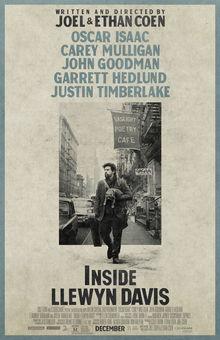
Inside Llewyn Davis
Maybe more than any other film that was considered for some Academy Award nominations, 2013's Inside Llewyn Davis landed with a thud when the nominations were actually released in February. It picked up just two nominations -- for Best Cinematography and Best Sound Mixing -- but won neither. Should it have picked up some other nominations? That's for others to decide. What isn't up for discussion is that awards season success aside, this is a good movie.
It's 1961 in New York City's Greenwich Village and Llewyn Davis (Oscar Isaac) is looking for work and more importantly, some money. A folk musician with a bit of a following, Llewyn released an album with a partner in recent years, but he's on his own now and struggling a bit to get by. His name has a reputation -- somewhat -- as a talented musician who's also a bit flighty. Mostly though, Llewyn wants to sing, to perform, to get his name out there and really to take his career to the next level. He's nearing rock bottom though, his money running out almost completely. It's the dead of winter and he's overextended all his relationships, his friendships, his business connections. He feels he's close, but he just needs that one break...if he can find it.
Another movie that proved difficult to write a one-paragraph plot synopsis. From the Coen brothers, Joel and Ethan, 'Inside' is a stylish, well-told, throwback-type story that follows about a week in the life of a struggling musician. It's easy to see why there was some outrage when it didn't pick up any prominent Oscar nominations. I'll get into some real analysis later, but the gist is this; it's a really good movie. Not quite a comedy, not a straight drama, it's just good.
The most obvious place to start is with directors/writers/producers Joel and Ethan Coen. There is a certain style in each and every one of their movies from Blood Simple to Fargo, True Grit to No Country for Old Men, O Brother, Where Art Thou to The Big Lebowski. The stylistic choice here is picking the location, 1960s New York City (with some out of state departures). From the look of the movie with the hairstyles, the wardrobe, the cars, the mindset, all these little things add up to one great puzzle. From beginning to end, you feel like you're in 1960s NYC. The visual is almost bland, washed out colors permeating almost every scene. As for the folk background, 'Inside' has an extreme love and appreciation for the folk music scene of the 1960s. It feels authentic down to the smallest detail, and that authenticity goes a long way. The story drifts at times, it's both dark and funny and dramatic, but it just feels real.
A young actor with a ton of potential, Oscar Isaac nails the lead part here as folk singer Llewyn Davis. He's had key supporting parts in Drive, The Bourne Legacy, 10 Years (where he also sang), and Robin Hood, but this is quite the breakout leading part. For starters, Llewyn is far from a likable character. He has moments where you feel sympathy for him, but mostly, his issues are self-made. We learn why he's on his own now and not working as a duo anymore. We learn how he's got to this spot, and most importantly, we see that desperation and frustration of an artist/musician who just wants his shot at the big time. Unlikable qualities aside, with a general lack of sympathy, I still found myself rooting for Llewyn....only to see him rip that away quickly with some jackass move. Like the story though, this has the distinct feel of an authentic character, a person with hopes and dreams, aspirations that just haven't been there so far. Likable? Nope. Interesting, fascinating to watch? Yes, you bet. Interesting to see where Isaac goes next, especially because many thought he should have picked up a Best Actor nomination for his part.
Those Cohens, they specialize in ensemble casts like nobody's business. I guess talented actors and actresses want to work with them for some reason. I especially liked Carey Mulligan as Jean, a fellow folk singer who has a checkered past with Llewyn including one major current issue. Justin Timberlake is excellent too as Jim, Jean's fiance, a singer who's carved a name out for himself already. The pairing of John Goodman as existential-thinking jazz musician Roland Turner is a scene-stealer, Garrett Hedlund providing some 1960s beatnik background as beat poet Johnny Five, Llewyn carpooling to Chicago with the odd duo. F. Murray Abraham has a good part as a Chicago club owner who's got some pull with record labels, giving Llewyn an impromptu audition. Also look for Ethan Phillips and Robin Bartlett as the Gorfeins, a middle-aged married couple who love Llewyn and allow him to crash on their couch from time to time. Max Casella also has a fun part as Papi, a club owner who likes Llewyn and keeps offering him different gigs.
An interesting movie for a whole lot of different reasons, most of them positive. The only one I didn't like was a stylistic choice with a framing device at the beginning and end, but it's not a huge deal. In general, there's plenty of things that can/will draw you in. There's a handful of musical numbers performed -- Isaac especially impressing -- with a nice nod to Bob Dylan late if you're paying attention. But across the board, whether it's the music, the story, the style, the acting, it's just good stuff. Enjoy it, appreciate it.
Inside Llewyn Davis (2013): ***/****
It's 1961 in New York City's Greenwich Village and Llewyn Davis (Oscar Isaac) is looking for work and more importantly, some money. A folk musician with a bit of a following, Llewyn released an album with a partner in recent years, but he's on his own now and struggling a bit to get by. His name has a reputation -- somewhat -- as a talented musician who's also a bit flighty. Mostly though, Llewyn wants to sing, to perform, to get his name out there and really to take his career to the next level. He's nearing rock bottom though, his money running out almost completely. It's the dead of winter and he's overextended all his relationships, his friendships, his business connections. He feels he's close, but he just needs that one break...if he can find it.
Another movie that proved difficult to write a one-paragraph plot synopsis. From the Coen brothers, Joel and Ethan, 'Inside' is a stylish, well-told, throwback-type story that follows about a week in the life of a struggling musician. It's easy to see why there was some outrage when it didn't pick up any prominent Oscar nominations. I'll get into some real analysis later, but the gist is this; it's a really good movie. Not quite a comedy, not a straight drama, it's just good.
The most obvious place to start is with directors/writers/producers Joel and Ethan Coen. There is a certain style in each and every one of their movies from Blood Simple to Fargo, True Grit to No Country for Old Men, O Brother, Where Art Thou to The Big Lebowski. The stylistic choice here is picking the location, 1960s New York City (with some out of state departures). From the look of the movie with the hairstyles, the wardrobe, the cars, the mindset, all these little things add up to one great puzzle. From beginning to end, you feel like you're in 1960s NYC. The visual is almost bland, washed out colors permeating almost every scene. As for the folk background, 'Inside' has an extreme love and appreciation for the folk music scene of the 1960s. It feels authentic down to the smallest detail, and that authenticity goes a long way. The story drifts at times, it's both dark and funny and dramatic, but it just feels real.
A young actor with a ton of potential, Oscar Isaac nails the lead part here as folk singer Llewyn Davis. He's had key supporting parts in Drive, The Bourne Legacy, 10 Years (where he also sang), and Robin Hood, but this is quite the breakout leading part. For starters, Llewyn is far from a likable character. He has moments where you feel sympathy for him, but mostly, his issues are self-made. We learn why he's on his own now and not working as a duo anymore. We learn how he's got to this spot, and most importantly, we see that desperation and frustration of an artist/musician who just wants his shot at the big time. Unlikable qualities aside, with a general lack of sympathy, I still found myself rooting for Llewyn....only to see him rip that away quickly with some jackass move. Like the story though, this has the distinct feel of an authentic character, a person with hopes and dreams, aspirations that just haven't been there so far. Likable? Nope. Interesting, fascinating to watch? Yes, you bet. Interesting to see where Isaac goes next, especially because many thought he should have picked up a Best Actor nomination for his part.
Those Cohens, they specialize in ensemble casts like nobody's business. I guess talented actors and actresses want to work with them for some reason. I especially liked Carey Mulligan as Jean, a fellow folk singer who has a checkered past with Llewyn including one major current issue. Justin Timberlake is excellent too as Jim, Jean's fiance, a singer who's carved a name out for himself already. The pairing of John Goodman as existential-thinking jazz musician Roland Turner is a scene-stealer, Garrett Hedlund providing some 1960s beatnik background as beat poet Johnny Five, Llewyn carpooling to Chicago with the odd duo. F. Murray Abraham has a good part as a Chicago club owner who's got some pull with record labels, giving Llewyn an impromptu audition. Also look for Ethan Phillips and Robin Bartlett as the Gorfeins, a middle-aged married couple who love Llewyn and allow him to crash on their couch from time to time. Max Casella also has a fun part as Papi, a club owner who likes Llewyn and keeps offering him different gigs.
An interesting movie for a whole lot of different reasons, most of them positive. The only one I didn't like was a stylistic choice with a framing device at the beginning and end, but it's not a huge deal. In general, there's plenty of things that can/will draw you in. There's a handful of musical numbers performed -- Isaac especially impressing -- with a nice nod to Bob Dylan late if you're paying attention. But across the board, whether it's the music, the story, the style, the acting, it's just good stuff. Enjoy it, appreciate it.
Inside Llewyn Davis (2013): ***/****
Thursday, April 10, 2014
Sam Whiskey
Before Burt Reynolds became a bankable star in the 1970s, he had to cut his teeth somewhere, both as a supporting player on a show like Gunsmoke (1962-1965) and in a handful of B-movies from the late 1960s like Navajo Joe, 100 Rifles, Impasse, and in 1969, Sam Whiskey, a generally forgotten B(ish)-western with a solid cast.
An orphan who grew up on his own during the 1840s/50s/60s, creating his own instantly recognizable reputation, Sam Whiskey (Reynolds) has done it all from being a cowboy to a shotgun driver on a stagecoach, an Army scout to a cattle rancher. Well, he's now gotten himself into something deep that could prove rather difficult. A widow, Laura Breckenridge (Angie Dickinson), approaches Sam with a favor, her dead husband having robbed the U.S. Mint of $200,000 worth of gold bars, but the ship it was being transported on sunk in the middle of a deep river. Laura doesn't want it back but to put it back so her husband's memory can be saved. With help from two partners, O.W. Bandy (Clint Walker), a quirky inventor, and Jed Hooker (Ossie Davis), a blacksmith, Sam goes about putting his plan into action, but there's some other parties who want the gold just as bad.
There are some movies out that that just don't want to be watched. I recorded this western from director Arnold Laven off of MGM-HD on TV over the last couple weeks only to receive a surprise. MGM doesn't use commercials, instead using a mid-movie intermission. Well, when the intermission came back, the credits for a new movie we're rolling. What the heck?!? Thankfully, it popped up on the schedule again, and I was able to watch the last 40 minutes. There's nothing classic about this comedic western, but if nothing else, it's cool to see this generally light-hearted, funny western in a time -- the late 1960s -- when the western was anything but. At times, it has the feel of an extended TV episode (mostly because of the town sets) with a limited budget. Expect an easygoing story with some fun characters, and you won't be disappointed.
Not yet the instantly recognizable leading man with the sex appeal and the bankable background, Reynolds looks to be finding his groove early of things to come in the future. His Sam Whiskey is an amiable if somewhat devious drifter who's done a little bit of everything to make some money. In the coming years, Reynold would eat a part like this for breakfast. It looks easy for him. He's charming and smooth, a quick thinker who always see the potential for a big payoff. He's also constantly singing, a little dirty ditty dubbed Mary McCarty, which adds to the general goofiness of the story. As for the humor, it leans toward the scandalous in certain departments. How exactly does Dickinson's Breckenridge convince Sam to help her? Sure, the money works, but so does jumping into bed with him. Dickinson disappears for vast stretches of a 97-minute movie -- watch out, Lady, men at work -- but her part is good, especially when she's forced to babysit a kidnapping victim (Woodrow Parfrey). Still, Reynolds and Dickinson have a pleasant chemistry throughout.
Much of the story revolves around Sam, Walker's Bandy and Davis' Hooker, a kind of oddball teaming but one that works surprisingly well nonetheless. Reynolds is Reynolds, the smooth, confident leader while the other two play well off Reynolds' antics. Walker especially plays against type, forsaking his usual strongman character for a smart, quirky inventor who's putting his alcohol-fueled life behind him...or at least trying, sometimes successfully. Davis as the blacksmith gets to play the straight man to the antics around him for the most part. His Jed Hooker isn't about to get conned by Sam, seeing through his shenanigans as they pop up. With much of the story following this trio on the trail, recovering the gold and eventually replacing the gold, it's never a bad thing when you've got three likable stars working together to carry the story.
The strongest part of 'Whiskey' comes in the second half -- after that doomed "intermission" -- when Sam, Bandy and Hooker try to put the gold back into the U.S. Mint in Denver. That's right, putting the gold back. 'Whiskey' is a comedic western, but this extended sequence is very well-done in the old drama department. Almost working like an anti-heist, the trio must work inside a well-guarded mint in the dead of night, guards patrolling all around, the mint superintendent (William Schallert) slowly figuring out their plan. An especially enjoyable sequence, improving on the first half of the movie that, while good, is a tad slow-moving at times. A good, not great comedy western overall.
Sam Whiskey (1969): ** 1/2 /****
An orphan who grew up on his own during the 1840s/50s/60s, creating his own instantly recognizable reputation, Sam Whiskey (Reynolds) has done it all from being a cowboy to a shotgun driver on a stagecoach, an Army scout to a cattle rancher. Well, he's now gotten himself into something deep that could prove rather difficult. A widow, Laura Breckenridge (Angie Dickinson), approaches Sam with a favor, her dead husband having robbed the U.S. Mint of $200,000 worth of gold bars, but the ship it was being transported on sunk in the middle of a deep river. Laura doesn't want it back but to put it back so her husband's memory can be saved. With help from two partners, O.W. Bandy (Clint Walker), a quirky inventor, and Jed Hooker (Ossie Davis), a blacksmith, Sam goes about putting his plan into action, but there's some other parties who want the gold just as bad.
There are some movies out that that just don't want to be watched. I recorded this western from director Arnold Laven off of MGM-HD on TV over the last couple weeks only to receive a surprise. MGM doesn't use commercials, instead using a mid-movie intermission. Well, when the intermission came back, the credits for a new movie we're rolling. What the heck?!? Thankfully, it popped up on the schedule again, and I was able to watch the last 40 minutes. There's nothing classic about this comedic western, but if nothing else, it's cool to see this generally light-hearted, funny western in a time -- the late 1960s -- when the western was anything but. At times, it has the feel of an extended TV episode (mostly because of the town sets) with a limited budget. Expect an easygoing story with some fun characters, and you won't be disappointed.
Not yet the instantly recognizable leading man with the sex appeal and the bankable background, Reynolds looks to be finding his groove early of things to come in the future. His Sam Whiskey is an amiable if somewhat devious drifter who's done a little bit of everything to make some money. In the coming years, Reynold would eat a part like this for breakfast. It looks easy for him. He's charming and smooth, a quick thinker who always see the potential for a big payoff. He's also constantly singing, a little dirty ditty dubbed Mary McCarty, which adds to the general goofiness of the story. As for the humor, it leans toward the scandalous in certain departments. How exactly does Dickinson's Breckenridge convince Sam to help her? Sure, the money works, but so does jumping into bed with him. Dickinson disappears for vast stretches of a 97-minute movie -- watch out, Lady, men at work -- but her part is good, especially when she's forced to babysit a kidnapping victim (Woodrow Parfrey). Still, Reynolds and Dickinson have a pleasant chemistry throughout.
Much of the story revolves around Sam, Walker's Bandy and Davis' Hooker, a kind of oddball teaming but one that works surprisingly well nonetheless. Reynolds is Reynolds, the smooth, confident leader while the other two play well off Reynolds' antics. Walker especially plays against type, forsaking his usual strongman character for a smart, quirky inventor who's putting his alcohol-fueled life behind him...or at least trying, sometimes successfully. Davis as the blacksmith gets to play the straight man to the antics around him for the most part. His Jed Hooker isn't about to get conned by Sam, seeing through his shenanigans as they pop up. With much of the story following this trio on the trail, recovering the gold and eventually replacing the gold, it's never a bad thing when you've got three likable stars working together to carry the story.
The strongest part of 'Whiskey' comes in the second half -- after that doomed "intermission" -- when Sam, Bandy and Hooker try to put the gold back into the U.S. Mint in Denver. That's right, putting the gold back. 'Whiskey' is a comedic western, but this extended sequence is very well-done in the old drama department. Almost working like an anti-heist, the trio must work inside a well-guarded mint in the dead of night, guards patrolling all around, the mint superintendent (William Schallert) slowly figuring out their plan. An especially enjoyable sequence, improving on the first half of the movie that, while good, is a tad slow-moving at times. A good, not great comedy western overall.
Sam Whiskey (1969): ** 1/2 /****
Labels:
1960s,
Angie Dickinson,
Burt Reynolds,
Clint Walker,
Heist movies,
Ossie Davis,
westerns
Subscribe to:
Posts (Atom)