The Sons of Katie Elder

The Sons of Katie Elder
"First, we reunite, then find Ma and Pa's killer...then read some reviews."

Sunday, June 12, 2011

Silver River

By 1948, times had changed for Hollywood legend Errol Flynn. The swashbuckling, high seas adventures just weren't there anymore, and his best roles were behind him. Flynn would continue acting right up until his death in 1959, but after 1945's Objective Burma!, he didn't have another classic (or even near-classic) to his name.  He is one of Hollywood's more interesting stars and personalities, a hard lifestyle taking its toll on him as he died young at just 50 years old.  The movies continued though in the late 1940s and into the 1950s, including one last hurrah with an old directing pal.

The movie is 1948's Silver River, teaming Flynn with frequent collaborator director Raoul Walsh. The actor-director combo worked together often in the 1940s, producing some really solid efforts like They Died With Their Boots on, Northern Pursuit, Desperate Journey, Uncertain Glory, and Objective Burma!  Working together one last time with 'River,' it has all the markings of a big budget 1940s western. The scope and scale is impressive, with money clearly not an issue here.  More than all the little details is something that sets this otherwise ordinary western apart. Flynn plays a bad guy...sort of...kind of.  I'll explain later.

Cashiered out of the U.S. Cavalry for a supposed act of cowardice and treachery at the battle of Gettysburg, Captain Mike McComb (Flynn) heads west looking for a second chance.  With him is Pistol Porter (Tom D'Andrea), another soldier blamed for the act, but before they go west, the duo finds their way into piles and piles of some cash from the army. They plan to head to Nevada where they set up a gambling house, initially tangling with a miner (Bruce Bennett) and his feisty wife, Georgia (Ann Sheridan). Feeling like he's been burned for doing nothing wrong in the past, McComb now doesn't care who gets caught in his path. He starts to build an empire dollar by dollar and business by business.  But has his seemingly limitless power gone too far?

This has all the positives and negatives of a lot of the Flynn westerns I've seen, and more than that (not to pile on Errol Flynn, one of my favorites) 1940s westerns in general.  They're BIG. The sets are large, the musical score loud and obvious, the cast features hundreds of extras in the background along with the requisite big names leading the way, and it's fun to watch if not particularly taxing.  The stories get to be too soapy though, too theatrical. Maybe the biggest thing working against it is that the story -- especially with Silver River -- keep you at a distance. There's no real heart or emotion to the story, and the actors always seem to be playing the same variation of themselves.  With a movie that moves slowly along at 110 minutes, that lack of interest in what happens to characters can be a problem, if you're into that sort of thing. I'm weird that way.

The supporting cast is pretty hit or miss here.  I liked Ann Sheridan working with Flynn in Edge of Darkness, but something doesn't ring true here.  As a love interest, it feels forced, things moving along because the story requires it. She hates Flynn's McComb, then really hates him, despises him...and BAM! She loves him with a passion. Because I sometimes lack a delicate way of saying things, I'll just say it. She's got a dudely factor going on her. Not a tomboy or anything, more like she is a DUDE. The always reliable Thomas Mitchell carries the movie in its slower moments as Plato Beck, a drunken lawyer who becomes McComb's right-hand man. It is basically a fat juicy fastball for Mitchell, playing a character he played in countless other movies. D'Andrea has the thankless part as the humorous sidekick, Bennett is solid but not flashy with Barton MacLane and Monte Blue as McComb's chief rivals, neither making an impression more than 'Hey, cool mustache.'

Enough with all that, let's get to Errol Flynn, the definition of a heroic, swashbuckling adventurer, playing a bad guy. The story isn't quite rags to riches, but it is close if nothing else. The opening is a cool sequence, Flynn's McComb burning a million dollars in U.S. Army payroll rather than let it fall into Confederate hands at Gettysburg in July 1863. He's crucified for it, and kicked out of the army. He feels taken advantage of and starts to look out for No. 1 alone, everyone else be damned.  We're not talking a brutal, vicious bad guy callously shooting down innocent people, but for Flynn, it is most definitely a departure.  People get trampled and left by the wayside because of his actions. As a big fan of Flynn and all the movies I've seen him in, it was fun to see him play against perception, and he looks to be having some fun with it too.

I should have been skeptical though as McComb takes a turn for the legitimately evil department. From his director's chair, Walsh starts tapping the breaks on the old evil speedometer. SPOILERS STOP READING SPOILERS McComb basically gets Bennett's husband character killed and then swoops in on his grieving widow. First, he tries to correct his mistake but fails. If you're making the character bad, just do that. Don't go half-hearted toward it. His rise and fall doesn't come as a surprise, but in the end, he redeems himself because he sees what a jackass he's been.  For a rise and fall from glory story to work, the fall has to be believable.  Think Scarface.  EPIC fall there, and some of that effort would have been good.  Still, it's fun to see Errol Flynn play against type, and that makes the movie watchable on its own.

Silver River <---trailer (1948): ** 1/2 /****   

Saturday, June 11, 2011

Kanal

Just a few weeks ago, I reviewed a 1955 Polish film, A Generation, from Polish director Andrzej Wajda. I loved it for all its unique storytelling techniques and a generally downbeat, honest look at the resistance movement in Poland during WWII. A quick Google search about Wajda revealed he's most well-known for an unofficial trilogy of WWII movies, starting with A Generation, continuing with 1957's Kanal, and wrapping up with 1958's Ashes and Diamonds. Thanks to TCM's scheduling, I'll be able to review all three so here goes with Kanal, an incredible war film unlike anything I've ever seen.

One of history's largest events in terms of how it changed the world, WWII nonetheless has stories that have been lost in the history books. One of the biggest omissions was the Warsaw Uprising in 1944 as the Polish resistance rebelled against their German occupiers, fighting a losing battle that would ultimately cost the lives of over 16,000 Polish resistance fighters and over 100,000 innocent civilians brutally massacred by German forces.  It is a story of courage in the face of impossible odds, a really incredible story when you think about it in terms of the sheer lunacy of the conflict. Courage, honor, bravery, impossible odds, all seems like the perfect blueprint for a feature film.

It is the closing days of the Warsaw Uprising as the German forces close in on the remaining Polish resistance in the city. One company of resistance fighters is commanded by Lt. Zadra (Wienczyslaw Glinski) who has seen his ranks ripped to pieces, where there were 70 fighters the day before are now 40 walking wounded and under-supplied fighters. Holding back one last German advance, Zadra receives orders from headquarters to withdraw, retreating further into the ruins of downtown Warsaw.  The only relatively safe way to fall back is through the sewers under the city. His few remaining fighters drop down to the sewer and all its horrors, always trying to stay one step ahead of their German pursuers.

As was the case with Wajda's A Generation, I was incredibly impressed with the tone of the movie, brutally honest and not at all interested in any easy answers, happy endings or genre conventions. SPOILERS STOP READING SPOILERS The opening monologue introduces Zadra's company and its more notable members.  The narration pauses, explaining the situation and stating simply "These are the tragic heroes...watch them closely in the remaining hours of their lives." Surprised much? Seconds into the movie we're told as an audience that all these people will be dead by the end of the movie.  You just don't see that reckless abandon in storytelling in so many American films. In a sick sense, you're drawn in. What will happen to these men and women? How will they die?  It's a brilliant little touch that immediately rips you into the movie.

I don't remember being struck on so many levels watching a film as I did with this movie. Visually, it is stunning in its darkness, starting with the ruins of Warsaw before descending into the filthy horrors of the sewers (Kanal is translated as 'sewer,' hence the title). Wajda films in black and white, adding such a feeling of stark reality that a color film would have struggled to do. Wajda shoots in long, unedited tracking shots that are impressive in their simplicity. We see a long line of feet and legs moving as Zadra's company moves into position. Another follows the weary faces and bodies of the survivors as they trudge through the sewers. The best is the opening shot, a long scene that introduces many of Zadra's fighters. No quick cuts, no close-ups, just one shot with no edits. There's nothing flashy about any of this, just a focused, moving look at this little told part of history.

In its simplicity, Kanal caught me by surprise in its presentation of its characters.  As was the case with A Generation, I had no personal background with almost all of these actors and actresses.  You don't see them as their other roles, just the people they're playing here.  Glinski as the commanding officer is the unquestioned lead, the driving force of the movie. Some of his company include Korab (Tadeusz Janczar, also starred in 'Generation') and Daisy (Teresa Izewska), two lovers trying to help each other survive. Korab is wounded and quickly losing any touch with reality. There is also Michal (Vladek Sheybal), a composer turned fighter searching for his family, Emil Karewicz as Lt. Wise, Zadra's quickly disintegrating second in command, Tadeusz Gwiazdowski as Sgt. Bullet, the note-taker and documentarian of the company, Stanislaw Mikulski as Slim, one of the company's most capable fighters, and Teresa Berzowska as Halinka, a teenage girl who finds love as death nears. I apologize if I confused the names. The print I saw had different names in the subtitles than the IMDB cast listing.

The first 30-45 minutes are classic on their own, but the movie reaches elite status once Zadra's company retreats into the sewers.  If you're claustrophobic, this is not the movie for you. It is an unsettling, uncomfortable movie to watch. It looks like the cast is actually walking through excrement up to their waist. You can feel the heat, smell the stench, know the horror these men and women went through. Avoiding their German pursuers, the company is separated into smaller groups, many getting lost in the winding, poorly marked sewers. The violence when it comes is not graphic, just shocking and surprising. Blood squibs and limbs being ripped apart when a movie connects on an emotional level, and there Kanal succeeds on so many levels.

With his movies, Wajda clearly had an agenda, a message he wanted to get across.  There will be no happy endings, no ride into the sunset with everything tied up nicely with a bow.  SPOILERS again SPOILERS  The opening monologue gives away the fact that all of Zadra's company will be killed so there's not a huge surprise by the end. Somehow though, the shock still hits home that each of these men and women will be dead soon.  Realities of war certainly hit home. Korab and Daisy walk in a daze, Korab bleeding out with each step. Michal loses his grasp of reality, marching off into the sewers playing a flute. Halinka kills herself when she realizes Wise has lied to her about his family. Wise reaches safety only to find the rest of the survivors captured by the Germans, execution waiting them all. Slim is killed trying to dismantle a German grenade booby trap.

Last, Zadra reaches safety with Bullet only to find out that his sergeant has lied about the whereabouts of the long-since separated company. Solely driven by his desire to save his company, Zadra guns the man down, and with a chance to move on instead makes a decision that will kill him. Armed with only a pistol, he descends back into the sewer to search out his company that no longer exists.  One of the most moving, unsettling endings I've ever seen in one of the best war movies I've ever seen. You can watch it at Youtube, starting HERE.

Kanal <---TCM clips (1957): ****/****

Friday, June 10, 2011

Paratroop Command

It's that face you recognize but don't necessarily know the name. He plays that background character, that supporting part that doesn't dominate the screentime but still plays a key part in a movie.  Yes, we're talking another review about character actors.  Name recognition in a big movie star has suckered me into countless movies, but often enough, it is the supporting cast that has pulled me into a movie. Today, our character actor of the day is Richard Bakalyan.

A movie and TV actor who's still chugging along at 82, Bakalyan made a career of those supporting roles.  I first noticed him as one of the few American prisoners in Von Ryan's Express, but he's been in a ton of other movies.  He was in Chinatown, Fox and the Hound and several other Disney movies, countless TV shows in guest starring roles, and even a couple of bad beach movies. Never a huge star, he didn't get many chances at a leading role, but when he did, he didn't disappoint, like 1959's Paratroop Command.

Jumping into North Africa with his squad, a private, Charlie (Bakalyan), is separated from his unit almost immediately. He finally catches up with them after they've knocked out a German machine gun nest and mistakenly shoots one of his squad-mates who is dressed as a German soldier. Separated from the rest of the men so quickly, the survivors think Charlie had turned tail and run, scared at the thought of fighting. Now, it gets piled on as they believe he's murdered one of their own in cold-blooded fashion. As the unit moves forward, also jumping into Italy and Sicily.  Alienated from his squad who would like nothing more than to see him get picked off, Charlie begins to believe he's a bad luck charm. As the fighting rages on, can he prove he is a good soldier?

I caught this movie several years back on AMC, and then rewatched it again recently as part of a Memorial Day Marathon.  It is only available now in a hard-to-find VHS tape and is not shown regularly so actually tracking the movie down can be difficult.  This is certainly different from most WWII movies I've reviewed here mostly because the budget seems to be about $20 bucks or so.  Director William Witney has the California hills stand in for Africa and Italy in locations you will almost assuredly have seen in countless western TV episodes and movies, not to mention "Korea" from M.A.S.H. The movie is just 77 minutes long and isn't interested in any wasted subplots. The story still manages to bounce around quite a bit, but it's always entertaining.

With that small budget, certain movies would be limited.  For 'Paratroop,' the scale certainly isn't on a grand scale.  We see these "invasions" from the point of view of this one squad, never getting a bigger picture of the battle or the conflict.  The squad's officer (Ken Lynch) briefs his men (and us as the viewer) just seconds before they will jump out of the planes as to what to expect from the coming fight. The firefights are on a squad-level scale, not a large-scale battlefield. It's a few men with machine guns vs. Germans with machine guns. Survival at its most basic.  For a low budget B-movie, the action is handled surprisingly well too, and there's a lot of it.  Just don't go in looking for a BIG war movie, and you'll enjoy this one.

Made on that smaller scale, some movies lose perspective because they try to make the finished product something bigger, something grander.  'Paratroop' stays grounded in its attempt, and gets points for staying on an appropriate level.  If anything, the story and tone can go much darker, much more realistic than a film with higher aspirations and a bigger budget. How many WWII movies do you see (from the 1950s much less) where an American soldier guns down another American soldier? Even if its accidental, that's not exactly audience-friendly. After Charlie's accidental shooting, some fellow soldiers even start to gun for him in combat situations. This isn't a cynical Vietnam movie where officers are getting fragged by their own men. This is a 1959 WWII movie made on a modest budget. The movie is that much better for it.

Dark in terms of story and tone, the ending comes as the biggest surprise.  SPOILERS from here on out SPOILERS  The squad is dropped into Salerno with the mission of finding a hidden German tank battalion somewhere in the Italian countryside.  They have to find it, call it in, and get the hell out quickly.  They find it easily enough, but are quickly on the defensive against a much larger German force.  The squad starts dropping like flies, and for a 1959 movie, the violence is surprisingly graphic with a fair share of blood used.  Most surprising? Charlie's redemption. Needing to get the radio generator to the Lieutenant, he walks into a mine to clear a path for a wounded squad-mate.  Just because it's a B-movie doesn't mean it can't be effective. It's a great, moving ending. END OF SPOILERS

Looking past the obvious limitations of a B-movie on a small budget, 'Paratroop' has been generally forgotten because the cast features very few recognizable names, much less big time stars.  Bakalyan is the tragic lead, the paratrooper that nothing can go right for.  Usually relegated to those background parts, it's always fun to see character actors get their shot at a lead, especially here.  Lynch's Lieutenant (no other name provided) is the officer trying to keep all his men on the same page.  The rest of the squad includes Jack Hogan as trigger-happy Ace, gunning for Charlie, Jimmy Murphy as the squad sergeant, Jeff Morris as Pigpen, and James Beck as Cowboy, and even an uncredited and unlisted Robert Conrad. An all-around above average WWII B-movie.    

Paratroop Command (1959): ***/****

Thursday, June 9, 2011

The Monster That Challenged the World

Made for an estimated $254,000 budget, 1957's The Monster That Challenged the World is not a very good movie.  Think about how little money that is in putting an entire feature film together. That wouldn't pay for a movie star's assistants today, or even the catering for cast and crew. According to TCM host Ben Mankiewicz, most of that budget went toward creating the titular monster. The movie is low-budget (nice way of saying cheap), the definition of a B-movie, and cheesy from the start. Yeah, I definitely liked this one mostly because of all those things.

The 1950s featured lots of movies like this, science fiction stories made on small budgets designed for drive-in theaters and second-run B-movie theaters. TCM is actually devoting Thursdays in June to many movies like this so hopefully there will be many more reviews to come.  Because of the decade they were in, you can't help but notice some Cold War scares as the world changed into a very nasty place. Nuclear and atomic tests continued around the world as the power countries armed themselves preparing for a nuclear Armageddon. The movies reflected that, a worry and question of how all this testing and development was affecting the world we live in. And according to the movies, it meant abnormally large, vicious creatures intent on wiping us out. Pleasant enough idea, don't you think?

An earthquake in the Salton Sea opens up a seam in the ground, and a creature escapes after years of being imprisoned...possibly as long ago as thousands and even millions of years ago. Several Navy personnel go missing, and reports start to come in of other missing persons.  Navy Intelligence officer John Twillinger (Tim Holt) is called in to investigate with the help of local law enforcement, and a scientist, Dr. Rogers (Hans Conried), to find out exactly what is going on. From a sample found on the water, Rogers deduces that the creature is some sort of immense, voracious mollusk that has an insatiable appetite.  Now, it is a race against time to seal off the area, and hopefully keep the quickly reproducing creatures from spreading. Is it too late though? Has one...or even many...escaped already?

It's clear very little money was spent on this movie, but that's part of the charm. The acting is especially stilted and downright wooden at times.  The scale is small especially when considering that this local incident threatens to spread all over the world. Why call in help when you've got a Navy officer, a local sheriff (Gordon Jones) and his force, and a scientist and his team?  Problem solved. The music score telegraphs everything that is about to happen, and the actual reveal of the creature is hysterical.  Basically all the reveals are hilarious. How does this immense snail/mollusk sneak up on anyone? They're huge, they're slow, just run away.

Through all the ridiculousness, there are these moments of bizarre stuff that you just can't make up. Holt's Intelligence officer starts to date Conreid's secretary, Gail (Audrey Dalton), a single mom who is wary of his intentions. In the middle of the investigation as they search for a runaway snail (you read right), they go on a date, driving into Mexico where Holt is approached by a Mexican boy selling pens.  It's surreal in its weirdness. You're wondering if this is actually happening.  Then there's the oddly eccentric museum curator (Milton Parsons) who is either so blatantly gay that I missed an explanation or I'm just reading far too much into the movie. Gail's daughter almost ends up killing them all because she's worried a rabbit in a lab is cold. No explanation, you've got to see it. All the little things that make you laugh -- intentional or not -- and make a bad movie enjoyable through its badness.

Casting in movies like this ranges from interesting to bad to amateur.  Tim Holt was a star of countless B-westerns (and some A-listers like My Darling Clementine and Treasure of the Sierra Madre) and stars here as the wooden but still smooth Navy Intelligence officer. I don't know what's going on with him because he had some talent as an actor, but he looks like he's reading his lines on cue cards off-screen. Conried's Rogers is the doctor who is always one step ahead of everyone, and Dalton is the hot single mom inexplicably drawn to Holt's officer. Max Showalter and Dennis McCarthy are Rogers' lab assistants with Harlan Warde playing Holt's subordinate officer. The performances are by no means award-winning -- far from it -- and are meant more just to advance the story, get things rolling until the next creature attack. And on we go to the monster.

Of the already not so impressive budget, much of it was spent on creating this monster. Mankiewicz joked in his pre-movie intro that it wasn't spent well, barely holding back his laughter. Watch a clip HERE, and you will see why. There was no CGI in 1957, just people building the creatures.  To be fair, it is a creepy monster, but how this creature (and all its offspring) are supposed to "challenge the world" is beyond me.  Just outrun the damn thing. How does it sneak up on anyone at all?  It's gigantic. That's the fun though, watching the badness develop as the snails some how escape the Salton Sea and move abroad (sort of, I guess).  Created by the radioactive testing done, it's another example of the Cold War scares on people's minds, one more condemnation of what all the world powers were up to.

On to the ending as Holt tries to save his love from certain death. A creature's egg was captured and basically incubated so it won't hatch. Long story short? It hatches, cornering Gail and her daughter in a closet. Holt saves the day throwing beakers and water at the pissed off creature, eventually holding him off with a loaded fire extinguisher.  Cue the army, soldiers shoot him, movie over. It is another in a long line of unintentionally funny scenes, especially when they show Holt walk by an ax on the wall. All I was thinking was 'Use the DAMN AX! Use it!' Eh, a fire extinguisher made for some good comic relief. Bad movie that is really good because it is SO bad.

The Monster That Challenged the World <---trailer (1957): ***/****

Wednesday, June 8, 2011

Bad Lands

So the timing isn't really good here as I throw remake and reboot one after another out there, but timing isn't everything, is it?  After reviewing 1955's I Died a Thousand Times which was a remake of 1941's High Sierra, I stumbled across another movie that's a virtual scene-for-scene remake of a John Ford classic. Where the previous review at least had a decade in between releases, this one was quite a bit closer.  The Ford version is a 1934 flick called The Lost Patrol, and the remake came out just five years later with 1939's Bad Lands.

The Lost Patrol is an interesting film for a lot of reasons, mostly because for a movie released in 1934, it was far ahead of its time.  It was quick, hard-hitting and violent, not playing up to conventions of the war genre.  Above all else, it is different. A small patrol of Foreign Legion soldiers is trapped at a desert oasis and under siege by Bedouin riflemen (almost always unseen). 'Lands' isn't quite an exact remake mostly because the setting is transplanted from the African desert to the American southwest in the 1870s.  Other than the setting though, it's the same movie. Not as good overall, it is still interesting, but mostly as a comparison piece to the better The Lost Patrol.

Leading a posse for a murdering bandit, Apache Jack, Sheriff Bill Cummings (Robert Barrat) is riding at the head of nine men.  They have ridden into the desert after Apache Jack escaped from jail and murdered a Mexican woman. Tracking him, they hole up at a water hole high up the rocky hills. The posse finds a vein of silver though in the rocks, and they begin to think about who can get a claim in first. That night though, an Apache war party steals their horses, stranding them in the middle of desert with nowhere to go. Cummings and his posse have ample water, but the Apaches are gunning for them. Should they send for help, or sit tight and hope they can hold out long enough for some sort of help to arrive?

The rehash of the story isn't as sketchy as it seems mostly because both films came from RKO Studios. Neither movie could have cost much to make with the small cast and little need for any sort of background players, army of extras, or any sets at all other than the desert.  None of this rehash comes as a judgment because in the years since the premise has been used repeatedly, including a very violent Euro-western, Chato's Land.  It is simple, straightforward, and effective. Until the end, we never see more than one Apache, leaving the enemy as more of a presence than an actual scare.  The warriors are everywhere and nowhere at the same time, just waiting for their chance to strike.

Maybe because the cast isn't that well known, but filling out the sheriff's posse isn't as fun this time around as The Lost Patrol. The characters are still more genre archetypes (I think that's the word I'm looking for) than red-blooded characters, but come on, they're basically fodder for the Apache war party. Along with Barrat's Sheriff Cummings, there's Mulford (Douglas Walton), the inexperienced rider from NYC, Eaton (Robert Coote), an amiable Englishman, Chick (Noah Beery Jr.), an unlikable rabble-rouser, Billy Sweet (Guinn Williams), a happy go lucky cowboy, Henry (Andy Clyde) and Garth (Francis Ford, John's brother), two old-timer prospectors with some gay undertones, Rayburn (Addison Richards), a gunslinger gunning for the sheriff, Curly (Paul Hurst), a crotchety cowboy, and Lopez (Francis McDonald), a Mexican looking for revenge for the murder of his wife.

With a movie that barely breaks the 60-minute mark with a 70-minute running time, you would think there would be no time to waste.  Well, you would be wrong.  Before the ambush and siege at the water hole, there's about 10-15 minutes of the posse riding around. Then at the water hole, there are long scenes of dialogue as the posse discusses their lives, their fears, and generally their frustration at the predicament they're in.  Throw in the possibility of vast riches with the silver vein, and you've got a lot going on that is not always interesting.  The Apaches are a presence for a majority of the movie, finally revealing themselves at the end in one last shootout. The fear of an attack is genuine, but the censors and lack of any violence limit the potential. Most of the posse is killed off-screen, and besides, there are only a few characters that are actually likable.

Just like The Lost Patrol, I liked this movie. It's a good movie that could have been great with a few tweaks here and there.  The premise is simple, and that's the beauty of it.  The story is straightforward with no wasted subplots, the hope for survival driving and moving everything along. Shot in black and white with an impressive dark streak for a movie from 1939, there's a lot to offer. It just isn't great, and it could have been better. Still, a western The Lost Patrol isn't a bad thing.

Bad Lands (1939): ** 1/2 /****

Tuesday, June 7, 2011

I Died a Thousand Times

As summer nears and all the big blockbusters hit theaters in the coming weeks and months, it is time to look ahead and see how many remakes and sequels are heading our way.  Long story short...there's a lot of them, some more necessary than others. As I've mentioned before, it's a huge pet peeve for me.  Why come up with something original or interesting or unique when you can just re-do something that was previously successful?  Remakes have always been made, but it seems like a more recent trend, or maybe there's just more out now.  Well, I can eat my words with 1955's I Died a Thousand Times.

Reading the movie's description at TCM's website, my first thought was 'That sounds familiar.' A simple Google search later, and it was easily figured out why.  It is a straight remake of 1941's High Sierra, a film noir classic from director Raoul Walsh and starring Humphrey Bogart and Ida Lupino. Both movies were released by Warner Bros. Pictures although 'Thousand Times' does take advantage of the recent widescreen-processing in production (it looks great, more on that later). It just seems an odd choice for a remake.  The 1941 version is a classic film noir, one held in high regard by reviewers and fans alike. So why remake it? Big pile of cash I'd assume.

Paroled early after serving part of a armed robbery sentence, well-known and feared gangster Roy Earle (Jack Palance) heads west, a new job already waiting for him. An old friend and partner, Big Mac (Lon Chaney Jr.), has set up a heist at a lavish resort where the end result could be almost a half million bucks.  He meets his inexperienced cohorts, Babe (Earl Holliman) and Red (Lee Marvin), as they wait for the signal from their inside man (Perry Lopez) to pull the job. Roy kills time with a poor family from Ohio, including their clubfooted daughter, Velma (Lori Nelson), and also with a dance hall girl, Marie (Shelley Winters) who tags along with Red. Going stir crazy just sitting and waiting around, the call finally comes to pull off the job, but even with an experienced crook like Roy along, nothing goes as planned.

Without a specific way of explaining it or putting it into words, there is a look to 1950s films that just appeals to me.  Movies were still in the early stages of taking advantage of that new widescreen process, especially here with CinemaScope. Even watching the film on TV, it looks gigantic, and I can only imagine what it looked like on a big screen in theaters. Director Stuart Heisler filmed his movie with cinematographer Ted D. McCord in Pine Hills, California, and it looks gorgeous. The Sierra mountains never looked better, and even some studio inserts for outdoor shots can't ruin it. The picture is BIG and the California desert and the tiny resort towns and stops along the highway provide a great, stark setting for this heist remake.

If there is anyone you don't want to follow in their footsteps as an actor, Humphrey Bogart has to be at the top of the list. His High Sierra performance is one of his best; a likable, sympathetic bad guy.  Stepping into the role, Jack Palance is a more than solid option to take over the Roy Earle character. Palance was an always intense actor who just by giving a look can intimidate.  Adding that sympathetic edge to his character, Palance's Roy is that tragic, doomed bad guy (whether you've seen the original or not, it's obvious from the start). This is supposed to be his last job, and through Winters' Marie and Nelson's Velma, he is looking for some sense of normalcy. Neither woman is the right choice for him, but he doesn't know that.  Roy wants to settle down, and even though he has a mean streak a mile wide, I genuinely liked this character. An underrated Palance performance.

As for the supporting cast, it is a case of the names being more impressive than the actual performances. That's not necessarily the fault of the cast, just a script that doesn't give the actors and actresses a lot to do. Instead, there's too many characters. Holliman and Marvin are generally wasted as Babe and Red, Roy's partners in the heist.  Winters is at her clingy, annoying best as Marie, a young woman who has to be around a man. She seems to play this part a lot. Pedro Gonzalez Gonzalez plays Chico, a helpful hotel attendant similar to the character he played in 1959's Rio Bravo four years later. Chaney Jr. isn't around much as Big Mac, but his quick scene with Palance is memorable.  Nelson is the surprisingly dark character, Velma, with Olive Carey and Ralph Moody playing her parents. Even look for very young Nick Adams and Dennis Hopper in small parts.  Dub Taylor has a quick appearance too as a gas station attendant.

Watching a remake when you're familiar with the original is tricky because you're basically watching the same movie. The 1955 version of High Sierra is virtually identical with nothing new or different really thrown in. The story lags some after the heist goes down, almost like some time needed to be killed before the finale.  The ending is the same and works just as well, mostly because it is an appropriate ending.  So watching the same movie, there has to be something to recommend for anyone who's seen High Sierra.  The cast -- especially Jack Palance in the lead -- makes this one worth watching. Check out High Sierra too, and compare.

I Died a Thousand Times <---TCM trailer (1955): ***/****

Monday, June 6, 2011

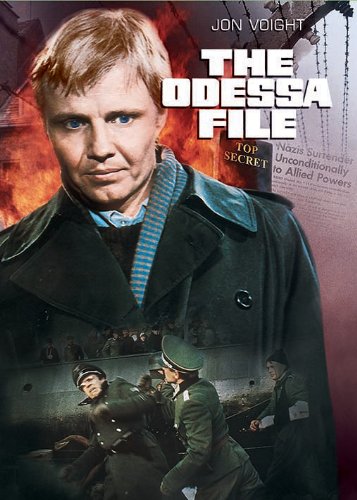
The Odessa File

Even knowing that they are true, it can be hard to comprehend the actions committed by the German SS in World War II involving the Holocaust, the concentration camps, and in general, war crimes on an epically large scale. Literally millions of people died at their hands in hopes of creating a master race of Aryans, and no matter what was said, they knew they were doing something wrong. As the war turned and a German defeat became inevitable, many of the highest ranking SS officers made preparations for new lives, leaving their old, highly checkered pasts behind them. What did they do with their new lives? Author Frederick Forsyth went into the topic with a 1972 novel that two years later was turned into a feature length film, 1974's The Odessa File.

I'm a huge fan of movies (if you hadn't figured that out), and an equally big fan of any sort of reading. I think one of the great treats is reading a book/novel, and then finding out that it was turned into a movie, especially a book you enjoyed a lot. You wonder how will it translate? Will it live up to expectations? What changes were made?  Does the visual in your head while you read match the screen version? Unfortunately in the examples I can think of, the film rarely lives up to the novel.  Just too much has to be sacrificed, and the movie suffers because of it. That was my biggest complaint with The Odessa File, and one odd example of bad casting.

A young German freelance journalist, Peter Miller (Jon Voight) stumbles into the diary of a concentration camp survivor at the camp at Riga. Living in 1963 Germany, Miller has seen the horrors of the war brushed out of the public view too often and is horrified at what he reads about Riga's commandant, dubbed 'the Butcher, Eduard Roschmann (Maximilian Schell). Convinced there's a story in the diary, Miller begins to investigate, seeing if he can find any trace of the long since disappeared SS officer. He begins to find clues that point to Roschmann still being very much alive, but has he dug himself into a hole? Someone seems very interested in keeping Roschmann's identity safe, and the life of one journalist isn't enough to stop them.

Like the other Forsyth novels I've read -- Day of the Jackal and The Dogs of War -- I very much enjoyed The Odessa File. It's the kind of low-key thriller that picks up momentum and intensity along the way, building to something you can't quite put your finger on.  When the reveal/surprise does come, it doesn't disappoint either. The premise is great, a well-organized and well-funded group protecting the identities of former SS officers and soldiers in a worldwide network that boggles the mind. Stumbling into this, Miller is almost immediately in over his head, and it is his head on the chopping block if something goes wrong.  Director Ronald Neame certainly has his work cut out for him because Forsyth's style isn't always movie-friendly, but he makes a go at it.

As an author, Forsyth is obsessed (in a good way) with the details, the little things that make a story feel authentic. That doesn't always work in a movie where the details are the first to go.  Even at 130 minutes, 'Odessa' is both a little long and too short.  What's there isn't always very interesting, and what was cut out could probably have done a good job of fleshing the movie out some.  Instead, there's little sense of urgency or fear. An organization of former Nazis is hunting you down, and this is the best you can do in terms of making an audience feel uncomfortable? Because of the cuts to the story, Voight's Miller hops around too much with too many things going unexplained.  I read the book just a week before watching the movie, and at times felt lost.

When reading a book, my head just naturally starts imagining what certain characters look like.  That's typically one of my biggest problems with film versions; the stars never match up with the image in my head. So goes Jon Voight as German freelance journalist Peter Miller in a case of miscasting.  I'm not a huge fan of Voight to begin with, but he just wasn't the right choice to play this character. Physically, he doesn't look anything like the book's protagonist, and his attempt at a German accent is just bad.  Worst of all though, he turns an interesting character into a bland one. Schell as Roschmann doesn't have a big part, but he certainly makes it memorable in his brief but effective scenes. Also look out for Derek Jacobi as an Odessa forger, Mary Tamm as Sigrid, Peter's girlfriend, and Shmuel Rodensky as famed Nazi hunter Simon Weisenthal among many others in an ensemble cast.

Both the novel and the movie claim that the story is based in the truth with a real-life ODESSA organization helping former Nazis and SS create new lives for themselves (certain names and places changed obviously). The novel's ending (including a great twist delivered by Miller) is appropriate and authentic to the real-life and fictional characters if not exactly a happy ending. The movie rewrites history somewhat in an ending that disappointed me, mostly because it ties everything up nicely when the effort just wasn't needed. The film version on the whole makes some odd choices, handicapping an otherwise interesting set-up and premise. Not horrible at all, but stick with the book.

The Odessa File <---trailer (1974): **/****

Sunday, June 5, 2011

A Generation

A guide to war movies I read years ago had a perfect list of stereotypes and staples of the genre.  Each specific example had been used several times before, some of them repeated over and over again. One of my favorites discussed French resistance fighters. The women would always be beautiful and wear very tight black sweaters. The men would always have a thin mustache and wear a beret. The reality of course concerning resistance fighters was that it was a horrific, fear-filled life that so often ended in death.

Making his directorial debut, Polish director Andrzej Wajda told his story of the Polish resistance in 1955's A Generation. It was part of an unofficial trilogy about Poland in World War II that has now been released through the Criterion Collection. All of the films are held in high regard as much for their brutal honesty as their impressive film-making. Telling the story of resistance fighters is almost always interesting, but seeing foreign films and their perspective is more interesting. You're going to get a different perspective, and as is the case here with Wajda's debut, an understated honesty that is so often missing in war movies.

It is early in World War II, and the German army is occupying Poland. Life moves on for most under their German occupiers, including young Stach (Tadeusz Lomnicki), who finds a job in a small factory making furniture and doors with his friend, Sekula (Janusz Paluszkiewicz). Stach begins to see other workers and supervisors working and moving around secretly, and finally he meets a young resistance leader, Dorota (Ursula Modrzynska). Stach is intrigued -- partially by the conflict and partially because of a crush he has on Dorota -- and joins up. He recruits his own small squad of fighters, helping to slow down the German war effort in any way they can. But as time passes, Stach begins to climb through the ranks. His reputation might grow too much though as the Germans (especially the Gestapo and the SS) are closing in.

Is it possible to get spoiled by the polished films that are released from American studios? And no, I don't intend that as some elitist dig at other countries' films.  I can't say I've seen many Polish films, much less those released over 50 years ago in 1955.  Wajda films in black and white, and the years haven't aged his movie well, producing a grainy, even washed out look at times.  The movie was shot on location in Warsaw, but not in any glamorous, pretty locations. Wajda shoots in the slums, the run-down housing, the dark back alleys and claustrophobic factories and buildings. The Polish people are struggling to get along under their German occupiers, and visually, it is easy to see their plight.

Call it a romantic portrayal or mental picture, but resistance fighters -- regardless of nationality so this isn't exclusive to Poles -- often did tasks that had no major impact on the war effort. They shot individual officers, they threw coal from trains bound for German troops, and they transported guns in small quantities, not grosses of guns. That is the brutal honesty of Wajda's resistance film. Stach's group, and Dorota's on a bigger level, will not change the course of the war through their actions. Instead, they make smaller efforts. On their own, maybe those events meant little. But combined over the course of weeks, months and years, it would add up. All the while, their efforts put them on watch lists of the Gestapo and the SS. So often, it ended with individuals being dragged away never to be seen again, almost certainly dying after hours and days of painful torture.

That is a major reason I enjoyed this movie. Stach almost gets in trouble because he stole a pistol. That's singular. Just one pistol. His squad accomplishes little, or at least little to what we see.  Dorota continues to try and recruit new members to the cause, the young people coming out more and more. The one slightly Hollywood touch comes in one of their few attempts at resistance. One of Stach's men, Jasio (Tadeusz Janczar), has already shot a German officer and struggles with his actions, the guilt tearing him apart. He's separated from the other fighters and leads his pursuers on a chase through the ruined city. It  is a chase that cannot end well because eventually the pursuers will corner him. Uncomfortable and exciting all rolled up into one scene, it is a remarkable sequence with an incredibly moving ending. You can watch it HERE with obvious SPOILERS. 

Almost always a positive watching lower budget foreign films is little background or experience with the actors and actresses. The acting here is incredibly natural, nothing forced or over the top. Lomnicki's Stach is the heart of the movie, a quiet but determined fighter who joins the cause. Janczar also delivers a great performance as Jasio, the emotionally torn fighter, and Modrzynska as Dorota ends up representing so much more to the cause, more than just a leader. Even look for a young Roman Polanski as one of Stach's squad. All the performances are like that, understated and effective. No stagey, nothing flashy, and nothing theatrical. Just a bare bones, moving story of individuals fighting a doomed battle.

A Generation <---TCM clips (1955): ***/****

Saturday, June 4, 2011

48 Hours

By 1982, Eddie Murphy had become the biggest, most popular member of the Saturday Night Live cast, bringing the show out of its first slump after the original cast had all left.  He was riding high and in the 1980s would make classic 1980s flicks like Beverly Hills Cop, The Golden Child, Coming to America, and Trading Places.  I always think of BHC cop as his star-making movie turn, but his first movie role came in 1982's 48 Hrs.

With this 80s comedy, we revisit one of my favorite genres of movies, the buddy cop movie.  It can be difficult looking back on these without thinking 'Been there, seen that' because in the years since, the buddy cop movie has been used to death. The 1980s seemingly had one released every week or so.  At the time though, they were original and hadn't been overused repeatedly.  The setting? San Francisco, always a good start for a cop movie. The director? Tough guy master Walter Hill. The cop pairing? Comedian and funnyman Murphy with gravelly-voiced Nick Nolte. The story and driving force is criminally simplistic, relying on its stars and their chemistry (of which they have plenty) to carry the movie.

Tagging along on a routine credit card fraud questioning, San Francisco detective Jack Cates (Nolte) is the lone survivor of a shootout when the investigation proves to be much more.  The suspects are Ganz (James Remar), an escaped convict, and Billy Bear (Sonny Landham), his former partner who busted him out. Cates comes under fire for his actions and wants to get revenge in bringing these two cop-killers to justice. He figures Ganz and Billy are looking for something in the city, and comes up with a way to figure it out. One of their old partners, a former accomplice, Reggie Hammond (Murphy), is in prison locally with six months to go on a 3-year sentence. Cates convinces Reggie to help him but with one catch; he has to have him back at lock-up within 48 hours.

Like any buddy movie, the key is the chemistry of said buddies. Newman and Redford, Gibson and Glover, any number of flicks.  Murphy and Nolte are great together, the complete polar opposites working together.  Murphy's Reggie Hammond is the fast-talking crook who agrees to help Cates, but basically he just wants to get laid and make sure his hidden away stash is in fact, hidden away.  Nolte's Jack Cates is the stereotypical grizzled, worn down cop with problems at home while constantly fighting with his girlfriend (Annette O'Toole). The nature of the relationship is that they will fight, clash, feel each other out, and end up bonding, forming some sort of genuine working/personal friendly relationship.  Follow the formula and let the actors do the rest, and you've got a winner.

The humor from the movie comes from the interactions between Murphy and Nolte.  The story itself is dark and violent, following their investigation throughout San Fran in hopes of catching the two killers.  Hill co-wrote the script with three other credited writers has some great one-liners (read IMDB's Memorable Quotes HERE) and some memorable set-pieces.  The opening hotel shootout is choreographed nicely, and Murphy's posing as a detective in a very white, very redneck bar (in San Francisco?) is priceless.  What I enjoyed most though was the banter between the stars, Murphy pushing and pulling and prodding his detective handler while Nolte growls and mutters through his lines.

Starting directing in 1975 with Hard Times, Walter Hill has carved out a great little niche for himself, especially in the 70s and 80s.  He has a reputation for hard-hitting, tough movies that don't pull any punches. Think a more manageable, not so crazy Sam Peckinpah.  Because of Hill's taut directing (and a fair share of blood squibs), the movie never really slows down. It clocks in at 96 minutes and never stays in one place too long. Setting a cop story in the home of Bullitt and Dirty Harry is never a bad idea mostly because San Francisco is just a cool place to base a story. Throw away the humor and the chemistry, and what you've got here is a police procedural.  Nothing flashy, no bigger schemes at play, just a cop and a convict in his charge trying to get their hands on two cop killers.

Groundbreaking it is not, but Murphy and Nolte look to be having a lot of fun together, and a Walter Hill-directed movie is rarely a bad thing.  Solid and entertaining with the right mix of action, humor and a never-ending stream of talk about sex.  How can you go wrong?  It also produced a sequel some years later, review to come at some point.

48 Hrs. <---trailer (1982): ***/****