The Sons of Katie Elder

The Sons of Katie Elder
"First, we reunite, then find Ma and Pa's killer...then read some reviews."

Friday, August 28, 2009

Triple Cross

The mid 1960s were a ripe time for historical movies with international casts, huge stories, and big budgets, from Roman times epics like Spartacus and The Fall of the Roman Empire to more modern stories like The Longest Day and Battle of Britain. The problem is that many relied too much on the stars to make something of the movie with nothing to back them up. One that comes through and doesn't just rest on its laurels is 1966's Triple Cross.

Behind the lines spy stories from WWII can be hard to mess up when translating stories to the big screen. There's typically going to be a strong villain, Germans or Japanese depending on the perspective, and a natural tension that livens up any story. Based on the true story of British criminal/spy Eddie Chapman, Triple Cross drags at times but ultimately comes through with a quality WWII spy story.

In the months leading up to WWII, British safecracker extraordinaire Eddie Chapman (Christopher Plummer) is stealing his way across the country, taking anything and everything he can from personal safes in houses and apartments. But vacationing on the Channel Islands, Chapman is captured and thrown into jail where months later he still resides when the Germans invade and take over. Fed up with his lot, Chapman offers his services to the German army as a spy. His English background and speaking abilities would clearly serve the Third Reich.

After some initial debates and tests, Chapman is sent to work a specialized German intelligence unit led by Baron Von Grunen (Yul Brynner), a career soldier and German colonel who doesn't necessarily agree with the Fuhrer and the Nazi party but nonetheless does his job. With the Baron's team are the Countess (Romy Schneider) who starts a relationship with Chapman, partially for herself but also for the job, and Colonel Steinhager (Gert Frobe), a former police officer suspicious of Chapman's intentions. The British turncoat goes through training and ends up as a trusted agent to Von Grunen, but what are his motivations?

Credit goes to Plummer for doing so well with this part because up until the 1:00-1:15 mark, you're not sure of his intentions. Is he a loyal Brit taking advantage of the situation to get back to England or does he intend to help the German war effort? Or is Chapman just looking out for himself and a chance at a big payday courtesy of the British and German intelligence outfits? Plummer plays the part so smoothly it's hard to figure out the character. He typically played a character like that, extremely smug, often overconfident that makes it hard to like him, and even when the intentions are revealed, you're not quite sure if you can believe them.

Directed by Terence Young and with Frobe as a supporting cast, the James Bond trio is completed with the casting of Claudine Auger (Domino in Thunderball). Kinda pointless trivia, but I thought worth pointing out. Trevor Howard also makes an appearance as the 'Distinguished Civilian,' no joke, a British higher-up working with Chapman on his possible collaboration with the British and Germans. It's the typical staunch, sophisticated British upper class role that Howard played so often and so well. Brynner too stands out in the cast as the intelligence colonel who sees the direction the war is going.

What I liked about Triple Cross was that the story doesn't settle for the spy adventure status-quo. One scene really jumped out for me when the Germans supposedly send Chapman out on his first mission, parachuting him into England. Thinking everything is legit, Chapman abandons his orders upon landing only to discover he's been dropped in Nazi-occupied France as a test. Scrambling to send the radio signal he was supposed to transmit an hour earlier, Eddie finds himself in a race for his life. And that's what is so nerve-wracking about spy movies. One slip up, even just a throwaway comment, can bring on your doom and when that dooms comes from the Nazis, you know you're in for it.

At times a little slow-moving and hard to follow, Triple Cross isn't the perfect spy thriller or even a very good one, but it is entertaining. Christopher Plummer and Yul Brynner provide memorable leads, and the based on a true story (loosely from what I've read) provide a nice backdrop for this WWII thriller. It seems the US version has been cut some so that might explain some flaws, but it's still worth checking out in its current form.

Triple Cross (1966): ***/****

Taras Bulba

Known for an ability to play both comedic roles, like Some Like it Hot, and dramatic roles, think The Defiant Ones, Tony Curtis can handle a wide variety of roles. In the late 1950s and early 1960s, Curtis had key parts in three movies from a different genre, the studio epic, in The Vikings, Spartacus, and Taras Bulba. If you're a movie fan like me, you recognize the first two movies and ask 'huh?' at the third one. An epic story set in 16th Century Poland and Ukraine, Taras Bulba is an underappreciated spectacle movie.

After helping their Polish neighbors defeat a common enemy, a large force of Cossacks is betrayed by their Polish allies. What is left of the force spreads to the four corners of their territory with plans of biding their time until they are once again a power to be dealt with. Flash forward 20 years later when Cossack warrior Taras Bulba (Yul Brynner) somewhat unwillingly sends his sons, Andrei (Curtis) and Ostap (Perry Lopez), to Kiev to learn the Polish culture and way of life. Met with resistance right away by the natives, Andre and Ostap settle in, Andrei especially who falls in love with a Polish princess Natalia (Christine Kaufmann). But their love sends ripples through Kiev and Natalia's brother is killed by the brothers.

Forced to run, Andre and Ostap return home with all they've learned of their treacherous enemies, the Poles. It's not long before the Polish aristocracy calls for a Cossack army to help in an invasion of the Baltic Sea, but Andrei convinces Taras that the Poles are the enemy to be dealt with. So starts a conflict between warring nations as Andrei just hopes to be reunited with his lost love.

Based on a novel by Nikolai Gogol, Taras Bulba deals with a time in history that is rarely dealt with in movies, but with the huge successes of epic movies it was only a matter of time before a movie came along. What I know about Polish/Ukrainian history in the 1500s would take as long for me to explain as a good, long blink so I'm not sure of the accuracy of the movie in relation to that history. But with a movie like this, accuracy shouldn't be your main concern, especially with Taras Bulba, because it's so damn entertaining right from the get-go.

As the father-son relationship, Brynner and Curtis (only 5 years younger than Brynner in real life) carry the movie. Brynner's Taras is fiercely patriotic and proud of his Cossack heritage. He wants what is best for his people and his family, sometimes in that order. Brynner's sheer physical presence makes this role stand out. It's easy to see why thousands of warriors would want to follow him. Curtis is not pushed to the background though, staying at the forefront of the story. His Romeo and Juliet-like love story with Natalia comes across as real and not nearly so forced as so many other epic movie love stories. The script also doesn't go for the easy ending, but it works more because it feels more real, more authentic to the characters and their makeup.

The fun of Taras Bulba though is the spectacle of it all, the sheer monstrosity of certain scenes. Director J. Lee Thompson clearly did not skimp on money here when it came to sets, costuming, and extras. Scenes of Cossack riders joining up on the road are a sight to see with literally hundreds, and maybe thousands in certain shots, of stuntmen/riders onscreen at the same time. I've made no bones hiding my distaste for overusing CGI because of scenes like that. Nothing fake about it, just hundreds of riders moving in formation.

The same goes for the battle scenes that are mostly saved for the last hour or so of the movie. Here's the first assault as the Cossack army attacks a walled Polish city. With the cannons going off in the background, extras on foot hauling ass for the safety of the castle and the large masses of riders wearing out horses behind them, it's just a fun, adrenaline-pumping scene to watch. Aided by Franz Waxman's score, these are the scenes epic movies were made for, like the chariot race in Ben-Hur or the climactic battle in Spartacus.

Just a fun movie overall that blends strong casting, especially Tony Curtis and Yul Brynner, with all that's positive about a big screen epic story including a worthwhile love story. Buy it cheap at Amazon, or look for it again on TCM in the coming months. Fans of historical period pieces won't be disappointed.

Taras Bulba (1962): ***/****

Thursday, August 27, 2009

The Killing

So after watching two Sterling Hayden movies last week on his TCM day and a third thanks to Netflix, The Killling, I've decided I need to go in a different direction with my movies for a little while. To be fair, the two on TCM were B-movies, Ten Days to Tulara and Battle Taxi, but they weren't even good B-movies. I figured The Killing sounded pretty good, but something just didn't click for me in actually watching it.

The story is gritty and realistic especially when considering it was released in 1956. With director Stanley Kubrick at the helm, the movie takes on an almost documentary like feel to it. Fresh out of prison after serving a five-year sentence, Johnny Clay (Hayden) is putting his master plan into effect. With a small crew, Clay intends to knock off a racetrack cash room (not unlike The Split would do 10 years later) on a day when hundreds and thousands of bets will go to the tickettakers. Clay figures the take will be just over $2 million dollars.

Clay has developed a complicated plan that requires split-second timing with help from a handful of people, some who know what they're doing and others who will remain in the dark, as Clay himself will actually pull off the actual robbery in the chaos they cause. But when you bring so many different people together, personality conflicts come up that you can't plan for in advance. Even the most detailed, well thought out plan can go awry with something that comes out of left field. The aftermath of the robbery and the ending provides a nice, little twist with that thought in mind.

I can't throw Hayden under the bus here for his performance because he's an ideal choice for the quiet, hardened ex-con looking to get his life back on track with his wife (Coleen Gray). The whole cast is good in roles that don't require any background or backstory. This is who they are, and Kubrick presents them as that without any unnecessary clutter. Clay's team includes Jay C. Flippen as the bankroller, Ted de Corsia as a cop who'll play an important role in the getaway, Elisha Cook Jr as an attendant with some problems at home with his wife (Marie Windsor), and Joe Sawyer as a bartender at the racetrack.

Watching The Killing some 50 years after its release, my first thought was 'I've seen this before' because it's style and story have been reused and taken into the lexicon of heist and robbery movies. It's not fair to hold that against The Killing because they couldn't account for the impact it would have on the sub-genre, but it is hard not to notice it. Kubrick tells the story in non-linear fashion, showing one character's involvement and then bouncing back 3 hours to another character. The negative to come from this is a very cheesy sounding narrative that sounds like something plunked from a Dragnet episode.

With that type of storyline, the heist is well-handled because we see things before they always know what they mean in the context of the robbery. Two parts especially stand out as Clay hires two men, Timothy Carey as a marksman, Carey's scenes with MASSIVE SPOILERS, and Kola Kwariani as a strongman, Kola's introduction, to cause diversions during the robbery. I liked both subplots and would have liked to know more about them, but maybe that's not what Kubrick was going for. Also, the subplot which becomes a major turning point in the movie, whipped Cook Jr and wife Windsor, are difficult to watch because Windsor is such a nasty character. Her plan with boyfriend Vince Edwards ends up making quite an impact on the aftermath.

I'd like to give The Killing a higher ranking, but I just couldn't get into it. Like I said though, I can't blame the movie itself for that. It set the groundwork for future heist/robbery movies with its style and frankness in dealing with thieves turning on each other and the double and triple cross. Maybe I'll give this one a try down the road because I can appreciate that it is a good movie, just not one I necessarily liked.

The Killing <----trailer (1956): ** 1/2 /****

Sunday, August 23, 2009

Inglourious Basterds

Is there a more polarizing personality in Hollywood than Quentin Tarantino? People hate him or love him with little middle ground. He's such an eccentric guy, both in his movies and in real life, that it's almost hard to believe he is for real. But say what you want about him, Tarantino knows, respects and loves movies. His newest, Inglourious Basterds, is one of his best with his own unique take on WWII.

Before you go and plop $10 to see this movie, there's some things you should know. Tarantino loves dialogue, lllllloves it, and with a running time of 153 minutes he really gets to delve into dialogue. The good thing to come of it? The dialogue scenes are top-notch with an intensity, a tension that would be hard to duplicate any other way. Other things, the violence can be a little extreme with several graphic, detailed scalpings, a German soldier is beaten to death with a baseball hat, that sort of thing. The other and maybe most important thing; don't go in expecting non-stop action. The movie really has very little action at all until the last 30 minutes or so.

With the story, I don't want to give too much away so here's a real brief summary of the several interweaving storylines. One, Lt. Aldo Raine (Brad Pitt) puts together a special team of Jewish-American soldiers who will be dropped behind enemy lines and basically kill, maim and torture any Nazi they can get their hands on. Two, Parisian cinema owner Shoshana Dreyfus (Melanie Laurent) finds out the German High Command intends to screen a new propaganda movie at her theater. The catch? Shoshana was the lone survivor of her Jewish family's massacre at the hands of SS Colonel Hans Landa (Christoph Waltz) and now she's looking for revenge by taking out the Third Reich's highest figures.

That's it in a nutshell, but anyone who has ever seen a Tarantino movie knows there's much more going on. The stories cross paths repeatedly as Aldo's Basterds become involved with the plot to take out Hitler, and Landa is always seemingly waiting in the background to strike. With some nice stylistic touches, Tarantino leaves his imprint on the movie, breaking the story into 5 chapters with title cards and everything. The opening sequence is almost 20 minutes of the most nerve-wracking dialogue you'll ever see as Landa interrogates a French dairy farmer hiding Shoshana's family in his cellar. It's the perfect game of cat and mouse as Landa toys with the farmer, and a perfect example of what Tarantino is capable of with strong dialogue.

My one disappointment is that the Basterds were underused. Aldo's hit squad is only in the movie for about 45 minutes or so as the story bounces between the Basterds, Landa and Shoshana's interaction with German war hero Fredrick Zoller (Daniel Bruhl) as she prepares for her big debut. The ensemble cast, and that's what it is, no two ways about it, carries this movie. Would I have liked some more background, more explanation? Of course, but what's there with the Basterds is quality stuff, especially an interrogation of German prisoners in the woods. You will be disappointed if you think Brad Pitt is in the movie the whole 150 minutes, but his character is so perfect you'll come away very pleased with the character, especially the ending. His scowling, squinting drawling Tennessean is just more proof that Pitt should do more comedic roles.

As good as Pitt is, and his name will certainly bring audiences in, it's Laurent's and Waltz's movie. Tarantino shoots French actress Laurent like a movie idol, and her plot for revenge sets the whole movie in motion. She's so natural in her scenes, so believable, and you're rooting for her to pull it off, and her scenes late in the movie are haunting and not easily forgettable. Waltz as SS Colonel Landa will get an Oscar nom for his supporting role. Landa is one of the best villains in recent movie history, a charming, intelligent detective labeled the Jew Hunter who crosses paths with all the characters and serves as the link among all the stories.

The rest of the casting has some interesting choices but I can't think of one that doesn't work as I write this. Of the Basterds, there's director Eli Roth as Sgt. Donny Donowitz, the Bear Jew who beats Germans with his baseball bat, Til Schweiger as Hugo Stiglitz, a German soldier who killed 13 Gestapo officers and is recruited by the Basterds, and then Gedeon Burkhard, Samm Levine, Omar Doom, and B.J. Novak. Other strong parts include Michael Fassbender as Lt. Archie Hicox, a British agent assigned to work with the Basterds, Diane Kruger looking like a 1930s/40s movie star as Bridget von Hammersmark, a German movie star and double agent working with the Allies, and even Mike Myers as a British general briefing Hicox. Classic Hollywood fans should look for Rod Taylor in a small part as Winston Churchill too.

This is a movie that at 153 minutes or so could have been much longer as odd as that sounds. Rumors abounded since its showing at Cannes that the Weinstein Company cut 40 minutes from the run time. As good as it is now, it feels like there's much more there, more background, more explanations including one deleted scene with Donny backing in Boston getting his baseball bat and having Jewish families write names of lost loved ones on the bat. Are there flaws? Sure, but nothing that takes away from the experience overall.

It all comes together so nicely here from Tarantino's direction and unique style to the casting, especially Pitt, Laurent and Waltz, the musical soundtrack choices, to the snappy dialogue and visceral violence, and even some rewriting of history. I know I was wavering some going in to see this movie so hopefully something I've written convinces you to go see this in theaters. The movie's last line may be a hint as to what Tarantino thinks of his movie, and I wholeheartedly agree, but I ain't spoiling it here.

Inglourious Basterds (2009): ****/****

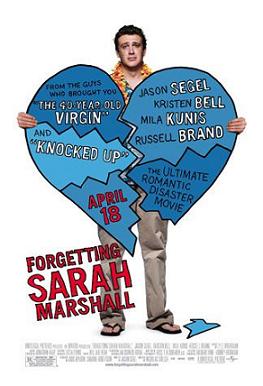
Forgetting Sarah Marshall

The first time around with the classic Freaks and Geeks on TV audiences missed out on Judd Apatow's unique sense of humor. All it took to get him noticed was two highly thought of comedies, The 40-Year Old Virgin and Knocked Up, with a string of other movies to his name as a producer and now moviegoers know who he is. I'm surprised by some reactions to him because I love the sometime bizarre humor his movies have. But looking at them as a whole, most of them have a heart, something comedies too often skip by.

Forgetting Sarah Marshall is one Apatow's movies where he's the producer, and it jumps ahead of all his other movies as the funniest yet. Comedies can be difficult to judge because humor is so different from person to person. Something you find hysterical can fly right over someone else's head. But FSM had so many laugh out moments I'd find it hard to believe that it couldn't produce a couple chuckles from even the most serious moviegoer. What works is that the characters are real people placed in real-life situations with some off the wall results.

Peter Bretter (star and writer Jason Segel) just got dumped by his TV star girlfriend Sarah Marshall (Kristen Bell). After three weeks of refusing to move on from the break-up, Peter goes on a vacation, going to Hawaii only to discover that Sarah is there with her new boyfriend and the guy she was cheating with, Aldous Snow (Russell Brand), an English pop star known for his prowess with women as much as his music. It seems nothing can go right for Peter, but he hits it off with a hotel employee, Rachel (Mila Kunis), and goes from there as he tries to get over his heartbreak.

That plot doesn't sound like a barrel of laughs, but it's these awkward situations that do produce some of the funniest moments. Peter just wants to move on with his life but can't seem to buy any good luck. Some of the humor comes from really quick, lightning fast moments that don't have a lot of build-up, they hit you and move on. Here's IMDB's Memorable Quotes and then some worthy break-up advice from the movie.

Since his role in Freaks and Geeks, Segel's been one of my favorites whether as a supporting player like Knocked Up or his starring roles like here and I Love You, Man. He's funny without mugging for the camera, and it's usually his delivery that sells the jokes. Russell Brand goes down the more obvious route, the over the top sexed-up pop singer, and is hysterical because he commits to being completely ridiculous. Bell has the most serious of the 4 main parts, but even she gets some really funny parts. The big surprise here is Kunis as basically the most perfect girl...ever. Most people know her from That 70s Show where she played a loud, annoying, very shrill teenager, but she shows what she can do with a well-written part. Her looks are not in question, but she's funny, very natural and makes an ideal girlfriend.

The 4 lead roles are solid, but like so many other Apatow movies, it's the little cameo parts that take the movie from funny to hysterical. Bill Hader plays Peter's stepbrother who keeps in touch via webcam, Maria Thayer and Jack McBrayer are Mormon newlyweds staying at the same hotel as Peter, Jonah Hill is an adoring waiter who loves Aldous and just wants to be around him, Paul Rudd is a pot-smoking surf instructor named Chuck or Konuu (Chuck in Hawaiian, 'You sound like you're from London!), and Kristen Wiig plays a sarcastic yoga instructor, check out her scene here. These parts go in and out of the story and aren't key to the main story between Peter, Sarah and Rachel, but they keep the momentum going.

The humor isn't as filthy here as it was in some other Apatow productions, but it isn't exactly clean, good old-fashioned humor either. Check out the gag reel from the DVD for some of the best laughs, especially the last one with Segel and Hader in the bar as much for Segel's reaction as anything else. It's a funny movie all around and should definitely have something for everyone.

Forgetting Sarah Marshall <----trailer (2009): ***/****

Friday, August 21, 2009

Duel in the Sun

After the huge success of Gone With the Wind in 1939, movie studios spent years looking for the next big epic to springboard off that epic's success. Ah, who am I kidding, they're still doing that now. GWtW producer David O. Selznick tried to duplicate the success with 1946's Duel in the Sun, a western with a feel of a Greek tragedy that has some interesting cast choices, good and bad, but never amounts to much.

Two key roles show the positive and negative in casting. Jennifer Jones, very white Jennifer Jones, plays a young woman who's father was Mexican and mother an Indian so she has to live with some prejudices against her simply because she's of mixed blood. Jones is doused in skin-darkening makeup to make her look like a Mexican/Indian which looks odd. As for her acting, this is one of those roles that critical fans can point to as being too theatrical. She's over-the-top from the start, and yes, the role requires emotion but it's too much and not believable.

The other interesting casting is rising star Gregory Peck who typically played the resolute, heroic good guy in his career. In 'Duel,' it's just the opposite as he plays the bad guy. And to be fair, Peck nails the part. He's the bad guy you love to hate who can spin a story so quickly and smoothly that you forget what a nasty guy is. This development builds from a cowboy who lives his own life and doesn't think much of what others see in him to a raging, psychopathic killer by the end of the movie. It was refreshing to see Peck in such an atypical role.

On to the story now, which begins with Pearl Chavez (Jones) moving to her distant relatives' sprawling ranch in Texas, the Spanish Bit, after her father is hung for murdering his cheating wife and the unlucky fellow she was with. Pearl, half Mexican/half Indian, finds quite the dysfunctional family at the ranch, starting with the family patriarch, Senator Jackson McCanles (Lionel Barrymore), a racist, crippled old man who refuses to admit the times are changing. Pearl falls for Jackson's son Jesse (Joseph Cotten), a lawyer changing with those times, but ends up with loutish Lewton (Peck), a freewheeling type who lives life how he wants it.

It's the years after the Civil War and the United States are developing and moving further west. The Senator wants nothing to do with the expansion, even when Jesse tries to explain it to him. Pearl is dropped into this perilous situation as the family is torn apart and go their separate ways. Trying to hold it all together, Laura Belle McCanles (Lillian Gish) is seemingly the one good person in the house along with her son Jesse.

This movie had issues from the start, especially when it came to the director's chair, just check out the bevy of directors who were at the helm at one point or another. I couldn't help watching the whole thing is that everyone is trying too hard. Some of my friends dislike pre-1960 movies because they are too theatrical, too stiff, and this is the type of movie where I agree with them. Cotten is good as the angelic brother, Barrymore is playing Barrymore, and Gish makes the most of a smaller part. Also Walter Huston has a small but solid supporting part.  But all in all, something doesn't connect. It feels like a Greek tragedy with family rivalries and disagreements, but there's no one to root for.

By the last 30 minutes or so, decisions are made that serve no real purpose or are even vaguely believable other than to drive the movie along. Pearl loves and hates Lewt, and their ever-so normal relationship starts to turn into listening to nails on the chalkboard. I wanted to say 'just let him go! He's messing with your head!' And then the ending, which is too much on any number of levels.

All this is disappointing because money was clearly spent on this big budget western. One scene with Barrymore and Cotten riding to stop the railroad tracks being built on their land has hundreds of men on horseback. They ride over a far-off hill and approach the rail camp, and it's great to watch. It's a gorgeous movie with some shots where you could freeze the DVD and swear it was a painting. But really it tries too hard to be an epic movie but never quite gets there.

Duel in the Sun (1946): **/****

Dial M for Murder

One of my all-time favorite lines in a movie comes late in The Bridge on the River Kwai in a conversation between Jack Hawkins' Warden and William Holden's Shears character. As they prepare to blow up the bridge, Warden says 'you're taught there's always something else you can do' because much of the time it's the unexpected thing that is the most costly. As meticulous a planner as you try to be, you can't plan for everything. That idea comes into play in Alfred Hitchcock's 1954 thriller Dial M for Murder.

Former pro tennis player Tony Wendice (Ray Milland) seems to have a perfect life, a beautiful wife, Margot (Grace Kelly), a lavish London apartment, and no job to speak of because his wife comes from money. But everything's not so rosy for Tony who has discovered his wife is having an affair with Mark Halliday (Robert Cummings), an American mystery/crime novelist. So cautiously and carefully, Tony sets up an elaborate plan to murder his wife and gain all her riches through her will. The main component of his plan is the most clever, blackmailing an old classmate (Anthony Dawson) to actually kill Margot.

Tony's plan seems perfect, every thing is planned down to the smallest detail as to how he plans to murder his wife. There will be no witnesses, the murderer will be paid off, and he'll have a perfect alibi. But the plan doesn't go smoothly (SPOILER here's the attempted murder plan), and Tony is forced to scramble to make everything right. Could his new plan still work? A detective (John Williams) can't quite put his finger on what's going on, but he knows something is fishy.

Director Alfred Hitchcock was always one of the best moviemakers around at toying with the audiences' perception of what was going on, the preconceived notion they bring into the theater before the movie even starts. Dial M is ripe with those sorts of things. For me, the biggest is that I was rooting for Milland's Tony to get away with it. He's so smooth, so suave in explaining his plan, you understand where he's coming from. As he explains it, you agree with him. To counter that, Hitchcock cast Grace Kelly as the cheating wife. Kelly looks about as angelic as any actress around so it's hard to believe she'd cheat on her husband, but she does just that. And lastly, Cummings' Halliday character is incredibly annoying so you hope things don't turn out well for him. It's all little touches Hitchcock adds that make the movies fun to watch.

Based on a Broadway play, Dial M is set almost exclusively in Tony and Margot's spacious London apartment. With a few exceptions of outdoor or other building scenes, the whole movie takes place in two rooms, the living room and the bedroom with an occasional glance out the window. But Hitchcock is so good filming these sequences, you hardly notice that the story never leaves the room. He shoots straight-on, from above, from below, POV shots, anything to keep it interesting.

With a play as its background, the story will obviously be dialogue-heavy. The scene where Tony explains his diabolical plan to Anthony Dawson made me think of a slow burn, a quietly building scene as more is revealed and Tony explains what he hopes to do and how they'll do it. It's so clear that when his perfect murder plan goes awry, the viewer knows precisely what's going on just as the characters onscreen do.

The casting of the major parts, as discussed before, works perfectly because so much is played against your perceptions. Some interesting posts at IMDB point out how differently the movie would play if Hitchcock had cast Jimmy Stewart as the conspiring husband. It'd certainly add a unique touch, but Milland is excellent as Tony. Nothing can rattle this guy no matter what's thrown at him. In her first of three movies with the director, Kelly is playing 2 different characters almost, the loving, doting wife and the cheating, passionate lover, and she nails both parts. Like I said, Cummings is annoying so I guess he did a good job, and Williams as Inspector Hubbard hits all the right notes.

Typically listed as one of Hitchcock's best movies, at least in his top 10, Dial M for Murder is a unique murder mystery/thriller. There's little to no action, but the story is so clearly laid out and explained with the actors doing such a fine job working that story out, you barely notice the time go by. Next thing you know, movie over!

Dial M for Murder <-----trailer (1954): ***/****

Wednesday, August 19, 2009

G.I. Joe: The Rise of Cobra

Now if you're judging my feelings of summer blockbusters by my review of Transformers 2, you might think I hate all those big action movies, but it's really just the opposite. I love movies like that, the review just shows how bad I thought T2 was in comparison to most similar movies. A good example of what an enjoyable summer action blockbuster is G.I. Joe: The Rise of Cobra which surprised me. I thought it looked good but wasn't dying to see it, but a day later I'm still glad I did.

Plots can be secondary and often third or fourth in the list of important elements to a blockbuster, but G.I. Joe takes a familiar formula, villain threatening to destroy the world city by city, and adds an interesting wrinkle with some new technology. They're called the nanomites, microscopic robots originally intended to fight cancer cells but transformed into weapons that take apart and completely dismantle whatever they're shot at, like tanks, cars, buildings, you name it. So here's the plot going from the nanomites.

With some funding from NATO, MARS Industry CEO James McCullen (Christopher Eccleston) has perfected turning the nanomites into an offensive weapon and has spent billions of dollars on manufacturing 4 warheads with his new weapon. But while being shipped, the column guarding the warheads is attacked, with Duke (Channing Tatum) and Ripcord (Marlon Wayans) as part of the force. Whoever is attacking them, led by the mysterious Baroness (Sienna Miller), has advanced technology that the army is defenseless against. The column is saved by a group of fighters who rescue the warheads and Duke and Ripcord as well.

The group is transported to 'the Pit' a top secret base deep below the Egyptian desert where they're introduced to General Hawk (Dennis Quaid) who explains the layout to their organization. They are G.I. Joe, the best soldiers from all around the world working together to keep Earth safe from whoever would do it harm. Duke and Ripcord blackmail their way into Team Alpha and get to work finding out who wants the technology. Everything points to McCullen who with the Baroness, and henchmen Storm Shadow (Byung-hun Lee), Zartan (Arnold Vosloo) and one mysterious villian (Joseph Gordon-Levitt) look to make another grab for the nanomite warheads and it doesn't look like anything can stop them.

What I like about big movies like this is that it allows huge casts to work together and let them clearly have fun making a highly entertaining movie. Come on, Dennis Quaid is in the movie for about 15 minutes, delivers some appropriately cheesy/inspirational lines, and looks tough. He's gotta be loving that. The G.I. Joe team is an interesting list of unique actors and characters like Heavy Duty (Adewale Akinnuoye-Agbaje), the tough sergeant of the group, Snake Eyes (Ray Park) the resident badass and expert in martial arts and by far the coolest Joe, Breaker (Said Taghmaoui), the communication expert, and Scarlett (Rachel Nichols), the team's weapons expert. So as anyone who read some past reviews of mine knows, this is basically the Magnificent 7, a men-on-a-mission movie with Duke and Ripcord joining the team.

With some ridiculously cool technology available, the beneficiary is the action scenes. The coolest gadget was the accerlation suits which help you react quicker and faster, jump higher, so basically PF Flyers on steroids. The chase through Paris as Storm Shadow and the Baroness try to take out the Eiffel Tower is an exciting, well-put together sequence as the Joes frantically try to catch up with Duke and Ripcord in the suits, Scarlet on a motorcycle, and Heavy Duty and Breaker just trying to keep up. On the whole, the action is the reason to see this movie. It's cut so you can actually see what's going on and the CGI is apparent but done well.

On to the casting which ranges from very good to very wooden. I don't know Channing Tatum's appeal, check that, I do but don't get it. The guy's got the personality and delivery of a cardboard box and his so-called dramatic lines come across as comical, hopefully unintentionally so. The rest of the cast makes up for, including surprisingly enough Marlon Wayans who revels in the smartass sidekick role along with Sienna Miller who has finally made a mainstream blockbuster. For one, with dark hair and low-cut leather outfits, she looks amazing, and two, her character is a badass. Hopefully, she sticks with the more mainstream movies, or at least not completely sticking with the indies. It's a fun cast and it looks like they enjoyed themselves making GI Joe.

So is G.I. Joe: The Rise of Cobra a stupid summer blockbuster full of action and somewhat short on story? You bet, but it does what it's supposed to. It doesn't overdo the action sequences and CGI and keeps it exciting without trying to melt your face with its 'Michael Bay coolness.' Good cast top to bottom with one cameo I won't spoil here, and an ending that leaves the door open for a sequel which hopefully they do make in the next couple of years. Surprised by how much I enjoyed this so don't listen to the negative reviews, G.I. Joe is a lot of fun.

G.I. Joe: The Rise of Cobra <-----trailer (2009): ***/****

Edge of the City

This has been bugging me since I finished 1957's Edge of the City yesterday, and I'm having trouble with it. I can't think of a buddy movie made before 1957, but I know there has to be examples out there. Now officially they didn't become known until the late 1960s or early 1970s with movies like Butch Cassidy and the Sundance Kid, but EotC is if nothing else a quasi-buddy movie with some racial undertones, and one I can highly recommend.

Made a year before the much more well-known The Defiant Ones, Edge of the City tells the story of two men, one white and one black, who become close friends in a short time, but one of their pasts comes back to haunt them. Axel North (John Cassavetes) walks into a shipping yard in New York looking for a job. He gets a job and is put to work with Charlie Malik (Jack Warden) and his work gang but quickly rubs Charlie the wrong way. Instead, Axel bonds with Tommy Tyler (Sidney Poitier) and joins his crew in the train yards.

But it's no time before Axel's somewhat checkered past comes back to haunt him. He becomes fast friends with Tommy and his wife Lucy (Ruby Dee) and even starts to date a teacher in the neighborhood, Ellen (Kathleen Maguire), but everything starts to unravel when news of his past gets out to certain people. The problems build to a twist I did not see coming, and an ending that is probably really authentic for the situation, and therefore that much more heartbreaking. It's a testament to these actors and their ability because the ending hits so hard.

Usually playing supporting parts in TV shows, Cassavetes gets a shot here in one of his first starring roles. An intense actor in every sense of the world, he creates a 3-D, believable, sympathetic character you can't help but root for. His Axel has made mistakes in the past and is trying to hide from them. He's a shy guy and doesn't want to face those problems, whether it be talking to his parents (Robert F. Simon and Ruth White, both great in their two scenes) or addressing any sort of confrontation with coworkers, especially Warden's Charlie, a great villainous, heavy role. It's the type of role that made me question why Cassavetes didn't become a bigger star, a more well-known name, because he clearly has the ability to act with the best.

Matching Cassavetes, Poitier's Tommy Tyler is a family man, a young husband with a wife and 2 kids trying to get by. Tommy becomes a bit of a big brother to Axel, looking out for him and helping him find his way. They talk together about their pasts but are also able to just go out and have a good time, having a beer at the bowling alley. Poitier gets to have some fun with the part, Tommy being an extremely outgoing guy both at work and home. For such a well-respected actor, I still think of him as completely underrated, and this is a great part for him. The two men present a believable friendship, Youtube clip here with quasi-spoilers, that carries the movie.

Released in 1957, I can't know what kind of reaction it got from critics and audiences, but it's the type of basic story, a black man befriending a white man, that could still push peoples' buttons today in 2009. And because of that, a movie released over 50 years ago, it's refreshing to see a story like this. Not once do Tommy and/or Axel mention that they have different skin color. It's not an issue for either of them, only some around them, but give director Martin Ritt credit. He tells the story by letting the actors do what they do and not calling attention to himself.

The strategy pays off because the characters and their relationships and interactions come across as authentic. A friendship starts with one man standing up for another and goes from there. A relationship begins with an awkard introduction between Axel and Ellen and turns into something more. The movie has an authentic, almost documentary-like feel to the story. The camera's never invasive and just follows the story. Filmed in New York and New Jersey in black and white, Ritt presents a realistic portrayal of lower middle class folks, some with pasts they'd rather forget.

I'd never heard of this one before stumbling across it on TCM, and it only caught my eye because of the two stars. I was glad I did watch it, and hopefully it continues to climb into the lexicon of movie fans because it's that good. It's been released on DVD as part of the Sidney Poitier Collection, but if you don't want to buy the set keep your eye out for it on the TCM upcoming schedule.

Edge of the City <----trailer (1957): *** 1/2 /****