The Sons of Katie Elder

The Sons of Katie Elder
"First, we reunite, then find Ma and Pa's killer...then read some reviews."

Saturday, July 11, 2009

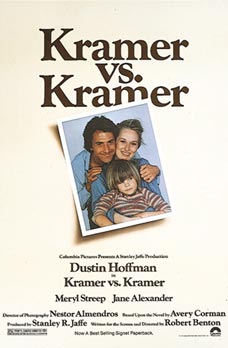
Kramer vs. Kramer

After the huge success of The Graduate, Dustin Hoffman put together a string of movies that are among the best that came out of the 1970s, movies like All the President's Men, Marathon Man, Papillon, Straw Dogs, and Little Big Man. But his best part from the decade came in 1979 in a performance that won him his first Academy Award as a single dad in Kramer vs. Kramer.

Coming home with great news from work, he's been given the biggest account the company holds, Ted Kramer (Hoffman) bursts through the door to tell his wife only to almost miss his wife's news. Joanna (Meryl Streep) has had enough of their marriage, doesn't think she's a good mother to 7-year old Billy (Justin Henry), and generally is in a bad place. She tells a completely baffled Ted that she's leaving him and Billy.

So with no way to stop her, Ted now becomes a single dad who has to raise his son, keep the apartment going, and also hold down a job where he's been given huge responsibilities. But after some early struggles, Ted and Billy get into a rhythm. They get up, eat breakfast together, and then Ted walks him to school each morning. At night, he picks him up at school and they do homework, play, read together. After almost 18 months of their new life, a problem arises, Joanna is back and wants custody of her boy. A custody battle ensues where all the dirty laundry comes out in the wash.

Should Joanna be given custody solely because she's the boy's mother even though she abandoned Billy? Or should Ted be given the benefit of the doubt since he's cared for Billy on his own for the last year and a half? The custody battle in court is a difficult section of the movie to watch because neither parent truly wants to rip the other one to shreds on the stand, but at the same time they both know it's what needs to happen if they hope to get custody of Billy. The decision the judge settles on doesn't make sense at all, but with the ending, everyone comes to their senses. And thank God for it, because I would have been pissed if the decision had stuck.

As two of their generations best actors, Hoffman and Streep both won Oscars for their performances. Streep disappears for much of the movie after she leaves her family so it's Hoffman's movie to carry. He doesn't disappoint, transforming into a father who knows every little thing about his son after only being partially involved in the boy's life for several years because of the work his job entails. Two scenes illustrate this change in a criminally simple fashion. The morning after Joanna leaves Ted scrambles to make Billy some french toast for breakfast. Without the gory details, let's say it doesn't go smoothly. Flash to 18 months later where Ted and Billy have it down to an art, the breakfast is made smooth with no incidents. It's a great way to illustrate the change the father and son have gone through.

While Hoffman and Streep were both nominated and won Oscars for their performances, 8-year old Justin Henry was only nominated for his part. Nowadays where child actors range from god awful to 'keep an eye on them in the future,' Henry is one of the most natural kids in a movie I've come across. He acts like a kid, talks like a kid, and comes across as completely believable. His interactions with Hoffman especially, Streep too though, bring the movie up a notch because I believed they were a family. Too bad he didn't win the Oscar because he fully deserved it.

As a mother torn about what to do with her life, Streep is only around for half the movie but leaves a lasting impression. She's trying to get her life in order at the cost of abandoning her son. Her decision to return shows Joanna realizes she made a mistake, but is too late for her? Here's her testimony at the custody hearing, SPOILERS. Out of the supporting cast, Jane Alexander has a good part as Margaret, a single mom who lives one floor down from the Kramers in their apartment building. She was Joanna's friend but becomes Ted's best friend after his wife leaves, the two bonding through their similar backgrounds.

Made in 1979, the movie has the look of a documentary. No crazy shots, no in your face filming, director Robert Benton just points the camera at the story and let's them go. As a viewer, you feel like a fly on the wall watching the Kramer family interact. It's a movie that almost swept its way through the Oscars, and for good reason. Kramer vs. Kramer can be a heartbreaking story but one with an ending that fits so perfectly.

Tuesday, July 7, 2009

Thief

Before there was Heat, Collateral or most recently Public Enemies, even director Michael Mann had to start somewhere. Directing his first feature film, Mann was already showing a style that he's become famous for with 1981's Thief.

With some directors, it takes time for a personal style to develop, but with Mann and Thief, it wouldn't be hard to believe if someone had told me this movie was made in the late 90s when he had become a very bankable director. It has all the elements fans have become used to, and in some cases scenes that are almost completely duplicated with later efforts, but more on that later.

Working on his own as a safecracker, ex-convict Frank (James Caan) is at the top of his game and bringing in a pretty penny while doing it. With help from his partner, Barry (Jim Belushi), it seems there's not a safe or vault out there the two men can't take down. Frank has only one demand when it comes to jobs, only money or diamonds, nothing too exotic and he picks the jobs. But after one particularly successful job, Frank is approached by a fence named Leo (Robert Prosky) to work under contract exclusively for him.

Frank wavers at first, but decides to take the offer. His plan is simple; do a handful of lucrative jobs and walk away from his career as a thief with his new wife, Jessie (Tuesday Weld). Apparently, Frank's never seen a mafia movie to know that as long as you make money for organized crime, they're not going to let you go easily. So for the expert safecracker, the situation goes from bad to worse, and he must now find a way out. Story-wise, this is nothing that hasn't been dealt with before in movies, books, and TV shows. But with Mann at the helms, you barely even notice that this all sounds really familiar. He does everything so well, so smoothly, that I got so wrapped up in the movie I didn't even notice the familiar storyline.

Ranking up there with Robert Deniro's Neal McCauley and Tom Cruise's Vincent, Caan as Frank is a great anti-hero and the perfect hard-edged character to lead the movie. Caan is one of those few actors who is just cool standing there. He doesn't have to try or pretend to be somebody he's not. For God's sake the man played Sonny Corleone! As Frank, Caan gives one of his career's best performances. After serving 11 years in prison, he's making up for lost time whether it be with his career or his newlywed bride. The scene where the two really connect for the first time, check it out here, is one example of a similar scene Mann would use 14 years later in Heat. It's the perfect scene to really get to know a character, and Caan is dead-on in the scene and Weld matches him.

As Frank's wife, Weld delivers a strong performance as a woman with a similarly troubled past. At first, she doesn't know how to read Frank's advances, but comes to see him as he really is, honest, sometimes brutally so, straightforward and just looking to lead a happy life. Prosky provides a good villain who for much of the movie is just a business partner. Of course, any self-respecting moviegoer knows he's not as legit as he's made out and problems arise. Belushi in a smaller part makes the partnership between Frank and Barry completely believable with very little said between them. And surprisingly, Willie Nelson joins the cast as Okla, a convict and sort of mentor/father figure to Frank who's serving the last 10 months of his sentence. He's only in 2 scenes, but Nelson is strong in both, giving a depth to Frank's background we otherwise would have no idea about.

On to the movie's style which is evident from the opening credits and the first vault break-in, seen here. Much of the movie's tone has to be chalked up to the score from Tangerine Dream which is a moody, dark, intense, very 80s electronica score. At times it can be overbearing, maybe a little over the top, but it fits the movie so perfectly. Filmed in Chicago, Thief is shot in shadows and darkness, almost a modern film noir, with some really innovative camera shots. I'll always be in favor of on-location shooting, especially when it involves my hometown of Chicago, because it's hard to duplicate the feel of a city elsewhere, whether it be a studio or another city posing as Chicago.

Less reliant on action and shootouts than some of Mann's later movies, Thief nonetheless does not disappoint when it comes to gunplay. It's after a $4 million dollar heist that the situation goes all to hell and Frank realizes everyone he loves and everything he owns is at risk. Drawing on his prison experience, "you have to have the mindset that you're not scared of dying," Frank goes after Leo and his henchmen in one last desperate attempt. You can see the last 10 minutes here, but obviously MAJOR SPOILERS. It's a very stylish, moving ending to the movie with another great sample from Tangerine Dream playing, even if I would have altered the ending a bit.

So take what I say with a grain of salt, I'm a huge Michael Mann fan, but Thief is as good if not better than the director's most well-known and respected movies like Heat and Collateral. Featuring a great performance from James Caan as an all-around badass who won't be messed with by anyone and a worthy supporting cast, Thief is one you should not let slip by.

Thief <----- trailer (1981): *** 1/2 / ****

Friday, July 3, 2009

Buchanan Rides Alone

When many people think of classic teamings between director and star in westerns, John Ford and John Wayne come to mind and for good reason. The duo made a handful of classic westerns that make many top 10 lists of all-time best westerns. One duo though that's been overshadowed over the years and has recently become more respected and held in high regard was the teaming between Randolph Scott and director Budd Boetticher.

A veteran of Hollywood movies since the late 1920s, Scott made a decision in the last half of the 1940s to only make westerns the rest of his career. Many of the movies he would then make were average, many of them B-westerns that have long since been forgotten. But teaming with Boetticher, Scott made a string of what are now considered cult classic westerns, six movies that last year were packaged in a long overdue DVD box set. Check that, five of the movies are in the set, Seven Men from Now is available separately.

These westerns are really just B-movies when comparing them to other westerns of the time like The Searchers or Shane. None are longer than 80 minutes and all of them are content to tell a simple, straightforward story. The main character in each of them, Scott in all 6, typically has a checkered past in one way or another and has to redeem himself in some way. While Scott was one of the first anti-heroes, the bad guys walked that fine line between good and bad, often working with Scott's character all the while building to a showdown. They're good old-fashioned movies, much like John Wayne's westerns, where you can just sit back and enjoy.

Having seen five of the six Scott/Boetticher westerns, I was happy to see Buchanan Rides Alone, the one I haven't seen, on TCM's schedule last week. It took me awhile to sit down and watch it, but it was worth the wait to say I've seen all six. Scott plays Tom Buchanan, a former mercenary coming back from fighting in the Mexican Revolution. He's got a pocketful of cash and is ready to start his spread up in west Texas. On the ride home, he's stopped in a dusty California town of Agry and quickly finds himself in a mess of a situation.

The man in charge in town, Simon Agry (Tol Avery), runs everything from the shops to the newspaper to the saloon and for good measure, his brother Lew (Barry Kelley) is the sheriff. Scott is having a drink at the saloon when a vaquero, Juan de la Vegas (Manuel Rojas), enters and promptly shoots Roy Agry, Simon's hot-headed son. We learn later Roy hit and possibly abused Juan's girlfriend. The townspeople jump to conclusions and think Buchanan was tied up in the shooting. Just wanting to start his life over in Texas, Buchanan now must fight his way out of one more brewing shootout.

What's notable from many Boetticher westerns was the director's ability to cast rising stars in a supporting role. As good as Scott is in these movies, it's often these actors who steal the scenes they're in. What's missing from 'Buchanan' is that great supporting cast. L.Q. Jones definitely qualifies as Pecos, another west Texas cowboy who sides with Buchanan, a role perfectly suited to the likable, drawling character actor. But other than Jones, no one jumps out or makes much of an impression. Craig Stevens plays Carbo, apparently Simon's right-hand man but he's never really explained so I could be wrong.

I'll always prefer wide-open wilderness westerns that town-based westerns, but this one at least takes advantage of shooting in a town. Filmed in Old Tucson, maybe most recognizably known from Rio Bravo, Agry feels like a real western town instead of shooting on a backlot in Hollywood. But other things don't work, especially some attempts at humor with Amos Agry (Peter Whitney), the somewhat slow-witted Agry brother who is always frantically running around town bringing news of developments at the jail or the ranch.

The final shootout could have been a good one, but parts of it were just too ridiculous. A saddlebag holding $50,000 lies on a dusty bridge with the two opposite groups on either side. When cowboys go running after it, they do just that...run. For goodness sake, crouch down and make your way out there. Other than the showdown at the end, Boetticher doesn't have much action here, but at just 78 minutes, the movie's always moving along at a good pace so you shouldn't be bored.

So while not as good as Ride Lonesome or Seven Men From Now, Buchanan Rides Alone is still a worthy entry in the Scott/Boetticher pairing. If you're looking to see these movies, they're available as a set at Amazon or any number of vendors (I included the link earlier) or rent them through Netflix. They may not be as known or even respected as many other westerns from the 50s, but they deserve to be listed with the classics like The Searchers and Shane. Here's a trailer and a 9-minute interview with filmmaker Taylor Hackford about 'Buchanan.'

Thursday, July 2, 2009

Grand Slam

Before I get into another review, I wanted to bring up an underrated DVD company that has done a great job over the years releasing a wide variety of cult classics and exploitation films from Europe, especially Italian movies. Thanks to Blue Underground, I've been able to see many movies that I otherwise would have only been able to read about or pay a nice bundle for a region free DVD player. BU does a great job with packaging the movies in widescreen presentations and doesn't skimp on the special features. Check out their website for some great if not so well known movie selections.

My latest Netflix movie was from Blue Underground, a 1967 Italian heist film called Grand Slam. It has drawn some comparisons to Rififi which are fair, but it stands on its own with a very 60s style to it. The movie was filmed in Rio de Janeiro which provides some interesting locations as the heist develops. Grand Slam begins with a bookend, a set-up for the rest of the movie. So if nothing else, GS gets points for originality.

After 30 years teaching in Rio, Professor James Anders (Edward G. Robinson) is retiring and heads home to New York. He visits an old friend, Mark Milford (Adolfo Celi), who's now heavily involved in the underworld with a proposition, a heist that's been brewing in Anders' head for many years. From his office in Rio, Anders had a view twice a year of a diamond shipment being delivered to the bank across the street. It comes like clockwork, and the professor has everything figured out on how to get the diamonds. And why do it this year? The delivery coincides with Carnival and will leave the bank closed for business for 4 days and wide open for the heist. With help from Milford recruiting a team, Anders puts his plan into action.

Heading the team is a German mercenary (Klaus Kinski), joined by an engineer (Riccardo Cucciolla), a safecracker (George Rigaud), and interestingly enough, a playboy (Robert Hoffmann) who typically has no problems with women. Part of the heist goes to the playboy, Jean-Paul, who must seduce a woman who works in the bank, Mary Ann (Janet Leigh), and get his hands on a set of keys to the vault. The planning goes smoothy until the foursome discover the bank has installed a new security system, the Grand Slam, which utilizes extremely sensitive microphones and sets off an alarm at the slightest sound over 16 decibels.

After the opening introduction and recruiting of the team, Robinson and Celi disappear until the last 15 minutes or so. Most of the movies belongs to the heist team with the planning, execution, and getaway of the diamonds. Just wanted to point that out so don't go in expecting a Robinson-dominated movie although he is good in what amounts to an extended cameo, Celi too. The always intense Kinski leads the team, and he doesn't disappoint here, seemingly always one good shove away from snapping. Hoffmann gets to smooze Leigh, that must have been tough, and Cucciolla falls for a local girl. As the stoic safecracker, Rigaud doesn't get any love interests, but as the veteran of the group provides some needed calmness and leadership with Kinski.

Following the huge success of Alfred Hitchcock's Psycho, Leigh was only in a handful of other movies while guest starring on a number of TV shows in the 60s and 70s. Made to look somewhat plain with a large pair of glasses and pulled back pale blond hair, Leigh is supposed to be the unattractive secretary that no man would be interested in. All I could think at that characterization was rrrrrrrrright. It would have been hard to 'ugly up' Leigh, with one character even saying "I'm glad it wasn't me" in reference to Jean-Paul having to woo her. Leigh has a great part here as a woman being played by the playboy.

Some of the comparisons to Rififi have to come from the similarities in the actual heist sequence. It's a quiet sequence although I'd have to go back and watch to see if there was actually any words spoken between the four men. The way the team gets around the Grand Slam security system is a creative one, one I hadn't thought of, and the setting of the opening of Carnival with a huge parade going on makes for an interesting entrance and getaway. The heist is long, lasting most of a half hour in running time as the plan develops, but it's well-choreographed, especially with two security guards patrolling the building on a 30-minute loop.

Other things worth mentioning include the ending with 2 different twists, both working very well without being forced. The second twist isn't as surprising as the first, but it works perfectly and should hopefully produce a chuckle or two because if we've learned anything from heist movies over the years, crime doesn't pay. It's the type of twist ending that can make a good movie into a very good movie. I won't say it's a classic heist movie, but Grand Slam does everything well. Ennio Morricone turns in another interesting, catchy score although it's really only used in the opening and closing credits. Check out the trailer if you're wavering on whether to see it.

Grand Slam (1967): ***/****

Wednesday, July 1, 2009

Netflix review #24: License to Kill

It's official, I've seen every James Bond movie from Dr. No to Quantum of Solace. I haven't watched the Pierce Brosnan entries straight through since their initial release so I won't rank them all just yet, but with 1989's License to Kill now checked off, I've seen 'em all.

What set the two Timothy Dalton Bond movies apart from the rest was that they weren't content to go with the status quo. The Moore movies started off strong but got too jokey, too satirical by the end of the run. The Living Daylights righted the ship with a great action/spy movie, and LtK expands on the James Bond character. Several posts at IMDB talk about LtK as a sort of spiritual sequel to On Her Majesty's Secret Service, and it's hard to disagree with.

Bond is on the vengeance trail here, going up against a drug dealer, not Ernst Blofeld trying to ransom off the world. On the way to old CIA buddy Felix Leiter's wedding, Bond joins Leiter (David Hedison) in an effort with the DEA to scoop up infamous drug kingpin Franz Sanchez (Robert Davi) who comes into jurisdiction for a quick snatch and grab job. Watch it here if curious. But when Sanchez is caught, he offers $2 million to anyone who can help him escape. Of course, there's a treacherous agent in the midst who helps Sanchez escape. The drug dealer begins his own path of revenge, maiming Leiter and killing his new wife.

Looking to avenge his friend and wife, Bond resigns from MI6 when he's told to take no part in the case against Sanchez. With no limits on his actions, Bond can move freely and act as viciously as the men he's chasing. It's good to see Bond go out on his own here instead of being tied down by MI6's rules and regulations. To a certan point we've seen similar stories in other movies, like Quantum of Solace, but this is the first time he's completely on his own although Q (Desmond Llewelyn) does show up and offer his support with a few gadgets. It's always great to see Q, especially here where he's allowed out of his lab.

On the vengeance trail, Bond tries to infiltrate Sanchez's inner circle, pitting the dealer against his most loyal men. It's as he gets closer to him that Bond discovers a bigger plan at work, a system of organizing the drug cartels from the east and west. They've developed a new way of transporting heroin, a system that makes the drug impossible to detect. It does provide for a great closing sequence with four oil tankers transporting the heroin racing down a mountain road, Bond doing his best to slow them down.

As Sanchez, Davi is a good if not great villain. He's not a maniacal hothead, instead a businessman with a plan to make millions. Sanchez insists on loyalty from his men and pays well to get it so when Bond shows up saying his men are looking to betray him the obvious problems arise. As for his henchmen, they're some of the best. Always a reliable bad guy/sidekick, Don Stroud is Heller, a mysterious American with a past in the armed forces, and a young Benicio Del Toro makes a frightening appearance as Dario, an ex-contra who does Sanchez's dirty work. Del Toro is only in a handful of scenes, but with some crazy eyes and his maniacal laughing makes the most of his smaller part.

On to the Bond girls, one good, one not so good. A pre-Law and Order Carrie Lowell plays Pam Bouvier, a former Army pilot who worked as one of Leiter's informants. Somewhat wooden in the part, Lowell is good in the part because she's not the helpless Bond girl who constantly needs 007 to save her. She's tough, able to handle herself, although when it comes down to it, she's got the hots for Bond. As for the not so good, Talisa Soto plays Lupe, Sanchez's girlfriend who wants out. Does she look good? Of course. Does her character serve a purpose? Not really. Others in the supporting cast include Anthony Zerbe and for the must-have odd casting in a Bond movie, Wayne Newton.

Unfortunately for the Bond series, this was the last movie in the bunch for six years until 1995's Goldeneye with Pierce Brosnan taking over the title role. LtK wasn't received that well in the U.S. at the box office, but I enjoyed it as much for a change of pace as anything. I went into the two Timothy Dalton movies with somewhat low expectations, but I can say now I think he's one of the better Bonds behind Connery and Craig.

License to Kill, <----trailer (1989): ***/****

Thursday, June 25, 2009

Experiment in Terror

I tend to avoid horror or slasher movies whenever I can. Seeing people's heads get lopped off or the torture porn in the Saw and Hostel movies just doesn't do it for me. It doesn't take much to make a movie a scary or frightening one, especially for me. You don't need mass murderers wielding chainsaws and machetes to bring out fear. Sometimes all it takes is the unknown, a stranger messing with your life like in 1962's Experiment in Terror.

Probably more well known for the Pink Panther movies, director Blake Edwards bases the story on a frightening premise; someone is always watching you, in this case an individual who knows almost everything about you and is holding it over your head. All it takes sometimes to get someone to do something, often against their will, is to threaten loved ones. That's the basic premise of 'Experiment' and even at over 2 hours it's always interesting with a back and forth cat and mouse game.

Coming home from a late-night party, Kelly Sherwood (Lee Remick) pulls into her garage and is heading to bed when a man grabs her from behind. Calmly and cooly with his arm around her throat, the stranger whispers to Kelly what he wants from her. One day soon, Kelly, a bank teller, will take $100,000 from her drawer and bring it to him. If she doesn't cooperate or goes to the authorities, he'll kill her 16-year old sister, Toby (Stefanie Powers) and then come after her. He leaves with an ominous final threat, someone will always be watching you so don't try any funny business.

Secretly calling the FBI, Kelly talks to Agent John Ripley (Glenn Ford) and enlists his help in finding the mysterious man blackmailing her into robbing her own bank. With Kelly unable to give a physical description of her attacker, all they have is one clue to go on; he's asthmatic and talks in a slow, halting pattern. Can they catch him with so little information before both Kelly and Toby come under the gun?

This is a thriller that is at it's best when it's dealing with the villain, played perfectly by Ross Martin. I won't go into his background or motivations because that would ruin some of the mystery. Known mostly for his work as Artemus Gordon, James West's partner in The Wild, Wild West, Martin is downright terrifying as the bad guy. Edwards always shoots him in dark, shadowy situations in close-ups that rarely give a clear shot of his face. If you've seen him in other shows, you'll recognize the distinctive voice right away. It's quite a departure for Martin who as Gordon was the amiable master of disguise always appearing at the perfect time to save the day. He was nominated for his part for a Golden Globe, but unfortunately was snubbed by the Academy Awards.

As the possible victim, Remick is an ideal damsel in distress. The 27-year old actress is rail-thin here and looks like a good wind would knock her over. At first, she's not quite sure how serious her attacker is in his threats so at times she's terrified of what he'll do and then other times eerily calm in her dealings with Ripley and the FBI. I like Glenn Ford more and more with each movie I see of his. He wasn't in a ton of classics and was almost a poor man's John Wayne, but Ford was always likable/believable as the tough leading man trying to save the day. A young Stefanie Powers, as cute as she ever was, is also good as Kelly's younger sister, a thankless role because she's not given much to do.

The story moves along as the FBI tries to secretly help Kelly and Toby, all the while trying to find the mysterious man threatening them. Martin coasts in and out of the story, making one ominous appearance after another until he finally puts his plan into play. The finale is a good one, filmed at a L.A. Dodgers vs. the San Francisco Giants game at Candlestick Park. With thousands of extras all around, it's a great setting as the FBI attempts to close in on their man, all the while trying to protect Kelly who's out in the open with little protection.

The DVD has been discontinued and can be hard to find, I caught it on TCM recently, but the print I saw was a good one, really taking advantage of the black and white filming. The movie's got a good score from Henry Mancini, here's a sample. Of course, I can't find any trailers, but TCM does have a handful of scenes you can watch through their website. It's a good thriller with a movie-stealing performance from a villainous Ross Martin and good parts from Ford, Remick and Powers.

Rififi

Sooner or later I'll find a caper/heist film that I don't like, but I hope it's a ways down the road. After watching a handful of Jean-Pierre Melville gangster/heist movies this year, I watched Rififi, a 1955 French movie that is often labeled as one of the best for its genre with one scene in particular standing out, that even 54 years later hasn't been topped.

Fresh out of jail for good behavior after serving a 5-year sentence for a diamond heist, Tony Stephanois (Jean Servais) looks for ties to his previous life including former girlfriend and love, Mado (Marie Sabouret). As he looks for her, Tony is so dedicated he even turns down an offer from his nephew, Jo (Carl Mohner), and a low-level but easygoing hood, Mario (Robert Manuel), to take part in an easy heist of a jewelry store. But when Tony finds out Mado quickly hooked on with another man soon after he was sent away, the veteran thief agrees to take part in the job but with some new demands. This won't be some smash and grab job, they're going after the big diamonds in the store safe. So recruiting a safecracker from Milan, Cesar (Jules Dassin), the four begin to plan the perfect heist.

Filmed in black and white, director Jules Dassin, doing double duty as director and actor, creates an atmospheric setting for his heist picture with on location shooting in Paris. He takes his time, in more ways than one, developing the story. What I've enjoyed about some of these older heist movies is that they were allowed to build and develop. So often now, movies have to get right to the heist and getaway with all its inherent action. But Dassin shows in detail the preparation and planning as the quartet case the jewelry store from an adjacent apartment and figure how to take out an alarm system that goes off with the slightest vibration or sound. It builds the tension, and then makes the actual heist more nervewracking because as the viewer we know what's coming.

The build-up is great, but the heist is something I'd never seen before. It starts about 45 minutes in and last almosts a full half-hour as Tony and Co. work their way into the jewelry store and then work on the safe. What's so impressive about that? Not a word is spoken the whole time, instead the sound of tools or nervous breathing from the four serving as the soundtrack. You can watch it in four different parts, one, two, three and four with the actual heist starting midway through the first link and continuing into the next three. I'd recommend just watching the whole movie, but the heist alone is worth it.

Another positive of non-Hollywood movies is that lack of a need or desire to make everything a happy ending with the nice little bow to finish things off. I loved the new Ocean's Eleven with George Clooney and Brad Pitt, but it wasn't exactly dealing in reality. Rififi is unsentimental, always dark, and more than a little narcissistic at times. The heist proves to be the easy part with the selling of the diamonds proving to be the most difficult. Human nature comes into play as a local mafioso, Pierre Grutter (Marcel Lupovici), and his two brothers catch wind of the heist. Nothing comes easy for Tony, Jo, Mario and Cesar, and the ending is anything but neat or tidy.

The casting is good, especially Servais in the lead. Tony is cynical and beaten down by his past and with one last heist looking to hit it big. There's a humanity to his character that comes across well with his great-nephew, Jo's son Tonio. He's got a hard edge to him, but in his interactions with the little boy he opens up and is always spoiling him with presents. Mohner as Jo is the young thug trying to get into the business who puts his family at risk with his work, and Manuel as Mario is a strong counter to the others. He is always ready with a laugh but is also prepared when the work starts. Dassin as Cesar gets to play the loverboy, the Italian safecracker always trying to impress the ladies.

Really one of the best heist/caper movies around, and one fully deserving of its reputation. Check out the trailer that's been dubbed into English and plays up the sex, of which there's very little, and violence, a few shootings late. The trailer does have some spoilers and hints at the ending so be forewarned going in. Don't be scared by the subtitles, Rififi is one of the best.

Wednesday, June 24, 2009

Transformers: Revenge of the Fallen

Where do you even start with a movie like Transformers: Revenge of the Fallen? I'm not one to pass up a midnight movie so I went and saw this last night with a sellout crowd. You know going in what you're getting, lots of action, explosions, crazy CGI, all the makeups of the classic summer blockbuster. I mildly liked the first movie so I went in with modest expectations at best for the sequel. Somehow though, it didn't even live up those low expectations, and I'm not even sure where to start.

A plot for a movie like this is about as unnecessary as it gets. It needs something to push the action forward and let the CGI take over from there. Here, even getting to that point is slow-going. Sam Witwicky (Shia LaBeouf) is off to college after saving the world from the Decepticons in the first movie with Optimus Prime and the Autobots. Life's pretty good for young Sam, he's got a gorgeous girlfriend, Mikaela (Megan Fox), and things have settled in nicely. But as he's moving, Sam finds a piece of the cube from the 1st movie with the little splinter giving him these crazy hallucinations with weird symbols.

Things develop and next thing you know new Decepticon leader Starscream is leading a rescue effort for Megatron, buried deep in an ocean trench, all in the hopes of helping the Fallen, a disgraced Decepticon, get back to Earth and take over the planet. There's more going on there, but it doesn't matter. The story bounces along and around so much it's hard to keep track of what's going on. Suffice it to say, most moviegoers aren't plopping down $11 to see Transformers for its well-written script.

So where to start? Just like the first movie, I enjoyed parts of the sequel and hated others. I'll get the negatives out of the way first. At 147 minutes, it's way too long. The Sam-to-college intro takes far too long to develop and tries too hard to get laughs including Sam's extremely annoying mother buying 'special' brownies and downing a whole bag. It's the type of college that never really exists, frat parties with strobe lights, pounding bass, beautiful girls dancing on tabletops and of course...cake with a serving knife. Uh, yeah, right.

In general, the humor is just too much from start to finish. Some good one-liners are needed in a movie like this, but not every other line of dialogue. Sam's parents, Kevin Dunn and Julie White, serve no purpose at all and provide many of the more groan-inducing lines, the Mom more than the Dad. Two new Autobots have been added, Mudflap and Skids, and might be the two most stereotypically offensive, annoying characters ever. SPOILER I hope they died in the battle with the sand-eating Decepticon, but I couldn't tell for sure.

Now for the action, what people pay to see right? Some criticisms of the 1st movie said there wasn't enough robot vs. robot action. Well, Bay took that too heart and overdoes it here. I'll give props when they're due. The CGI in both movies is so ridiculously good that at times I believe there's actually an Optimus Prime fighting Megatron. It rarely looks fake like so many other big budget blockbusters. But the problem for me is that when it comes down to it, it's still 2 nameless robots beating the crap out of each other. They're so detailed it's hard to even tell what's happening until one or the other rips his opponent's arm or head off. The finale in Egypt goes on far too long as robots go to town on each other.

To the casting now, both the good and the bad. I didn't care for LaBeouf much in the first movie, thought his character almost ruined Indiana Jones 4, but came around some when I saw Eagle Eye. He's actually pretty good here, toning down some of his eccentricities from the first one. He still yells too much just to yell, but it was his storyline that kept me at least somewhat interested. That storyline is with smoking girlfriend Mikaela, the babely Megan Fox. By no means a great actor, she's believable here as Sam's girlfriend, their relationship in general is pretty believable. Bay of course know his audience and has Fox running in slow motion in a ton of shots as you can see above, I lost track after 7, and changing and undressing and posing on motorcycles. I am that audience so I'm not complaining, just pointing it out.

My favorite part of the first one was the soldiers, Josh Duhamel and Tyrese, dealing with the appearance of the Decepticons in the Middle East. It didn't seem as forced as the rest of the movie. Two years later in the sequel, they've been upgraded to the NEST program, a joint operation betwen U.S. forces and the Autobots to protect the Earth. Their characters aren't given much to do, but they're cool characters even if they talk in overused, well-known movie cliches like "This isn't going to end well" and "What the hell is that?"

John Turturro returns as Agent Simms and with new arrival Ramon Rodriguez as Leo, Sam's roommate, a conspiracy theorist, provide the most annoying pairing in the movie. Turturro, almost always dead on in his parts, provides most of the comic relief or at least attempts at it but is just too overdone to be enjoyed. Rodriguez is required to scream every few minutes and look worried before saying something stupid. Other than that, no big casting changes although Australian beauty Isabel Lucas is good in a small part as Alice, a fellow freshman with the hots for Sam.

That's the movie in a nutshell, well a big nutshell I guess. I realize that with summer blockbusters we're not looking for all-time classics, but I do want to be entertained. By the last 40 minutes or so, I was bored to tears hoping all the robots would just kill each other and be done with it. It felt to me like Michael Bay came up with all these great ideas, threw them in a blender and started filming. The movie's all over the place with no real sense of direction other than crazy, stupid action, and even Megan Fox's hotness can't save it although she tries her best. And brace yourself, there's a third one coming! GASP! Keep it in mind when we're supposed to think Sam's dead. Ooops, spoiler alert.

Monday, June 22, 2009

Netflix review #23: Madigan

At the top of any list of tough guy directors with Sam Peckinpah and Robert Aldrich, one that certainly belongs is Don Siegel. In the 60s and 70s, Siegel made a string of strong, gritty, realistic movies, often starring Clint Eastwood, that were often ahead of their times and rarely disappointing. Maybe most well known for directing Dirty Harry, Siegel actually made two lesser cop films in 1968, Coogan's Bluff which I reviewed a few months back, and Madigan. Neither are as good as Dirty Harry, but both have redeeming qualities.

In the 60s and 70s when everyone from John Wayne and Steve McQueen were making cop movies, it seemed every well-known guy's guy actor was taking a crack at the genre. And why not really? With American audiences becoming more cynical and wanting the more hard-hitting stories, movies could delve into tougher subjects and even previously taboo topics, like sex, drugs, racism, all that good stuff. Released in 1968, Madigan starts to incorporate those things, but it's almost just testing the waters. A villain who likes kinky sex? Mention it and move on. A cop who 'forgets' suspects' rights? Hint at it and change the topic!

New York detectives Daniel Madigan (Richard Widmark) and Rocco Bonaro (Harry Guardino) are looking to bring a witness in for questioning in a murder case. But what starts as routine investigating takes a nasty turn when the witness, Barney Benesch (Steve Ihnat), takes advantage of a brief lapse of concentration from the two veteran detectives. He pulls a gun on them, takes their guns and escapes into the city. Both detectives have come under fire in the past for their rough methods, but they're given 72 hours to bring Benesch in.

Looking down on all that happens from City Hall, police commisioner Anthony X. Russell (Henry Fonda) is trying to juggle any number of prickly cases, including the Madigan debacle, but also a possible corruption scandal with his close friend and Chief Inspector Charles Kane (James Whitmore). Russell has a past with Madigan and neither man thinks the other is completely on the up and up.

My first reaction after finishing the movie was that Siegel, typically as good as they get with telling a no-frills story that gets right to the point, bit off more than he could chew here. There's too much going on in the way of story here. It's not a long movie at just 101 minutes so both stories, Madigan and Bonaro hunting down the fugitive and Russell trying to keep rein on the city, suffer from lack of development. Both stories are interesting, but each could have had their own movie. Instead, we get a sometimes rushed, not all the way developed procedural cop movie.

Siegel's films almost always did a fine job casting, and for all its faults, Madigan has a strong cast top to bottom. Widmark was an anti-hero in the 1950s before anyone even knew what that meant so as Madigan he's an ideal choice. Det. Madigan is not a likable character with little in the way of redeeming qualities. He's completely driven by his job and cheats on his wife, Julia (a good part for Inger Stevens), mostly because he can. As his superior though, Fonda sleepwalks through his part as the police commisioner. It's not a great part to begin with, but even Fonda doesn't do much with it.

With Widmark, the best parts go to Guardino and Whitmore, two great, often underappreciated character actors. Guardino had already worked with Siegel in 1962's Hell is For Heroes, a WWII movie everyone should see, and would work with him again in Dirty Harry. The New York actor is an ideal sidekick to Widmark because he doesn't have to do much to be noticed. He's a good presence and works well with Widmark. Whitmore does the same as a veteran cop who's risen through the ranks but now sees his career possibly tumbling down around him for a decision he was forced to make. The rest of the cast includes Susan Clark, Michael Dunn, Don Stroud, Sheree North, Raymond St. Jacques, and Frank Marth.

Being a Siegel cop movie, certain touches are there that would be hard to miss. This isn't a good guys vs. bad guys cop movie from the 1950s. Right off the bat, there's nudity in the first scene. The villain is known for his kinky sex preferences and somewhat easier to track because of it. There's police brutality, hinted at more than shown, and quite a bit of shoot first, ask questions later mentality. None of these things are pushed too far or overdone, but even a year or two previously, these subjects might have shocked audiences.

So I can't say I loved the movie or even really enjoyed it, but because of the strong casting, especially Widmark in the lead, and Siegel's typically consistent style, I can mildly recommend Madigan. Here's the trailer with surprisingly enough, female nudity. I can't think of a trailer that's gotten away with that other than red-band trailers, even now in 2009.

Madigan (1968): **/****