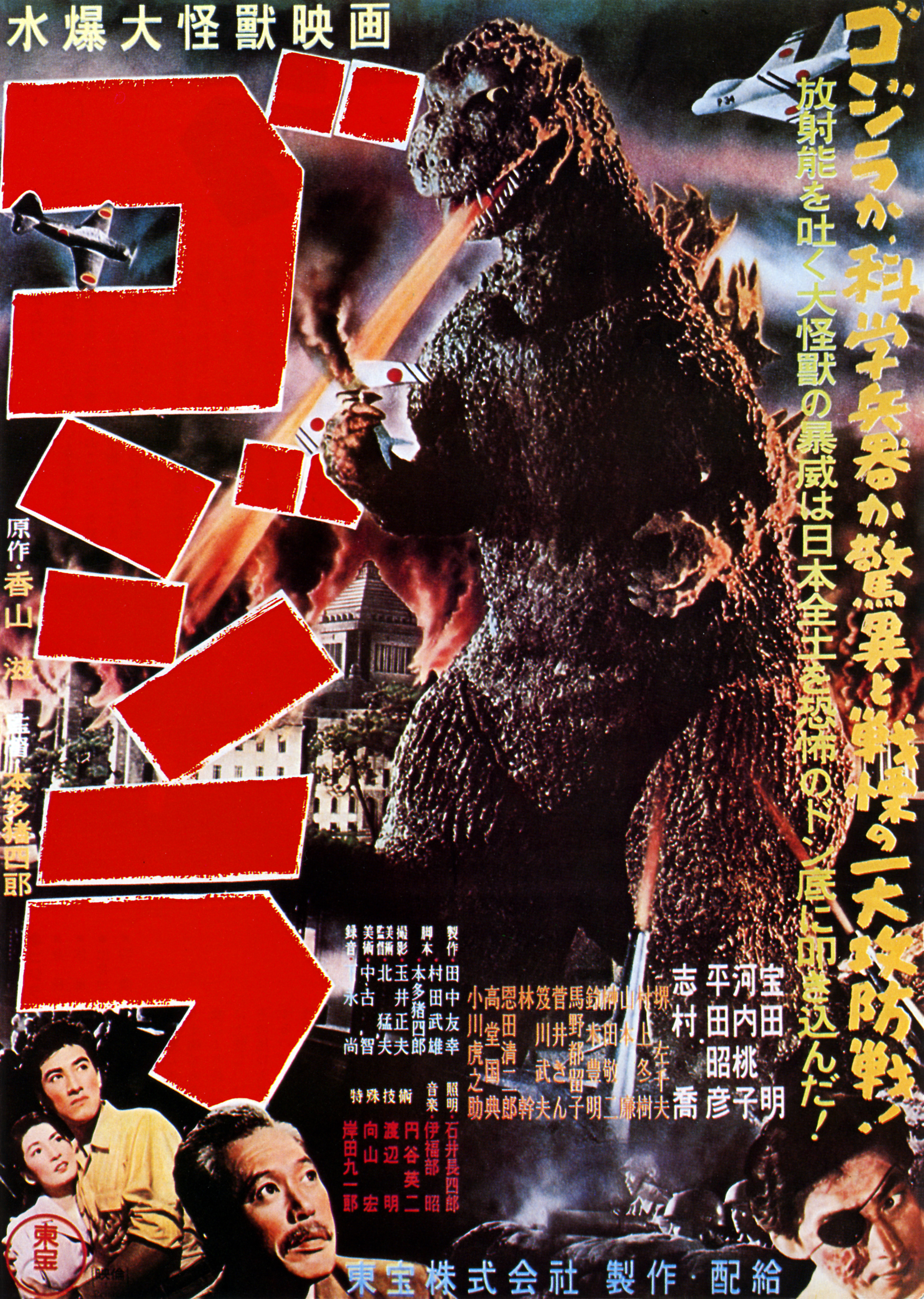
It is a character that has spawned countless movies, sequels, prequels, spoofs. The character? Oh, yes, the Japanese monster himself, Godzilla, an immense dinosaur-like creature who wreaks havoc on the Pacific. The Godzilla franchise has become a beast unto itself (Pun! Words are fun!) with its cult following, and another reboot is due in 2014, but the creature had to start somewhere, and that's the 1954 original, Gojira.
A Japanese fishing boat goes missing in the ocean, and in the aftermath, several rescue ships are lost as well. What exactly is going on? Some cite an ancient legend of a creature, Godzilla, who terrorized coastal fishing villages with the villagers sacrificing young women to appease him. Following the disappearances, a village on an isolated village reports sightings and weird occurrences, prompting archaeologist Yamane (Takashi Shimura) and a team to investigate. They find odd clues that speak to an immense creature's background, everything from radioactivity to evidence of a creature from millions of years ago. It's on the island the creature is first sighted, a reptilian creature several hundred feet tall with seemingly no weakness. What can Japan and the government do? Can anything at all be done to stop this creature?
My first exposure to the Godzilla character was this pretty bad but highly entertaining Roland Emmerich-directed 1998 blockbuster. That's not to say I was unaware of the Japanese monster's other....endeavors, but I finally decided to check the original out. The Godzilla character itself is a gem, a radioactive beast wreaking havoc wherever it goes. It's the distinct look of the creature -- dinosaur-like -- and that very unique roar (listen HERE) that is forever linked to him and the franchise/series. He is like King Kong on steroids, transplanting New York City for Tokyo, and his attacks provide some of the movie's coolest moments.
The problem I had is that there isn't enough of the Godzilla monster in this already pretty short movie at 95 minutes. From director Ishiro Honda, the story focuses far more on the human aspect of the story. We see the efforts of the doctors and scientists (like Shimura's archaeologist) who want to study and examine the monster while others in the government and military want to destroy it as quickly as possible. That's fine because a solid story on top of some epic monster attacks is gravy. Instead, this almost documentary-like style shooting is dull, stilted and preachy. Cheesy though they may be, Godzilla's attacks are the high points of the story. They're limited by 1950s special effects and a smallish budget, but there is a certain retro (read: cheap) charm to the scenes. Far more attention should have been paid to the creature, not the dull individuals hunting him.
I debated how much to criticize this next issue I had with the 1954 original. The script is less than subtle in its condemnation of the United States for nuclear testing in the Pacific in the 1940s/1950s. How was Godzilla created exactly? He was some sort of prehistoric creature unearthed by the nuclear testing who grew to immense proportions because of the radioactivity. I don't want to sound insensitive when I write this, and that's why I struggled with how to even put it. The conclusion of WWII, and more importantly the bombing of Hiroshima and Nagasaki with atomic bombs, was just nine years removed when this movie was made. The condemnation of the U.S. (and nuclear testing on an international scale) is fair, but it's so beyond obvious the message that it becomes painful to watch. Historical rant and side note; the Japanese attacked Pearl Harbor, started the conflict with WWII, and committed countless horrific war crimes. An invasion of Japan would have cost millions of lives. I in no way intend this to sound as insensitive as it does in my head, but a not thinly veiled dig at the U.S. use of atomic bombs sounds like sour grapes and gives an almost amateur feel to the script.
Enough ranting, let's get back to the movie. The acting ranges from impressive (Shimura) to acceptable to wooden and even amateurish at times. A story about a creature terrorizing Tokyo and Japan is stripped down to a.....love story?!? You've got to be kidding me. Yamane's daughter, Emiko (Momoko Kochi), is in love with Ogata (Akira Takarada), a salvage ship captain. Oh, no! She's already engaged to a brilliant scientist, Serizawa (Akihiko Hirata), who may hold the key to defeating Godzilla! That's the best they could come up with? A love triangle? Distractions from Godzilla attacks are one thing, but using maybe the laziest storytelling technique ever as a distraction? Yeah, I'm not going to be on board with that.
Sorry to say I was hugely disappointed with this original film. I'll stick with it to a point because Godzilla is a great creature character, but the series is walking on thin ice.
Gojira (1954): **/****
The Sons of Katie Elder
"First, we reunite, then find Ma and Pa's killer...then read some reviews."
Showing posts with label Takashi Shimura. Show all posts
Sunday, February 10, 2013
Sunday, March 21, 2010
The Hidden Fortress
It would be hard not to be influenced by other movies if you work in the business in some capacity; actor, director, writer, whatever. In 1977, George Lucas had a huge mega-hit on his hands with Star Wars and the subsequent Empire Strikes Back and Return of the Jedi, not to mention the three more recent prequels. I'd read enough times that with the storyline of Star Wars Lucas was influenced by a Japanese film, 1958's The Hidden Fortress, and couldn't help but think that it was an odd choice for a science fiction movie.
The Japanese film is from director Akira Kurosawa and does have a storyline similar to Luke Skywalker, Han Solo and Co. trying to save Princess Leia from Darth Vader and the evil Empire...albeit in Japan of course without Jedis or Wookies (unfortunately). It is an exciting movie that has a handful of main characters -- some more likable than others -- working together to save the life of one of their own. There is also betrayal, a huge treasure of gold, and the ever present battle for honor and loyalty.
Returning home from a failed venture to make money in a war, two gravediggers, Tahei (Minoru Chiaki) and Matakishi (Kamatari Fujiwara), stumble upon two pieces of gold hidden in two pieces of wood. They begin to look around for more of what they believe to be the Akizuki clan treasure. But as they search, a man (Toshiro Mifune) appears, telling them he knows where the gold is and he'll split it with them. It's all a test for the two gravediggers because the man is actually General Rokurota Makabe, and he's already mined all the gold, some 200 pieces. Makabe needs help as he's been given the task of bringing Princess Yuki (Misa Uehara), the last surviving member of the Akizuki clan to safety. The rival clans that wiped out her family want her dead too, offering a large reward of gold, making Makabe's already difficult mission even harder.
With a running time of 139 minutes, 'Fortress' covers a lot of ground. It is almost 30 minutes before Mifune's Makabe is introduced and another 15-20 minutes before the real storyline of rescuing the Princess is laid out. In that way, the movie is a road movie with the unique twist that it is in feudal Japan in the 1500s or so (the time period is never established for sure). Besides the basic premise, there are scenes that clearly influenced Lucas in creating Star Wars although he clearly mainlined some of the plot and characters. Yuki is obviously Leia, Makabe a mix between Luke and Han, and Tahei and Matakishi as R2-D2 and C-3PO with a devious streak right down their back.
Chiaki and Fujiwara are at the heart of the story as the characters first introduced. They bicker like an old married couple, and if they didn't constantly talk about all the women they want, I would have been convinced they were gay. At one point, they even pull straws to see who gets to "spend some alone time" with a sleeping Princess Yuki. Clearly, they're not the most lovable characters, and they are pretty dimwitted to boot. Not the most likable of characters -- and it seems odd that these would-be rapists are used as comic relief -- but they are interesting characters if nothing else. The same goes for Uehara as Yuki, who comes across as high and mighty, condescending and basically a bitch on wheels. Once again, interesting character but not easy to root for.
As when I reviewed Throne of Blood, the star of course is Mifune as the heroic General Makabe. It is his duty to save the Princess, and he's going to get the job done no matter who he has to work with or what he has to do. This is a more subdued part for the most famous of Japanese actors, and as much as I like verbose, theatrical Mifune, it's great to see him do a part like this. He has to put up with the two idiotic gravediggers and a young woman who doesn't want to be saved even with her life at risk, but somehow Makabe keeps it all together. Also, Mifune handles all his own stunts -- again -- including one amazing stunt where he's on horseback charging at full speed, sitting straight up in the saddle, holding a samurai sword above his head. In other words, as badass as it gets. This guy is quickly becoming one of my favorite actors.
This was Kurosawa's first venture into widescreen filming, and the movie looks great because of it. The director fills the screen in every shot whether it be a crowded city or a lonely hillside. Kurosawa filmed at Mt. Fuji again and with all the different locations there is a real sense that over the course of the movie these characters are in fact moving long distances. The finale too is pretty good as Makabe's ever-growing motley group tries a dangerous border crossing with a friend/rival (Susumu Fujita) deciding to join the effort. Also look for Kurosawa regular Takashi Shimura in a great two-scene part, and Toshiko Higuchi as a slave girl Makabe rescues.
I've seen a handful of Kurosawa's movies now, and I'm definitely going to continue to look out for his films. The director has a great eye for the visual -- typically filming in black and white -- while also being able to craft stories with 3-D characters and action that few other directors would be able to do. Star Wars fans or just a movie fan, The Hidden Fortress is one not to pass up. No subtitles in the trailer, my bad.
The Hidden Fortress <----trailer (1958): ***/****
Labels:
1950s,
Akira Kurosawa,
Takashi Shimura,
Toshiro Mifune
Thursday, March 18, 2010
Throne of Blood
Some things just go together naturally, like peanut butter and jelly, macaroni and cheese, and of course the most obvious one, William Shakespeare and Akira Kurosawa. The English playwright and poet's works have inspired countless stage, film, and TV adaptations while many of the Japanese director's films are held in the highest regard, as well as being one of the most talented directors ever. So a Kurosawa interpretation of a Shakespeare source seems like a no-brainer, right? Pretty much, as was the case with 1957's Throne of Blood.
The source material is maybe Shakespeare's most well-respected work, Macbeth, which has been a breeding ground for great stage and film actors for hundreds of years because there's two roles ideal for some showing off, Macbeth and Lady Macbeth. A story set in the English countryside in the 1500s doesn't seem like a natural setting for a Japanese movie though, does it? Kurosawa moves the well-known story to feudal Japan without missing a beat. Like so many of the director's movies, 'Throne' has a style all to itself, and even in the slower moments is a beautiful movie to watch.
Going to visit Lord Tsuziki, the commander of the armies, after a great victory, generals Washizu (Toshiro Mifune) and Miki (Minoru Chiaki) are visited by a spirit in the woods surrounding the lord's castle. The spirit makes odd foretellings of what is to come in both men's lives, including predictions of great power and command. The two old friends laugh it off and continue on, only to have the lord give them the exact promotion the spirit told them they would get. Shaken by the news, Washizu tells his wife, Lady Asaji (Isuzu Yamada), only to have her convince him they should kill the lord and live up to the foreboding prediction.
It takes some convincing and some prime manipulation on Asaji's part, but a nervous Washizu goes along with the plan. The murder is blamed on the lord's drunken bodyguards, and Washizu ascends to the most powerful position in the land. Two men have escaped though with the knowledge of what actually happened, the prince and a strong general (Takashi Shimura, a Kurosawa regular). Now the only thing standing in the way of complete power is his friend, Miki. Asaji tries to convince Washizu that he too must die, but a rattled Washizu is not so convinced and begins to unravel mentally and emotionally. All the while, powers are working against him to overthrow him.
Where Scorsese has De Niro and Pacino and Ford had Wayne, Kurosawa had Toshiro Mifune. The director-star combo combined to make 16 movies together, many of them considered classics. Mifune needed a stage as big as the screen for his ability as an actor. A very physical actor, it's a pleasure just watching him move around, whether it be within a scene of dialogue or in a fight sequence. He's perfectly suited for the Washizu/Macbeth role because he always seems to be one good push away from completely losing his mind. His role in The Seven Samurai remains my favorite of his parts, but this is a worthy competitor in Mifune's filmography.
As for the directing, Kurosawa -- as were many non-U.S. directors -- was ahead of the curve. Hollywood movies were still rather theatrical in the 1950s, but Kurosawa had a filming and storytelling style that was based in reality. More often than not, his shots were stationary in dialogue scenes, and even scenes with movement the camera was very subtle in its depictions. Some shots do drag on in those instances, but the style -- right there on the ground with the characters -- works wonders. A funeral procession goes on and on entering a castle from a burned out plain. No fancy camerawork here showing crying faces, just a medium long shot of many downtrodden soldiers following their lord.
The sets are really something else here, including the main one for the first fortress where Washizu takes command eventually. The outdoor sets were filmed on Mt. Fuji with the volcanic setting providing an almost-apocalyptic feel to the story. The ending especially creates a sense of the end of the world as if this castle was its own world and it is being torn apart. Filming at a studio for the interior scenes, there's a sparseness to the sets which calls attention to the actors and their lines. There is nothing to distract the viewer, just bare rooms with little in the way of furniture or design. It seems a simple concept, but it works perfectly.
Good directors always have to have a bit of crazy in them, and Kurosawa is no exception, saving his craziness for the end. SPOILERS STOP READING SPOILERS Washizu eventually has his army turn on him in a final twist of the spirit's prediction with his archers trying to pick him off and eventually succeeding. Instead of using stunt doubles or stunt arrows, Kurosawa actually has choreographed archers shooting at/near Mifune. It is a remarkable sequence (check it out HERE, just watch it on mute) because a couple inches here and there, Mifune would have been a real pincushion. It is a great ending to a great movie with Mifune showing again why he was Kurosawa's favorite actor. Definitely look for this Japanese version of Macbeth.
Throne of Blood <----trailer (1957): ***/****
Labels:
1950s,
Akira Kurosawa,
Takashi Shimura,
Toshiro Mifune
Subscribe to:
Posts (Atom)