Because guns, grenades and bombs weren't good enough at killing people, a new type of weapon started to be developed in the 20th century. It started as early as WWI with mustard and poison gas being used during trench warfare. It escalated and became more sophisticated, more efficient over the years. As part of the Cold War mutual destruction strategy, world powers turned to scientists to give them an edge in fighting...a different sort of fighting. Germ and chemical warfare became a topic of conversation, little strands of diseases that could destroy the world in minutes, days, and weeks without a weapon fired. That's the background for 1965's The Satan Bug.
This is one of those hidden gems that you're glad you stumbled upon, in this case, because of the director of the film, John Sturges. I knew his other movies like The Magnificent Seven and The Great Escape so reading through his list of films, I happened upon this one, a well-made and exciting if at times confusing espionage thriller centered around germ and chemical warfare. It is based on a novel by Alistair MacLean of Guns of Navarone and Where Eagles Dare fame, originally published under his pseudonym Ian Stuart. In a different setting from his usual WWII adventures, some changes were made to MacLean's book for the movie version, transplanting the story from dreary old England to the arid, dry American southwest. It is the rare novel that makes it to film completely the same as it was written, but as far as novel-to-film transformations go, this is a good one.
At remote, isolated and heavily guarded Station 3 somewhere in the Southwestern desert, two men are killed and several flasks of a recently developed germ/disease strand have been stolen. The robbery and murder seem too perfect considering the heavy security at the facility, but former security head and all-around rebel Lee Barrett (George Maharis) is called in to investigate. He's given some sobering news early on in his investigation. One strand of botulinus that's been stolen has the potential to wipe out hundreds and thousands of lives but has a short life once its oxidizes. The other strand is far more dangerous, a world killer that if unleashed will destroy every living thing on Earth. What mastermind orchestrated the job, and more importantly, what do they intend to do with the new formula, dubbed simply the Satan Bug. Up against the clock, Barrett has to figure out who did it, why, and where exactly the flasks are. Can he do it in time though?
If I had to pick a decade as my favorite in terms of movies, it would be the 1960s, and the decision isn't a tough one. I love the epic quality, the stars, the character actors, and especially the style. In one of the great descriptions I've ever read of an era, one reviewer pointed out that The Satan Bug is one of the last hurrahs of the suit and hat. This movie has style. All the characters wear a suit and tie and stylish hats as they race all over the Southwest looking for these disease-filled flasks. These aren't rogue agents who look like bums off the street. These are the good guys, and they're going to look good catching the bad guys. The sets scream 1960s leisurely style, and composer Jerry Goldsmith turns in an eerie, unsettling score that keeps things moving at a brisk pace. It will also ring in your head for a couple days so beware of that too. Sometimes all a movie needs to work is that style, and The Satan Bug is a very cool movie to watch.
As a director over four decades with more than 40 movies to his name, Sturges made a career out of tough guy movies with typically male-dominated casts (Great Escape, Mag7, Bad Day at Black Rock), and while the big star name recognition doesn't qualify here, the cast is still impressive. Maharis is a good lead, the super intelligent investigator who pieces things together quicker than any man should be able to do. He's also worried about ex-wife Mary (Anne Francis), but that's understandable. Dana Andrews is General Andrews, a former military man who still holds a mysterious position in the government who also happens to be Barrett's father-in-law. Richard Basehart is Dr. Hoffman, one of Station 3's top doctors who include John Larkin and Simon Oakland. John Anderson plays Reagan, the security officer in charge of Station 3, albeit briefly. Richard Bull is Cavanaugh, a police investigator working with Barrett to catch Ed Asner and Frank Sutton, two of the murdering thieves. Yes, Lou Grant and Sgt Carter as bad guys. It takes some getting used to. The star quality might not be there, but the cast makes up for it, working smoothly together from the start.
Now I like this movie, but I can admit I have no idea what's going on half the time. My first viewing? I must have watched it in a daze, only to review it a couple days later. I understood more if not everything. MacLean's novel The Satan Bug is a mystery thriller, throwing lots of characters and suspects at you. It's just hard to keep up. In the movie, characters are introduced, killed off, and then we find out they were important much later. Nothing is spelled out at all, forcing the viewer to jump to or make their own conclusions. Not always the best idea when it comes to movies. Maharis' Barrett makes some ridiculous jumps in logic too, piecing together pieces of evidence so effortlessly that it is almost laughable. By the end, I feel I've got some sort of grip on what was happening, but it is all relative. Explanations, reasoning, development, not really present at any point.
Just like MacLean's novel, the movie takes some liberties with these mankind-killing diseases, but I won't spoil them here. They're supposedly able to wipe out men everywhere...except...well, it doesn't matter. But if Barrett needs to survive, he comes up with some off-the-wall plan to postpone death, mostly because the story requires his presence. These characters are also surprisingly lax with an easily breakable flask carrying the disease that will literally wipe out the Earth. This isn't a great movie, and it might not even be a good movie, but the 1960s style and ensemble cast make up for the lack of logic in the rest of the movie. It is available to watch at Youtube, starting HERE with Part 1 of 11.
The Satan Bug <---trailer (1965): ***/****
The Sons of Katie Elder
"First, we reunite, then find Ma and Pa's killer...then read some reviews."
Monday, May 16, 2011
Sunday, May 15, 2011
One Million Years B.C.
Earlier in 1966, Raquel Welch starred in Fantastic Voyage, a cool little science fiction movie with an impressive ensemble cast. But if we're talking movies Welch starred in during 1966, that conversation is going to begin and end with one movie, One Million Years B.C.. Before this cult caveman classic was even released, 20th Century Fox Studios released photos of Miss Welch outfitted in a skimpy fur bikini that not surprisingly, went over quite well with audiences (I'm assuming a male-dominated audience). The pictures are easy to find -- just do a simple Google search -- and if anything, it is the outfit that is remembered more than the actual movie, which is pretty bad all things considered. It's up there with Ursula Andress in Dr. No coming out of the water in her white bikini as moments burned into the brains of thousands of viewers. As for the movie, you can take it or leave it.
Rewatching it this week for the first time in years, I realized how bad a movie it is. It was made by Hammer Films -- master of cheesy schlock in science fiction, horror, thriller and B-movies -- and came at a time when audiences ate up these low-budget flicks. In one of those weird examples where it is hard to explain reasoning, movie-going audiences went through a caveman/creature faze in the late 1960s and early 1970s. Of the ones I've seen, none of them are very good, but I don't know exactly what to say. These were movies about cavemen. Were they supposed to be good? Maybe not, but if nothing else they offered a chance to see some cool creature creations (more on that later) and female castmembers in various stages of undress or in scantily clad outfits. Take Raquel Welch out of this movie, and we're talking about a flick left to the ages.
In some sort of ridiculous past time where dinosaurs and people lived together, a caveman from the Rock tribe, Tumak (John Richardson), is banished from the group after a fight with the tribe's chieftain, Akhoba (Robert Brown). He heads out in the vast wasteland that is the desert wilderness on his own, battling creatures and conditions, desperately clinging to life. Tumak walks and walks and finally at the brink of death collapses near a large body of water where another tribe, the blonde Shell people, rescue him and bring him to their caves. One member of the tribe, the beautiful Loana (Welch), takes a keen interest in this strange, dark-looking man who walked out of the wild. But almost immediately, Tumak's ways burn that bridge too, and together he and Loana head back out into the wilderness. As they try to start a new life, a conflict is brewing between the two tribes, one that will bring them all together.
I've seen this movie a handful of times (it was a favorite of mine as a kid), but it wasn't until just now I realized how stupid it really is. To say there is an actual plot is a gigantic understatement. This is Cavemen Walking in the Desert. That's it. Occasionally, they grunt at each other, battle some prehistoric creatures, and then keep walking. The script -- yes, there is a script -- is an oddity because no actual conversation goes on at any point. There is some sort of pig latin caveman speak, but any interactions among anyone on-screen is a grunt, a blank stare, or a pissed off "I'm going to kill you!" look. If you're looking for a positive, and trust me, I'm trying, it's that director Don Chaffey shot this movie in the Canary Islands off of Spain. What did the landscape look like in prehistoric times? Who knows for sure, but this movie looks like some sort of post-apocalyptic hellhole where anything would struggle to survive. Stupid story, you bet. Great-looking movie, that too.
To talk about performances here feels beyond ridiculous to me so I'm not going to even make an attempt. Typically, I try and avoid minimizing criticisms/judgment of female characters based on looks or sex appeal alone, but that's basically impossible to do here because the whole movie is an excuse to watch Raquel Welch in her skimpy fur and leather bikini. That's it. End of movie. She's gorgeous, beautiful, out of this world sexy. Reviews have some fun pointing out that she's the most well-maintained cave-woman ever. A blonde, tan Raquel Welch in a bikini running around from all sorts of cavemen and creatures trying to kill her? It sounds like a decent basis for a movie. Who actually needs words spoken or a story when you've got that? Because there are at least a few other people in the movie, I'll mention them too. Richardson is phenomenal at looking bug-eyed and screaming, Brown is one gnarly-looking, angry dude, Percy Herbert is equally pissed off and willing to kill anyone who as much as looks at him funny, and Martine Beswick is Welch's Rock people adversary, a gorgeous, brunette cave-woman. See what they did there? Pretty sneaky.
One of the reasons movies like this are remembered so fondly are the creature creations of model-master Ray Harryhausen, he of Jason and the Argonauts fame among many other 1950s and 1960s flicks. Some 40-plus years later, the special effects do look dated, but they all add to the camp appeal of the movie. His stop-motion filming technique was a staple of a pre-CGI era in Hollywood. We see an allosaurus attack the Shell people's village, a pterodactyal swoop down and scoop up Welch's Loana, a giant turtle attack a hunting party, and several other examples peppered throughout the film. There is also the technique of super-imposing smaller animals (lizards, snakes, tarantulas) onto the screen to make them look gigantic, dwarfing the cast members. The movie never goes long without throwing some odd creature into the story, building up to the apocalyptic ending when all hell breaks loose when the volcanoes start to go. Yeah, no explanation needed there, just go with it. Throw in composer Mario Nascimbene and his epic, booming score, and you've certainly got a visually interesting movie.
Read through the DVD reviews at Amazon or anyplace really, and you'll come across complaints that the film as is on the DVD is an edited version of the film that was released in theaters in 1966. Almost 10 full minutes were cut out, and fans understandably were pissed they weren't seeing the whole movie. Good news for those fans, the print Turner Classic Movies aired recently is the full 100-minute long version. All the scenes mentioned that were cut (read IMDB's Alternate Versions HERE) were in the movie, back for everyone to enjoy. This is a guilty pleasure movie if there ever was one. A really bad, even awful movie, but one you can't help but enjoy through all the camp and cheesiness.
One Million Years B.C. <---trailer (1966): ** 1/2 /****
Rewatching it this week for the first time in years, I realized how bad a movie it is. It was made by Hammer Films -- master of cheesy schlock in science fiction, horror, thriller and B-movies -- and came at a time when audiences ate up these low-budget flicks. In one of those weird examples where it is hard to explain reasoning, movie-going audiences went through a caveman/creature faze in the late 1960s and early 1970s. Of the ones I've seen, none of them are very good, but I don't know exactly what to say. These were movies about cavemen. Were they supposed to be good? Maybe not, but if nothing else they offered a chance to see some cool creature creations (more on that later) and female castmembers in various stages of undress or in scantily clad outfits. Take Raquel Welch out of this movie, and we're talking about a flick left to the ages.
In some sort of ridiculous past time where dinosaurs and people lived together, a caveman from the Rock tribe, Tumak (John Richardson), is banished from the group after a fight with the tribe's chieftain, Akhoba (Robert Brown). He heads out in the vast wasteland that is the desert wilderness on his own, battling creatures and conditions, desperately clinging to life. Tumak walks and walks and finally at the brink of death collapses near a large body of water where another tribe, the blonde Shell people, rescue him and bring him to their caves. One member of the tribe, the beautiful Loana (Welch), takes a keen interest in this strange, dark-looking man who walked out of the wild. But almost immediately, Tumak's ways burn that bridge too, and together he and Loana head back out into the wilderness. As they try to start a new life, a conflict is brewing between the two tribes, one that will bring them all together.
I've seen this movie a handful of times (it was a favorite of mine as a kid), but it wasn't until just now I realized how stupid it really is. To say there is an actual plot is a gigantic understatement. This is Cavemen Walking in the Desert. That's it. Occasionally, they grunt at each other, battle some prehistoric creatures, and then keep walking. The script -- yes, there is a script -- is an oddity because no actual conversation goes on at any point. There is some sort of pig latin caveman speak, but any interactions among anyone on-screen is a grunt, a blank stare, or a pissed off "I'm going to kill you!" look. If you're looking for a positive, and trust me, I'm trying, it's that director Don Chaffey shot this movie in the Canary Islands off of Spain. What did the landscape look like in prehistoric times? Who knows for sure, but this movie looks like some sort of post-apocalyptic hellhole where anything would struggle to survive. Stupid story, you bet. Great-looking movie, that too.
To talk about performances here feels beyond ridiculous to me so I'm not going to even make an attempt. Typically, I try and avoid minimizing criticisms/judgment of female characters based on looks or sex appeal alone, but that's basically impossible to do here because the whole movie is an excuse to watch Raquel Welch in her skimpy fur and leather bikini. That's it. End of movie. She's gorgeous, beautiful, out of this world sexy. Reviews have some fun pointing out that she's the most well-maintained cave-woman ever. A blonde, tan Raquel Welch in a bikini running around from all sorts of cavemen and creatures trying to kill her? It sounds like a decent basis for a movie. Who actually needs words spoken or a story when you've got that? Because there are at least a few other people in the movie, I'll mention them too. Richardson is phenomenal at looking bug-eyed and screaming, Brown is one gnarly-looking, angry dude, Percy Herbert is equally pissed off and willing to kill anyone who as much as looks at him funny, and Martine Beswick is Welch's Rock people adversary, a gorgeous, brunette cave-woman. See what they did there? Pretty sneaky.
One of the reasons movies like this are remembered so fondly are the creature creations of model-master Ray Harryhausen, he of Jason and the Argonauts fame among many other 1950s and 1960s flicks. Some 40-plus years later, the special effects do look dated, but they all add to the camp appeal of the movie. His stop-motion filming technique was a staple of a pre-CGI era in Hollywood. We see an allosaurus attack the Shell people's village, a pterodactyal swoop down and scoop up Welch's Loana, a giant turtle attack a hunting party, and several other examples peppered throughout the film. There is also the technique of super-imposing smaller animals (lizards, snakes, tarantulas) onto the screen to make them look gigantic, dwarfing the cast members. The movie never goes long without throwing some odd creature into the story, building up to the apocalyptic ending when all hell breaks loose when the volcanoes start to go. Yeah, no explanation needed there, just go with it. Throw in composer Mario Nascimbene and his epic, booming score, and you've certainly got a visually interesting movie.
Read through the DVD reviews at Amazon or anyplace really, and you'll come across complaints that the film as is on the DVD is an edited version of the film that was released in theaters in 1966. Almost 10 full minutes were cut out, and fans understandably were pissed they weren't seeing the whole movie. Good news for those fans, the print Turner Classic Movies aired recently is the full 100-minute long version. All the scenes mentioned that were cut (read IMDB's Alternate Versions HERE) were in the movie, back for everyone to enjoy. This is a guilty pleasure movie if there ever was one. A really bad, even awful movie, but one you can't help but enjoy through all the camp and cheesiness.
One Million Years B.C. <---trailer (1966): ** 1/2 /****
Labels:
1960s,
Hammer Productions,
Percy Herbert,
Raquel Welch,
Ray Harryhausen
Saturday, May 14, 2011
Due Date
Where Phillips is one of hotter comedic directors around, comedian turned star Zach Galifianakis is one of the most popular comedic actors around, thanks in great part to his hilarious role in Phillips' The Hangover. The director-actor combo teams up here again, and the results are equally as entertaining. Galifianakis has been around in the spotlight since the late 1990s, starring in movies and TV shows while also making a name for himself as a comedian. Given his chance to shine, he hit it out of the park in Hangover, and continues that trend with Due Date.
Traveling on business, architect Peter Highman (Robert Downey Jr.) is trying to get from Atlanta to Los Angeles so he can be there for the birth of his firstborn child with wife, Sarah (Michelle Monaghan). Her C-section is scheduled for several days away so Peter has plenty of time...at first. Thanks to an incident on the plane with fellow passenger, Ethan Tremblay (Galifianakis), Peter is taken off the flight and placed on a no-fly list. So now what would have taken a few hours is going to take him a few days to get home. Making his situation even worse, he's lost his wallet with any sort of ID, money, or credit card. His one option to get home? Drive with Ethan who was able to rent a car for his trip to L.A. where he intends to make it big as an actor. Desperate to get home on time, Peter decides to go along, having no idea what awaits him on the open road with Ethan.
Sound familiar? It should. It's called Planes, Trains and Automobiles from 1987 starring Steve Martin and John Candy. Due Date isn't a remake of any sort, instead just using a similar storyline. It certainly has more in your face humor than P, T and A, and things have been changed enough to make the movie interesting thankfully. The humor is easy, put two complete opposites together in a situation completely out of their control and sit back, let the hi-jinx and shenanigans commence. It's traveling across the country. Has a cross country trip ever gone smoothly in the history of time? It's almost fated not to end well. This is a genuinely funny flick though, partially because everyone can appreciate the hell that is traveling long distances.
What surprised me some was the mean-spirited nature of Due Date, much of that coming from Downey Jr. as Peter, a high strung father to be. A character in a movie does not have to be easy to like, that's a given, but for lack of a better description, Peter is an asshole. He seems to revel in it too. He realizes he has anger management issues and has agreed to work on the problem for his wife, but let's say that Ethan brings out the worst in him. The humor of course comes from this jackass of a man who is not likable in the least. You come to like him -- to a point -- but watching him lose his mind one interaction at a time is great. Downer Jr. is a great comedic actor, and he doesn't disappoint, going through ups and downs, lefts and rights around every corner on this trip from hell.
As good as he is though, this is Galifianakis' movie. He gets all the great lines and ends up delivering some easily quotable one-liners for the audience. His Ethan is a spin on The Hangover's Alan, a little less crazy but with all the eccentricities and oddities still present. He manages to make this character creepy, innocent, crazy at times, naive, innocent, frightfully slow at other times, an eccentric, and a man with no boundaries. Through it all though, Galifianakis makes Ethan a character, and one you like in spite of all his weird, little quirks. It's his line delivery, his general cluelessness at what's going on around him, his physical mannerisms, everything adds up to make this great character.
While Downey Jr. and Galifianakis dominate the screen and don't disappoint, Due Date has a handful of cameos that play well off its two stars. Former Wu Tang Clan member RZA plays a racially paranoid airport security screener, Jamie Foxx is Darryl, Peter's long-time friend who helps him out in Texas (sort of), Juliette Lewis is great as Heidi, a drug dealer in Birmingham Ethan goes to see, Danny McBride as an Iraq vet with a secret, and Phillips favorite Matt Walsh as a TSA agent. None of these parts are in the movie for more than five or six minutes, but they all make the most of their screentime.
The humor is all over the place here, ranging from good to bad. Some of the gross-out humor -- Ethan's dog Sonny masturbates while Ethan does -- doesn't work as well as some of the more subtle laughs. Downey Jr. and Galifianakis play off each other so well that their conversations are sublimely perfect, especially an acting challenge Peter gives to Ethan in a gas station bathroom that ends with a surprisingly real, touching moment. The physical humor doesn't disappoint either, especially some highway craziness that includes a breakout from Mexico. Yes, you read that right. A breakout from Mexico. Sure, it's crazy, but like the rest of the movie, just go along with it.
Due Date <---trailer (2010): ***/****
Friday, May 13, 2011
The Chairman
I really didn't like 1969's The Chairman. There. That's my lead, my all-encompassing, powerful intro to this review. And you know what? It's the best I got. The Netflix rating didn't think I'd like it. The IMDB votes have it at 5.5 out of 10 as I write this review. I was curious though. I had seen a trailer that was a special feature on another DVD and thought it looked interesting so when I saw it pop up on TCM's schedule, I taped it. That was my first mistake.
Just a few days ago when I reviewed 1954's Night People (a movie light years ahead of this one), I mentioned the Cold War and the easy source for a villain, the Russians. This 1969 film basically pegs everyone as a villain, American, Chinese, Russian, no one is immune. The paranoia that ruled the Cold War years is understandable. There was this cloud hanging over the world that the entire population of Earth could be wiped out in a second by massive payloads of nuclear weapons. It seems like an easy transition to make a movie out of that. Instead, The Chairman is a movie that just doesn't know where it is going at all.
An American scientist who years before won the Nobel Prize, Dr. John Hathaway (Gregory Peck) is approached by a deep undercover, multi-national military group (with government backing) to undertake a dangerous mission. An old teacher and mentor of Hathaway's, Professor Soong Li (Keye Luke), has surfaced in China, writing a letter to the doctor that he would like to see him. Leading the government-financed operation, Colonel Shelby (Arthur Hill) wants Hathaway to use the visit as a pretext to perform a secret mission. It is believed the Chinese have created an enzyme usable in agriculture so crops can grow year-round regardless of climate or conditions. Hathaway agrees, even allowing a small microchip to be placed into his skull so he can be heard and monitored at all times. What he doesn't know is that Shelby has a back-up plan for the chip if the mission fails.
I'll start with what I thought to be the biggest flaw, the microchip implanted in Hathaway's skull just behind his right ear. Because of a satellite flying over China, Shelby and his subordinate officers (Alan Dobie as Benson and Ori Levy as Shertov, his Russian counterpart) and everyone at the secret base can hear everything Hathaway says and does. It's a cool little technique, whether it be in 1969 when this concept had to be ahead of its time in terms of movie-making or now in 2011 when all sorts of technology is available to us. As a plot device, it is great. Alone in a hotel room or standing at a window, Peck's Hathaway talks to his superiors as if they were in front of him, the officers anxiously awaiting what he has to report.
That of course is not the whole story. Implanting the chip in the doctor's skull, Shelby left out one essential tidbit of information. While the small device is a transmitter, it is also explosive. If the good doctor fails at his mission or is in danger of being captured, Shelby and Co. will push a button, detonate the device, and obviously kill Hathaway in the process. First, why would they need to kill him? What does he know that could hurt America? In a conversation with Chairman Mao (Conrad Yama), Hathaway freely admits that he's there to find the enzyme and bring it back, or at least it's molecular structure. The Chinese know what he's there to do. They've allowed him in, welcoming him into the country.
Piling on to what could have been a cool plot device is the premise that Hathaway -- an unknowing, walking bomb -- could be used on a suicide mission to kill the Chairman when he meets him. Dobie's Benson asks Shelby about exactly that idea, taking him out in one clean swoop. Shelby reacts stunned and disgusted, and then thinks about it, even checking with his superiors. Okay, let me get this right. Working for a shadow company funded by $5 billion American dollars, Shelby (an otherwise seemingly intelligent man) never thought once that Hathaway could be used in that fashion? We're just going to put a bomb in his head just to be careful. Right. The movie never makes it very clear what the intention is so the whole thing suffers.
Having said I disliked this movie, I can also say there was certainly potential to do something good here. Working with director J. Lee Thompson for the fourth time, Peck does his best with an odd character, a mix of not-so-good secret agent and intelligent doctor. The tone of the movie is odd, and that's the best way I can classify it. There's romance with girlfriend Anne Heywood, some out of place moments of humor, a story that doesn't have a sense of urgency until too late, and a final scene that could have been out of a Doris Day comedy. Hathaway -- having narrowly escaped China into Russia (that's a whole other story) -- walks away with Heywood, almost doomed to be "accidentally" murdered, but he's got a smile on his face, talking about how glorious it will be to take down the system. Yeah, right. The Chairman 2: Hathaway's Vengeance. I'll pass, and so should you on this dud.
The Chairman <---TCM trailer (1969): */****
Just a few days ago when I reviewed 1954's Night People (a movie light years ahead of this one), I mentioned the Cold War and the easy source for a villain, the Russians. This 1969 film basically pegs everyone as a villain, American, Chinese, Russian, no one is immune. The paranoia that ruled the Cold War years is understandable. There was this cloud hanging over the world that the entire population of Earth could be wiped out in a second by massive payloads of nuclear weapons. It seems like an easy transition to make a movie out of that. Instead, The Chairman is a movie that just doesn't know where it is going at all.
An American scientist who years before won the Nobel Prize, Dr. John Hathaway (Gregory Peck) is approached by a deep undercover, multi-national military group (with government backing) to undertake a dangerous mission. An old teacher and mentor of Hathaway's, Professor Soong Li (Keye Luke), has surfaced in China, writing a letter to the doctor that he would like to see him. Leading the government-financed operation, Colonel Shelby (Arthur Hill) wants Hathaway to use the visit as a pretext to perform a secret mission. It is believed the Chinese have created an enzyme usable in agriculture so crops can grow year-round regardless of climate or conditions. Hathaway agrees, even allowing a small microchip to be placed into his skull so he can be heard and monitored at all times. What he doesn't know is that Shelby has a back-up plan for the chip if the mission fails.
I'll start with what I thought to be the biggest flaw, the microchip implanted in Hathaway's skull just behind his right ear. Because of a satellite flying over China, Shelby and his subordinate officers (Alan Dobie as Benson and Ori Levy as Shertov, his Russian counterpart) and everyone at the secret base can hear everything Hathaway says and does. It's a cool little technique, whether it be in 1969 when this concept had to be ahead of its time in terms of movie-making or now in 2011 when all sorts of technology is available to us. As a plot device, it is great. Alone in a hotel room or standing at a window, Peck's Hathaway talks to his superiors as if they were in front of him, the officers anxiously awaiting what he has to report.
That of course is not the whole story. Implanting the chip in the doctor's skull, Shelby left out one essential tidbit of information. While the small device is a transmitter, it is also explosive. If the good doctor fails at his mission or is in danger of being captured, Shelby and Co. will push a button, detonate the device, and obviously kill Hathaway in the process. First, why would they need to kill him? What does he know that could hurt America? In a conversation with Chairman Mao (Conrad Yama), Hathaway freely admits that he's there to find the enzyme and bring it back, or at least it's molecular structure. The Chinese know what he's there to do. They've allowed him in, welcoming him into the country.
Piling on to what could have been a cool plot device is the premise that Hathaway -- an unknowing, walking bomb -- could be used on a suicide mission to kill the Chairman when he meets him. Dobie's Benson asks Shelby about exactly that idea, taking him out in one clean swoop. Shelby reacts stunned and disgusted, and then thinks about it, even checking with his superiors. Okay, let me get this right. Working for a shadow company funded by $5 billion American dollars, Shelby (an otherwise seemingly intelligent man) never thought once that Hathaway could be used in that fashion? We're just going to put a bomb in his head just to be careful. Right. The movie never makes it very clear what the intention is so the whole thing suffers.
Having said I disliked this movie, I can also say there was certainly potential to do something good here. Working with director J. Lee Thompson for the fourth time, Peck does his best with an odd character, a mix of not-so-good secret agent and intelligent doctor. The tone of the movie is odd, and that's the best way I can classify it. There's romance with girlfriend Anne Heywood, some out of place moments of humor, a story that doesn't have a sense of urgency until too late, and a final scene that could have been out of a Doris Day comedy. Hathaway -- having narrowly escaped China into Russia (that's a whole other story) -- walks away with Heywood, almost doomed to be "accidentally" murdered, but he's got a smile on his face, talking about how glorious it will be to take down the system. Yeah, right. The Chairman 2: Hathaway's Vengeance. I'll pass, and so should you on this dud.
The Chairman <---TCM trailer (1969): */****
Thursday, May 12, 2011
Helen of Troy (1956)
There are stories, and then there are STORIES. Written by Homer, The Iliad is one of the latter, an epic in every sense of the word about honor, love, war, betrayal, loyalty, and a lot of other great stuff that wouldn't seem out of place in a daytime soap opera. In the early 2000s, a rash of feature films and TV movies came out telling the story, most notably 2004's epic Troy. It is a story that lends itself well to the epic format that Hollywood used as its bread and butter in the 1950s and early 1960s, including 1956's Helen of Troy.
If you're known as the person in history with "the face that launched a thousand ships," you're clearly not going to be forgotten anytime soon. With all the different versions and takes on the Iliad, it was cool to see this epic from Helen's perspective as opposed to the more major players. Yes, she was the cause of the decade-long confrontation between the Trojans and the Spartans, but once the war did start, she's almost an afterthought as the major players step to the front. It is cool to see the story from her perspective, but there's only one problem. Director Robert Wise forgot to make her or her lover Paris interesting in even the slightest way.
With war brewing on the horizon, Trojan prince Paris (Jacques Sernas) travels to Sparta to see if he can negotiate a treaty for peace after all other efforts have failed. On the trip there he is washed overboard in rough seas only to float to shore where he is saved by Helen (Rossana Podesta), Queen of Troy, who is instantly drawn to the prince, but knows nothing can come of it and instead poses as a slave girl. Paris heads to the city to meet Menelaus (Niall MacGinnis), King of Sparta, and is more than a little surprised to see Helen there too at his side. Sparta is far from willing to negotiate any deal with Troy so Paris prepares to leave, but as he goes he takes Helen with him. Menelaus and his brother Agamemnon (Robert Douglas) prepare for war, bringing their army together from all corners of their empire, ready to bring back Helen and destroy Troy in the process.
The characters here are some of the best you will ever come across in literature, and here in the movie version. These are larger than life individuals, battling on a huge stage with thousands of lives hanging in the balance over a love triangle (this is one of the few exceptions where the love triangle plot device actually works). How then does a movie make these people boring, uninteresting and un-engaging? No idea, but this movie accomplishes that not so pleasant feat. Even at just over two hours, this is an epic shooting for the heights of Ben-Hur or Fall of the Roman Empire. It is all about the spectacle and what the eye can behold more than plot or character development. That's somewhat fair with this story because most people are somewhat familiar with the Iliad. But effort -- even a small one -- would have been appreciated.
Using 2004's Troy as a jumping off point, I mentioned that seeing Helen and Paris' perspective was interesting...at first. My biggest issue is that both characters are nearly impossible to like. They love each other so much that they're willing to basically allow two warring countries to wipe each other out. Oh no, we're so drawn to each other we can't be apart. Bah, they're two of the whiniest characters ever. Troy wisely pushes them aside once the story is presented. Not helping the cause is that Podesta as Helen and Sernas as Paris are two of the most lackluster, wooden performers I've ever seen. They have passionate embraces (oh, scandalous) and exchange some knowing glances, but I couldn't have cared less about either of them.
Piling on to the casting department, let's rip the rest of the cast. Granted this is not your prototypical epic that goes for three hours with an all-star cast and sets the world on fire. It tries to be though. I can't think of a cast from an epic that left as little of an impression on me as this 1956 epic did. The cast is backed into a corner right away with a dud of a script so it's not entirely their fault, but just about every one on-screen is just angrily reciting lines. Stanley Baker is a relative bright spot, hamming it up as a near-lunatic Achilles, Harry Andrews is miscast as Hector, the good prince and son of Troy, and Cedric Hardwicke plays Priam, King of Troy, among a long listing of actors and actresses who I've seen in little else. These are great characters who end up being cardboard cutouts of something better. If nothing else, look for a 22-year old Brigitte Bardot in a supporting role as Helen's attendant/slave, Andraste.
Helen of Troy is not a complete waste, mostly because of the scale and the spectacle. Wise films his movie in Italy so the locations are gorgeous, and the sets and costuming were clearly spared no expense. The scale of the movie is impressive. The Spartans' first attack on Troy and its high city walls is something to behold. Literally thousands of extras were used to fill out the ranks of either army. That is the one part of the movie that truly feels like an epic. It is too bad then that the story and character and any sort of plot tension is completely missing.
Helen of Troy <---trailer (1956): **/****
If you're known as the person in history with "the face that launched a thousand ships," you're clearly not going to be forgotten anytime soon. With all the different versions and takes on the Iliad, it was cool to see this epic from Helen's perspective as opposed to the more major players. Yes, she was the cause of the decade-long confrontation between the Trojans and the Spartans, but once the war did start, she's almost an afterthought as the major players step to the front. It is cool to see the story from her perspective, but there's only one problem. Director Robert Wise forgot to make her or her lover Paris interesting in even the slightest way.
With war brewing on the horizon, Trojan prince Paris (Jacques Sernas) travels to Sparta to see if he can negotiate a treaty for peace after all other efforts have failed. On the trip there he is washed overboard in rough seas only to float to shore where he is saved by Helen (Rossana Podesta), Queen of Troy, who is instantly drawn to the prince, but knows nothing can come of it and instead poses as a slave girl. Paris heads to the city to meet Menelaus (Niall MacGinnis), King of Sparta, and is more than a little surprised to see Helen there too at his side. Sparta is far from willing to negotiate any deal with Troy so Paris prepares to leave, but as he goes he takes Helen with him. Menelaus and his brother Agamemnon (Robert Douglas) prepare for war, bringing their army together from all corners of their empire, ready to bring back Helen and destroy Troy in the process.
The characters here are some of the best you will ever come across in literature, and here in the movie version. These are larger than life individuals, battling on a huge stage with thousands of lives hanging in the balance over a love triangle (this is one of the few exceptions where the love triangle plot device actually works). How then does a movie make these people boring, uninteresting and un-engaging? No idea, but this movie accomplishes that not so pleasant feat. Even at just over two hours, this is an epic shooting for the heights of Ben-Hur or Fall of the Roman Empire. It is all about the spectacle and what the eye can behold more than plot or character development. That's somewhat fair with this story because most people are somewhat familiar with the Iliad. But effort -- even a small one -- would have been appreciated.
Using 2004's Troy as a jumping off point, I mentioned that seeing Helen and Paris' perspective was interesting...at first. My biggest issue is that both characters are nearly impossible to like. They love each other so much that they're willing to basically allow two warring countries to wipe each other out. Oh no, we're so drawn to each other we can't be apart. Bah, they're two of the whiniest characters ever. Troy wisely pushes them aside once the story is presented. Not helping the cause is that Podesta as Helen and Sernas as Paris are two of the most lackluster, wooden performers I've ever seen. They have passionate embraces (oh, scandalous) and exchange some knowing glances, but I couldn't have cared less about either of them.
Piling on to the casting department, let's rip the rest of the cast. Granted this is not your prototypical epic that goes for three hours with an all-star cast and sets the world on fire. It tries to be though. I can't think of a cast from an epic that left as little of an impression on me as this 1956 epic did. The cast is backed into a corner right away with a dud of a script so it's not entirely their fault, but just about every one on-screen is just angrily reciting lines. Stanley Baker is a relative bright spot, hamming it up as a near-lunatic Achilles, Harry Andrews is miscast as Hector, the good prince and son of Troy, and Cedric Hardwicke plays Priam, King of Troy, among a long listing of actors and actresses who I've seen in little else. These are great characters who end up being cardboard cutouts of something better. If nothing else, look for a 22-year old Brigitte Bardot in a supporting role as Helen's attendant/slave, Andraste.
Helen of Troy is not a complete waste, mostly because of the scale and the spectacle. Wise films his movie in Italy so the locations are gorgeous, and the sets and costuming were clearly spared no expense. The scale of the movie is impressive. The Spartans' first attack on Troy and its high city walls is something to behold. Literally thousands of extras were used to fill out the ranks of either army. That is the one part of the movie that truly feels like an epic. It is too bad then that the story and character and any sort of plot tension is completely missing.
Helen of Troy <---trailer (1956): **/****
Wednesday, May 11, 2011
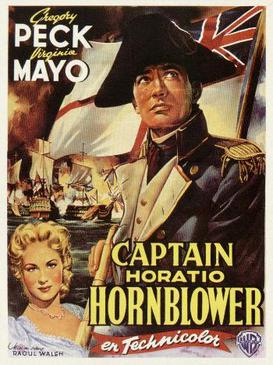
Captain Horatio Hornblower R.N.
Maybe it is the beauty of the ocean, hundreds and thousands of miles of open water. Maybe it is the sight of the tall, wooden ships sailing across the water. Maybe it is just the time of so long ago. One of the most recognizable and loved fictional historical characters on the high seas was Horatio Hornblower, an officer in the Royal Navy during the Napoleonic wars. In a series of books written by author C.S. Forester, Hornblower sailed the seas, battling England's enemies wherever he went. A&E had a TV show appropriately titled show 'Hornblower' that ran for five years. Before all that though, there was 1951's Captain Horatio Hornblower R.N.
It's 1807 and Captain Horatio Hornblower (Gregory Peck) is at the helm of the HMS Lydia, a small British warship sailing around Cape Horn and heading toward Central America on a secret, very dangerous mission. His crew is suspicious of where he's leading them, questioning what he's up to. Their objective is to help a Panamanian revolutionary leading an uprising against their Spanish occupiers. But just days after leaving an enormous cache of weapons with them, they discover that Spain has allied with England in an effort to defeat French dictator Napoleon. His decision on what to do is made more difficult when a young British woman, Lady Barbara (Virginia Mayo), engaged to a British admiral, is placed in his care. Now Hornblower must balance out his duty to England, the Navy and his crew with concerns over Barbara's safety.
That is about as condensed a plot description as you're going to get from this Raoul Walsh-directed sea epic. There is not so much a linear story line that has a beginning, a middle, and an end as much as it is Hornblower's adventures on the seas. None of this is to be taken as a criticism because if anything the movie works better because of that lack of focused storytelling. Instead, things sort of flow along, introducing problems here and there, situations to be solved, enemies to face and ultimately destroy. Yes, Hornblower wins...spoilers, I guess.
That may be the best thing this sea epic has going for it. Filmed in technicolor, the movie looks a little dated with its somewhat faded colors and obvious stage work. It all adds to the appeal, adding to the mystique of the high seas. This is how people must imagine life at sea, not what it was actually like. Balancing out the scenes shot on-board the Lydia (and a later ship Hornblower commands) are gorgeous shots of these clippers cutting across the ocean. You watch these scenes and understand why some people are drawn to sea travel. There is something unexplainable about the beauty of an old warship with all its sails up cutting through the water.
Who better to play the stoic, courageous, noble British Navy captain than Gregory Peck, still rising to stardom at the age of 35. This is going to sound ridiculous considering Peck's legendary status as one of Hollywood's all-time greats, but the more I see of his films, the more I like him as an actor. He has this balance on-screen, one minute the serious, stone-faced commander who makes difficult decision as easily as snapping his fingers. The next, he's stuttering upon meeting Mayo's Lady Barbara, fumbling for the right words. He gives Hornblower a personality, a likable quality that even in his most trying times, he's going to make the right decision. I don't often think of Peck as a love interest in his movies, but his chemistry with Mayo is spot-on, making their budding romance that can't be tougher to watch. It is 1951 though so you kind of know where things will end up...don't you?
Joining Peck on-board the Lydia is a supporting cast that does not disappoint in the least. His fellow officers include Robert Beatty as Lt. Bush, Moultrie Kelsall as Lt. Crystal, Terence Morgan as Lt. Gerard, and James Kenney as Midshipman Longley, the youngest of the officers. As for the crew, watch out for a very young-looking Stanley Baker and a scene-stealing James Robertson Justice as Quist. The crew gets their chance to shine in several exciting sea battles as these warships fire point blank into each other with cannon fire. Enough action to keep you entertained without overdoing it. The balance of the movie help make this movie what it is, a little bit of something for everyone watching. You can watch it at Youtube, starting HERE.
Captain Horatio Hornblower R.N. <---trailer (1951): *** 1/2 /****
Labels:
1950s,
Gregory Peck,
Historical epics,
Raoul Walsh,
Stanley Baker,
Virginia Mayo
Tuesday, May 10, 2011
Night People
From the end of World War II when Berlin was divided into two sections, American and Russians, the movies had a villain basically written for them for the next 50 years; the Russkies, the Red scare, the Pinkos, the Commies. Whatever you want to call them, it worked. They were the complete opposites of us civil, humane Americans, always up to something shady in hopes of taking the United States and everything it represented down a notch or two or ten.
Made in 1954, Night People uses the Russians as the bad guys, but never puts a face on the villains. Instead, they are only talked about, leaving the audience to make up their mind about them. We hear about their tactics, their underhanded way of doing things. They're always up to something, holding a resentment against the Americans and anyone that opposes their way of life. It is a weird little movie that can be hard to follow at times, but considering it was released in the midst of McCarthyism as Senator Joe McCarthy went on a Communist witch hunt in the U.S., it certainly is an interesting time capsule of the 1950s.
Walking back to the U.S. base in Berlin, an Army corporal is kidnapped and smuggled into the Russian sector in the city. An officer with the Provost Marshal, Colonel Steve Van Dyke (Gregory Peck) is given the case, told to get the corporal back through negotiations with the Russians. The soldier's father, Charles Leatherby (Broderick Crawford), is involved in big business back in the states and travels to Germany to help the effort, claiming he'll put pressure on people who aren't used to being pressured. Van Dyke though is a veteran of these prickly situations while Leatherby has no idea what he's getting into. The Russians offer a prisoner exchange, the soldier for two private citizens living in Berlin they want to get their hands on. Nothing comes easy though, and the exchange isn't as simple as it is made out to be.
Some reviews at the IMDB pointed out that director Nunnally Johnson's film doesn't have the same grittiness that similar movies like Carol Reed's The Third Man did. That's a fair criticism to make of Night People because honestly, it isn't as gritty or hard-hitting in its story about a post-WWII city trying to move on. It was filmed in vivid Technicolor (which even pan-n-scan can't ruin) so the movie is full of color and brightness, gorgeous city locations. It is too polished at times, too representative of a big studio production as opposed to a darker, seeder film. I don't know what I'd expect differently though. It's a movie made in 1954 meant for an audience rooting for the Americans.
Maybe ahead of its time is its handling of government matters concerning two governments who want nothing to do with each other as sworn enemies. Both the Americans and Russians can't help each other out in the open, resorting to back channels, secret messages, double agents, and under the table agreements to get a job done. Peck's Col. Van Dyke knows how to work the system for all it's worth to pull off the mission successfully. We see his interactions with the state department (Max Showalter), his own agents in the field (Anita Bjork and Peter van Eyck), British intelligence (John Horsley), and in this situation, even the father of the kidnapped soldier who assumes he can do the job better than anyone else. Sometimes difficult to follow, the plot does deliver a solid twist or two late that I didn't see coming.
A story about an American attempt to negotiate a kidnapped soldier sounds pretty serious to me in terms of a movie's tone and level of seriousness. Why then does this movie rely on these little comedic bits that seem ripped from another much lighter movie? Walter Abel's Doctor is constantly bumming cigarettes off anyone who will give him one, later claiming 'these things will kill you. That's why I don't smoke.' Buddy Ebsen's Sgt. McColloch is always slipping away to find a score of a baseball game, talking about all his 'dolls' in every city. Peck's Colonel Van Dyke says 'Holy Moses!' so much it could be a drinking game. The only reasonable explanation I can come up with is an attempt (a weak one at that) to humanize these American characters against the evil monstrosity that is the Russians. The comedy definitely takes you out of the movie though, a completely unnecessary addition to the movie.
Now onto the cast which is pretty good. I liked Peck's character the best, a young officer who's been worn down some by the nature of his job. He knows it is a nasty business that has to be done, but it's always been his job. When Crawford's Mr. Leatherby shows up, he is forced to show the newcomer how nasty his profession can be. Peck and Crawford have a great chemistry together right from the start. Also look for Rita Gam as Ricki, Peck's girlfriend/secretary, Jill Esmond as one of the prisoners meant to be exchanged, along with Ebsen, Abel, Showatler, and all the other names previously mentioned.
Night People <---TCM trailer (1954): ** 1/2 /****
Made in 1954, Night People uses the Russians as the bad guys, but never puts a face on the villains. Instead, they are only talked about, leaving the audience to make up their mind about them. We hear about their tactics, their underhanded way of doing things. They're always up to something, holding a resentment against the Americans and anyone that opposes their way of life. It is a weird little movie that can be hard to follow at times, but considering it was released in the midst of McCarthyism as Senator Joe McCarthy went on a Communist witch hunt in the U.S., it certainly is an interesting time capsule of the 1950s.
Walking back to the U.S. base in Berlin, an Army corporal is kidnapped and smuggled into the Russian sector in the city. An officer with the Provost Marshal, Colonel Steve Van Dyke (Gregory Peck) is given the case, told to get the corporal back through negotiations with the Russians. The soldier's father, Charles Leatherby (Broderick Crawford), is involved in big business back in the states and travels to Germany to help the effort, claiming he'll put pressure on people who aren't used to being pressured. Van Dyke though is a veteran of these prickly situations while Leatherby has no idea what he's getting into. The Russians offer a prisoner exchange, the soldier for two private citizens living in Berlin they want to get their hands on. Nothing comes easy though, and the exchange isn't as simple as it is made out to be.
Some reviews at the IMDB pointed out that director Nunnally Johnson's film doesn't have the same grittiness that similar movies like Carol Reed's The Third Man did. That's a fair criticism to make of Night People because honestly, it isn't as gritty or hard-hitting in its story about a post-WWII city trying to move on. It was filmed in vivid Technicolor (which even pan-n-scan can't ruin) so the movie is full of color and brightness, gorgeous city locations. It is too polished at times, too representative of a big studio production as opposed to a darker, seeder film. I don't know what I'd expect differently though. It's a movie made in 1954 meant for an audience rooting for the Americans.
Maybe ahead of its time is its handling of government matters concerning two governments who want nothing to do with each other as sworn enemies. Both the Americans and Russians can't help each other out in the open, resorting to back channels, secret messages, double agents, and under the table agreements to get a job done. Peck's Col. Van Dyke knows how to work the system for all it's worth to pull off the mission successfully. We see his interactions with the state department (Max Showalter), his own agents in the field (Anita Bjork and Peter van Eyck), British intelligence (John Horsley), and in this situation, even the father of the kidnapped soldier who assumes he can do the job better than anyone else. Sometimes difficult to follow, the plot does deliver a solid twist or two late that I didn't see coming.
A story about an American attempt to negotiate a kidnapped soldier sounds pretty serious to me in terms of a movie's tone and level of seriousness. Why then does this movie rely on these little comedic bits that seem ripped from another much lighter movie? Walter Abel's Doctor is constantly bumming cigarettes off anyone who will give him one, later claiming 'these things will kill you. That's why I don't smoke.' Buddy Ebsen's Sgt. McColloch is always slipping away to find a score of a baseball game, talking about all his 'dolls' in every city. Peck's Colonel Van Dyke says 'Holy Moses!' so much it could be a drinking game. The only reasonable explanation I can come up with is an attempt (a weak one at that) to humanize these American characters against the evil monstrosity that is the Russians. The comedy definitely takes you out of the movie though, a completely unnecessary addition to the movie.
Now onto the cast which is pretty good. I liked Peck's character the best, a young officer who's been worn down some by the nature of his job. He knows it is a nasty business that has to be done, but it's always been his job. When Crawford's Mr. Leatherby shows up, he is forced to show the newcomer how nasty his profession can be. Peck and Crawford have a great chemistry together right from the start. Also look for Rita Gam as Ricki, Peck's girlfriend/secretary, Jill Esmond as one of the prisoners meant to be exchanged, along with Ebsen, Abel, Showatler, and all the other names previously mentioned.
Night People <---TCM trailer (1954): ** 1/2 /****
Labels:
1950s,
Broderick Crawford,
Buddy Ebsen,
Gregory Peck,
Peter van Eyck
Sunday, May 8, 2011
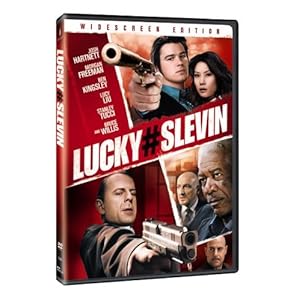
Lucky Number Slevin
I don't know what to say about 2006's Lucky Number Slevin. On a friend's recommendation, I got around to seeing this movie with my latest Netflix movie. Besides the impressive cast, I went into this movie looking forward to it based off a trailer that made it look like a fast-paced, stylish, shoot 'em up case of mistaken identity. Well, sort of. The trailer basically flat out lies to you. It's smarter than just a good old-fashioned action movie. Is it good though? I'm not sure.
This is a smart (maybe too smart), well-written movie that is meant to deceive you. It just is, plain and simple. It involves an epic case of mistaken identity, think of North by Northwest on steroids or some sort of performance-enhancing drugs. The movie is very much one for movie afficionados, paying tribute to other movies like Hitchcock's classic and many others. I felt like it did enough to stand on its own, and be enjoyed without all the references, but I couldn't help wondering if maybe things went too far. In hopes of deceiving the viewer, the end result is both easy to predict and convoluted to follow along the way. Make any sense? Yeah, I didn't think so.
His whole life basically crashing down around him, Slevin (Josh Hartnett) visits a friend's apartment in New York City. He is almost immediately kidnapped by thugs from the Boss (Morgan Freeman) who believes that he's Nick, his friend, who owes him some $96,000. Slevin tries to explain but finds out the only way out of this predicament is to pull off a hit for the Boss. The target? Kill the son of a rival gangster, the Rabbi (Ben Kingsley). That's not enough though because the Rabbi also wants to see him, also believing he's the friend, Nick. Apparently Nick owed some $33,000, and the Rabbi wants it back. An extreme case of mistaken identity, and Slevin is left in the middle. What to do? Run to the police for help or go along with the plan and hope to somehow make it out alive?
Throwing the shoot 'em up angle out the window from the trailer, this is much more a modern film noir than it is an action flick. All the noir conventions are there in a story that introduces characters as quickly as it can. Director Paul McGuigan has made a stylish, well-done, and always intriguing movie. The problem is that I think McGuigan and this movie know it too. Is it a bad thing if a movie knows that it's freakishly stylish and very smart? Can dialogue be too quick-paced, too rapid fire, too comically smart? 'Slevin' has some great dialogue, but I felt like groaning at times because it's too smart. The filming techniques used include flashbacks, flash-sideways, and in general the most non-linear story line you're going to find. Usually a good thing, but there's a such thing as too much of a good thing.
The cast though is impeccable. It'd be hard not to be with this many big names. Hartnett's performance as Slevin has taken some heat, but it's a supremely cool part for the actor. He's suave and cool even as all these ridiculously crazy situations are thrown at him. Freeman and Kingsley are and always will be cool, and seeing them as rival gangsters is a treat. A one-on-one between them late in the movie is classic. There's more. Bruce Willis is a scene-stealer as Smith, a mysterious hired gun seemingly working for both sides. Lucy Liu is the good girl, the neighbor who takes a liking to Slevin and tries to keep up with him as everything is thrown at him. Then for good measure, Stanley Tucci plays Brikowski, the detective desperately trying to piece everything together before it is all too late. These are all fun parts for very talented actors who look to be having a lot of fun making the movie.
I am all for a movie that is trying to deceive you, trying to throw you a curve when you're expecting a fastball. Lucky Number Slevin's sole purpose seems to be doing that exact thing. The only problem is that it tells you it is trying to confuse you in a great opening sequence that runs almost 15 minutes before any characters are introduced. It explains the Kansas City Shuffle, a con that makes you think you're going right when you're really going left. That's the whole movie right there. Can you predict the twist? I would think not in any sort of specific detail. But big picture? I thought it was ridiculously easy to see where things were going. 'Slevin' tries too hard to confuse you, and ends up giving away too much in the effort. Not a deal breaker, but the attempt doesn't work as well as it should.
That said, the ending is well-executed as all the little details, all the little pieces of the puzzle start to click together for good. That is the key to the whole house of cards standing up. Do you go along for the ride? It would be easy to take the movie apart plot hole by plot hole, but what's the fun in that? I enjoyed the movie through all its flaws and all the ridiculousness. The cast is too good to pass up so I'm going to give this movie a mild recommendation, almost in spite of itself.
Lucky Number Slevin <---trailer (2006): ** 1/2 /****
This is a smart (maybe too smart), well-written movie that is meant to deceive you. It just is, plain and simple. It involves an epic case of mistaken identity, think of North by Northwest on steroids or some sort of performance-enhancing drugs. The movie is very much one for movie afficionados, paying tribute to other movies like Hitchcock's classic and many others. I felt like it did enough to stand on its own, and be enjoyed without all the references, but I couldn't help wondering if maybe things went too far. In hopes of deceiving the viewer, the end result is both easy to predict and convoluted to follow along the way. Make any sense? Yeah, I didn't think so.
His whole life basically crashing down around him, Slevin (Josh Hartnett) visits a friend's apartment in New York City. He is almost immediately kidnapped by thugs from the Boss (Morgan Freeman) who believes that he's Nick, his friend, who owes him some $96,000. Slevin tries to explain but finds out the only way out of this predicament is to pull off a hit for the Boss. The target? Kill the son of a rival gangster, the Rabbi (Ben Kingsley). That's not enough though because the Rabbi also wants to see him, also believing he's the friend, Nick. Apparently Nick owed some $33,000, and the Rabbi wants it back. An extreme case of mistaken identity, and Slevin is left in the middle. What to do? Run to the police for help or go along with the plan and hope to somehow make it out alive?
Throwing the shoot 'em up angle out the window from the trailer, this is much more a modern film noir than it is an action flick. All the noir conventions are there in a story that introduces characters as quickly as it can. Director Paul McGuigan has made a stylish, well-done, and always intriguing movie. The problem is that I think McGuigan and this movie know it too. Is it a bad thing if a movie knows that it's freakishly stylish and very smart? Can dialogue be too quick-paced, too rapid fire, too comically smart? 'Slevin' has some great dialogue, but I felt like groaning at times because it's too smart. The filming techniques used include flashbacks, flash-sideways, and in general the most non-linear story line you're going to find. Usually a good thing, but there's a such thing as too much of a good thing.
The cast though is impeccable. It'd be hard not to be with this many big names. Hartnett's performance as Slevin has taken some heat, but it's a supremely cool part for the actor. He's suave and cool even as all these ridiculously crazy situations are thrown at him. Freeman and Kingsley are and always will be cool, and seeing them as rival gangsters is a treat. A one-on-one between them late in the movie is classic. There's more. Bruce Willis is a scene-stealer as Smith, a mysterious hired gun seemingly working for both sides. Lucy Liu is the good girl, the neighbor who takes a liking to Slevin and tries to keep up with him as everything is thrown at him. Then for good measure, Stanley Tucci plays Brikowski, the detective desperately trying to piece everything together before it is all too late. These are all fun parts for very talented actors who look to be having a lot of fun making the movie.
I am all for a movie that is trying to deceive you, trying to throw you a curve when you're expecting a fastball. Lucky Number Slevin's sole purpose seems to be doing that exact thing. The only problem is that it tells you it is trying to confuse you in a great opening sequence that runs almost 15 minutes before any characters are introduced. It explains the Kansas City Shuffle, a con that makes you think you're going right when you're really going left. That's the whole movie right there. Can you predict the twist? I would think not in any sort of specific detail. But big picture? I thought it was ridiculously easy to see where things were going. 'Slevin' tries too hard to confuse you, and ends up giving away too much in the effort. Not a deal breaker, but the attempt doesn't work as well as it should.
That said, the ending is well-executed as all the little details, all the little pieces of the puzzle start to click together for good. That is the key to the whole house of cards standing up. Do you go along for the ride? It would be easy to take the movie apart plot hole by plot hole, but what's the fun in that? I enjoyed the movie through all its flaws and all the ridiculousness. The cast is too good to pass up so I'm going to give this movie a mild recommendation, almost in spite of itself.
Lucky Number Slevin <---trailer (2006): ** 1/2 /****
Labels:
2000s,
Ben Kingsley,
Bruce Willis,
Josh Hartnett,
Morgan Freeman,
Stanley Tucci
Saturday, May 7, 2011
Drango
The Civil War was the bloodiest conflict in American history, but the Confederate surrender at Appomattox was far from the end of the war for much of the country. Not even accounting for the loss of life, huge portions of the South had been literally destroyed by the war. Business and industry literally had to be built from the ground up. The Reconstruction Era followed the Civil War and lasted all the way into the late 1870s as America healed from the wounds of the war.
As few Civil War movies as there are (good ones at least), I can think of very few movies dealing with the Reconstruction, and that's part of what drew me to 1957's Drango. I will admit that at first I thought I had stumbled onto some weird American hybrid and a predecessor to the 1966 spaghetti western Django, but I was sorely mistaken. During the war, North fought South in an attempt to regain control in the country, the North trying to free the slaves and the South fighting for states' rights (in a very simplified explanation of the war). But once the North had won, it was up to the U.S. government to rebuild because if the country hoped to move on, something had to be done to help the war-torn southern states.
Just months removed from the Confederate surrender and the end of the Civil War, two Union officers, Major Clint Drango (Jeff Chandler) and Capt. Marc Banning (John Lupton), ride into the town of Kennessaw Pass in Georgia. Drango has been tasked with starting the rebuilding process but immediately sees that the townspeople want nothing to do with him or his efforts, holding a deep hatred and resentment for what Union forces did just a year before in General Sherman's infamous march to the sea. Dealing with some inner demons, Drango goes to work, trying to go about the rebuilding the right way, by winning over the people instead of forcing them to do something. His plan takes time, but it starts to show signs of working, only to see the groundwork torn apart by a Confederate officer, Clay Allen (Ronald Howard), who hopes to start the war all over again, resorting to terror tactics.
While few parts of the country went untouched during the war years between 1861 and 1865, few regions were as heavily impacted as the state of Georgia. Trying to destroy Confederate infrastructure, General William Tecumseh Sherman basically unleashed his army through Georgia, burning, looting and destroying an entire state. His March to the Sea is infamous in its brutal effectiveness and efficiency. In a historical context, it was necessary if brutal. Seeing the aftermath though, even in a movie made almost 100 years later, is startling, and we're just seeing one small Georgia town. Crops burned, stores stolen, houses, churches and businesses burned to the ground. It's easily understandable to see why these Southerners hold such a bubbling resentment of any help from Union officers. Any complaints about the movie aside, that's Drango at its best.
Dying at the young age of 42 from blood poisoning following a back surgery, Jeff Chandler never became the star he could have. In a 15-year span though, he was able to make over 40 movies, most of them B-movies and not major studio productions. But as was the case here with Drango, he delivers a moving performance that shows he was capable of the bigger, flashier roles. His Clint Drango was part of Sherman's army, destroying as much of Georgia as possible, so he wants to right at least one wrong. He bonds with Joanne Dru's Kate, the daughter of a Union sympathizer who also deals with the glares, looks and judgments of the townspeople. He knows the job laid out for him is extremely difficult, but he intends to follow through, no matter how long it takes.
Portraying a post Civil War very bitter south is a trick subject here, especially with a movie that's only 92-minutes long. For my liking, the townspeople's sentiment bounces around too much. They're incredibly fickle, swaying and changing with every fresh wind coming down the road. First, they hate Drango, then love him when they see his intentions are true, and then hate him again. Maybe a longer, more developed movie could have covered these changes more effectively, but we're left with this shorter version. It is frustrating also to see a people so full of hate they won't accept the helping hand being offered them. Instead of moving on and putting their hate behind them, they're basically willing to wither away and die before admitting they need help. True to history? Maybe, but frustrating still.
In the opening credits, I was briefly under the impression that I was about to watch a 9-hour movie judging by the cast listing which was spread out over four or five pages of very small print. After Chandler and Dru, the acting ranges from hammy and bad to moving and emotional. Howard is a superb villain, charming and conniving all rolled up into one. Donald Crisp is Judge Allen, the town patriarch blinded by his feelings who starts to see the error of his ways. The beautiful Julie London plays Shelby Ransom, Clay's girlfriend who questions what he's up to. Lupton isn't around enough to make much of an impression as Banning, but that's not his fault. Some of the townspeople include Parley Baer, Walter Sande, and Barney Phillips.
An interesting little picture covering a time in American history that is often overshadowed by the events that preceded it, and the events that would follow. If you can find a copy, definitely a movie worth watching.
Drango (1957): ***/****
As few Civil War movies as there are (good ones at least), I can think of very few movies dealing with the Reconstruction, and that's part of what drew me to 1957's Drango. I will admit that at first I thought I had stumbled onto some weird American hybrid and a predecessor to the 1966 spaghetti western Django, but I was sorely mistaken. During the war, North fought South in an attempt to regain control in the country, the North trying to free the slaves and the South fighting for states' rights (in a very simplified explanation of the war). But once the North had won, it was up to the U.S. government to rebuild because if the country hoped to move on, something had to be done to help the war-torn southern states.
Just months removed from the Confederate surrender and the end of the Civil War, two Union officers, Major Clint Drango (Jeff Chandler) and Capt. Marc Banning (John Lupton), ride into the town of Kennessaw Pass in Georgia. Drango has been tasked with starting the rebuilding process but immediately sees that the townspeople want nothing to do with him or his efforts, holding a deep hatred and resentment for what Union forces did just a year before in General Sherman's infamous march to the sea. Dealing with some inner demons, Drango goes to work, trying to go about the rebuilding the right way, by winning over the people instead of forcing them to do something. His plan takes time, but it starts to show signs of working, only to see the groundwork torn apart by a Confederate officer, Clay Allen (Ronald Howard), who hopes to start the war all over again, resorting to terror tactics.
While few parts of the country went untouched during the war years between 1861 and 1865, few regions were as heavily impacted as the state of Georgia. Trying to destroy Confederate infrastructure, General William Tecumseh Sherman basically unleashed his army through Georgia, burning, looting and destroying an entire state. His March to the Sea is infamous in its brutal effectiveness and efficiency. In a historical context, it was necessary if brutal. Seeing the aftermath though, even in a movie made almost 100 years later, is startling, and we're just seeing one small Georgia town. Crops burned, stores stolen, houses, churches and businesses burned to the ground. It's easily understandable to see why these Southerners hold such a bubbling resentment of any help from Union officers. Any complaints about the movie aside, that's Drango at its best.
Dying at the young age of 42 from blood poisoning following a back surgery, Jeff Chandler never became the star he could have. In a 15-year span though, he was able to make over 40 movies, most of them B-movies and not major studio productions. But as was the case here with Drango, he delivers a moving performance that shows he was capable of the bigger, flashier roles. His Clint Drango was part of Sherman's army, destroying as much of Georgia as possible, so he wants to right at least one wrong. He bonds with Joanne Dru's Kate, the daughter of a Union sympathizer who also deals with the glares, looks and judgments of the townspeople. He knows the job laid out for him is extremely difficult, but he intends to follow through, no matter how long it takes.
Portraying a post Civil War very bitter south is a trick subject here, especially with a movie that's only 92-minutes long. For my liking, the townspeople's sentiment bounces around too much. They're incredibly fickle, swaying and changing with every fresh wind coming down the road. First, they hate Drango, then love him when they see his intentions are true, and then hate him again. Maybe a longer, more developed movie could have covered these changes more effectively, but we're left with this shorter version. It is frustrating also to see a people so full of hate they won't accept the helping hand being offered them. Instead of moving on and putting their hate behind them, they're basically willing to wither away and die before admitting they need help. True to history? Maybe, but frustrating still.
In the opening credits, I was briefly under the impression that I was about to watch a 9-hour movie judging by the cast listing which was spread out over four or five pages of very small print. After Chandler and Dru, the acting ranges from hammy and bad to moving and emotional. Howard is a superb villain, charming and conniving all rolled up into one. Donald Crisp is Judge Allen, the town patriarch blinded by his feelings who starts to see the error of his ways. The beautiful Julie London plays Shelby Ransom, Clay's girlfriend who questions what he's up to. Lupton isn't around enough to make much of an impression as Banning, but that's not his fault. Some of the townspeople include Parley Baer, Walter Sande, and Barney Phillips.
An interesting little picture covering a time in American history that is often overshadowed by the events that preceded it, and the events that would follow. If you can find a copy, definitely a movie worth watching.
Drango (1957): ***/****
Labels:
1950s,
Donald Crisp,
Jeff Chandler,
Joanne Dru,
The Civil War
Subscribe to:
Posts (Atom)