The Sons of Katie Elder

The Sons of Katie Elder
"First, we reunite, then find Ma and Pa's killer...then read some reviews."

Wednesday, May 25, 2011

Kiss Kiss Bang Bang

Right up there with westerns, WWII, historical epics, and spaghetti westerns, I've reviewed my fair share of film noir movies over the last several years. At their height of the genre's popularity in the 1940s and 1950s, they were a breath of fresh air, dark (in terms of story and literally shot in dark alleys and smokey bars) and cynical, throwing audiences for a loop. They never really went away, they're just not around as much or as readily available now. Some recent entries are more quasi-noirs. Is that a word? Well, it is now. Like 2005's Kiss Kiss Bang Bang.

One of the best and worst things a movie can have going for it (or working against it) is a deep, extensive knowledge of the movies that came before it, the predecessors who paved the way. The good? You pay homage while putting your own spin on those things. The bad? You get so wrapped up in paying homage and showing how smart your movie is it never ends up being a good movie. 'Kiss Bang' is of the good variety. It's a modern film noir with a darkly comedic vibe to it that features one of the best-written scripts I can remember from the last 10 years. Story is great (and funny to boot), the cast is perfect, and it never takes itself too seriously. That's a perfect 3-for-3 in my book. Bear with me though, this plot description could be a doozy.

A small-time crook in New York, Harry Lockhart (Robert Downey Jr.) stumbles into an acting gig through an odd set of circumstances and ends up in Los Angeles just a day after being shot in the arm in a botched robbery. In line to get an acting job as a private detective, Harry is set up with a real P.I. and consultant for Hollywood studios, Perry (Val Kilmer), to get to know the business. Riding with Perry on a job, Harry is witness to a murder as they find a dead girl in the trunk of a car driven into a lake. So as not to get pegged as the killers, Perry and Harry bail only to have the body show up in Harry's hotel room the next day. At the same time, Harry's long-time crush, Harmony (Michelle Monaghan), is back in the picture asking him for help when her younger sister shows up in Los Angeles, dead of an apparent suicide. He agrees to help her out, and wonders, is there any way the two seemingly unrelated crimes are connected in some way?

I should qualify that description in two ways. One, it is nowhere near as serious and darkly-toned as I made it out to be.  Two, that's a very basic, general description. Director/writer Shane Black is at the helms of one of the smartest, funniest movies I've seen in quite awhile. Naturally because this movie wasn't ridiculously popular in theaters, Black has since written one thing -- a short film -- and directed exactly zero projects. Meanwhile, hundreds of sequels, reboots and remakes (yeah, a long-awaited Footloose remake!) are hitting theaters every single week. As smart and funny as this movie is though, it's never an aggressive, 'hey, look at how funny we're being!' type of humor.  It reminded me in a lot of ways of the Coen Brothers' Burn After Reading, a movie that is funny in both smart and stupid humor.

The two leads -- Downey Jr. and Kilmer -- play variations on characters that were ingrained into the noir genre.  Downey's Harry is the small-time crook brought into something much bigger than he is. Where it differs is that he goes along with all the craziness, getting himself fully involved in it all.  Kilmer's Perry -- Gay Perry is his nickname because he's...well, because he's gay -- is the experienced professional, knowing the ins and outs of the business.  They're the characters you know and are well aware of ratcheted up a notch or two.  They keep the movie grounded as all the craziness unfolds all around them, and don't be confused. The story bounces off the walls at all times.  Throw in the lovely and very talented Ms. Monaghan to complete the triangle of lead characters, and you've got a winner.

Throwing all that talent together is one thing, but will they work well together?  A resounding 'yes' is the answer here.  Harry is the high-wire, fast-talking crook, and the movie's narrator (one of the funniest, most honest and blunt narrations you'll ever see/hear). Perry is easily agitated by Harry's antics but never shows it. Kilmer delivers his lines so deadpan it takes a second for them to land. When they do, they produce big laughs. Even taken out of context with no knowledge of the movie, the quotes are funny. Give them a read HERE. Add in Monaghan's Harmony (an aspiring actress) and her genuine frustration with Harry and worry about her sister, and you've got this oddly perfect setting and casting. Also look for Corbin Bernsen as a Hollywood big-wig, Larry Miller as Harry's agent, Dash Mihok and Rockmond Dunbar as two thugs tailing Harry, and Shannyn Sossamon as a mysterious girl involved with all of the above.

I don't know how to classify this movie though as I try to wrap things up. The IMDB page has 'action, comedy, and crime' listed, and all three are legitimate descriptions.  A modern film noir doesn't even do it justice, it just happened to be the thing that came to mind.  It is all those things, and it's much more.  Imagine a typical film noir with some action, throw in a touch of romance and even romantic comedy -- gasp! -- with plenty of genuinely funny laughs (smart humor and physical humor), and you've got this movie. It probably should be an awful movie because all those things together just shouldn't gel at all.  But it does, and we get to watch it all come together in one of the most underrated movies of the last 20 years.

Kiss Kiss Bang Bang <---trailer (2005): ****/****

Tuesday, May 24, 2011

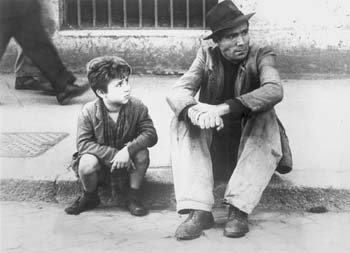
The Bicycle Thief

For all the great stories and scripts that twist and turn, throwing you for a loop around every corner, sometimes the simplest plot devices are the best.  There's nothing to distract from a single, pointed effort as a character searches for one thing, something that needs to be achieved at all costs to continue living in any sort of reasonable fashion. That's one of many reasons I really enjoyed 1948's The Bicycle Thief.

As a fan of movies in general, I try to watch movies from different countries and not just U.S. made productions.  The more I see, the more I like Italian films, especially the neo-realistic films that hit theaters in the years following WWII. The beauty of these movies is their basis in reality. In an age of editing and style where films make you very aware that you are in fact watching a movie, these Italian films do just the opposite. These are slice of movies, partially out of necessity, partially out of an intentional style. This is life. Watch it, and go along for the ride. I like all sorts of movies, but it is refreshing watching movies like this every so often.

Struggling to support his small family including his wife, Maria (Lianella Carell) and his two small children, Antonio Ricci (Lamberto Maggiorani) manages to get a job placing posters all over Rome for fair wages. The only requirement for the job is that he needs to have a bicycle at his disposal. He gets one, renting one for all the money he can put together between him and his wife. He heads off to work on his first day, excited and ready to start, only to have the bike stolen a few hours in. Wanting to keep his new-found job, Antonio starts a desperate search with his son, Bruno (Enzo Staiola), through the city for any sign of the bike. The search is like looking for a needle in a haystack, and Antonio begins to question if anything can go right for him.

Is that one of the most simple, straightforward stories you've ever heard? Man needs bike for job, bike gets stolen, man needs to find bike. It's criminally simplistic, but I think that's part of the genius of the movie. Anything more "dramatic," anything more over-the-top or emotional would have failed miserably.  Director Vittoria De Sica never tries to do anything else, knowing he's got the perfect tone as is. There is nothing to distract from the issue at hand. Don't go in thinking there is a twist coming halfway through. Half of the movie -- literally, not figuratively -- is Antonio and Bruno searching the stores, fairs and markets of Rome on a Sunday morning and afternoon. That's it. It is almost idiotic how straightforward it is, and I mean that in the most positive sense.

One of De Sica's trademarks as a director -- as was the case with many Italian directors at the time -- was to cast amateur actors in key lead roles.  Maggiorani was in 16 movies in his career, most of them bit parts and none of them as important or as moving as his part here as Antonio, a father stretched to his limit. Carell is equally as good as Maria, his equally distressed wife who knows they must grasp at any gasp of hope in front of them. She basically disappears once the search starts, letting the spotlight shine on Maggiorani and Staiola playing their eldest son, Bruno. When you see so many awful child actors around, it's always nice to see some talent. Like all of the actors here, young Staiola is as natural as they come. It never feels forced, his performance feeling genuine, a young boy who worships his Dad and would do anything to help him.

That is the heart of the movie, the father and son relationship, the father-son bonding that happens over the course of their day-long search. Some of the movie's most beautiful parts are montages set to composer Alessandro Cicognini's score of Antonio and Bruno walking through the crowded Rome streets. Maybe because they weren't classically trained actors, but this relationship (like so much of the movie) is as authentic as possible. They joke and argue, always looking out for each other. The city of Rome ends up being its own character thanks to De Sica's direction and Carlo Montuori's cinematography. Like many European cities, it is hard to make Rome not look good, but in black and white filming, it is a visually gorgeous, even stunning city. You fall in love with the city and all its beauty.

The Italian movies I've seen are notorious for downer endings, if "downer" is the right choice. The endings are typically realistic, and how about that? Real-life solutions aren't always happy. The Bicycle Thief is no exception. Realizing their efforts are fruitless, Antonio attempts to steal a bike only to get caught in the effort. Seeing the strain on this man, the bike's owner decides not to press charges. Antonio and Bruno walk away as the sun sets, dejected at their lack of success and not knowing what awaits them. The End. It came as a surprise certainly for me, but it is a thing of beauty. Seeing Antonio's anguish as he contemplates stealing the bike and ultimately decides to do it is an uncomfortable, moving scene to watch unfold. I liked the ending because it is real. There's rarely a nice, tidy ending, and anything else would have seem forced here.

The Bicycle Thief <---trailer (1948): *** 1/2 /**** 

Monday, May 23, 2011

Captain Kidd

The name is synonymous with the idea of a pirate, Captain William Kidd, a supposed pirate tried, sentenced and executed in 1701 for his actions as a pirate on the high seas. Historians debate now whether Kidd was in fact a pirate because much of his actions seemed to correspond more with the idea of a privateer, not a pirate. Nonetheless, his name still conjures up stereotypical pirates with eye patches and parrots on their shoulders. Released in 1945, Captain Kidd is anything but historically accurate no matter who or what the real-life Kidd was like. It's a Hollywood take on his "pirating" years, historical accuracy be damned.

Right in the middle of Hollywood's Golden Era, Captain Kidd was released when high seas adventures were at their most popular. Swashbuckling adventures starring Errol Flynn always went over well with audiences, and the appeal is clear when watching films like these. Traveling across thousands of miles of open water on tall ships does have an air of romanticism even though the life had nothing romantic or glamorous about it. Idealized is a good way to describe the life of a sailor on these ships, but it can be fun just to imagine what the life was like. In this case, Kidd is a very smart, very devious captain, always looking for a way to become rich himself, making promises to anyone who will listen only to turn on them the first chance he gets. Sounds like a good guy, doesn't he?

After looting an English ship off Madagascar, Captain William Kidd (Charles Laughton) and three officers (John Carradine, Gilbert Roland, and Sheldon Leonard) bury piles of treasure taken from the ship. They return to London, no one the wiser of what they've just done. Ever the convincing sort, Kidd manages to acquire a contract as an escort of an English ship traveling from India back to London by way of Madagascar. With a crew of pardoned convicts, Kidd's ship heads south around South Africa looking to meet their future target. Kidd has some ulterior motives though, starting with killing off his three officers who also know the location of the buried treasure. He's suspicious though of one of the crew, Adam Mercy (Randolph Scott), who he believes to be a spy placed on board by the English king to keep an eye on things. What are Mercy's intentions, and what exactly is he up to?

Laughton was no stranger himself to movies on the high seas, starring in 1935's Mutiny on the Bounty as the evil Captain Bligh, pushing his crew to a mutiny. In that role, he plays straight evil, a captain with a mean streak down his back like no other. Playing another historical figure here, Laughton gets to have a little more fun with the part. There's no doubt Kidd is the villain. That's not in questions. He connives and backstabs, betrays and lies, doing anything he can to kill off his rivals for the treasure. But in a weird way, he's got this odd ability to be charming in doing it. Granted, you know nothing good will come of anything he does, but he's able to disarm worries almost at will, an ability that certainly comes in handy when eveyrone around him is suspicious of him.

Above all else, Laughton's performance as Captain William Kidd is the best thing the movie has going for it. Bringing that charm to the character, Laughton makes every scene interesting. He is always up to something and then retreats to his cabin where he keeps a list of all his intended targets. When he does start knocking them off, he slowly draws a line through their name, an evil smile ever present on his face. It also doesn't hurt that Laughton's physical appearance throws you off. He's short and chubby, disheveled hair on his head. He doesn't look evil or even particularly bad. That's the fun though, a villain with a sense of humor, that ever-present mean streak, and a sense of paranoia when things start to go against him.

Looking surprisingly young for someone who was 47 years old at the time, Randolph Scott plays...well, Randolph Scott. His Adam Mercy character delivers a good twist about three-quarters of the way into the movie, but not the one you would think or have been led to believe. He's the strong-willed, silent but very capable character who in a lot of movies would have been the lead. Instead, he gets overshadowed by Laughton's performance. Still, it's Randolph Scott, and he's still cool. Carradine and Roland are unfortunately underused, but just by being there, the story is enhanced. I think Carradine always played the bad guy, and Roland gets a crack at his familiar Latin lover part. Throwing in a love interest, Barbara Britton plays Lady Anne, a woman brought on-board who Scott's Mercy looks out for.

Not as well known as so many other entries, Captain Kidd has lapsed into the public domain over the years. What's that mean? No studio holds rights on the movie so anyone who wants to can distribute the film in any form they so choose. Because of this, the prints aren't going to be that good with a grainy, washed out look. Individual shots are different shades of black and white, one scene much too dark and grainy, the next too bright where things are hard to make out. It's not a deal-breaker, but you can't help but notice it as you watch the movie. All complaints aside though, I liked this movie a lot, thanks in great part to Charles Laughton as the titular character, Captain Kidd. The movie would be just okay without him, but as is, it's moved up a notch. You can watch it at Youtube HERE.

Captain Kidd <---TCM clips (1945): ***/****

Sunday, May 22, 2011

Kiss Me Deadly

In the late 1940s and into the 1950s when film noir ruled theaters with its uniquely dark storytelling and innovative filming techniques, no one was more popular writing crime novels than author Mickey Spillane.  He started off writing comic books before turning to novels in 1947 with his debut story, I, Jury, eventually writing over 20 novels in all.  His stories were incredibly dark and hard-edged, not looking to pull any punches.  They seem like the perfect springboard for film noir flicks.

Nowhere was Spillane's writing more appropriate for film noir than his most famous character, private detective/investigator Mike Hammer. For lack of a better or more eloquent description, all I can think of to describe this individual is that he's one gnarly dude.  Male leads in film noir -- film or literature -- are never particularly likable characters, but there's almost always some glimmer of goodness in them. Hammer? Not so much. He is brutally violent, hates women basically across the board, and also seems genuinely pissed at the world. All of that is on display in 1955's Kiss Me Deadly.

Driving through the desert outside Los Angeles in the dead of night, Mike Hammer (Ralph Meeker) almost crashes into a young woman, Christina (Cloris Leachman), trying to wave him down. He picks her up, quickly finding out she's escaped from an insane asylum. It's only a few miles later where they're driven off the road. Mike wakes up hours later, beaten severely to find that Christina has been tortured to death. She told him if anything happens, 'Remember her.' Now, Mike wants to know what's going on. What was this woman involved with? With help from his assistant, Velda (Maxine Cooper), he starts to look into it. Already as jaded as possible, even Mike can't prepare for what he finds.

I really don't know what to make of this movie. Released in 1955, it's basically different from any other movie you will have seen from that year or even that decade. Director Robert Aldrich puts his own darker, more cynical take on the film noir genre. It is a black and white world where there really isn't any "white," as in anything good. The characters -- with an exception here and there -- are out for themselves. It's a seedy world where nothing is on the level. Visually, Aldrich uses some cool, ahead of their time camera techniques, and films on location in and around 1950s Los Angeles. The time portal argument again, yes, 1950s LA looks cool.

Starting with Meeker in the lead role as Hammer, there aren't any big names associated with this cast. It helps here because as is so often the case, as an audience we don't have much in the way of preconceived notions or backgrounds on these people. Whether he was playing a good guy or a bad guy (typically bad or at least morally questionable good), Meeker has an intensity on-screen like few other actors in Hollywood.  In that way, he's an ideal choice to play Hammer, one of the more despicable lead characters ever. He's just oozing anger, intensity and pure rage as he investigates the weirdness of the girl's death. More importantly, you feel he's capable of just about anything. His "business" as a detective involves blackmailing clients by sleeping with the women or having Velda sleep with the men. White-washed 1950s movie this is not, but Meeker is at his best.

No big names at all after Meeker, but the cast is great nonetheless, mostly because of Spillane's writing. He has all these great characters, all with their own motivations and incentives.  Albert Dekker remains in the shadows most of the movie playing the baddie, Dr. Soberin, putting everything in motion. Cooper as Velda is a good match to Meeker, equally cynical but still somehow with feelings for Hammer. She's the scarred female lead that these noirs so often used/needed. Also worth mentioning are Wesley Addy as Pat Murphy, a cop associate if not friend of Hammer's, Paul Stewart as one of Soberin's men (with thugs Jack Lambert and Jack Elam), Gaby Rodgers as Gabrielle, Christina's long-suffering roommate, and Nick Dennis as Nick, one of Meeker's few friends, a mechanic. Even look for a young Strother Martin as someone Hammer interviews.

This movie has gained quite a cult reputation over the years, largely due to the fact that it's basically an anti-1950s movie.  You just won't see many movies like this one from that decade.  But somewhere in between Spillane's novel and the Aldrich film version, any sort of coherence gets lost in the shuffle.  It opens with a bang, the opening sequence is one of the coolest I can think of. But as Hammer starts his investigation, the story weaves this way and that way without any sense of direction. It is a talky movie, and not necessarily a good one. Hammer slaps countless people to get the information he wants, and then moves on. It took me several sittings to get through this 106-minute movie just because I struggled to get involved with anything that was happening.

That builds to the ending, the reason Christina (Leachman in her screen debut) was brutally murdered. The story goes timely, tying things up with a reference to the Manhattan Project in the Nuclear Age.  SPOILERS STOP READING SPOILERS How we don't know, but she has in her possession a box that contains some sort of nuclear/radioactive item that when released actually blows up a house. We've got this hard-edged detective story, and then WHAM!, we're going symbolic science fiction about evil and the end of the world. There is an alternate ending (read about it HERE) which actually sounds better considering the studio interference.

Kiss Me Deadly <---trailer (1955): **/****

Saturday, May 21, 2011

The Dogs of War

With almost 20 books to his name, author Frederick Forsyth has carved out quite a little niche for himself in the world of thrillers and espionage. His characters are killers, mercenaries, hard-edged cops, all the dirty jobs that no one wants to talk about but know exist nonetheless.  His realistic, detail-oriented stories translate well to film, including The Day of the Jackal, The Odessa File, and also 1980's The Dogs of War, based off a 1974 Forsyth novel.

The book is a quality example of Forsyth's style as an author.  His talent isn't coming under fire here, anything but. His stories of killers, hired guns, and mercenaries are flashy or Hollywood.  They're based in the darkness of those people's lives, the constant fear and battle with death. 'Dogs' as a novel is more a day-to-day description of how to mount a mercenary operation than a shoot 'em up, action-packed story. If anything, it gets somewhat tedious in its ridiculous amount of detail and description. Reading it, you can't help but wonder how a movie version would translate, all the while wondering, how would they make this work? Easier said than done, but the movie is certainly enjoyable, if flawed.

A mercenary who has fought all over the world, James Shannon (Christopher Walken) returns home to New York City after doing a job in Central America. He is approached to do a recon job in a tiny west African country, Zangaro, just a quick job where he sees what the country's military forces have to offer. Shannon agrees, taking the long trip to the poverty-stricken, desolate country ruled by a blood-thirsty dictator. During his visit, he is arrested and beaten within an inch of his life, only to be rescued by a British journalist, North (Colin Blakely). Returning home, he delivers his report and is offered another job by the mysterious Endean (Hugh Milais). For a large sum of money, Shannon must lead a mercenary outfit into Zangaro and topple the government. Looking for revenge, he agrees, starting from the ground up, recruiting a small team of mercenaries to help in the effort.

If the story sounds somewhat familiar, it should. With a few tweaks here and there, 2010's The Expendables borrowed heavily from the basic storyline.  That movie was more fun overall, but The Dogs of War is the better movie. Forsyth doesn't portray his mercenary warriors as anything but what they are, hired killers, working for whoever will pay them, ideals and principles long since thrown out.  This is a story interested in the details, the things many movies would brush to the side. Where do you get guns? Where do you acquire uniforms? How do you sneak into a country? It may not sound too exciting, but there's an interesting angle of the mercenary movie -- the background -- that you just don't see that often.  'Dogs' isn't as good as Dark of the Sun or The Wild Geese, but it certainly belongs in the conversation.

Intending this in the most positive sense, I think Christopher Walken is one of the weirdest, oddest, and ultimately, coolest actors to ever star in a movie.  Watching him, you can't pull your eyes off of him. He's quirky, eccentric, different and rarely goes where you think he will with a character.  Reading the book, Walken was nothing like what I imagined the Shannon character to be like.  But the joke was on me because above all else, this movie works because of Walken.  He carries this movie. Jamie Shannon is a veteran mercenary with countless battles, firefights and wars behind him. He's alone in the world (JoBeth Williams is his ex-wife) and doesn't particularly like what he does, but he's good at it, and the pay is good. A great main character, and a sympathetic one.

One of the cooler aspects of the book was Forsyth's assembling of this multi-national team of mercenaries Shannon works with in hopefully leading the coup d'etat.  The movie drops the ball in that respect. Tom Berenger plays Drew, Shannon's best friend and right hand man, a mercenary who loves fighting, getting some sick enjoyment out of it. Also joining the team are Paul Freeman as Derek and Jean-Francois Stevenin as Michel. Eddie Tagoe plays Jinga, leader of the exiled African fighters working as Shannon's attack force. Other than Berenger's Drew, we're given no character development or any kind of personal background on either man. They're more cardboard cutouts of characters, ideas of what and who they should be. The team is still cool because they are the steely-eyed, cold-blooded mercenary, but so much more could have been done with the team as the book proved.

Interested in the little things, the background details, the movie (directed by John Irvin) saves up all its action for the finale, a nighttime assault on the Zangaro dictator's heavily guarded compound. Irvin spends a long scene showing Shannon's team (along with 24 exiled African fighters) moving into position, moving through the empty streets of Clarence, the capitol city.  It builds the tension to a boiling point so when the action does start, it is like a release of anxiety.  The attack is loud and chaotic, but still a little short.  It doesn't feel rushed, but like so much more concerning the movie, I felt like more could have been done.  The finale does deliver a solid twist, one that stays true to the Forsyth novel, neither a downer nor a happy ending. Just an ending.

Still, I can't help but feel disappointed after watching the movie.  The book is a hefty if very readable 400 pages, and the movie does an admirable job trying to stick to the novel. Too much gets left out though, like an actual reason for why the government needs to be toppled. It is hinted at, but never explained, left to be unexplained by those who haven't read the book.  The ending is a particularly dour note, a sudden ending and a moving one, but not as moving as it could have been. Other than Shannon, you don't feel much for the other characters. That's the main problem. 'Dogs' keeps you at a distance from the start.

The Dogs of War <---trailer (1980): ** 1/2 /**** 

Friday, May 20, 2011

Land Raiders

Thanks to the huge success of Sergio Leone's Dollars trilogy starring Clint Eastwood in Europe and around the world, American studios were left trying to figure things out and somehow keep up.  American audiences had grown somewhat tired of the same old westerns by the late 1960s so seeing the success the spaghetti western genre made, the studios made similar movies that's become part of a whole new sub-genre of westerns, Italian westerns made with American backing.

These were movies that at first glance look and feel like a hard-hitting, dark spaghetti western. Give it a closer look though, and things are a little different.  The casts lean more toward American actors and actresses for one, and for the most part, they ease up on the gas.  So with that, you see movies like 100 Rifles and El Condor among others.  Of course, some went all-in, throwing all their chips in, taking everything that made the spaghetti westerns so good and taking it up a notch or two. I saw the end to 1969's Land Raiders a hundred times or so growing up on TBS' Afternoon Movie, and thanks to Netflix Instant watch, I caught up with it this week in its entirety.

In the Arizona territory in the 1870s, Vince Carden (Telly Savalas) has assembled millions of acres of land, his Carden Ranch dominating the area. He has hopes of building the ranch bigger and bigger, making himself the richest man around. His younger brother, Paul (George Maharis), has ridden back to see his ailing father after several years away from the ranch, a falling out with his brother driving the family apart. Paul still despises his brother for what he did in the past, but their family problems look ready to be swept away. An Apache war party is terrorizing the territory, and Vince sees the potential to wipe out every Apache for hundreds of miles around. His plan though has the potential to backfire, putting the lives of everyone else in the territory at risk.

Writing past reviews of spaghetti westerns, I haven't been shy about my love for the genre. This darker, even harsher quasi-spaghetti is going to fall under that category. It isn't a particularly good movie with its fair share of cheese, bad acting, and low-budget qualities. I still like it though. Director Nathan Juran uses a handful of familiar locations in Almeria, albeit the greener, more picturesque areas of the region. I recognized the town from Django Kill! (among others), and the church from Guns of the Magnificent Seven. Composer Bruno Nicolai's score -- a frequent collaborator with spaghetti master Ennio Morricone -- seems to sample from a long list of spaghetti scores, but it's good samples if nothing else. I can't place the main theme (listen HERE), but even its familiar tune (especially the quieter moments) work well. 

Like many westerns, 'Raiders' has its roots in some Greek tragedy, even Biblical roots with Maharis as the Prodigal Son returning home after years away from his family.  In the darker, almost gothic tones of the movie, you get that sense of Greek tragedy, the family tearing itself apart, the individual members on the brink of killing each other. The motivating force here is a mystery with a young Mexican girl, Luisa (Jocelyn Lane), who was engaged to Paul but died under mysterious circumstances, apparently linked to Vince. A handful or so of grainy, fuzzy flashbacks pepper the story, adding a second layer to the proceedings even if it is clear what actually happened right away. I'm not saying Land Raiders is any sort of modern classic -- far from it -- but it is interesting, striving for something more than just a 90-minute shoot 'em up.

With the idea of the quasi-spaghetti comes the casting of two American actors as the leads, one a future TV star and the other a TV star of the past. Savalas is one of my favorites, a versatile actor who could play good, bad, amoral, and in between.  Here, he's fully embracing his epically bad side.  There is not a redeeming character about his Vince character, and that's the beauty of it.  He's one bad dude, and you know karma is coming around to kick him square in the butt.  Five years removed from Route 66, Maharis was still trying to become a bigger star, something he never really attained. His Paul is the more sympathetic of the two Carden/Cardenas brothers, even if Maharis makes a pretty bad attempt at a heavy Spanish accent and looks like a gay caballero all duded up immaculately in clothes that look like they've never seen the trail.

Trying to one-up the spaghetti westerns, 'Raiders' certainly does its best to push the boundaries as so many movies did in the late 1960s.  This movie has it all, surprising amounts of language (Savalas even calls a woman a bitch), some gratuitous nudity, and over the top violence that uses squibs and gallons of that ultra-red blood-like substance.  Where other movies edit this type of thing into the movie in a subtle fashion, 'Raiders' doesn't really care.  A woman captured by Apaches has her shirt ripped off. Oh, a topless woman! The camera lingers a little too long. The violence is a little shocking, some graphic depictions of scalpings, among other things. Changing times for the western genre, and Land Raiders doesn't disappoint in trying to do something very different.

Leading into the supporting cast, one odd note. Character actor Paul Picerni plays two parts in a bizarre fashion, no explanation provided. The studio clearly thought it could pull a fast one, listing one character as played by Picerni, the other by H.P. Picerni. One character is a murdering gunman working for Vince, the other an old fun-loving Mexican friend of Paul's. Too weird, just one of those things I guess. Other parts worth mentioning include Arlene Dahl as Martha, Paul's wife, Janet Landgard as Kate, a young girl all grown up with a crush on Paul, Guy Rolfe as Major Tanner, the local cavalry commander, and Phil Brown as Sheriff John Mayfield, Kate's father caught in the middle of a situation with no easy way out. Even look for spaghetti regular Fernando Rey as what else? A priest. A good western that isn't really that good at all, but it's a solid guilty pleasure.

Land Raiders <---trailer (1969): ***/****

Thursday, May 19, 2011

Spencer's Mountain

I have never seen an episode of The Waltons. Not one, not even one scene.  The popular TV show ran between 1972 and 1981 with 221 episodes to the show's name and seven TV movies to boot.  I'm aware of the show, know a little bit what it was about it, and at least somewhat know it's place in pop culture history. But still, I never saw a single episode.  And to tell you the truth, I don't feel like I'm missing much.

Having little to no background with one of America's favorite TV families, I was then surprised when I started watching 1963's Spencer's Mountain from director Delmer Daves. Watching the movie in two different sittings, I did some investigating in between, quickly finding out that this movie is based off a novel by Earl Hamner. The novel turned into a feature length movie and some eight years later was turned into one of TV's most beloved shows, The Waltons. So having watched 'Mountain,' I can say I don't need to look into the TV show, not because it wasn't good, but because I doubt the 1970s show can live up to its predecessor.

For over 100 years in the shadow of the Grand Tetons, the Spencer family has lived, leading a simple, hard-working life. The oldest of nine boys, Clay Spencer (Henry Fonda), works at the local mill, putting in a solid day of work and returning home to his wife, Livy (Maureen O'Hara), and their passel of nine kids. Working hard to keep things up, Clay hopes to one day build his wife a dream house on the side of the family's mountain, giving her everything he knows she deserves. But as the kids grow up, Clay wants to give each of them everything he can, starting with his oldest, Clay Boy (James MacArthur), who just graduated from high school and wants to enroll at college. But nothing comes cheap, especially for the hard-working father who now must work even hard to support his family.

Just like The Waltons would come to be during their successful run on TV, Spencer's Mountain is a little slice of Americana.  This isn't a rich family that lives life in piles of money. This isn't the dirt poor, scraping out a little niche for itself. This is a large family that isn't rich and isn't poor. Money is hard to come by, but they know that at a certain point, happiness is more important than possessions.  It's hard not to get behind this family. They do what they need to do to survive, often making sacrifices so that survival is possible. The story and the setting though is pure American, hard-working, steadfast, honest people who aren't afraid of putting their back into something.

For this little piece of growing up and living as a family in America, director Daves turns in one of the most epically sweeping movies I've ever seen.  It isn't about hundreds of extras in the background or flashy camera techniques.  Plain and simple, this is a camera showing the pure beauty that is the American west in all its glory.  Daves doesn't mess up a good thing, knowing all he has to do is set up the camera and start the film rolling. He films in Jackson Hole and Grant Teton National Park -- both in Wyoming -- and the landscape ends up being a key character. You understand Clay's motivation, his love of the land, just by seeing what he sees. This is one of those movies that needs to be seen in widescreen to appreciate what Daves filmed. I can only imagine what the movie would have looked like in 1963 on a big screen in movie theaters all over the country.

The timing is spooky, but the story from Sometimes a Great Notion is eerily similar to Spencer's Mountain. Maybe that's on account of its similar outlook on life in that hard-working, middle to lower class American family.  In a long line of great performances and characters, Henry Fonda adds another exception part as Clay Spencer, the fun-loving family man who loves everything about life, the sinning and otherwise. He embraces the good and the bad, just going along for the ride at times. Maureen O'Hara is his polar opposite, a God-fearing woman trying to raise her children right, turning her back on carousing, drinking, fighting. So in their different outlooks, they find their perfect match. Fonda and O'Hara are two of my all-time favorites, and their chemistry in all their scenes together is spot-on. I wouldn't expect anything less from two professionals like them.

I've always been a fan of James MacArthur because of his role first in Swiss Family Robinson and then later in Hawaii Five-O. It's cool to see him in a starring role here, not a supporting part, and he plays well off of Fonda and O'Hara.  He's the only one of the Spencer kids who gets more than a line or two of dialogue, his story dominating the second half of the movie in a positive way. This is Fonda, O'Hara and MacArthur's movie, but there's worthwhile supporting parts for Donald Crisp and Lillian Bronson as the Spencer grandparents, Wally Cox as Preacher Goodman, Mimsy Farmer as Claris, a teenager with her eyes set on Clay Boy, Virginia Gregg as Clay's high school teacher and biggest supporter, and Whit Bissell as Doc Campbell.

Waltons fan or not, this is just a good movie, well worth checking out.

Spencer's Mountain <---TCM trailer (1963): ***/****

Wednesday, May 18, 2011

Love in the Afternoon

One of the biggest stars to come out of Hollywood's Golden Era, Gary Cooper was at the top of his game in the 1930s and 1940s. By the 1950s on the other side of 50 years old, Cooper's star faded some. He still made some great movies -- Vera Cruz and Friendly Persuasion are personal favorites -- but he didn't age well as cancer slowly spread through his system. He didn't always look well on screen, but he continued on working up to his death in 1961.

The image of Gary Cooper is what many movie fans remember most about him. I always think of Sgt. York, the country boy turned war hero in WWI. I think of Sheriff Will Kane, defending his town against a gang of outlaws even when the entire town turns their back on him. That's Gary Cooper, and without sounding cheesy, he's a symbol of Americana. He's honest, strong, steadfast, and when the chips are down, he's at his best. That is what makes Billy Wilder's 1957 film, Love in the Afternoon, so hard to digest. Cooper plays a philandering ladies man who moves from one woman to the next as he travels across the world. The movie is enjoyable enough, but it is an epic case of miscasting when it comes to Cooper's character.

Growing up in Paris, young Ariane (Audrey Hepburn) lives in an apartment with her father, Claude (Maurice Chevalier), hoping to one day be a concert cellist. Claude is a private detective, specializing in some of the sleazier cases in Paris. Ariane is a little naive to the ways of the world but can't help but be interested in her father's files, reading all about the steamy adventures of globe-trotting lovers. She takes a special interest in one case, one Frank Flanagan (Cooper), an American businessman with his hand in everything. He has a woman in every city, leaving them as quickly as he meets them. Ariane knows that a scorned husband is gunning for Flanagan, and at the last minute, saves him. She quickly falls for the older American, and he's curious about this mysterious Parisian girl. There's no way they should work, but can they?

Director Billy Wilder is too talented for this movie not to be worthwhile. He's just too good behind the camera, and it feels funny to write this, but this is the first review I've done here in over two years of his movies. He never had a dud in his career, just degrees of average to above average. This is a 1950s romantic comedy, full of style and story. It is well-written, and while the Parisian locations aren't used to their potential (Cooper and Hepburn are never outside if I recall), the Paris setting is hard to beat. I enjoyed the movie, appreciated the comings and goings of the story, and watching Cooper and Hepburn is never a bad thing.  

The basic premise of the story though is that we have to buy Gary Cooper as this philandering, globe-trotting, worldly businessman. It's just not happening. Cooper was Grace Kelly's husband, Dorothy McGuire's husband. Flanagan would be TMZ fodder in the modern age, always in the news for his social shenanigans with any number of women. Wilder supposedly originally wanted Cary Grant in the role, and that makes sense. You would believe Grant as this character. Cooper -- as talented as he is -- just was not the right choice for this character. He's too old, and he looks it. It is hard to believe a beautiful young woman like Hepburn's Ariane falling for him as quickly as she does. This isn't a movie-killer, but it is certainly something you can't help but notice.

Because Cooper is too talented an actor for this movie to be a complete botched effort, it is still watchable, especially because of Miss Hepburn. The 27-year old actress was at the height of her success and popularity in 1957. She might be a couple years too old to play Ariane, but it works. As was the case with many of her roles (pre-Breakfast at Tiffanys at least), she plays the innocent, even naive young woman to a T. Ariane wants to be in love and quickly falls for Cooper's Flanagan (why, we never know, he's not smooth or charming). What's great about the character is how she ropes Flanagan in, pretending to be a female version of him, an exotic guy friend in cities all over the world. Hepburn sells it too, throwing off the cuff remarks left and right, Cooper slowly losing his mind, aware that he could be getting played but not knowing how to prove it.

If this is what romantic comedies were still like in 2011, the movie world would be a better place. It just would. The humor is smart, coming from interesting situations and worthwhile conversations. It's never obvious, painful slapstick humor. So while Cooper may have been miscast, the banter between him and Hepburn is well-written and well-delivered. Chevalier is great in the supporting role as Ariane's private detective father, and John McGiver is memorable as Monsieur X, one of Claude's customers. Also worthwhile, Flanagan's almost live-in band, the Gypsies, a jazz band who plays for him and his lady friends in his hotel room. The movie isn't great, and is a bit long in the tooth at 130 minutes, but it's good, old-fashioned moviemaking that rises above its flaws.

Love in the Afternoon <---trailer (1957): ** 1/2 /****

Tuesday, May 17, 2011

Four Brothers

Released in 1965 and starring John Wayne, The Sons of Katie Elder is an all-around underrated western and one of my favorite Duke movies. It's different from most westerns, and the sense of camaraderie that develops among the four main characters -- brothers reunited after their mother's death -- is a high point. I know I'm not exactly timely on the subject, but 2005's Four Brothers is a quasi-remake of the 1965 western, albeit set in Detroit as opposed to 1870s west Texas.

A likable and talented cast, a director with some solid movies to his name, and a story that worked well in its original form and should have worked here. Those were three things I thought would carry this movie. Soon after viewing the movie, I'm still surprised at my initial reaction to 'Brothers.' It is not just a bad movie. It is truly awful. I can't remember the last movie that disappointed me this badly. As things moved along, I laughed out loud at several scenes (scenes not meant to be funny either) and groaned at others.  No two ways about it, this movie stinks to the high heavens.

A well-known and highly respected foster parent, Evelyn Mercer (Fionnula Flanagan) is killed in a grocery store robbery, shot down by the two robbers. Four of her foster kids -- long since grown up -- including Bobby (Mark Wahlberg), Jeremiah (Andre Benjamin of Outkast), Angel (Tyrese Gibson), and Jack (Garrett Hedlund) return home for her funeral. They want to know what's being done to bring in their mother's killers, but quickly realize the case is being brushed aside. Led by the fiery, hot-tempered Bobby, the brothers start investigating on their own, finding out that this wasn't just any random act of violence. Two Detroit detectives (Terrence Howard and Josh Charles) are close behind, trying to stop the brothers before more blood is shed.

One of my first reactions -- and there were a lot, mostly negative -- was that director John Singleton was trying to make a movie that was a throwback to the crime thrillers of the 1970s, blaxploitation flicks and seedy movies about the underworld, gangsters, and crime across the board. That's fine with me. The 1970s produced countless great crime movies. A tribute movie released in 2005 could have been a good idea, a movie honoring those that came before it. Instead, 'Brothers' gets so bogged down in cliches for characters and story, and trying to be cool, the whole movie falls flat on its face.

There are a lot of places to I could start off with and rip this movie apart. I'll start with the one that disappointed me the most. I've found myself defending Mark Wahlberg to haters of the actor for many of his roles, but this is the first performance I've seen of his that just does not work. He's supposed to be this born troublemaker with the most checkered of a past, but we never find out why. His Bobby also tries too hard to be ghetto, to be tough, and the effort does not work at all.  Gibson is the best of the bunch as Angel, but it's still not a great performance. Hedlund is a talented actor on the rise, but his James Dean impression is awful. One half of Outkast, Benjamin doesn't make much of an impression as Jeremiah, the one brother that seemingly amounted to something.

So with four main characters, none of them actually redeeming in any way, we've got a list of supporting characters that are ripped from the Screenwriters Cliche Guide textbook, stock characters used to death in the 1970s and ever since. Howard is the cop with mixed emotions, trying to balance his duty with what he believes is right. Charles is his crooked partner (no reasoning/explanation provided). Sofia Vergara plays Angel's girlfriend, Sofi, a character that requires her to be a fiery, hot-tempered Latina.  Stereotype much? The worst though is Chiwetel Ejiofor as Victor Sweet, the ridiculously over the top local kingpin, so hammy and over the top you can't even take the character seriously. Ejiofor is a gifted actor, but whether it's his interpretation or just poor writing, this is a character that is simply beneath him.

The acting handicaps the movie almost from the start, but there's so much more that is wrong here.  The brothers lead their own vigilante investigation, making jumps from one thing to another without a reason given. More than that, nothing is ever established in stone as to exactly what's going on. There are bad guys and badder guys, and apparently they all wanted to knock off this sweet old foster mother. I think I know what was going on, but then again, by about an hour in, I just didn't care. Awful movie, couldn't be more disappointed. Stick with The Sons of Katie Elder.

Four Brothers <---trailer (2005): */****