Director John Sturges has built up a lot of credibility to me when looking at his list of movies. Two of those, The Great Escape and The Magnificent Seven, are even in my all-time top 5 movies. But after the huge success of The Great Escape in 1963, it seems like Sturges just hit a wall. He never made another great movie, instead finishing his career with nine movies that range from decent to plain bad. The biography I read, Escape Artist, explored this some, stating that late in his career Sturges started to phone in his efforts.
Courtesy of Netflix, I finished watching those nine movies with 1969's Marooned which reading the plot outline and cast sounded promising to me. But in its execution, something is missing with the result a heartless story with a wasted cast that could have been a much better movie.
The premise is a good one, and even a bit eerie considering the movie was released a year before the Apollo 13 disaster. Three astronauts, Commander Jim Pruett (Richard Crenna), young scientist Clayton Stone (James Franciscus) and Buzz Lloyd (Gene Hackman), are sent on a dangerous mission that is much of a scientific experiment as anything else. The trio is sent to live in orbit in a space station for seven months, being observed the whole time to see the toll it takes on them. The experiment goes surprisingly well, even if NASA headman Charles Keith (Gregory Peck) pulls the plug early, sending the order to bring the men back after five months in space.
But as they board Ironman One to reenter Earth's atmosphere, they discover something's wrong, and the engine won't ignite. They're trapped with no way to seemingly get back. With only 42 hours or so of oxygen left in the shuttle, Keith and fellow astronaut Ted Dougherty (David Janssen) and all of NASA must decide what to do to save them; figure out what's malfunctioning on the ship or put together a desperate rescue mission that typically would take weeks to organize. They opt for the rescue mission, but with time drifting by realize there's only enough oxygen for two of the three men. Can the rescue still make it in time?
Even reading the description now having already seen the movie, I can't help but think 'hey, that sounds interesting.' But from the start, this movie doesn't have a pulse. Filmed almost like a documentary dealing with the subject, the story never comes alive. We're expected to feel for these astronauts and the men trying to save them, but we're never given a reason. The story is developed and unfolded before we even learn anything about the men. The one truly effective scene that comes to mind has the astronauts talking to their wives as NASA begins to think time is running out. It's an emotional scene, especially between Crenna's Pruett and his wife Celia (Lee Grant), but it's too late.
The special effects have taken a beating since its release, but I thought that was one of the better aspects of the movie. At times it looked like models, but most of the movie appeared somewhat realistic. That's another problem. Sooooooo much of the dialogue is technical jargon that means nothing to the average moviegoer. There are far too many discussions between Houston and Ironman One that did nothing for me other than throw me for a loop. Maybe Sturges and Co. were going for an ultra-realistic look at a possible situation for NASA and its astronauts, but they might have gone too far.
As for the cast, I can't say it's their fault. Because there is little to no background until well over halfway into the movie, we know nothing about them. Sure, I was rooting for them to get back to Earth safely, I'm no sadist, but it wasn't like Ron Howard's much better Apollo 13 where I had a vested interest in the characters. The same goes for Peck and Janssen on the ground in Houston. Peck mumbles and grimaces through conversations with officials and reporters while Janssen disappears here and there to mount the rescue effort. It all builds to an ending that's just too perfect, too coincindental, all too ludicrous.
Not that I'd recommend running out and buying the DVD, but it's good packaging. The disc offers the movie in widescreen presentation with trailers for 4 other movies, but oddly enough, not Marooned. No other special features are included. A big disappointment here all around, and a movie I definitely won't be revisiting anytime soon.
Marooned (1969): */****
The Sons of Katie Elder
"First, we reunite, then find Ma and Pa's killer...then read some reviews."
Thursday, June 18, 2009
The Taking of Pelham 1 2 3
The original Pelham One Two Three is a cult classic in its own right with Walter Matthau and Robert Shaw as the two leads with one big claim to fame, providing inspiration for Quentin Tarantino's Reservoir Dogs. So the remake, with bigger names headlining, still had some pretty big shoes to fill. Is it as good as the original? I'll have to think about that, but gut reaction, close but not as good.
The story is the same with a few slight changes. On a New York subway train, Pelham 123, four men led by Ryder (John Travolta) hijack a single car with its 18 passengers. Getting in contact with the Metro Transit Authority headquarters, they make their demands. They want $10 million in one hour or else they will start shooting a passenger for every minute they're late. At the other end of the radio at MTA HQ is Walter Garber (Denzel Washington), a former supervisor demoted to a desk job while under investigation for supposedly taking a bribe. What follows is a cat and mouse game as Ryder and Garber talk back and forth while NY desperately tries to put together the $10 million ransom.
The heist-like premise is a good one that quickly brings up interesting questions. They've hijacked a train, but how will they escape once they get the money? They're underground after all. It's a tense movie as Ryder, either the sanest villain ever or the craziest, I just can't decide, plays mind games with Garber and hostage negotiator Camonetti (John Turturro, good as always). A SWAT team waits at either end of the single car waiting for the order to take down the hijackers while inside the quartet are one push away from blowing away the hostages.
Enough has been changed that director Tony Scott left his mark on the movie to set it apart from the original. There's an element of technology added to the heist as Ryder has a wireless connection to Google his counterpart on the other end of the radio, and the aspect of the stock market comes up. The heist isn't as straightforward as the original with bigger plans at work, but with a reveal of Ryder's identity late in the movie the additions work. Scott's movies are often more known for their style and flash than story, and that's true here to a point, lots of slow motion blurry shots, quick cuts that can be hard to keep up with, but the director doesn't go too far with it.
There's a natural tension in the story that would be hard to mess up from the director's chair. An hour is not a long time, especially when talking about getting $10 million from a bank and then driving it through NY traffic with the time remaining. The mayor (James Gandolfini in a great part) does question at some point, "Why didn't we just use a helicopter?" Because Mr. Mayor, then we couldn't have the cool race through Manhattan as a squad car with motorcycle escort weaves through traffic.
Working with Scott for the fourth time, Washington is the heart of the movie. His Garber character is an everyman, John Smith trying to care for his family, go to work and pay his mortgage and his kids' tuition. It's the type of part that Washington could do with his eyes closed, and he doesn't disappoint. Most of the running time, all Garber can do is talk, desperately trying to stop Ryder or at least slow him down. There's a twist that works to a fault and does come as a surprise because well....he's Denzel Washington. Hamming it up as the villain, Travolta goes too far at times, but for the character his theatrics are appropriate. He's the bad guy you love to hate but can laugh at too with how off the wall some of his comments can be.
'Pelham' is Washington's and Travolta's movie. The rest of the cast makes the most of smaller parts, especially Turturro and Gandolfini, but other than those two parts no one stands out. One of my favorite character actors Luis Guzman is criminally underused in his part as Ramos, one of the four hijackers. The other two hijackers, Victor Gojcaj and Robert Vataj, are intimidating, but I don't even recall hearing their names. The two are characters with automatic weapons, and that's it, but I guess that is what the script called for. Michael Rispoli and Ramon Rodriguez are good in smaller roles as two members of MTA headquarters.
I didn't love the remake like I wanted to, but I did enjoy it. I can chalk up a lot of that to the trailer which really convinced me to see it. The ending is forced a little too much for me, but the build-up makes up for that. So overall, it lived up to my expectations of a remake. Good but not great, and worth a watch. I do recommend seeing the original, if for nothing else than to compare the two. Go see the Pelham remake, if for nothing else than Washington in a great part going toe to toe with villainous Travolta.
Sunday, June 14, 2009
The Train
It's rare that you find a movie that's just the perfect blend of action, drama, story and character. And to find it in a war movie which usually concentrates on one or two of those things? Even better. Director John Frankenheimer accomplished that, making maybe the perfect war movie, 1964's The Train, a tale of French resistance fighters in WWII in the days leading up to the fall of Paris.
In another casting choice that might seem odd, Burt Lancaster stars as Paul Labiche, a French railroad supervisor who is also a member of a small group of resistance that started the war with 18 members, but is now down to just three. An art museum curator, Mademoiselle Villard (Suzanne Flon) comes to him with a plea. The retreating Germans have boxed hundreds of famous paintings, Renoirs, Gaugins, Picassos, Van Goghs, and are putting them on a train heading deep into the Third Reich. Villard desperately requests Labiche and his men, Didont (Albert Remy) and Pesquet (Charles Millot), slow the train up enough that the advancing Allies can overtake it before it gets into Germany. Going up against a driven German colonel, Von Waldheim (Paul Schofield), who appreciates the beauty of the art, can the Resistance pull the job off?
I'm struggling to come up with many examples of war movies that so seamlessly blend a message with so many incredible action sequences, but The Train does it beautifully. Labiche and his men unwillingly join in on the plan to halt the train, all the while questioning if it's worth it. They're told the paintings are the 'heritage of France' but is the collection worth their lives? It's this question that haunts Labiche as the bodies start to pile up. What makes it more effective for these characters? They believe in the idea of the paintings. Didont admits never seeing any of them previously and tells Labiche when they complete their mission, 'we should have a look at the paintings.' He believes their mission is a necessary one, even if he and the others might not understand why.
As hundreds of Frenchmen along the rail line help the cause and the Germans begin to retaliate, Labiche meets Christine (Jeanne Moreau), a hotel owner still struggling with the loss of her husband. It's Christine who helps him realize the futility of what they're doing. Is it worth it to die for a painting? Some think so. But I found myself asking is Labiche continuing with his effort because he believes in his mission, or because he has to continue for the cost that's already been paid? It's that question that drives Lancaster's character, one of his best performances from a distinguished career.
Now onto the ridiculously good action sequences, and remember no CGI in 1964 for Frankenheimer. So many movies can be good, but that doesn't mean they're entertaining to watch. As a director, Frankenheimer has a flair for shooting action, even making tracking shots of characters walking through a trainyard or a busy German HQ memorable. SPOILERS if you're going to watch this clip, but imagine this scene made today in 2009. I'm thinking cheesey, ridiculous looking CGI trains. Frankenheimer crashes 3 trains at some pretty good speeds! But that's just the start, check these out too, a Spitfire chases Labiche in a locomotive, and an Allied bombing mission on Labiche's rail yard, in Spanish but it's for the visual.
Leading an otherwise mostly French cast, Lancaster does double duty for his part. He's the one who wavers in his decision to help the effort to stop the train. It seems ridiculous to him to work to save art when he could be doing any number of things to help the war effort. Looking at the action aspect of the movie, Lancaster, a stunt man before he was an actor, goes back to his roots as you could see in the bombing mission clip, 1:14-1:32. No cuts where a stunt man jumps in, Lancaster slides down that 25-foot ladder, lands smoothly, and boards a fast-moving train. I don't know what else to say. That's just badass.
As his opposite in the cat and mouse game to save the train, Schofield as von Waldheim matches Lancaster, no easy feat, in every scene. Expected to think of the paintings as degenerate art, Waldheim sees what a treasure the collection really is. But even then, he has to convince the High Command that the paintings are worth something, not just on a cultural level. He becomes obsessed with getting his train into Germany and meets his match in perseverance in Labiche.
The supporting cast is equally strong, especially Moreau as Christine and Remy and Millot as Lancaster's resistance partners. Michel Simon gives a memorable if short turn as Papa Boule, a veteran engineer who's convinced by others the importance of the train and starts the slowing-up effort. Regulard contributor to WWII movies as the requisite tough German officer Wolfgang Preiss plays Major Herren, an officer trying to help Waldheim even if he may think his superior has lost it.
Well, I've done my fair share of rambling about this movie, but it's really one of my favorites. The Train does everything right from beginning to end with a great story, developed characters that change over the course of the movie, impressively staged action, and some great French shooting locations. If you've missed this in the past, definitely check it out.
In another casting choice that might seem odd, Burt Lancaster stars as Paul Labiche, a French railroad supervisor who is also a member of a small group of resistance that started the war with 18 members, but is now down to just three. An art museum curator, Mademoiselle Villard (Suzanne Flon) comes to him with a plea. The retreating Germans have boxed hundreds of famous paintings, Renoirs, Gaugins, Picassos, Van Goghs, and are putting them on a train heading deep into the Third Reich. Villard desperately requests Labiche and his men, Didont (Albert Remy) and Pesquet (Charles Millot), slow the train up enough that the advancing Allies can overtake it before it gets into Germany. Going up against a driven German colonel, Von Waldheim (Paul Schofield), who appreciates the beauty of the art, can the Resistance pull the job off?
I'm struggling to come up with many examples of war movies that so seamlessly blend a message with so many incredible action sequences, but The Train does it beautifully. Labiche and his men unwillingly join in on the plan to halt the train, all the while questioning if it's worth it. They're told the paintings are the 'heritage of France' but is the collection worth their lives? It's this question that haunts Labiche as the bodies start to pile up. What makes it more effective for these characters? They believe in the idea of the paintings. Didont admits never seeing any of them previously and tells Labiche when they complete their mission, 'we should have a look at the paintings.' He believes their mission is a necessary one, even if he and the others might not understand why.
As hundreds of Frenchmen along the rail line help the cause and the Germans begin to retaliate, Labiche meets Christine (Jeanne Moreau), a hotel owner still struggling with the loss of her husband. It's Christine who helps him realize the futility of what they're doing. Is it worth it to die for a painting? Some think so. But I found myself asking is Labiche continuing with his effort because he believes in his mission, or because he has to continue for the cost that's already been paid? It's that question that drives Lancaster's character, one of his best performances from a distinguished career.
Now onto the ridiculously good action sequences, and remember no CGI in 1964 for Frankenheimer. So many movies can be good, but that doesn't mean they're entertaining to watch. As a director, Frankenheimer has a flair for shooting action, even making tracking shots of characters walking through a trainyard or a busy German HQ memorable. SPOILERS if you're going to watch this clip, but imagine this scene made today in 2009. I'm thinking cheesey, ridiculous looking CGI trains. Frankenheimer crashes 3 trains at some pretty good speeds! But that's just the start, check these out too, a Spitfire chases Labiche in a locomotive, and an Allied bombing mission on Labiche's rail yard, in Spanish but it's for the visual.
Leading an otherwise mostly French cast, Lancaster does double duty for his part. He's the one who wavers in his decision to help the effort to stop the train. It seems ridiculous to him to work to save art when he could be doing any number of things to help the war effort. Looking at the action aspect of the movie, Lancaster, a stunt man before he was an actor, goes back to his roots as you could see in the bombing mission clip, 1:14-1:32. No cuts where a stunt man jumps in, Lancaster slides down that 25-foot ladder, lands smoothly, and boards a fast-moving train. I don't know what else to say. That's just badass.
As his opposite in the cat and mouse game to save the train, Schofield as von Waldheim matches Lancaster, no easy feat, in every scene. Expected to think of the paintings as degenerate art, Waldheim sees what a treasure the collection really is. But even then, he has to convince the High Command that the paintings are worth something, not just on a cultural level. He becomes obsessed with getting his train into Germany and meets his match in perseverance in Labiche.
The supporting cast is equally strong, especially Moreau as Christine and Remy and Millot as Lancaster's resistance partners. Michel Simon gives a memorable if short turn as Papa Boule, a veteran engineer who's convinced by others the importance of the train and starts the slowing-up effort. Regulard contributor to WWII movies as the requisite tough German officer Wolfgang Preiss plays Major Herren, an officer trying to help Waldheim even if he may think his superior has lost it.
Well, I've done my fair share of rambling about this movie, but it's really one of my favorites. The Train does everything right from beginning to end with a great story, developed characters that change over the course of the movie, impressively staged action, and some great French shooting locations. If you've missed this in the past, definitely check it out.
Labels:
1960s,
Burt Lancaster,
Jeanne Moreau,
John Frankenheimer,
WWII
Saturday, June 13, 2009
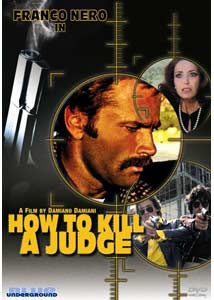
Netflix review #21: How to Kill a Judge
Thankfully, DVD companies like Blue Underground are out there to release any number of lesser known and cult classics that otherwise are near impossible to find. Trying to catch up with Nero's movies, BU has been more than helpful with my latest movie being 1974's How to Kill a Judge. I was expecting more of an action movie going in, but director Damiano Damiani's mystery thriller was still a solid effort.
Nero stars as Giacomo Solaris, an Italian movie director, who has just released his latest effort. It's causing quite a stir as fans flock to see the film that details the somewhat dubious past of an Italian judge, Alberto Traini (Marco Guglielmi) including one major controversy where witnesses ended up dead, protocol was ignored and a major criminal was let out of prison halfway through his sentence. Solaris' movie ends in a bang quite literally as the judge is shot for his past transgressions. Traini actually laughs off the movie even though everyone around him, including his wife Antonia (Francoise Fabian), wants to take him to court for slander.
The situation gets out of hand when Traini is murdered in an empty park one morning with no witnesses to see how it happened or who did it. Solaris comes under fire for having incited the murder with his movie, now even more successful in theatres, but the director can't help but think, is he next as more bodies start to pile up? Everyone from the local mafia bosses to corrupt politicians become suspects, but there's no clear suspect. All of them had a motive, but who had the guts to go through with it?
As I wrote before, there wasn't much action in this movie, which is fine with me, just don't go in looking for a shoot 'em up like so many other Nero movies, action and western. It's really a murder mystery as Solaris, feeling at least partially guilty and trying to clear his name, goes into detective mode to find the judge's real killer. There's too many twists and turns following the killing to even mention here, and besides I'm not sure I even know what was going on at all times. The last 15 minutes delivers a pretty good twist with the reveal of the murderer, which I sort of saw coming, but I thought all the characters were guilty at some point.
With little to no action, the movie's success hinges on the story then which can be confusing. What stood out for me was the dialogue. It's quick, snappy and even provides a laugh or two. One exchange stands out as Traini introduces Solaris to a young actress who's been in two westerns. Traini snaps back "Oh, he doesn't do westerns," a nice little good-hearted dig at Nero and the spaghetti westerns that made him a star. A great physical actor and presence, Nero's conversations with Vincenzo Terrasini (Renzo Palmer), his mafia connection, and Commisario Zamagna (Gianni Zavota) help propel the movie forward when it might have gotten bogged down in all the suspects and conspiracy theories that develop.
The Blue Underground DVD is a bit pricey, but like they're other products, it's a good package. The movie is shown in widescreen presentation, the Italian city shooting stands out as very strong, with the option to watch the movie in its original Italian audio with English subtitles or in a dubbed English version. Special features include 'The Damiani/Nero Connection,' a 15-minute featurette with interviews with Nero and Damiani, and then the trailer in both English and Italian. The interviews just point out why I like Nero especially, he loves movies and loves talking about them. With so many DVDs released with no special features, it's always a treat to see DVDs like this, even if it's just an average movie on the whole.
How to Kill a Judge (1974): ** 1/2 /****
Tuesday, June 9, 2009
The Sugarland Express
Going back to Duel and continuing here, it's obvious Spielberg had talent right away behind the camera. Sure, he refined that talent over the years as he became one of the most bankable directors of all time, but even before he was well known he knew how to shoot a movie. His debut tells the true story of a young couple in Texas trying to get their 2-year old son back after he's been put into foster care. Fresh out of jail herself, Lou Jean Poplin (Goldie Hawn) goes to visit her husband, Clovis Michael Poplin (William Atherton), who's also serving a jail sentence. Lou Jean convinces him to escape so they can work together to get their son back.
It's not long though before trouble arises. At a routine traffic stop, Lou Jean freaks out and tries to escape, starting a car chase that ends with the couple kidnapping a young highway patrol officer, Patrolman Maxwell Side (Michael Sacks). They tell him all they want to do is get to Sugarland, Texas and get their boy back, but nothing goes smoothly, and soon enough a convoy of police cars led by Captain Harlan Tanner (Ben Johnson) is on their tail waiting to make a move.
Going into the movie, I knew the basic storyline, but I had a different movie in mind. The DVD cover makes the movie seem more like a light-hearted romp of a road trip with a young Hawn taking up much of the space. It's really anything but that. There's a darkness to the story I was not expecting that still, fits appropriately. As the Poplins drive closer to Sugarland to get their boy back, the "chase" becomes a media event. Newstrucks and field reporters join in the convoy, and fans begin to appear along the road to root them on in their efforts.
It was late in the movie when Lou Jean, Clovis and Maxwell drive into a town where they're met by hundreds of adoring fans that something clicked for me. I've never read anything to confirm this, but Spielberg must have been influenced by Billy Wilder's Ace in the Hole with his debut here. Both films don't paint the main characters as true villains or good guys, but instead put that on the audience, the people who stop and slow down at a car accident for just one example. The movie serves as much of a condemnation of the American people and our fascination with crooks, criminals, and car chases as it does a condemnation of the Poplins for being lousy parents.
In Hawn as the lead, Spielberg had a rising star who gets to show off her legitimate acting chops, not just being cute, blonde and giggily as she was on Laugh-In. We don't know much about her or Clovis' personal background so it's hard to judge the character, but as a mother who just wants her son back, she gives a strong dramatic performance. She does want custody of her son, but she's still a young woman. Lou Jean gets sidetracked at all the attention and seems to momentarily forget why she's even getting that attention. As her husband, Atherton is somewhat more realistic, knowing that as is their situation cannot end as smoothy as they plan.
Sacks, who was only in a handful of movies in his career, is the third member of the trio in the kidnapped patrol car. He's conflicted from the start, trying to convince the Poplins to turn themselves in, but like Lou Jean this adoration catches him off guard and he begins to see their side too. Call it Stockholm Syndrome I guess, but when trouble arises he knows their plan cannot succeed. In another strong supporting performance, Johnson is nicely cast as a weary patrol captain leading the chase. He wants to help the Joplins, he legitimately does, but all the hoopla and circus-like atmosphere around the pursuit isn't helping his effort.
All that said, the movie doesn't quite know what it is. Is it a straight drama or is it an action comedy? Parts are funny poking fun at the idiocy of the situation. At one point, Lou Jean has to go to the bathroom so the whole convoy, squadrons of police cars too, pull to the side of the road while a port-a-potty is brought in. But then other parts, with car chases and even a chaotic gun battle in a used car lot are too over the top and really, uncalled for. The ending works on some levels, if the whole movie had been played seriously it would fit perfectly. But in general, there's not one tone that Spielberg takes, and because of it the movie is taken down a notch overall.
If you'd like to see the movie, a Youtube user was kind enough to post it all, starting here with Part I. Here's the trailer if you'd rather rent or buy it and you just want a feel for the movie. Looking at the movie as a whole, it's a good start for Spielberg as a director. Flaws aside, he tells the story well, showing both sides of the coin and letting your feelings fall where they may, rooting for the Joplins or for Harlan and his patrolmen. It's a good sign of the things that were still to come.
Sunday, June 7, 2009
The Last Picture Show
In the typical sense, Picture Show doesn't have a plot, or at least a straightforward, linear plot. Character storylines are laid out and then intertwined as we learn more about them and their exchanges, interactions and relationships. It's three main characters that carry the bulk of the story, three Texas teenagers in their senior year of high school in the tiny town of Anarene, population 1,131 in 1951. First, there's Sonny (Timothy Bottoms), kind of a quiet kid who's an athlete but not the star, who's popular but not the most popular. Next is his friend Duane (Jeff Bridges), the designated 'cool guy' in town. He's the star athlete and he's dating the prettiest girl in town, Jacy (Cybill Shepherd). Jacy is the ideal girl, or so it seems, the one all the guys want to be with, and of course, she knows this and drives everyone wild.
Almost going through the motions of senior year, Sonny starts to have an affair with Ruth Popper (Cloris Leachman), the basketball/football coach's wife, a plain woman who feels completely ignored by the world. Meanwhile, Duane and Jacy's relationship starts to strain thanks in great part to her manipulation of anyone and everyone around her. At it's most basic, that's the movie but there's so much more here. My summary doesn't do it justice. Bigger picture, it's one of the best movies to ever deal with growing up. Sonny, Duane and Jacy are all trying to figure out who and what they are, going about it in completely different ways. It's never easy and often you end up with your heart broken, something Bogdanovich never shies away from showing.
Made in the early 70s as the general tone of movies started to shift, Picture Show is a movie that feels like a classic Hollywood film but with a 70s message of a story set in 1951-52 Texas, if that makes sense. It's heavy on sex but never gratuitiously, some scenes are just awkward to watch not because it's handled poorly, but because that's what the characters are going through. Because of that, parts of the movie are heartbreaking. In his novel, McMurtry truly brought this cast of characters to life, something Bogdanovich did here. None of them are perfect, far from it, but for the most part I cared about these characters, especially Sonny.
What helps pull this off is the casting with mostly relative newcomers in the leads. How Bottoms wasn't nominated for an Oscar for his part escapes me. Having made just one other movie, the 20-year old actor delivers a believable, always moving performance of a Texas teenager trying to figure out who he is and where he belongs. I guess going up against The Godfather had something to do with that lack of nomination. Earning a nom for his supporting part, Bridges is a good counter to Bottoms' Sonny. Duane isn't the easiest character to like, but their friendship is a real one. And making her screen debut, Shepherd is sexy and smart as Jacy, a young woman who knows what kind of power she can have over people, just not how to use it all the time.
Bringing the movie up a notch from really good to great is the cast behind the three young leads. Leachman won the best supporting actress Oscar, and deservedly so. The female parts in general are across the board strong. Ellen Burstyn as Jacy's mother Lois is dead on, a preview of what her daughter could become 15 or 20 years later. Lois is stuck in a life where she's bored, looking for almost any sort of excitement. Part of her wants to see Jacy go through the same thing, part of her wants to change. Eileen Brennan is Genevieve, a waitress in the town diner who becomes a surrogate mother of sorts for Sonny.
Right alongside Sonny though, the best role here is from Ben Johnson, and yes, I'm biased because the real-life cowboy is one of my all-time favorite actors. Like Leachman, Johnson was nominated and won an Oscar for his performance, here as Sam the Lion, the owner of the pool hall, the diner and the movie house. He's getting up there in years and misses the good old days. It's a smaller part, maybe a handful of scenes, but one that's not easily forgotten. The DVD special features talked about how Johnson hated dialogue, but two of his most memorable parts are remembered for just that. If you ask me, he won the Oscar because of this scene. The other's in Bite The Bullet, which I reviewed a few months back. Just another great part for a very underrated actor.
Directing only his second movie, Bogdanovich leaves his mark all over the movie. Shooting in black and white at the recommendation of Orson Welles, Bogdanovich made the right choice. There's a washed-out, blank feel to the on-location shooting in Archer City, Texas, here's the opening. Another choice, to not use a soundtrack other than songs playing in the background, keeps the movie flowing like you're there with the characters, no overbearing score to distract you from what's on the screen. Bogdanovich has a touch with the camera, shooting almost as a documentary filmmaker in just his second film.
The DVD is an oddity for me after far too many reviews of discs with the movie and a trailer and nothing else. Filmed in black and white, a perfect choice for the story, the widescreen presentation looks great. Special features include a 12-minute interview with Bogdanovich, a 64-minute making of documentary, a theatrical re-release featurette running about 6 minutes, and the original trailer. I can't build this movie up enough, it's as moving and effective as all films should be.
The Last Picture Show (1971): ****/****
Thursday, June 4, 2009
Valdez is Coming!
Sorry, couldn't resist myself with the spaghetti western title. In the second half of his career, Burt Lancaster, like many aging stars, turned to the western for movie roles. Some, like 1966's The Professionals is highly regarded and respected by fans, but it was in the 70s that Lancaster made a quasi-trilogy of revisionist westerns that were so common at the times. All done in a 2-year span, Lancaster made three movies that tried to show the wild west wasn't so glamorous, instead showing it as it really was.
First, came Lawman, followed by Valdez is Coming, and wraps up with Ulzana's Raid, my favorite of the three. I'd seen the bookends, but finally got around to seeing Valdez is Coming this week. To be fair, there's no common link to these three movies, no recurring character or anything of that sort. But in tone and message, they're very similar. The west in the last half of the 19th Century was a nasty place. People looked out for No. 1 first, second and third before helping others out. It was a tough life that often ended violently and bloody. So in that sense, these three movies serve as a trilogy.
Bob Valdez (Lancaster) is a Mexican sheriff in the little town of Lanoria. No one pays him much mind as he keeps tabs on the "Mexican part of town." But when trying to bring in a suspect, a deserter from the 10th Cavalry, the Buffalo Soldiers, Valdez is forced to kill him, leaving an Apache widow behind. Seeing she's left with nothing to survive on, the kindly constable tries to raise money to help her. A town council of sorts say they'll put up $100 for her if cattle and land owner Frank Tanner (Jon Cypher, great as the villainous rich land owner). Valdez goes to see Tanner, only to be humiliated. He's tied to a cross and set off into the desert. Pushed too far, Valdez goes after Tanner and his gunhands.
First off, the casting of Lancaster as a Mexican sheriff seems odd, but he was such a great actor, he makes it believable with a decent accent and a heavy tan/makeup. It sounds cliched, but Valdez is a man of a few words. When he talks, you'd better listen. Here's a great sample of some of the dialogue. The dialogue in general is a highlight of the movie, and coming from a novel by Elmore Leonard, it's no surprise. Westerns were perfect for just plain cool exchanges. One of my favorites here, Valdez is approached by El Segundo (Barton Heyman), Tanner's right hand man. Segundo asks, "Do you know how many you've killed?" Valdez: "11." Segundo: "So you can count?" Valdez: "You bet." It's so simple but perfectly effective.
Filmed in Almeria with several familiar locations from spaghetti westerns, 'Valdez' has several touches of 1970s westerns. The violence for one thing, utilizes a fair share of squibs a la The Wild Bunch, but it's never gratuitiously graphic. There's some language, but it always fits and never seems forced in for the sake of swearing. And with the violence, much is saved until the last 30 minutes or so when Valdez goes up against Tanner and his men. Here's an example, Valdez picking off riders with his Sharps buffalo rifle. The trailer too makes it look like an action-packed movie, but don't be confused. When it comes, the action is well-choreographed, but it's spread out evenly over the movie's 91 minutes.
Joining Lancaster in the cast is Susan Clark as Gay Erin, Tanner's fiance with a past. She becomes an unwilling participant in the cat and mouse game between Valdez and Tanner, but it's a strong part, especially when female characters in westerns could so often be left out of a movie. Frank Silvera makes the most out of a small part as Diego, an old friend of Valdez who feels conflicted between his loyalty to his friend and also to his family. And in just his second movie, he also starred in Lawman, Richard Jordan plays R.L. Davis, a young gunhand trying to prove himself to whoever will listen. There's an intensity to his part that Jordan brings, making a supporting character a very memorable one.
Valdez is Coming is a relatively straightforward look at the western. The thing that starts it all is so simple it almost makes the story hard to believe. But Valdez sees a wrong and tries to right it, not cause he wants to or is told to. He knows it is the right thing to do, and when pushed to his breaking point, he has no option left other than to respond with force.
The DVD is a good buy at under $10. Good if not great widescreen presentation, but it's a very watchable print of the movie. Special feature is just the trailer I linked to earlier. Western and Burt Lancaster fans should definitely enjoy this one. Give Valdez is Coming a shot!
Valdez is Coming (1971): ***/****
First, came Lawman, followed by Valdez is Coming, and wraps up with Ulzana's Raid, my favorite of the three. I'd seen the bookends, but finally got around to seeing Valdez is Coming this week. To be fair, there's no common link to these three movies, no recurring character or anything of that sort. But in tone and message, they're very similar. The west in the last half of the 19th Century was a nasty place. People looked out for No. 1 first, second and third before helping others out. It was a tough life that often ended violently and bloody. So in that sense, these three movies serve as a trilogy.
Bob Valdez (Lancaster) is a Mexican sheriff in the little town of Lanoria. No one pays him much mind as he keeps tabs on the "Mexican part of town." But when trying to bring in a suspect, a deserter from the 10th Cavalry, the Buffalo Soldiers, Valdez is forced to kill him, leaving an Apache widow behind. Seeing she's left with nothing to survive on, the kindly constable tries to raise money to help her. A town council of sorts say they'll put up $100 for her if cattle and land owner Frank Tanner (Jon Cypher, great as the villainous rich land owner). Valdez goes to see Tanner, only to be humiliated. He's tied to a cross and set off into the desert. Pushed too far, Valdez goes after Tanner and his gunhands.
First off, the casting of Lancaster as a Mexican sheriff seems odd, but he was such a great actor, he makes it believable with a decent accent and a heavy tan/makeup. It sounds cliched, but Valdez is a man of a few words. When he talks, you'd better listen. Here's a great sample of some of the dialogue. The dialogue in general is a highlight of the movie, and coming from a novel by Elmore Leonard, it's no surprise. Westerns were perfect for just plain cool exchanges. One of my favorites here, Valdez is approached by El Segundo (Barton Heyman), Tanner's right hand man. Segundo asks, "Do you know how many you've killed?" Valdez: "11." Segundo: "So you can count?" Valdez: "You bet." It's so simple but perfectly effective.
Filmed in Almeria with several familiar locations from spaghetti westerns, 'Valdez' has several touches of 1970s westerns. The violence for one thing, utilizes a fair share of squibs a la The Wild Bunch, but it's never gratuitiously graphic. There's some language, but it always fits and never seems forced in for the sake of swearing. And with the violence, much is saved until the last 30 minutes or so when Valdez goes up against Tanner and his men. Here's an example, Valdez picking off riders with his Sharps buffalo rifle. The trailer too makes it look like an action-packed movie, but don't be confused. When it comes, the action is well-choreographed, but it's spread out evenly over the movie's 91 minutes.
Joining Lancaster in the cast is Susan Clark as Gay Erin, Tanner's fiance with a past. She becomes an unwilling participant in the cat and mouse game between Valdez and Tanner, but it's a strong part, especially when female characters in westerns could so often be left out of a movie. Frank Silvera makes the most out of a small part as Diego, an old friend of Valdez who feels conflicted between his loyalty to his friend and also to his family. And in just his second movie, he also starred in Lawman, Richard Jordan plays R.L. Davis, a young gunhand trying to prove himself to whoever will listen. There's an intensity to his part that Jordan brings, making a supporting character a very memorable one.
Valdez is Coming is a relatively straightforward look at the western. The thing that starts it all is so simple it almost makes the story hard to believe. But Valdez sees a wrong and tries to right it, not cause he wants to or is told to. He knows it is the right thing to do, and when pushed to his breaking point, he has no option left other than to respond with force.
The DVD is a good buy at under $10. Good if not great widescreen presentation, but it's a very watchable print of the movie. Special feature is just the trailer I linked to earlier. Western and Burt Lancaster fans should definitely enjoy this one. Give Valdez is Coming a shot!
Valdez is Coming (1971): ***/****
Labels:
1970s,
Burt Lancaster,
Frank Silvera,
Richard Jordan,
westerns
Monday, June 1, 2009
Badge 373
In the vein of The French Connection, Dirty Harry, and Bullitt comes 1973's Badge 373. This was the 1970s when movie audiences liked their cops treading that fine line between raging psychopaths and honorable officers trying to protect citizens. The characters weren't always easy to like, but that's the fun of the anti-hero.
Starring as Eddie Ryan, the real-life inspiration for The French Connection, Robert Duvall gets to really dig into his part. One of my favorite actors, Duvall has always been a criminally underrated actor to me. He wasn't a crazy, over the top method actor like Dustin Hoffman, but he was certainly capable of pulling off roles that required some dark, very bleak background. And coming just a year since the monumental success of The Godfather where he played Tom Hagen, Duvall was riding high in 1973.
Duvall's performance can't help but remind of Gene Hackman's Academy Award winning performance in The French Connection. As Ryan, he's been warped by what he's seen on the streets a vice cop. Ryan is racist, completely intolerant of Hispanics especially, and isn't afraid to bend the rules if it will help close a case or put a crook behind bars. He's a tough cop who's capable of quick outbursts of violence, but it's these feelings that stop him from getting close to anyone, even to Maureen (Verna Bloom), a waitress he dates who has a similar background. Her past isn't perfect, but she just wants to be happy.
As far as Badge 373's plot, there's nothing you haven't seen before in other police procedural movies and shows. Ryan is suspended when an investigation is started as to whether he killed a suspect, a Puerto Rican gangster, who fell off a roof during an interrogation. During his suspension, he takes a job as a bartender where he meets Maureen. One night, his old partner, Gigi Caputo, comes in and catches up with him, but the next morning Eddie gets a call. Gigi's dead, his throat cut from ear to ear. So starts a vengeance trail as Ryan, without badge or gun, investigates what his possibly dirty partner was into.
Politically correct this movie is not, but that's what makes the movies from the 70s so good. No one was interested in appealing to people's sensitive sides. Stories were told, and if you were insulted, tough luck. The bad guys here are Puerto Ricans looking to free their country with a bloody revolution. Ryan begins to find out Gigi was following a huge shipment of machine guns meant to start the fighting. The always slimy Henry Darrow stars as Sweet William, the Hispanic guns dealer Ryan's come across in the past. I have yet to see Darrow in a movie or TV show where he wasn't the villain, and he doesn't disappoint here as Duvall's adversary. Also in the cast is the real Eddie Egan as Lt. Scanlon, Ryan's superior who wants to help the veteran cop out even at a hefty cost.
As Ryan investigates his partner's death, the story drags at points, but it's never boring. Instead of a car vs. L-train chase, we get Duvall taking over a bus and trying to escape from a mob of Puerto Rican gangsters in a cool chase scene through New York. The violence is quick and sometimes shocking with squibs exploding left and right. The language is the same way with plenty of good old cussing and enough ethnic slurs to make just about anybody wince. But that's the whole feel of the movie, it's a story of a cop looking for revenge that goes for realism instead of big, extravagant action.
Duvall is the reason to watch Badge 373. Watching him go from quiet scenes with Bloom to rage-filled outbursts against gangsters is a treat, just like it was watching Hackman, Eastwood and McQueen do it in their movies. There's nothing groundbreaking here, but it's worth a watch, especially if you're a fan of gritty 1970s cop thrillers.
Starring as Eddie Ryan, the real-life inspiration for The French Connection, Robert Duvall gets to really dig into his part. One of my favorite actors, Duvall has always been a criminally underrated actor to me. He wasn't a crazy, over the top method actor like Dustin Hoffman, but he was certainly capable of pulling off roles that required some dark, very bleak background. And coming just a year since the monumental success of The Godfather where he played Tom Hagen, Duvall was riding high in 1973.
Duvall's performance can't help but remind of Gene Hackman's Academy Award winning performance in The French Connection. As Ryan, he's been warped by what he's seen on the streets a vice cop. Ryan is racist, completely intolerant of Hispanics especially, and isn't afraid to bend the rules if it will help close a case or put a crook behind bars. He's a tough cop who's capable of quick outbursts of violence, but it's these feelings that stop him from getting close to anyone, even to Maureen (Verna Bloom), a waitress he dates who has a similar background. Her past isn't perfect, but she just wants to be happy.
As far as Badge 373's plot, there's nothing you haven't seen before in other police procedural movies and shows. Ryan is suspended when an investigation is started as to whether he killed a suspect, a Puerto Rican gangster, who fell off a roof during an interrogation. During his suspension, he takes a job as a bartender where he meets Maureen. One night, his old partner, Gigi Caputo, comes in and catches up with him, but the next morning Eddie gets a call. Gigi's dead, his throat cut from ear to ear. So starts a vengeance trail as Ryan, without badge or gun, investigates what his possibly dirty partner was into.
Politically correct this movie is not, but that's what makes the movies from the 70s so good. No one was interested in appealing to people's sensitive sides. Stories were told, and if you were insulted, tough luck. The bad guys here are Puerto Ricans looking to free their country with a bloody revolution. Ryan begins to find out Gigi was following a huge shipment of machine guns meant to start the fighting. The always slimy Henry Darrow stars as Sweet William, the Hispanic guns dealer Ryan's come across in the past. I have yet to see Darrow in a movie or TV show where he wasn't the villain, and he doesn't disappoint here as Duvall's adversary. Also in the cast is the real Eddie Egan as Lt. Scanlon, Ryan's superior who wants to help the veteran cop out even at a hefty cost.
As Ryan investigates his partner's death, the story drags at points, but it's never boring. Instead of a car vs. L-train chase, we get Duvall taking over a bus and trying to escape from a mob of Puerto Rican gangsters in a cool chase scene through New York. The violence is quick and sometimes shocking with squibs exploding left and right. The language is the same way with plenty of good old cussing and enough ethnic slurs to make just about anybody wince. But that's the whole feel of the movie, it's a story of a cop looking for revenge that goes for realism instead of big, extravagant action.
Duvall is the reason to watch Badge 373. Watching him go from quiet scenes with Bloom to rage-filled outbursts against gangsters is a treat, just like it was watching Hackman, Eastwood and McQueen do it in their movies. There's nothing groundbreaking here, but it's worth a watch, especially if you're a fan of gritty 1970s cop thrillers.
The Living Daylights
Fans of James Bond seem to be pretty mixed when it comes to feelings about the Roger Moore era. I was surprised as anyone, but I ended up liking most of the Moore Bonds. They're not classics other than The Spy Who Loved Me, but they're very entertaining if at times too campy. I moved on this week to the brief two-film Timothy Dalton stint as everyone's favorite 00 agent with 1987's The Living Daylights.
Just like the movies, I'm working my way through Ian Fleming's Bond books and short stories. And with just one movie, I can say Dalton is closest of all the Bond actors to what Fleming originally intended with the character. Lost amidst all the cool gadgets, gorgeous women and beautiful locations is that James Bond is a cold character, an agent who will stop at nothing to get the job done no matter who or what gets in his way. All the actors, Connery, Lazenby, Moore, Brosnan and most recently Craig, put their own spin on 007. But Dalton in his first movie gets Bond back to his roots, an efficient, effective spy who can be ruthless in his methods at times.
The Living Daylights across the board tries to get back to the basics. There's no arch-villain trying to take over the world here with some harebrained scheme to ransom off the Earth with nuclear bombs. Instead, Bond is helping a Russian general, Koskov (Jeroen Krabbe) defect or so it seems at first. The KGB kidnaps the General only after he reveals a Russian plan to start knocking off MI6's agents. But it all seems too easy and the only trail leads to a Russian cello player, Kara Milovy (Maryam d'Abo). Bond begins to unravel a plan that includes diamonds, opium smuggling, a multimillion arms deal, and even the Mujahideen, the Afghan freedom fighters.
After some initial confusion with backstabs and double-crosses, TLD finds it's groove really quickly. With a new actor in the lead role, the opening pre-credit sequence is always interesting to see. This is one of the best as three MI6 agents go through a training exercise in Gibraltar. We don't know which one is Bond until a fourth agent appears and starts killing the others. Check it out here courtesy of what else? Youtube. Without the general overdone jokey feel of some of the Moore movies, TLD gets to focus on what most Bond fans want to see, the action and story. The last 40 minutes is basically one long extended sequence with a raging battle on an airstrip as the Mujahideen, Russian soldiers, and Bond duke it out for a plane filled with bags of raw opium and a bomb.
Here's the finale of the plane fight as Bond fights with henchmen Necros (Andreas Wisniewski) at the back end of a cargo plane. It's got some of the best stuntwork I've yet to see in the Bond series. I can't say enough about the action in general. Directing his fourth movie from the series, John Glen clearly knows what he's doing by now with this the best by far of the quartet.
Behind Dalton, the supporting cast might lack some of the name recognition of the other movies, but it's a more than solid group. d'Abo is cute as the Bond girl here, but it's not a particularly memorable Bond girl. Joining Krabbe and Wisniewski in the villain department, Joe Don Baker gets to ham it up as Brad Whittaker, an ex-West Point cadet booted for cheating now making money as a worldwide arms dealer. Fans of the Brosnan movies should recognize him several years before he played CIA agent Jack Wade. John Rhys-Davies has a brief part as Pushkin, a Russian general being played by all sides. It's not much, but Rhys-Davies is the type of actor who gives a movie credibility just by being there. Then there's Art Malik as Kamran Shah, a Mujahideen fighter teaming up with Bond. In the years since 9/11, it's still odd to see the Afghan resistance portrayed the way they are, especially knowing how history developed and changed as the Afghans went from allies to enemies.
Going in I wasn't sure what to expect from the Dalton opener because I usually heard negative reviews, but I got wrapped up in The Living Daylights right away. I love how Dalton leaves his own mark on Bond, not settling for a rehashed version of Connery or Moore, and it's a Bond movie at least remotely based in reality. Here's the trailer and the title song by A-Ha, not one of the best themes but not bad either. Composer John Barry doesn't disappoint either, turning in another memorable score with all the recognizable music with some new twists.
Just like the movies, I'm working my way through Ian Fleming's Bond books and short stories. And with just one movie, I can say Dalton is closest of all the Bond actors to what Fleming originally intended with the character. Lost amidst all the cool gadgets, gorgeous women and beautiful locations is that James Bond is a cold character, an agent who will stop at nothing to get the job done no matter who or what gets in his way. All the actors, Connery, Lazenby, Moore, Brosnan and most recently Craig, put their own spin on 007. But Dalton in his first movie gets Bond back to his roots, an efficient, effective spy who can be ruthless in his methods at times.
The Living Daylights across the board tries to get back to the basics. There's no arch-villain trying to take over the world here with some harebrained scheme to ransom off the Earth with nuclear bombs. Instead, Bond is helping a Russian general, Koskov (Jeroen Krabbe) defect or so it seems at first. The KGB kidnaps the General only after he reveals a Russian plan to start knocking off MI6's agents. But it all seems too easy and the only trail leads to a Russian cello player, Kara Milovy (Maryam d'Abo). Bond begins to unravel a plan that includes diamonds, opium smuggling, a multimillion arms deal, and even the Mujahideen, the Afghan freedom fighters.
After some initial confusion with backstabs and double-crosses, TLD finds it's groove really quickly. With a new actor in the lead role, the opening pre-credit sequence is always interesting to see. This is one of the best as three MI6 agents go through a training exercise in Gibraltar. We don't know which one is Bond until a fourth agent appears and starts killing the others. Check it out here courtesy of what else? Youtube. Without the general overdone jokey feel of some of the Moore movies, TLD gets to focus on what most Bond fans want to see, the action and story. The last 40 minutes is basically one long extended sequence with a raging battle on an airstrip as the Mujahideen, Russian soldiers, and Bond duke it out for a plane filled with bags of raw opium and a bomb.
Here's the finale of the plane fight as Bond fights with henchmen Necros (Andreas Wisniewski) at the back end of a cargo plane. It's got some of the best stuntwork I've yet to see in the Bond series. I can't say enough about the action in general. Directing his fourth movie from the series, John Glen clearly knows what he's doing by now with this the best by far of the quartet.
Behind Dalton, the supporting cast might lack some of the name recognition of the other movies, but it's a more than solid group. d'Abo is cute as the Bond girl here, but it's not a particularly memorable Bond girl. Joining Krabbe and Wisniewski in the villain department, Joe Don Baker gets to ham it up as Brad Whittaker, an ex-West Point cadet booted for cheating now making money as a worldwide arms dealer. Fans of the Brosnan movies should recognize him several years before he played CIA agent Jack Wade. John Rhys-Davies has a brief part as Pushkin, a Russian general being played by all sides. It's not much, but Rhys-Davies is the type of actor who gives a movie credibility just by being there. Then there's Art Malik as Kamran Shah, a Mujahideen fighter teaming up with Bond. In the years since 9/11, it's still odd to see the Afghan resistance portrayed the way they are, especially knowing how history developed and changed as the Afghans went from allies to enemies.
Going in I wasn't sure what to expect from the Dalton opener because I usually heard negative reviews, but I got wrapped up in The Living Daylights right away. I love how Dalton leaves his own mark on Bond, not settling for a rehashed version of Connery or Moore, and it's a Bond movie at least remotely based in reality. Here's the trailer and the title song by A-Ha, not one of the best themes but not bad either. Composer John Barry doesn't disappoint either, turning in another memorable score with all the recognizable music with some new twists.
Subscribe to:
Posts (Atom)