The Sons of Katie Elder

The Sons of Katie Elder
"First, we reunite, then find Ma and Pa's killer...then read some reviews."
Showing posts with label Royal Dano. Show all posts

Tuesday, January 19, 2016

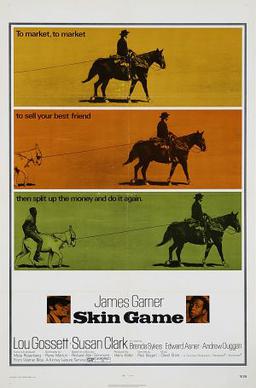
Skin Game

You know what isn't particularly funny? There's no way this introduction isn't in poor taste but...slavery! In recent years, even movies like Django Unchained that were fan favorites and critically loved caused a stir because of its slavery subject matter. So movies like Django, 12 Years a Slave, miniseries like Roots, the subject matter is played straight. That is NOT the case with 1971's Skin Game, a pre-Civil War story with comedy and drama rolled into one.

It's 1857 in Missouri when two men ride into a small town. Quincy (James Garner) is a plantation owner with some money problems, meaning he has to sell one of his slaves, Jason (Lou Gossett Jr.). He gets several hundred dollars for him and they part ways, Quincy onto the next town with Jason waiting to travel with his new owner. Well, that's what you'd think at least, what the supposed-plantation owner and his slave want you to think. In reality, they're con men, going from town-to-town, Quincy "selling" Jason to one plantation/land owner after another and getting out of town while Jason manages to escape in one way or another. The plan has worked well for quite a while now with a hefty bank account waiting for them back in Chicago when they decide they've had enough. Jason, he's had enough as he's the one taking more risk. Quincy, he'd like to travel to a couple more towns and pull off their successful con. What could possibly go wrong?

I've long been aware of this 1971 comedy-drama but never caught up with it. Thank you, Turner Classic Movies! It was worth the wait. From director Paul Bogart -- and an uncredited Gordon Douglas, I imagine there's a good story there -- it takes a touchy, potentially explosive subject matter in slavery and manages to tread the fine line between funny, at-times dramatic and just in poor taste. Come on...slavery. There's just nothing funny in that department. 'Game' doesn't minimize it or make light of it, instead attacking one of the most horrific periods in American history from the side. Considering it that way, it's actually pretty smart. Two con men looking to make some serious cash out of the sale of fellow human beings, now that is creative and certainly unique.

Playing on an oddball variety of a familiar storytelling device, Garner and Gossett have a ton of fun with their odd couple, buddy relationship. We don't learn too much about them, only that they've been con men for several years now piling up the cash with their risky play in each new town. We do learn that Jason was born a free man in New Jersey and chooses to do this, an important detail in my opinion. In a brief, quickly-cut flashback, we also see how the duo met, a fun aside and a necessary one that shows and tells a lot about these two. Sure, there are differences between the two men, but they're cut from the same cloth. The chemistry between Garner and Gossett is not in question with plenty of laughs and some great dialogue flying back and forth throughout the 102-minute running time. A great buddy combo to lead the way.

Also look for Susan Clark in a fun part as Ginger, a fellow con-man...um, con woman who crosses paths with Quincy and Jason at some inopportune moments. Brenda Sykes plays Naomi, a slave who Jason meets and wants to buy her freedom. Ed Asner is perfectly slimy as Plunkett, a slave trader with brutal tactics and no regard for his "merchandise." As for assorted slave and plantation owners, look for Andrew Duggan, Parley Baer, George Tyne, J. Pat O'Malley, and Henry Jones. Also watch for a quick appearance by Royal Dano as violent abolitionist John Brown.

There are some portions in the final act that run a tad sluggish with a story that has some pretty decent surprises. It tends to drift at times, but for the most part, this is an interesting story. I'm mostly recommending it though for the unique, inventive story and the spot-on, perfect chemistry between James Garner and Lou Gossett Jr. This isn't a movie that breaks any new ground, but it deserves more of a reputation than it currently does. Worth a watch for a creative story, unique setting in the pre-Civil War south and a very solid cast. Give it a watch!

Skin Game (1971): ***/****

Thursday, April 9, 2015

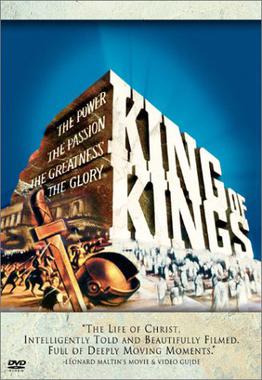
King of Kings

Is there a more daunting task as an actor to play a man millions of people around the world believe to be the Son of God? Sure, any portrayal of a real-life person has to be intimidating, but playing Jesus? That's gotta be on a whole other level. As I learned from the Internet, this movie was the first American film to show an actor's face portraying Jesus Christ. Here it is, a childhood favorite and one I revisited this past Easter weekend, 1961's King of Kings.

This is the story of Jesus (Jeffrey Hunter), a man who grew up in tumultuous times in Judea as Roman occupiers keep the Jewish/Hebrew people oppressed under their thumb. Revolts and rebellions rise up from year to year as Judea seeks its freedom, its independence to get away from the control of the Roman empire. Into this world, Jesus grows up into manhood ready to do his life's calling. Having worked his entire life and living in the Galilean town of Nazareth as a carpenter, Jesus in his late 20's ventures out into the world to embrace his calling as the messiah, the son of God who will teach the world how to live. It is a message that preaches peace but will no doubt send ripples throughout the Roman empire. As Jesus travels around the country with a small group of disciples, his name, his message and his words begin to spread. His followers increase, but so does the danger around him as many want nothing more than to kill him before he becomes too dangerous.

A plot description for a film about the life of Jesus Christ is pretty unnecessary, but I had to lay things out at least a little bit. In the age of the historical film epic, this entry from director Nicholas Ray has always been one of my favorites. I grew up watching it with my Mom every spring, and even years later, it holds up. If anything, I liked it more as a 29-year old viewer as opposed to a 10-year old kid. A whole lot of history is covered in 168 minutes but things never feel rushed. 'King' was filmed on-location in Spain with countless lavish sets and natural backdrops adding an incredibly authentic feel to the proceedings. The TCM print shown on Easter looked PHENOMENAL. Just a stunningly good-looking visual movie. The musical score from composer Miklos Rozsa is pretty perfect too, big and booming mixed in with softer, quieter and just as effective emotional moments. Listen to a sample HERE.

What struck me most in this 1961 epic about Jesus is that...well, it isn't just about Jesus. Ray and writer Philip Yordan use Jesus, his life and his teachings to tell a story about the times this man lived his life. Yes, the focus is on him, but it isn't exclusively focused on him. The casting is very solid with Jeffrey Hunter playing Jesus. Up there with The Searchers as his most famous, respected and recognizable role, Hunter does an excellent job here. It isn't the most human part, but that's not his fault. Hunter is sincere and likable and genuine with a script that keys in on Jesus' teachings more than getting to know the man as a person, as an individual. What works so well is the quieter moments and the impact we see as viewers that this man has on those around him, both the believers and the non-believers. Hunter never became the huge star he could have before his tragic death in 1969, but performances like this show his acting skill.

Four years later, a similarly-themed Jesus epic -- The Greatest Story Ever Told -- would set the bar for ridiculously overdone all-star casts. That ain't the case here. Ray fills out some major roles with recognizable faces and some stars, but this is even't close to being considered an all-star cast. Oh, and that's a good thing. The best supporting part goes to Ron Randell as Lucius, a Roman officer in the garrison at Jerusalem tasked with figuring out if Jesus is a threat to be dealt with. A human, questioning part, and a really good one. Next up, Irish actress Siobhan McKenna as Mary, Jesus' mother, making the character memorable with just a few quick scenes. And then there's the most recognizable face, Robert Ryan getting a meaty part as John the Baptist, a prophet more fiery than Jesus but who preaches the same peaceful message, one predicting the coming of the Son of God.

Who else to look for? If you're familiar with Jesus and the gospels, you know the names. Also in the cast are Pontius Pilate (Hurd Hatfield), Roman governor of Judea, Claudia (Viveca Lindfors), Pilate's more open-minded wife, Herod Antipas (Frank Thring), the Judean governor, his wife, Herodias (Rita Gam), and his stepdaughter, Salome (Brigid Bazlen), disciples Peter (Royal Dano) and Judas (Rip Torn), Barabbas (Harry Guardino), and Mary Magdalene (Carmen Sevilla).

Working consistently throughout the 1950s, director Ray carved a niche for himself as a director of smaller scale human dramas. A biblical epic about Jesus? Not his usual cup of tea. For all the immense scale though, it is the softer, quieter scenes that work. Quick montages of Jesus' miracles set to Rozsa's score are beautiful and effective. The sermon on the mount boasts all sorts of massive scale but is effective because of the dialogue and Hunter's acting. Certain events are glossed over more than others with a bigger focus late on the Passion and Resurrection. Obviously not nearly as graphic as the Passion of the Christ, it remains a moving finale.

King of Kings works because it doesn't try to be gigantically epic. It is content to tell a big story -- maybe history's BIGGEST story -- and to tell it well. Well worth it though, definitely worth checking out. Also listen for Ray Bradbury's uncredited narration, Orson Welles reading said narration, and future familiar face from the spaghetti western genre, Aldo Sambrell, making his screen debut.

King of Kings (1961): ****/****

Thursday, September 11, 2014

Santiago

I can think of exactly one movie made about the Spanish-American War. Okay, there I go again lying. It's actually a miniseries, 1997's Rough Riders, that's pretty good if not so well known. Well, I can kinda add a second movie to the list although it involves the years leading up to the war before the U.S. officially got involved. Here we go with 1956's Santiago.

Riding through the swamps of Florida, Cash Adams (Alan Ladd) arrives in Tampa with wagons loaded with guns, ammunition and dynamite ready to close a deal and make some money for himself and his men. Not so fast though, Mr. Adams. The deal he cut with Cuban revolutionaries fighting the Spanish is okay, but now he has to get all his materiel to Cuba himself. Adams finds an old steamboat captain and Civil War veteran, Sidewheel Jones (Chill Wills), to transport his supplies but it's not that simple. On board the boat is another gunrunner, Clay Pike (Lloyd Nolan), who has cut a similar deal with the Cubans. Adams has a rivalry with Pike dating back 10-plus years and the voyage across the Gulf of Mexico will be anything but easy. Spanish ships are waiting to stop them, if the ship can even get there before Adams and Pike tear each other apart.

Airing recently on Turner Classic Movies, 'Santiago' is from director Gordon Douglas. Not necessarily a well-known name, Douglas still has quite a few really solid movies to his name including Rio Conchos, Chuka, In Like Flint, Up Periscope and Golf of the Seven Saints among others. He specialized in tough movies, action and western and war flicks full of tough guy actors doing tough guy stuff. Douglas didn't have a huge visual style or anything that truly set him apart from the rest, but he was a solid, workmanlike director, and I have very much enjoyed a lot of his movies. This one? It's pretty decent, ahead of its time in certain moments with its use of on-screen violence and unfortunately too familiar in other scenes. It doesn't rewrite the genre, but I enjoyed it, 94 minutes of exciting action with a pretty cool cast and a different background, the Cuban War of Independence. Spanish-American War still to come!

The best comparison I can make is the similarities here with Robert Aldrich's 1954 classic western Vera Cruz, one of the most influential westerns of all-time. Here with 'Santiago,' Alan Ladd and Lloyd Nolan channel Gary Cooper and Burt Lancaster, two rivals who are forced to work together to battle a common enemy. All the while, they know a showdown is looming. Ladd is pretty decent as Cash Adams, his backstory providing most of the interest. A cavalry officer fighting the Apaches, he was dishonorably discharged when a captive Apache chief escaped because one of his men got drunk on guard duty. And who was providing those Apaches with repeating rifles? Why Nolan's Clay Pike of course! The rivalry is a little tame, little lacking in energy, but it seems Adams and Pike are never too far away from throwing down and having it out. 

I wish there was more of that darker story material, and that becomes the issue. Yeah, it's a rivalry....but not really. Ladd's Adams is a good gunrunner (if there is such a thing), supplying materiel for the right side. Nolan's Pike doesn't care who gets the guns as long as he gets paid. And because that wasn't enough, we get a love interest with Rossana Podesta playing Dona Isabella, a beautiful Cuban revolutionary who works as the middleman for shipment of the guns. Who do you think she'll end up with?!? You won't need two guesses. There's also an adorable little Cuban boy who bonds with Adams, but you just know things aren't going to end well for the little stinker. At times, things are a tad too clean, a little slow-moving, but for the most part I was entertained throughout. Also, kudos to Ladd who in muggy Florida and Cuba manages to keep his tailored white shirts immaculate no matter what's going on. Now, THAT is talent.

Who else to look for? Wills is excellent, toning down his over the top act that could be a little hammy when overdone, Don Blackman playing Sam, his former slave and current right-hand man. Paul Fix is similarly very good as Trasker, Adams' loyal right-hand man with an interesting background that explain his loyalty. Some of the other tough guys on hand include Royal Dano, L.Q. Jones, and Frank DeKova. The movie is at its strongest when it leans on Ladd, Nolan and the familiar faces all around them. Romance? Motivations for independence? Meh, no thanks. The action and violence can be pretty startling -- even bloody -- and the finale especially is memorable. It even reminded me of the final battle in Major Dundee, a chaotic, quick-cut bloody mess where characters are dispatched without warning.

A decent movie that could have been better, but still worth a watch.

Santiago (1956): ** 1/2 /****

Saturday, April 26, 2014

The Undefeated

Considering the extreme and far-reaching effects the Civil War had on American history, it's odd there haven't been more movies about the most costly war in the United States' relatively young history. The western genre has done its fair share of quasi-Civil War movies, the war becoming a jumping off point for a shoot 'em up story. What to do once the war is over? Like Major Dundee and Vera Cruz, many went south into Mexico. We can add 1969's The Undefeated to that short list.

After four years of bloody fighting, the Civil War has come to a close, leaving both the North and South to figure out where to go forward. With some of his remaining soldiers, a former Union cavalry officer, Colonel John Henry Thomas (John Wayne), rounds up a herd of 3,000 wild horses with the intention of driving them south into Mexico where they'll sell them to Emperor Maximilian's forces. A former Confederate officer, Colonel James Langdon (Rock Hudson), who had outfitted his own regiment, is leaving his plantation behind, moving south to Mexico with his surviving men, along with their wives, children and family in hoping to start a new life. In turbulent times for both the U.S. and Mexico, these two groups' paths may cross, and with wounds from the war still fresh on both sides.

This portion of history has always fascinated me, especially in movies like this, Major Dundee and Vera Cruz. I grew up watching this John Wayne western, and in spite of its flaws, I've always been a fan. From frequent Wayne collaborator and director Andrew V. McLaglen, 'Undefeated' is a fun western with a very good, deep cast, authentic locations in and around Durango, Mexico (Dundee fans will appreciate some familiar spots), a memorable score from composer Hugo Montenegro (listen HERE, disregard the odd video choice), and in general an entertaining quality that lifts it up past the flaws. It plays like a lot of Wayne's later movies; easy to sit back and watch, some action and shootouts, some drama, some romance, and some laughs here and there. When westerns were changing so dramatically in the late 1960s and heading into the 1970s, it can be fun just to watch an old-fashioned western with good guys and bad guys. No more, no less.

In a pretty cool casting choice, Wayne goes toe to toe here with Rock Hudson. It's not the most obvious pairing, but it works, simple as that. Wayne is playing a variation on his archetypal cowboy part, the leader of a small, surviving group of volunteers that rode with him throughout the Civil War. Now, he's looking for some cash to start over with, hence the immense horse drive. Hudson's Langdon too is looking for a clean start, the horrors and severe losses of the war still fresh on his mind. They're two different men, but they also have many similarities. They're fighting men who stand by what's right, loyal to those who ride with them, and ultimately try to do what they should do, not what's easiest. Their scenes together are the high points of the story, an easygoing charm with just a little Union vs. Confederacy animosity lingering. Two parts I liked a lot.

Working with a big story and a whole lot of characters, there's a lot going on in 'Undefeated,' clocking in at 119 minutes. Both halves -- Union and Confederacy -- are interesting, but I liked Wayne's half more. His trail-worn, loyal riders include Ben Johnson as Short Grub, his right hand man, Harry Carey Jr., John Agar (his part was heavily cut, including his early death scene), Don Collier (a familiar face, often a stunt man in Wayne movies), Jerry Gatlin and Dub Taylor as McCartney, the cantankerous cook who's always looking to fight, a mangy cat, High Bred, at his side. NFL quarterback Roman Gabriel joins the cast too as Blue Boy, Thomas' adopted Cherokee son. With so many western regulars, there's an ease to these scenes that are just fun to watch. Also look briefly for small parts for Paul Fix, Royal Dano and Pedro Armendariz Jr.

With the kinda-sorta episodic story that amiably drifts along, half of the focus is on those Confederates. It's never boring, but it's also not as interesting as their Union counterparts. We meet Langdon's wife (Lee Meriwether), his buxom teenage daughter, Charlotte (Melissa Newman), and his widowed sister-in-law (Marian McCargo). His men include Bruce Cabot, NFL star Merlin Olsen, Jan-Michael Vincent, Robert Donner, Edward Faulkner and whiny Big John Hamilton. We get to see young, pretty Charlotte hold off Jan-Michael Vincent's Bubba Wilkes' advances (she like Blue Boy). We get to see worrying wife Lee Meriwether....well, look worried. Olsen's Little George hangs out with the kids, then fights the Union cavalry. There's plenty of familiar faces, some good parts, but it's simply not as interesting to watch. Not bad, just not as good as it could have been.

Certain portions of the episodic story drag, but some certainly stand out. The pre-credits sequence wraps up the Civil War in a quick Union attack on a Confederate position. Later, Wayne and Hudson must team up to hold off a bandit attack on the Confederate wagon train, a good, exciting sequence. My favorite though is a late battle between the Union riders and French cavalry, the horse herd used as a weapon and negotiating ploy with a Mexican officer (Tony Aguilar). I'm wavering here. It's not a great western -- maybe not even a good one -- but I'm always entertained watching it. John Wayne fans, western fans alike should like this one.

The Undefeated (1969): ***/****

Monday, March 25, 2013

Posse from Hell

Ah, the posse, where men can be men and.....do manly stuff? Ride horses, shoot guns, track bad guys, eat jerky and drink bad coffee around a fire out in the desert under the stars. Pretty cool, huh? Eh, probably not, but for a western nut like myself, I could get on board with that. Obviously it wasn't a pleasant experience -- tracking down the bad guys to bring them to justice -- but there's been countless westerns following the posse, but few have been better than 1961's Posse from Hell.

Four very dangerous, murdering convicts led by an outlaw named Crip (Vic Morrow) descend on a small, peaceful western town, wreaking havoc and leaving a handful of dead in their wake, including the town marshal. The gang steals $11,000 from the bank and also kidnaps young Helen Caldwell (Zohra Lampert) and takes her with them. As a posse forms the following day, a new deputy arrives in town. His name is Banner Cole (Audie Murphy), and he immediately assumes the marshal's duties, starting with forming the posse. His honesty about the coming hunt scares many people away, leaving Banner with just six men riding with him to take down a four-man gang. The trail awaits with ambushes, double crosses, personal grudges and cowards waiting around every corner. Can Banner hold the group together long enough to get the gang?

From director Herbert Coleman, here is an example of a solid western that's flown under the radar in the 50-plus years since its release. It doesn't hit the 90-minute mark -- wrapping up in 89 instead -- and is most definitely a B-western. 'Hell' was filmed on the backlots with a few excursions to the California desert. The music is pretty standard stuff to the point the full cast and crew listing don't even list a composer. So why does it work then? Western novelist Clair Huffaker (wrote the novel and the screenplay) knows what he's doing. He knows the western and more importantly the characters. His good guy is resolute, his bad guys extremely nasty, and the rest are cannon fodder. Familiar? Maybe, but it's fun and entertaining throughout.

Maybe because it was a B-western and not a huge studio release, 'Hell' can get away with some stuff. That stuff ranks pretty high on the nasty, dark meter. There are things you would expect out of a spaghetti western or revisionist American western from the late 1960s or early 1970s, not a 1961 western. Morrow's Crip is a cold-blooded killer (channeling a similar character he played on an episode of The Rifleman) who favors a double-barreled shotgun and kills with no discretion. His gang kills because they can, not because it actually accomplishes anything. After leaving the town behind, Crip's gang even rapes Helen and leaves her for dead. Banner's posse is equally treacherous with insane, cowardly, big-talking individuals who can't back themselves up. It's a refreshing change of pace from some straightforward white hat good guys and black hat bad guys.

The king of the American B-western, Audie Murphy is an ideal lead. At times, his acting could be a tad wooden, but his stone-faced, almost monotone delivery plays well here. He's less than interested in the feelings or reactions of his posse. He's out there to do a job, not worry about the personalities of these people he's just met. The best dynamic is between Murphy's Banner and John Saxon's Seymour Kern, an Easterner working with the bank in town who's told to go with the posse to watch over the recovered money. The veteran cowboy and the inexperienced Easterner is a familiar convention, but it works. The rest of the posse includes Robert Keith as a power-happy former Union officer, Rodolfo Acosta as a Mexican cowboy known for his tracking ability, Royal Dano as Helen's drunken uncle, Frank Overton as the revenge-seeking townsperson trying to avenge his brother, and Paul Carr as the fast-draw with a pistol who's got little real life experience with his pistols. Also look for Lee Van Cleef as one of Crip's gang. It's a cool group with a variety of personalities, some around to be targets for Crip's gang.

The story is fairly episodic once the posse gets out on the trail. With seven members of the posse, it's clear some aren't going to make it so it becomes a guessing game as to who will survive. There are some surprising twists there so stay tuned through the end. Overall, the story doesn't really know how to end so it does drag a little in the final 15-20 minutes, but the build-up is so worthwhile I barely noticed. It's not enough to detract from a western I very much enjoyed. Highly recommended. Give it a shot at Youtube, link included below.

Posse from Hell (1961): *** 1/2 /****

Friday, March 15, 2013

The Dangerous Days of Kiowa Jones

The 1950s and early 1960s were the era of the TV westerns. Countless shows from Bonanza to Gunsmoke, The Rifleman to Rawhide and many more dotted the TV landscape. Audiences wanted to see them, and the studios and channels obliged them. By 1966 though, their popularity was waning a bit. A TV movie that was never picked up as a show, The Dangerous Days of Kiowa Jones, was unfortunately a tad bit too late.

A drifting cowboy on the trail to a job, Kiowa Jones (Robert Horton) stumbles across two prisoners at an isolated cabin guarded by Marshal Duncan (Gary Merrill), a peace officer slowly dying from fever and smallpox. Duncan enlists Jones' help, swearing him in as a deputy to help him transport the duo. The cowboy wants nothing to do with it, but goes along with Duncan's plan just the same. It's less than a day later though when the Marshal dies from the fever, leaving Jones to bring the two prisoners to justice in Fort Smith. There's a problem though. One of the prisoners, Bobby Jack Wilkes (Sal Mineo), has made a standing offer. Anyone who rescues him from the hangman's noose will be rewarded with $2,000. As if his impromptu job wasn't tough enough, now Jones has to defend his prisoners from every man in the territory who can carry a gun.

First shown on TV in 1966, 'Kiowa' wasn't picked up by a network. It's unfortunate because it certainly has some potential. I think the biggest positive is Horton as the titular Kiowa Jones. He had already starred in Wagon Train and A Man Called Shenandoah so he was familiar with audiences and the genre. In other words, he knew what worked. Horton was never a huge star on film or on television, and besides the oh so awful but oh so good The Green Slime, I'd never seen him in anything in either format. The best TV westerns had memorable lead characters, and I feel like Horton's Kiowa Jones certainly had the potential to be a pretty memorable lead.

Why is that you ask? Simple. Like I reviewed recently in A Man Called Gannon, there's something iconic and even a little romantic about the concept of a drifting cowboy. Everything he owns is on his horse with him. He rides from town to town and job to job, living on his own and by his own code of ethics and morals. Horton is able to put a fresh spin on it. His Kiowa Jones is a likable, easy-going cowboy who carries a rifle but doesn't wear a pistol. Thrust into the unlikely position as a deputy, he commits to it because he gave his word. Nothing else. It would be easy to ride out, leave the Marshal behind. He could even hand over his prisoners to any of the gunmen trying to free Bobby Jack. The best part? Kiowa wants nothing to do with the $1,000 reward he would earn by delivering the prisoners. His reasoning? He'd just get in trouble with it. He likes his easy-going lifestyle. That money would just be a hassle. I really, really liked what Horton did with the Kiowa Jones character.

Getting the prisoners to Fort Smith provides about as difficult as you would assume, but 'Kiowa' introduces a solid list of supporting characters along the trail. Doing what seems like a rift on Billy the Kid, Mineo is a scene-stealer as Bobby Jack. He cackles and laughs hysterically, defying Kiowa to just let him go. The dynamic between the two reminded me a little of Anthony Mann's The Naked Spur, albeit on a smaller, less dark level. Nehemiah Persoff is similarly a scene-stealer as Skoda, Kiowa's second prisoner and a gypsy who's accepted his fate with the hangman, predicting what comes with his tarot cards. In an interesting addition, Diane Baker plays Amilia Rathmore, a middle-aged, single, even a little plain woman traveling by wagon to her new teaching post. I especially liked the give and take between her and the trail-wise Kiowa.

On the trail, also look for Royal Dano as Otto, an aging family patriarch out for revenge against Bobby Jack, with his two sons (Lonny Chapman and Zalman King) along for the ride. Harry Dean Stanton and Val Avery make a quick appearance as two greedy bounty hunters tailing Kiowa, Bobby Jack and Skoda with dollar signs for eyes. Robert H. Harris plays Dobie, the hangman.  

Clocking in at 98 minutes, the story in 'Kiowa' is episodic, dealing with one issue at a time before moving on. It is a TV movie so the budget wasn't gigantic. The entire movie is spent on the trail so there's no need for extras or towns. Nighttime scenes are clearly indoor sets, but with my penchant for anything 1960s and/or westerns, there's a certain cheeseball charm to the lack of budget. The music is a little goofy at times, little too light-hearted, but it works. Mostly though, I liked this movie a lot for the casting. I loved Horton as Kiowa. It's a fun part, but there's a darkness to it as evident when the peaceful Kiowa is forced to kill a man. It's a surprisingly dramatic moment in a surprisingly good western. Too bad it was never picked up as a show, but this is a pretty good stand-alone flick on its own.

The Dangerous Days of Kiowa Jones (1966): ***/****

Wednesday, August 15, 2012

Trooper Hook

As settlers moved west in the United States in the 1800s, there were just some things that a husband/grandfather/brother would not allow happen to a woman traveling with the group. At the top of that list? Don't allow a woman to become a captive of any number of Indian tribes. These were were abused, tortured and beaten down if they were even allowed to live. Obviously a darker topic, westerns nonetheless explored the unpleasant topic, most notably The Searchers, but with other movies as well, like 1957's Trooper Hook.

Having led a successful attack on a warring Apache village, Sgt. Clovis Hook (Joel McCrea) is left in an interesting predicament. Among the prisoners is the leader of the rampaging Apaches, a chief called Nanchez (Rodolfo Acosta). That's just one problem though because a white woman, Cora Sutliff (Barbara Stanwyck), is among the prisoners, and she has a son with her. The father? Nanchez himself. Cora has been a prisoner of the Apaches for nine-plus years and has long since been feared dead. What can she do now? She can't return to the Apaches, but the white people in the fort and the surrounding towns are less than welcoming, questioning how a white woman could become an Apache warrior's squaw. Hook steps in, taking orders to take Cora to her husband, but nothing will come easy on this trip for either of them. 

From director Charles Marquis Warren, 'Hook' is a no-frills, low-budget western from the 1950s. It was filmed on a small scale -- with ample use of poorly built "outdoor" sets standing in for nature's majesty -- and it shows. But because of its dark, adult subject matter, it rises above its smaller, modest background. Besides McCrea's Sgt. Hook, basically everyone forms an opinion (and quickly) about Stanwyck's Cora. They look at her with disdain, like she's less of a human because she tried to survive rather than kill herself and take the easy way out. This is a story about the people though, not interested in any bigger picture of how the west was conquered and the Indians were defeated.

An actor who made a career out of playing staunch, resolute heroes in B-movies and westerns, McCrea never rose to the heights of a John Wayne or even a Randolph Scott. He was excellent at playing a niche, a part in his comfort zone, and this movie is right in his wheelhouse. His Sgt. Hook (not Trooper as the title suggests) is a veteran horse soldier, experienced and trustworthy in every way, brutally effective in his soldiering. As for Stanwyck, she wasn't the in-demand starlet anymore, but she still delivers the movie's best performance. She doesn't say a word for some 30 minutes, but when she does speak (with a swinging shovel as accompaniment), you'd better watch out! The relationship that develops between Hook and Cora ends up being the key and the most important thing going for the movie. In his only career performance, Terry Lawrence plays Quito, Cora's half-breed six-year old son. 

In a movie that's more interested in the people than the action, violence or gunplay, a handful of other supporting parts are worth mentioning. The best one going is Earl Holliman as Jeff Bennett, a down-on-his-luck cowboy who ends up traveling with Hook, Cora and the boy. A little inexperienced in the ways of the world, Holliman's Bennett is one of those archetypal western characters, a scene-stealing part for sure. John Dehner similarly has an interesting part not because it's a likable character but because of a question hanging over his head. He plays Cora's husband, a man who thought his wife was long since dead and now has to decide if he wants to care for someone else's son, much less an Apache chief's son. Edward Andrews, Celia Lovsky and Susan Kohner play other  people the group meets on the stagecoach; Kohner a possible love interest for Holliman's Bennett. Royal Dano also has some fun as Mr. Trude, the fast-talking ex-Confederate soldier and current stagecoach driver. 

While the story is anything but light and fluffy, I liked the low-key nature of 'Hook.' The action is kept to a minimum for the most part, and even when there is some gunfights, they're over almost as quick as they start. This is more a story about the people and how they choose to deal with a not so easy topic. How does a woman reintroduce herself to a life she knew so many years earlier? Will that life and society let her back? The story does a good job showing all the different possible answers here. That said, the ending loses some momentum once Dehner shows up. It's never in doubt where the story's going, but it takes awhile to get there. Still a worthwhile western, especially for parts from McCrea, Stanwyck and Holliman.

Trooper Hook <---fan-made video (1957): ** 1/2 /****

Saturday, April 10, 2010

Tension at Table Rock

In a career that spanned over 30 years, Richard Egan was in over 60 movies and made guest appearances on several TV shows.  But like so many Hollywood actors/actresses from the time, he's been mostly forgotten in the years since his death in 1987.  Some of it surely has to do with his films -- not one is a true classic -- but that doesn't mean he was in good movies.  Where some stars reach the heights of the profession, Egan became more known for his work in B-movies.  I'll never consider him a great actor, but even in his lesser roles, he had presence to spare.

A good example of his abilities is on display in the 1956 western Tension at Table Rock.  Egan plays the main character -- a gunfighter running from his past -- in a story that uses just about every western cliche available and still manages to be halfway decent.  Egan has one emotion in this movie, if you can call it an emotion, and it's monotone.  His voice never goes up or down whether he's angry, wooing a lady, or just having a conversation.  His face seems to be stuck in the one position for the whole 93 minutes, and through it all still makes it an interesting character.

Wes Tancred (Egan) is dealing with his name becoming legendary -- and not in a good way -- after he shot his best friend and partner, a fellow gunslinger, who was turning on him.  The legend builds that Wes gunned him down in the back, and soon enough, a ballad pops up describing the killing.  Wes is pardoned by the governor and moves further west under a new name. He takes a job at a stagecoach station but is forced to move on after a robbery with the loner survivor of the attempt, young Jody (Billy Chapin) in tow.  Jody has an uncle living in the nearby town of Table Rock who happens to be the sheriff, Fred Miller (Cameron Mitchell).  Some well-hidden sparks start to fly between Wes (alias 'Bailey') and Miller's wife Lorna (Dorothy Malone), but that's the least of the problems.  Fred is still recovering from a brutal attack and with a cattle drive coming his way, he will have to stick up for the town against the rowdy cowboys, with or without Wes's help.

The story does take its time setting everything up, and it's over 45 minutes in before the cattle drive and its boss (John Dehner) is even introduced.  The different storylines bounce every which way with just about every possibility imaginable taken into account in one way or another.  'Table Rock' borrows liberally from other 1950s westerns but still manages to put its own spin on things.  All the important elements of a good western are there; honesty, loyalty, doing what's right no matter the cost, and being true to yourself.  Still, it's hard not to shake the idea that the plot was never really settled on.  Everything wraps up nicely though in the end with the heroic Egan moving on to another town rather than cause a disruption where he is.

The western drifter/gunfighter has been done to death although on a positive note this was well before Sergio Leone got his hand on the genre and infused a bit of cynicism into the western.  Egan's Wes is a flawed man who's made out to be something he's not.  Sure, he's good with a gun, but he's not a cold-blooded killer.  1950s westerns love flawed characters like these because they're not bad guys, but they're not white hatted good guys either.  These sort of anti-heroes usually end up making some sort of personal sacrifice -- not usually involving their own death, it is the 1950s -- so that a family or a town can move on from their pasts.

Joining Egan is a strong supporting cast, especially Mitchell as Sheriff Fred Miller.  He's still recovering from a horrific beating that almost killed him and is thrown right into the fire to protect his town from the incoming rowdy cowpokes.  Mitchell makes Miller a character who wavers over what to do but ends up figuring out what's right and what's wrong, consequences be damned.  Malone is good as Miller's wife Lorna who can't help but be attracted to the steely-eyed, mysterious gunfighter.  Dehner is wasted as a quasi-villain with Royal Dano having some fun with his part as the crotchety old newspaper man.  Only in one scene, DeForest Kelly (pre Star Trek) makes a strong impression as Jim Breck, a hired gun with a unique mission.

Nothing really remarkable about this B-western, but as several IMDB reviewers point out, doing a well-worn formula picture well has to count for something.  At Youtube, several clips have been posted focusing on child star Billy Chapin's performance for those curious and looking for more about the movie.  Also look for a young Angie Dickinson in a small part, playing against the image she would become known for when she became a star.  Innocent enough western that is a pleasant enough way to spend 90 minutes.

Tension at Table Rock <----trailer (1956): ** 1/2 /****

Saturday, September 19, 2009

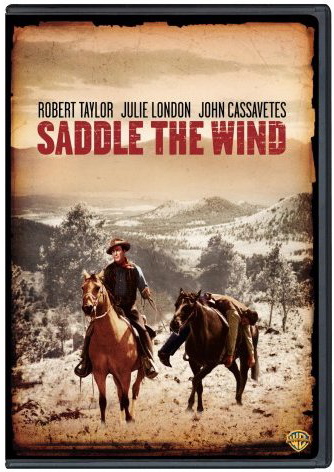
Saddle the Wind

With my review a couple weeks back of Duel in the Sun, I pointed out how much certain westerns seem related to many Greek tragedies. When you think about it, it's pretty easy to turn one into the other. As families spread across the U.S. in the 1800s, just about everybody had problems/conflicts that could only be resolved amongst the members of the family. Before westerns got too cynical in the 1960s, many American westerns used the Greek tragedy formula, including 1958's Saddle the Wind.

The key to pulling off that transformation from Greek tragedy to the wild west is in the relationships. 'Saddle' has this in a quasi-love triangle between two brothers who own a ranch in a mountain valley and the saloon girl one of the brothers brings home to be his wife. It's the type of story that if you can't predict how it ends, you definitely have not seen enough movies or read enough books. Director Robert Parrish and writer Rod Serling of The Twilight Zone do just enough with the story though to make it different, including a twist on the ending you can see coming a mile off.

In a lush, green mountain valley, two ranch owners live peacefully, Dennis Deneen (Donald Crisp), a grizzled old rancher who has come to despise violence and everything it brings, and Steve Sinclair (Robert Taylor), a reformed gunfighter trying to move on from his checkered, bloody past. Coming back from selling part of their herd, Steve's younger brother Tony (John Cassavetes) returns home with a fiance in tow, a saloon girl, Joan Blake (Julie London) who supposedly sees a better life than she's used to. Tony has also purchased a new pistol with a hair-trigger to boot.

Everything seems fine at the Sinclair's Double S ranch but in the span of a few days, two people arrive in town, both causing trouble in their own way. There's Larry Venables (Charles McGraw), a gunslinger as fast as Steve's ever seen gunning for the older Sinclair, and Clay Ellison (Royal Dano), a former Union soldier who says part of the valley rightfully belongs to him. Steve is forced to deal not only with these two problems, but also from Deneen and then his hot-tempered younger brother.

The family conflict comes across as authentic with a nice dynamic between Taylor and Cassavetes. Steve grew up caring for his younger brother, who in the process started to idolize his gunfighting older brother and now that he's full grown, he intends to be just as fast with a six-gun as Steve. Tony's intentions are good, he just wants to protect his brother (who doesn't wear a gun now), but caught up in the moment, a new side of him is revealed. Thrown into the mix is London's saloon girl who quickly sees maybe she didn't make a wise decision siding with fiery Tony.

Except for his lead role in Bataan, I've never been a huge fan of Taylor. He comes across as too wooden sometimes, but his role as Steve is the best I've seen yet. The reformed gunslinger is nothing new in a western, but Taylor brings humanity to the part as a man who genuinely regrets his past actions. As for Tony, who better to play hot-tempered, quick on the trigger brother than Cassavetes? Bordering on the obsessed with his drive, Cassavetes is the anger to Taylor's calm. London plays a strong woman, too often left behind in westerns, and even gets to serenade Cassavetes in an awkward, out of place scene.

There aren't any true villains here, but McGraw and Dano at least provide the lighter fluid for this fire. Gravelly voiced McGraw is intimidating and gruff as the new gunslinger in town and Dano as the beaten-down farmer looking to make something for his family provide strong support. Crisp makes the most of his part as the stodgy old ranch owner while recognizable character actors Richard Erdman, Ray Teal, and Douglas Spencer round out the supporting cast.

As is the case with the more story-oriented westerns, the action/gunplay is left by the wayside for most of the movie. Two gunfights are high on tension, but they're over in the blink of an eye, and the final shootout isn't much of a shootout at all. This isn't a complaint, I just felt the need to point it out so anyone watching the movie isn't expecting 100 minutes of western shootouts. It's a well-told story though with believable characters and good performances from Taylor, Cassavetes, and London. I couldn't find a trailer, but here's two scenes from later in the movie with semi-SPOILERS, one and two.

Saddle the Wind (1958): ***/****

Friday, March 13, 2009

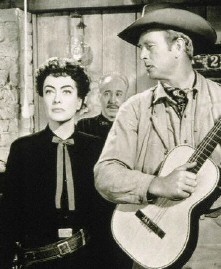
Johnny Guitar

Certain westerns try to switch things up when it comes to the old reliables of the genre. One of those is the male hero. Nicholas Ray's offbeat 1954 western Johnny Guitar turned that aspect of westerns away immediately with Joan Crawford as the lead and a woman as her main rival. A definite inspiration for Sergio Leone with Once Upon a Time in the West, the basic plot is similar, this was an interesting movie that certainly deserves its cult status.

A guitar-playing cowboy (it's not as bad as it sounds) rides into a lonely saloon one day looking for a job as a musician. His name: Johnny Guitar (Sterling Hayden in one of his better parts). He has a past with the saloon owner, Vienna (Joan Crawford), who is sitting on a fortune and everyone knows it. She owns much of the land where the railroad will have to drive through. When the rails reach her acreage, she'll be rich. But not so fast, Guitar finds out there's two factions in town, the ranchers and the outlaws.

Tough-talking Emma Small (Mercedes McCambridge) and ranch owner John McIvers (Ward Bond) want Vienna out of the town so they can swoop in and grab her land and saloon. On Vienna's side is a gang led by an outlaw called the Dancin' Kid (Scott Brady). The Kid and his gang, Turkey Ralston (Ben Cooper), Bart Lonergan (Ernest Borgnine), and Corey (Royal Dano) are as equally hated as Vienna. Johnny Guitar rode into town thinking he had an easy job playing his guitar but finds out quickly nothing comes easy. Throw in John Carradine and Paul Fix as two of Vienna's employees and you've got quite a cast.

Lots going on here in this western. It's a talkative western with some gunplay sprinkled in but not too much. There's elements of other genres, straight romance stories, bits of film noir, and even a little McCarthy-ism just for good measure. And as mentioned, there's a lot of influence on later westerns, especially OUATITW. A posse all dressed in black hunts down the Kid and his gang look like something out of a spaghetti western like Django Kill! And where most westerns don't know what to do with female characters, this one puts them front and center. Both characters are interesting and developed with the fanatical rivalry kinda frightening.

The cast works well for the most part. Crawford doesn't look comfortable, but she gives a good performance. Always a little wooden in the acting department, Hayden pulls off the part of a guitar-playing cowboy with a past well. McCambridge is a good counter to Crawford as two women who hate each other and would love to see the other one dead. The finale, a shootout between the two, is the only woman vs. woman gunfight I can even think of in a western. About as different from the norm as you could get with a western, especially in the straight-laced 50s, Johnny Guitar should be a must-see for western fans!

Sunday, March 8, 2009

Netflix review #9: The Outlaw Josey Wales

It would have been hard for Clint Eastwood to improve on his directorial debut in the genre that made him a star, High Plains Drifter. Three years later, he made an even better western with The Outlaw Josey Wales, a Civil War western that was one of the best to come out of the 1970s and genre as a whole.

The Squinty One plays title character Josey Wales, a Missouri farmer looking for revenge after his family is brutally murdered by a gang of Kansas Redlegs, renegade Union troopers, and his farm burned down. He joins a guerilla outfit of Confederate raiders, spending the war wreaking havoc on Union forces. But it's late in the war, and Robert E. Lee has surrendered. Convinced by their commander, Fletcher (a great part for John Vernon) to surrender they turn themselves in only to be massacred. The one man who didn't go? Josey Wales of course.

Now with a bounty of $5,000 on his head, Wales heads west into the Indian Nations and Texas to escape, building a quirky, motley crew of a family along the way of other people in equally troubling situations. All the while, a group of Redlegs is on his trail, and making it worse, the bounty has brought anyone who can handle a gun out looking for some easy money.

Eastwood's previous American westerns are all good in one way or another, but other than HPD I don't really consider them classics. Working as director and star here, Eastwood really puts everything together. The story is good, dealing with a subject most westerns don't deal with. There are very few Civil War movies and fewer that talk about the border wars of Kansas and Missouri. The location filming is dead on, including Arizona, Utah and California, giving the feeling that these characters are actually traveling. Jerry Fielding's score earned him an Oscar nomination, and it's a good one, certain parts reminiscent of The Wild Bunch score.

Action-wise, Eastwood's Josey Wales is a killer who racks up quite a kill count but is humane at the same time. He looks out for those around him, even if he may pretend to be the tough guy. The director packs plenty of gunplay in as Wales deals with Redlegs, Comanches, bandits, bounty hunters, and a ruthless gang of Comancheros. The finale is the most memorable as Wales single-handedly faces at least 20 Redlegs, getting some help after the initial showdown. Another couple of great exchanges, Wales talking with Comanche chief Ten Bears, and one of the best dialogue exchanges to ever come out of a western, watch it here.

Talking about the cast, it's about as dead-on as a western could be. Eastwood's a given, he's always great. Chief Dan George is perfectly cast as Lone Watie, an old Cherokee man Josey meets on the trail. An unlikely friendship develops between two men who have more in common than you'd originally think. Sondra Locke plays Laura Lee, a young woman traveling west with her family who Josey rescues from Comancheros. John Vernon is the quasi-villain as Fletcher, a man who tried to help his troopers surrender to Union forces only to see them massacred. Fletcher is ordered to hunt his old partner and kill him, even as his gut tells him otherwise. Super 70s villain Bill McKinney is Terrill, leader of the Redlegs hunting Wales. Was there a better villain than McKinney in the 70s? I can't think of one.

It's not just the leads that are strong, the whole supporting cast stands out. Paula Trueman, Sam Bottoms, and Geraldine Kearns are three people who join the outlaw on the trail, Trueman is Grandma Sarah, Bottoms is Jamie, a wounded guerilla fighter, and Kearns is Moonlight, a Navajo woman. Just some of the other supporting roles include Woodrow Parfrey, Sheb Wooley, Joyce Jameson, Matt Clark, Charles Tyner, John Davis Chandler, Royal Dano, Will Sampson, John Quade, Richard Farnsworth, and John Russell. You couldn't ask for a better cast.

The DVD is a steal at under $10. Widescreen presentation looks great and special features include a 30-minute making of documentary, "Hell Hath No Fury," with some great cast and crew interviews including Eastwood, an 8-minute featurette made during filming, a trailer, and three or four interactive menus about the cast, crew, and movie background. A western that is good on many levels, definitely give this one a try.

The Outlaw Josey Wales (1976): ****/****