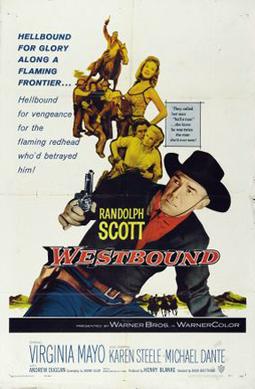
Well, I did it. It may have taken me years, but I finally did it! Thanks to a recent airing on Turner Classic Movies (my go-to movie station), I was able to finally watch the only Budd Boetticher-Randolph Scott pairing I had not seen. That entry? From 1959, Westbound, actually the sixth of seven films the director and star worked together on. Where does it end up among the seven? Read on and find out!
It's late in the Civil War as the Union and Confederacy continue the bloody fighting, both sides looking for more gold to bankroll all the fighting. One of the keys? Getting that gold from California across the southwest to safety so it can be deposited in banks and mints. In steps John Hayes (Scott), an extremely capable Union cavalry officer who has a background in running a stagecoach line. He's now being sent to start up a line on the fly, one that will be running coaches full of gold being shipped as fast as humanly possible. The task is incredibly difficult, especially because Southerners in abundance are going to do their damnedest to stop him from succeeding. First up on that list is his former employee, Clay Putnam (Andrew Duggan), a Confederate sympathizer who's hijacked much of the already-established stage line. Into it all, Hayes steps in with little room for error and less time to get things right.
As a western fan, it is hard not to like these films, these seven pairings between Boetticher and Scott. Their reputation has grown over the years -- thankfully! -- to the point that western fans look to these films as some of the best of the genre, a canon to be recognized. Where does 'Westbound' fall? Right in the middle. I liked it a lot, but I can't put it on the same level as 7 Men from Now and Ride Lonesome, my two favorites of the bunch. It's better too than Decision at Sundown and Buchanan Rides Alone, putting it instead among Comanche Station and The Tall T as the 'good, but not great' entries. None of them are bad, just some better than others. 'Westbound' is one that grew on me during its 72-minute running time. Something clicked in about the 25-minute mark or so, and I was hooked.
I've made no bones about my dislike and worry over so many heavy, overdone adult westerns from the 1950's. The drama, the emotion, the betrayals, it was all laid on so thick. One of many beauties of the Boetticher/Scott films is their outlook on the west. There was good, bad and those caught in the middle, those who have to decide to do what's right (and possibly dangerous) or just go along with the easy payday, what's easy. Among westerns -- and films, stories in general -- there's nothing more direct than good vs. evil. Where will everyone fall in the end? Boetticher follows the similar formula, the same archetypes and at just 72-minutes, 'Westbound' is a fast-moving, often dark, adult western that flies by. An excellent, underrated final product.
Leading the way and navigating through the good and bad is star Randolph Scott, an ideal lead for these movies, a necessary front man. Movie-in and movie-out, Scott was what these movies needed. His John Hayes is no different, resolute in getting the job done no matter what odds are stacked against him. He doesn't see black or white or shades of grey. Hayes sees what is right and intends to get the job done. There's never a doubt of his intentions. These aren't anti-heroes, but instead, a last wave of true western heroes. Scott throws himself into those parts with abandon. He's believable. You buy it that he will never take the easy way out. But you ask, even when a lost love (Virginia Mayo) is waiting there to be swept away? NO! Our hero wouldn't dream of it! What about a lovely young bride (Karen Steele) who he's clearly attracted to? Double NO! It just ain't gonna happen, a true western hero, a dying breed by 1959 in the genre.
There's some good parts all around in this Boetticher western. I liked Duggan a lot as Putnam, the Confederate sympathizer determined to stop Hayes but even he has limits. His enforcer, Mace (Michael Pate), has no such limits, providing some tense moments as their plan is put into action. Mayo is Putnam's wife, a woman torn by her past feelings of Scott's Hayes and her genuine feelings for her current husband. Steele is a bright spot also as Jeanie Miller, a young bride to Rod (Michael Dante), a Union soldier who lost an arm in the fighting and was sent home. There's an interesting dynamic among Hayes, Jeanie and Rod as the stage plan comes together that takes some surprising turns as the story develops. Wally Brown provides some comic relief as Stubbs, the stagecoach driver, with John Daheim memorable as the sneering henchman of Mace's...Russ.
Nothing flashy, nothing too out of the ordinary. It wouldn't fit with Boetticher's straightforward, no-nonsense smile. This is a western at its finest with a story that doesn't pull any punches, a hero who it's easy to root for, villains you can't wait to see get their due, and all of it wrapped tightly in a nice 72-minute package. If you're a fan of the other Boetticher/Scott pairings, you'll definitely enjoy this one too.
Westbound (1959): ***/****
The Sons of Katie Elder
"First, we reunite, then find Ma and Pa's killer...then read some reviews."
Showing posts with label Andrew Duggan. Show all posts
Tuesday, February 16, 2016
Tuesday, January 19, 2016
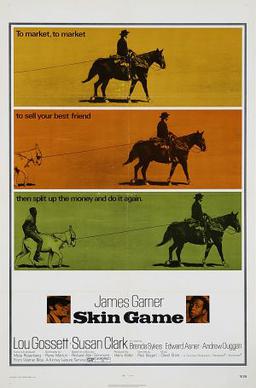
Skin Game
You know what isn't particularly funny? There's no way this introduction isn't in poor taste but...slavery! In recent years, even movies like Django Unchained that were fan favorites and critically loved caused a stir because of its slavery subject matter. So movies like Django, 12 Years a Slave, miniseries like Roots, the subject matter is played straight. That is NOT the case with 1971's Skin Game, a pre-Civil War story with comedy and drama rolled into one.
It's 1857 in Missouri when two men ride into a small town. Quincy (James Garner) is a plantation owner with some money problems, meaning he has to sell one of his slaves, Jason (Lou Gossett Jr.). He gets several hundred dollars for him and they part ways, Quincy onto the next town with Jason waiting to travel with his new owner. Well, that's what you'd think at least, what the supposed-plantation owner and his slave want you to think. In reality, they're con men, going from town-to-town, Quincy "selling" Jason to one plantation/land owner after another and getting out of town while Jason manages to escape in one way or another. The plan has worked well for quite a while now with a hefty bank account waiting for them back in Chicago when they decide they've had enough. Jason, he's had enough as he's the one taking more risk. Quincy, he'd like to travel to a couple more towns and pull off their successful con. What could possibly go wrong?
I've long been aware of this 1971 comedy-drama but never caught up with it. Thank you, Turner Classic Movies! It was worth the wait. From director Paul Bogart -- and an uncredited Gordon Douglas, I imagine there's a good story there -- it takes a touchy, potentially explosive subject matter in slavery and manages to tread the fine line between funny, at-times dramatic and just in poor taste. Come on...slavery. There's just nothing funny in that department. 'Game' doesn't minimize it or make light of it, instead attacking one of the most horrific periods in American history from the side. Considering it that way, it's actually pretty smart. Two con men looking to make some serious cash out of the sale of fellow human beings, now that is creative and certainly unique.
Playing on an oddball variety of a familiar storytelling device, Garner and Gossett have a ton of fun with their odd couple, buddy relationship. We don't learn too much about them, only that they've been con men for several years now piling up the cash with their risky play in each new town. We do learn that Jason was born a free man in New Jersey and chooses to do this, an important detail in my opinion. In a brief, quickly-cut flashback, we also see how the duo met, a fun aside and a necessary one that shows and tells a lot about these two. Sure, there are differences between the two men, but they're cut from the same cloth. The chemistry between Garner and Gossett is not in question with plenty of laughs and some great dialogue flying back and forth throughout the 102-minute running time. A great buddy combo to lead the way.
Also look for Susan Clark in a fun part as Ginger, a fellow con-man...um, con woman who crosses paths with Quincy and Jason at some inopportune moments. Brenda Sykes plays Naomi, a slave who Jason meets and wants to buy her freedom. Ed Asner is perfectly slimy as Plunkett, a slave trader with brutal tactics and no regard for his "merchandise." As for assorted slave and plantation owners, look for Andrew Duggan, Parley Baer, George Tyne, J. Pat O'Malley, and Henry Jones. Also watch for a quick appearance by Royal Dano as violent abolitionist John Brown.
There are some portions in the final act that run a tad sluggish with a story that has some pretty decent surprises. It tends to drift at times, but for the most part, this is an interesting story. I'm mostly recommending it though for the unique, inventive story and the spot-on, perfect chemistry between James Garner and Lou Gossett Jr. This isn't a movie that breaks any new ground, but it deserves more of a reputation than it currently does. Worth a watch for a creative story, unique setting in the pre-Civil War south and a very solid cast. Give it a watch!
Skin Game (1971): ***/****
It's 1857 in Missouri when two men ride into a small town. Quincy (James Garner) is a plantation owner with some money problems, meaning he has to sell one of his slaves, Jason (Lou Gossett Jr.). He gets several hundred dollars for him and they part ways, Quincy onto the next town with Jason waiting to travel with his new owner. Well, that's what you'd think at least, what the supposed-plantation owner and his slave want you to think. In reality, they're con men, going from town-to-town, Quincy "selling" Jason to one plantation/land owner after another and getting out of town while Jason manages to escape in one way or another. The plan has worked well for quite a while now with a hefty bank account waiting for them back in Chicago when they decide they've had enough. Jason, he's had enough as he's the one taking more risk. Quincy, he'd like to travel to a couple more towns and pull off their successful con. What could possibly go wrong?
I've long been aware of this 1971 comedy-drama but never caught up with it. Thank you, Turner Classic Movies! It was worth the wait. From director Paul Bogart -- and an uncredited Gordon Douglas, I imagine there's a good story there -- it takes a touchy, potentially explosive subject matter in slavery and manages to tread the fine line between funny, at-times dramatic and just in poor taste. Come on...slavery. There's just nothing funny in that department. 'Game' doesn't minimize it or make light of it, instead attacking one of the most horrific periods in American history from the side. Considering it that way, it's actually pretty smart. Two con men looking to make some serious cash out of the sale of fellow human beings, now that is creative and certainly unique.
Playing on an oddball variety of a familiar storytelling device, Garner and Gossett have a ton of fun with their odd couple, buddy relationship. We don't learn too much about them, only that they've been con men for several years now piling up the cash with their risky play in each new town. We do learn that Jason was born a free man in New Jersey and chooses to do this, an important detail in my opinion. In a brief, quickly-cut flashback, we also see how the duo met, a fun aside and a necessary one that shows and tells a lot about these two. Sure, there are differences between the two men, but they're cut from the same cloth. The chemistry between Garner and Gossett is not in question with plenty of laughs and some great dialogue flying back and forth throughout the 102-minute running time. A great buddy combo to lead the way.
Also look for Susan Clark in a fun part as Ginger, a fellow con-man...um, con woman who crosses paths with Quincy and Jason at some inopportune moments. Brenda Sykes plays Naomi, a slave who Jason meets and wants to buy her freedom. Ed Asner is perfectly slimy as Plunkett, a slave trader with brutal tactics and no regard for his "merchandise." As for assorted slave and plantation owners, look for Andrew Duggan, Parley Baer, George Tyne, J. Pat O'Malley, and Henry Jones. Also watch for a quick appearance by Royal Dano as violent abolitionist John Brown.
There are some portions in the final act that run a tad sluggish with a story that has some pretty decent surprises. It tends to drift at times, but for the most part, this is an interesting story. I'm mostly recommending it though for the unique, inventive story and the spot-on, perfect chemistry between James Garner and Lou Gossett Jr. This isn't a movie that breaks any new ground, but it deserves more of a reputation than it currently does. Worth a watch for a creative story, unique setting in the pre-Civil War south and a very solid cast. Give it a watch!
Skin Game (1971): ***/****
Saturday, October 30, 2010
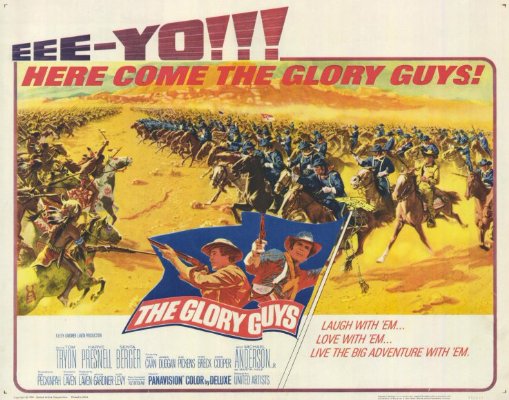
The Glory Guys
For over two years, I've been a Netflix member and have caught up with a lot of movies that were either impossible to find or I just wasn't willing to buy to actually see them. Over the two years, Netflix has added many features but maybe none better than the ability to watch a long list of movies instantly through your computer or even by downloading through your TV. There are some hidden gems among these many movies, but you've just got to find them. I stumbled across a western today I've long wanted to see, 1965's The Glory Guys.
I don't know how many years back, but I caught the last 10 or 15 minutes of this on TCM when I got home from school. Because it looked good and I was interested in seeing it again, it obviously hasn't been on TCM and of course is not available in any format. Thank you, Netflix, for making it available. With a screenplay by infamous director Sam Peckinpah, this western is a thinly veiled version of the massacre at the Little Big Horn when George Armstrong Custer and the 7th Cavalry were wiped out by a huge grouping of plains Indians. TV director Arnold Laven is listed as the movie's director, but rumors persist that Peckinpah handled some of the directing duties. For a western that is long forgotten, it has too many positives to be left behind as it is.
After fighting the Apaches in the southwest, Captain Demas Harrod (Tom Tryon) is transferred to Fort Doniphan by the orders of famed Indian fighter General Frederick McCabe (Andrew Duggan). He is assigned a company in the renowned 3rd Cavalry, but the men are a motley group of misfits with little experience with horses or firearms. With the help of his company sergeant, Gregory (Slim Pickens), Harrod goes about whipping the men into shape for the coming campaign. Harrod also finds himself in a fight for the hand of widowed gunslinger Lisa Woodard (the always lovely Senta Berger) against Army scout Sol Rogers (Harve Presnell). All their problems aside though, the 3rd Cavalry is part of a huge campaign meant to control the plains Indians for good, and Gen. McCabe is looking for glory in the process, no matter the cost in men.
Part of the reason this western has been forgotten over the last 45 years is the casting of the leads, Tryon and Presnell. Neither actor was a big star coming into 'Glory Guys' and neither would be afterward. They're the type of roles you can see much bigger names taking over, but for me I thought the two did solid jobs. Tryon can be a tad wooden at times, and Presnell's character is underwritten and underused, but they have a good chemistry together as they fight for Berger (and who'd blame them?). The unnecessary love triangle isn't as awful as it could have been thankfully, and besides a few scenes that kill momentum in the middle is left by the wayside.
More than a few things here reminded me of Peckinpah's other 1965 western, Major Dundee. The big ones are obvious, a cavalry story fighting Indians serving as the basis for both movies' story. But then there's the location filming in Durango, Mexico for both, and the casting of Berger, Pickens, and Michael Anderson Jr. in an eerily similar role to the one he played in Major Dundee. Whoever ended up directing more of 'Glory Guys,' there is the distinct feel of a Peckinpah movie whether it's seeing the same locations or just the dynamic among male characters. Peckinpah had a knack for tough, hard-edged male characters who fight and fight only to side with each other when the chips are down. There is a code among men like these, and they tend to live by it no matter the end result. So yes, it may be an average western, but it's elements like this that help lift it up a notch or two.
What works best when the story isn't focusing on the love triangle is the training and development of Harrod's D Company as they arrive at the fort only to turn into highly competent cavalry soldiers. Pickens is perfectly cast as tough Sgt. Gregory with Anderson Jr., a very young James Caan as brawling Irishman Anthony Duggan (the accent is must-hear), Adam Williams, and Erik Holland rounding out the recognizable faces in the company. Peckinpah's screenplay is at its best when dealing with the training and the camaraderie that develops among these men. The characters lean to outlines more than red-blooded characters, but Cann especially stands out, as does Anderson Jr. Tryon's Harrod pushes his men because he's seen Gen. McCabe's dangerous battlefield tactics and knows the better prepared his men are, the more likely they'll make it through alive. I wish more time could have been spent with D Company, but what's here is quality.
Now onto one of my self-named elements of movies I love, the sense of doom. With a story about an eventual massacre, you know where everything's going to end up. The last 45 minutes are dripping with tension as the 3rd Cavalry unknowingly rides to their doom. The actual battle is a spectacle to behold, hundreds of cavalry and Indians on horseback going toe to toe. Clearly some serious money was spent on the finale, an epic, well choreographed and constructed battle that would preview similar scenes in Major Dundee and The Wild Bunch. If you're a Netflix member, I recommend checking this one out, and if not, keep an eye out for it. How hard is it to find? I couldn't even find a trailer or a video clip.
The Glory Guys (1965): ***/****
I don't know how many years back, but I caught the last 10 or 15 minutes of this on TCM when I got home from school. Because it looked good and I was interested in seeing it again, it obviously hasn't been on TCM and of course is not available in any format. Thank you, Netflix, for making it available. With a screenplay by infamous director Sam Peckinpah, this western is a thinly veiled version of the massacre at the Little Big Horn when George Armstrong Custer and the 7th Cavalry were wiped out by a huge grouping of plains Indians. TV director Arnold Laven is listed as the movie's director, but rumors persist that Peckinpah handled some of the directing duties. For a western that is long forgotten, it has too many positives to be left behind as it is.
After fighting the Apaches in the southwest, Captain Demas Harrod (Tom Tryon) is transferred to Fort Doniphan by the orders of famed Indian fighter General Frederick McCabe (Andrew Duggan). He is assigned a company in the renowned 3rd Cavalry, but the men are a motley group of misfits with little experience with horses or firearms. With the help of his company sergeant, Gregory (Slim Pickens), Harrod goes about whipping the men into shape for the coming campaign. Harrod also finds himself in a fight for the hand of widowed gunslinger Lisa Woodard (the always lovely Senta Berger) against Army scout Sol Rogers (Harve Presnell). All their problems aside though, the 3rd Cavalry is part of a huge campaign meant to control the plains Indians for good, and Gen. McCabe is looking for glory in the process, no matter the cost in men.
Part of the reason this western has been forgotten over the last 45 years is the casting of the leads, Tryon and Presnell. Neither actor was a big star coming into 'Glory Guys' and neither would be afterward. They're the type of roles you can see much bigger names taking over, but for me I thought the two did solid jobs. Tryon can be a tad wooden at times, and Presnell's character is underwritten and underused, but they have a good chemistry together as they fight for Berger (and who'd blame them?). The unnecessary love triangle isn't as awful as it could have been thankfully, and besides a few scenes that kill momentum in the middle is left by the wayside.
More than a few things here reminded me of Peckinpah's other 1965 western, Major Dundee. The big ones are obvious, a cavalry story fighting Indians serving as the basis for both movies' story. But then there's the location filming in Durango, Mexico for both, and the casting of Berger, Pickens, and Michael Anderson Jr. in an eerily similar role to the one he played in Major Dundee. Whoever ended up directing more of 'Glory Guys,' there is the distinct feel of a Peckinpah movie whether it's seeing the same locations or just the dynamic among male characters. Peckinpah had a knack for tough, hard-edged male characters who fight and fight only to side with each other when the chips are down. There is a code among men like these, and they tend to live by it no matter the end result. So yes, it may be an average western, but it's elements like this that help lift it up a notch or two.
What works best when the story isn't focusing on the love triangle is the training and development of Harrod's D Company as they arrive at the fort only to turn into highly competent cavalry soldiers. Pickens is perfectly cast as tough Sgt. Gregory with Anderson Jr., a very young James Caan as brawling Irishman Anthony Duggan (the accent is must-hear), Adam Williams, and Erik Holland rounding out the recognizable faces in the company. Peckinpah's screenplay is at its best when dealing with the training and the camaraderie that develops among these men. The characters lean to outlines more than red-blooded characters, but Cann especially stands out, as does Anderson Jr. Tryon's Harrod pushes his men because he's seen Gen. McCabe's dangerous battlefield tactics and knows the better prepared his men are, the more likely they'll make it through alive. I wish more time could have been spent with D Company, but what's here is quality.
Now onto one of my self-named elements of movies I love, the sense of doom. With a story about an eventual massacre, you know where everything's going to end up. The last 45 minutes are dripping with tension as the 3rd Cavalry unknowingly rides to their doom. The actual battle is a spectacle to behold, hundreds of cavalry and Indians on horseback going toe to toe. Clearly some serious money was spent on the finale, an epic, well choreographed and constructed battle that would preview similar scenes in Major Dundee and The Wild Bunch. If you're a Netflix member, I recommend checking this one out, and if not, keep an eye out for it. How hard is it to find? I couldn't even find a trailer or a video clip.
The Glory Guys (1965): ***/****
Sunday, August 15, 2010
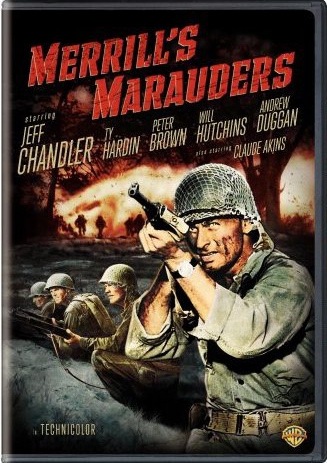
Merrill's Marauders
After reviewing a heavily anti-war movie yesterday, I thought it was only right to counter today with a different look at war and soldiers in a more heroic light. The 1960s were full of war flicks that focused on real-life military units, like 1968's The Devil's Brigade that dealt with the First Special Service Force, and then for a change of pace here, 1962's Merrill's Marauders in the Pacific theater of WWII.
Directed by WWII vet Samuel Fuller, Marauders tells a mostly factual story of the 5307th Composite Unit (provisional), dubbed Merrill's Marauders after their commander, General Frank Merrill. This was a fighting force of 3,000 American volunteers with experience in jungle warfare after years of island-hopping across the Pacific on places like Guadalcanal, Bougainville, and many others. Fuller doesn't try to present the Marauders as a unit of Superman-like soldiers who can't be defeated. These are men pushed to their physical, emotional and mental limits as they undertake a near-suicide mission late in WWII. Heroes of course, but Fuller isn't going to shove any rhetoric down your throat. Here's the story, and if you don't like it, tough.
Early in 1944 as the advantage shifts toward the Allies in WWII, the 5307th Composite Unit marches into Burma from India with a dangerous mission, get behind enemy lines and walk 125 miles undetected in Japanese territory to knock out a key Japanese supply base. Commander Brigadier General Frank Merrill (Jeff Chandler) is at the lead, pushing his men every step of the way. The mission is a success if a costly one, but it's only the start. The Marauders are ordered to continue on, marching further into the Burmese jungle on their way to an essential airfield at Myitkyina where they will link up with British forces. Out in front leading his scout platoon, Lt. Stockton (Ty Hardin) begins to see the men wear down but somehow continue on, ready for whatever awaits them.
Telling the story of the Marauders, Fuller puts together a fast-paced, full of action story that never slows down, even in the moments following the firefights as the men wait for orders. With backing from the U.S. Army, Fuller films his story in the Philippines which does a fine job filling in for Burma. Much of the movie is filmed in dense jungle, giving a feel of what trudging through such horrifically dense landscape would be like. Howard Jackson's musical score borrows some from 1945's Objective Burma! but stands well on its own, supplying a driving pace at times that balance out the softer moments as the Marauders cope with their situation.
Chandler tragically died at the age of 42 before this last movie of his was ever in theaters, a shame because of how good his performance is. Never a huge star, he was a class professional, and makes Merrill a red-blooded character, an officer who knows he must sacrifice some of his men if the Allies ever hope to win the war. Difficult decisions, but he knows the end result will prove it all worthwhile. He has a father-son relationship with Hardin's Stock, the platoon leader who struggles dealing with the ever-increasing casualties among his men. Joining the platoon is Bullseye (Peter Brown), the sharpshooter, Kolowicz (Claude Akins), the tough but fair sergeant, Muley (Charlie Briggs), the mule driver with his pack animal Eleanor, Chowhound (Will Hutchins), the platoon a-hole, and Taggy (Filipino star Pancho Magalona), a Filipino volunteer. We get to know little to nothing about these men, but by seeing their actions, as viewers we get a strong sense of who they are as people. The personal background would be a wasted effort.
Certain moments can bring a war movie up a notch or two, and it doesn't require an epic battle or a heroic sacrifice. Here, it comes following a bloody battle at a railyard. Stock walks over cement posts where the heaviest fighting took place, the bodies mingled together so closely it is impossible to tell who was American and who was Japanese. It is one long tracking shot as Stock surveys the battle silently, Jackson's score playing softly. A few minutes later, Akins -- in a career-best performance -- is offered food by a young boy and his grandmother. They're just offering a cup of water and a bowl of rice (very little in the grand scheme of things), but Akins' Wolowicz breaks down, the exhaustion taking over of months behind enemy lines. These are the moments that stick with you more than anything else, the mark of a truly moving story.
With his lightning quick pacing, Fuller covers a ton of ground in just 97 minutes. The studio made certain cuts -- including a slightly different ending -- giving the story a sometimes disjointed feel, but it never distracts for long. The battle sequences sound like toy guns instead of real guns (Fuller opted for blanks instead of sound effects), but they're shot so well you hardly notice minutes in. The movie ends on a positive note, asking the question that's been brought up the whole movie by Doc (Andrew Duggan). Men on the brink of exhaustion after months of fighting with limited supplies, how do they do it? They did it because they had to. A great, underrated WWII movie well worth catching up with.
Merrill's Marauders <---trailer (1962): *** 1/2 /****
Directed by WWII vet Samuel Fuller, Marauders tells a mostly factual story of the 5307th Composite Unit (provisional), dubbed Merrill's Marauders after their commander, General Frank Merrill. This was a fighting force of 3,000 American volunteers with experience in jungle warfare after years of island-hopping across the Pacific on places like Guadalcanal, Bougainville, and many others. Fuller doesn't try to present the Marauders as a unit of Superman-like soldiers who can't be defeated. These are men pushed to their physical, emotional and mental limits as they undertake a near-suicide mission late in WWII. Heroes of course, but Fuller isn't going to shove any rhetoric down your throat. Here's the story, and if you don't like it, tough.
Early in 1944 as the advantage shifts toward the Allies in WWII, the 5307th Composite Unit marches into Burma from India with a dangerous mission, get behind enemy lines and walk 125 miles undetected in Japanese territory to knock out a key Japanese supply base. Commander Brigadier General Frank Merrill (Jeff Chandler) is at the lead, pushing his men every step of the way. The mission is a success if a costly one, but it's only the start. The Marauders are ordered to continue on, marching further into the Burmese jungle on their way to an essential airfield at Myitkyina where they will link up with British forces. Out in front leading his scout platoon, Lt. Stockton (Ty Hardin) begins to see the men wear down but somehow continue on, ready for whatever awaits them.
Telling the story of the Marauders, Fuller puts together a fast-paced, full of action story that never slows down, even in the moments following the firefights as the men wait for orders. With backing from the U.S. Army, Fuller films his story in the Philippines which does a fine job filling in for Burma. Much of the movie is filmed in dense jungle, giving a feel of what trudging through such horrifically dense landscape would be like. Howard Jackson's musical score borrows some from 1945's Objective Burma! but stands well on its own, supplying a driving pace at times that balance out the softer moments as the Marauders cope with their situation.
Chandler tragically died at the age of 42 before this last movie of his was ever in theaters, a shame because of how good his performance is. Never a huge star, he was a class professional, and makes Merrill a red-blooded character, an officer who knows he must sacrifice some of his men if the Allies ever hope to win the war. Difficult decisions, but he knows the end result will prove it all worthwhile. He has a father-son relationship with Hardin's Stock, the platoon leader who struggles dealing with the ever-increasing casualties among his men. Joining the platoon is Bullseye (Peter Brown), the sharpshooter, Kolowicz (Claude Akins), the tough but fair sergeant, Muley (Charlie Briggs), the mule driver with his pack animal Eleanor, Chowhound (Will Hutchins), the platoon a-hole, and Taggy (Filipino star Pancho Magalona), a Filipino volunteer. We get to know little to nothing about these men, but by seeing their actions, as viewers we get a strong sense of who they are as people. The personal background would be a wasted effort.
Certain moments can bring a war movie up a notch or two, and it doesn't require an epic battle or a heroic sacrifice. Here, it comes following a bloody battle at a railyard. Stock walks over cement posts where the heaviest fighting took place, the bodies mingled together so closely it is impossible to tell who was American and who was Japanese. It is one long tracking shot as Stock surveys the battle silently, Jackson's score playing softly. A few minutes later, Akins -- in a career-best performance -- is offered food by a young boy and his grandmother. They're just offering a cup of water and a bowl of rice (very little in the grand scheme of things), but Akins' Wolowicz breaks down, the exhaustion taking over of months behind enemy lines. These are the moments that stick with you more than anything else, the mark of a truly moving story.
With his lightning quick pacing, Fuller covers a ton of ground in just 97 minutes. The studio made certain cuts -- including a slightly different ending -- giving the story a sometimes disjointed feel, but it never distracts for long. The battle sequences sound like toy guns instead of real guns (Fuller opted for blanks instead of sound effects), but they're shot so well you hardly notice minutes in. The movie ends on a positive note, asking the question that's been brought up the whole movie by Doc (Andrew Duggan). Men on the brink of exhaustion after months of fighting with limited supplies, how do they do it? They did it because they had to. A great, underrated WWII movie well worth catching up with.
Merrill's Marauders <---trailer (1962): *** 1/2 /****
Labels:
1960s,
Andrew Duggan,
Claude Akins,
Jeff Chandler,
Peter Brown,
Sam Fuller,
Ty Hardin,
WWII
Subscribe to:
Posts (Atom)