The Sons of Katie Elder

The Sons of Katie Elder
"First, we reunite, then find Ma and Pa's killer...then read some reviews."
Showing posts with label John Russell. Show all posts

Monday, July 21, 2014

Rio Bravo

Do you have a favorite western? No? What's wrong with you?!? Do a search for top 10 lists, of fans and critics alike pointing out their favorite westerns, and you'll see countless picks. One that pops up often that I'm not a huge fan of is 1952's High Noon. You know who else isn't a big fan? The Duke himself, John Wayne. Working with a deep cast, a talented director and a great script, here's Wayne's response to High Noon, 1959's Rio Bravo.

In the Texas border town of Rio Bravo, Sheriff John T. Chance (Wayne) finds himself in a bit of a spot. A man named Joe Burdette (Claude Akins) callously shot down an unarmed man in a bar argument and is now sitting in Chance's jail. A murderer in itself isn't big news, but when Joe's brother is one of the richest men in Texas -- and with a small army of gunmen at his side -- that provides some problems for Chance. Burdette has bottled up the town so Chance can't transport his prisoner and he can't bring help in either. All the sheriff is left with is two deputies, Dude (Dean Martin), a drunkard, and Stumpy (Walter Brennan), an aging crippled man, to help do the job. With the town waiting to see what happens, Burdette's gunmen similarly waiting on the streets, Chance goes about putting a plan into action to get out alive and bring Joe Burdette to justice.

Wowza, what a good movie, a western that deserves its classic status. I grew up watching this Howard Hawks-directed western a lot as a kid and recently revisited it for the first time in years. The plot description proved a little rough because....well, the script is excellent, but the story isn't the most well-connected, concise of stories. If there's a complaint, it's that at 141 minutes and with an episodic story, things can be a tad slow at times, but you never really notice it (or I didn't at least). It isn't a comedy western, and it isn't a cynical, ultra-dark western, but somewhere in between as it mixes comedy (the script again), the drama and the action. Old Tucson is a great location spot for the town of Rio Bravo, that archetypal winding, dusty western town. Composer Dimitri Tiomkin turns in a great subtle score -- very whistle-worthy -- and even test runs part of the score he'd use a year later in The Alamo. All key contributions to a winning formula.   

Of all his movies, John Wayne is most associated with the western genre. Many consider his western roles -- The Searchers, Red River, She Wore a Yellow Ribbon, The Shootist -- to be among his strongest. Maybe not the showiest part, but Wayne's leading role here as Rio Bravo sheriff John T. Chance is Wayne at his tough, likable, easy-going best. If not his best acting performance, it's one of his most visually iconic, the vest over the red or blue shirt, the bent-up hat brim, the ever-present Winchester rifle in his hand. In the acting department, this is one of my favorites of the Duke's. He makes it look criminally easy what he's doing. He lets those around him show off more with "bigger" performances, content to do his thing. In the process, you can't help but watch him. He's the tough lead, the lead with some great comedic timing, and has one of his all-time best love interests in the form of Angie Dickinson as Feathers, a young woman with some troubles behind her. That chemistry is perfect, Wayne's Chance more and more exasperated with each passing scene. Just a great underplayed performance.

As a director, one of Hawks' specialties was the bonds and friendships formed among men in serious situations, a life and death drama. I don't know if that dynamic was ever better than it was here. There isn't a weak spot in the bunch with Wayne as Chance and Martin and Brennan as his maligned deputies. Even teen idol Ricky Nelson manages to find a good spot as Colorado Ryan, a young gunslinger looking to mind his business....at first. Facing seemingly insurmountable odds, they bond, put their differences aside and become stronger as a collective group. Their chemistry is evident throughout, their dialogue crackling with each passing scene. Sure, they sing a couple songs together (My Rifle, My Pony and Me, Cindy, listen HERE) but it's Dean Martin! You're rooting for these guys, each of the quartet bringing something different to the table. Just hard to beat, one of the best, underrated casts in a western.

That's where the script steps to the plate. We don't get much in the way of backstory about most of the characters. In a line here and there, we pick up more than you'd think. We learn what drove Dude to drink, why cackling, ranting Stumpy has a limp, why Chance carries a rifle. Good, interesting characters we get to know quickly, and from there, the cast does the rest. Also look for Ward Bond (in his last film role) as Pat Wheeler, a freight owner who offers to help Chance, an underused, sneering Akins at his best, John Russell as his intimidating older brother, Nathan, Pedro Gonzalez Gonzalez as Carlos, the hotel owner, and Estelita Rodriguez as his wife, Consuela. 

So there isn't the most pointed story here. So be it, Hawks was never interested in the most linear, fast-paced stories. The pacing works here, too many episodic moments to mention. The opener is several minutes of silence as we're introduced to Chance and Dude, ultimately seeing Joe gun an unarmed man down. My personal favorite is a set piece with Chance and Dude following a wounded hired killer with muddy boots into a saloon...only they can't find him. It's a great little scene with an excellent payoff. The movie is full of such great moments, including the finale as Chance and Co. go toe-to-toe with the Burdettes during a prisoner exchange with Old Tucson again providing a pitch perfect backdrop to the western action.

Is it a perfect movie? No, but as far as entertaining movies goes, this one is hard to beat whether it is a western or not. The cast is perfectly used, showing off a chemistry that makes it fun to watch. Some truly funny laughs (Chance calling Stumpy "a treasure" and kissing him on his bald head), some great dialogue and one-liners, and a script that provides some great quotables. Hard to beat, and one of my favorite movies. If you're a fan, check out both El Dorado and Rio Lobo, Hawks basically remaking his own movie twice more.

Rio Bravo (1959): ****/****

Friday, November 15, 2013

Hostile Guns

The name A.C. Lyles doesn't exactly ring a bell with famous western directors/producers. He's no John Ford, no Budd Boetticher, no Sergio Leone. Why no notoriety? Short answer? He didn't produce any classics, maybe not even any just old fashioned, good flicks. I caught 1967's Hostile Guns on a recent airing on a movie channel -- a Lyles production -- and let's just say it's.....well....not so good.

Readying to transport prisoners to the Huntsville Prison, Marshall Gid McCool (George Montgomery) is struggling to find a deputy willing to travel with him. No one is willing to take on the dangerous job -- even if it pays well -- until McCool meets Mike Reno (Tab Hunter), a young, fiery cowboy thrown into a jail cell for starting a fight in the town's saloon. With the promise of $50 for his services, Reno agrees, signing on as a deputy and immediately slugs it out with the prisoner they're transporting, a convicted murderer, Hank Pleasant (Leo Gordon), who intends to make the trip just as difficult as possible. With a specially outfitted wagon, McCool and Reno head out on the trail, picking up prisoners as they go at different stops on the way to Huntsville, including a female prisoner, Laura Mannon (Yvonne De Carlo), another convicted murderer. The new arrival may be the least of their concerns though, both McCool and Reno quickly realizing they're being followed. Who's trailing them?

I guess it should have clicked for me early on. I've been watching westerns since I was a little kid, and when this one popped up on the TV schedule, I should have put it together. At no point in my tries to watch as many westerns as I can had I ever come across this western from director R.G. Springsteen. No mention, N-O-N-E, for good or bad. Nonetheless, I plodded on. After all, it sounded promising with a more than respectable cast. Yeah, that's about all it's good. This is a western that at 91 minutes reeks of cheapness. I'm thinking total budget here couldn't have been more than a couple bucks here and there, and that money went to assembling the cast, the best thing going here by far. Where to start, where to start?

Made on a small budget doesn't/shouldn't be a deal breaker. On the contrary, it can be nothing but a positive. For 'Hostile' though, huge stretches of the already dull 91-minute flick is simply shots of McCool, Reno and the wagon riding through the rocky, desert mountains. Then, we get a follow-up shot of their pursuers. I swear the angles of the shot were tweaked because it felt like I saw the same rock formation one time after another. Same for the follow-up shot of those evil bad guys!!! My personal favorite in the Badness Department is the fight scenes. Usually a halfway decent movie does its best to delicately transition the shots of the stunt doubles fighting with those of the actors "fighting." This was almost amateurish in that department. Not only don't the stunt doubles resemble who they're posing as, the fight scenes are so poorly edited you clearly see the face of the doubles. Get a sample in the link below.

If there is anything to remotely recommend here, it's not surprisingly the cast. They're almost all stock characters you've seen before in any number of westerns, but they have their moments. A familiar face if not a star, Montgomery is solid as the stoic, very capable marshal who's working with a real bad hand. Hunter is actually pretty respectable for the most part, only going high up on the Annoying Meter late. Their veteran law officer, young punk cowboy dynamic is good. Gordon does what he does best, growls and looks menacing as the brutal killer while De Carlo makes the most of her part as the society woman who's guilt or innocence is debatable. Brian Donlevy makes what amounts to a cameo as another marshal, while Pedro Gonzalez Gonzalez (as a goat thief) and Robert Emhardt (as a corrupt railroad official) play two other prisoners being transported. John Russell plays Pleasant's pursuing brother, Aaron, James Craig playing his cousin, both looking to spring Pleasant. 

Familiar situations, bad stunt work, recognizable characters, none of them are deal-breakers for me with a western. Just plain boredom and laziness? Now we're talking. A B-western that uses the same stock footage over and over is just bad. How many times can we see Russell and Craig ride down the same hill? How much was actually filmed outdoors? Not much, most of the trail scenes relegated to indoor studio work. Mostly, it's just boring. There's lot of talking, intense staring, all of it building up to some sort of showdown that never comes to fruition. The finale is disappointing, and then it ends. Not very good.

Hostile Guns (1967): */****

Tuesday, November 5, 2013

Yellowstone Kelly

One of the turning points in the history of the taming of the west in the U.S., the massacre at the Little Big Horn has certainly received its due in film adaptations. Maybe more so is the fallout from the battle that wiped out George Custer and his famed 7th Cavalry. There's been a-plenty of westerns about what happened after the battle, like 1959's Yellowstone Kelly.

It's been several months since the Battle of the Little Bighorn, and well-known trapper and frontiersman Yellowstone Kelly (Clint Walker) has ridden down out of the hills with his trappings from a busy season. He catches a ride on a steamboat where he meets Anse Harper (Edd Byrnes), a young, inexperienced man traveling west, Kelly agreeing to take him along -- somewhat unwillingly -- when he heads back up into the mountains. Kelly is also approached by the cavalry to scout for them in helps of leading an expedition against the Sioux and Cheyenne. The veteran scout knows the land as well as anyone, but he also has an agreement with the warring Sioux so he declines the offer, instead heading out with Anse into the mountains. His decision has been made, but his involvement between the Indians and the cavalry is far from over.

From director Gordon Douglas, this 1959 western is a good but not great entry. It popped up recently on Encore Westerns and with no regular DVD out there for viewing, I wanted to give it a shot. If it doesn't do anything particularly new in the western genre, so be it. It's mostly entertaining. 'Kelly' benefits from some great location shooting in the Coconino National Forest and Sedona, Arizona. This is a Technicolor movie that needs to be viewed in widescreen. Just watching Walker's Kelly ride around through the mountains is a visual treat. Mountains, deserts, it's got it all to produce a great-looking movie. As well, the score from an uncredited Howard Jackson is good, borrowing from themes from They Died With Their Boots On, as well as a familiar tune here and there from The Charge at Feather River. It must be the Warner Brothers file archive.

Right in the midst of his successful TV run on Cheyenne, Walker takes a break to star here, and it's a good part. He's a good if not great actor, as much of a domineering physical presence as anything. The 6-foot-6 actor was certainly a presence on-screen, appearing to tower over his co-stars. He has a good chemistry with another TV star in Edd Byrnes. The experienced trailhand and scout working with the oppositely inexperienced younger man is a familiar genre convention, but it works well here. Neither Walker or Byrnes ever became huge stars, but the TV turned movie stars do very capably here. If there's a weak point, it's when Kelly and Harper rescue Wahleeah (Andra Martin), an Arapaho captive of the nearby Sioux tribe. Byrnes' Harper falls quickly for her, Kelly recommending he stays clear of her. It's just not as interesting as the other story. It's not awful, but it does slow things down in a 92-minute movie. 

This must have been a TV stars convention here for the cast. Star of TV's Lawman, John Russell wears some skin darkener and wears a pair of braids as Gall, a Sioux chieftain who had his life saved by Walker's Kelly years before. Now, he has an uneasy deal with the scout about where he can/can't go. Ray Danton plays Sayapi, Gall's pissed off nephew who wants his Arapaho captive back, and he doesn't care who's trying to stop him. Leading the cavalry contingent is Rhodes Reason as Major Townes, an officer who seemingly learns nothing from the past (i.e. Custer) with Gary Vinson as his Lieutenant, Claude Akins and Warren Oates playing Sergeant and Corporal, no names provided.

The action is kept on the small scale for the most part. An early fistfight has Kelly and Harper teaming to tangle with Akins' Sergeant and his soldiers. The biggest fighting is saved for the finale between the cavalry and the attacking Indians on a desert hillside covered in trees. It's pretty quick and doesn't have a ton of scale, but it's a good action scene. That's the western itself. Nothing flashy, but I enjoyed it. A pleasant time-waster with good locations and cast.

Yellowstone Kelly (1959): ** 1/2 /****

Tuesday, July 30, 2013

Pale Rider

By the 1980s, the western genre had played out the string. Revisionist westerns of the 1970s had nailed that coffin shot, leaving an occasional western for a 1980s audience, flicks like The Long Riders (good), Tom Horn (a near classic), Heaven's Gate (potential but a disaster), and Silverado (okay but meh) among others. What was the most financially successful western of the decade? That would be 1985's Pale Rider.

It's the 1880s somewhere in the California mountains and Hull Barrett (Michael Moriarty) is one of many miners trying to carve a life for himself in a small, isolated mining village. Some gold has been found -- enough to keep the people around -- but no huge lode just yet. Finding any gold strike has proved to be extremely difficult as a local businessman and miner himself, LaHood (Richard Dysart), constantly sends a gang of thugs to disrupt the village's activities. Miners and not gunfighters, the village doesn't know what to do following one particularly dangerous raid. The situation seems hopeless until a mysterious drifter known only as the Preacher (Clint Eastwood) arrives in town. He instantly tangles with LaHood's thugs, prompting a bigger showing of power. Will the Preacher be able to hold off LaHood, especially when he calls in help from a corrupt marshal?

Making over $41 million in theaters in the United States alone, 'Rider' was a huge hit with audiences. Both producing and directing as well as starring, Eastwood makes his return to the western genre that helped make him an international star. His last true western was a classic in itself, 1976's The Outlaw Josey Wales. It is an interesting if not particularly unique western, borrowing very liberally from both Shane and another Eastwood flick, High Plains Drifter. I liked it if I didn't love, a dark if still traditional western that is worth a watch. The filming locations in the Boulder Mountains and Sawtooth National Recreation Area in Idaho are a change of pace visually, beautiful, cluttered and claustrophobic like it's hanging over the story. Composer Lennie Niehaus' score was forgettable as I'm unable to member a single note or tune.

This is one of a few Eastwood movies that's evaded me over the years. I heard less than sterling reviews, but when it showed up on TCM's scheduling recently I wanted to give it a shot. Eastwood is one of a few faces of the western genre, a huge star who's name is instantly associated with it. He plays a similar character here to what we're familiar with, a quiet (although he talks more than usual) drifter, a gunman who travels with the clothes on his pack and his bedroll and saddle. He doesn't seem to take money, only doing what he believes to be right; in this case, defending the miners against the greedy, evil LaHood. Though he is downright talkative relative to his other roles, Eastwood is a menacing, intimidating presence more than anything. His Preacher is a great character, a familiar if worthwhile anti-hero.

The most accurate description I can give of this movie is Shane meets High Plains Drifter. It blends the idea of a hired gun -- Shane -- protecting landowners/farmers with a possibly other-worldly potential -- as was the case in HPD. Nothing is ever spelled out, but there is obviously the intention that Eastwood's Preacher is some sort of avenging angel, quoting literally Revelations. Preacher actually shows up following a prayer asking for help. He moves effortlessly, seemingly disappearing at times, especially in a final showdown. Hired guns fire blindly where they saw him, but he's not there anymore. Is he a ghost? Is he dead? An avenging angel? There's another route, one that I prefer. Preacher is a man back from the dead -- we see his back riddled with past bullet wounds -- and one key character appears to know him from somewhere. However you interpret the character, it allows for some pretty cool possibilities.

The supporting cast, while solid, doesn't jump off the page. Maybe there's too many characters, too much going on. Moriarty is the Joe Starrett character, the miner trying to build a life for himself, taking in a widow (shrill, annoying Carrie Snodgress) and her daughter (Sydney Penny), both taking an instant like to Preacher. He pairs well with Eastwood, both good men, one just more pure. Dysart is a decent villain but underused. The real villain is John Russell as Stockburn, an aging, corrupt marshal who works for whatever law will pay him and travels with six gunslinging deputies (including Billy Drago). Also look for Chris Penn as LaHood's bullying, entitled son and Richard Kiel as one of his miners/henchmen. That's just the start though with at least a dozen other speaking parts, none given a whole lot to do.

The action too is saved for a few specific set pieces. One, Preacher's introduction in town as he whales on a handful of LaHood henchmen with a solid piece of hickory, almost like a samurai wielding a sword (watch it HERE). The best is the finale as Preacher goes up against Stockburn and his deputies on an empty, quiet street. This is the scene that most convinced me the character is some sort of avenging angel, especially the ultimate resolution. I did like this western, but it is missing something that prevents it from being a classic. The insistence on Snodgress' Sarah and Penny's Megan both falling for Preacher is a little much, especially in execution in some painfully stilted scenes. Even the final scenes loses some effectiveness because of it. A good western, not a great one.

Pale Rider (1985): ***/****    

Wednesday, March 6, 2013

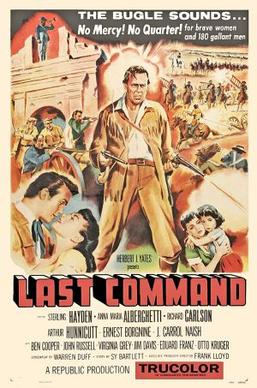
The Last Command (1955)

Of the three most well-known heroes of the battle of the Alamo, David Crockett, James Bowie and William Travis, there's no doubt who is the most well-known of the three. Oh, that'd be Crockett for those unfamiliar with history. In second place, the infamous knife fighter Jim Bowie who's had several films based on his exploits including 1952's The Iron Mistress (meh) and for today's review, 1955's The Last Command.

It's 1834, and knife fighter, adventurer and land owner Jim Bowie (Sterling Hayden) is riding south through Texas to Mexico to see his home and his family. As he rides through the territory though, he finds that many Texan colonists have had enough with Mexican president, Santa Anna (J. Carrol Naish), who's become more of a dictator with each passing day. Old friends with the president, Bowie isn't sure who to side with at first, but when his wife and children die, he's forced to come up with answers about what he believes and what he should ultimately do with the coming revolution. He joins the fighting, leading a group of volunteers. Santa Anna has started to march an army north from Mexico City to deal with the revolutionaries, and all roads lead to the town of San Antonio and a ruined old mission, the Alamo.

Anyone familiar with John Wayne's The Alamo from 1960 will no doubt notice some similarities between that film and this 1955 flick from Republic Studios. The reason? This was originally made with Wayne -- still working at Republic -- attached as an actor. He wanted to make an Alamo film, but disagreements with the studio drove the two sides apart. The end result was simple; Wayne left Republic, Republic made the film without Wayne, apparently out of spite. There are some similarities, from Davy Crockett's death to the Alamo defenders raiding the surrounding Mexican army for artillery and many others. The biggest difference though is obvious, a focus on Jim Bowie.

It's funny that in the casting of the infamous knife fighter, one of America's truly unique historical personalities, two of Hollywood's most wooden, vanilla actors were chosen. In 'Iron,' Alan Ladd starred, and here, Hayden takes the reins as Bowie. I'll say this. I don't think Hayden has a "showy" side, but he at least commits here and shows some energy in the lead. Just like Wayne's film would do, there is an unnecessary -- even painful -- love story as Bowie falls for Consuelo (Anna Maria Alberghetti), a young Mexican woman from a rich family (Eduard Franz plays her well-to-do uncle). Above all else, it's cool to see Bowie get a movie devoted to him and his involvement in the months leading up to and in the Texas Revolution. He was a fiery, passionate fighter who fought for what he believed in. His friendship with Santa Anna is a little much (the Mexican dictator affectionately calls him 'Jimmy'), but seeing a familiar story from an unfamiliar angle is refreshing.

Overall, the story focuses on a two-year period starting in 1834 and running through March 1836 and the battle and fall of the Alamo. The movie runs just 110-minutes and is a little slow-moving at times -- rather talky -- so non-history fans may lose some interest. Alamo buffs will get a kick out of the story though that focuses on Texas history that most Alamo movies simply ignore. We do meet some familiar faces, including Colonel Travis (Richard Carlson), Davy Crockett (Arthur Hunnicutt) and Lt. Dickinson (John Russell). Carlson is solid as the similarly fiery Travis, and Hunnicutt is a scene-stealer as the backwoods, storytelling Crockett that's based more in myth than the real-life Crockett. The story doesn't just jump right to the Alamo, but lays some ground work and background leading up to the famous battle. Also look for Ernest Borgnine as Mike Radin a rival-turned-friend of Bowie's and Ben Cooper as Jeb Lacey, a young Texan who looks up to Bowie. Other Alamo defenders include Slim Pickens, Jim Davis, Roy Roberts and Russell Simpson as the Parson.

The actual battle for the Alamo takes up about the last 40 minutes of 'Command.' The set is somewhat limited -- we basically see one corner of the mission along with the wooden palisade -- but there's something oddly cool about the set built near Bracketville, Texas (where Wayne's film was made). For a movie released in 1955, the final assault on the Alamo is surprisingly vicious and violent. Nothing graphic, but still pretty hardcore stuff for a 1950s audience. Each character gets their moment, their on-screen death with Bowie saved for last.

There's nothing hugely memorable about this 1955 Republic picture, but I like it just the same. Composer Max Steiner's score is a highlight -- give it a sample HERE -- and the Jim Bowie theme song (listen HERE) is pretty awful, but in an amazingly bad and memorable way. Lots of good actors, familiar faces and an enjoyable if unspectacular story in director Frank Lloyd's historical bio-pic. One IMDB reviewer points it out accurately. It's neither a big budget A-movie or a low-budget B-movie, but it's somewhere in between. TCM has three clips available so give them a watch at the link below.

The Last Command (1955): ***/****

Tuesday, November 9, 2010

Cannon for Cordoba

What I love more and more about movies as I look harder for those hard-to find gems is that there is always another gem around the corner.  They are the movies that you read about but can't find or can't afford that pricey VHS through an Amazon vendor.  They're the ones with these great casts that have somehow escaped your grasp for years.  I love stumbling across one of these older gems more than I appreciate seeing a really good new movie at the theaters.  For me, most of these gems are westerns or war movies, including 1970's Cannon For Cordoba

I read about this American western shot in Spain a few years back and was immediately interested but just couldn't find a copy anywhere, and it never seemed to be on TV anywhere.  Well, just like I was able to watch 1965's The Glory Guys last week, I found 'Cordoba' available through Netflix's Instant watch feature.  I knew from the first time I read about the movie I'd like it because it comes from the always reliable 'men on a mission' sub-genre that stretches across countless types of movies.  It is a mix somewhere between The Guns of Navarone, The Magnificent Seven, and The Professionals so it is fair to say you won't see anything you haven't seen before.  It is a western that follows the formula closely and is the better for it, even if it isn't anything new.

It's 1916 and General Black Jack Pershing (John Russell) is on the Texas/Mexico border with the U.S. army doing his best to protect the border from bandit attacks, none of whom is worse than a rogue general named Cordoba (Raf Vallone).  In a raid, Cordoba and his own army steals six artillery pieces and transport them back to his mountaintop fortress. Pershing has no option but to send some men undercover into Mexico to destroy the guns and possibly bring Cordoba out alive.  He chooses an officer, Captain Rod Douglas (George Peppard) to the lead the raid that will have his team travel 200 dangerous miles into Mexico. On his team are three men from his unit (Don Gordon, Pete Duel, and Nico Minardos), a Mexican officer (Gabriele Tinti) and a beautiful, mysterious woman who will be used as bait looking for revenge (Giovanni Ralli).  The odds are stacked against them though, and Douglas isn't sure any of them will come back.

Director Paul Wendkos sticks close the successful men on a mission formula from beginning to end here, and turns in a finished product that will never be thought of as classic, but it's like comfort food.  Just cause you've seen it before doesn't mean it's a bad thing.  He lays things out with an evil general as the villain, establishes a suicidal mission, assembles a team of specialists to pull off the job, throws in some curveballs, and lets the action take over.  Throw in a solid if unspectacular score from composer Elmer Bernstein, beautiful location shooting in Spain, a touch of nudity here and there, and enough action to fill in all the gaps.  It's typical of cheaper but well made westerns from the late 1960s and early 1970s that weren't trying to change the world. They were content to be damn entertaining, and whoever didn't like it didn't have to watch.

After some huge success in the early 1960s, Peppard was at a bit of a crossroads in his career, taking parts wherever he could get them.  He's not slumming here, but the part and movie as a whole clearly isn't as large scale as he'd probably like.  Playing Capt. Douglas, Peppard is a nice choice to lead a small team of specialists on a suicide mission.  He was cool in just about everything he did, and his cigar chomping (hello Hannibal!), don't give a damn officer is a solid anti-hero to lead the proceedings.  His team is made up of TV actors, and the four are given just enough background to make them interesting.  Gordon is the soldier looking for revenge against Peppard, Duel is Andy, the fun-loving nut of the group ready to turn on anyone and everyone, Minardos is the Greek immigrant with a touch for explosives, and Tinti is the loyal Mexican officer also looking for some vengeance.  I was surprised by which ones of the group actually makes it through the mission, but that's always part of the fun with these men on a mission movies.

This is an action western, and Wendkos does not disappoint.  Three huge set pieces dominate the gunplay, all building up to the explosive finale that is just an orgy of gunfire, explosions and nameless henchmen getting blown away.  Cordoba's raid on the cannons starts things off on a big scale, followed by Peppard's team tangling with some of Cordoba's men in a ruined, crumbling church.  Smaller scale, but still exciting.  Then in the finale, the actual suicidal mission.  For one, Cordoba's mountaintop fortress is a very cool set so placing a battle in its midst with chaos and explosions everywhere is a great finish.  It reminded me some of the ending to another Wendkos western, Guns of the Magnificent Seven, in terms of the large scope it takes.  Exciting to the very end with some good twists.

For a story set in the Mexican Revolution, 'Cordoba' does follow a fair share of genre conventions, all the better to stick with that formula.  You've got the generic evil general, the waves of nameless men in his armies more interested in women and drinking than fighting, and the requisite European general -- Swedish, not German this time -- played by Hans Meyer.  Vallone is given little to do as the evil Cordoba, but he looks the part with that menacing glint in his eyes.  He of course gets his comeuppance in the end as the bad guy always does.  A classic this is not, but an exciting, always entertaining western that is worth tracking down. No luck finding a trailer either, my apologies.

Cannon for Cordoba (1970): ***/****

Sunday, February 22, 2009

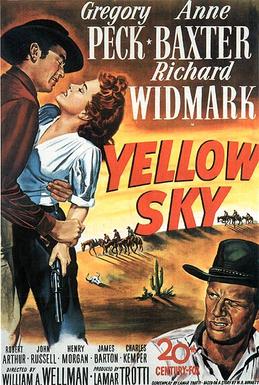
Netflix review #7: Yellow Sky

In the late 1940s when westerns still portrayed good guys in white taking on bad guys wearing black, William Wellman's Yellow Sky was released in theaters in 1948. It's a western that seems more fitting for the late 1960s or early 1970s with its presentation of characters and their interactions.

In 1867, a gang robs a bank in a small town and high tails it out of town with a cavalry troop hot on their trail. Their leader, Stretch Dawson (Gregory Peck), takes them out onto the salt flats, 70 miles of desolate, uninhabited land, leaving the cavalry behind. After days of riding with little water, they stumble upon a ghost town called Yellow Sky. The only residents are an old man and his granddaugther. Dawson and Co. begin to wonder why these two are out in the wilderness? They find out quickly enough, there's gold in the hills. Tensions rise immediately at the mention of gold. Who's going to turn on who?

First off, the characters look like they're straight out of the old west. Their clothes are dusty, they stink, their faces show the wear and tear of riding in the sun, and they're all sporting beards. Remember, no barbers out in the desert. Too many westerns have the star in immaculate clothes that look newly-bought, but not here.

Second, there's no good guys anywhere in sight, just varying degrees of badness. Peck ends up being the closest to the hero as the gang leader who begins to question what his men are doing. Richard Widmark is his counterpart, Dude, the biggest villain in the group who's interested in himself and little else. The gang is willing to turn on each other at the drop of hat. Supporting cast as the gang includes Robert Arthur, Harry Morgan, Charles Kemper, Robert Adler, and John Russell.

Third, a female character is introduced but she doesn't feel like an add-on, she belongs. Anne Baxter plays Constance Mae, "Mike," the young woman living with her grandpa out in the desert. She can shoot and throw a punch as good as any man. Baxter presents a strong female character when so often westerns used women as the damsel in distress.

Released late in the 40s when film noir was so popular, this western could fit in that genre. Lots of pyschological undertones, shadowy scenes, and plenty of backstabbing. Yellow Sky is almost bored with the action scenes, but it works. A finale with a three-way shootout in an abandoned saloon isn't even seen, only heard. It doesn't even matter though, you'll be wrapped up in what's going on.

The DVD has the movie in its standard presentation, looking great with the black and white cinematography in the Death Valley filming locations. Shots of riders crossing a vacant desert as blips on the sand stand out as memorable, years before David Lean did similar shots in Lawrence of Arabia. Special features include three photo galleries, a trailer, and three trailers for other Fox Flix westerns.

Yellow Sky (1948): ***/****