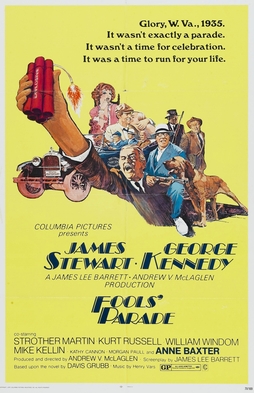
So you know what sounded pretty awful? The Great Depression. Man, I'm good at writing introductions to these reviews, aren't I? For every well-known Depression-era movie out there, it seems like there's that many more generally forgotten in a wave of flicks. Here's one I stumbled across on a cable movie channel recently and simply couldn't pass up because of an impressive cast, 1971's Fools' Parade.
It's 1935 and three convicts are being released from a West Virginia penitentiary, including Mattie Appleyard (James Stewart), Lee (Strother Martin) and Johnny (Kurt Russell), all of them having served their sentence for varying crimes. They're driven to the train station by a vicious prison guard, Doc Council (George Kennedy), who ominously states that he'll see them soon. The trio boards the train with plans of opening a general store down the train line, using Mattie's hard-earned savings as a bankroll to get things started. There's a problem though as they get further away from the town and penitentiary. Mattie's check -- earned and saved from 40 years in prison -- can only be cashed back in Glory...where they've been less than pleasantly told to never come back. If they do, Council will be waiting for them. That's not their only problem. Council may not even be waiting that long to hunt them down...
From the older classic like The Grapes of Wrath to the newer entries like O, Brother, Where Art Thou, Depression-era flicks are a cool little genre of flicks that doesn't always get a ton of attention. Maybe it's the whole soul-killing tone of these flicks. Maybe. I don't know. The 1970's especially had some cool entries, including this flick, Emperor of the North Pole, Hard Times, Paper Moon and Dillinger among others. 'Parade' belongs in that group. It's dark(ish), gritty and has the look and feel of one of America's roughest historical stretches.
So why then does this 1971 drama with some light comedy touches have virtually no reputation? Virtually no following? Well, for starters, it most definitely and assuredly is very, very odd. I can't specifically put a finger on said oddness, but it is. It's there. It...is...odd. Maybe as close as I can get is the tone, or lack of. From director Andrew McLaglen and a screenplay by James Lee Barrett, 'Parade' is just a bit of an oddball flick. It's able to build up an impressive sense of doom early on but it never quite takes off. Things slowly derail as the 98-minute running time nears its finish. Still, this is a movie that's never dull or boring. Very watchable, just odd.
Sometimes, an all over the place tone comes in second to something, anything else that's far more appealing. Here, that's easy. It's the cast. That cast. We mostly follow our three recently-freed crooks in Stewart, Martin and Russell. Stewart's Mattie served a 40-year sentence for killing two men, Martin's Lee six years for bank robbery, and Russell's Johnny a shorter sentence for an incident with a girl that's generally left unexplained. The story doesn't linger long on our trio's past criminal transgressions (wisely), instead focusing on them trying to start over again, albeit at different points in their lives. I especially liked Stewart as Mattie, sporting a bizarre-looking glass eye, the oldest of the three who most strongly wants that fresh start. He stashed away all his money during his 40-year sentence (earning a ridiculous-sounding $25,000) and now meets all sorts of roadblocks in getting that cash. Martin's Lee is seemingly a little simple-minded in his obsession with putting together a general store inventory while Russell's Johnny is stubbornly loyal to Mattie. Still, there's something charming about the trio, and there is a solid chemistry among the group.
An interesting cast all-around. When he wanted to, George Kennedy could play one interesting bad guy, and that's on display here. It's just creepy watching him. You're rooting for him to get his due and get it badly. Who else to watch for? An unrecognizable Anne Baxter as a madam who's fallen on hard times, William Windom as an unlucky traveling salesman, Mike Kellin and Morgan Paull as Doc's oddball killers, Robert Donner as a train conductor, Katherine Cannon as Baxter's lone "girl," and David Huddleston as the greedy bank owner. Quite the eclectic bunch!
I can't quite put my finger on it as to 'why' exactly, but I very much enjoyed this movie. Though the subject matter is dark, it is an easy-going, mostly pleasant movie. Yeah, it is a touch slow at times for a movie that runs just 98-minutes, but it is never dull. The West Virginia filming locations are an ideal backdrop for the story as well, giving it an authentic sense of watching where this story would have actually happened. Worth a watch. Apparently, it's somewhat difficult to find so here's my help to the situation. I watched it on Retro, a movie channel coupled with the Encore package on cable. It's a movie I recommend tracking down. Hope you enjoy it!
Fools' Parade (1971): ***/****
The Sons of Katie Elder
"First, we reunite, then find Ma and Pa's killer...then read some reviews."
Showing posts with label Anne Baxter. Show all posts
Thursday, January 21, 2016
Tuesday, June 4, 2013
Three Violent People
While the Civil War officially ended when Robert E. Lee surrendered to Ulysses Grant at Appomattox Courthouse in April 1865, the fighting continued for several months throughout the country as the news spread. Beyond the fighting though, the nation had to deal, and it came in one of U.S. history's nastiest periods, the Reconstruction Era. It's a touchy suspect and not surprisingly hasn't been dealt much via film. Released in 1956, Three Violent People kinda deals with the time period. Kinda.
It's been a few months since the end of the Civil War, and decorated Confederate cavalry officer Capt. Colt Saunders (Charlton Heston) is trying to return home to his cattle ranch in Texas. Making one last stop, he's knocked out in a fight as he tries to rescue a beautiful woman from some drunken carpetbaggers. The woman's name is Lorna (Anne Baxter), and she's a former dance hall girl but doesn't tell Colt that. They marry within hours of meeting and head to the ranch, but problems galore await. The provisional government, including Commissioner Harrison (Bruce Bennett), is scooping up land, cattle and horses with little in return for the owners. Looking to keep his ranch going, Colt has no intention of just handing over everything he owns. As Lorna holds out on her secret, Colt readies for a fight to protect what's his own.
Telling the story of the Reconstruction era via a Texas ranch is a pretty cool idea for director Rudolph Mate's western. The opening scene does a solid job of setting the stage. Carpetbaggers have descended on towns all across the war-torn south, scooping up businesses and failed ranches for rock bottom prices. A Confederate vet and a native Texan, Colt obviously doesn't abide by this new development. It's cool to see a western deal with this subject, especially the corruption that riddled the government. In hopes of rebuilding the country, some rather nasty decisions had to be made.
Unfortunately though, that's probably the best thing going for Mate's film; the story. Basically everything else falls short, starting with the leads. Heston was always at home in historical flicks whether they be westerns, biblical stories, or period pieces. It's odd then saying that he's miscast here as Capt. Colt Saunders a fiery, short-tempered rancher who does what he needs/wants and everything else can be damn. Heston could be all of those things depending on the role, but he looks to be sleepwalking here. It obviously doesn't help then when Heston and Baxter have little to no chemistry together. The whole relationship seems forced and goofy, the duo exchanging lots of passionate embraces and even....GASP!....a few kisses. And fade to black!
The rest of the cast is slightly better if still misused or underused. Gilbert Roland is not surprisingly a scene-stealer as Innocencio, Colt's top hand and longtime worker at the ranch. We've seen the part before as Roland uses a mix of Spanglish and 'Ay Chihuahua!' moments. Still, he's good at it so be it. Even look for some familiar faces among his five sons, the very Mexican-looking Robert Blake and a pre-MASH Jamie Farr. Tom Tryon has a cool character as Cinch, Colt's one-armed younger brother who holds a ton of resentment for his brother, but Tryon's not the most personable actor. Bennett is slimy as Harrison with Forrest Tucker wasted as his main henchman, Cable.
With a slow-moving, sappy story, I really disliked the first hour-plus of this 99-minute flick. The final half hour or so saves it from being a complete waste of time thankfully. All these different characters and rivalries finally step up to the plate and embrace some of their Greek mythology roots. Brother hates brother? Wife with secret hates husband? Betrayals, greed and redemption? Yes, it must be Greek mythology! The ending is a little too tidy, but it is significantly more enjoyable than the first hour. Still not a great movie, but not awful. If that's not a ringing endorsement, I don't know what is.
Three Violent People (1956): **/****
It's been a few months since the end of the Civil War, and decorated Confederate cavalry officer Capt. Colt Saunders (Charlton Heston) is trying to return home to his cattle ranch in Texas. Making one last stop, he's knocked out in a fight as he tries to rescue a beautiful woman from some drunken carpetbaggers. The woman's name is Lorna (Anne Baxter), and she's a former dance hall girl but doesn't tell Colt that. They marry within hours of meeting and head to the ranch, but problems galore await. The provisional government, including Commissioner Harrison (Bruce Bennett), is scooping up land, cattle and horses with little in return for the owners. Looking to keep his ranch going, Colt has no intention of just handing over everything he owns. As Lorna holds out on her secret, Colt readies for a fight to protect what's his own.
Telling the story of the Reconstruction era via a Texas ranch is a pretty cool idea for director Rudolph Mate's western. The opening scene does a solid job of setting the stage. Carpetbaggers have descended on towns all across the war-torn south, scooping up businesses and failed ranches for rock bottom prices. A Confederate vet and a native Texan, Colt obviously doesn't abide by this new development. It's cool to see a western deal with this subject, especially the corruption that riddled the government. In hopes of rebuilding the country, some rather nasty decisions had to be made.
Unfortunately though, that's probably the best thing going for Mate's film; the story. Basically everything else falls short, starting with the leads. Heston was always at home in historical flicks whether they be westerns, biblical stories, or period pieces. It's odd then saying that he's miscast here as Capt. Colt Saunders a fiery, short-tempered rancher who does what he needs/wants and everything else can be damn. Heston could be all of those things depending on the role, but he looks to be sleepwalking here. It obviously doesn't help then when Heston and Baxter have little to no chemistry together. The whole relationship seems forced and goofy, the duo exchanging lots of passionate embraces and even....GASP!....a few kisses. And fade to black!
The rest of the cast is slightly better if still misused or underused. Gilbert Roland is not surprisingly a scene-stealer as Innocencio, Colt's top hand and longtime worker at the ranch. We've seen the part before as Roland uses a mix of Spanglish and 'Ay Chihuahua!' moments. Still, he's good at it so be it. Even look for some familiar faces among his five sons, the very Mexican-looking Robert Blake and a pre-MASH Jamie Farr. Tom Tryon has a cool character as Cinch, Colt's one-armed younger brother who holds a ton of resentment for his brother, but Tryon's not the most personable actor. Bennett is slimy as Harrison with Forrest Tucker wasted as his main henchman, Cable.
With a slow-moving, sappy story, I really disliked the first hour-plus of this 99-minute flick. The final half hour or so saves it from being a complete waste of time thankfully. All these different characters and rivalries finally step up to the plate and embrace some of their Greek mythology roots. Brother hates brother? Wife with secret hates husband? Betrayals, greed and redemption? Yes, it must be Greek mythology! The ending is a little too tidy, but it is significantly more enjoyable than the first hour. Still not a great movie, but not awful. If that's not a ringing endorsement, I don't know what is.
Three Violent People (1956): **/****
Labels:
1950s,
Anne Baxter,
Charlton Heston,
Forrest Tucker,
Gilbert Roland,
Rudolph Mate,
westerns
Friday, August 3, 2012
I Confess
As a director, some individuals just have a talent that others can only hope to attain. I've always thought of Alfred Hitchcock as one of those very unique, very talented directors. He's able to turn the typical, the usual, even the mundane into something special and fun to watch. Anyone who's ever watched a police procedural has heard of doctor-patient confidentiality, or the same principle between a priest hearing someone's confession. But a whole movie on that simple law-abiding premise? Hitchcock does it again with 1953's I Confess.
Working at St. Marie's Church in Quebec, Father Michael Logan (Montgomery Clift) is in the quiet, empty church one night when Otto Keller (O.E. Hasse), the church caretaker, stumbles in. Keller tells Father Logan that he's accidentally killed a man and doesn't know what to do. Logan hears his confession but doesn't know what else to do. The next morning he visits the dead man's home where Keller has "stumbled" across the body and called the police. Through an unlucky set of circumstances and clues, the police, including persistent Inspector Larrue (Karl Malden), believe Logan is a top suspect. It seems ridiculous, but could Father Logan actually be hiding something? His vows as a priest prevent him from completely exonerating himself as he's unable to tell the police who the killer really is
With some obvious tweaks, 'Confess' bears some resemblance to The Wrong Man, Hitchcock's film made three years later where an innocent man is believed by everyone and their mother to be a killer. But just looking at this 1953 venture on originality alone, 'Confess' gets a lot of brownie points. The whole success of the story -- and Clift's typically fine acting -- depends on that one unique situation. Clift's Father Logan's situation hangs in the balance. Does he maintain his vows and keep Keller's confession secret? Does he save himself, basically renouncing everything he admits he believes in? It is the simplest of plot devices and the most clever at the same time. Hitchcock takes that simple premise and instead of swinging and missing, hits a home run.
One of the coolest things going for this movie was the use of on-location shooting for much of the indoor and outdoor scenes. It took me a little while to realize the story was set in Quebec, and why everyone was either speaking French, had a French name, and why Father Logan seems very American. Interior shots at churches, hotels, and a variety of spots around Quebec give the proceedings an authentic feel that studio shots just couldn't match. Also worth mentioning is Dimitri Tiomkin's musical score. It's obviously a little different from a typical Franz Waxman (Hitchcock's usual composer), but it is effective to build up some tension as everything points to Father Logan being the real killer.
The combination of the ultra-professional in Hitchcock and method acting Clift not surprisingly produced some fireworks on-set during filming. The director grew increasingly frustrated with Clift's botching multiple takes as he tried to get scenes just right. Whatever the process to get to the end result, I thought Clift did a great job with the role. No one did the tortured, flawed individual in the 1950s quite like Montgomery Clift, and he doesn't disappoint. His past comes out over the course of the movie -- wouldn't you know it? It's a checkered past -- and he truly wants to maintain his beliefs and principles, even if it ends up costing him his career, his reputation, and possibly his life if the evidence does enough to convict him.
Beyond Clift as the tortured priest with a moral and ethical decision, the cast is uniformly solid. Hasse as the real killer, Keller, is a despicable human being. He admits to the murder having looked for some easy cash, but then to protect himself basically turns on everyone around him, including guilt-tripping his wife (Dolly Haas). A villain who starts as one thing and develops into another, one who's very easy to hate. Anne Baxter is the mysterious Ruth (what a sexy name, huh?), a woman who may be involved with the murder and Logan's past too. Malden is the dogged police investigator, following the clues as needed in a case with no obvious suspects. Brian Aherne is the chief prosecutor, smelling blood in the water once a suspect is presented, Roger Dann is Ruth's well-to-do and powerful husband, and Charles Andres as Father Millars, the head priest at St. Marie's.
I Confess is not always mentioned as one of Hitchcock's best, instead hiding in the weeds with all his other solid if unspectacular films waiting to be discovered by audiences. It isn't necessarily on par with his best efforts, but it certainly is above average. Definitely worth a watch for his fans, but also a good introduction to Hitchcock in general.
I Confess <---trailer (1953): ***/****
Working at St. Marie's Church in Quebec, Father Michael Logan (Montgomery Clift) is in the quiet, empty church one night when Otto Keller (O.E. Hasse), the church caretaker, stumbles in. Keller tells Father Logan that he's accidentally killed a man and doesn't know what to do. Logan hears his confession but doesn't know what else to do. The next morning he visits the dead man's home where Keller has "stumbled" across the body and called the police. Through an unlucky set of circumstances and clues, the police, including persistent Inspector Larrue (Karl Malden), believe Logan is a top suspect. It seems ridiculous, but could Father Logan actually be hiding something? His vows as a priest prevent him from completely exonerating himself as he's unable to tell the police who the killer really is
With some obvious tweaks, 'Confess' bears some resemblance to The Wrong Man, Hitchcock's film made three years later where an innocent man is believed by everyone and their mother to be a killer. But just looking at this 1953 venture on originality alone, 'Confess' gets a lot of brownie points. The whole success of the story -- and Clift's typically fine acting -- depends on that one unique situation. Clift's Father Logan's situation hangs in the balance. Does he maintain his vows and keep Keller's confession secret? Does he save himself, basically renouncing everything he admits he believes in? It is the simplest of plot devices and the most clever at the same time. Hitchcock takes that simple premise and instead of swinging and missing, hits a home run.
One of the coolest things going for this movie was the use of on-location shooting for much of the indoor and outdoor scenes. It took me a little while to realize the story was set in Quebec, and why everyone was either speaking French, had a French name, and why Father Logan seems very American. Interior shots at churches, hotels, and a variety of spots around Quebec give the proceedings an authentic feel that studio shots just couldn't match. Also worth mentioning is Dimitri Tiomkin's musical score. It's obviously a little different from a typical Franz Waxman (Hitchcock's usual composer), but it is effective to build up some tension as everything points to Father Logan being the real killer.
The combination of the ultra-professional in Hitchcock and method acting Clift not surprisingly produced some fireworks on-set during filming. The director grew increasingly frustrated with Clift's botching multiple takes as he tried to get scenes just right. Whatever the process to get to the end result, I thought Clift did a great job with the role. No one did the tortured, flawed individual in the 1950s quite like Montgomery Clift, and he doesn't disappoint. His past comes out over the course of the movie -- wouldn't you know it? It's a checkered past -- and he truly wants to maintain his beliefs and principles, even if it ends up costing him his career, his reputation, and possibly his life if the evidence does enough to convict him.
Beyond Clift as the tortured priest with a moral and ethical decision, the cast is uniformly solid. Hasse as the real killer, Keller, is a despicable human being. He admits to the murder having looked for some easy cash, but then to protect himself basically turns on everyone around him, including guilt-tripping his wife (Dolly Haas). A villain who starts as one thing and develops into another, one who's very easy to hate. Anne Baxter is the mysterious Ruth (what a sexy name, huh?), a woman who may be involved with the murder and Logan's past too. Malden is the dogged police investigator, following the clues as needed in a case with no obvious suspects. Brian Aherne is the chief prosecutor, smelling blood in the water once a suspect is presented, Roger Dann is Ruth's well-to-do and powerful husband, and Charles Andres as Father Millars, the head priest at St. Marie's.
I Confess is not always mentioned as one of Hitchcock's best, instead hiding in the weeds with all his other solid if unspectacular films waiting to be discovered by audiences. It isn't necessarily on par with his best efforts, but it certainly is above average. Definitely worth a watch for his fans, but also a good introduction to Hitchcock in general.
I Confess <---trailer (1953): ***/****
Labels:
1950s,
Alfred Hitchcock,
Anne Baxter,
Karl Malden,
Montgomery Clift
Monday, July 16, 2012
Cimarron (1960)
My typical stance on an epic film is 'Bring it on.' You can't have too many of them, especially from the age of the epics, the 1950s through the 1960s. These are big, big movies. Then, I think of my favorite genre; the western. I can't name many quality epic, classic westerns. One exception is How the West Was Won, but I'm drawing a blank as to others. One that aspires to be an epic but ultimately fails is 1960's Cimarron.
Having put his wild cowboy drifting days behind him, Yancy 'Cimarron' Cravat (Glenn Ford) hopes to settle down with his newlywed bride, Sabra (Maria Schell). Yancy's plan starts with an impossible offer from the government, one that seems too good to be true. The Oklahoma territory and its millions of acres will be open to anyone who can stake a claim (the 1889 Land Run, read HERE), and Yancy has a spot all picked out to start a family with Sabra. Things don't go quite as planned though, forcing the couple to improvise and adjust. Setting up a small newspaper in Osage, Oklahoma, Yancy and Sabra are to become part of an era in American history full of drastic and modern change.
From director Anthony Mann, this is an appropriately big epic. The scale is impressive with scenes of hundreds of extras filling the screen behind the biggest names in the cast. None is more impressive than the depiction of the Oklahoma land rush. Literally hundreds of riders and wagons fill the screen from edge to edge as all these hopeful land owners race to stake a claim to their own land. Scenes like this make you appreciate what an epic is in all of its glory on such a large scale. The look of the movie is a beauty from the open prairies of the 1880s to the settled cityscapes of the 1910s. But that is where the positives end unfortunately.
Even with a movie clocking in at 149 minutes, it feels like Cimarron tackles too much. The story covers 25-plus years, but doesn't cover any of those years adequately. The script has jumps in times that come fast and furious, jumping a few months one time and then ten years the next. An episodic, somewhat drifting story can be a necessity dealing with a film of this scale, but at some point it has to be interesting even just a little bit. The tinier episodes here lack any of that interest with an exception here and there. Mann was at his best with smaller scale stories -- The Naked Spur, The Man from Laramie -- but struggles with stories of this magnitude. There's little heart, little emotion, and little interest to see a budding America growing from the wild west to the modern world.
That lack of emotion can be chalked up to any number of things, but the most glaring mistake was the casting. From top to bottom, 'Cimarron' lacks the huge star power of other epics, but that's not a deal breaker. It is though when almost to a man the characters are miscast. Ford and Schell don't have a great chemistry; a problem when these two characters are magnetically drawn together by their unexplained love. Ford's Yancy is trying to put a somewhat checkered past behind him, but that past is never even remotely dealt with, only hinted at. His character ends up being this icon of a growing America, and I'm thinking 'Really?' He bails on his wife for five years at one point, ten years at another. Schell too is trying here, but a character that could -- and probably should -- have been sympathetic comes across as shrill and whiny. When the two leads aren't especially likable, we could be in for a long ride.
The rest of the cast is hit or miss, and as is the case with epics gone bad, it's not always their fault. The ones given more screentime include Arthur O'Connell and Mercedes McCambridge as Tom and Sarah Wyatt, parents of a brood of eight trying to start a new life, a family that befriends Yancy and Sabra. Russ Tamblyn is a scene-stealer as the Cherokee Kid, a troubled youth Yancy tries to help with Vic Morrow as part of his gang. Anne Baxter is wasted as Dixie, a former love of Yancy's who now holds a grudge against him, a businesswoman who opens a whorehouse (a classy one at least). Potential for a cool character, but she's gone halfway through the movie. Also throw in Robert Keith, Charles McGraw, Harry Morgan, Edgar Buchanan, L.Q. Jones and David Opatoshu in supporting parts, some gone in a flash so don't blink. The problem is not the actors, but the lack of any character development. They drift in as needed and disappear as quickly as they appeared. Lots of potential for some very interesting characters, but nothing comes of it as Yancy and Sabra's story develops.
Once again, this won't sound like it makes a whole lot of sense, but there's both too much and not enough going on in a 149-minute movie. It's dull. The story moves along far too fast, glazing over significant portions of the story. I can't think of an epic with characters as unsympathetic as the ones here. I didn't care for most of the characters or how things ended up, and in the end, nothing comes of it. The resolution (using that term loosely) is disappointing and seemingly hypocritical for what we've seen up to this point. An epic attempt, but ultimately a disappointing failure.
Cimarron <---TCM trailer (1960): **/****
Having put his wild cowboy drifting days behind him, Yancy 'Cimarron' Cravat (Glenn Ford) hopes to settle down with his newlywed bride, Sabra (Maria Schell). Yancy's plan starts with an impossible offer from the government, one that seems too good to be true. The Oklahoma territory and its millions of acres will be open to anyone who can stake a claim (the 1889 Land Run, read HERE), and Yancy has a spot all picked out to start a family with Sabra. Things don't go quite as planned though, forcing the couple to improvise and adjust. Setting up a small newspaper in Osage, Oklahoma, Yancy and Sabra are to become part of an era in American history full of drastic and modern change.
From director Anthony Mann, this is an appropriately big epic. The scale is impressive with scenes of hundreds of extras filling the screen behind the biggest names in the cast. None is more impressive than the depiction of the Oklahoma land rush. Literally hundreds of riders and wagons fill the screen from edge to edge as all these hopeful land owners race to stake a claim to their own land. Scenes like this make you appreciate what an epic is in all of its glory on such a large scale. The look of the movie is a beauty from the open prairies of the 1880s to the settled cityscapes of the 1910s. But that is where the positives end unfortunately.
Even with a movie clocking in at 149 minutes, it feels like Cimarron tackles too much. The story covers 25-plus years, but doesn't cover any of those years adequately. The script has jumps in times that come fast and furious, jumping a few months one time and then ten years the next. An episodic, somewhat drifting story can be a necessity dealing with a film of this scale, but at some point it has to be interesting even just a little bit. The tinier episodes here lack any of that interest with an exception here and there. Mann was at his best with smaller scale stories -- The Naked Spur, The Man from Laramie -- but struggles with stories of this magnitude. There's little heart, little emotion, and little interest to see a budding America growing from the wild west to the modern world.
That lack of emotion can be chalked up to any number of things, but the most glaring mistake was the casting. From top to bottom, 'Cimarron' lacks the huge star power of other epics, but that's not a deal breaker. It is though when almost to a man the characters are miscast. Ford and Schell don't have a great chemistry; a problem when these two characters are magnetically drawn together by their unexplained love. Ford's Yancy is trying to put a somewhat checkered past behind him, but that past is never even remotely dealt with, only hinted at. His character ends up being this icon of a growing America, and I'm thinking 'Really?' He bails on his wife for five years at one point, ten years at another. Schell too is trying here, but a character that could -- and probably should -- have been sympathetic comes across as shrill and whiny. When the two leads aren't especially likable, we could be in for a long ride.
The rest of the cast is hit or miss, and as is the case with epics gone bad, it's not always their fault. The ones given more screentime include Arthur O'Connell and Mercedes McCambridge as Tom and Sarah Wyatt, parents of a brood of eight trying to start a new life, a family that befriends Yancy and Sabra. Russ Tamblyn is a scene-stealer as the Cherokee Kid, a troubled youth Yancy tries to help with Vic Morrow as part of his gang. Anne Baxter is wasted as Dixie, a former love of Yancy's who now holds a grudge against him, a businesswoman who opens a whorehouse (a classy one at least). Potential for a cool character, but she's gone halfway through the movie. Also throw in Robert Keith, Charles McGraw, Harry Morgan, Edgar Buchanan, L.Q. Jones and David Opatoshu in supporting parts, some gone in a flash so don't blink. The problem is not the actors, but the lack of any character development. They drift in as needed and disappear as quickly as they appeared. Lots of potential for some very interesting characters, but nothing comes of it as Yancy and Sabra's story develops.
Once again, this won't sound like it makes a whole lot of sense, but there's both too much and not enough going on in a 149-minute movie. It's dull. The story moves along far too fast, glazing over significant portions of the story. I can't think of an epic with characters as unsympathetic as the ones here. I didn't care for most of the characters or how things ended up, and in the end, nothing comes of it. The resolution (using that term loosely) is disappointing and seemingly hypocritical for what we've seen up to this point. An epic attempt, but ultimately a disappointing failure.
Cimarron <---TCM trailer (1960): **/****
Thursday, March 4, 2010
Five Graves to Cairo
Walking out of the desert after his tank was destroyed and his crew killed, Cpl. J.J. Bramble (Franchot Tone) wearily stumbles into a hotel in a dusty, bombed-out town. The owner, Farid (Akim Tamiroff), and his staff of one, housekeeper Mouche (Anne Baxter), don't know what to do with him and the situation instantly escalates when a German convoy drives into town. It's an advance group of Field Marshall Erwin Rommel's headquarters looking to set up HQ as the Germans march back across Egypt, pushing the British back with ease. When Rommel's aide (Peter van Eyck) questions who the man is, Bramble poses as the hotel's waiter who was killed in the previous night's bombing.
But just looking for any shot at survival, Bramble's plan falls apart. The actual waiter, an Alsatian by the name of Paul Davos, was a German agent working as an advance scout for the German attacks. Luckily, no one knew Davos by appearance, only by reputation, so Bramble is able to play along and poses as the agent. Even Rommel (Erich von Stroheim) falls for the ruse, talking openly about his plans for an upcoming attack. But more importantly, Rommel talks about secret supply depots, the 'Five Graves,' buried deep beneath the Egyptian desert, explaining how his lines and troops are so well-supplied. But surrounded by Germans, can Bramble figure a way to get this information to the retreating Allies?
From the moment the Germans arrive, it's pretty clear who Bramble is going to have to worry about, Van eyck's German lieutenant, Schwegler. Based on a play by Lajos Biro, Wilder's story has that claustrophobic feel of being on a stage with Farid's run-down hotel substituting for that stage. Bramble is between a rock and a hard place; he can't run away, where would he go? Into the desert? If he stays, he's almost surely to be caught sooner or later. Instead, he's forced to hide in a hornets' nest of people who would shoot him as easily as snapping their fingers if they figured out his actual identity.
Wilder films these hotel scenes -- many of them at night -- in the dark and shadows where anything could be waiting to strike. This is not a large hotel with just 16 rooms so Bramble, Farid and Mouche room just a few doors down from Rommel and his staff. That does provide for some awkward moments as Bramble is a bit of a loud talker, making me question how no one heard him spouting his plans to ruin the Germans. These are some great scenes, full of foreboding and claustrophobia that Bramble is stuck in this situation with nowhere to go.
With this self-contained story -- the war somehow feels very far off even though bombs are dropping not too far away -- the characters are more archetypal than red-blooded, 3-D characters. Tone's Bramble is the stiff upper-lip British soldier who sees a chance to cripple the German war effort. Baxter's Mouche is a young French woman looking to rescue her brother from a German concentration camp and is not beneath conspiring with the Germans to get what she wants. Tamiroff's Farid is a worrier, both for his life and his hotel, and is more of a stereotype than anything but he still manages to make the character sympathetic. von Stroheim and van Eyck are perfectly cast as the intimidating Germans, and von Stroheim especially is an inspired choice to play Rommel, although he does make him a bit of an eccentric.
Released in 1943, Wilder's movie is suspiciously devoid of a propaganda, war-time message...until the end. For about 80 minutes, this is a spy story in a war setting full of tension and drama. The last 15 minutes try to deliver that ever-important message of hope to the home front. Surprisingly enough, this message works surprisingly well because of a twist revealed in these final scenes. Leave it to a pro like Wilder to make a propaganda message actually entertaining. Too often movies released in wartime sacrifice story and entertainment for delivering that message, but not Wilder, who revels in it and fits it in nicely with his script. A hidden gem from one of Hollywood's most well-known and well-respected directors.
Five Graves to Cairo <----trailer (1943): ***/****
Labels:
1940s,
Akim Tamiroff,
Anne Baxter,
Billy Wilder,
Franchot Tone,
Peter van Eyck,
WWII
Sunday, February 22, 2009
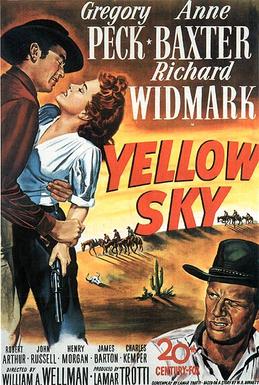
Netflix review #7: Yellow Sky
In the late 1940s when westerns still portrayed good guys in white taking on bad guys wearing black, William Wellman's Yellow Sky was released in theaters in 1948. It's a western that seems more fitting for the late 1960s or early 1970s with its presentation of characters and their interactions.
In 1867, a gang robs a bank in a small town and high tails it out of town with a cavalry troop hot on their trail. Their leader, Stretch Dawson (Gregory Peck), takes them out onto the salt flats, 70 miles of desolate, uninhabited land, leaving the cavalry behind. After days of riding with little water, they stumble upon a ghost town called Yellow Sky. The only residents are an old man and his granddaugther. Dawson and Co. begin to wonder why these two are out in the wilderness? They find out quickly enough, there's gold in the hills. Tensions rise immediately at the mention of gold. Who's going to turn on who?
First off, the characters look like they're straight out of the old west. Their clothes are dusty, they stink, their faces show the wear and tear of riding in the sun, and they're all sporting beards. Remember, no barbers out in the desert. Too many westerns have the star in immaculate clothes that look newly-bought, but not here.
Second, there's no good guys anywhere in sight, just varying degrees of badness. Peck ends up being the closest to the hero as the gang leader who begins to question what his men are doing. Richard Widmark is his counterpart, Dude, the biggest villain in the group who's interested in himself and little else. The gang is willing to turn on each other at the drop of hat. Supporting cast as the gang includes Robert Arthur, Harry Morgan, Charles Kemper, Robert Adler, and John Russell.
Third, a female character is introduced but she doesn't feel like an add-on, she belongs. Anne Baxter plays Constance Mae, "Mike," the young woman living with her grandpa out in the desert. She can shoot and throw a punch as good as any man. Baxter presents a strong female character when so often westerns used women as the damsel in distress.
Released late in the 40s when film noir was so popular, this western could fit in that genre. Lots of pyschological undertones, shadowy scenes, and plenty of backstabbing. Yellow Sky is almost bored with the action scenes, but it works. A finale with a three-way shootout in an abandoned saloon isn't even seen, only heard. It doesn't even matter though, you'll be wrapped up in what's going on.
The DVD has the movie in its standard presentation, looking great with the black and white cinematography in the Death Valley filming locations. Shots of riders crossing a vacant desert as blips on the sand stand out as memorable, years before David Lean did similar shots in Lawrence of Arabia. Special features include three photo galleries, a trailer, and three trailers for other Fox Flix westerns.
Yellow Sky (1948): ***/****
Subscribe to:
Posts (Atom)