Released in 1950 and based off a novel by writer W.R. Burnett, The Asphalt Jungle has withstood the test of time and still remains one of the best examples of a film noir ever released. It is a classic that deserves its reputation built up over the years. Just eight years later, the successful noir was back in theaters with a little twist, it was now a western, the movie 1958's The Badlanders.
Having served a majority of his sentence, Peter van Hoek (Alan Ladd), better known as 'the Dutchman,' is released early from the Yuma territorial prison. A mining engineer, Dutchman maintains that he was framed for a robbery of a gold shipment, still claiming his innocence. He's got a plan to get back at those who set him up, robbing a supposedly useless mine that never produced any gold, or so it seemed. Dutchman enlists the help of McBain (Ernest Borgnine), another recently released prisoner, and Vincente (Nehemiah Persoff), a dynamite specialist, to help in the plan which will require split second timing. The plan seems perfect, but one never knows what might come up when so much gold is involved.
I've never hidden the fact that I'm not a fan of remakes, especially remakes of movies like The Asphalt Jungle that didn't need to be touched. On the other hand, if you're going to do a remake, add something new, a unique feature or departure from the original, much like director Delmer Daves did here. Transplanting the team of crooks, robbers and specialists to the dusty desert of the wild west is an inspired choice. 'Badlanders' was filmed in Old Tucson, Arizona, a filming location western fans will be especially familiar with. The lonely western town surrounded by mountains is a great backdrop to the heist story. As a fan of both westerns and heist flicks, I couldn't help but like this one. How often do we actually see western heists? Few and far between.
The cast is streamlined some, certain characters tweaked or completely dropped from 'Asphalt.' The focus is on Ladd's Dutchman and Borgnine's McBain. Ladd's quiet, easy-going and understated acting style works here, even if a little more visible revenge-seeking would have helped. His background is never fully explained, but we know he wants some revenge, and he's had years to think about it. Playing his partner in crime, Borgnine shows a different side of his acting ability. He isn't the loud, aggressive thug he played so often in the 1950s as he built up a name for himself. His McBain was sent to prison on a manslaughter charge and then saw his land and home pulled out from under him. He too wants revenge but doesn't know where to start until the Dutchman approaches him with a plan. A subplot with McBain and Anita (Katy Jurado), a prostitute in town, helps develop the character as well.
Having two very solid leads in those roles is both good and bad. The good is obvious; it's fun to see Ladd and Borgnine working together on this heist. The bad in an 85-minute movie? The focus is on them, but little else gets dealt with. We hear about both Dutchman and McBain's predicament, their background in getting sent to the Yuma prison, but that's all. We hear, but there's little in the way of details. When Dutchman sets up the plan, are the higher-ups in town the ones who set him up? Does he intend to get them back or just earn himself some money? Not even breaking the 90-minute mark, things feel rushed, like key scenes and explanations were left in the editing room. The villains aren't developed, subplots that are there feel forced and/or pointless, and all the sudden the movie's over. It's an enjoyable ride along the way, but it could have been much better.
Throwing so many different elements into an 85-minute long movie is unfortunate because there's just too much going on. Jurado's Anita is a bright spot, making the most of her time with Borgnine's McBain as the heist plan comes together, but Persoff doesn't come across as well as the Mexican dynamite expert. As mentioned though, the villains are weak and poorly developed. Kent Smith is Lounsberry, the town hot-shot who will serve as a fence for the stolen gold, Robert Emhardt playing Sample, a partner in the coming double-cross. Claire Kelly is Ada (sexy name, huh?), Lounsberry's girlfriend literally locked away in a hotel room until she's needed, there because Ladd's Dutchman needs a love interest. Supporting player in the original 'Asphalt,' Anthony Caruso is Comanche, one of Sample's gunhands while Adam Williams does what he did best, playing a possibly unhinged, highly dangerous gunfighter, albeit a deputy named Leslie.
Like a lot of movies, this one had the potential to be an above average, pretty memorable western, but it never quite gets there. Where 'Asphalt' reveled in its darkness and cynicism, 'Badlanders' refuses to go there, especially in its ending which is just too nice and tidy when it could have been incredibly dark and surprising. It's still a good movie with some solid performances, but it isn't as good as it could have been.
The Badlanders <---TCM trailer (1958): ** 1/2 /****
The Sons of Katie Elder
"First, we reunite, then find Ma and Pa's killer...then read some reviews."
Showing posts with label Delmer Daves. Show all posts
Wednesday, March 21, 2012
Saturday, February 25, 2012
Drum Beat
History provides all sorts of little tidbits, small, little-known stories that are often enough lost in the history books. The development of the American west had countless examples of this in the 19th Century, small-scale incidents that were major at the time, but were generally forgotten. Made in 1954, Drum Beat is a solid and generally forgotten western telling the story of the Modoc War in 1872 and 1873.
A well-known and respected Indian fighter, Johnny MacKay (Alan Ladd) has been tasked with a mission from President Grant (Hayden Rorke). In the Oregon territory, the Modoc tribe has left the reservation and causing problems for the white settlers. Johnny is hired as a peace commissioner with the hopes of both the white settlers and and Modoc Indians signing a treaty that will bring a halt to all the violence. He is skeptical of the two sides working together, but Johnny travels back west hoping to meet with Captain Jack (Charles Bronson), the chief of this group of Modocs. The Indians are less than cooperative though, and peace won't come easily.
From director Delmer Daves, this is a BIG western. It isn't an epic that runs 3-hours with intermission and a cast of thousands, but it is nonetheless big. It was filmed in Cinerama and takes full advantage of the on-location shooting in Sonora. You can see and feel the immensity of the frontier as the settlers tangle with the warring Indians. The developing story is somewhat familiar in that sense, but it never feels dull. Yes, there are scenes that rely solely on the natural background, long, uninterrupted scenes of riders moving across a horizon. At 111 minutes, it is a tad long in the tooth, but it's not a deal breaker. Victor Young's score is appropriately sweeping without overpowering anything on-screen, and thankfully the Ballad of Drum Beat is only played over the opening credits.
With Daves at the helm, the story is just solid. He's an underrated, underappreciated director who was consistent throughout his career, directing one excellent movie after another. The story is familiar here -- settlers/whites vs. Indians -- but it doesn't feel familiar. Credit to Ladd and Bronson there. I really liked Ladd's performance as Johnny MacKay, an Indian fighter who's good at what he does but doesn't necessarily enjoy it. Bronson as an Indian seems like a bad choice, but that too works. It borders on a caricature but never goes too far. He looks out for the best interest of his tribe...at first...only to get swept up in the glory of fighting. Their scenes together are surprisingly good, especially their final scene in the closing minutes. The fight leading up to that scene ain't too shabby either.
An ensemble cast of familiar faces backs up Ladd and Bronson, Audrey Dalton leading the way as Nancy, an Easterner who's moved west to help the cause and surprise, surprise...falls for Ladd's Johnny! Who saw that coming?!? Oh, everybody? My bad. Marisa Pavan and Anthony Caruso rise above stereotypes as Toby and Mannock, two peaceful Modocs working with Johnny and not against him. Robert Keith plays Bill, an older frontiersman with a grudge while Rodolfo Acosta and Perry Lopez play two of Bronson's warriors. Look for recognizable character actors Willis Bouchey, Elisha Cook Jr., Strother Martin and Denver Pyle in small parts.
As a quasi-western buff, I do have to poke some holes in this story. A title card starts with 'This is true except for the fictional characters and storylines needed to dramatize the truth.' So basically a cop-out. A true story until the truth isn't entertaining enough. Sonora, Arizona does not look like Oregon in the least, and the Modocs look and are portrayed more like Apaches than any other tribe. Just weird observations that ran through my head. Still a good movie, especially a large-scale battle on a Modoc fortress on an impenetrable rock formation, with an interesting cast.
Drum Beat <---credits/opening (1954): ***/****
A well-known and respected Indian fighter, Johnny MacKay (Alan Ladd) has been tasked with a mission from President Grant (Hayden Rorke). In the Oregon territory, the Modoc tribe has left the reservation and causing problems for the white settlers. Johnny is hired as a peace commissioner with the hopes of both the white settlers and and Modoc Indians signing a treaty that will bring a halt to all the violence. He is skeptical of the two sides working together, but Johnny travels back west hoping to meet with Captain Jack (Charles Bronson), the chief of this group of Modocs. The Indians are less than cooperative though, and peace won't come easily.
From director Delmer Daves, this is a BIG western. It isn't an epic that runs 3-hours with intermission and a cast of thousands, but it is nonetheless big. It was filmed in Cinerama and takes full advantage of the on-location shooting in Sonora. You can see and feel the immensity of the frontier as the settlers tangle with the warring Indians. The developing story is somewhat familiar in that sense, but it never feels dull. Yes, there are scenes that rely solely on the natural background, long, uninterrupted scenes of riders moving across a horizon. At 111 minutes, it is a tad long in the tooth, but it's not a deal breaker. Victor Young's score is appropriately sweeping without overpowering anything on-screen, and thankfully the Ballad of Drum Beat is only played over the opening credits.
With Daves at the helm, the story is just solid. He's an underrated, underappreciated director who was consistent throughout his career, directing one excellent movie after another. The story is familiar here -- settlers/whites vs. Indians -- but it doesn't feel familiar. Credit to Ladd and Bronson there. I really liked Ladd's performance as Johnny MacKay, an Indian fighter who's good at what he does but doesn't necessarily enjoy it. Bronson as an Indian seems like a bad choice, but that too works. It borders on a caricature but never goes too far. He looks out for the best interest of his tribe...at first...only to get swept up in the glory of fighting. Their scenes together are surprisingly good, especially their final scene in the closing minutes. The fight leading up to that scene ain't too shabby either.
An ensemble cast of familiar faces backs up Ladd and Bronson, Audrey Dalton leading the way as Nancy, an Easterner who's moved west to help the cause and surprise, surprise...falls for Ladd's Johnny! Who saw that coming?!? Oh, everybody? My bad. Marisa Pavan and Anthony Caruso rise above stereotypes as Toby and Mannock, two peaceful Modocs working with Johnny and not against him. Robert Keith plays Bill, an older frontiersman with a grudge while Rodolfo Acosta and Perry Lopez play two of Bronson's warriors. Look for recognizable character actors Willis Bouchey, Elisha Cook Jr., Strother Martin and Denver Pyle in small parts.
As a quasi-western buff, I do have to poke some holes in this story. A title card starts with 'This is true except for the fictional characters and storylines needed to dramatize the truth.' So basically a cop-out. A true story until the truth isn't entertaining enough. Sonora, Arizona does not look like Oregon in the least, and the Modocs look and are portrayed more like Apaches than any other tribe. Just weird observations that ran through my head. Still a good movie, especially a large-scale battle on a Modoc fortress on an impenetrable rock formation, with an interesting cast.
Drum Beat <---credits/opening (1954): ***/****
Friday, November 11, 2011
The Hanging Tree
Playing again with perceptions, I have an image of Gary Cooper as the perfect leading man. No flaws, just a strong, resolute, good man that he so often plays with his characters. Call it Sgt. York Syndrome, or Friendly Persuasion Fever. I see more and more with his roles that he didn't have to play that character as he was capable of so much more, darker, more in-depth characters, like 1959's The Hanging Tree.
In the Montana hills during a gold strike in 1873, Dr. Joseph Frail (Cooper) rides into a gold boom-town and sets up shop. He quickly helps a young gunshot victim, Rune (Ben Piazza), who was shot but managed to escape while robbing the sluice of a miner, Frenchy Plante (Karl Malden). No one saw Rune to identify him, leaving only Frail that knows what he was caught attempting. Frail holds it over his head, insisting he work off his "bill" while not telling him that he threw away the bullet he dug out of his shoulder. Rune agrees, but news hits the town of a woman struggling to survive in the wilderness his problems are pushed aside. The woman, Elizabeth Mahler (Maria Schell), a Swedish immigrant, is found near death. Frail treats her, but questions arise about his intentions. Can the doctor's path come back to haunt him again?
It's odd to see a leading man in a role like this as Cooper plays. He is the star, but with an ensemble cast that features four key parts, Cooper is often pushed to the side in the second act. Of his time in front of the camera through, the screen veteran makes the most of it, again showing his darker, flawed side. His Dr. Frail means well in almost all of his intentions, but the execution of those intentions leave something to be desired. He wants to help those around him, but his manner of doing so is odd. Because he doesn't care what others think of him, Frail obviously rubs some people the wrong way. In the dark, tragic character department, he's also trying to right a wrong, redeem himself for a past action that hovers around him wherever he goes. Somewhat underused, but a great part for Cooper.
Because I feel the need to categorize every movie, I guess you can say this is a western...sort of. The TCM description/review said a movie that's 'Not for all tastes.' It isn't a shoot 'em up, guns blazing western. From director Delmer Daves, this qualifies more as a psychological western, focused more on the individual personalities and dynamics than the wild west action. All the characters are scarred in some way, flawed in another and thrust into this difficult time and place to survive in. Because of that, the pacing can be a little slow at times as the story struggles to pick up any momentum. It took me three different sit-downs to get through the 106-minute movie. When it works, it really works though.
It's also different from most westerns in the setting, the mountains and hills of Montana in the 1870s. There aren't gunfighters or cowboys and Indians. Instead, it's gold prospectors, shop owners, doctors, fanatical preachers, and even families with children around. The look of the movie is great, Daves filming the story in Washington. There is also a very entertaining and completely wrong toned theme song, sung by Marty Robbins. Give it a listen HERE. It's catchy. I'll give him that, even if it sounds like it should have been in a lighter western.
What works through some of the slower portions of the movie is the characters around Dr. Frail, especially Schell's Elizabeth. I probably complain too much about this, but if a western is going to feature a female lead, this is a good example. Elizabeth was traveling with her father when their stagecoach was held up, her father killed in the robbery. In the wilderness, she starts walking and barely survives, brought back to good health by Frail once she's found. She wants to start out on her own, creating a life for herself. Schell's Elizabeth is a good-natured but strong-willed woman, liking to think the best of people but knowing that isn't always the case. Granted, she's put into an unnecessary love triangle between Frail and Rune, but Daves handles it in the right way. Very solid performance and a strong female performance.
My only experience with Piazza was his small part in The Blues Brothers -- trust me, you'll recognize him -- but in his second feature film, he manages to keep up with Gary Cooper. Malden does what he does best, shows off his versatility. He could play good and bad, sometimes within the same role, like here. You know from his introduction he's up to no good, and a confrontation is coming. Karl Swenson is good as Fraunce, the general store owner and friend of Frail's, while George C. Scott has a small part as a Bible-beating "healer" who sees competition in Frail.
The movie picks up steam toward the last 30 minutes, a mob mentality taking over as the psychological effects start to kick in, the very powerful affect gold has on people. Startling in its brutality, the ending works although the final shot leaves the conclusion to your own interpretation. Slow moving at times, but a worthwhile, underrated psychological western.
The Hanging Tree <---TCM trailer (1959): ***/****
In the Montana hills during a gold strike in 1873, Dr. Joseph Frail (Cooper) rides into a gold boom-town and sets up shop. He quickly helps a young gunshot victim, Rune (Ben Piazza), who was shot but managed to escape while robbing the sluice of a miner, Frenchy Plante (Karl Malden). No one saw Rune to identify him, leaving only Frail that knows what he was caught attempting. Frail holds it over his head, insisting he work off his "bill" while not telling him that he threw away the bullet he dug out of his shoulder. Rune agrees, but news hits the town of a woman struggling to survive in the wilderness his problems are pushed aside. The woman, Elizabeth Mahler (Maria Schell), a Swedish immigrant, is found near death. Frail treats her, but questions arise about his intentions. Can the doctor's path come back to haunt him again?
It's odd to see a leading man in a role like this as Cooper plays. He is the star, but with an ensemble cast that features four key parts, Cooper is often pushed to the side in the second act. Of his time in front of the camera through, the screen veteran makes the most of it, again showing his darker, flawed side. His Dr. Frail means well in almost all of his intentions, but the execution of those intentions leave something to be desired. He wants to help those around him, but his manner of doing so is odd. Because he doesn't care what others think of him, Frail obviously rubs some people the wrong way. In the dark, tragic character department, he's also trying to right a wrong, redeem himself for a past action that hovers around him wherever he goes. Somewhat underused, but a great part for Cooper.
Because I feel the need to categorize every movie, I guess you can say this is a western...sort of. The TCM description/review said a movie that's 'Not for all tastes.' It isn't a shoot 'em up, guns blazing western. From director Delmer Daves, this qualifies more as a psychological western, focused more on the individual personalities and dynamics than the wild west action. All the characters are scarred in some way, flawed in another and thrust into this difficult time and place to survive in. Because of that, the pacing can be a little slow at times as the story struggles to pick up any momentum. It took me three different sit-downs to get through the 106-minute movie. When it works, it really works though.
It's also different from most westerns in the setting, the mountains and hills of Montana in the 1870s. There aren't gunfighters or cowboys and Indians. Instead, it's gold prospectors, shop owners, doctors, fanatical preachers, and even families with children around. The look of the movie is great, Daves filming the story in Washington. There is also a very entertaining and completely wrong toned theme song, sung by Marty Robbins. Give it a listen HERE. It's catchy. I'll give him that, even if it sounds like it should have been in a lighter western.
What works through some of the slower portions of the movie is the characters around Dr. Frail, especially Schell's Elizabeth. I probably complain too much about this, but if a western is going to feature a female lead, this is a good example. Elizabeth was traveling with her father when their stagecoach was held up, her father killed in the robbery. In the wilderness, she starts walking and barely survives, brought back to good health by Frail once she's found. She wants to start out on her own, creating a life for herself. Schell's Elizabeth is a good-natured but strong-willed woman, liking to think the best of people but knowing that isn't always the case. Granted, she's put into an unnecessary love triangle between Frail and Rune, but Daves handles it in the right way. Very solid performance and a strong female performance.
My only experience with Piazza was his small part in The Blues Brothers -- trust me, you'll recognize him -- but in his second feature film, he manages to keep up with Gary Cooper. Malden does what he does best, shows off his versatility. He could play good and bad, sometimes within the same role, like here. You know from his introduction he's up to no good, and a confrontation is coming. Karl Swenson is good as Fraunce, the general store owner and friend of Frail's, while George C. Scott has a small part as a Bible-beating "healer" who sees competition in Frail.
The movie picks up steam toward the last 30 minutes, a mob mentality taking over as the psychological effects start to kick in, the very powerful affect gold has on people. Startling in its brutality, the ending works although the final shot leaves the conclusion to your own interpretation. Slow moving at times, but a worthwhile, underrated psychological western.
The Hanging Tree <---TCM trailer (1959): ***/****
Labels:
1950s,
Delmer Daves,
Gary Cooper,
George C Scott,
Karl Malden,
westerns
Thursday, May 19, 2011
Spencer's Mountain
I have never seen an episode of The Waltons. Not one, not even one scene. The popular TV show ran between 1972 and 1981 with 221 episodes to the show's name and seven TV movies to boot. I'm aware of the show, know a little bit what it was about it, and at least somewhat know it's place in pop culture history. But still, I never saw a single episode. And to tell you the truth, I don't feel like I'm missing much.
Having little to no background with one of America's favorite TV families, I was then surprised when I started watching 1963's Spencer's Mountain from director Delmer Daves. Watching the movie in two different sittings, I did some investigating in between, quickly finding out that this movie is based off a novel by Earl Hamner. The novel turned into a feature length movie and some eight years later was turned into one of TV's most beloved shows, The Waltons. So having watched 'Mountain,' I can say I don't need to look into the TV show, not because it wasn't good, but because I doubt the 1970s show can live up to its predecessor.
For over 100 years in the shadow of the Grand Tetons, the Spencer family has lived, leading a simple, hard-working life. The oldest of nine boys, Clay Spencer (Henry Fonda), works at the local mill, putting in a solid day of work and returning home to his wife, Livy (Maureen O'Hara), and their passel of nine kids. Working hard to keep things up, Clay hopes to one day build his wife a dream house on the side of the family's mountain, giving her everything he knows she deserves. But as the kids grow up, Clay wants to give each of them everything he can, starting with his oldest, Clay Boy (James MacArthur), who just graduated from high school and wants to enroll at college. But nothing comes cheap, especially for the hard-working father who now must work even hard to support his family.
Just like The Waltons would come to be during their successful run on TV, Spencer's Mountain is a little slice of Americana. This isn't a rich family that lives life in piles of money. This isn't the dirt poor, scraping out a little niche for itself. This is a large family that isn't rich and isn't poor. Money is hard to come by, but they know that at a certain point, happiness is more important than possessions. It's hard not to get behind this family. They do what they need to do to survive, often making sacrifices so that survival is possible. The story and the setting though is pure American, hard-working, steadfast, honest people who aren't afraid of putting their back into something.
For this little piece of growing up and living as a family in America, director Daves turns in one of the most epically sweeping movies I've ever seen. It isn't about hundreds of extras in the background or flashy camera techniques. Plain and simple, this is a camera showing the pure beauty that is the American west in all its glory. Daves doesn't mess up a good thing, knowing all he has to do is set up the camera and start the film rolling. He films in Jackson Hole and Grant Teton National Park -- both in Wyoming -- and the landscape ends up being a key character. You understand Clay's motivation, his love of the land, just by seeing what he sees. This is one of those movies that needs to be seen in widescreen to appreciate what Daves filmed. I can only imagine what the movie would have looked like in 1963 on a big screen in movie theaters all over the country.
The timing is spooky, but the story from Sometimes a Great Notion is eerily similar to Spencer's Mountain. Maybe that's on account of its similar outlook on life in that hard-working, middle to lower class American family. In a long line of great performances and characters, Henry Fonda adds another exception part as Clay Spencer, the fun-loving family man who loves everything about life, the sinning and otherwise. He embraces the good and the bad, just going along for the ride at times. Maureen O'Hara is his polar opposite, a God-fearing woman trying to raise her children right, turning her back on carousing, drinking, fighting. So in their different outlooks, they find their perfect match. Fonda and O'Hara are two of my all-time favorites, and their chemistry in all their scenes together is spot-on. I wouldn't expect anything less from two professionals like them.
I've always been a fan of James MacArthur because of his role first in Swiss Family Robinson and then later in Hawaii Five-O. It's cool to see him in a starring role here, not a supporting part, and he plays well off of Fonda and O'Hara. He's the only one of the Spencer kids who gets more than a line or two of dialogue, his story dominating the second half of the movie in a positive way. This is Fonda, O'Hara and MacArthur's movie, but there's worthwhile supporting parts for Donald Crisp and Lillian Bronson as the Spencer grandparents, Wally Cox as Preacher Goodman, Mimsy Farmer as Claris, a teenager with her eyes set on Clay Boy, Virginia Gregg as Clay's high school teacher and biggest supporter, and Whit Bissell as Doc Campbell.
Waltons fan or not, this is just a good movie, well worth checking out.
Spencer's Mountain <---TCM trailer (1963): ***/****
Having little to no background with one of America's favorite TV families, I was then surprised when I started watching 1963's Spencer's Mountain from director Delmer Daves. Watching the movie in two different sittings, I did some investigating in between, quickly finding out that this movie is based off a novel by Earl Hamner. The novel turned into a feature length movie and some eight years later was turned into one of TV's most beloved shows, The Waltons. So having watched 'Mountain,' I can say I don't need to look into the TV show, not because it wasn't good, but because I doubt the 1970s show can live up to its predecessor.
For over 100 years in the shadow of the Grand Tetons, the Spencer family has lived, leading a simple, hard-working life. The oldest of nine boys, Clay Spencer (Henry Fonda), works at the local mill, putting in a solid day of work and returning home to his wife, Livy (Maureen O'Hara), and their passel of nine kids. Working hard to keep things up, Clay hopes to one day build his wife a dream house on the side of the family's mountain, giving her everything he knows she deserves. But as the kids grow up, Clay wants to give each of them everything he can, starting with his oldest, Clay Boy (James MacArthur), who just graduated from high school and wants to enroll at college. But nothing comes cheap, especially for the hard-working father who now must work even hard to support his family.
Just like The Waltons would come to be during their successful run on TV, Spencer's Mountain is a little slice of Americana. This isn't a rich family that lives life in piles of money. This isn't the dirt poor, scraping out a little niche for itself. This is a large family that isn't rich and isn't poor. Money is hard to come by, but they know that at a certain point, happiness is more important than possessions. It's hard not to get behind this family. They do what they need to do to survive, often making sacrifices so that survival is possible. The story and the setting though is pure American, hard-working, steadfast, honest people who aren't afraid of putting their back into something.
For this little piece of growing up and living as a family in America, director Daves turns in one of the most epically sweeping movies I've ever seen. It isn't about hundreds of extras in the background or flashy camera techniques. Plain and simple, this is a camera showing the pure beauty that is the American west in all its glory. Daves doesn't mess up a good thing, knowing all he has to do is set up the camera and start the film rolling. He films in Jackson Hole and Grant Teton National Park -- both in Wyoming -- and the landscape ends up being a key character. You understand Clay's motivation, his love of the land, just by seeing what he sees. This is one of those movies that needs to be seen in widescreen to appreciate what Daves filmed. I can only imagine what the movie would have looked like in 1963 on a big screen in movie theaters all over the country.
The timing is spooky, but the story from Sometimes a Great Notion is eerily similar to Spencer's Mountain. Maybe that's on account of its similar outlook on life in that hard-working, middle to lower class American family. In a long line of great performances and characters, Henry Fonda adds another exception part as Clay Spencer, the fun-loving family man who loves everything about life, the sinning and otherwise. He embraces the good and the bad, just going along for the ride at times. Maureen O'Hara is his polar opposite, a God-fearing woman trying to raise her children right, turning her back on carousing, drinking, fighting. So in their different outlooks, they find their perfect match. Fonda and O'Hara are two of my all-time favorites, and their chemistry in all their scenes together is spot-on. I wouldn't expect anything less from two professionals like them.
I've always been a fan of James MacArthur because of his role first in Swiss Family Robinson and then later in Hawaii Five-O. It's cool to see him in a starring role here, not a supporting part, and he plays well off of Fonda and O'Hara. He's the only one of the Spencer kids who gets more than a line or two of dialogue, his story dominating the second half of the movie in a positive way. This is Fonda, O'Hara and MacArthur's movie, but there's worthwhile supporting parts for Donald Crisp and Lillian Bronson as the Spencer grandparents, Wally Cox as Preacher Goodman, Mimsy Farmer as Claris, a teenager with her eyes set on Clay Boy, Virginia Gregg as Clay's high school teacher and biggest supporter, and Whit Bissell as Doc Campbell.
Waltons fan or not, this is just a good movie, well worth checking out.
Spencer's Mountain <---TCM trailer (1963): ***/****
Labels:
1960s,
Delmer Daves,
Donald Crisp,
Henry Fonda,
James MacArthur,
Maureen O'Hara
Friday, December 31, 2010
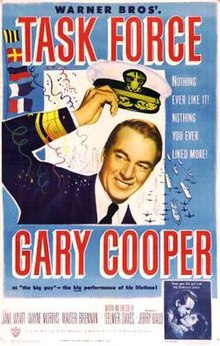
Task Force
All those things were bouncing around in my head as I watched 1949's Task Force this week. It tells the partial story of the development of carriers in the Navy and their involvement with pilots and aviation to advance the Navy's capabilities. They started off as basically sailing airfields on the oceans where rickety planes could land when necessary and developed into immense, very necessary war machines by World War II. A character mentions early on that when trying to land on the flat top of a carrier deck it looks a lot like a tombstone with your name on it, the ship bucking and rolling with the sea. The movie is certainly informative about the subject, but it's missing something, and I wish I could give it a higher rating.
As a young pilot in the Navy, Jonathan Scott (Gary Cooper) is among the first pilots to be trained in carrier landings. Through all the difficulty in this extremely dangerous training, he sees the benefits of a plane being able to land on a ship as it sails across the ocean, and the Navy has a convert. The higher-ups in the Navy don't see the benefit a carrier would have weighed against the huge costs and risks involved. With help from his commanding officer, Capt. Pete Richard (Walter Brennan), Scott continues to work toward the development of carrier task forces in the U.S. Navy, often causing ripples when he should sit back and shut up. Aided on the home front by his wife, Mary (Jane Wyatt), Scott continues on as the Navy continues to develop, unknowingly working toward the coming conflict in WWII where carriers will play a key role in the Pacific theater.
I'll say this first so no one accuses me of hating America or anything similar, but I do like Gary Cooper. I don't love him though. So many of his parts are so bland, so vanilla, that I don't consider myself a huge fan of his. I've never avoided a movie of his because I saw his name and thought 'Hey, that guy sucks!' but at the same time I don't always seek him out. His part here as Capt. Jonathan Scott falls somewhere in the middle of the movies I've seen with him. It's not a particularly lively performance, and he comes across as a bit too whiny for my liking. He has some good interactions with Brennan (solid as ever) and his marriage with Wyatt's Mary doesn't feel as out of place as so many other armed forces marriages in movies, but something's just missing overall in the movie, and that's not a criticism of Cooper or his acting.
All I can wrap my head around is that this movie is basically a documentary about the history of the Navy carrier, but instead of a voiceover provided we get actors stepping into the roles. If anything, Cooper's part is the tour guide, navigating the viewer through this story. He does provide a voiceover of how things are changing for the Navy, but it becomes tedious. If I wanted to watch a history of the U.S. Navy, I'd turn on the History Channel and get caught up with a better made documentary about the subject. As is typical with these movies, a title card thanks the Navy for all their help in making the movie, and cynical guy that I am I couldn't wonder how much control the government and the armed forces had in what the story did and didn't cover. As for Cooper's part, it's a lose-lose battle for him in a part that could have been filled by any cookie-cutter actor.
What saves the movie late is the depiction of the Navy in the days, weeks and months following the sneak attack on Pearl Harbor December 7th, 1941. Pearl Harbor and the battle of Midway are both covered in detail in the movie's last 45 minutes. The problem is though that no matter how good these segments are, there are whole movies devoted to these stories (1976's Midway is a personal favorite) that cover the subject better. Still, that's not a fair criticism of Task Force because director Delmer Daves is doing what he can with what's in front of him. It's easy to forget now some 70 years later, but the course of the war changed at Midway, and if the U.S. had lost that battle WWII might have gone a very different route. As Brennan's character explains, 'The west coast better be ready to fight on the beaches.' One of the darker times in American history, and one where the armed forces came through in a must-win situation.
This isn't a bad movie at all, it's just not a great movie either. It certainly has some potential with an interesting story, but it focuses on trying to tell too big of a story instead of keying in on the most interesting parts of the story. The movie on the whole lacks any real heart, any reason for us to get invested with the story and its characters. It is informative but not very exciting in getting its info out. Worth watching for WWII buffs probably.
Task Force <---trailer (1949): ** 1/2 /****
Labels:
1940s,
Delmer Daves,
Gary Cooper,
Walter Brennan,
WWII
Thursday, November 18, 2010
Dark Passage
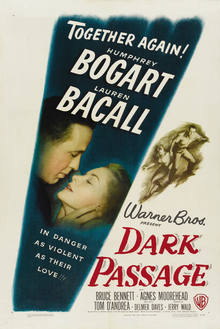
The ultimate tough guy who shouldn't have been. Whatever he may have lacked in stature or just pure physical intimidation, Bogie made up for it with a presence that very few actors can even come close to duplicating. So what about a movie with Bogart starring where for 45 minutes we don't actually see his face but know it is him nonetheless? Then for another 15 minutes, we see and hear his familiar voice but his face is covered in bandages. That's 1947's Dark Passage, an underrated film noir that relies on a gimmick, but in a good way. If you're a fan of Mr. Bogart, this is not one to miss.
Serving a sentence after being found guilty for murdering his wife, Vincent Parry (Bogart) is on the run having escaped from San Quentin Prison outside of San Francisco. He's picked up by a young woman, Irene (Lauren Bacall), who willingly goes along and agrees to sneak him into San Fran through all the police searches and roadblocks. With the police combing the state for him, Vince decides he needs to undergo plastic surgery because his face is too recognizable. His plan starts to come together with Irene agreeing to help hide him, but Vince has bigger ideas. He didn't kill his wife and is going to do everything in his power to find out who the real killer is. He may not have to look far though because the killer could be coming for him instead.
The gimmick here is that for the first hour of the movie we don't actually see Humphrey Bogart's face. How cool is that, how original? I just can't see stars like George Clooney or Brad Pitt doing that, can you? The first 45 minutes anytime Bogie is in a scene, the camera is Bogie's face. It's his point of view, his perspective. In these pre-surgery scenes, Parry looks like someone else, a picture we even see in the newspaper. So really, it's Bogie...but it ain't Bogie. Then after the surgery while he recovers, his head and face are completely covered by bandages for another 15 minutes in movie time. It's such an original idea and so ahead of its time that I enjoyed the movie that much more just because of its originality. It's a gutsy call to hide your star for an hour in a 2-hour movie, but it is handled so well that the movie and its story doesn't miss a beat.
Using this technique of Bogie's eyes serving as the camera certainly is a roll of the dice because if that strategy doesn't work, you've lost the viewers less than halfway through the movie. Then when we do see Bogart on-screen, the audience is either gone or bored with a movie they have decided to stick with all the way through. In other words, it could be too late. The pacing can be a little slow as Parry's plan comes together, but it's never too slow. More tension could have been added, more sense of the police closing in on him, but that comes into play more the second half of the movie. Director Delmer Daves moves the camera around as if this character was walking around in an apartment or navigating a confrontation with an overly inquisitive driver. Original, innovative, and ahead of its time, all positives toward overshadowing the slower moving portions of the movie.
Now onscreen or offscreen, Bogart is an ideal choice to play a character like this. Basically, we don't need to actually see him. We know it's him just by his distinctive, deep, gravelly voice. And even though Bogart played his fair share of shady characters, you know, you just KNOW, there's no way he could have killed his wife so of course he's telling the truth. He brings his typically hard edge to his role of a man who knows he's been wronged and intends to fix things no matter how long it takes. Regular Bogie co-star and current Mrs. Bogart Lauren Bacall always worked well with her husband, and this part is no different. She was one of the few actresses who could match him for on-screen charisma and presence. And in a completely pointless aside that has nothing to do with the movie, Bacall looks ridiculously gorgeous here. She always looked good, but this is a step above the rest.
All good elements aside, the execution and revelation of the actual murderer doesn't completely gel. It feels rushed at times and thrown together. The reveal is really obvious and somewhat surprising at the same time (if that makes sense) with just too much coincidence thrown in to keep it somewhat manageable. The final scene on the other hand is perfect, one that was repeated almost 50 years later in The Shawshank Redemption. The rest of the cast includes Agnes Moorehead (later of Bewitched fame) as noisy neighbor Madge, Bruce Bennett as Bob, a fella with an understandable interest in Irene, and Tom D'Andrea as a friendly cabby who helps Vince. An all-around solid film noir with some great performances from Bogart and Bacall, and some filmmaking techniques that are still worth watching over 60 years later.
Dark Passage <---trailer (1947): ***/****
Labels:
1940s,
Delmer Daves,
Film Noir,
Humphrey Bogart,
Lauren Bacall
Wednesday, July 7, 2010
Kings Go Forth
In the midst of a world conflict that threatens the fate of the free world, it seems odd that personal conflicts and prejudices could play a part. Take WWII where Allied forces did everything they could to stop Adolf Hitler from taking over the world. Soldiers from countries all over the world worked together to accomplish this mission. But what about a soldier-to-soldier basis? They were united in their efforts, but that doesn't mean they thought alike. They still had differences and prejudices that almost certainly made an impact on their lives.
It sounds stupid, but what about racist soldiers? Wrapped in a worldwide conflict, some surely still found times to criticize or ridicule blacks, Hispanics, and any number of other ethnicities and cultural backgrounds. Just because you're defeating Hitler doesn't mean you still can't have some fun, right? I meant that sarcastically if you didn't pick that up. That is the basic premise of 1958's Kings Go Forth where personal prejudices end up playing a large part in the relationships of two soldiers and a young French girl in the months following the D-Day invasion in 1944.
Working with an advanced observation unit positioned ahead of the lines, Lt. Sam Loggins (Frank Sinatra) is used to working in dangerous situations, doing his best to get his men through the war unscathed. The casualties continue to mount though with a new radioman, Cpl. Britt Harris (Tony Curtis) assigned to Loggins' squad who starts to stir things up. While on leave in Nice, Sam meets a young French girl, Monique (Natalie Wood) who he instantly clicks with. As the war wages onward, their relationship grows, but two things stand in their way. Monique has a secret she's worried about sharing with Sam, and smooth, suave ladies man Britt shows up just in time to possibly steal her away from Sam.
The story description does come off as a bit too much like a soap opera, but it's not as painfully obvious while watching. Sinatra, Curtis and Wood have a good chemistry together in making this love triangle (maybe the laziest plot device ever) not only entertaining, but believable. It's fairly clear from early on in the movie that Sinatra and Curtis are going to butt heads, it is only a matter of time until we find out why and how. I should also point out this is a love story set in WWII, not the other way around. Don't go in expecting epic battle scenes with hundreds of extras. What little action there is in the movie is saved for the end when Sam and Britt undertake a dangerous mission in a German-held Italian town.
Director Delmer Daves is hamstrung a bit by 1950s censors but gets away with a fair amount in his storytelling. Parts are subtle so pay attention because you're not going to be hit over the head with any obvious reveals. The secret Monique is so worried about is that her father was black so she thinks no American is going to want any part of her. Sinatra's Sam seems more bothered about it while Curtis' Britt doesn't seem fazed in the least. Of course, that would be too obvious an ending so don't think I gave anything a way. These elements make the soap opera-esque story more worthwhile and not just three lonely individuals trying to find happiness in war. If that was the case, I might have turned the movie off halfway through.
Telling this story, Daves wisely focuses on his three main characters with a few supporting parts worth mentioning. Sinatra didn't have the greatest range as an actor, but when he found the right part he typically knocked it out of the park. His Sam Loggins is a good example of what he can do with that right part. Curtis gets to play against type to a bit, putting a harsher spin on his typical lovable rogue who you still like. He's not a straight bad guy, but if there is a villainous character here, it is him. It is fun though seeing two performers like Sinatra and Curtis work together with some meatier roles. Other than her French accent, Wood is excellent as Monique. The 20-year old actress looks beautiful and makes Monique sympathetic in her trials as she grows up, trying to figure out what she wants in life while dealing with this cloud over her head she has no control over. Leora Dana has a good if small part as Monique's mother while Karl Swenson is good as Sinatra's commanding officer.
Other things worth mentioning include the camerawork and the filming locations. Daves shoots the movie in black and white, a good choice that makes the story and setting more sparse, more basic emotion. With color, I don't know if the movie works as well. With a few notable exceptions, the movie was also shot in France and Italy including some great shots of the French Riviera. A beautiful movie to look at, and with a good story on top of it. See this unheralded WWII love story for the acting thing, especially the three stars.
Kings Go Forth <----trailer (1958): ***/****
It sounds stupid, but what about racist soldiers? Wrapped in a worldwide conflict, some surely still found times to criticize or ridicule blacks, Hispanics, and any number of other ethnicities and cultural backgrounds. Just because you're defeating Hitler doesn't mean you still can't have some fun, right? I meant that sarcastically if you didn't pick that up. That is the basic premise of 1958's Kings Go Forth where personal prejudices end up playing a large part in the relationships of two soldiers and a young French girl in the months following the D-Day invasion in 1944.
Working with an advanced observation unit positioned ahead of the lines, Lt. Sam Loggins (Frank Sinatra) is used to working in dangerous situations, doing his best to get his men through the war unscathed. The casualties continue to mount though with a new radioman, Cpl. Britt Harris (Tony Curtis) assigned to Loggins' squad who starts to stir things up. While on leave in Nice, Sam meets a young French girl, Monique (Natalie Wood) who he instantly clicks with. As the war wages onward, their relationship grows, but two things stand in their way. Monique has a secret she's worried about sharing with Sam, and smooth, suave ladies man Britt shows up just in time to possibly steal her away from Sam.
The story description does come off as a bit too much like a soap opera, but it's not as painfully obvious while watching. Sinatra, Curtis and Wood have a good chemistry together in making this love triangle (maybe the laziest plot device ever) not only entertaining, but believable. It's fairly clear from early on in the movie that Sinatra and Curtis are going to butt heads, it is only a matter of time until we find out why and how. I should also point out this is a love story set in WWII, not the other way around. Don't go in expecting epic battle scenes with hundreds of extras. What little action there is in the movie is saved for the end when Sam and Britt undertake a dangerous mission in a German-held Italian town.
Director Delmer Daves is hamstrung a bit by 1950s censors but gets away with a fair amount in his storytelling. Parts are subtle so pay attention because you're not going to be hit over the head with any obvious reveals. The secret Monique is so worried about is that her father was black so she thinks no American is going to want any part of her. Sinatra's Sam seems more bothered about it while Curtis' Britt doesn't seem fazed in the least. Of course, that would be too obvious an ending so don't think I gave anything a way. These elements make the soap opera-esque story more worthwhile and not just three lonely individuals trying to find happiness in war. If that was the case, I might have turned the movie off halfway through.
Telling this story, Daves wisely focuses on his three main characters with a few supporting parts worth mentioning. Sinatra didn't have the greatest range as an actor, but when he found the right part he typically knocked it out of the park. His Sam Loggins is a good example of what he can do with that right part. Curtis gets to play against type to a bit, putting a harsher spin on his typical lovable rogue who you still like. He's not a straight bad guy, but if there is a villainous character here, it is him. It is fun though seeing two performers like Sinatra and Curtis work together with some meatier roles. Other than her French accent, Wood is excellent as Monique. The 20-year old actress looks beautiful and makes Monique sympathetic in her trials as she grows up, trying to figure out what she wants in life while dealing with this cloud over her head she has no control over. Leora Dana has a good if small part as Monique's mother while Karl Swenson is good as Sinatra's commanding officer.
Other things worth mentioning include the camerawork and the filming locations. Daves shoots the movie in black and white, a good choice that makes the story and setting more sparse, more basic emotion. With color, I don't know if the movie works as well. With a few notable exceptions, the movie was also shot in France and Italy including some great shots of the French Riviera. A beautiful movie to look at, and with a good story on top of it. See this unheralded WWII love story for the acting thing, especially the three stars.
Kings Go Forth <----trailer (1958): ***/****
Labels:
1950s,
Delmer Daves,
Frank Sinatra,
Natalie Wood,
Tony Curtis,
WWII
Subscribe to:
Posts (Atom)